
Trends in Solvent Management in the Pharmaceutical Industry

- Slides: 17
Trends in Solvent Management in the Pharmaceutical Industry C. Stewart Slater and Mariano J. Savelski Department of Chemical Engineering Rowan University Glassboro, NJ Session 656: Green Engineering in the Fine Chemical and Pharmaceutical Industry AICh. E Annual Meeting Nashville, TN November 8 -13, 2009
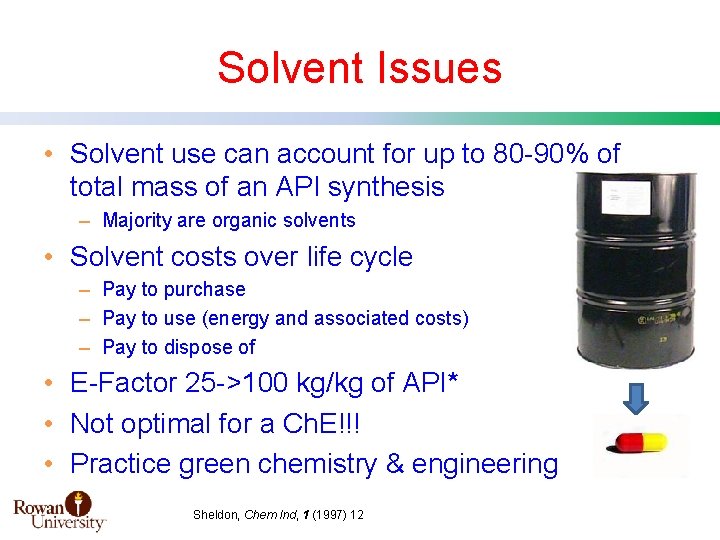
Solvent Issues • Solvent use can account for up to 80 -90% of total mass of an API synthesis – Majority are organic solvents • Solvent costs over life cycle – Pay to purchase – Pay to use (energy and associated costs) – Pay to dispose of • E-Factor 25 ->100 kg/kg of API* • Not optimal for a Ch. E!!! • Practice green chemistry & engineering Sheldon, Chem Ind, 1 (1997) 12
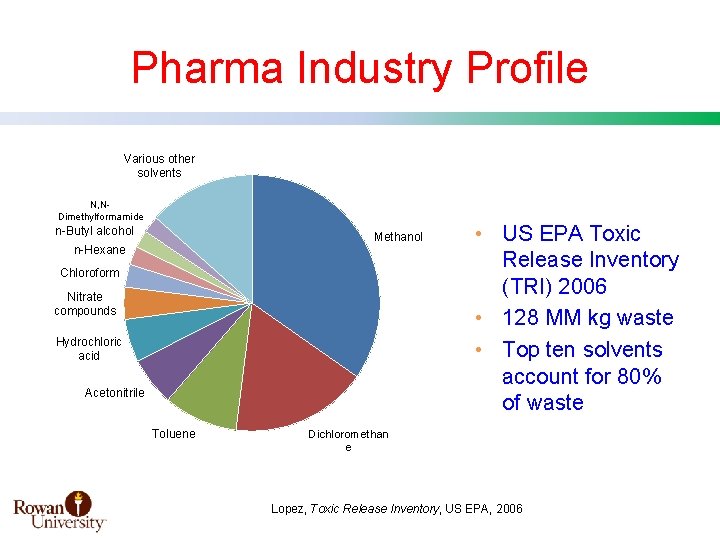
Pharma Industry Profile Various other solvents N, NDimethylformamide n-Butyl alcohol Methanol n-Hexane Chloroform Nitrate compounds Hydrochloric acid Acetonitrile Toluene • US EPA Toxic Release Inventory (TRI) 2006 • 128 MM kg waste • Top ten solvents account for 80% of waste Dichloromethan e Lopez, Toxic Release Inventory, US EPA, 2006
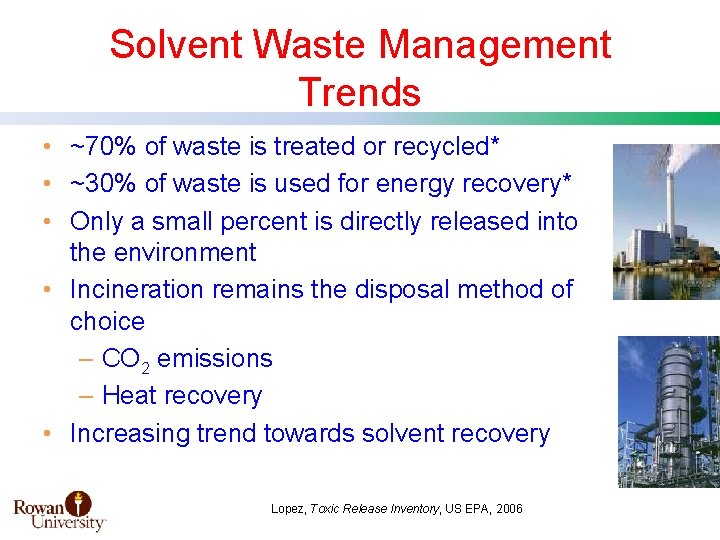
Solvent Waste Management Trends • ~70% of waste is treated or recycled* • ~30% of waste is used for energy recovery* • Only a small percent is directly released into the environment • Incineration remains the disposal method of choice – CO 2 emissions – Heat recovery • Increasing trend towards solvent recovery Lopez, Toxic Release Inventory, US EPA, 2006
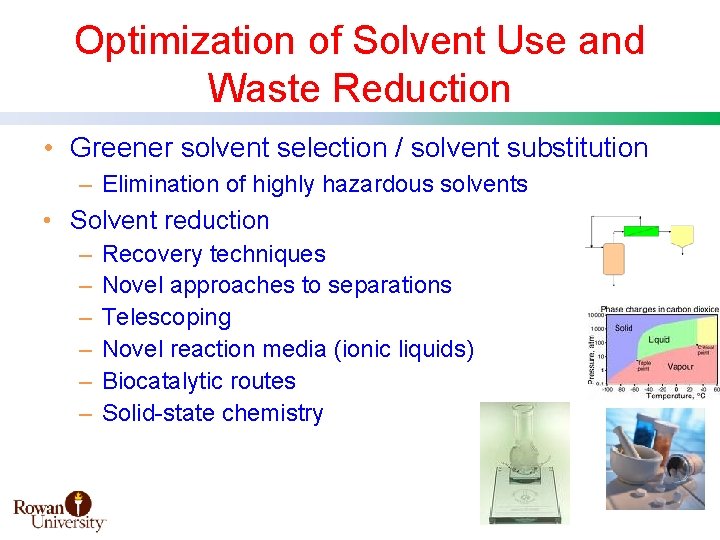
Optimization of Solvent Use and Waste Reduction • Greener solvent selection / solvent substitution – Elimination of highly hazardous solvents • Solvent reduction – – – Recovery techniques Novel approaches to separations Telescoping Novel reaction media (ionic liquids) Biocatalytic routes Solid-state chemistry
“Plant of the Future” • The plant of the future will likely use a limited number of ‘universal’ green solvents – Properties allow for easy recovery – Used with other campaigns – Integrated solvent recovery systems • Continuous processing simplifies recovery design strategies • Energy exchange networks Slater and Savelski, Innov Pharma Tech, 29 (2009) 78
Solvent Recovery • Solvent recovery has increased, On-site and Off-site recovery facilities • Distillation still dominates - straightforward separation for ideal mixtures • Pharmaceutical wastes typically contain – Multiple solvents – Azeotropic mixtures – Unconverted reactants, etc • Complex separation trains to obtain high quality solvent for reuse • Centralized solvent recovery facility > New approach integrate separation processes at the point of use
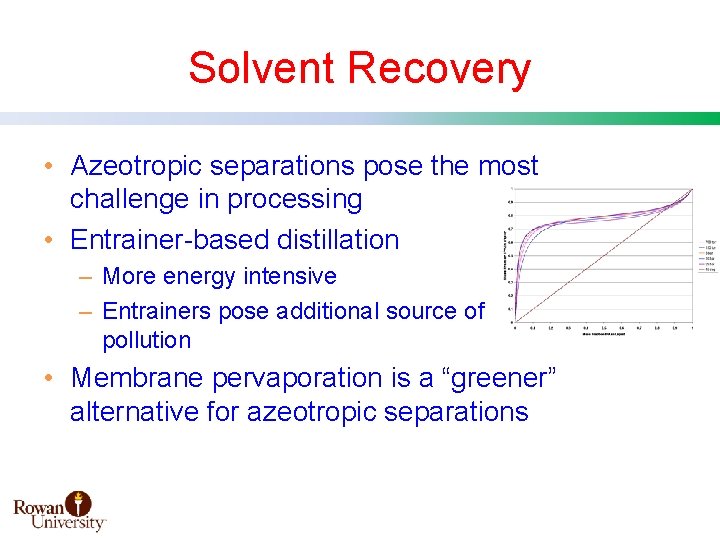
Solvent Recovery • Azeotropic separations pose the most challenge in processing • Entrainer-based distillation – More energy intensive – Entrainers pose additional source of pollution • Membrane pervaporation is a “greener” alternative for azeotropic separations
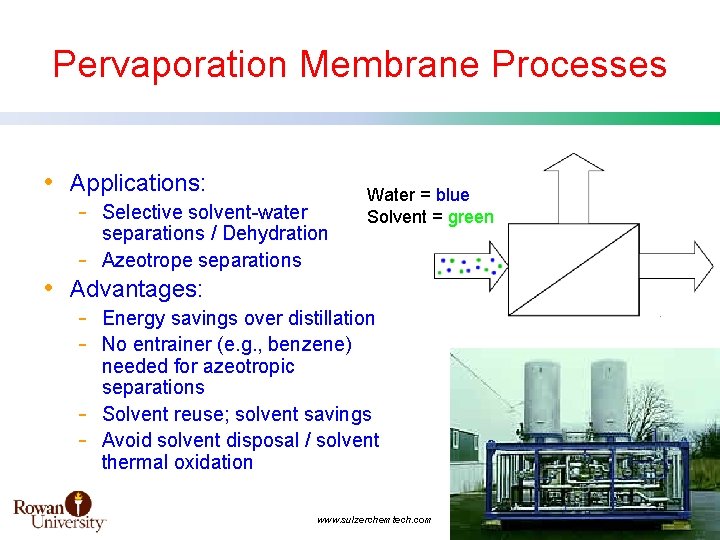
Pervaporation Membrane Processes • Applications: - Selective solvent-water separations / Dehydration - Azeotrope separations Water = blue Solvent = green • Advantages: - Energy savings over distillation - No entrainer (e. g. , benzene) needed for azeotropic separations - Solvent reuse; solvent savings - Avoid solvent disposal / solvent thermal oxidation www. sulzerchemtech. com
PV Process Integration Dehydrated solvent for reuse Solvent-water azeotropic mixture Pervaporation Solvent-water waste stream Low flow rate stream: water with some solvent Typical Solvents • Isopropanol (az) • Ethanol (az) • Methanol • Ethyl acetate • Butyl acetate • Acetone • Acetronitrile (az) • Tetrahydrofuran (az) • n-Butanol • Methylketone (az)
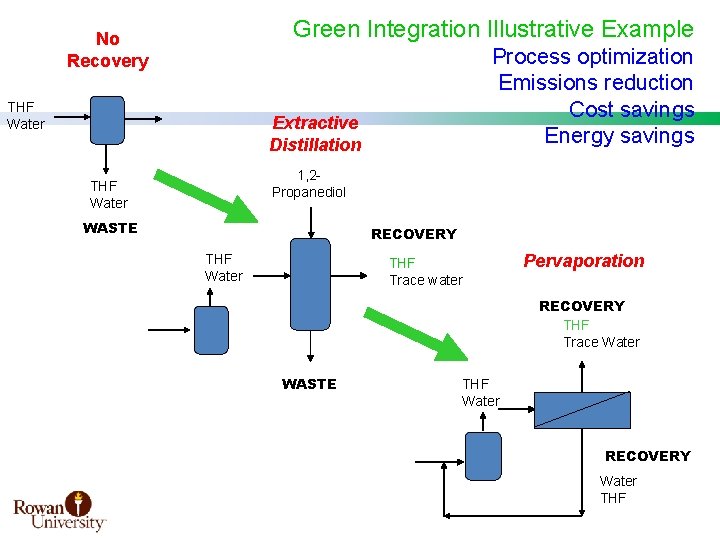
Green Integration Illustrative Example No Recovery THF Water Process optimization Emissions reduction Cost savings Energy savings Extractive Distillation 1, 2 Propanediol THF Water WASTE RECOVERY THF Water THF Trace water Pervaporation RECOVERY THF Trace Water WASTE THF Water RECOVERY Water THF
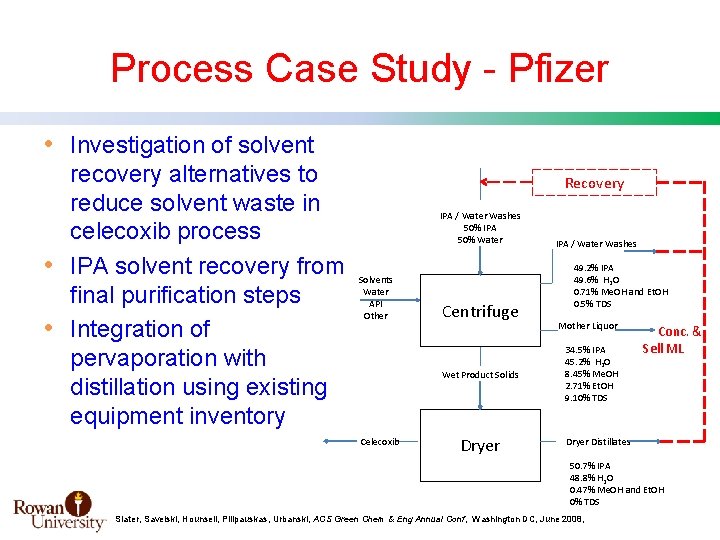
Process Case Study - Pfizer • Investigation of solvent recovery alternatives to reduce solvent waste in celecoxib process • IPA solvent recovery from final purification steps • Integration of pervaporation with distillation using existing equipment inventory Recovery IPA / Water Washes 50% IPA 50% Water Solvents Water API Other Centrifuge Wet Product Solids Celecoxib Dryer IPA / Water Washes 49. 2% IPA 49. 6% H 2 O 0. 71% Me. OH and Et. OH 0. 5% TDS Mother Liquor 34. 5% IPA 45. 2% H 2 O 8. 45% Me. OH 2. 71% Et. OH 9. 10% TDS Conc. & Sell ML Dryer Distillates 50. 7% IPA 48. 8% H 2 O 0. 47% Me. OH and Et. OH 0% TDS Slater, Savelski, Hounsell, Pilipauskas, Urbanski, ACS Green Chem & Eng Annual Conf, Washington DC, June 2008,
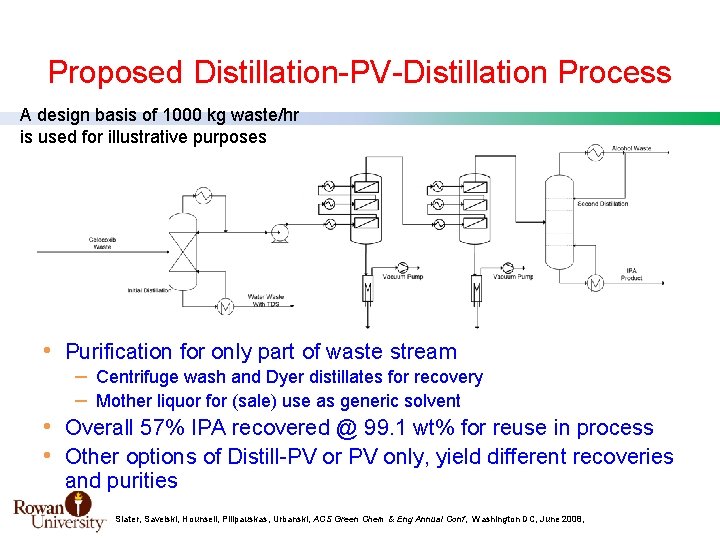
Proposed Distillation-PV-Distillation Process A design basis of 1000 kg waste/hr is used for illustrative purposes • Purification for only part of waste stream • • – Centrifuge wash and Dyer distillates for recovery – Mother liquor for (sale) use as generic solvent Overall 57% IPA recovered @ 99. 1 wt% for reuse in process Other options of Distill-PV or PV only, yield different recoveries and purities Slater, Savelski, Hounsell, Pilipauskas, Urbanski, ACS Green Chem & Eng Annual Conf, Washington DC, June 2008,
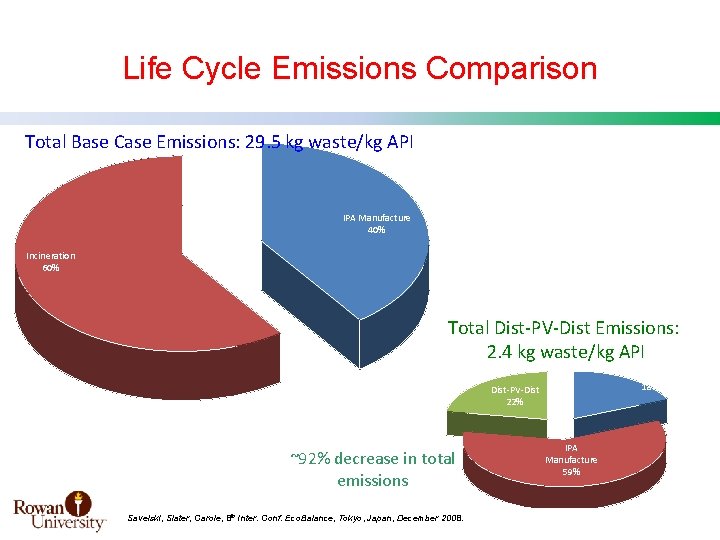
Life Cycle Emissions Comparison Total Base Case Emissions: 29. 5 kg waste/kg API IPA Manufacture 40% Incineration 60% Total Dist-PV-Dist Emissions: 2. 4 kg waste/kg APIML Distillation 18% Dist-PV-Dist 22% ~92% decrease in total emissions Savelski, Slater, Carole, 8 th Inter. Conf. Eco. Balance, Tokyo, Japan, December 2008. IPA Manufacture 59%
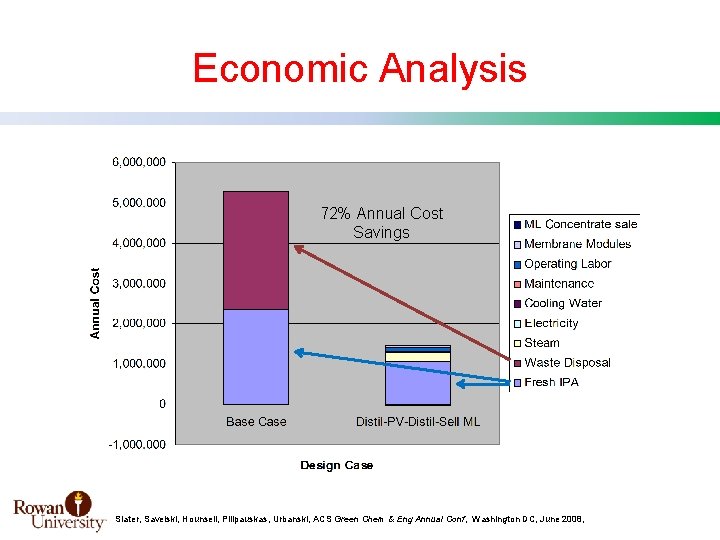
Economic Analysis 72% Annual Cost Savings Slater, Savelski, Hounsell, Pilipauskas, Urbanski, ACS Green Chem & Eng Annual Conf, Washington DC, June 2008,
Summary • Solvent use and waste practices should be constantly reviewed • Development of sustainable practices Green advantage • Waste minimization • Cost effective
Acknowledgements • Pfizer • U. S. Environmental Protection Agency P 2 grant #NP 97257006 -0