
Trends in Satellite Electric Propulsion From 2000 to
- Slides: 14
Trends in Satellite Electric Propulsion From 2000 to 2019 February 2020 Aerojet Rocketdyne Proprietary
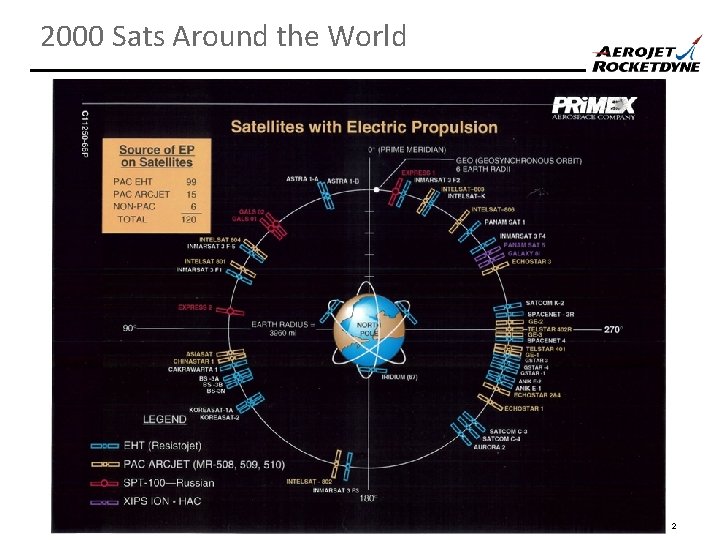
2000 Sats Around the World 2
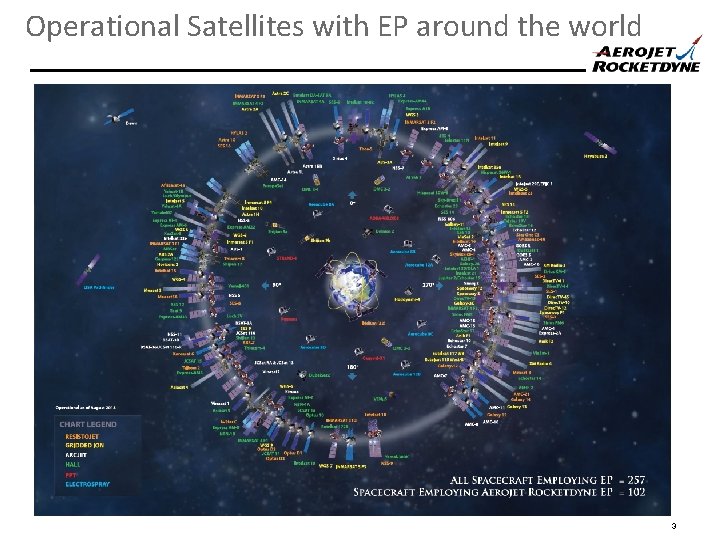
Operational Satellites with EP around the world 3
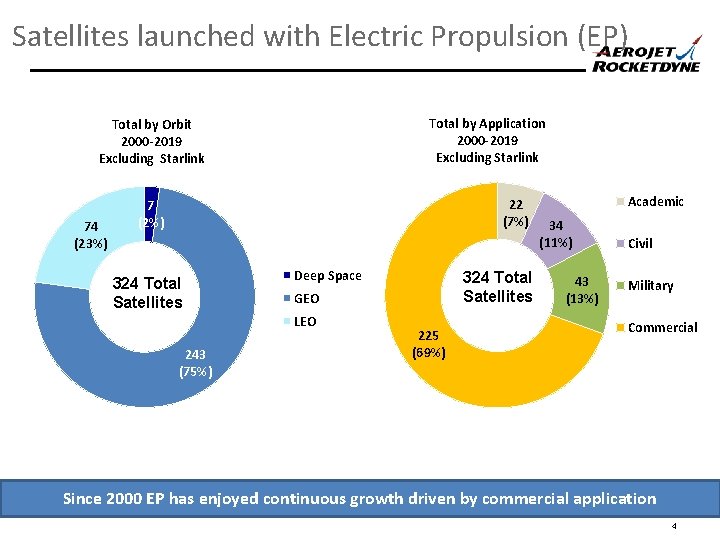
Satellites launched with Electric Propulsion (EP) Total by Application 2000 -2019 Excluding Starlink Total by Orbit 2000 -2019 Excluding Starlink 74 (23%) 22 (7%) 7 (2%) 324 Total Satellites Deep Space GEO LEO 243 (75%) 324 Total Satellites 225 (69%) Academic 34 (11%) 43 (13%) Civil Military Commercial Since 2000 EP has enjoyed continuous growth driven by commercial application 4
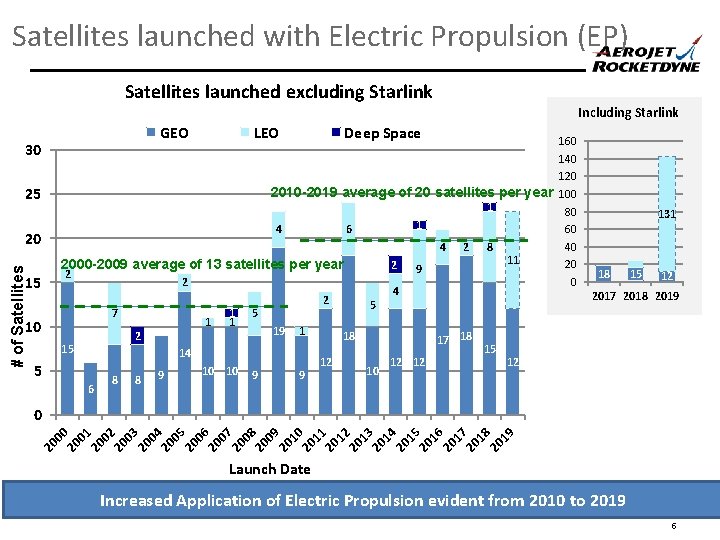
Satellites launched with Electric Propulsion (EP) Satellites launched excluding Starlink GEO Deep Space 160 140 120 2010 -2019 average of 20 satellites per year 100 1 80 1 60 4 6 40 4 2 8 11 20 2 2000 -2009 average of 13 satellites per year 9 2 0 2 4 2 5 7 1 5 1 1 19 1 2 18 17 18 15 15 14 12 12 10 10 9 9 8 8 6 30 25 20 # of Satellites LEO 15 10 5 Including Starlink 131 18 15 12 2017 2018 2019 20 00 20 01 20 02 20 03 20 04 20 05 20 06 20 07 20 08 20 09 20 10 20 11 20 12 20 13 20 14 20 15 20 16 20 17 20 18 20 19 0 Launch Date Increased Application of Electric Propulsion evident from 2010 to 2019 5
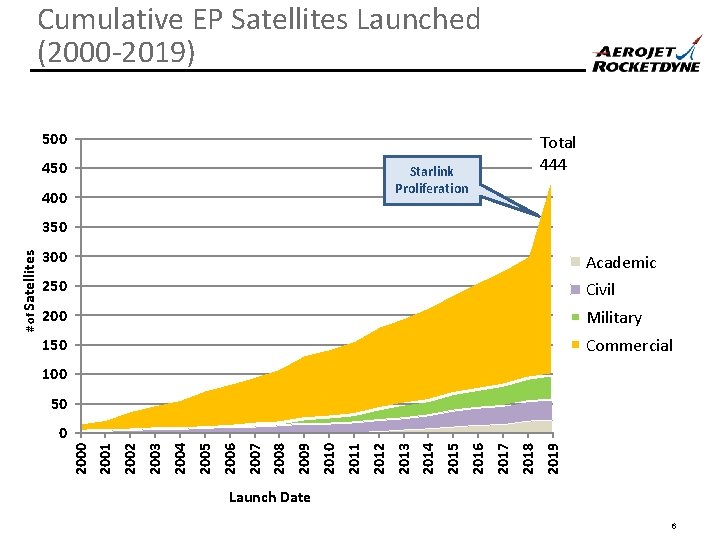
Cumulative EP Satellites Launched (2000 -2019) 500 450 Total 444 Starlink Proliferation 400 300 Academic 250 Civil 200 Military 150 Commercial 100 50 2019 2018 2017 2016 2015 2014 2013 2012 2011 2010 2009 2008 2007 2006 2005 2004 2003 2002 2001 0 2000 # of Satellites 350 Launch Date 6
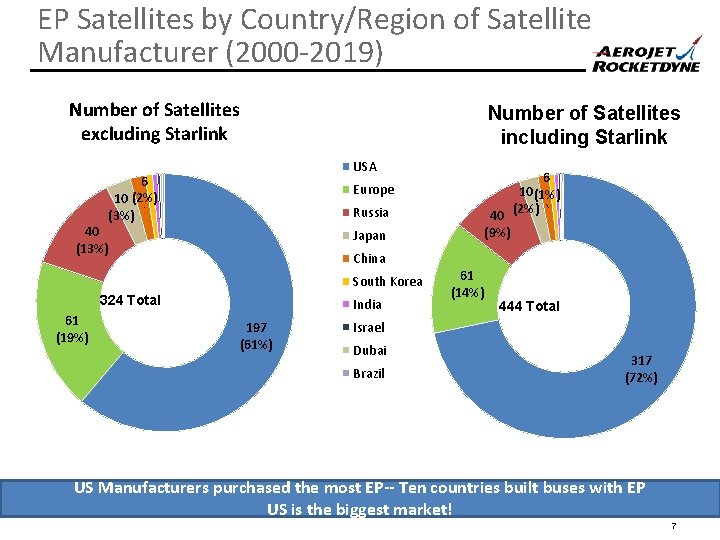
EP Satellites by Country/Region of Satellite Manufacturer (2000 -2019) Number of Satellites excluding Starlink Number of Satellites including Starlink USA 6 10 (2%) (3%) Europe Russia 40 (13%) Japan China South Korea 324 Total Satellites 61 (19%) 40 (9%) India 197 (61%) 61 (14%) 6 10 (1%) (2%) 444 Total Satellites Israel Dubai Brazil 317 (72%) US Manufacturers purchased the most EP-- Ten countries built buses with EP US is the biggest market! 7
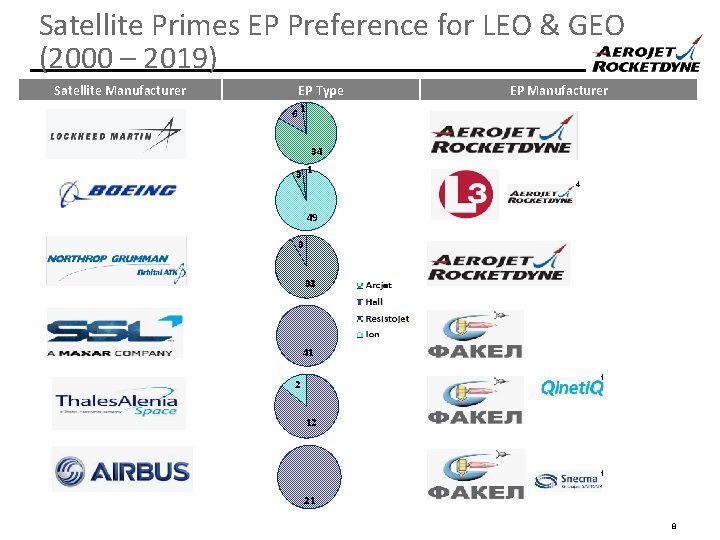
Satellite Primes EP Preference for LEO & GEO (2000 – 2019) Satellite Manufacturer EP Type 6 EP Manufacturer 1 34 3 1 4 49 3 33 41 1 2 12 1 21 8
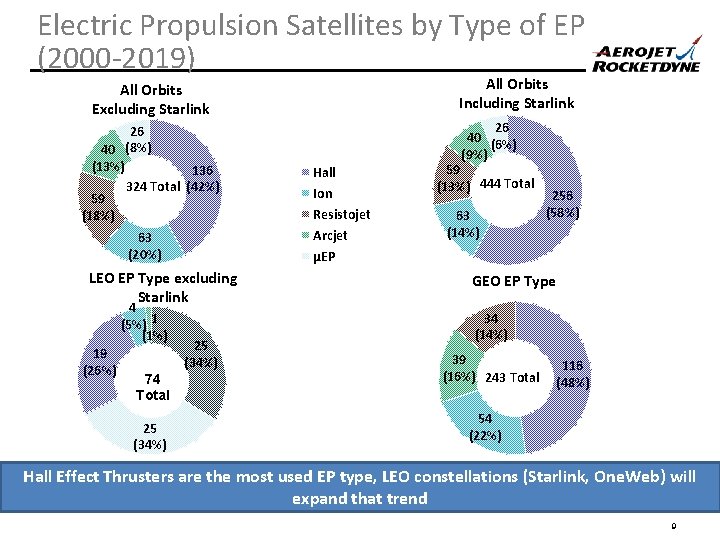
Electric Propulsion Satellites by Type of EP (2000 -2019) All Orbits Including Starlink All Orbits Excluding Starlink 26 40 (8%) (13%) 136 324 Total (42%) 59 (18%) 63 (20%) LEO EP Type excluding Starlink 4 (5%) 1 (1%) 19 (26%) 74 Total 25 (34%) 26 40 (6%) (9%) Hall Ion Resistojet Arcjet μEP 59 (13%) 444 Total 63 (14%) 256 (58%) GEO EP Type 34 (14%) 39 (16%) 243 Total 116 (48%) 54 (22%) Hall Effect Thrusters are the most used EP type, LEO constellations (Starlink, One. Web) will expand that trend 9
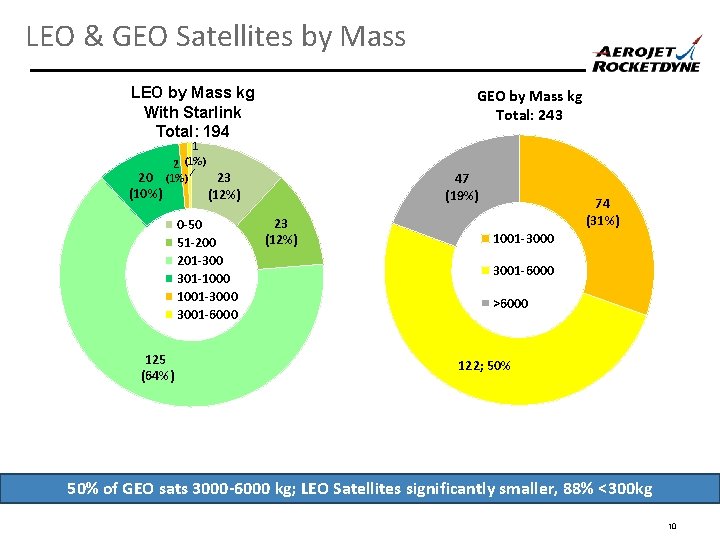
LEO & GEO Satellites by Mass LEO by Mass kg With Starlink Total: 194 20 (10%) GEO by Mass kg Total: 243 1 2 (1%) 23 (1%) (12%) 0 -50 51 -200 201 -300 301 -1000 1001 -3000 3001 -6000 125 (64%) 47 (19%) 23 (12%) 74 (31%) 1001 -3000 3001 -6000 >6000 122; 50% of GEO sats 3000 -6000 kg; LEO Satellites significantly smaller, 88% <300 kg 10
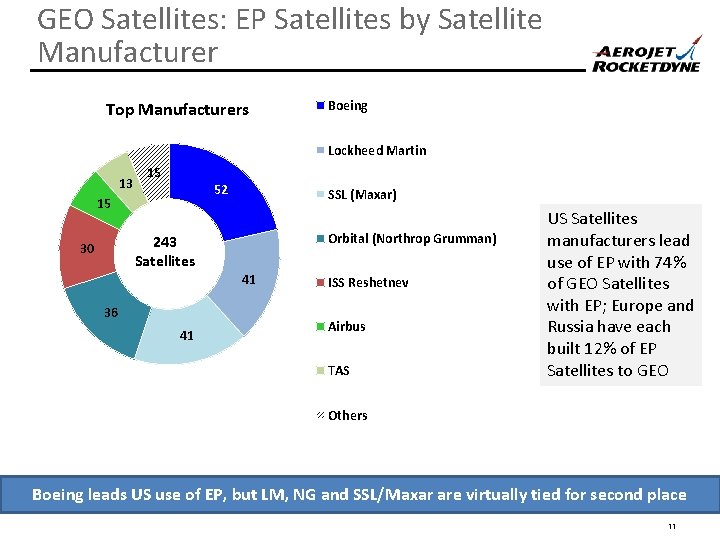
GEO Satellites: EP Satellites by Satellite Manufacturer Top Manufacturers Boeing Lockheed Martin 13 15 52 15 SSL (Maxar) Orbital (Northrop Grumman) 243 Satellites 30 41 36 41 ISS Reshetnev Airbus TAS US Satellites manufacturers lead use of EP with 74% of GEO Satellites with EP; Europe and Russia have each built 12% of EP Satellites to GEO Others Boeing leads US use of EP, but LM, NG and SSL/Maxar are virtually tied for second place 11
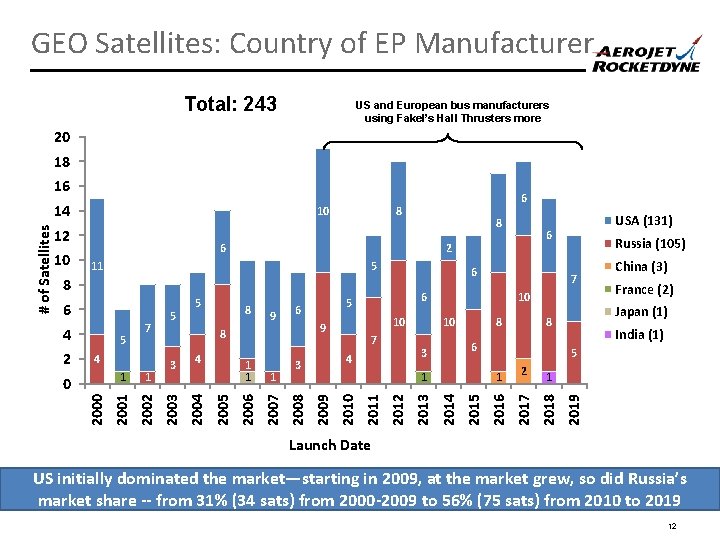
GEO Satellites: Country of EP Manufacturer Total: 243 US and European bus manufacturers using Fakel’s Hall Thrusters more 20 18 16 2 5 6 10 10 8 France (2) India (1) 5 1 2018 2 2017 1 2014 2012 1 China (3) Japan (1) 8 6 3 4 3 2011 1 7 2010 1 1 2009 4 10 9 2008 1 3 6 5 6 8 2007 2000 0 1 2002 4 9 2006 7 8 2005 5 2004 4 5 2003 6 5 Russia (105) 7 2016 11 USA (131) 6 2019 6 8 2013 10 6 8 2015 12 2001 # of Satellites 14 10 Launch Date US initially dominated the market—starting in 2009, at the market grew, so did Russia’s market share -- from 31% (34 sats) from 2000 -2009 to 56% (75 sats) from 2010 to 2019 12
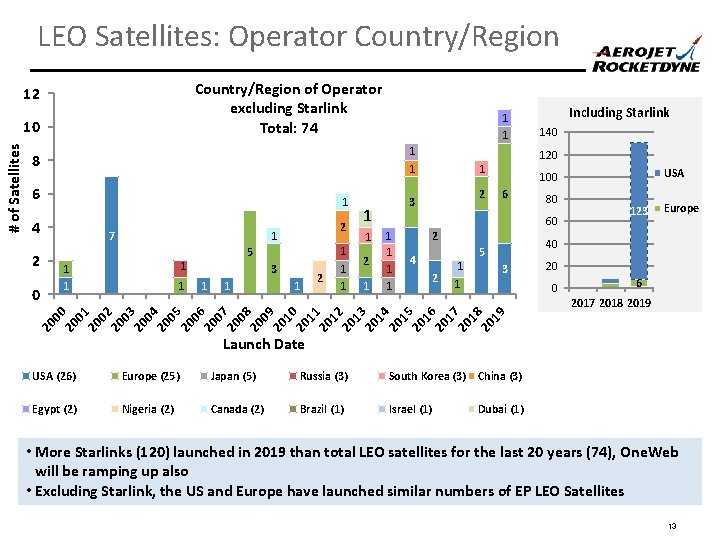
LEO Satellites: Operator Country/Region of Operator excluding Starlink Total: 74 12 1 1 8 6 1 4 7 2 0 2 1 1 1 5 1 1 1 3 1 1 1 2 1 2 1 1 2 6 80 60 1 1 USA 100 2 4 140 120 1 3 Including Starlink 123 Europe 40 5 3 20 0 6 19 18 20 17 20 16 20 20 15 14 20 13 20 12 20 20 11 10 20 09 20 08 20 07 20 20 06 05 20 04 20 03 20 20 02 01 20 20 00 2017 2018 2019 20 # of Satellites 10 1 1 Launch Date USA (26) Europe (25) Japan (5) Russia (3) South Korea (3) China (3) Egypt (2) Nigeria (2) Canada (2) Brazil (1) Israel (1) Dubai (1) • More Starlinks (120) launched in 2019 than total LEO satellites for the last 20 years (74), One. Web will be ramping up also • Excluding Starlink, the US and Europe have launched similar numbers of EP LEO Satellites 13
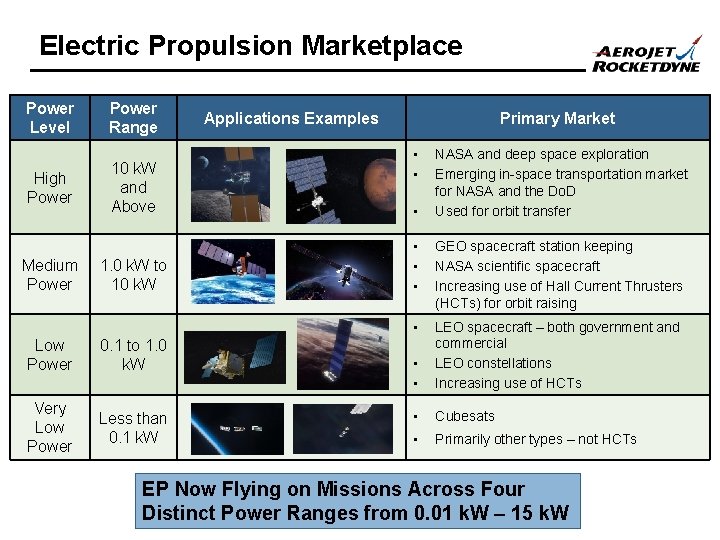
Electric Propulsion Marketplace Power Level High Power Medium Power Range 10 k. W and Above 1. 0 k. W to 10 k. W Low Power 0. 1 to 1. 0 k. W Very Low Power Less than 0. 1 k. W Applications Examples Primary Market • • • NASA and deep space exploration Emerging in-space transportation market for NASA and the Do. D Used for orbit transfer • • • GEO spacecraft station keeping NASA scientific spacecraft Increasing use of Hall Current Thrusters (HCTs) for orbit raising • • • LEO spacecraft – both government and commercial LEO constellations Increasing use of HCTs • Cubesats • Primarily other types – not HCTs EP Now Flying on Missions Across Four Distinct Power Ranges from 0. 01 k. W – 15 k. W