
TRENDS IN NEWS CONSUMPTION IN THE U S
- Slides: 13
TRENDS IN NEWS CONSUMPTION IN THE U. S. Unit 5: Mass Media
1. TREND OVER TIME • Newspaper began in 1780 s, really boomed post Civil War due to industrialization Radio in 1920 s, by 1930 s Newspaper declines, radio takes hold TV in 1950 s, but really booms for news with Vietnam & Watergate late 1960 s & early 1970 s with major network & network news leading the broadcasting era; newspaper continues declining with radio behind Cable begins narrowcasting with likes of CNN in 1980 s & 1990 s; newspaper down, radio down, some major network TV news down Internet comes on the scene in late 1990 s, newspaper almost dead, radio weak, major network down, cable news popular, internet blogs/sites on rise
A. MOST POPULAR SOURCES OF NEWS • TV 66% (seeing is still believing) • Internet 41% and rising • Newspaper 31% and declining
B. WHAT SOURCES MORE/LESS POPULAR • More Popular: • Internet • Cable News • Less Popular: • Newspaper • Radio • Nightly news network • Local TV news
C. RESULT OF DECLINE OF NETWORK NEWS SHOWS • More narrowcasting, more partisan or group oriented networks & shows only telling one side of the story: • More Media Bias!
D. DIFFERENCE IN AGE & NEWSGATHERING HABITS • 18 -24: • evenly distributed across online, radio, TV • overall lowest levels for all sources • Newspaper the least used source • 25 -34: • TV leads, Internet follows, with radio last • a bit more involvement than previous group • 35 -49: • TV is king, Radio follows, online third & newspaper last • This group there at beginning of TV generation, medium to high involvement • 50 -64 & 65 to infinity: • More traditional TV followed by Newspaper with radio third & most current internet last, very high involvement
E. HOW MANY CHOOSE TO NOT READ NEWS? • In 2008: • 19% • an increase of 5% from 1998 to 2008 • Generally for all ages except for 50 to 64 • 3/5 age categories by sharp amount
F. DIFF BETWEEN GOP VS. DEM. & TV NEWS • Republicans: • Most Stick to FOX strongly • Smaller % spread it out evenly • Democrats: • More evenly with stronger viewing all around • Independents: • Much more evenly spread out among all sources
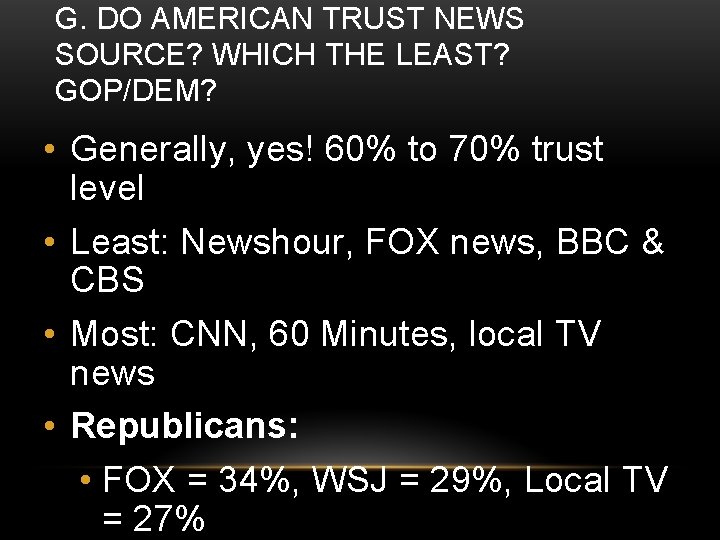
G. DO AMERICAN TRUST NEWS SOURCE? WHICH THE LEAST? GOP/DEM? • Generally, yes! 60% to 70% trust level • Least: Newshour, FOX news, BBC & CBS • Most: CNN, 60 Minutes, local TV news • Republicans: • FOX = 34%, WSJ = 29%, Local TV = 27%
H. IMPACT OF POLARIZATION OF AMERICAN NEWS MEDIA • Media Bias! • One side of story only told! • Citizens not well informed!
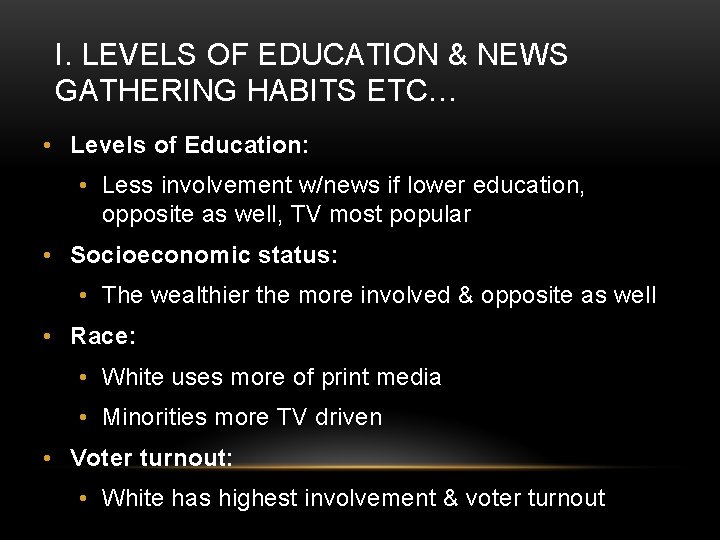
I. LEVELS OF EDUCATION & NEWS GATHERING HABITS ETC… • Levels of Education: • Less involvement w/news if lower education, opposite as well, TV most popular • Socioeconomic status: • The wealthier the more involved & opposite as well • Race: • White uses more of print media • Minorities more TV driven • Voter turnout: • White has highest involvement & voter turnout
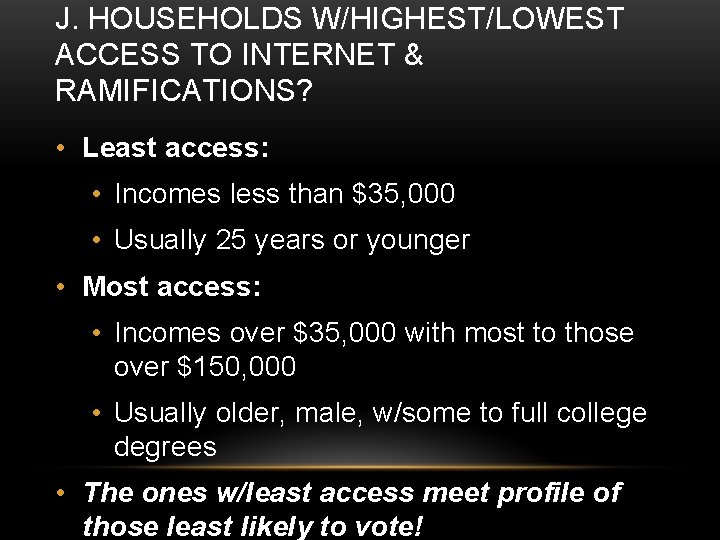
J. HOUSEHOLDS W/HIGHEST/LOWEST ACCESS TO INTERNET & RAMIFICATIONS? • Least access: • Incomes less than $35, 000 • Usually 25 years or younger • Most access: • Incomes over $35, 000 with most to those over $150, 000 • Usually older, male, w/some to full college degrees • The ones w/least access meet profile of those least likely to vote!
SUMMARY • Trends: • Declining news audiences, especially among young audiences • Differences among levels of SES in news readership and access to cable & internet • Declining newspapers, declining radio • Narrowcasting has led to polarization of news • Rise in cable news & internet news • However, in all categories TV still leads, but mainly cable & local news & not major