
Trends in Healthcare Eric Percher Equity Analyst Pharmaceutical


- Slides: 37
Trends in Healthcare Eric Percher Equity Analyst, Pharmaceutical Supply Chain & HCIT Nephron Research
Disclosure Declaration § Mr. Percher does not have a vested interest in or affiliation with a corporate organization offering financial support or grant monies for this CE activity. § Mr. Percher does not have an affiliation with an organization that has a specific interest in therapeutic areas under discussion. Ernest Mario School of Pharmacy
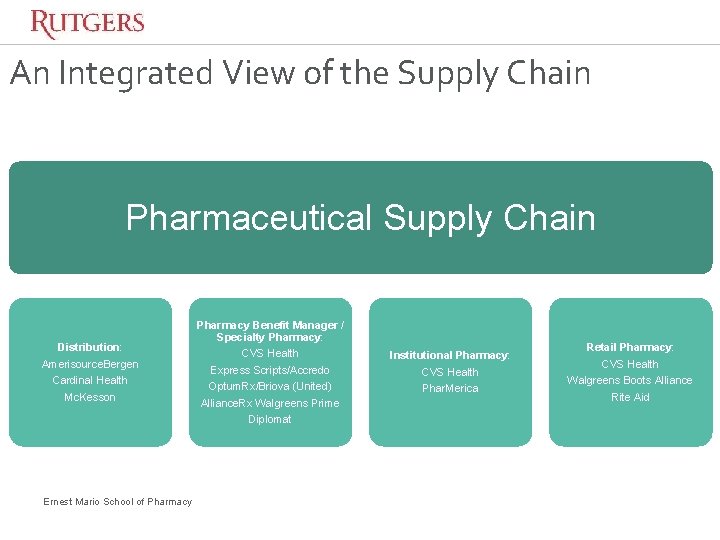
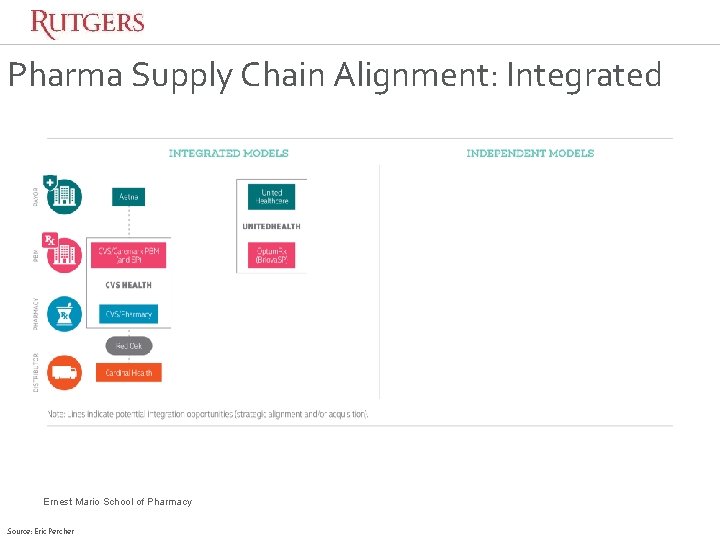
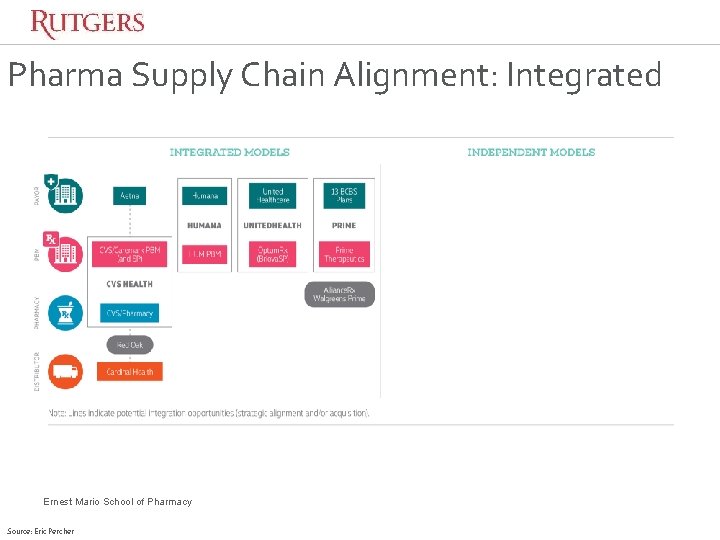
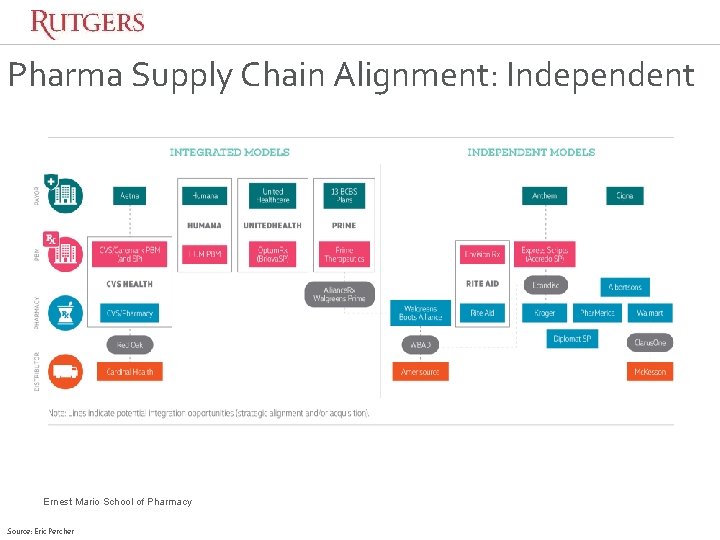
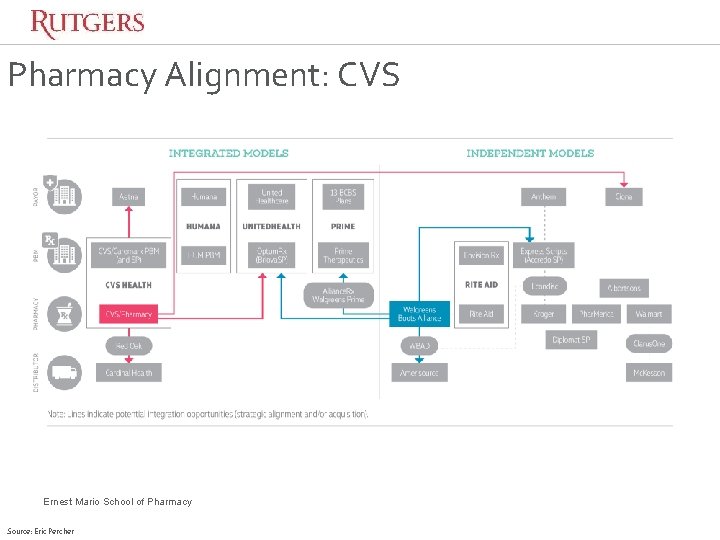
An Integrated View of the Supply Chain Pharmaceutical Supply Chain Distribution: Amerisource. Bergen Cardinal Health Mc. Kesson Ernest Mario School of Pharmacy Benefit Manager / Specialty Pharmacy: CVS Health Express Scripts/Accredo Optum. Rx/Briova (United) Alliance. Rx Walgreens Prime Diplomat Institutional Pharmacy: CVS Health Phar. Merica Retail Pharmacy: CVS Health Walgreens Boots Alliance Rite Aid
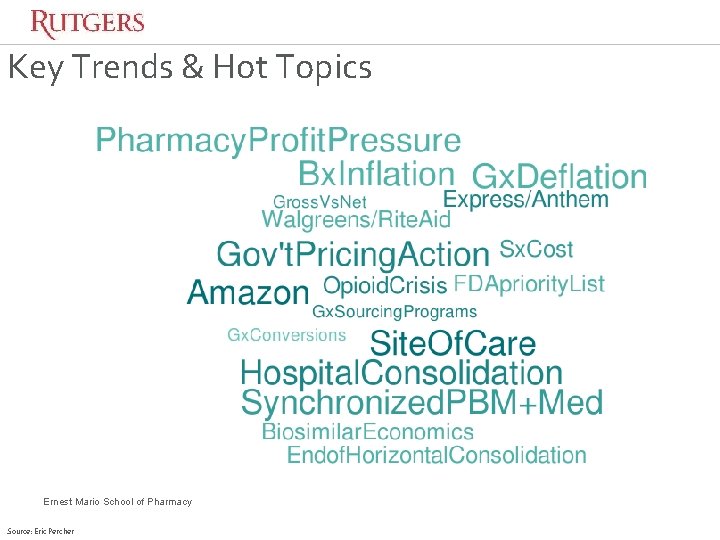
Key Trends & Hot Topics Ernest Mario School of Pharmacy Source: Eric Percher
The Two Trends in Healthcare Ernest Mario School of Pharmacy
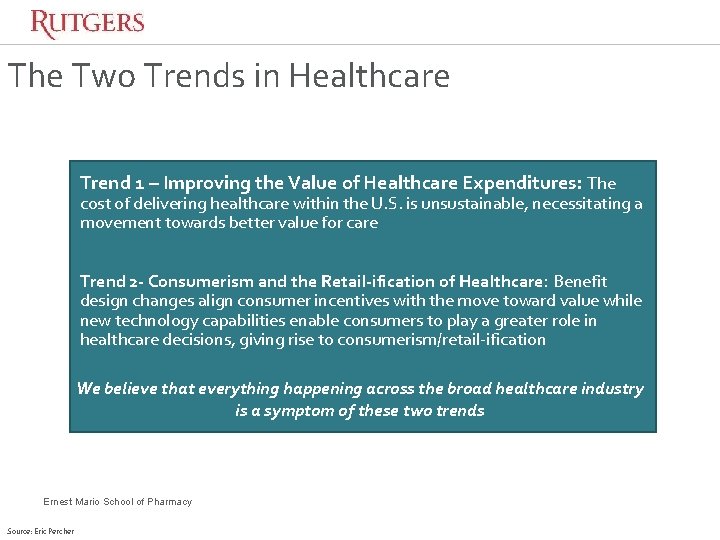
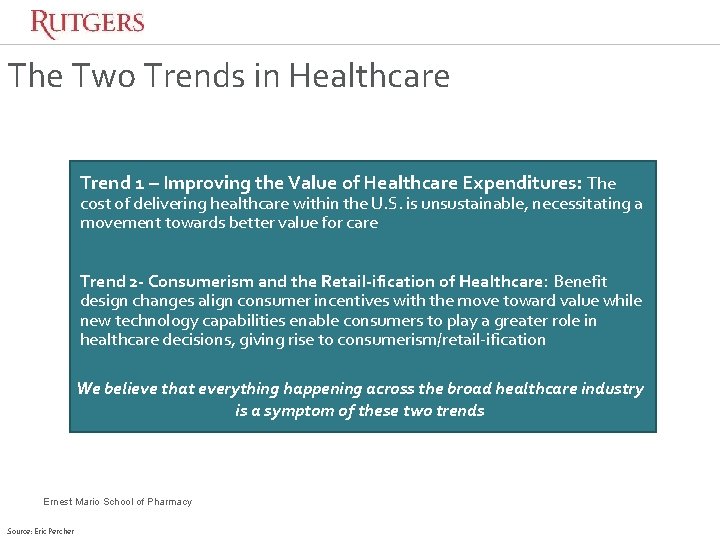
The Two Trends in Healthcare Trend 1 – Improving the Value of Healthcare Expenditures: The cost of delivering healthcare within the U. S. is unsustainable, necessitating a movement towards better value for care Trend 2 - Consumerism and the Retail-ification of Healthcare: Benefit design changes align consumer incentives with the move toward value while new technology capabilities enable consumers to play a greater role in healthcare decisions, giving rise to consumerism/retail-ification We believe that everything happening across the broad healthcare industry is a symptom of these two trends Ernest Mario School of Pharmacy Source: Eric Percher
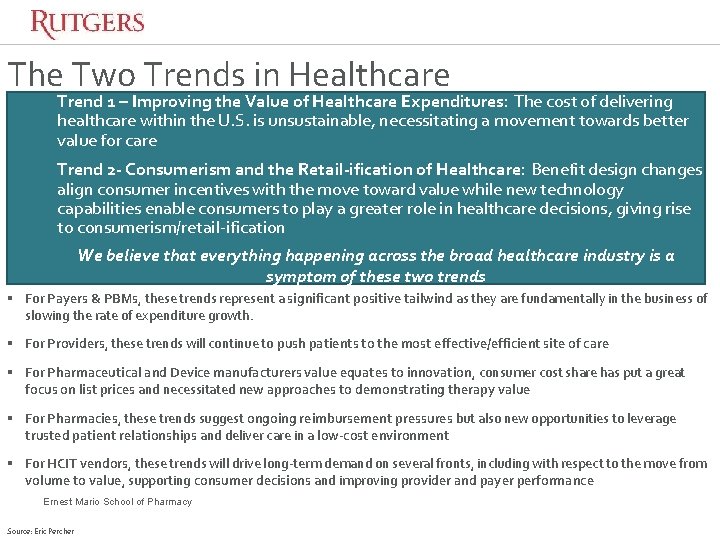
The Two Trends in Healthcare Trend 1 – Improving the Value of Healthcare Expenditures: The cost of delivering healthcare within the U. S. is unsustainable, necessitating a movement towards better value for care Trend 2 - Consumerism and the Retail-ification of Healthcare: Benefit design changes align consumer incentives with the move toward value while new technology capabilities enable consumers to play a greater role in healthcare decisions, giving rise to consumerism/retail-ification We believe that everything happening across the broad healthcare industry is a symptom of these two trends § For Payers & PBMs, these trends represent a significant positive tailwind as they are fundamentally in the business of slowing the rate of expenditure growth. § For Providers, these trends will continue to push patients to the most effective/efficient site of care § For Pharmaceutical and Device manufacturers value equates to innovation, consumer cost share has put a great focus on list prices and necessitated new approaches to demonstrating therapy value § For Pharmacies, these trends suggest ongoing reimbursement pressures but also new opportunities to leverage trusted patient relationships and deliver care in a low-cost environment § For HCIT vendors, these trends will drive long-term demand on several fronts, including with respect to the move from volume to value, supporting consumer decisions and improving provider and payer performance Ernest Mario School of Pharmacy Source: Eric Percher
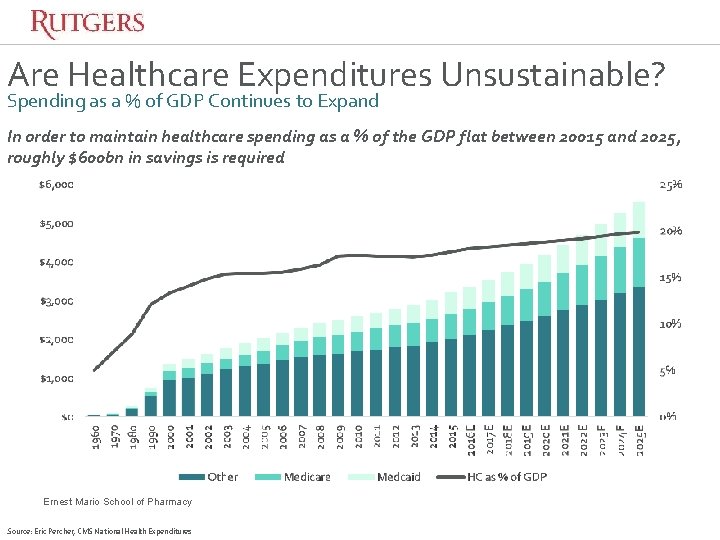
Are Healthcare Expenditures Unsustainable? Spending as a % of GDP Continues to Expand In order to maintain healthcare spending as a % of the GDP flat between 20015 and 2025, roughly $600 bn in savings is required Ernest Mario School of Pharmacy Source: Eric Percher, CMS National Health Expenditures
Pharma Cost Relative to Total Expenditures Pharma expenditures as a % of total Healthcare expenditures are expected to stay relatively flat Total pharma expenditures are expected to plateau at 14% of Healthcare expenditures Ernest Mario School of Pharmacy Source: Eric Percher, Altarum Institute “A Ten Year Projection of the Prescription Drug Share of National Health Expenditures Including Non- Retail”
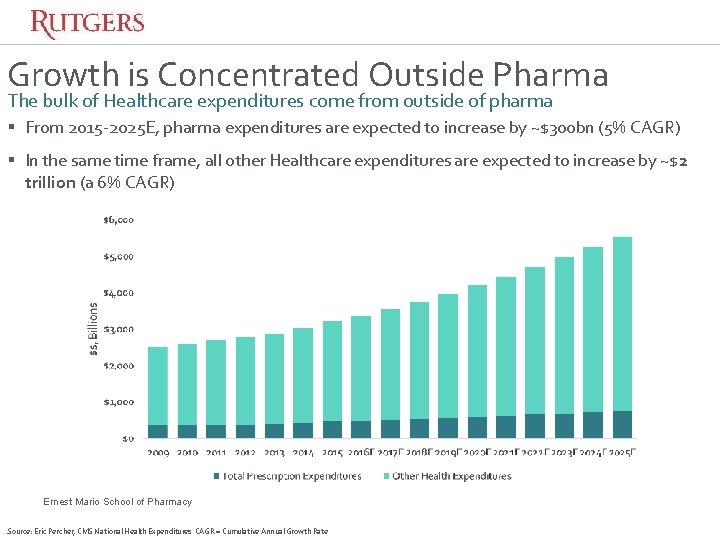
Growth is Concentrated Outside Pharma The bulk of Healthcare expenditures come from outside of pharma § From 2015 -2025 E, pharma expenditures are expected to increase by ~$300 bn (5% CAGR) § In the same time frame, all other Healthcare expenditures are expected to increase by ~$2 trillion (a 6% CAGR) Ernest Mario School of Pharmacy Source: Eric Percher, CMS National Health Expenditures CAGR = Cumulative Annual Growth Rate
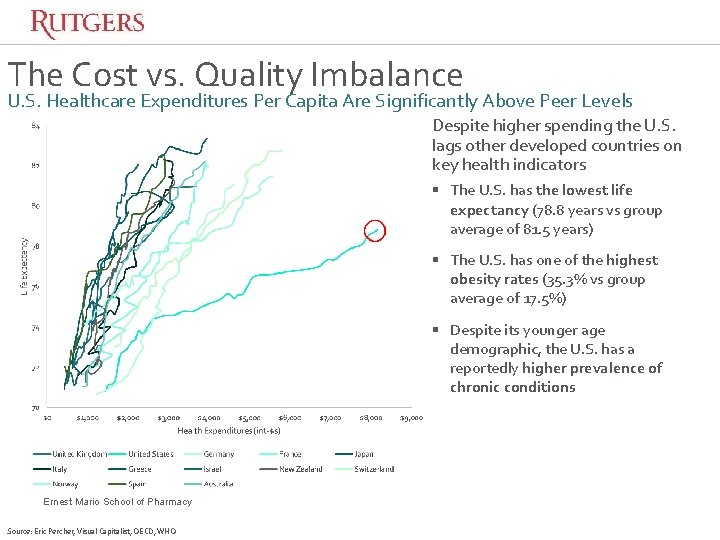
The Cost vs. Quality Imbalance U. S. Healthcare Expenditures Per Capita Are Significantly Above Peer Levels Despite higher spending the U. S. lags other developed countries on key health indicators § The U. S. has the lowest life expectancy (78. 8 years vs group average of 81. 5 years) § The U. S. has one of the highest obesity rates (35. 3% vs group average of 17. 5%) § Despite its younger age demographic, the U. S. has a reportedly higher prevalence of chronic conditions Ernest Mario School of Pharmacy Source: Eric Percher, Visual Capitalist, OECD, WHO
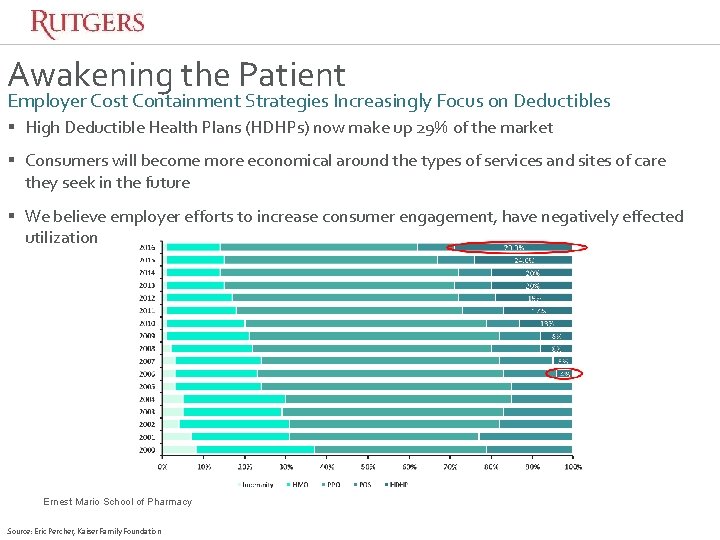
Awakening the Patient Employer Cost Containment Strategies Increasingly Focus on Deductibles § High Deductible Health Plans (HDHPs) now make up 29% of the market § Consumers will become more economical around the types of services and sites of care they seek in the future § We believe employer efforts to increase consumer engagement, have negatively effected utilization Ernest Mario School of Pharmacy Source: Eric Percher, Kaiser Family Foundation
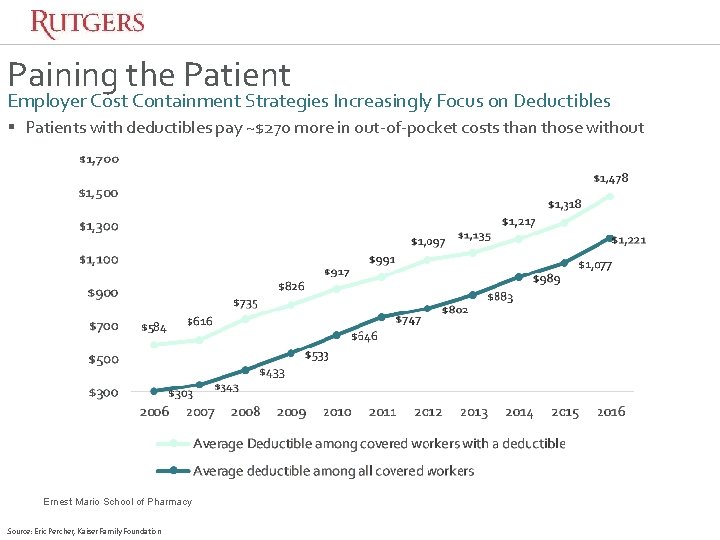
Paining the Patient Employer Cost Containment Strategies Increasingly Focus on Deductibles § Patients with deductibles pay ~$270 more in out-of-pocket costs than those without Ernest Mario School of Pharmacy Source: Eric Percher, Kaiser Family Foundation
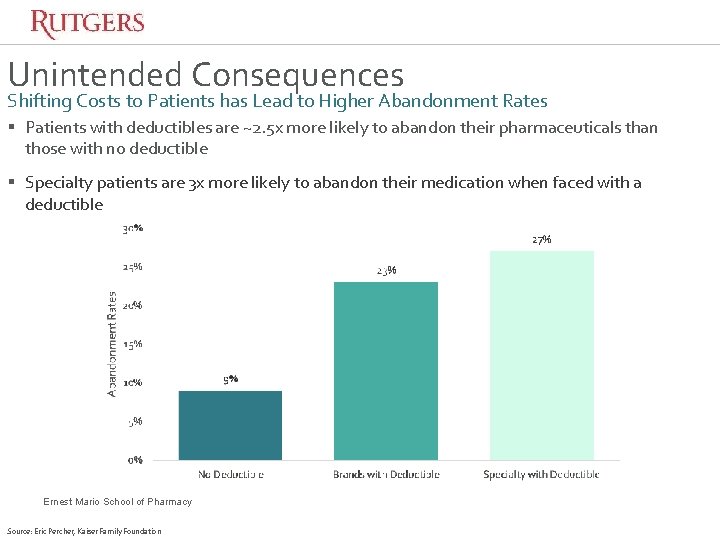
Unintended Consequences Shifting Costs to Patients has Lead to Higher Abandonment Rates § Patients with deductibles are ~2. 5 x more likely to abandon their pharmaceuticals than those with no deductible § Specialty patients are 3 x more likely to abandon their medication when faced with a deductible Ernest Mario School of Pharmacy Source: Eric Percher, Kaiser Family Foundation
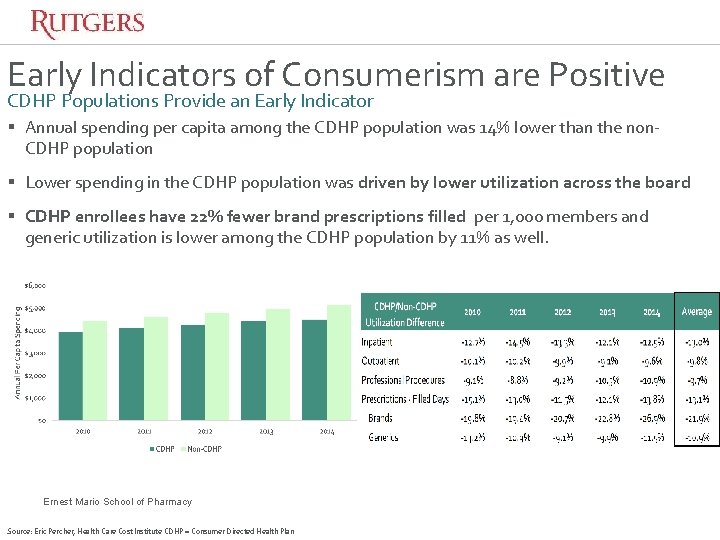
Early Indicators of Consumerism are Positive CDHP Populations Provide an Early Indicator § Annual spending per capita among the CDHP population was 14% lower than the non. CDHP population § Lower spending in the CDHP population was driven by lower utilization across the board § CDHP enrollees have 22% fewer brand prescriptions filled per 1, 000 members and generic utilization is lower among the CDHP population by 11% as well. Ernest Mario School of Pharmacy Source: Eric Percher, Health Care Cost Institute CDHP = Consumer Directed Health Plan
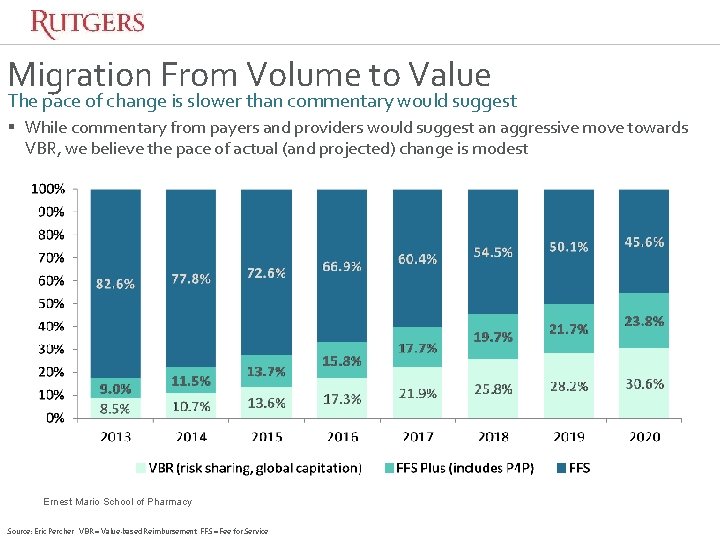
Migration From Volume to Value The pace of change is slower than commentary would suggest § While commentary from payers and providers would suggest an aggressive move towards VBR, we believe the pace of actual (and projected) change is modest Ernest Mario School of Pharmacy Source: Eric Percher VBR = Value-based Reimbursement FFS = Fee for Service
Focusing in on Pharmaceutical Growth Ernest Mario School of Pharmacy
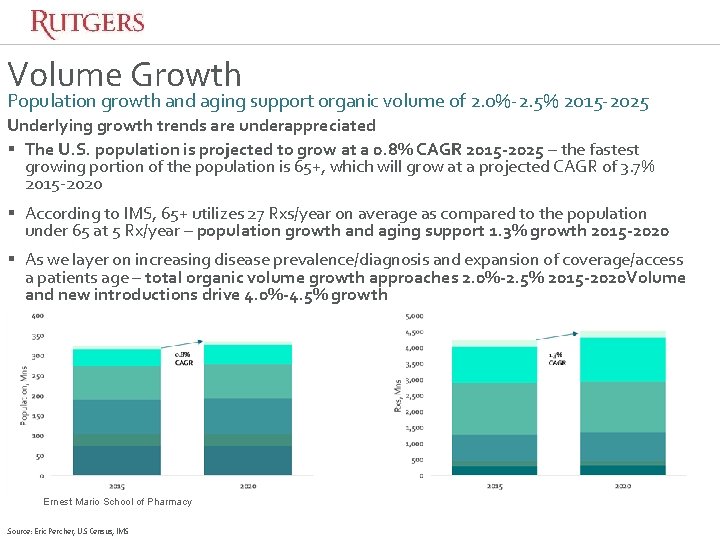
Volume Growth Population growth and aging support organic volume of 2. 0%-2. 5% 2015 -2025 Underlying growth trends are underappreciated § The U. S. population is projected to grow at a 0. 8% CAGR 2015 -2025 – the fastest growing portion of the population is 65+, which will grow at a projected CAGR of 3. 7% 2015 -2020 § According to IMS, 65+ utilizes 27 Rxs/year on average as compared to the population under 65 at 5 Rx/year – population growth and aging support 1. 3% growth 2015 -2020 § As we layer on increasing disease prevalence/diagnosis and expansion of coverage/access a patients age – total organic volume growth approaches 2. 0%-2. 5% 2015 -2020 Volume and new introductions drive 4. 0%-4. 5% growth Ernest Mario School of Pharmacy Source: Eric Percher, US Census, IMS
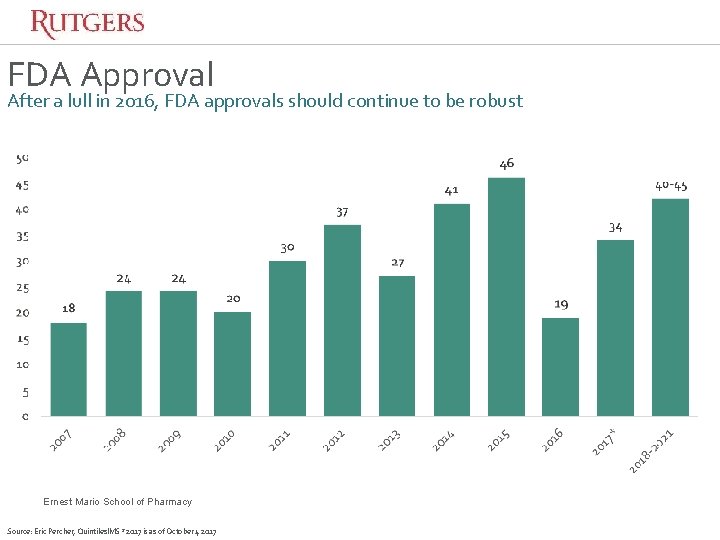
FDA Approval After a lull in 2016, FDA approvals should continue to be robust Ernest Mario School of Pharmacy Source: Eric Percher, Quintiles. IMS *2017 is as of October 4 2017
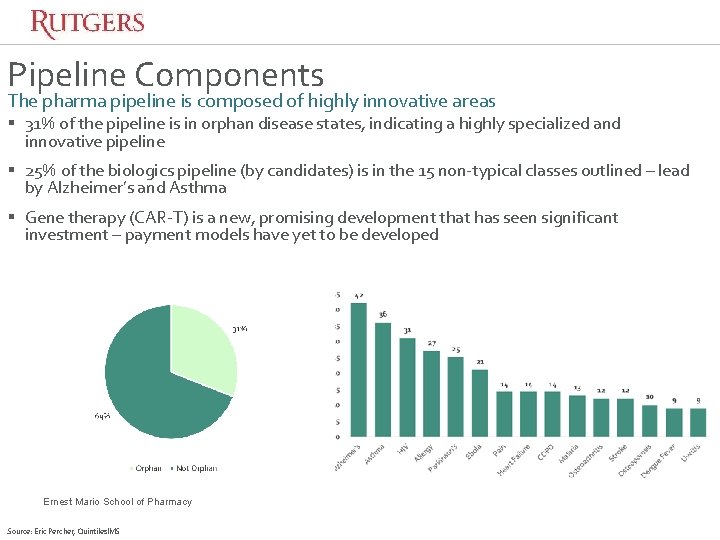
Pipeline Components The pharma pipeline is composed of highly innovative areas § 31% of the pipeline is in orphan disease states, indicating a highly specialized and innovative pipeline § 25% of the biologics pipeline (by candidates) is in the 15 non-typical classes outlined – lead by Alzheimer’s and Asthma § Gene therapy (CAR-T) is a new, promising development that has seen significant investment – payment models have yet to be developed Ernest Mario School of Pharmacy Source: Eric Percher, Quintiles. IMS
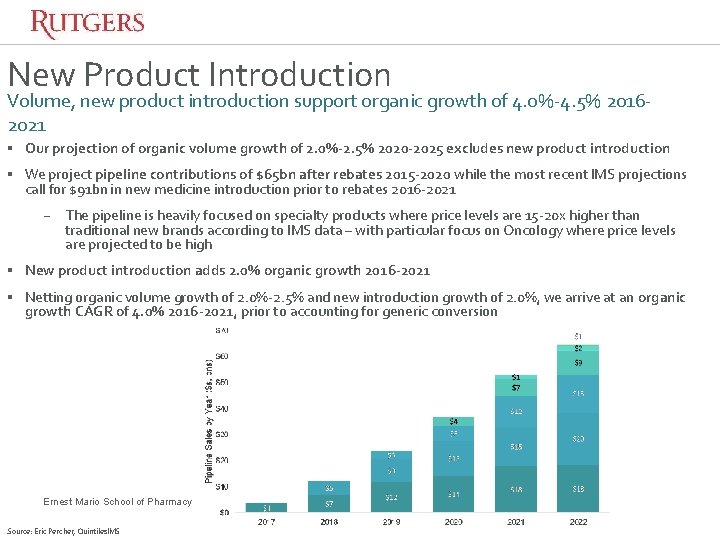
New Product Introduction Volume, new product introduction support organic growth of 4. 0%-4. 5% 20162021 § Our projection of organic volume growth of 2. 0%-2. 5% 2020 -2025 excludes new product introduction § We project pipeline contributions of $65 bn after rebates 2015 -2020 while the most recent IMS projections call for $91 bn in new medicine introduction prior to rebates 2016 -2021 − The pipeline is heavily focused on specialty products where price levels are 15 -20 x higher than traditional new brands according to IMS data – with particular focus on Oncology where price levels are projected to be high § New product introduction adds 2. 0% organic growth 2016 -2021 § Netting organic volume growth of 2. 0%-2. 5% and new introduction growth of 2. 0%, we arrive at an organic growth CAGR of 4. 0% 2016 -2021, prior to accounting for generic conversion Ernest Mario School of Pharmacy Source: Eric Percher, Quintiles. IMS
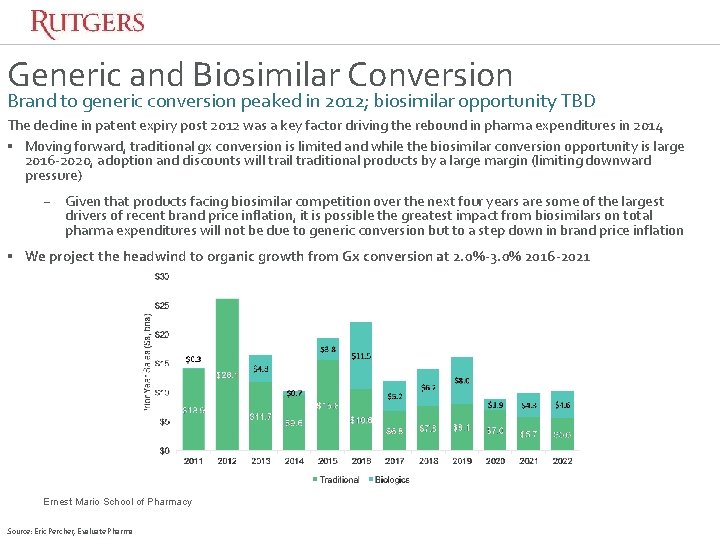
Generic and Biosimilar Conversion Brand to generic conversion peaked in 2012; biosimilar opportunity TBD The decline in patent expiry post 2012 was a key factor driving the rebound in pharma expenditures in 2014 § Moving forward, traditional gx conversion is limited and while the biosimilar conversion opportunity is large 2016 -2020, adoption and discounts will trail traditional products by a large margin (limiting downward pressure) − Given that products facing biosimilar competition over the next four years are some of the largest drivers of recent brand price inflation, it is possible the greatest impact from biosimilars on total pharma expenditures will not be due to generic conversion but to a step down in brand price inflation § We project the headwind to organic growth from Gx conversion at 2. 0%-3. 0% 2016 -2021 Ernest Mario School of Pharmacy Source: Eric Percher, Evaluate Pharma
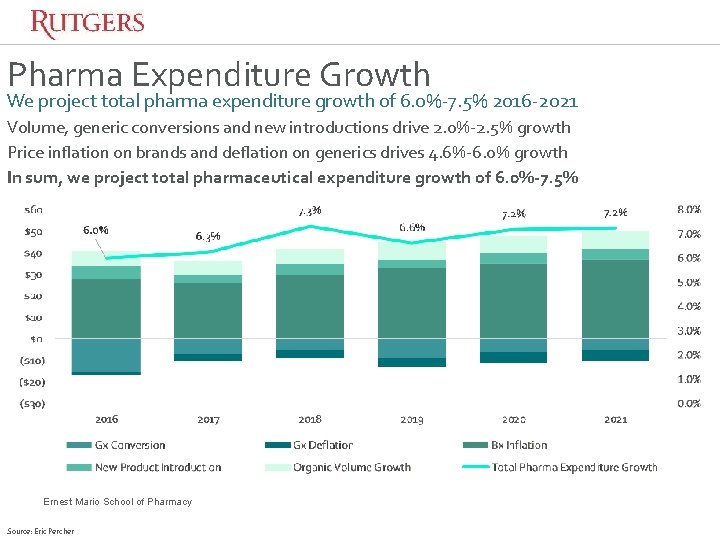
Pharma Expenditure Growth We project total pharma expenditure growth of 6. 0%-7. 5% 2016 -2021 Volume, generic conversions and new introductions drive 2. 0%-2. 5% growth Price inflation on brands and deflation on generics drives 4. 6%-6. 0% growth In sum, we project total pharmaceutical expenditure growth of 6. 0%-7. 5% Ernest Mario School of Pharmacy Source: Eric Percher
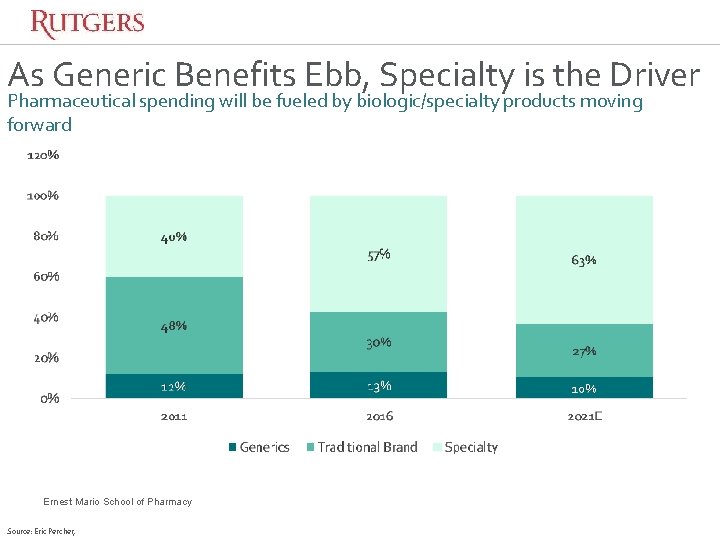
As Generic Benefits Ebb, Specialty is the Driver Pharmaceutical spending will be fueled by biologic/specialty products moving forward Ernest Mario School of Pharmacy Source: Eric Percher,
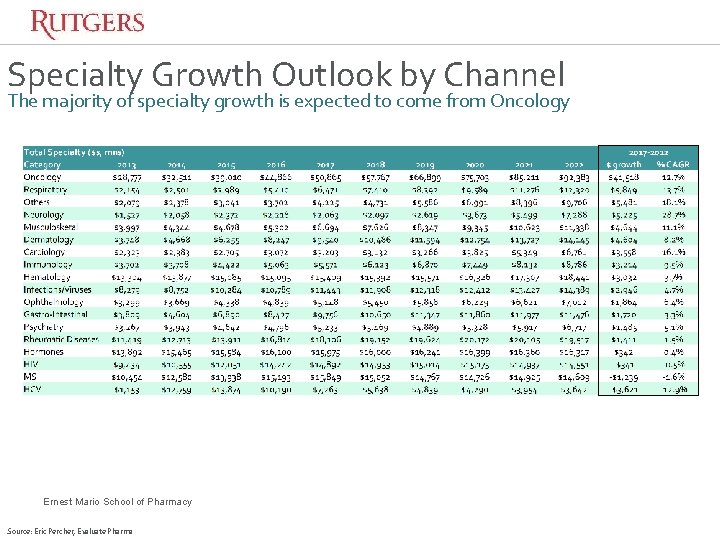
Specialty Growth Outlook by Channel The majority of specialty growth is expected to come from Oncology Ernest Mario School of Pharmacy Source: Eric Percher, Evaluate Pharma
The Two Trends in Healthcare Trend 1 – Improving the Value of Healthcare Expenditures: The cost of delivering healthcare within the U. S. is unsustainable, necessitating a movement towards better value for care Trend 2 - Consumerism and the Retail-ification of Healthcare: Benefit design changes align consumer incentives with the move toward value while new technology capabilities enable consumers to play a greater role in healthcare decisions, giving rise to consumerism/retail-ification We believe that everything happening across the broad healthcare industry is a symptom of these two trends Ernest Mario School of Pharmacy Source: Eric Percher
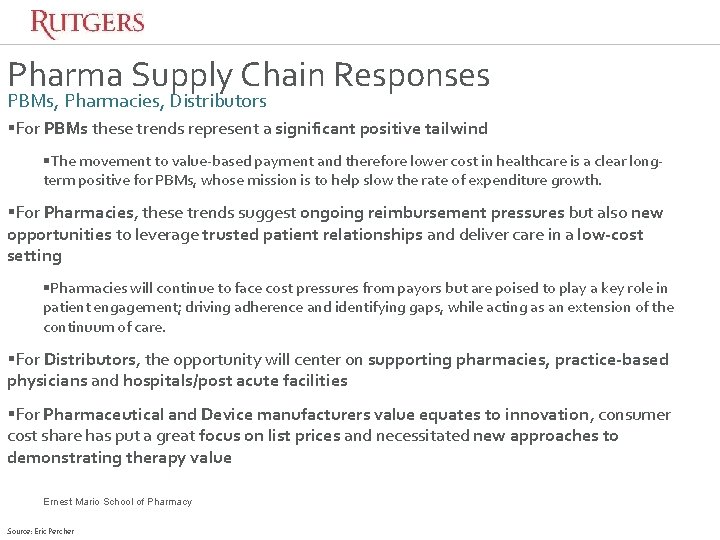
Pharma Supply Chain Responses PBMs, Pharmacies, Distributors §For PBMs these trends represent a significant positive tailwind §The movement to value-based payment and therefore lower cost in healthcare is a clear longterm positive for PBMs, whose mission is to help slow the rate of expenditure growth. §For Pharmacies, these trends suggest ongoing reimbursement pressures but also new opportunities to leverage trusted patient relationships and deliver care in a low-cost setting §Pharmacies will continue to face cost pressures from payors but are poised to play a key role in patient engagement; driving adherence and identifying gaps, while acting as an extension of the continuum of care. §For Distributors, the opportunity will center on supporting pharmacies, practice-based physicians and hospitals/post acute facilities §For Pharmaceutical and Device manufacturers value equates to innovation, consumer cost share has put a great focus on list prices and necessitated new approaches to demonstrating therapy value Ernest Mario School of Pharmacy Source: Eric Percher
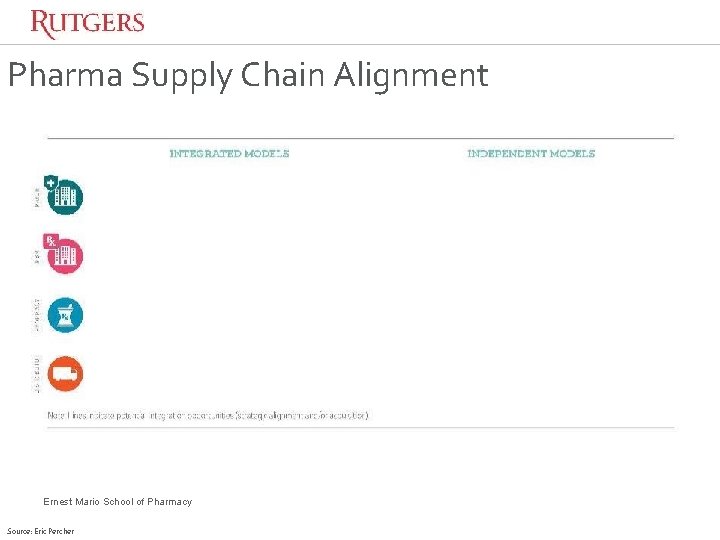
Pharma Supply Chain Alignment Ernest Mario School of Pharmacy Source: Eric Percher
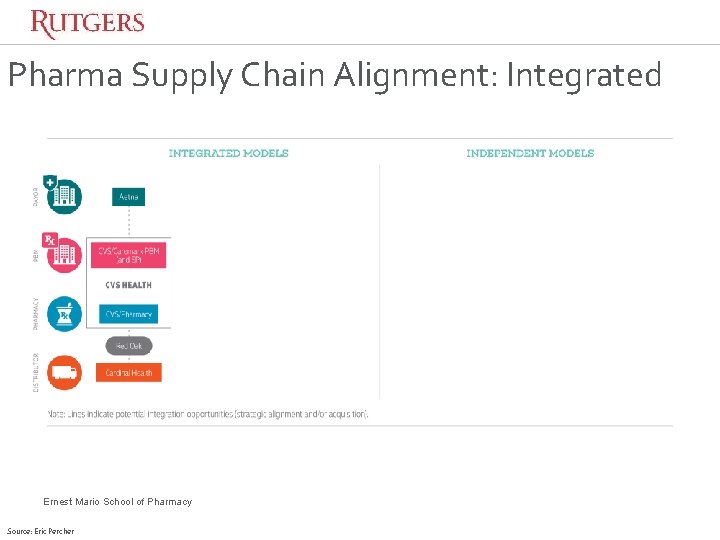
Pharma Supply Chain Alignment: Integrated Ernest Mario School of Pharmacy Source: Eric Percher
Pharma Supply Chain Alignment: Integrated Ernest Mario School of Pharmacy Source: Eric Percher
Pharma Supply Chain Alignment: Integrated Ernest Mario School of Pharmacy Source: Eric Percher
Pharma Supply Chain Alignment: Independent Ernest Mario School of Pharmacy Source: Eric Percher
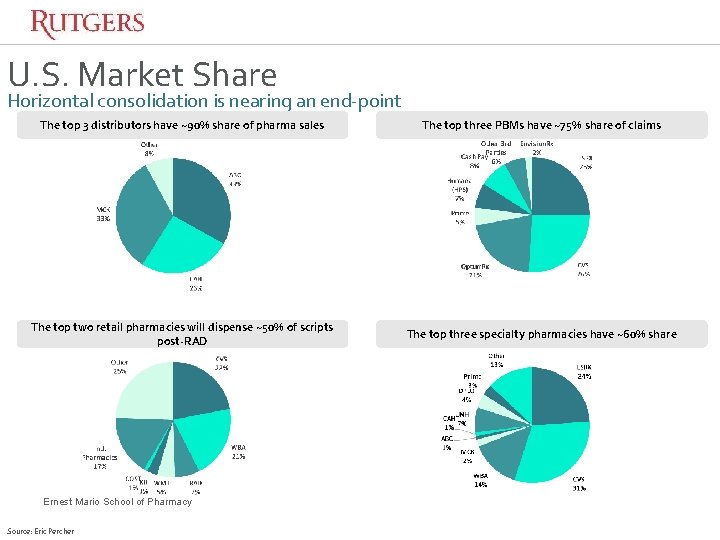
U. S. Market Share Horizontal consolidation is nearing an end-point The top 3 distributors have ~90% share of pharma sales The top three PBMs have ~75% share of claims The top two retail pharmacies will dispense ~50% of scripts post-RAD The top three specialty pharmacies have ~60% share Ernest Mario School of Pharmacy Source: Eric Percher
Pharmacy Alignment: CVS Ernest Mario School of Pharmacy Source: Eric Percher
Provider Responses Improving Value and Consumerism §Significant changes in health insurance benefits in recent years will continue to temper demand for hospital services – we believe the current environment of tempered demand in utilization is structural not cyclical. §Similarly, a continued shift toward managed Medicare and Medicaid will further pressure utilization and reimbursement §Health insurance trends will lead to a narrowing of networks and consumer-oriented decision-making that should force more volume to the most efficient sites of care, which may skew visits away from inpatient settings. §For providers and facilities, these trends will continue to push patients to the most efficient site of care §Facilities that can prove a higher level of value, including Ambulatory Surgery Centers, outpatient service providers in general and lower cost acute care providers will benefit §Those entities that resist the movement to lower cost of care will ultimately face severe volume pressures §There is also an important opportunity to promote brand as patients “shop” at the facility level. §We see a compelling opportunity for growth in outpatient services that will help alternate site providers as well as acute care hospitals willing to pivot. §Confluence of operating environment, regulatory changes and managed care consolidation will lead to continued mergers and acquisitions. Ernest Mario School of Pharmacy Source: Eric Percher
Managed Care Responses Improving Value and Consumerism §For the managed care sector, these trends should be positive tailwinds, particularly for the largest plans with the lowest cost structures §Managed care organizations are increasingly expected to actually manage care §The movement to value based payments, and therefor lower costs in healthcare is a clear positive long term for managed care companies whose mission is to help slow the rate of growth in healthcare § The biggest winners should be the individuals who buy insurance as they will receive cheaper options and better service §Managed care plans will go back to the future with sales processes that progress through to the individual level, and not just stop at the benefit manager at employers. §Customer service will become a meaningful driver of share. Front end tools will increase significantly in popularity. §The key to managing costs will be through patient engagement, necessitating a new level of trust between plan and member (that has clearly not materialized in the past). §The biggest winners should be the individuals, or consumers, who buy insurance as they will receive cheaper options and better service Ernest Mario School of Pharmacy Source: Eric Percher
Eric Percher percher@nephronresearch. com (917) 796 -4545 Ernest Mario School of Pharmacy