
Trends in Extended Producer Responsibility within Enterprises Thomas
Trends in Extended Producer Responsibility within Enterprises Thomas Lindhqvist IIIEE – Lund University Prague 11 April 2011 The International Institute for Industrial Environmental Economics Lund University, Sweden
Original Problem • Costly waste management paid by municipalities • More societal and legislative demands: – to treat waste with better standars – to recycle more • This leads to a need for – more money – better products (= design changes) The International Institute for Industrial Environmental Economics Lund University, Sweden
The “bright” idea • Engage producers to give incentives for change • Use knowledge of producers to develop new systems • Gather enough resources (financial) The International Institute for Industrial Environmental Economics Lund University, Sweden

Extended Producer Responsibility (EPR) – A Swedish concept • Concept presented and developed in two reports written by the author to the Swedish Ministry of Environment in 1990 and 1991 • A principle for policy making: Extending the responsibility of producers over the life cycle of the products they manufacture in order to get environmental improvements of the whole life cycle and in particular the end-of-life treatment. The International Institute for Industrial Environmental Economics Lund University, Sweden

Extended Producer Responsibility (EPR) - a policy principle • Two groups of objectives: - Using resources in waste 1. Effective collection 2. High treatment standard 3. Re-use and recycling - Incentives for design changes • The one who can change should be given responsibility = producers The International Institute for Industrial Environmental Economics Lund University, Sweden
EPR-based EU Directives • Implementation of the Directive on Packaging and Packaging Waste (1994 revised in 2004) • Directive on End-of-life Vehicles (2000) • Directives on Electrical and Electronic Equipment (WEEE & Ro. HS) (2003) • Directive on Batteries and Accumulators (2006) The International Institute for Industrial Environmental Economics Lund University, Sweden

Today’s Practice • Companies join a Producer Responsibility Organisation (PRO) • Pay a fee to that the PRO • The PRO organises collection and recycling using waste and recycling companies • The PRO reports to government that they fulfil the demands of legislation (% rate of recycling or kg collected) The International Institute for Industrial Environmental Economics Lund University, Sweden

Everyone’s responsibility is no one’s responsibility • The solution is to create individual incentives If a company invests – then that company gets the profit Individual Producer Responsibility (IPR) The International Institute for Industrial Environmental Economics Lund University, Sweden
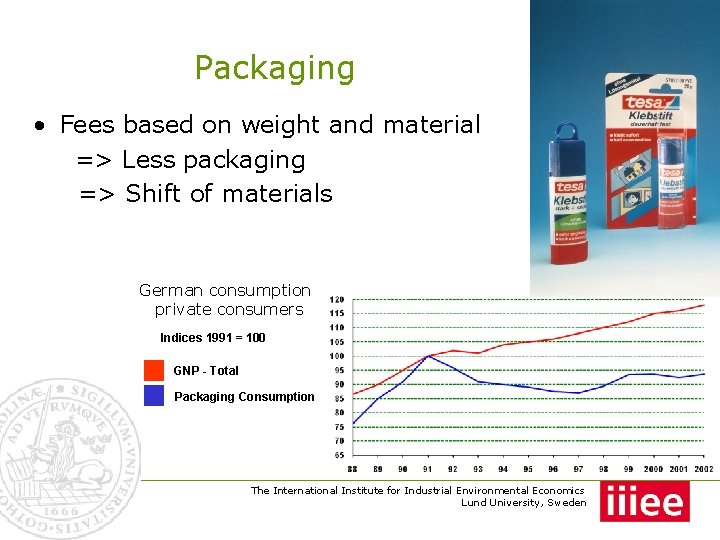
Packaging • Fees based on weight and material => Less packaging => Shift of materials German consumption private consumers Indices 1991 = 100 GNP - Total Packaging Consumption The International Institute for Industrial Environmental Economics Lund University, Sweden
Closing loops and taking reponsibility – a business opportunity • Copying machines • One-way cameras • Carpets The International Institute for Industrial Environmental Economics Lund University, Sweden
Ideas – but not yet reality • Baby trams • Hobby tools The International Institute for Industrial Environmental Economics Lund University, Sweden
Reasons to Take Responsibility Beyond Legislation • • • Preempt future legislation Create new business models (after sales etc. ) Securing access to scarce materials Taking control over second hand markets Compete on quality, not quantity The International Institute for Industrial Environmental Economics Lund University, Sweden
A dilemma Is it a good idea to recycle? The only limitation is our lack of creativity!! The International Institute for Industrial Environmental Economics Lund University, Sweden
IIIEE reports on EPR Thomas. Lindhqvist@iiiee. lu. se www. iiiee. lu. se The International Institute for Industrial Environmental Economics Lund University, Sweden
- Slides: 14