
Trends in autoionization of Rydberg states converging to
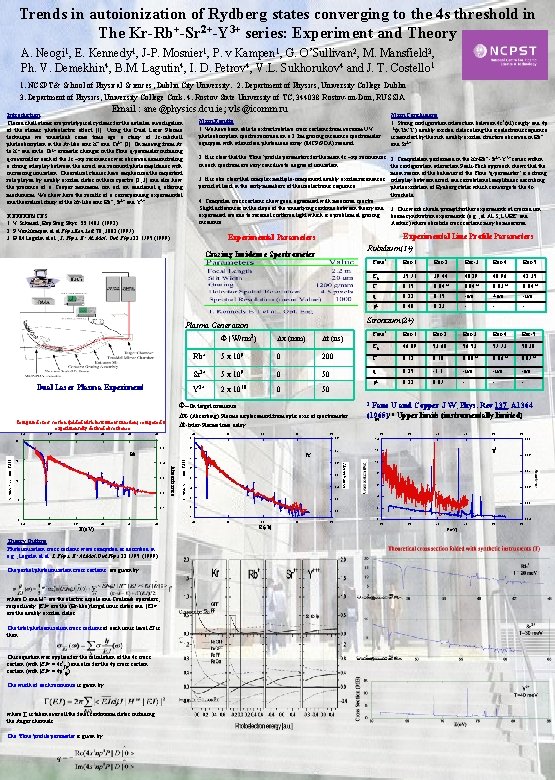
Trends in autoionization of Rydberg states converging to the 4 s threshold in The Kr-Rb+-Sr 2+-Y 3+ series: Experiment and Theory A. Neogi 1, E. Kennedy 1, J-P. Mosnier 1, P. v Kampen 1, G. O’Sullivan 2, M. Mansfield 3, Ph. V. Demekhin 4, B. M. Lagutin 4, I. D. Petrov 4, V. L. Sukhorukov 4 and J. T. Costello 1 1. NCSPT & School of Physical Sciences, Dublin City University. 2. Department of Physics, University College Dublin 3. Department of Physics, University College Cork. 4. Rostov State University of TC, 344038 Rostov-on-Don, RUSSIA Email : ane@physics. dcu. ie; vls@icomm. ru Introduction Closed shell atoms are prototypical systems for the detailed investigation of the atomic photoelectric effect [1]. Using the Dual Laser Plasma technique we undertook some time ago a study of 3 s-subshell photoabsorption in the Ar-like ions K+ and Ca 2+ [2]. On moving from Ar to K+ and on to Ca 2+ dramatic changes in the Fano q-parameter including q-reversal for each of the 3 s – np resonances was observed demonstrating a strong interplay between the direct and resonant photoamplitudes with increasing ionization. Theoretical studies have emphasised the important role played by doubly excited states in these spectra [2, 3] and also how the presence of a Cooper minimum can act an additional q altering mechanism. We show here the results of a corresponding experimental and theoretical study of the Kr-like ions Rb+, Sr 2+ and Y 3+. Main Results 1. We have been able to extract relative cross sections from vacuum-UV photoabsorption spectra recorded on a 2. 2 m grazing incidence spectrometer equipped with intensified photodiode array (MCP/PDA) readout. 2. It is clear that the ‘Fano’ profile parameters for the main 4 s – np resonances 2. Computation performed in the Kr-Rb+-Sr 2+-Y 3+ series within in each spectrum are very sensitive to degree of ionization. the configuration interaction Pauli-Fock approach shows that the main reason of the behavior of the Fano ‘q-parameter’ is a strong 3. It is also clear that complex multiple-component doubly excited resonances interplay between direct and correlational amplitudes describing persist at least in the early members of the isoelectronic sequence. photoexcitation of Rydberg states which converge to the 4 sthreshold. 4. Computed cross sections show good agreement with measured spectra. Slight differences in the slope of the underlying continua between theory and 3. This work should prompt further experiments at crossed ion experiment are due to residual scattered light which is a problem at grazing beam-synchrotron experiments (e. g. , at ALS, LURE and incidence. Aarhus) where absolute cross sections may be measured. REFERENCES 1. V Schmidt, Rep. Prog. Phys. 55 1483 (1992) 2. P Van. Kampen et al. Phys. Rev. Lett 78, 3082 (1997) 3. B M Lagutin et al. , J. Phys. B: At. Mol. Opt. Phys 32 1795 (1999) Experimental Line Profile Parameters Rubidium(1+) Experimental Parameters Grazing Incidence Spectrometer Dual Laser Plasma Experiment 34 36 38 40 F (W/cm 2) Dx (mm) Dt (ns) Rb+ 5 x 10⁹ 0 200 Sr 2+ 109 50 Y 3+ 42 5 x 0 2 x 10¹⁰ 0 50 F-On target irradiance Dx-(Absorbing) Plasma displacement from optic axis of spectrometer Dt-Inter-Plasma time delay 45 44 50 55 60 8 0. 5 + 2+ Rb 0. 4 0. 2 5 Absorbance 0. 3 10 Res-2 Res-3 Res-4 Res-5 E 0 35. 71 39. 44 40. 29 40. 96 42. 35 G 0. 15 0. 04* 0. 03* 0. 04* q 0. 22 0. 15 -ive +ive -ive r 2 0. 40 0. 23 - - - Fano 1 Res-2 Res-3 Res-4 Res-5 E 0 46. 89 53. 68 56. 53 57. 73 58. 38 G 0. 12 0. 10 0. 08* 0. 06* 0. 07* q 0. 25 -1. 1 -ive r 2 0. 22 0. 07 - - - Fano U and Copper J W, Phys. Rev 137, A 1364 (1965)/* Upper limits (instrumentally limited) 65 1 60 0. 8 14 0. 7 12 0. 6 10 0. 5 8 65 70 75 80 85 0. 09 3+ Y Sr 7 15 Res-1 65 9 20 Fano 1 Strontium(2+) Plasma Generation Computed cross section (folded with instrument function) compared to experimentally derived absorbance Main Conclusions 1. Strong configuration interaction between 4 s-1(nl) singly and 4 p -2(n’l’n”l”) doubly excited states along the isoelectronic sequence is manifest by the rich doubly excited structure observed in Rb+ and Sr 2+. 0. 08 6 5 0. 4 4 3 0. 07 6 0. 06 4 0. 05 0. 1 2 0. 2 1 0 34 36 38 40 42 44 E(e. V) Theory Outline Photoionization cross sections were computed as described in e. g. , Lagutin et al. J. Phys. B: At. Mol. Opt. Phys 32 1795 (1999) The partial photoionization cross sections are given by: where D and Hee are the electric dipole and Coulomb operators, respectively. |EJ> are the (Br-like) target ionic states and |EJ> are the doubly excited states. The total photoionization cross sections of each ionic level EJ is then: This equation was applied for the calculation of the 4 s cross section (with |EJ> = 4 s 1 Jp) and also for the 4 p cross section (with |EJ> = 4 p 5 Jp). The width of each resonance is given by: where ∑ is taken over all the final continuum states including the Auger channels. The ‘Fano’profile parameter is given by: 45 50 55 E(e. V) 60 65 2 0 0. 04 60 65 70 75 E(e. V) 80 85
- Slides: 1