
Trends in alternative tourism and tailormade products ecotourism
- Slides: 25
Trends in alternative tourism and tailor-made products – ecotourism, adventure tourism, cultural, historical tourism Cross. Tour Fair “A Danubian Al-TOUR-native Dream” 26 -30 January 2012 Rousse, Bulgaria January, 28 th 2012
Topics q. Essence of trends. General trends. q. Alternative tourism product consumers q Tailor-made products advantages q. Current trends through experience economy and branding
What is a ‘trend’? Trends are, seen from today‘s point of view, likely developments in the future è which can be seen at present, è and of which we can reasonably assume that è that they will continue to exist in the future.
Emerging factors = Trends in tourism demand (1) Stable demand volume with changing structure (2) Destination choice remains stable in broad categories (domestic, European, long-haul), but opportunities within these categories for single countries and destinations to attract more tourists (increasing competition) (3) Stable basic motivation, but higher expectations on how to realise them and greater differentiation (4) Growing consumer competence
Emerging factors = Trends in tourism demand (6) Activities: manifold, with the trend to realise more different types of activity within one trip, e. g. relax, culture, sports, family (7) Duration: slightly shorter (8) Expenditures: higher, but more pricesensitive (9) Tour operators and travel agencies: increase, especially online (10) Accommodation: higher quality expectations (hardware, atmosphere & service)
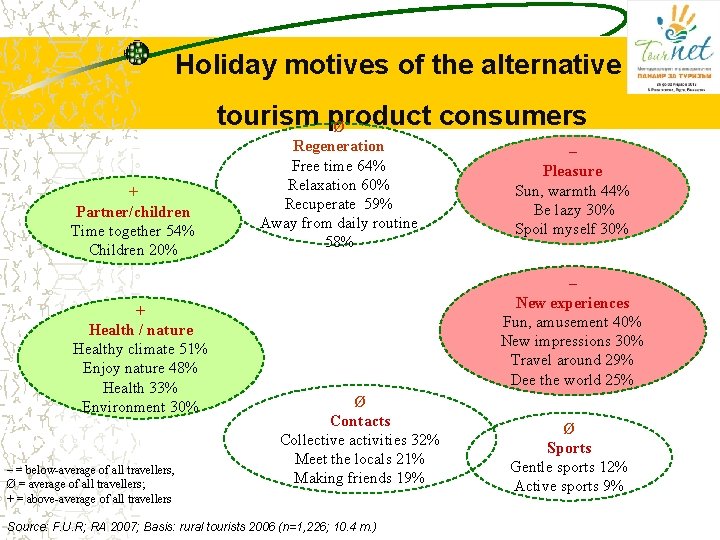
Holiday motives of the alternative tourism product consumers Ø + Partner/children Time together 54% Children 20% + Health / nature Healthy climate 51% Enjoy nature 48% Health 33% Environment 30% – = below-average of all travellers, Ø = average of all travellers; + = above-average of all travellers Regeneration Free time 64% Relaxation 60% Recuperate 59% Away from daily routine 58% – Pleasure Sun, warmth 44% Be lazy 30% Spoil myself 30% – New experiences Fun, amusement 40% New impressions 30% Travel around 29% Dee the world 25% Ø Contacts Collective activities 32% Meet the locals 21% Making friends 19% Source: F. U. R; RA 2007; Basis: rural tourists 2006 (n=1, 226; 10. 4 m. ) Ø Sports Gentle sports 12% Active sports 9%
Tailor-made products – Advantages The aim of this tour is customers to customize the tour package for their convenient. So this kind of tour also known as customizable tour packages. You have the option of booking everything that has to do with your tour. You have the freedom to do whatever you want. You are making your perfect vacation with the flexibility and satisfaction. Saves your time and money. You can get guide and personalised advice from the
Eco-Tourism Definition: Environmentally responsible travel and visitation to relatively undisturbed natural areas → to enjoy and appreciate nature (and any accompanying cultural features, both past and future) Travel that promotes conservation, has low negative visitor impact and provides for beneficially active social-economic involvement of local populations
Ecotourism of the 21 st century (1) Covers unpolluted nature-based areas e. g. national parks, coral reefs, wetland areas Tourists have responsible attitude towards what and whom they come into contact with in the nature-based areas Education is part of the tourists’ experience while they enjoy and appreciate what they learn about nature and any accompanying traditions and cultures of the local communities. Education also on the importance of conservation
Ecotourism of the 21 st century (2) Caters to small groups of tourists → minimise negative impact on the natural environments and local communities e. g. i) flora and fauna not disturbed ii) local communities not displaced iii) no need to clear large areas to make way for built up environment to accommodate droves of tourists iv) Encourages the active involvement of local communities in the planning and promotion of ecotourism in their nature based areas e. g. locals serve as guides, run businesses related to providing
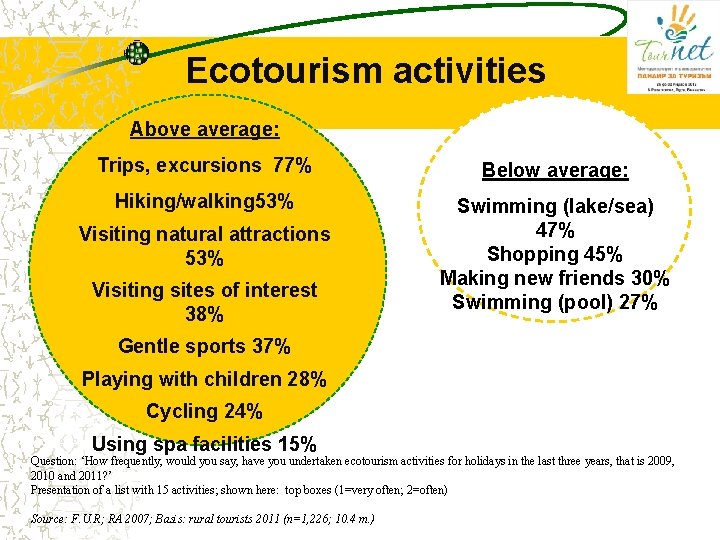
Ecotourism activities Above average: Trips, excursions 77% Below average: Hiking/walking 53% Swimming (lake/sea) 47% Shopping 45% Making new friends 30% Swimming (pool) 27% Visiting natural attractions 53% Visiting sites of interest 38% Gentle sports 37% Playing with children 28% Cycling 24% Using spa facilities 15% Question: ‘How frequently, would you say, have you undertaken ecotourism activities for holidays in the last three years, that is 2009, 2010 and 2011? ’ Presentation of a list with 15 activities; shown here: top boxes (1=very often; 2=often) Source: F. U. R; RA 2007; Basis: rural tourists 2011 (n=1, 226; 10. 4 m. )
In its purest form, ecotourism today minimises negative social, cultural and ecological impacts empowers local communities in conservation and management of natural and cultural resources. brings in economic benefits to local communities and directs revenue to local people living in and around protected areas, and increases revenues for protected areas
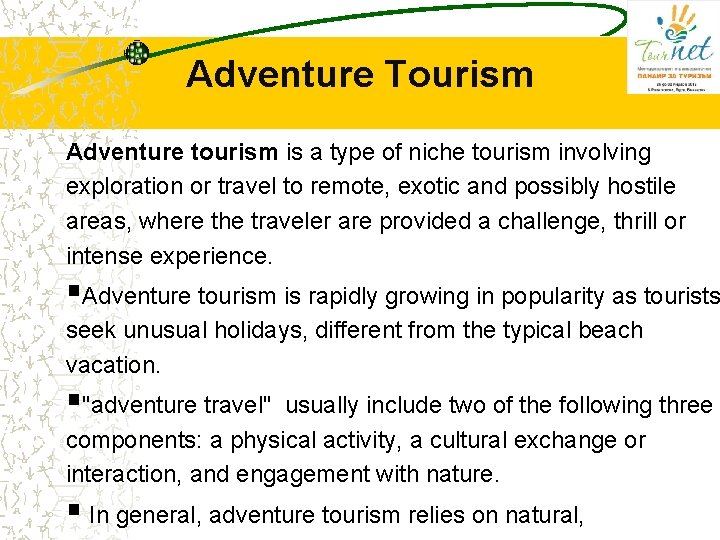
Adventure Tourism Adventure tourism is a type of niche tourism involving exploration or travel to remote, exotic and possibly hostile areas, where the traveler are provided a challenge, thrill or intense experience. §Adventure tourism is rapidly growing in popularity as tourists seek unusual holidays, different from the typical beach vacation. §"adventure travel" usually include two of the following three components: a physical activity, a cultural exchange or interaction, and engagement with nature. § In general, adventure tourism relies on natural,
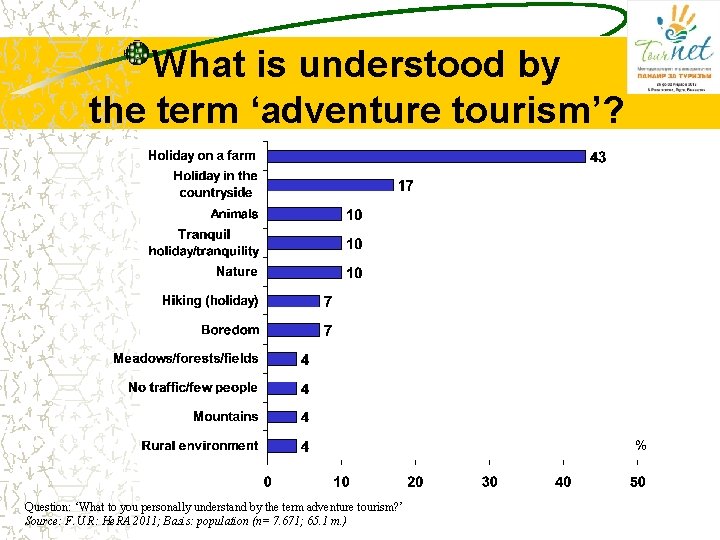
What is understood by the term ‘adventure tourism’? Question: ‘What to you personally understand by the term adventure tourism? ’ Source: F. U. R: He. RA 2011; Basis: population (n= 7. 671; 65. 1 m. )
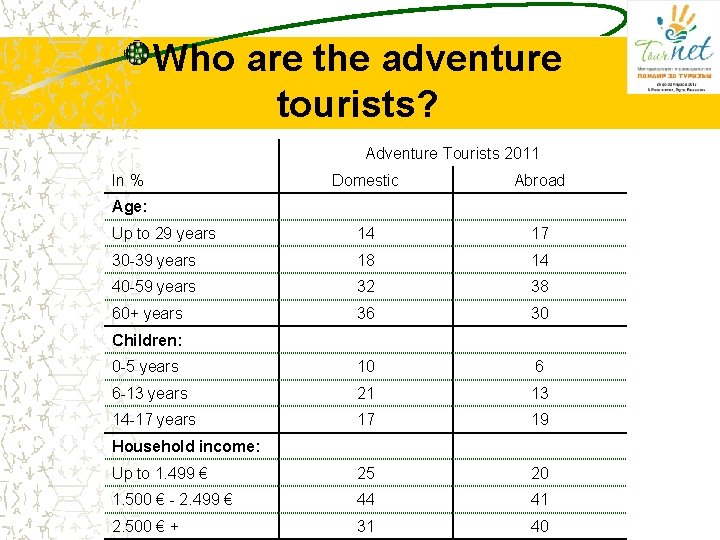
Who are the adventure tourists? Adventure Tourists 2011 Domestic Abroad Up to 29 years 14 17 30 -39 years 18 14 40 -59 years 32 38 60+ years 36 30 0 -5 years 10 6 6 -13 years 21 13 14 -17 years 17 19 Up to 1. 499 € 25 20 1. 500 € - 2. 499 € 44 41 2. 500 € + 31 40 In % Age: Children: Household income:
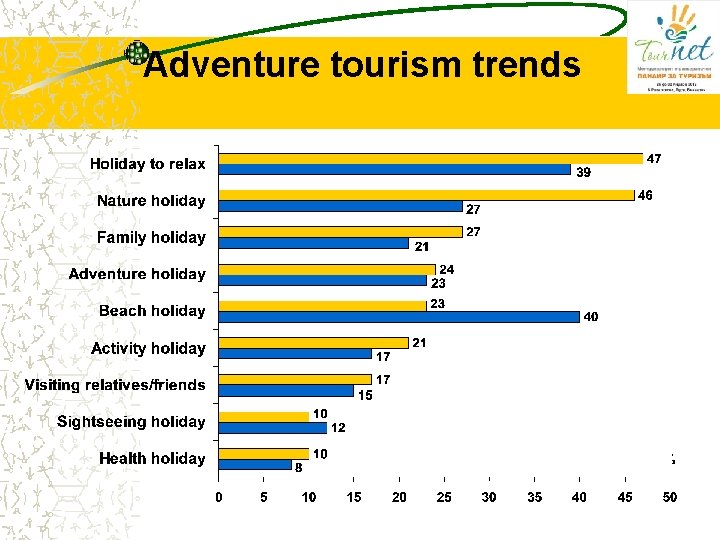
Adventure tourism trends
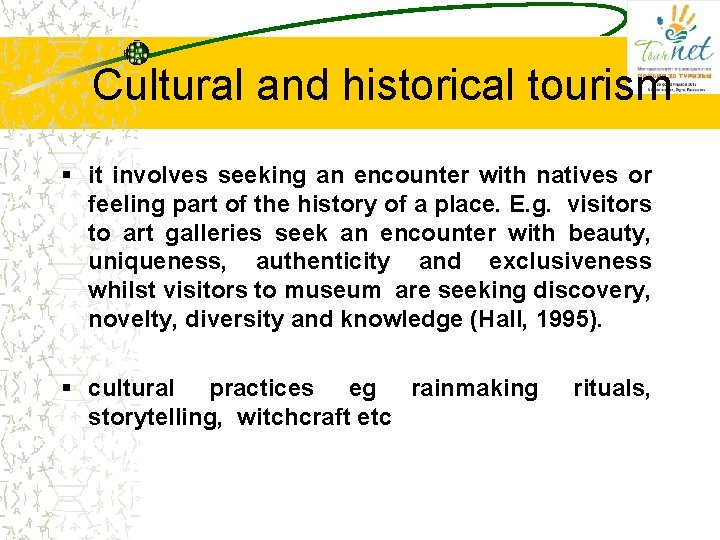
Cultural and historical tourism § it involves seeking an encounter with natives or feeling part of the history of a place. E. g. visitors to art galleries seek an encounter with beauty, uniqueness, authenticity and exclusiveness whilst visitors to museum are seeking discovery, novelty, diversity and knowledge (Hall, 1995). § cultural practices eg rainmaking storytelling, witchcraft etc rituals,
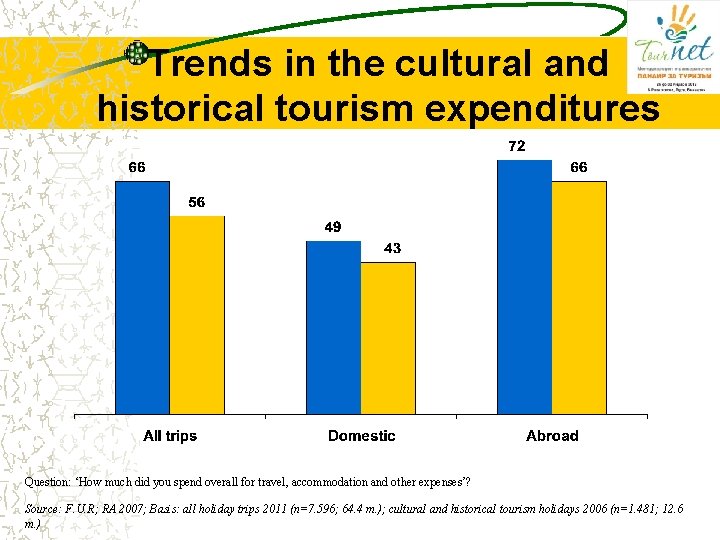
Trends in the cultural and historical tourism expenditures Question: ‘How much did you spend overall for travel, accommodation and other expenses’? Source: F. U. R; RA 2007; Basis: all holiday trips 2011 (n=7. 596; 64. 4 m. ); cultural and historical tourism holidays 2006 (n=1. 481; 12. 6 m. )
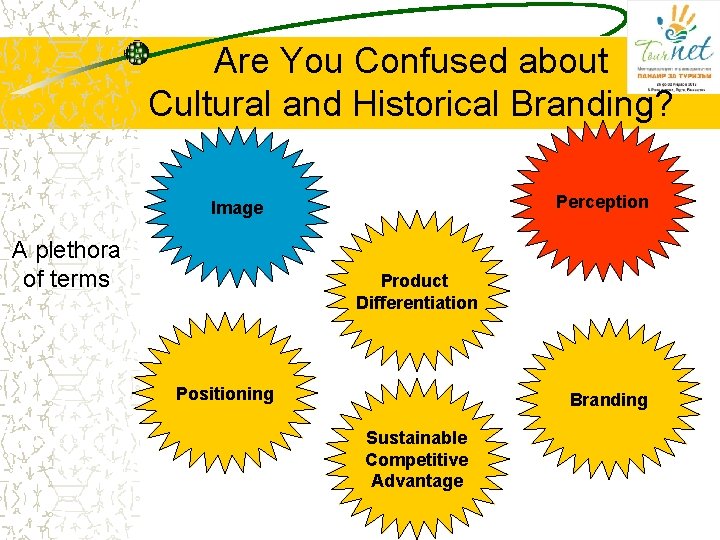
Are You Confused about Cultural and Historical Branding? Perception Image A plethora of terms Product Differentiation Positioning Branding Sustainable Competitive Advantage
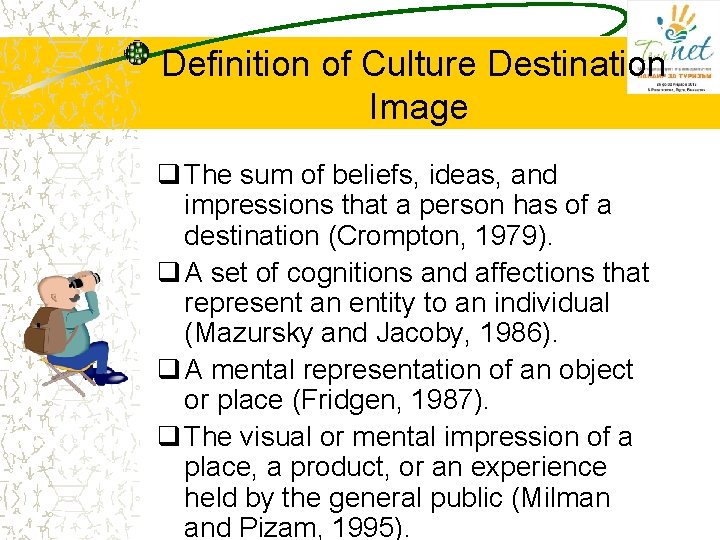
Definition of Culture Destination Image q The sum of beliefs, ideas, and impressions that a person has of a destination (Crompton, 1979). q A set of cognitions and affections that represent an entity to an individual (Mazursky and Jacoby, 1986). q A mental representation of an object or place (Fridgen, 1987). q The visual or mental impression of a place, a product, or an experience held by the general public (Milman and Pizam, 1995).
Components of the new cultural destination perception q Gunn (1972) identified two components of image: Ø Organic: Images formed by individuals themselves through such things as past experiences with destinations, and through unbiased sources of information (e. g. , news reports, movies, newspaper articles, etc. ). Ø Induced: Images created through information received from external sources, including destination advertising
Current trends through brand The alternative tourism product is: q A way to communicate a destination’s unique identity to visitors q A means of differentiating a destination from its competitors q A uniform “look” that all destination partners can consistently use q A symbol, name, term or design, or combination of these elements
Challenges of Branding tailor-made and alternative tourism products q Destinations are not a single product but composite products consisting of a mix of different components (the destination mix). q Destination marketers have little control over the destination mix they are branding. q There is a diverse range of organizations and partners involved in crafting and delivering on the brand. q Often there is a lack of enough funding for branding efforts. q Political influences may be felt.
The Experience Economy’s key words • Differentiation: Identity & values, individualisation • Experiences: Content, dream, fantasy, variation • Influence: Self-determination & open codes • Social capital: Community & network, as well as virtual - and for the development of the integrated
Thank you very much for your attention!