
Trends and realities in European Culture values attitudes






- Slides: 41
Trends and realities in European Culture: values, attitudes, practices Where does Malta stand? Consecrated Life in A European Malta KSMR Seminar, 31 May 2004 ANTHONY M. ABELA
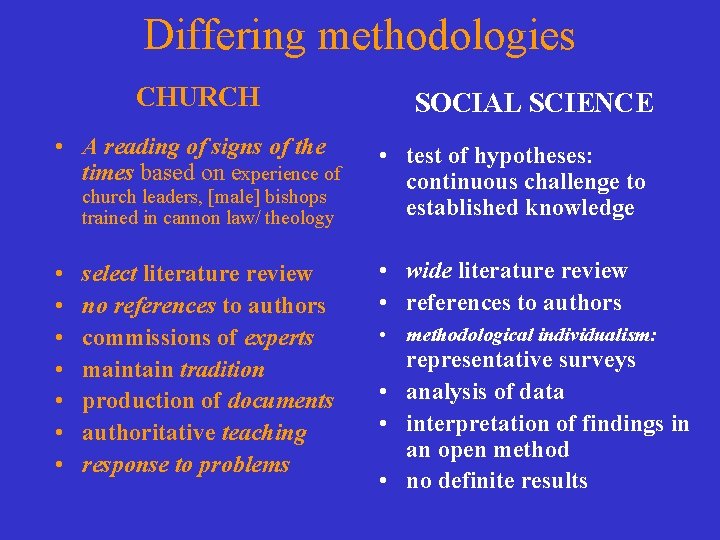
Differing methodologies CHURCH SOCIAL SCIENCE • A reading of signs of the times based on experience of • test of hypotheses: continuous challenge to established knowledge • • wide literature review • references to authors church leaders, [male] bishops trained in cannon law/ theology select literature review no references to authors commissions of experts maintain tradition production of documents authoritative teaching response to problems • methodological individualism: representative surveys • analysis of data • interpretation of findings in an open method • no definite results
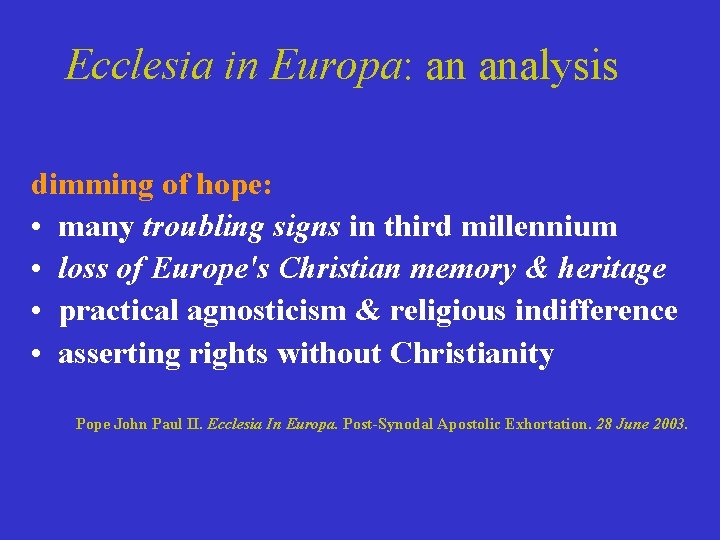
Ecclesia in Europa: an analysis dimming of hope: • many troubling signs in third millennium • loss of Europe's Christian memory & heritage • practical agnosticism & religious indifference • asserting rights without Christianity Pope John Paul II. Ecclesia In Europa. Post-Synodal Apostolic Exhortation. 28 June 2003.
An analysis of culture and society (1) • • loss of meaning in life diminishing number of births decline in vocations to priesthood and religious life difficulty/ outright refusal to lifelong commitments, including marriage widespread existential fragmentation. Loneliness, divisions and conflicts phenomenon of family crises & weakening concept of family ethnic conflicts, racism, interreligious tensions a selfishness, closes individuals/groups on themselves
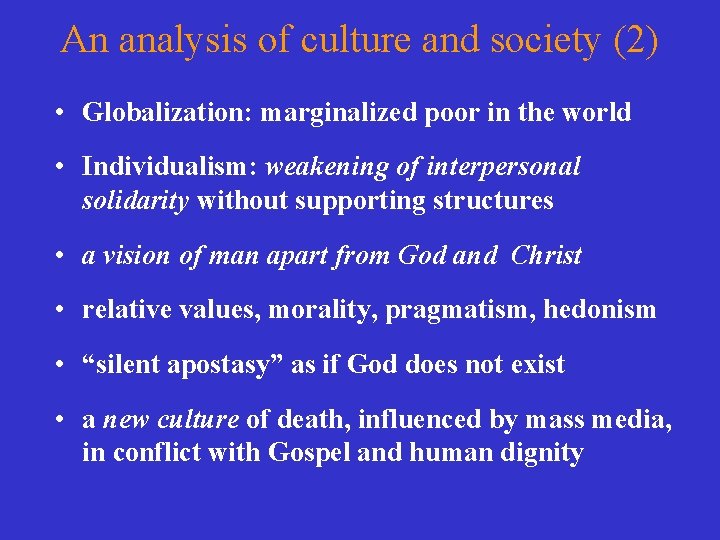
An analysis of culture and society (2) • Globalization: marginalized poor in the world • Individualism: weakening of interpersonal solidarity without supporting structures • a vision of man apart from God and Christ • relative values, morality, pragmatism, hedonism • “silent apostasy” as if God does not exist • a new culture of death, influenced by mass media, in conflict with Gospel and human dignity
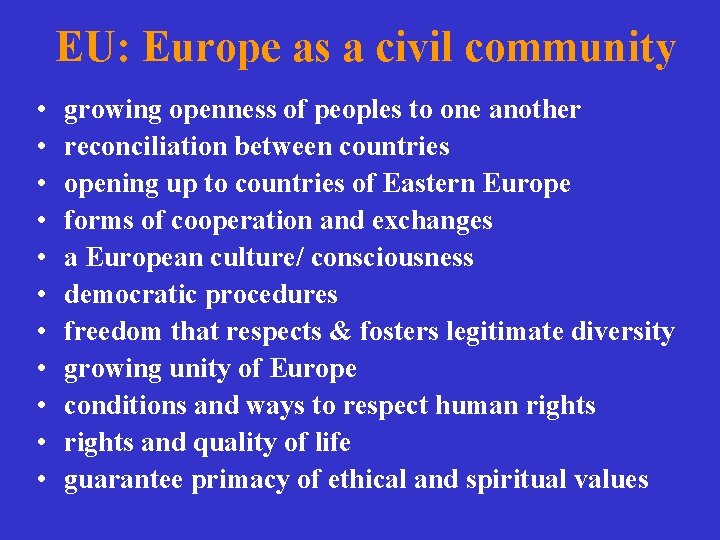
EU: Europe as a civil community • • • growing openness of peoples to one another reconciliation between countries opening up to countries of Eastern Europe forms of cooperation and exchanges a European culture/ consciousness democratic procedures freedom that respects & fosters legitimate diversity growing unity of Europe conditions and ways to respect human rights and quality of life guarantee primacy of ethical and spiritual values
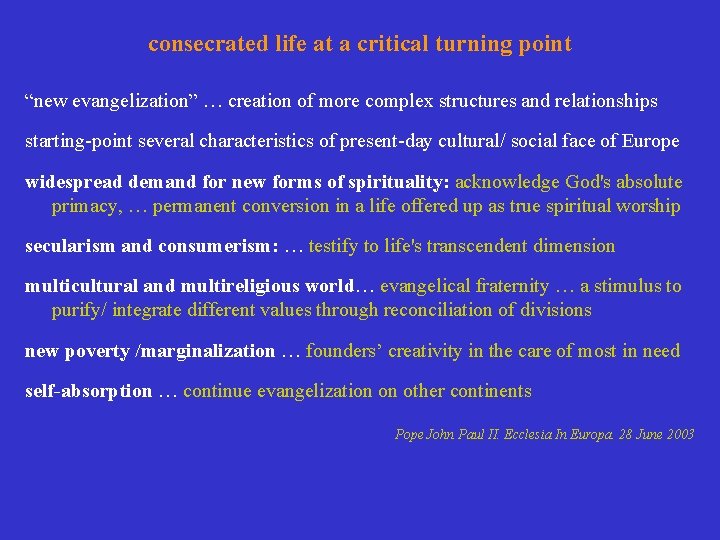
consecrated life at a critical turning point “new evangelization” … creation of more complex structures and relationships starting-point several characteristics of present-day cultural/ social face of Europe widespread demand for new forms of spirituality: acknowledge God's absolute primacy, … permanent conversion in a life offered up as true spiritual worship secularism and consumerism: … testify to life's transcendent dimension multicultural and multireligious world… evangelical fraternity … a stimulus to purify/ integrate different values through reconciliation of divisions new poverty /marginalization … founders’ creativity in the care of most in need self-absorption … continue evangelization on other continents Pope John Paul II. Ecclesia In Europa. 28 June 2003
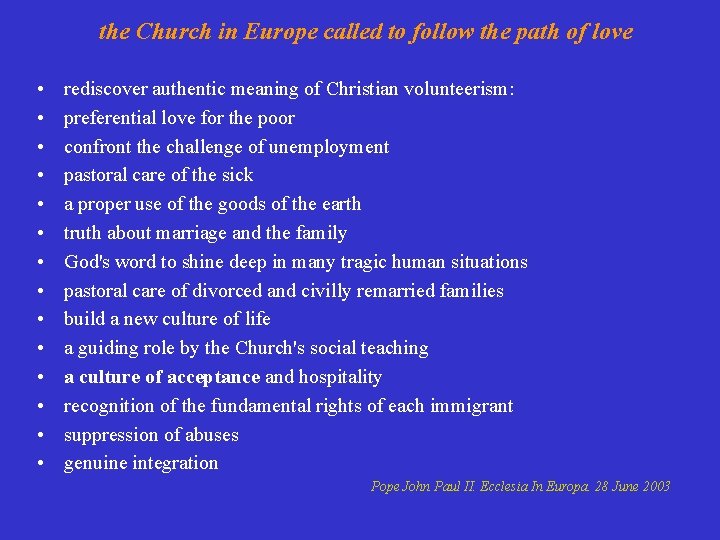
the Church in Europe called to follow the path of love • • • • rediscover authentic meaning of Christian volunteerism: preferential love for the poor confront the challenge of unemployment pastoral care of the sick a proper use of the goods of the earth truth about marriage and the family God's word to shine deep in many tragic human situations pastoral care of divorced and civilly remarried families build a new culture of life a guiding role by the Church's social teaching a culture of acceptance and hospitality recognition of the fundamental rights of each immigrant suppression of abuses genuine integration Pope John Paul II. Ecclesia In Europa. 28 June 2003
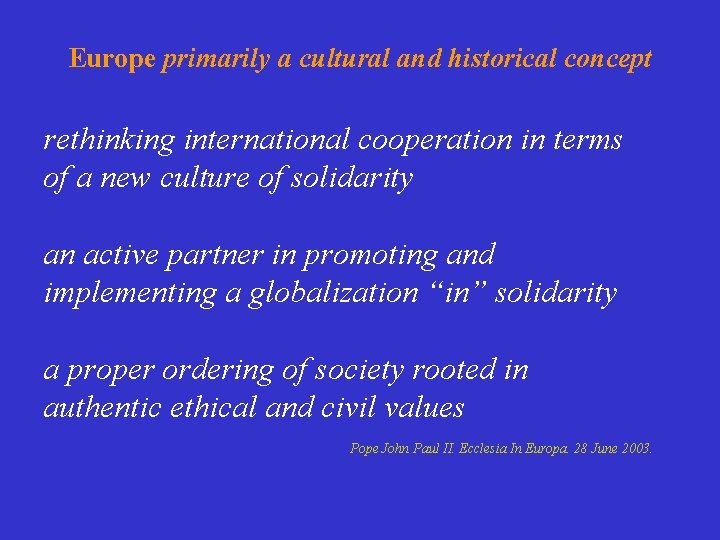
Europe primarily a cultural and historical concept rethinking international cooperation in terms of a new culture of solidarity an active partner in promoting and implementing a globalization “in” solidarity a proper ordering of society rooted in authentic ethical and civil values Pope John Paul II. Ecclesia In Europa. 28 June 2003.
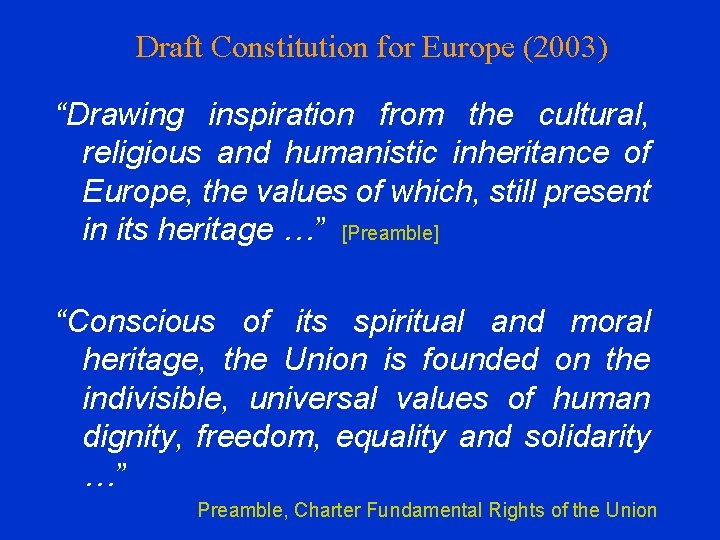
Draft Constitution for Europe (2003) “Drawing inspiration from the cultural, religious and humanistic inheritance of Europe, the values of which, still present in its heritage …” [Preamble] “Conscious of its spiritual and moral heritage, the Union is founded on the indivisible, universal values of human dignity, freedom, equality and solidarity …” Preamble, Charter Fundamental Rights of the Union
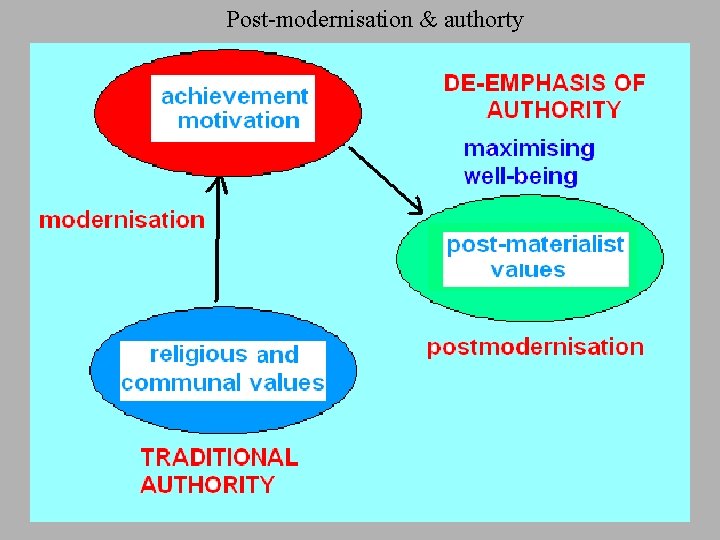
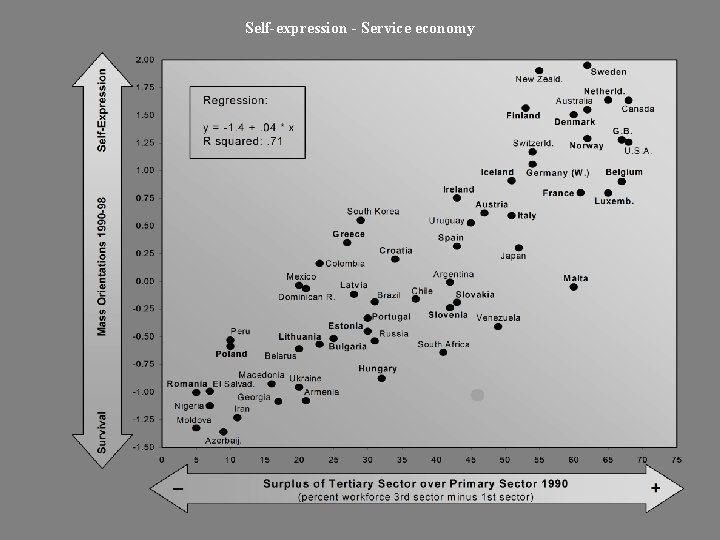
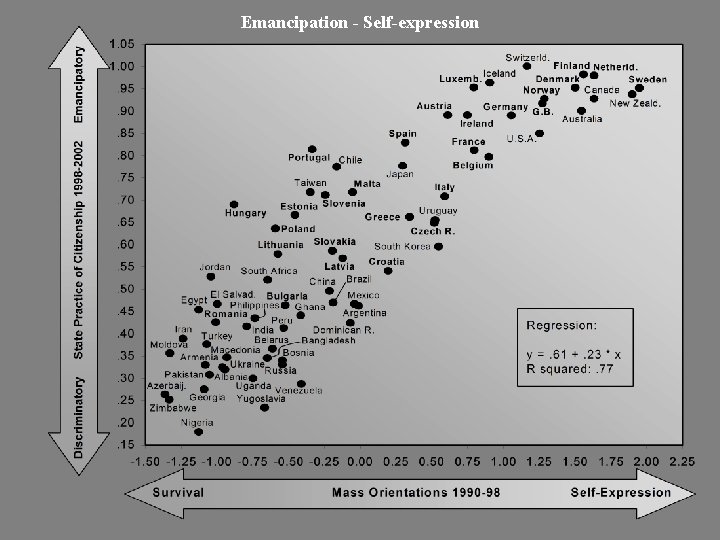
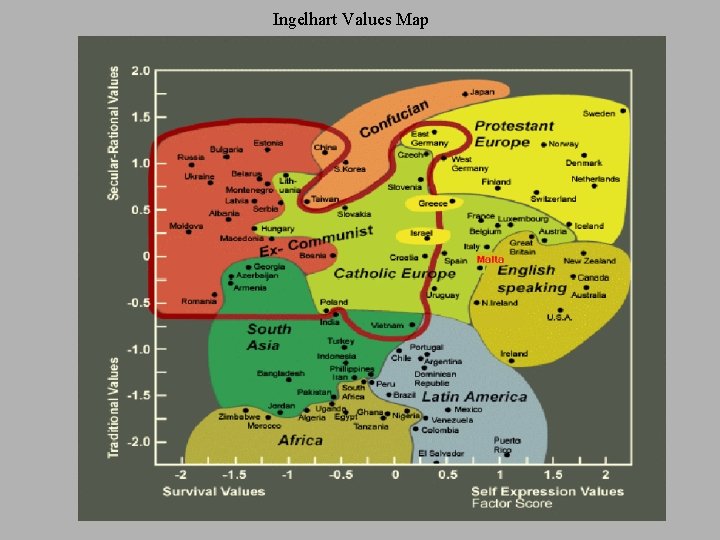
World/European Values Study: culture shifts post-materialism: material security self-expression, participation … individualisation: external authority individual self-direction Two dimensions explain cross-cultural variation: 1. Survival vs self-expression values 2. Traditional vs secular-rational authority
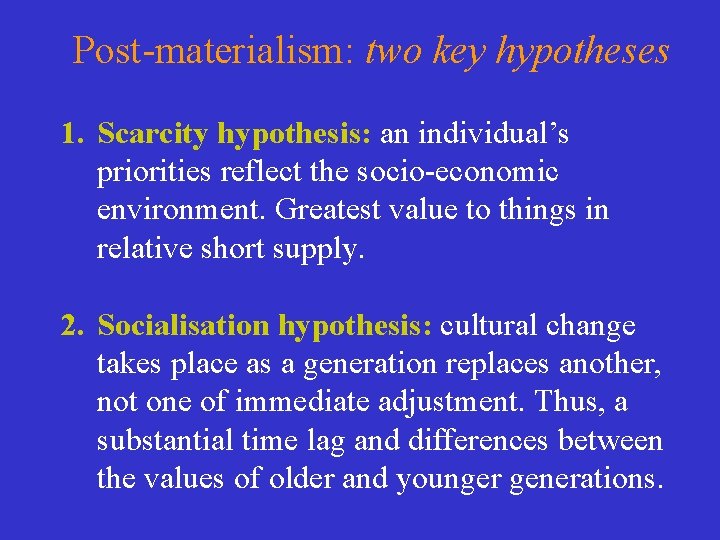
Post-materialism: two key hypotheses 1. Scarcity hypothesis: an individual’s priorities reflect the socio-economic environment. Greatest value to things in relative short supply. 2. Socialisation hypothesis: cultural change takes place as a generation replaces another, not one of immediate adjustment. Thus, a substantial time lag and differences between the values of older and younger generations.
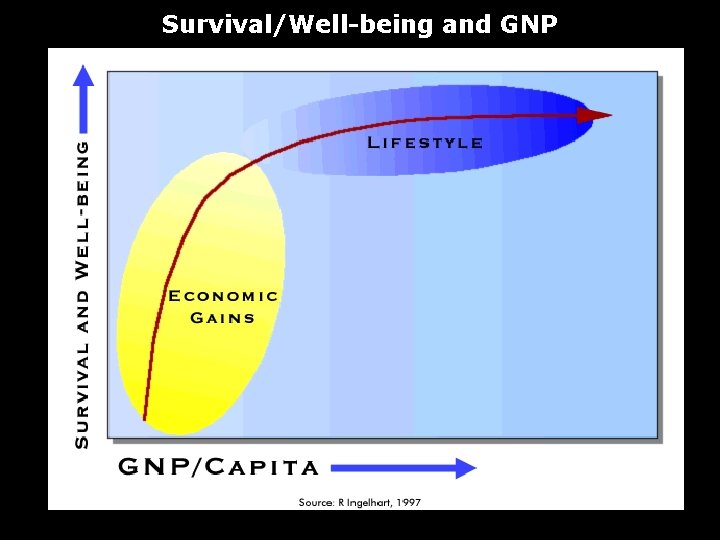
Survival/Well-being and GNP
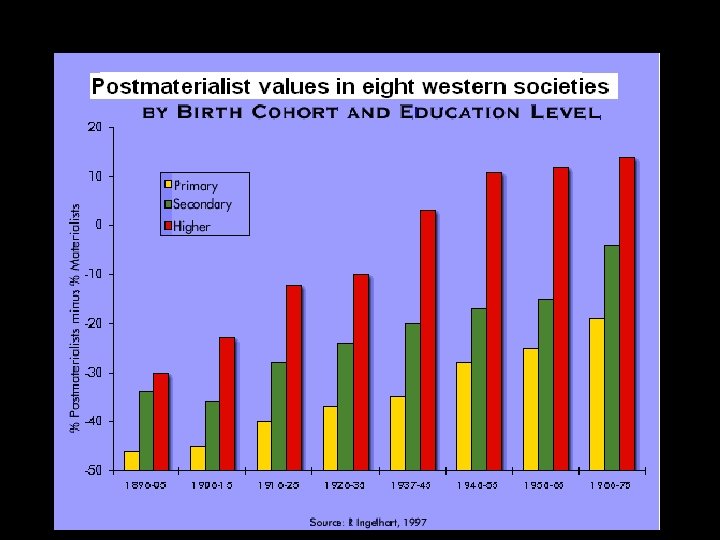
Postmaterialists, age & education
Post-modernisation & authorty
Self-expression - Service economy
Emancipation - Self-expression
Ingelhart Values Map
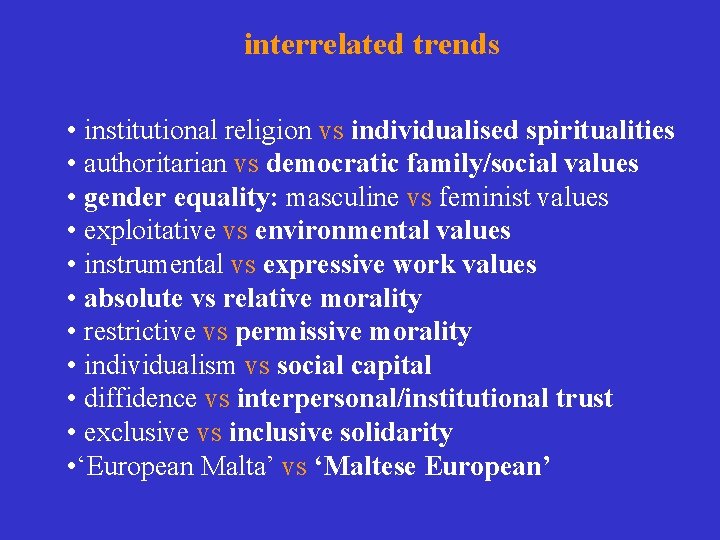
interrelated trends • institutional religion vs individualised spiritualities • authoritarian vs democratic family/social values • gender equality: masculine vs feminist values • exploitative vs environmental values • instrumental vs expressive work values • absolute vs relative morality • restrictive vs permissive morality • individualism vs social capital • diffidence vs interpersonal/institutional trust • exclusive vs inclusive solidarity • ‘European Malta’ vs ‘Maltese European’
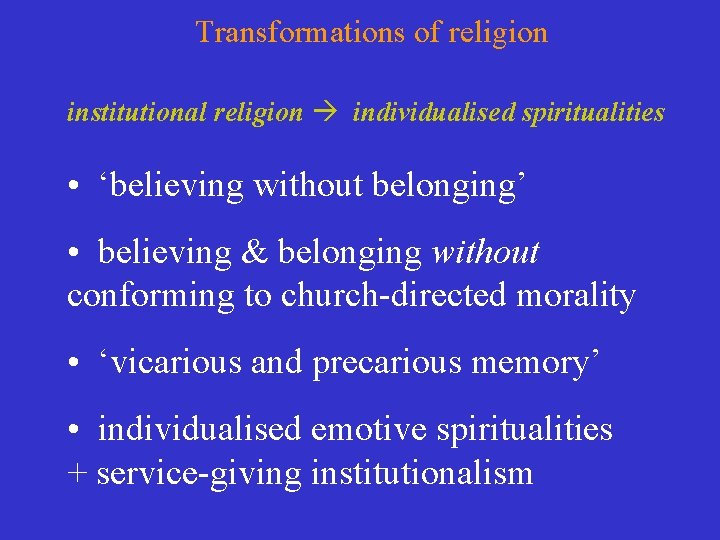
Transformations of religion institutional religion individualised spiritualities • ‘believing without belonging’ • believing & belonging without conforming to church-directed morality • ‘vicarious and precarious memory’ • individualised emotive spiritualities + service-giving institutionalism
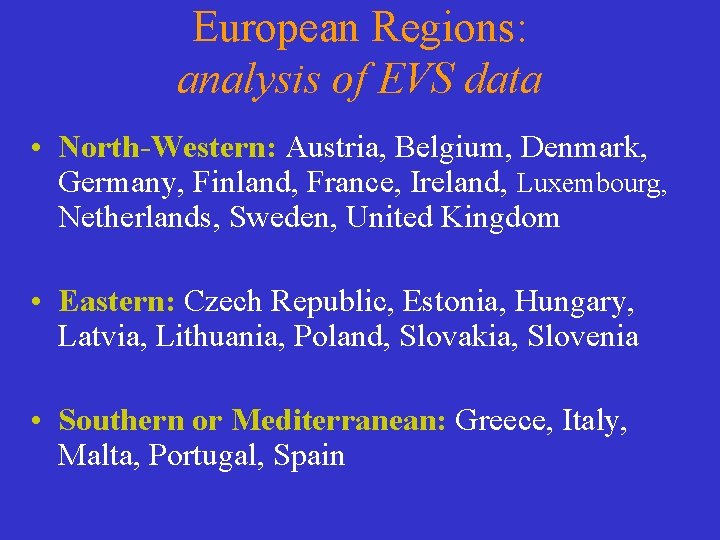
European Regions: analysis of EVS data • North-Western: Austria, Belgium, Denmark, Germany, Finland, France, Ireland, Luxembourg, Netherlands, Sweden, United Kingdom • Eastern: Czech Republic, Estonia, Hungary, Latvia, Lithuania, Poland, Slovakia, Slovenia • Southern or Mediterranean: Greece, Italy, Malta, Portugal, Spain
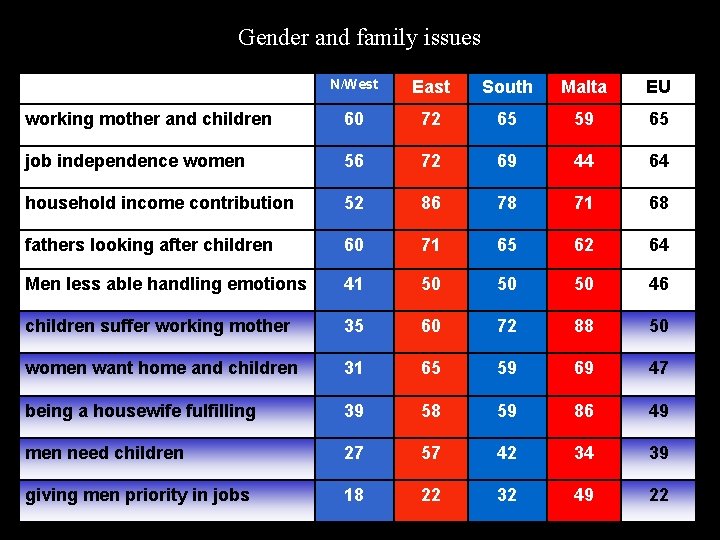
Gender and family issues N/West East South Malta EU working mother and children 60 72 65 59 65 job independence women 56 72 69 44 64 household income contribution 52 86 78 71 68 fathers looking after children 60 71 65 62 64 Men less able handling emotions 41 50 50 50 46 children suffer working mother 35 60 72 88 50 women want home and children 31 65 59 69 47 being a housewife fulfilling 39 58 59 86 49 men need children 27 57 42 34 39 giving men priority in jobs 18 22 32 49 22
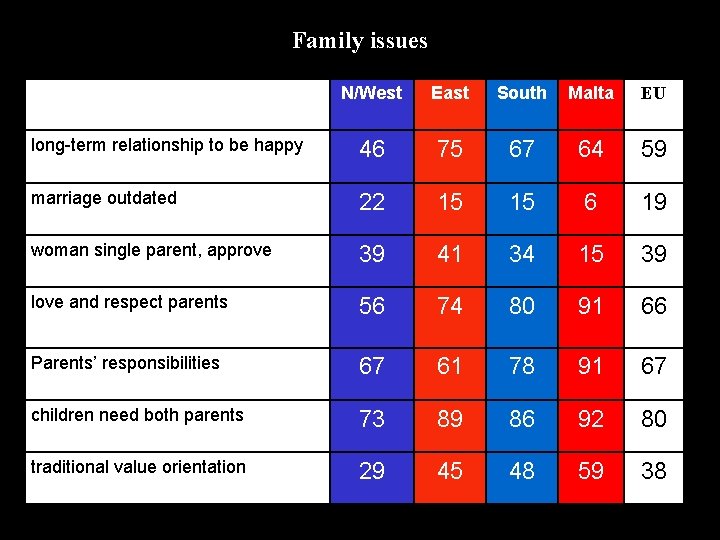
Family issues N/West East South Malta EU long-term relationship to be happy 46 75 67 64 59 marriage outdated 22 15 15 6 19 woman single parent, approve 39 41 34 15 39 love and respect parents 56 74 80 91 66 Parents’ responsibilities 67 61 78 91 67 children need both parents 73 89 86 92 80 traditional value orientation 29 45 48 59 38
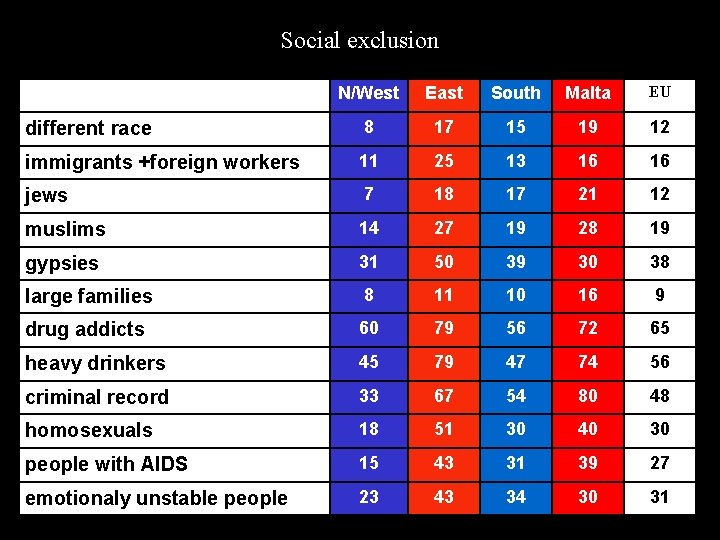
Social exclusion N/West East South Malta EU different race 8 17 15 19 12 immigrants +foreign workers 11 25 13 16 16 jews 7 18 17 21 12 muslims 14 27 19 28 19 gypsies 31 50 39 30 38 large families 8 11 10 16 9 drug addicts 60 79 56 72 65 heavy drinkers 45 79 47 74 56 criminal record 33 67 54 80 48 homosexuals 18 51 30 40 30 people with AIDS 15 43 31 39 27 emotionaly unstable people 23 43 34 30 31
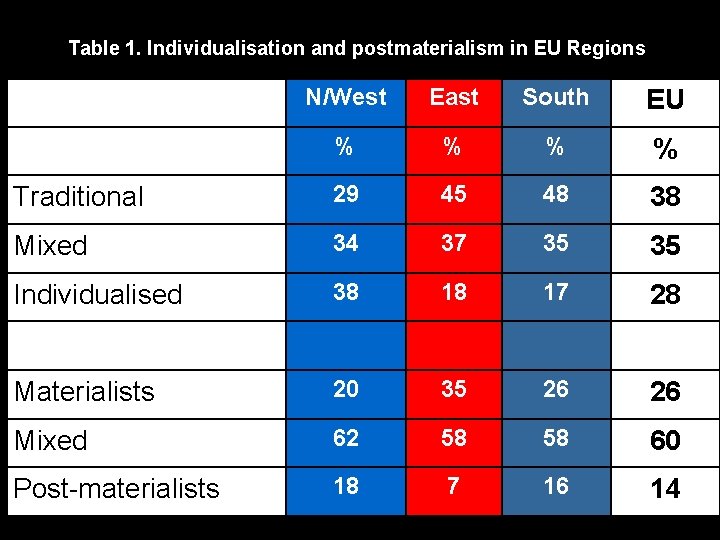
Table 1. Individualisation and postmaterialism in EU Regions N/West East South EU % % Traditional 29 45 48 38 Mixed 34 37 35 35 Individualised 38 18 17 28 Materialists 20 35 26 26 Mixed 62 58 58 60 Post-materialists 18 7 16 14
Religion-Society relationship three ideal types 1) paleo-Durkheimian: church co-extensive with society 2) neo-Durkheimian: political entity to carry out God’s design 3) post-Durkheimian: expressive spiritualities dissociated from society (Charles Taylor 2002)
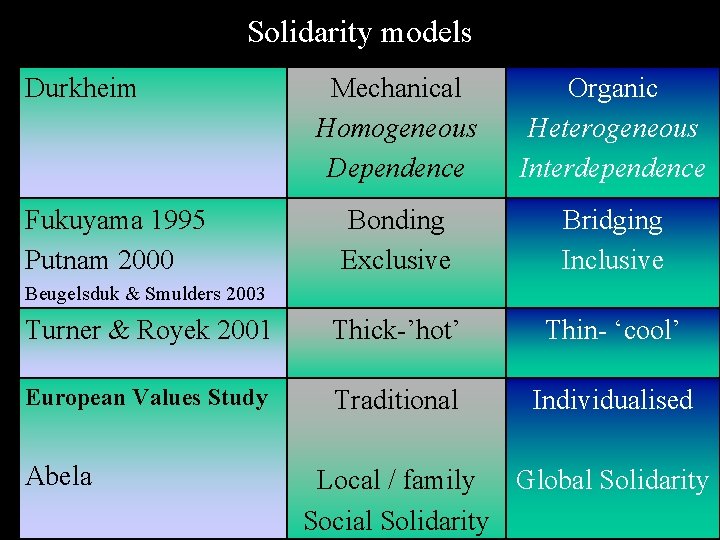
Solidarity models Durkheim Mechanical Homogeneous Dependence Organic Heterogeneous Interdependence Bonding Exclusive Bridging Inclusive Turner & Royek 2001 Thick-’hot’ Thin- ‘cool’ European Values Study Traditional Individualised Fukuyama 1995 Putnam 2000 Beugelsduk & Smulders 2003 Abela Local / family Global Solidarity Social Solidarity
Table 2 a. Institutional Religion in EU Regions Belong to church/ religion Religious service birth Religious service marriage Religious service death Confidence in church - Individual/moral problems - family life - social problems - spiritual needs N/West East South % 67 64 67 75 43 31 27 22 49 % 62 68 68 75 49 42 39 22 61 % 90 82 85 88 66 50 45 37 65 EU % 70 69 71 77 50 38 34 25 56
Table 2 b. Religious Belief in EU Regions N/West East South EU % % Belief in God 66 64 90 70 Belief in life after death 43 41 53 44 Belief in hell 23 27 44 28 Belief in heaven 39 33 56 41 Belief in sin 46 58 69 54 Belief in telepathy 34 40 30 35 Belief in reincarnation 16 21 17 18
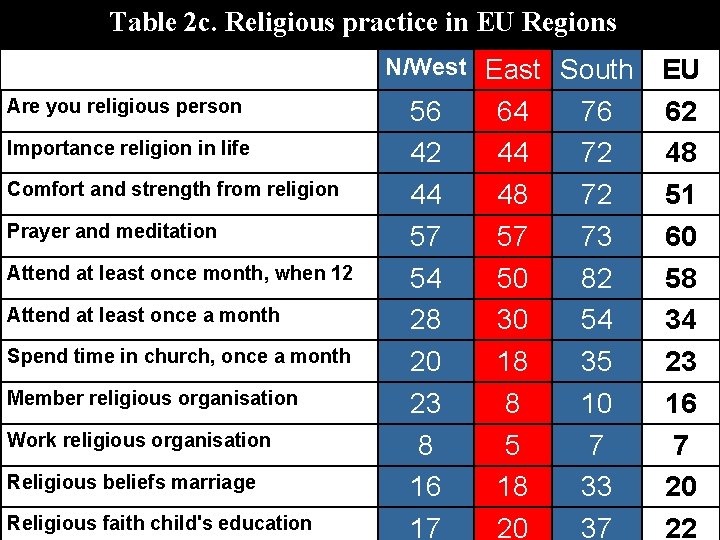
Table 2 c. Religious practice in EU Regions Are you religious person Importance religion in life Comfort and strength from religion Prayer and meditation Attend at least once month, when 12 Attend at least once a month Spend time in church, once a month Member religious organisation Work religious organisation Religious beliefs marriage Religious faith child's education N/West East South 56 42 44 57 54 28 20 23 8 16 17 64 44 48 57 50 30 18 8 5 18 20 76 72 72 73 82 54 35 10 7 33 37 EU 62 48 51 60 58 34 23 16 7 20 22
Table 3. Religion and Generations Belong to church / religion Attend at least once month, when 12 Attend at least once a month Confidence in church - Individual needs & moral problems - family life - social problems - spiritual needs Prayer and meditation Are you religious person Comfort and strength from religion Importance religion in life Pre. WW 2 Post 1960 s EU 78 70 69 58 65 50 70 59 46 62 49 44 33 63 70 73 64 62 32 46 35 31 23 54 59 61 49 45 25 41 30 27 19 51 53 53 40 38 34 50 38 34 25 56 60 62 51 48
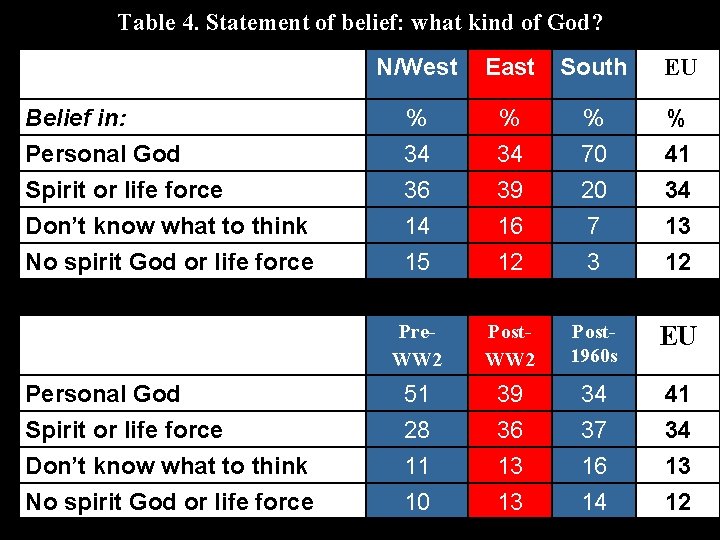
Table 4. Statement of belief: what kind of God? N/West East South EU Belief in: Personal God Spirit or life force % 34 36 % 34 39 % 70 20 % 41 34 Don’t know what to think No spirit God or life force 14 15 16 12 7 3 13 12 Pre. WW 2 Post 1960 s EU 51 28 11 10 39 36 13 13 34 37 16 14 41 34 13 12 Personal God Spirit or life force Don’t know what to think No spirit God or life force
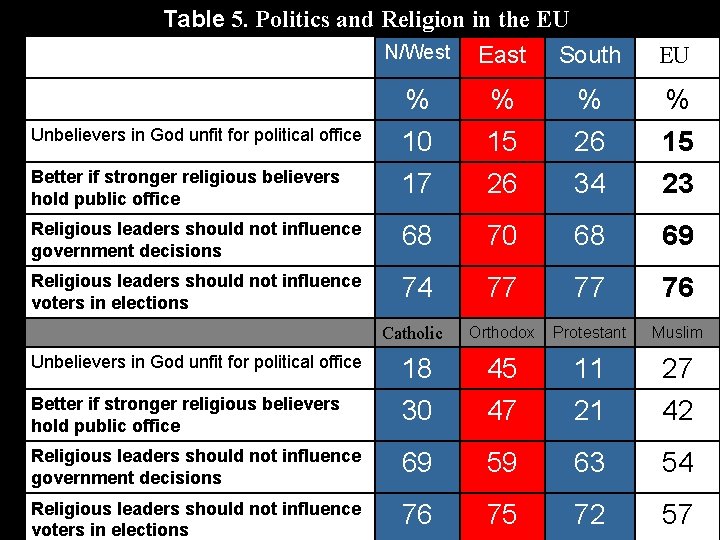
Table 5. Politics and Religion in the EU N/West East South EU % 10 % 15 % 26 % 15 Better if stronger religious believers hold public office 17 26 34 23 Religious leaders should not influence government decisions 68 70 68 69 Religious leaders should not influence voters in elections 74 77 77 76 Catholic Orthodox Protestant Muslim Unbelievers in God unfit for political office 18 45 11 27 Better if stronger religious believers hold public office 30 47 21 42 Religious leaders should not influence government decisions 69 59 63 54 Religious leaders should not influence voters in elections 76 75 72 57 Unbelievers in God unfit for political office
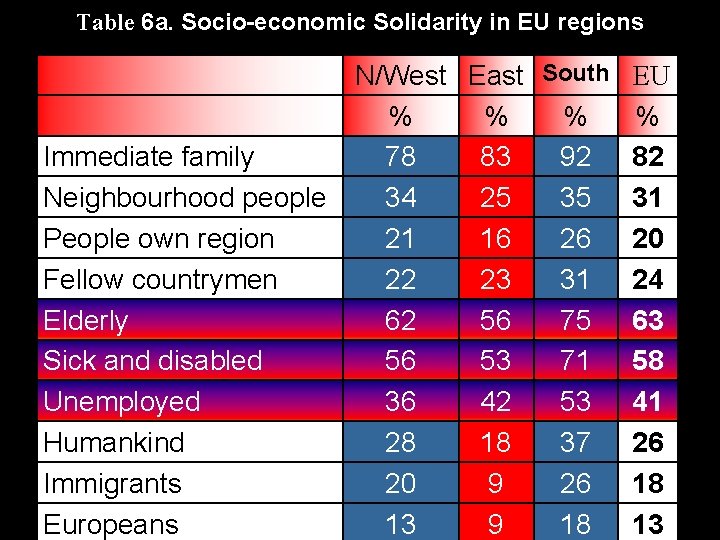
Table 6 a. Socio-economic Solidarity in EU regions Immediate family Neighbourhood people People own region Fellow countrymen Elderly Sick and disabled Unemployed Humankind Immigrants Europeans N/West East South EU % % 78 83 92 82 34 25 35 31 21 16 26 20 22 23 31 24 62 56 75 63 56 53 71 58 36 42 53 41 28 18 37 26 20 9 26 18 13 9 18 13
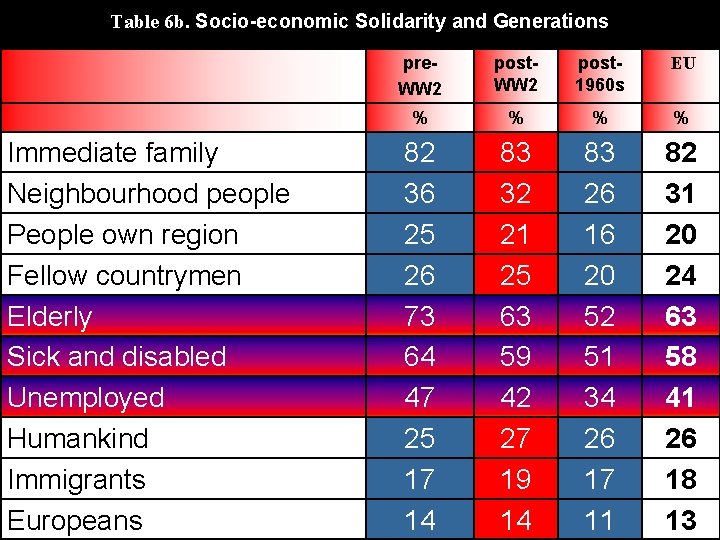
Table 6 b. Socio-economic Solidarity and Generations pre. WW 2 post 1960 s EU % % 82 36 25 26 73 64 47 25 17 14 83 32 21 25 63 59 42 27 19 14 83 26 16 20 52 51 34 26 17 11 82 31 20 24 63 58 41 26 18 13 Immediate family Neighbourhood people People own region Fellow countrymen Elderly Sick and disabled Unemployed Humankind Immigrants Europeans
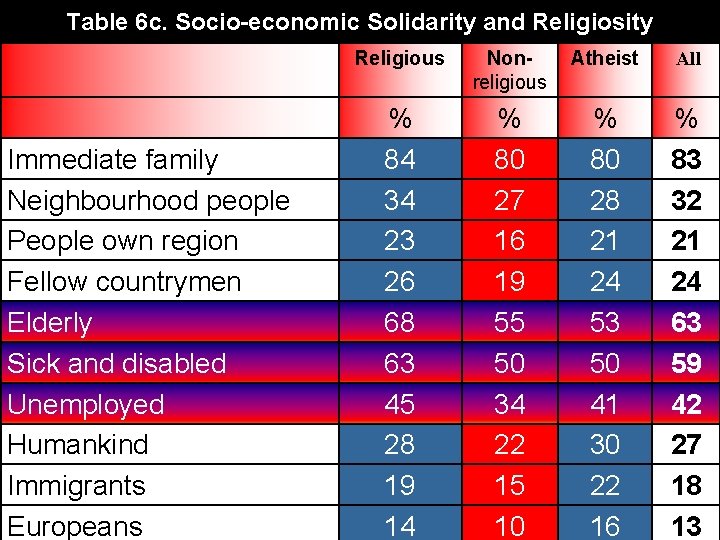
Table 6 c. Socio-economic Solidarity and Religiosity Immediate family Neighbourhood people People own region Fellow countrymen Elderly Sick and disabled Unemployed Humankind Immigrants Europeans Religious Nonreligious Atheist All % 84 34 23 26 68 63 45 28 19 14 % 80 27 16 19 55 50 34 22 15 10 % 80 28 21 24 53 50 41 30 22 16 % 83 32 21 24 63 59 42 27 18 13
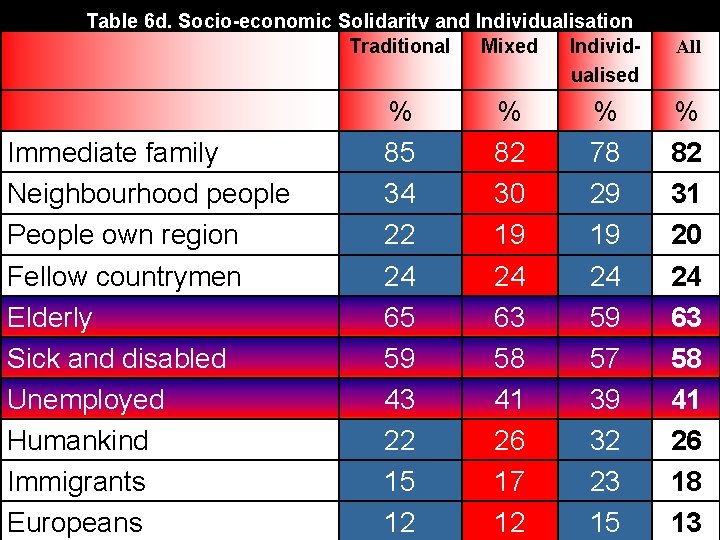
Table 6 d. Socio-economic Solidarity and Individualisation Traditional Mixed Individualised Immediate family Neighbourhood people People own region Fellow countrymen Elderly Sick and disabled Unemployed Humankind Immigrants Europeans % 85 34 22 24 65 59 43 22 15 12 % 82 30 19 24 63 58 41 26 17 12 % 78 29 19 24 59 57 39 32 23 15 All % 82 31 20 24 63 58 41 26 18 13
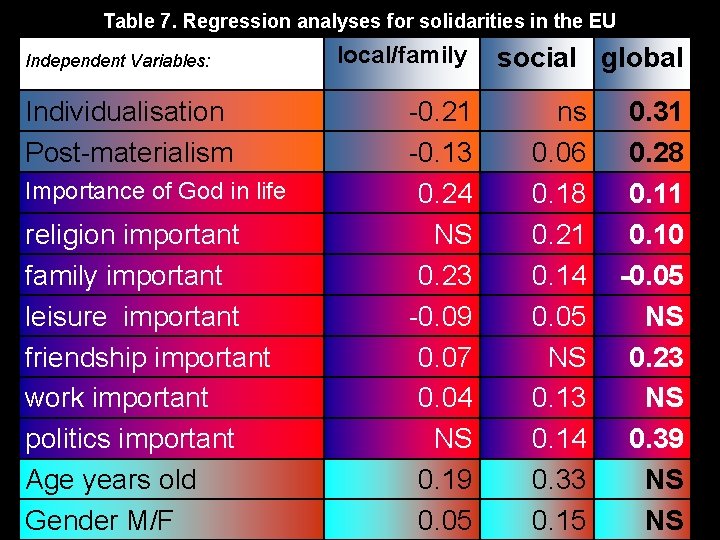
Table 7. Regression analyses for solidarities in the EU Independent Variables: Individualisation Post-materialism Importance of God in life religion important family important leisure important friendship important work important politics important Age years old Gender M/F local/family -0. 21 -0. 13 0. 24 NS 0. 23 -0. 09 0. 07 0. 04 NS 0. 19 0. 05 social global ns 0. 06 0. 18 0. 21 0. 14 0. 05 NS 0. 13 0. 14 0. 33 0. 15 0. 31 0. 28 0. 11 0. 10 -0. 05 NS 0. 23 NS 0. 39 NS NS
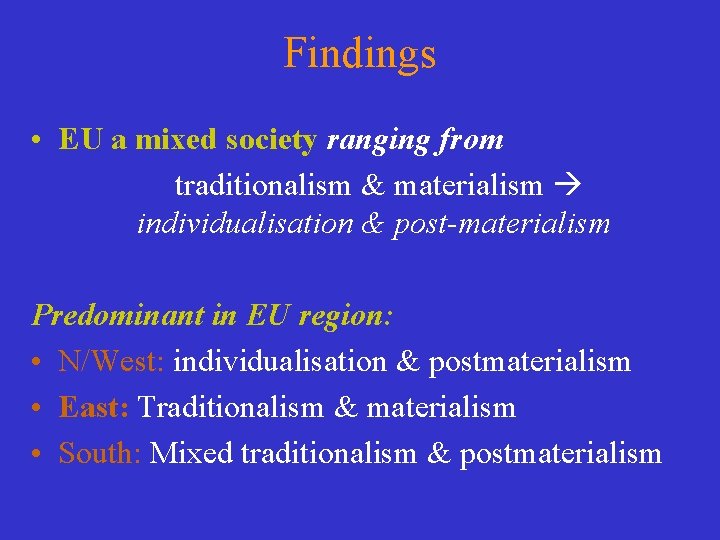
Findings • EU a mixed society ranging from traditionalism & materialism individualisation & post-materialism Predominant in EU region: • N/West: individualisation & postmaterialism • East: Traditionalism & materialism • South: Mixed traditionalism & postmaterialism
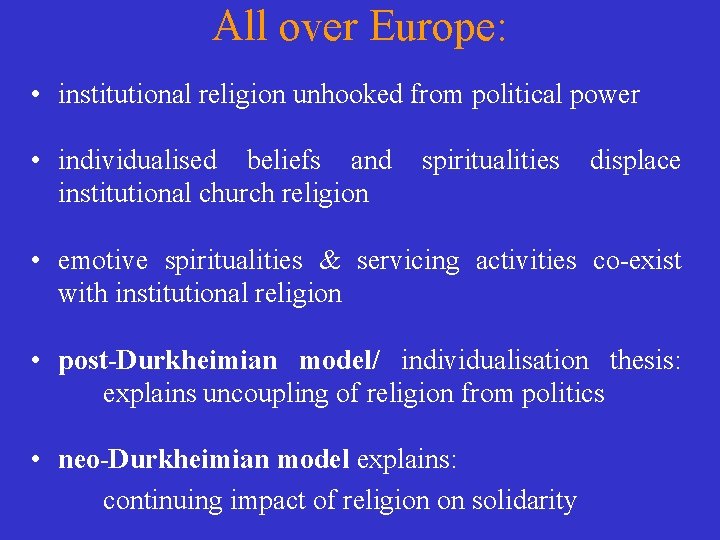
All over Europe: • institutional religion unhooked from political power • individualised beliefs and spiritualities displace institutional church religion • emotive spiritualities & servicing activities co-exist with institutional religion • post-Durkheimian model/ individualisation thesis: explains uncoupling of religion from politics • neo-Durkheimian model explains: continuing impact of religion on solidarity
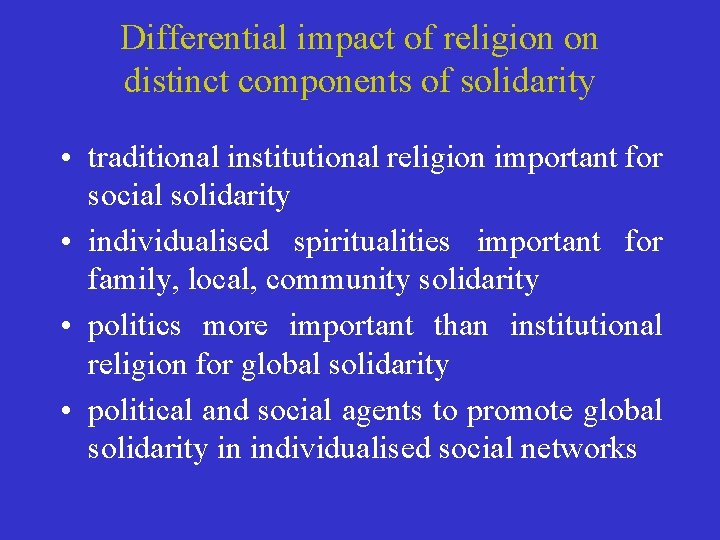
Differential impact of religion on distinct components of solidarity • traditional institutional religion important for social solidarity • individualised spiritualities important for family, local, community solidarity • politics more important than institutional religion for global solidarity • political and social agents to promote global solidarity in individualised social networks