
Trends and Economic Impacts of Food Beverage Manufacturing
Trends and Economic Impacts of Food & Beverage Manufacturing In NYS Todd M. Schmit, Associate Professor Charles H. Dyson School of Applied Economics and Management Agricultural and Food Business Outlook January 10, 2017
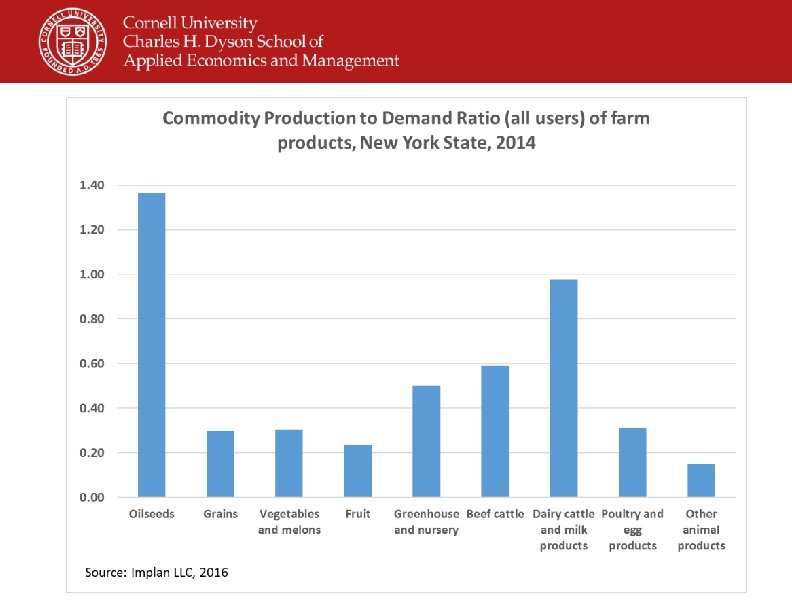
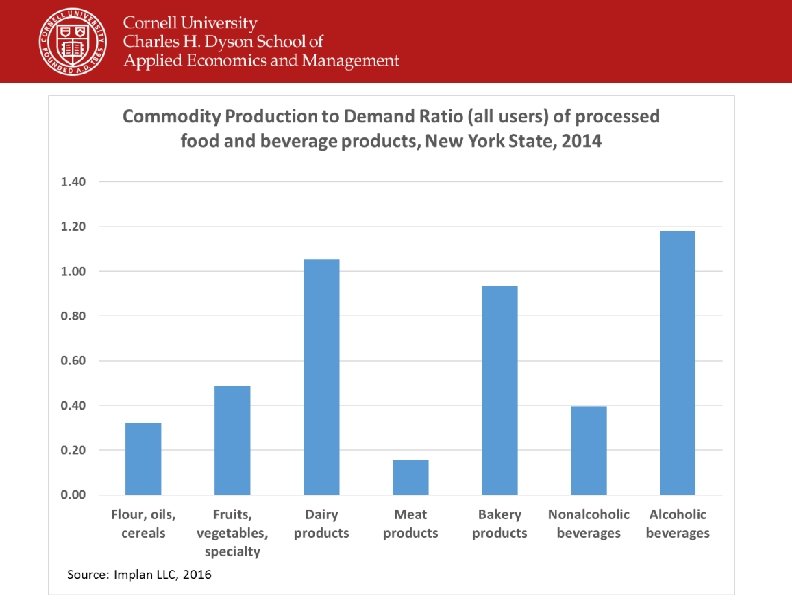
Outline • Where are we now? Economic contribution analysis • Where have we been? Trends and industry comparisons • Backward linkages: economic multipliers • Forward linkages: commodity destination, supply to demand ratios
Agriculture Contribution Analysis 2014 • How define “agriculture”? Focus on ag and food production. • What’s there? What isn’t (data limitations)? • NYS is a big economy (hint: NYC). • Variation and importance across local regions • Implications of marginal changes; i. e. , next dollar of investment
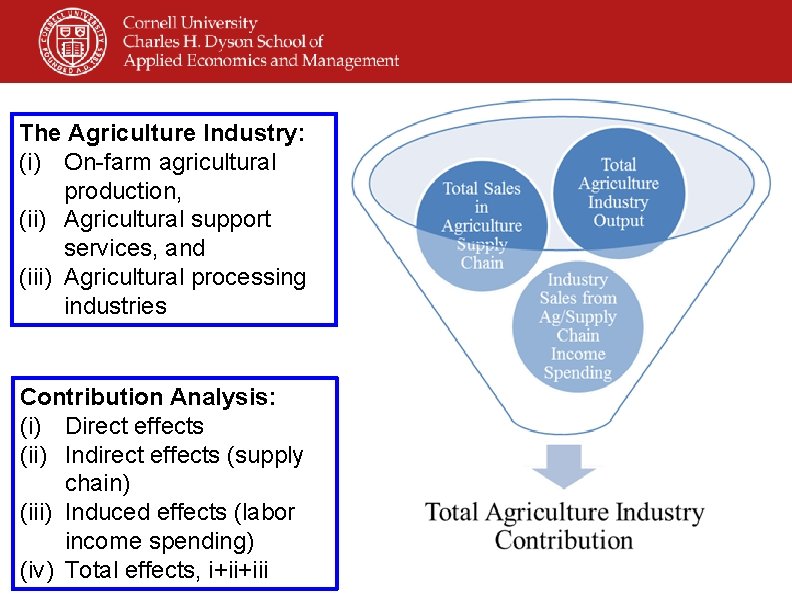
The Agriculture Industry: (i) On-farm agricultural production, (ii) Agricultural support services, and (iii) Agricultural processing industries Contribution Analysis: (i) Direct effects (ii) Indirect effects (supply chain) (iii) Induced effects (labor income spending) (iv) Total effects, i+ii+iii
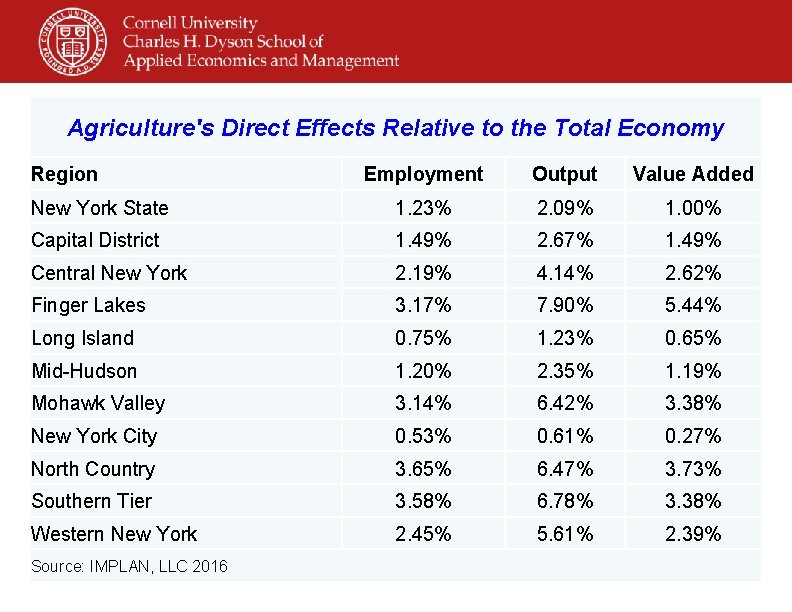
Agriculture's Direct Effects Relative to the Total Economy Region Employment Output Value Added New York State 1. 23% 2. 09% 1. 00% Capital District 1. 49% 2. 67% 1. 49% Central New York 2. 19% 4. 14% 2. 62% Finger Lakes 3. 17% 7. 90% 5. 44% Long Island 0. 75% 1. 23% 0. 65% Mid-Hudson 1. 20% 2. 35% 1. 19% Mohawk Valley 3. 14% 6. 42% 3. 38% New York City 0. 53% 0. 61% 0. 27% North Country 3. 65% 6. 47% 3. 73% Southern Tier 3. 58% 6. 78% 3. 38% Western New York 2. 45% 5. 61% 2. 39% Source: IMPLAN, LLC 2016
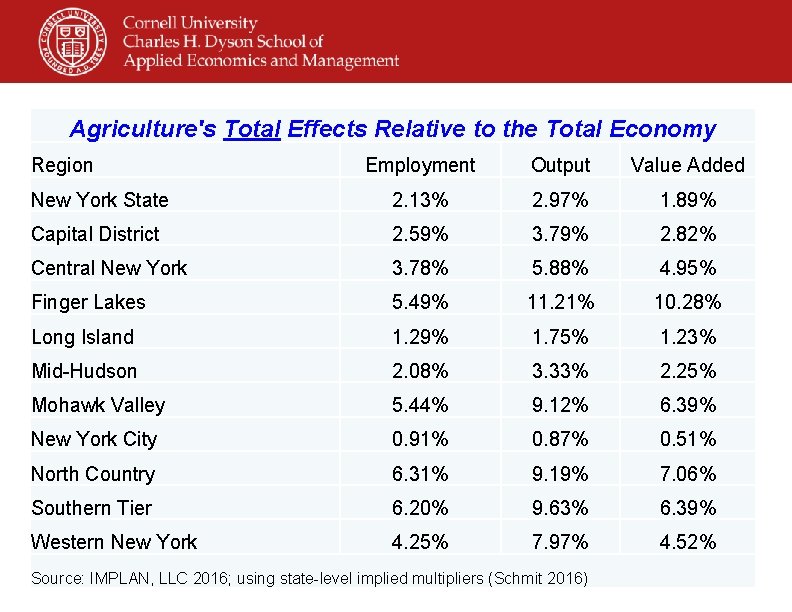
Agriculture's Total Effects Relative to the Total Economy Region Employment Output Value Added New York State 2. 13% 2. 97% 1. 89% Capital District 2. 59% 3. 79% 2. 82% Central New York 3. 78% 5. 88% 4. 95% Finger Lakes 5. 49% 11. 21% 10. 28% Long Island 1. 29% 1. 75% 1. 23% Mid-Hudson 2. 08% 3. 33% 2. 25% Mohawk Valley 5. 44% 9. 12% 6. 39% New York City 0. 91% 0. 87% 0. 51% North Country 6. 31% 9. 19% 7. 06% Southern Tier 6. 20% 9. 63% 6. 39% Western New York 4. 25% 7. 97% 4. 52% Source: IMPLAN, LLC 2016; using state-level implied multipliers (Schmit 2016)
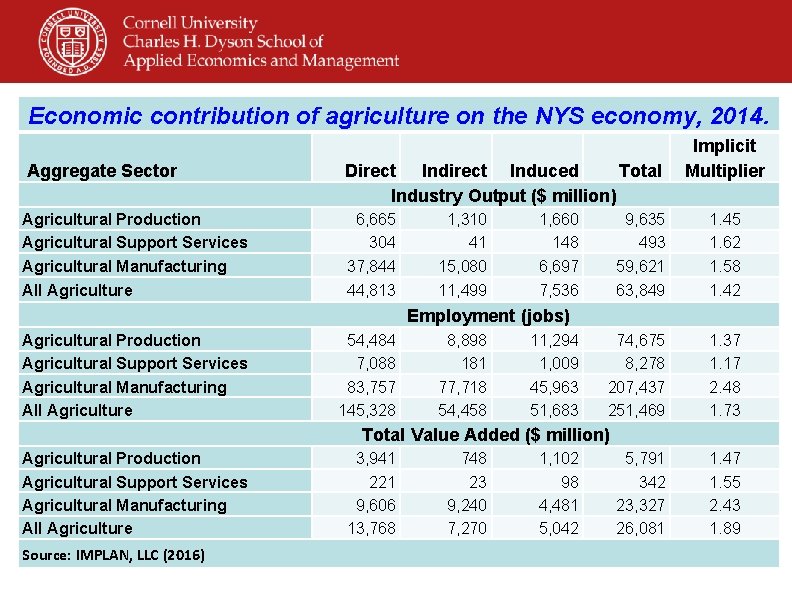
Economic contribution of agriculture on the NYS economy, 2014. Aggregate Sector Direct Induced Total Industry Output ($ million) Implicit Multiplier Agricultural Production Agricultural Support Services Agricultural Manufacturing 6, 665 304 37, 844 1, 310 41 15, 080 1, 660 148 6, 697 9, 635 493 59, 621 1. 45 1. 62 1. 58 All Agriculture 44, 813 11, 499 7, 536 63, 849 1. 42 74, 675 8, 278 207, 437 251, 469 1. 37 1. 17 2. 48 1. 73 Employment (jobs) Agricultural Production Agricultural Support Services Agricultural Manufacturing All Agriculture 54, 484 7, 088 83, 757 145, 328 8, 898 181 77, 718 54, 458 11, 294 1, 009 45, 963 51, 683 Total Value Added ($ million) Agricultural Production Agricultural Support Services Agricultural Manufacturing All Agriculture Source: IMPLAN, LLC (2016) 3, 941 221 9, 606 13, 768 748 23 9, 240 7, 270 1, 102 98 4, 481 5, 042 5, 791 342 23, 327 26, 081 1. 47 1. 55 2. 43 1. 89
Industry Trends in Food and Agriculture
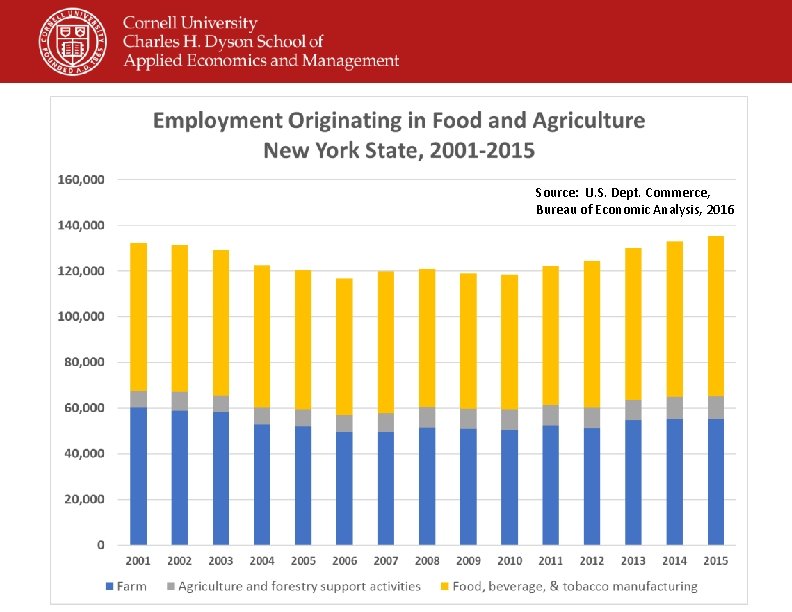
• sfdg Source: U. S. Dept. Commerce, Bureau of Economic Analysis, 2016
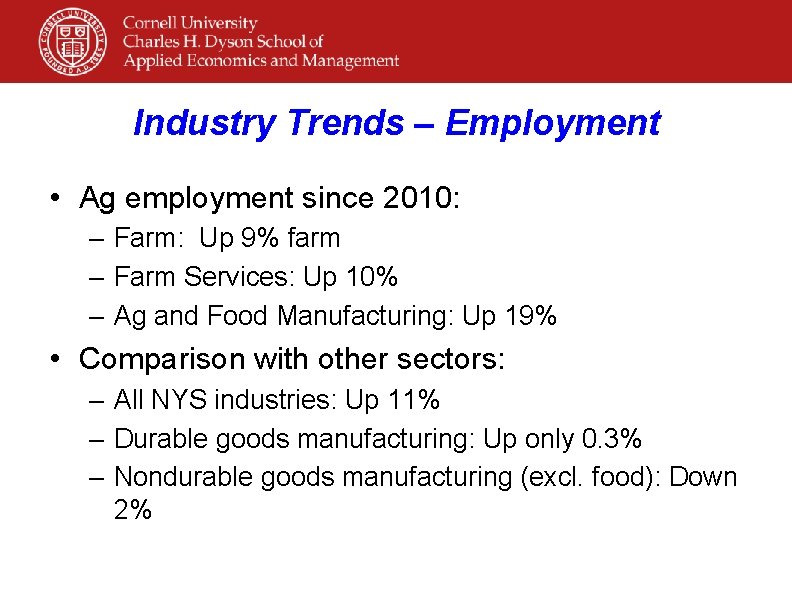
Industry Trends – Employment • Ag employment since 2010: – Farm: Up 9% farm – Farm Services: Up 10% – Ag and Food Manufacturing: Up 19% • Comparison with other sectors: – All NYS industries: Up 11% – Durable goods manufacturing: Up only 0. 3% – Nondurable goods manufacturing (excl. food): Down 2%
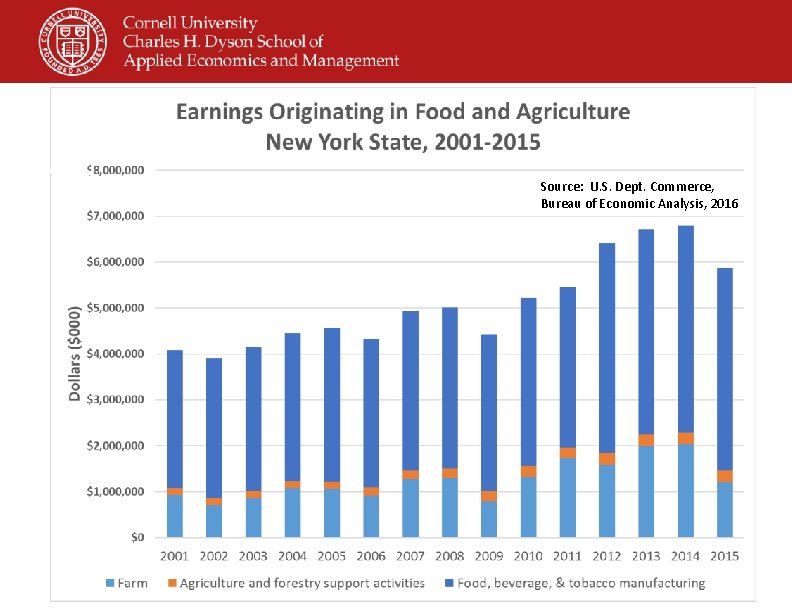
• sfdg Source: U. S. Dept. Commerce, Bureau of Economic Analysis, 2016
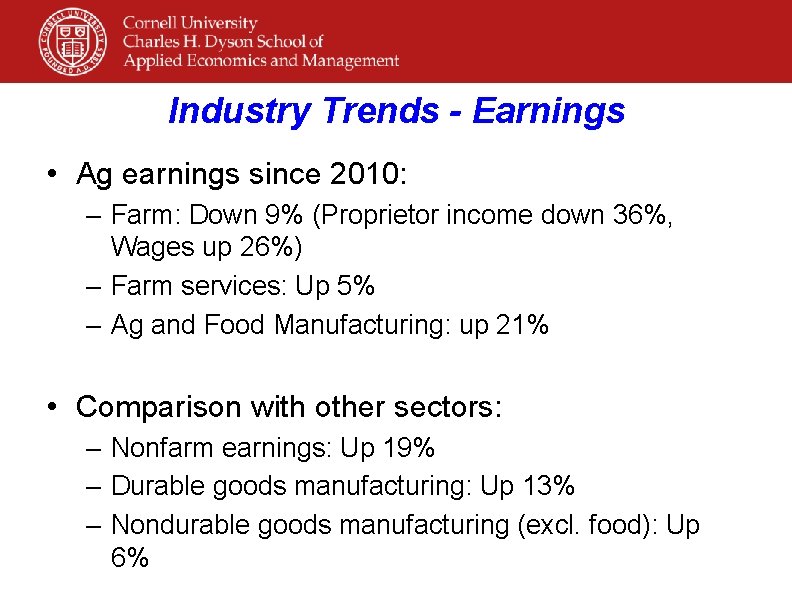
Industry Trends - Earnings • Ag earnings since 2010: – Farm: Down 9% (Proprietor income down 36%, Wages up 26%) – Farm services: Up 5% – Ag and Food Manufacturing: up 21% • Comparison with other sectors: – Nonfarm earnings: Up 19% – Durable goods manufacturing: Up 13% – Nondurable goods manufacturing (excl. food): Up 6%
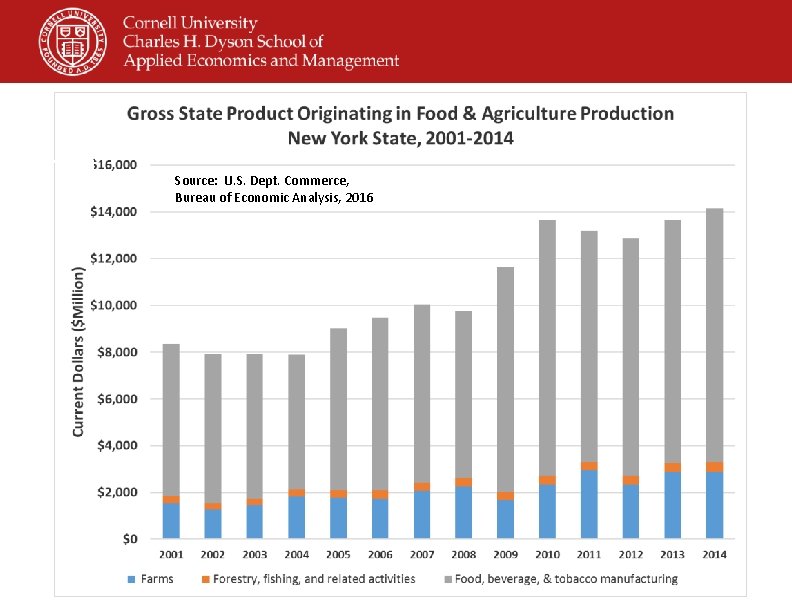
• sfdg Source: U. S. Dept. Commerce, Bureau of Economic Analysis, 2016
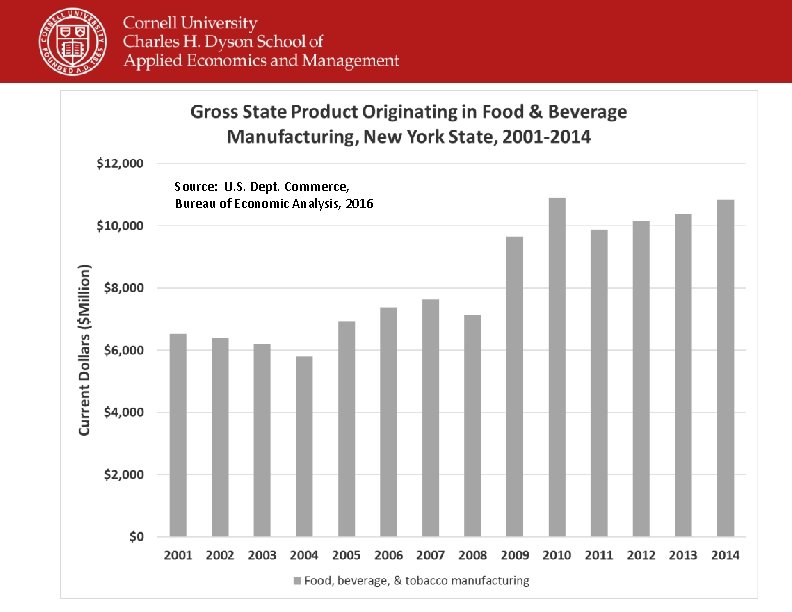
• sfdg Source: U. S. Dept. Commerce, Bureau of Economic Analysis, 2016
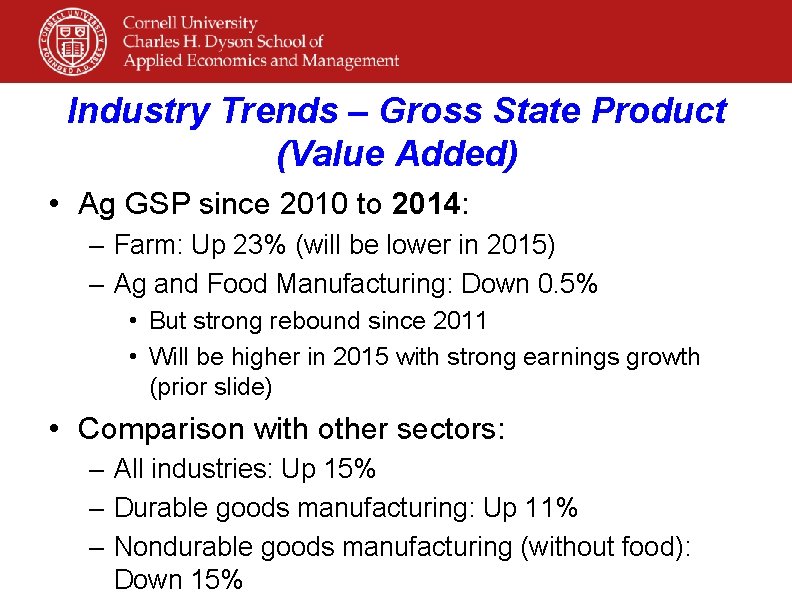
Industry Trends – Gross State Product (Value Added) • Ag GSP since 2010 to 2014: – Farm: Up 23% (will be lower in 2015) – Ag and Food Manufacturing: Down 0. 5% • But strong rebound since 2011 • Will be higher in 2015 with strong earnings growth (prior slide) • Comparison with other sectors: – All industries: Up 15% – Durable goods manufacturing: Up 11% – Nondurable goods manufacturing (without food): Down 15%
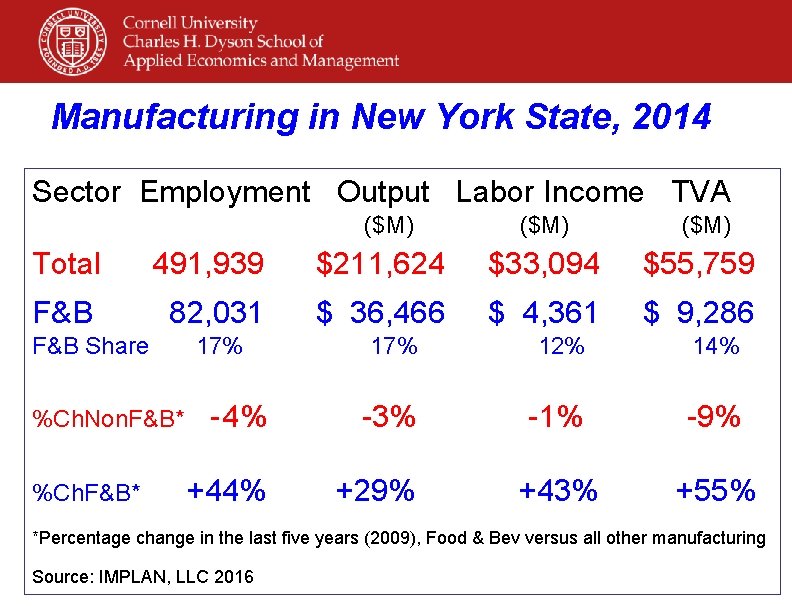
Manufacturing in New York State, 2014 Sector Employment Output Labor Income TVA ($M) Total 491, 939 $211, 624 $33, 094 $55, 759 F&B 82, 031 $ 36, 466 $ 4, 361 $ 9, 286 F&B Share %Ch. Non. F&B* %Ch. F&B* 17% 12% 14% -3% -1% -9% +44% +29% +43% +55% *Percentage change in the last five years (2009), Food & Bev versus all other manufacturing Source: IMPLAN, LLC 2016
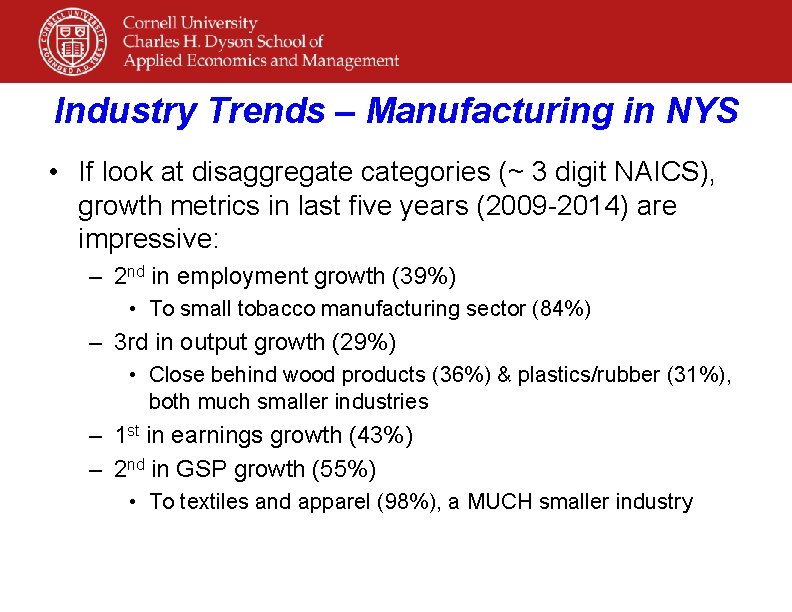
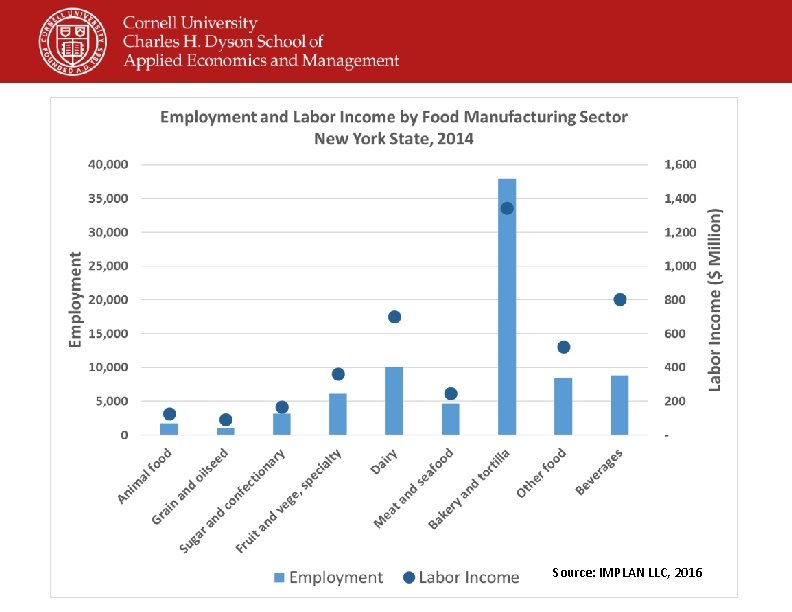
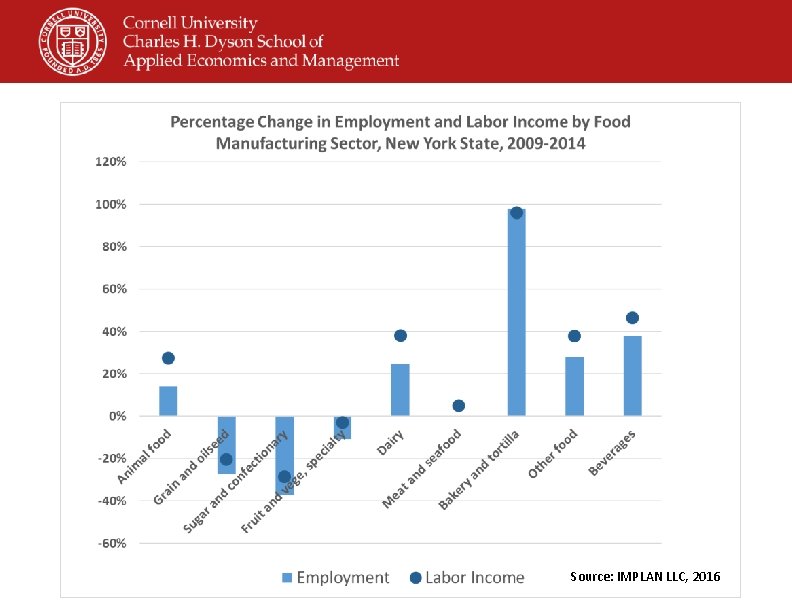
Industry Trends – Manufacturing in NYS • If look at disaggregate categories (~ 3 digit NAICS), growth metrics in last five years (2009 -2014) are impressive: – 2 nd in employment growth (39%) • To small tobacco manufacturing sector (84%) – 3 rd in output growth (29%) • Close behind wood products (36%) & plastics/rubber (31%), both much smaller industries – 1 st in earnings growth (43%) – 2 nd in GSP growth (55%) • To textiles and apparel (98%), a MUCH smaller industry
Subsector Trends in Food and Beverage Manufacturing
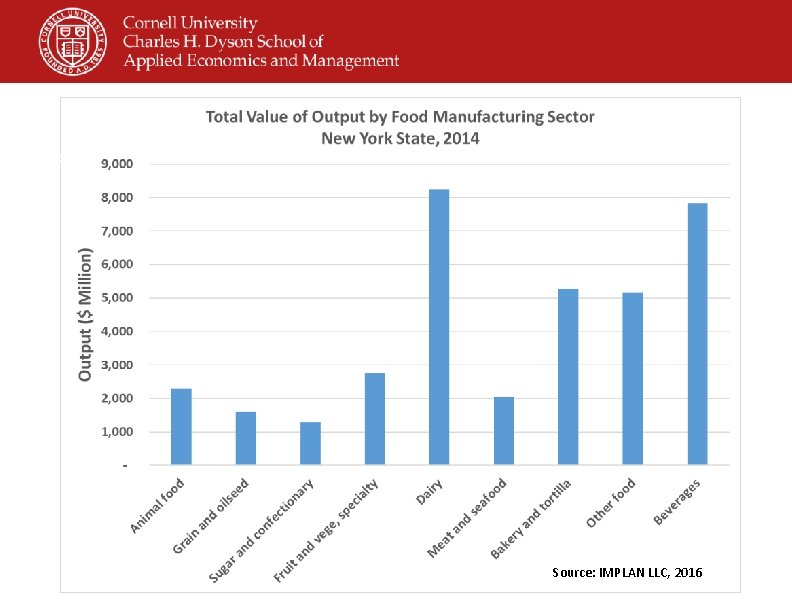
• sfdg Source: IMPLAN LLC, 2016
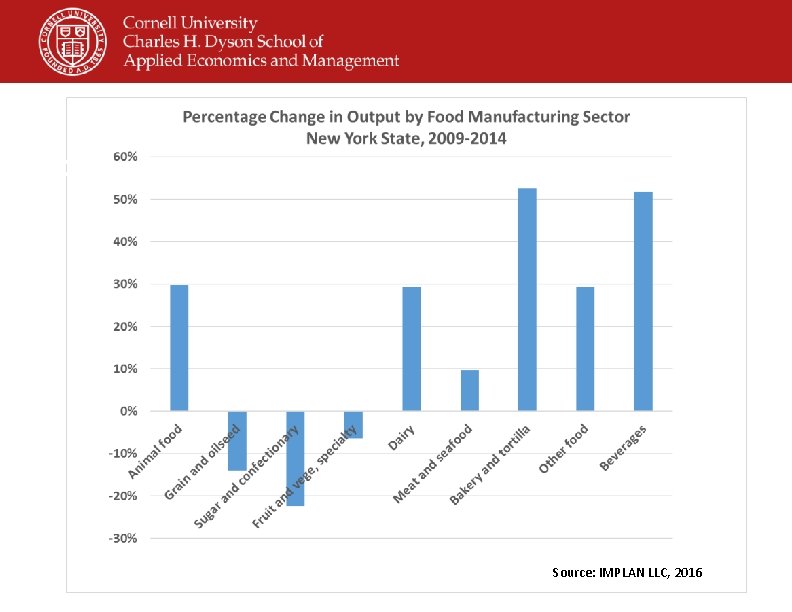
• sfdg Source: IMPLAN LLC, 2016
• sfdg Source: IMPLAN LLC, 2016
Source: IMPLAN LLC, 2016
Economic Multipliers in Food and Beverage Manufacturing
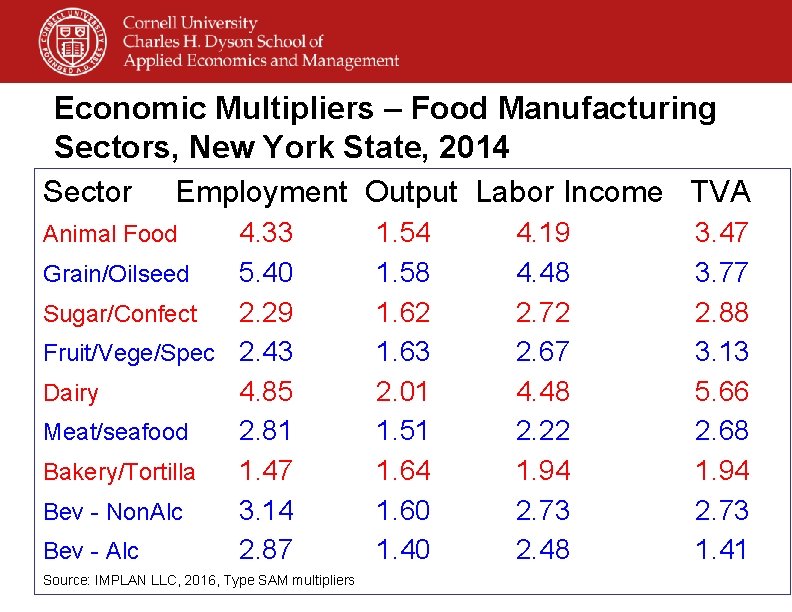
Economic Multipliers – Food Manufacturing Sectors, New York State, 2014 Sector Employment Output Labor Income TVA 4. 33 Grain/Oilseed 5. 40 Sugar/Confect 2. 29 Fruit/Vege/Spec 2. 43 Dairy 4. 85 Meat/seafood 2. 81 Bakery/Tortilla 1. 47 Bev - Non. Alc 3. 14 Bev - Alc 2. 87 Animal Food Source: IMPLAN LLC, 2016, Type SAM multipliers 1. 54 1. 58 1. 62 1. 63 2. 01 1. 51 1. 64 1. 60 1. 40 4. 19 4. 48 2. 72 2. 67 4. 48 2. 22 1. 94 2. 73 2. 48 3. 47 3. 77 2. 88 3. 13 5. 66 2. 68 1. 94 2. 73 1. 41
Forward Linkages: Farm and Food Manufacturing
• sfdg
• sfdg
• sfdg
• sfdg
• sfdg
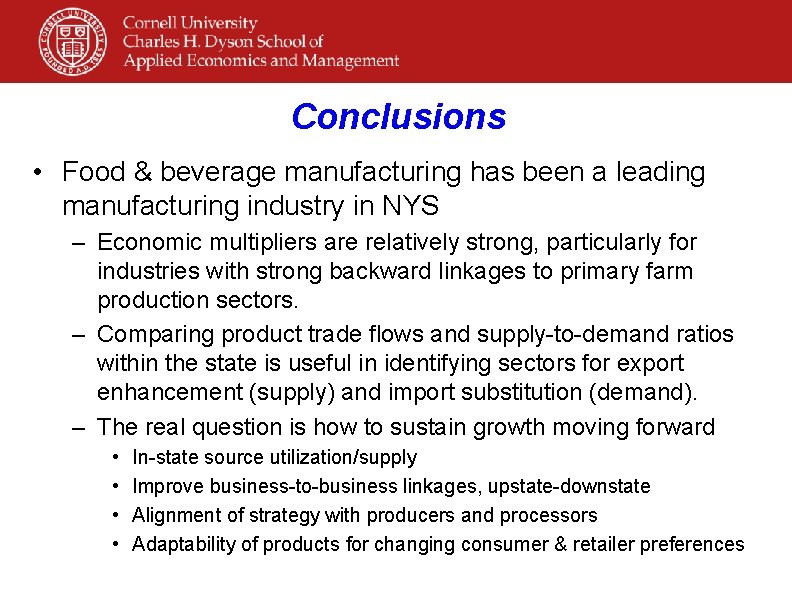
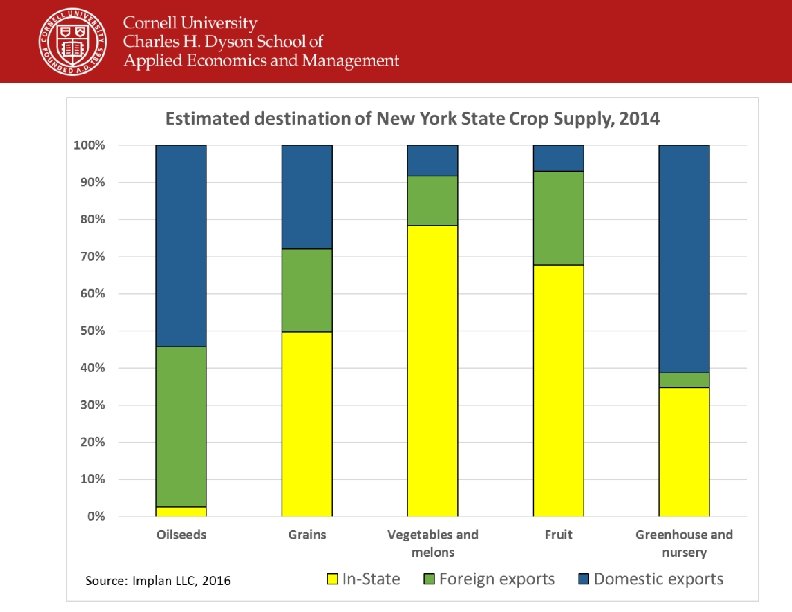
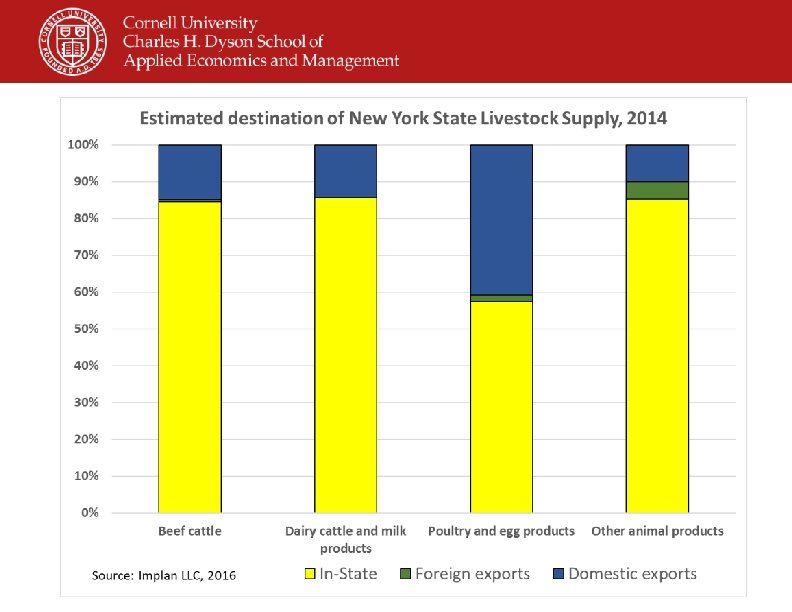
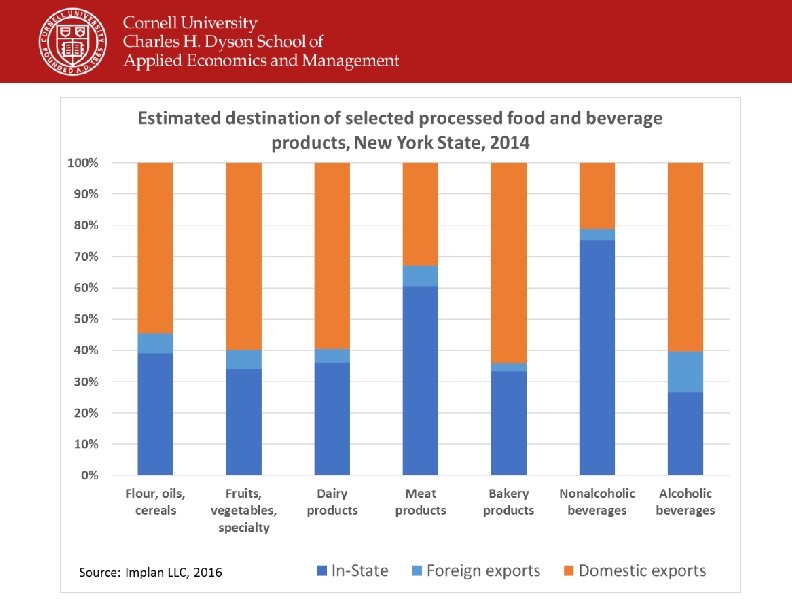
Conclusions • Food & beverage manufacturing has been a leading manufacturing industry in NYS – Economic multipliers are relatively strong, particularly for industries with strong backward linkages to primary farm production sectors. – Comparing product trade flows and supply-to-demand ratios within the state is useful in identifying sectors for export enhancement (supply) and import substitution (demand). – The real question is how to sustain growth moving forward • • In-state source utilization/supply Improve business-to-business linkages, upstate-downstate Alignment of strategy with producers and processors Adaptability of products for changing consumer & retailer preferences
Thank You! For more information: The Economic Contribution of Agriculture in NYS (2014) http: //publications. dyson. cornell. edu/outreach/extensionpdf/2016/Cornell-Dyson-eb 1609. pdf Todd M. Schmit 350 A Warren Hall Cornell University Ithaca, NY 14853 -7801 tms 1@cornell. edu https: //dyson. cornell. edu/people/todd-schmit Office: 607 -255 -3015 Mobile: 607 -592 -2316
- Slides: 32