
Trends and Challenges in Financial Aid and College
- Slides: 28
Trends and Challenges in Financial Aid and College Affordability Mark Kantrowitz Publisher of Fin. Aid and Fastweb October 24, 2011
Decrease in College Affordability § Need-based grants are failing to keep pace with increases in college costs § Federal and state governments are cutting student aid spending to reduce budget deficits § College costs continue to rise • Public college tuition inflation is driven by cuts in state appropriations (effectively taxing students) • College discount rates are increasing, putting pressure on college student aid budgets § Family income is stagnant due to the economy § More families are demonstrating financial need
Consequences of Drop in Affordability § Families are more concerned about college costs and financial aid because of the increase in out-of-pocket costs § Low and moderate income students shifting enrollments to lower-cost colleges, causing a decline in Bachelor’s degree attainment § Average debt at graduation is increasing by thousands of dollars § There is an increased focus on improving the efficiency and effectiveness of student aid funds
Recent Cuts in Student Aid Funding
Cuts to Pell Grant Program Funding § Department of Defense and Full-Year Continuing Appropriations Act, 2011 (P. L. 112 -10) suspended the Year-Round Pell Grant program effective with the 2011 -12 award year • The Year-Round Pell Grant program allowed students in accelerated degree programs to receive two Pell Grants in a single award year • This cuts $8 billion/year in Pell Grant program funding § 2010 -11 was also the last year of the Academic Competitiveness Grant (ACG) and National SMART Grant programs (SMART Grant)
Increases in Funding are Inadequate § Scheduled increases in maximum Pell Grant will fall short of inflation through 2020 • Health Care and Education Reconciliation Act of 2010 (P. L. 111 -152) provided funding for anemic increases in the maximum Pell Grant through 2019 -2020 • Five years of no increases, five years of CPI increases, the equivalent of CPI – 0. 75% § Budget Control Act of 2011 allocated $17 billion to the Pell Grant program for 2012 -13 to address an existing funding shortfall, but left the program with a $1. 3 billion funding shortfall
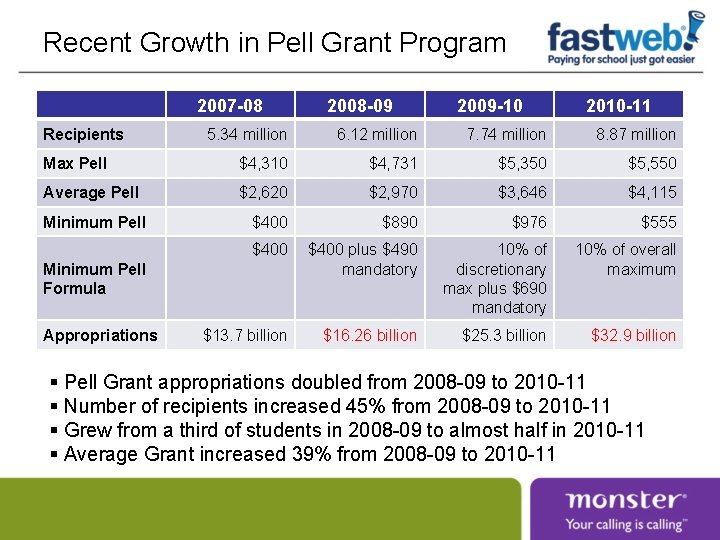
Recent Growth in Pell Grant Program 2007 -08 Recipients 2008 -09 2009 -10 2010 -11 5. 34 million 6. 12 million 7. 74 million 8. 87 million Max Pell $4, 310 $4, 731 $5, 350 $5, 550 Average Pell $2, 620 $2, 970 $3, 646 $4, 115 $400 $890 $976 $555 $400 plus $490 mandatory 10% of discretionary max plus $690 mandatory 10% of overall maximum $13. 7 billion $16. 26 billion $25. 3 billion $32. 9 billion Minimum Pell Formula Appropriations § Pell Grant appropriations doubled from 2008 -09 to 2010 -11 § Number of recipients increased 45% from 2008 -09 to 2010 -11 § Grew from a third of students in 2008 -09 to almost half in 2010 -11 § Average Grant increased 39% from 2008 -09 to 2010 -11
Most Likely Changes to the Pell Grant § Priority is on maintaining maximum Pell Grant of $5, 550, but there will be no increases § Cut subsidized interest on undergraduate subsidized Stafford loans to yield funding for Pell Grant program § Reduce the number of semesters of eligibility from 18 to 12 for Bachelor’s degree programs, with lower limits for Certificate and Associate’s degree programs § Require a minimum of half-time enrollment § Eliminate eligibility for students who qualify for less than 10% of the maximum Pell Grant § Changes to federal need analysis, such as changes to income protection allowance or auto-zero-EFC threshold
Other Student Aid Cuts Are Likely § Efficiency improvements from reallocating funds from one student aid program to another will be diverted toward deficit reduction • Budget Control Act of 2011 cut subsidized interest for graduate students and loan discounts, saving $21. 6 billion, but redirected $4. 6 billion to deficit reduction § Budget Control Act of 2011 cut budget deficit, but did not specify what would be cut • Across-the-board budget cuts are likely • Extension of 3. 4% subsidized Stafford loan interest rate for undergraduates is unlikely • Bush Administration tax cuts expire at end of 2012
Impact on College Affordability and Debt
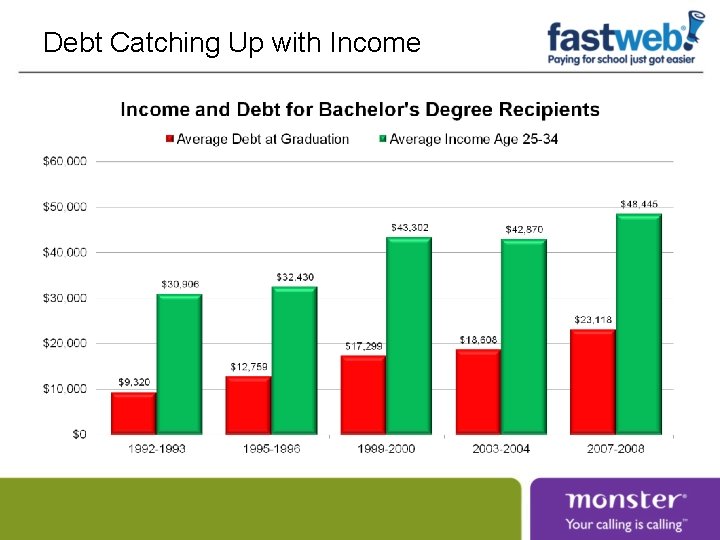
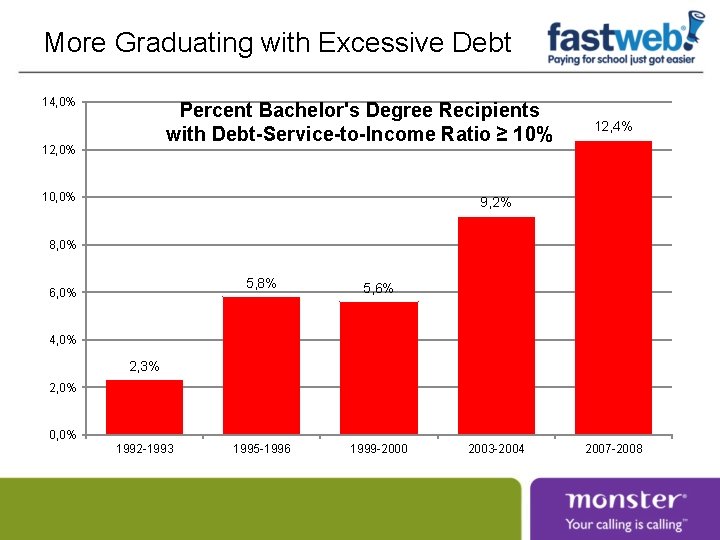
Growth in Student Loan Debt § Student loan debt continues to grow faster than income, driven by the failure of grants to keep pace with increases in college costs § Total student loan debt outstanding exceeded credit card debt outstanding in June 2010 § Total student loan debt outstanding will reach the $1 trillion mark in late 2011 § One-third of students are graduating with more than $20, 000 in debt, eligible for 20 -year or longer repayment terms
Debt Catching Up with Income
More Graduating with Excessive Debt 14, 0% Percent Bachelor's Degree Recipients with Debt-Service-to-Income Ratio ≥ 10% 12, 0% 10, 0% 12, 4% 9, 2% 8, 0% 6, 0% 5, 8% 5, 6% 1995 -1996 1999 -2000 4, 0% 2, 3% 2, 0% 0, 0% 1992 -1993 2003 -2004 2007 -2008
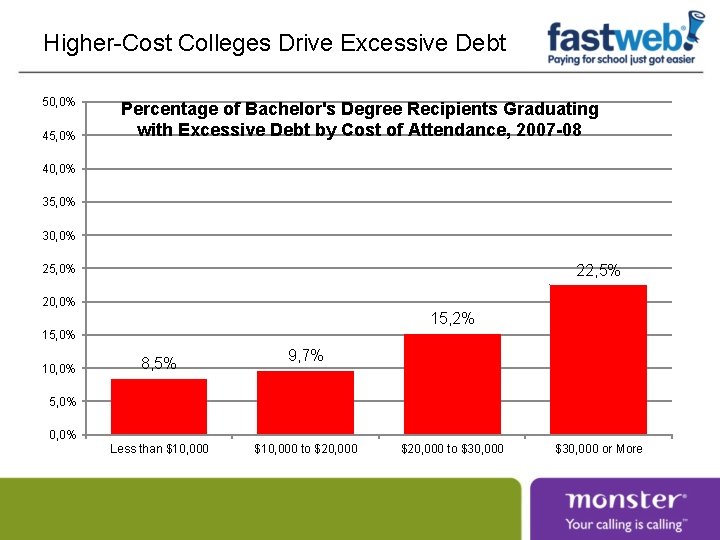
Higher-Cost Colleges Drive Excessive Debt 50, 0% 45, 0% Percentage of Bachelor's Degree Recipients Graduating with Excessive Debt by Cost of Attendance, 2007 -08 40, 0% 35, 0% 30, 0% 22, 5% 25, 0% 20, 0% 15, 2% 15, 0% 10, 0% 8, 5% 9, 7% 5, 0% 0, 0% Less than $10, 000 to $20, 000 to $30, 000 or More
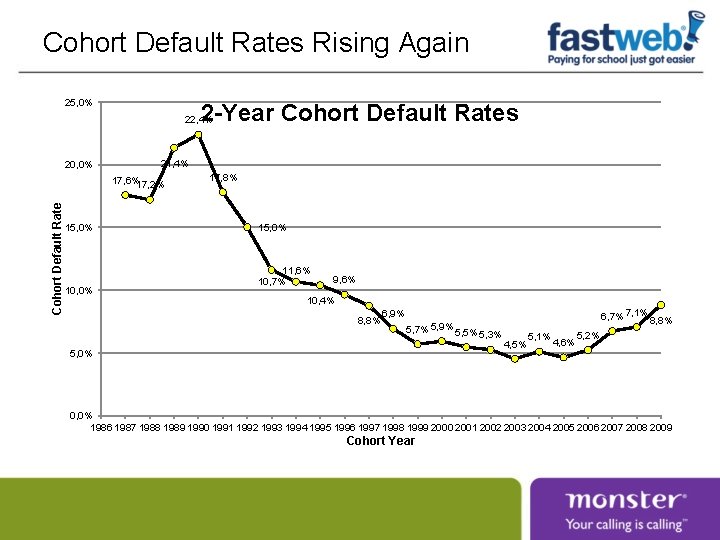
Cohort Default Rates Rising Again 25, 0% 2 -Year Cohort Default Rates 22, 4% 20, 0% 21, 4% Cohort Default Rate 17, 6%17, 2% 15, 0% 10, 0% 17, 8% 15, 0% 11, 6% 10, 7% 9, 6% 10, 4% 8, 8% 6, 7% 7, 1% 8, 8% 6, 9% 5, 7% 5, 9% 5, 5% 5, 0% 5, 3% 4, 5% 5, 1% 4, 6% 5, 2% 0, 0% 1986 1987 1988 1989 1990 1991 1992 1993 1994 1995 1996 1997 1998 1999 2000 2001 2002 2003 2004 2005 2006 2007 2008 2009 Cohort Year
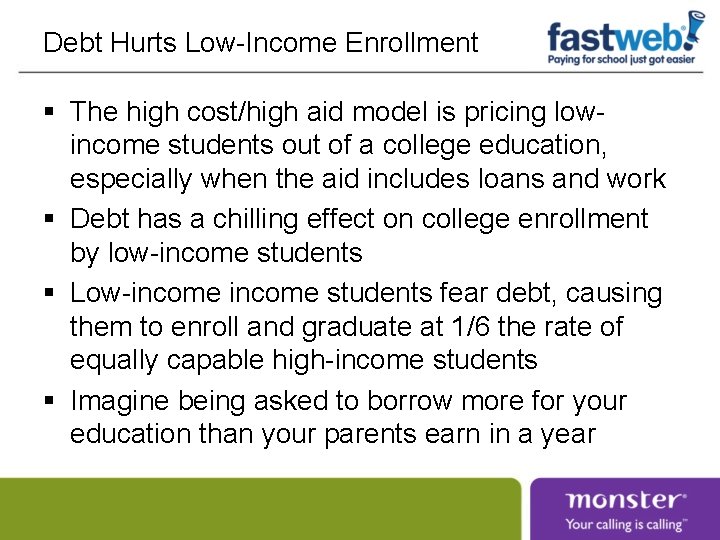
Debt Hurts Low-Income Enrollment § The high cost/high aid model is pricing lowincome students out of a college education, especially when the aid includes loans and work § Debt has a chilling effect on college enrollment by low-income students § Low-income students fear debt, causing them to enroll and graduate at 1/6 the rate of equally capable high-income students § Imagine being asked to borrow more for your education than your parents earn in a year
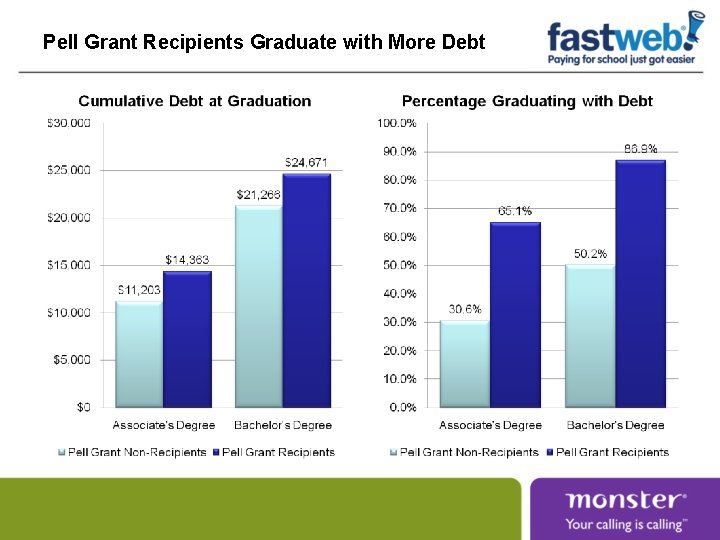
Pell Grant Recipients Graduate with More Debt
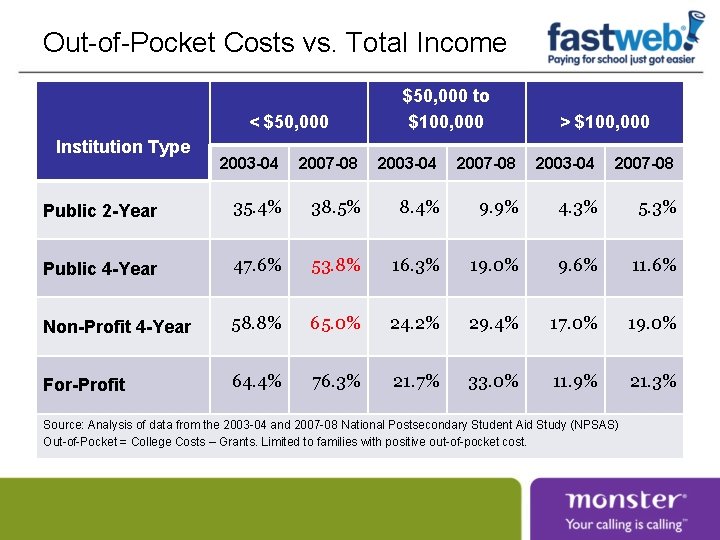
Out-of-Pocket Costs vs. Total Income < $50, 000 Institution Type $50, 000 to $100, 000 > $100, 000 2003 -04 2007 -08 Public 2 -Year 35. 4% 38. 5% 8. 4% 9. 9% 4. 3% 5. 3% Public 4 -Year 47. 6% 53. 8% 16. 3% 19. 0% 9. 6% 11. 6% Non-Profit 4 -Year 58. 8% 65. 0% 24. 2% 29. 4% 17. 0% 19. 0% For-Profit 64. 4% 76. 3% 21. 7% 33. 0% 11. 9% 21. 3% Source: Analysis of data from the 2003 -04 and 2007 -08 National Postsecondary Student Aid Study (NPSAS) Out-of-Pocket = College Costs – Grants. Limited to families with positive out-of-pocket cost.
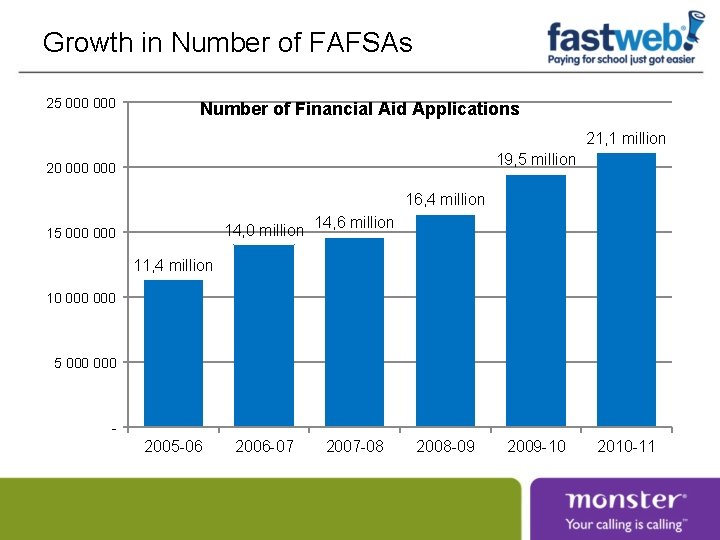
Growth in Number of FAFSAs 25 000 Number of Financial Aid Applications 21, 1 million 19, 5 million 20 000 16, 4 million 14, 0 million 14, 6 million 15 000 11, 4 million 10 000 5 000 - 2005 -06 2006 -07 2007 -08 2008 -09 2009 -10 2010 -11
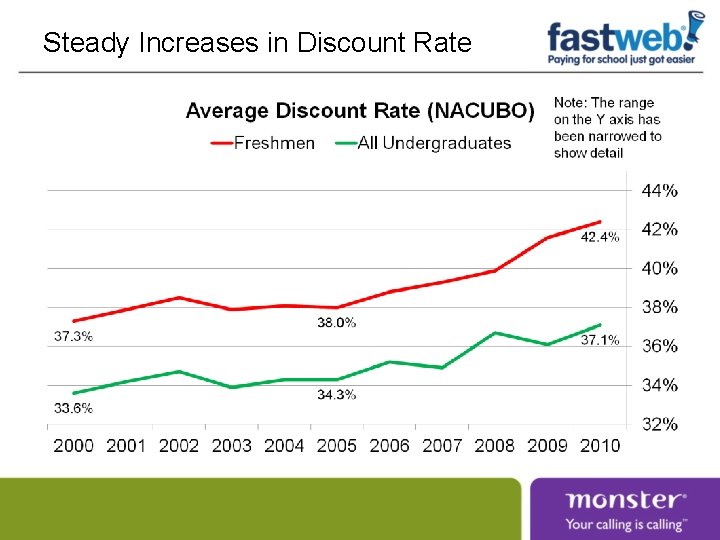
Steady Increases in Discount Rate
2011 College Decision Impact Survey § Greater emphasis on bottom line costs and ROI § Three most important reasons chose college • • • Quality of major (44. 6%) Scholarship or financial assistance (43. 2%) Total costs (40. 8%) Academic reputation (38. 4%) Campus setting/environment (35. 6%) Close to home (34. 5%) § Students who are concerned about the economy are much more likely to enroll at public colleges
“Switchers” Influenced by Money § More likely to switch preference from non-profit to public (24%) than public to non-profit (9%) § 37. 3% of high school seniors did not enroll at their first-choice college. Main reasons: • A third (31. 2%) said they could not afford 1 st choice • A tenth (11. 4%) got a better aid offer elsewhere • Among switchers from public to non-profit, a fifth (20. 3%) said got a better aid offer • Among switches from public to non-profit, a third (33. 0%) appealed for more aid and almost half (44. 7%) got an increase in the financial aid offer
More Emphasis on Improving Efficiency
Potential for Greater Efficiency § Given limited funding increases, there will be more emphasis on improving efficiency • Eliminate waste and abuse • Focus funding on the most effective programs • Target financial literacy training, debt counseling and job placement assistance at highest-risk borrowers § Unfortunately, savings from efficiency improvements may be applied to deficit reduction instead of student aid § Affordable debt restrictions (gainful employment rules) may be extended to all colleges
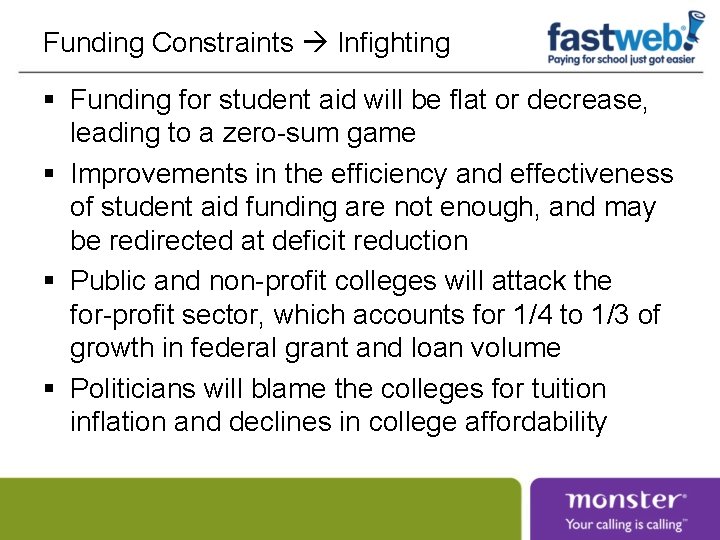
Funding Constraints Infighting § Funding for student aid will be flat or decrease, leading to a zero-sum game § Improvements in the efficiency and effectiveness of student aid funding are not enough, and may be redirected at deficit reduction § Public and non-profit colleges will attack the for-profit sector, which accounts for 1/4 to 1/3 of growth in federal grant and loan volume § Politicians will blame the colleges for tuition inflation and declines in college affordability
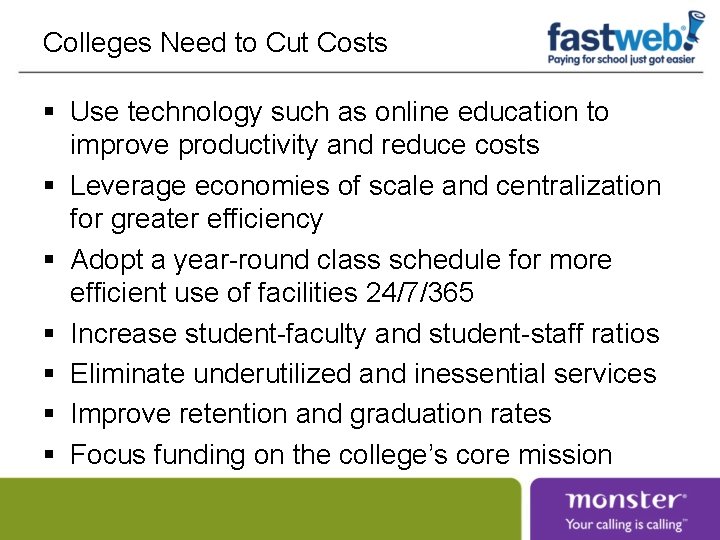
Colleges Need to Cut Costs § Use technology such as online education to improve productivity and reduce costs § Leverage economies of scale and centralization for greater efficiency § Adopt a year-round class schedule for more efficient use of facilities 24/7/365 § Increase student-faculty and student-staff ratios § Eliminate underutilized and inessential services § Improve retention and graduation rates § Focus funding on the college’s core mission
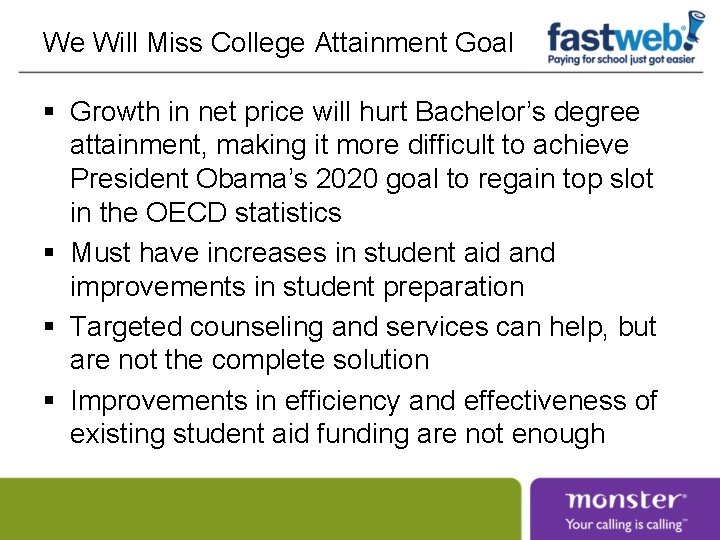
We Will Miss College Attainment Goal § Growth in net price will hurt Bachelor’s degree attainment, making it more difficult to achieve President Obama’s 2020 goal to regain top slot in the OECD statistics § Must have increases in student aid and improvements in student preparation § Targeted counseling and services can help, but are not the complete solution § Improvements in efficiency and effectiveness of existing student aid funding are not enough
Thank You! Mark Kantrowitz’s student aid policy analysis papers may be found at www. finaid. org/studentaidpolicy