
Trench Warfare The causes dangers and lasting problems
Trench Warfare The causes, dangers, and lasting problems of the trenches

Rise of the Trenches n Departure from traditional battle tactics n n n Germans were advancing too quickly French and British needed an effective defense Trenches armed with machine guns n n n Sandbags protected the soldiers from bullets and shrapnel Barbed wire slowed an enemy’s advance As a whole, they slowed the enemy

Rise of the Trenches
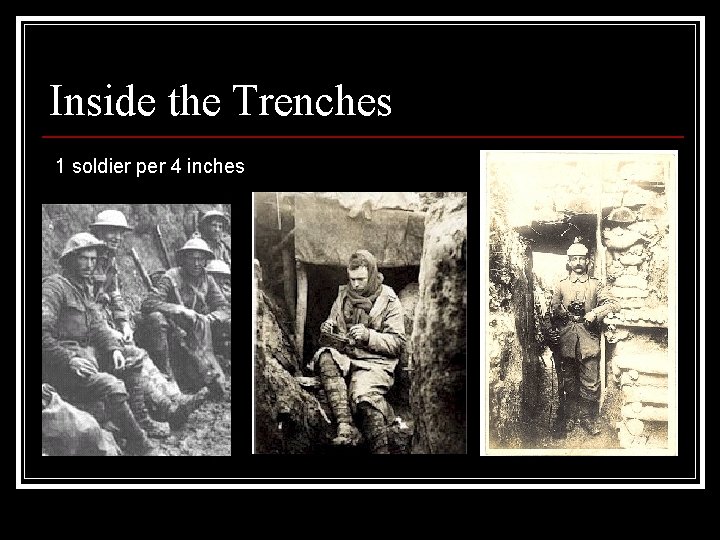
Inside the Trenches 1 soldier per 4 inches

Effective Trenches n n n Barbed wire: Difficult to cut, forced enemy down a specific path and to move at a walking pace Machine guns: Mowed down advancing army Gas: Worked especially well on heavily laden attackers n n Mustard gas: Yellowish color and distinctive smell. Deadly even with gas mask. Causes horrible blisters and sores and can cause cancer. Phosgene gas: Odorless and deadly if breathed
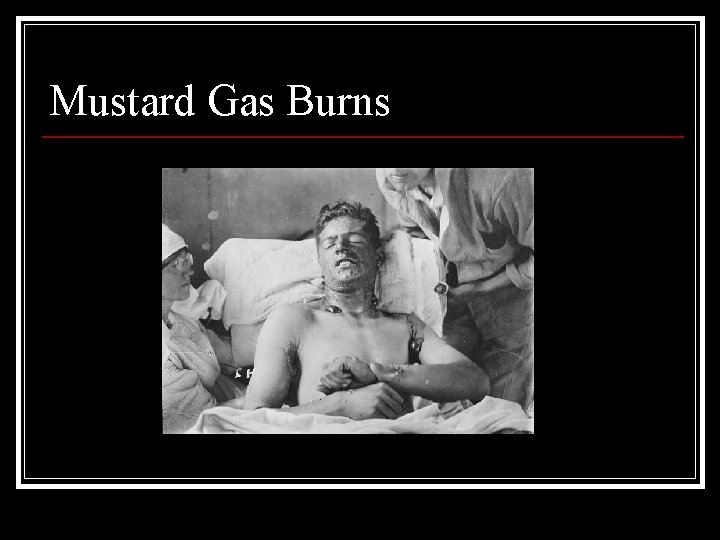
Mustard Gas Burns

Effective Trenches

Effective Trenches

Effective Trenches

Effective Trenches

Effective Trenches Shells: Tore up the ground causing the trenches to be partially destroyed n No secrecy: You were able to see the supplies being delivered to your enemy n Nearby railway: Brought reinforcements quickly n

Effective Trenches n n Lack of experience: Neither side had used this tactic before Zigzagging trenches: Prevented the destruction of the entire trench

Parts of the Trenches Communication trenches: Connected to main trenches n Blind alleys: Led nowhere; built to confuse enemy n Forward positions: Built for miners and snipers n

Parts of the Trenches n n Underground “saps”: Tunnels dug under an enemy’s trench so that explosives could be placed and detonated No man’s land: The open field between the two trenches
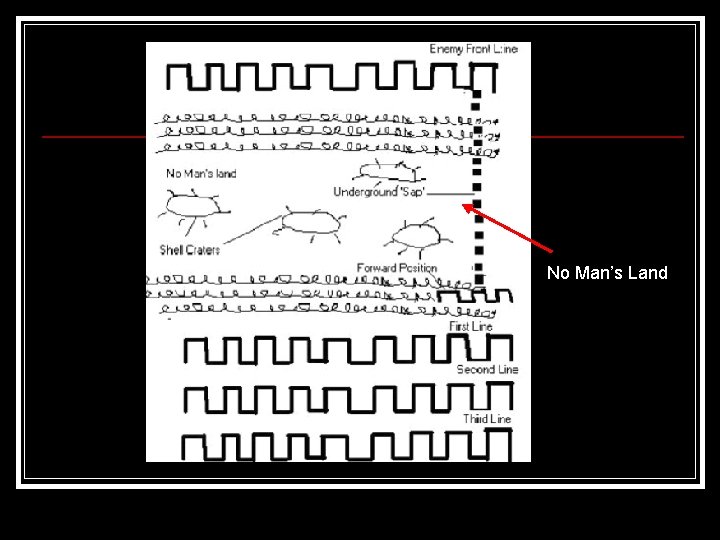
No Man’s Land

Parts of the Trenches

Parts of the Trenches

An aerial view of the trenches

Consequences of the Trench rats n Trench foot n Body lice n Stalemate n

Trench Rats “Rats bred by the tens of thousands and lived on the fat of the land. When we were sleeping in funk holes the things ran over us, played about, copulated and fouled our scraps of food, their young squeaking incessantly. There was no proper system of waste disposal in trench life. Empty tins of all kinds were flung away over the top on both sides of the trench. Millions of tins were thus available for all the rats in France and Belgium in hundreds of miles of trenches. During brief moments of quiet at night, one could hear a continuous rattle of tins moving against each other. The rats were turning them over. What happened to the rats under heavy shell-fire was a mystery, but their powers of survival kept place with each new weapon, including poison gas. ”
Trench Rats “The rats were huge. They were so big they would eat a wounded man if he couldn't defend himself. “ n “Two or three rats would always be found on a dead body. They usually went for the eyes first and then they burrowed their way right into the corpse. ” n

Trench Rats “The brown rat was especially feared. Gorging themselves on human remains (grotesquely disfiguring them by eating their eyes and liver) they could grow to the size of a cat. ” n “A single rat couple could produce up to 900 offspring in a year, spreading infection and contaminating food. ” n

Trench Rats

Trench Foot n “The trenches were wet and cold and at this time some of them did not have duckboards and dugouts. The battalion lived in mud and water. Altogether about 200 men were evacuated for trench feet and rheumatism. Gum boots were provided for the troops in the most exposed positions. Trench feet was still a new ailment and the provision of dry socks was vitally important. Part of the trench was reserved for men to go two at a time, at least once a day, and rub each other's feet with grease.

Trench Foot n Disclaimer: If you don’t want to see something gross, then do not look.
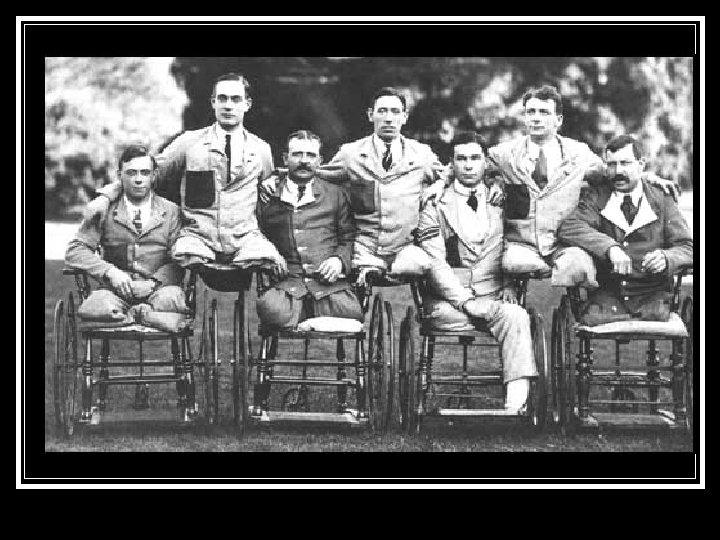

Body Lice n “A full day's rest allowed us to clean up a bit, and to launch a full scale attack on lice. I sat in a quiet corner of a barn for two hours delousing myself as best I could. We were all at it, for none of us escaped their vile attentions. The things lay in the seams of trousers, in the deep furrows of long thick woolly pants, and seemed impregnable in their deep entrenchments. A lighted candle applied where they were thickest made them pop like Chinese crackers. After a session of this, my face would be covered with small blood spots from extra big fellows which had popped too vigorously. Lice hunting was called 'chatting'. In parcels from home it was usual to receive a tin of supposedly death-dealing powder or pomade, but the lice thrived on the stuff. ”


Body Lice It thrived in warm conditions, which was provided by body heat and layers of clothing. n It spread from man to man as they slept near each other to fight the cold. n It is estimated that 97% of all soldiers who lived in the trenches had lice. n

Body Lice It often carried with it trench fever, an illness characterized by headaches, skin rashes, inflamed eyes, and leg pains. n Since men lived in the trenches, only rotating from the front lines, to support trenches, to reserve trenches, there was no solution until their short rest from the trenches (about 70 days out of the year) n

Body Lice

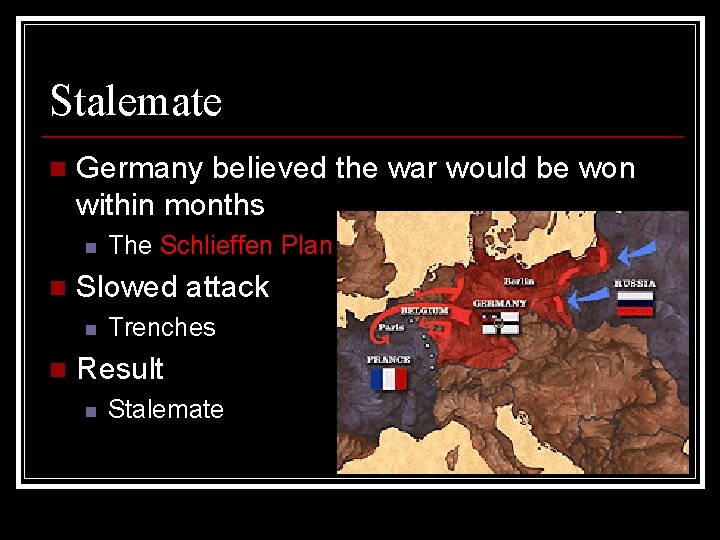
Stalemate n Germany believed the war would be won within months n n Slowed attack n n The Schlieffen Plan Trenches Result n Stalemate
Stalemate “I've a little wet home in a trench Where the rainstorms continually drench, There's a dead cow close by With her feet in towards the sky And she gives off a terrible stench. Underneath, in the place of a floor, There's a mass of wet mud and some straw, But with shells dropping there, There's no place to compare, With my little wet home in the trench. ”
Stalemate n Between rotting carcasses, overflowing latrines, men who hadn’t bathed in weeks or even months, the lingering odor of poison gas, cigarette smoke, and cooking food, the first thing most new recruits noticed was the stench.
Stalemate: A situation in which further action is blocked; a deadlock n The war moved slowly n No clear advantage for either side n Something needed to change n And then… n
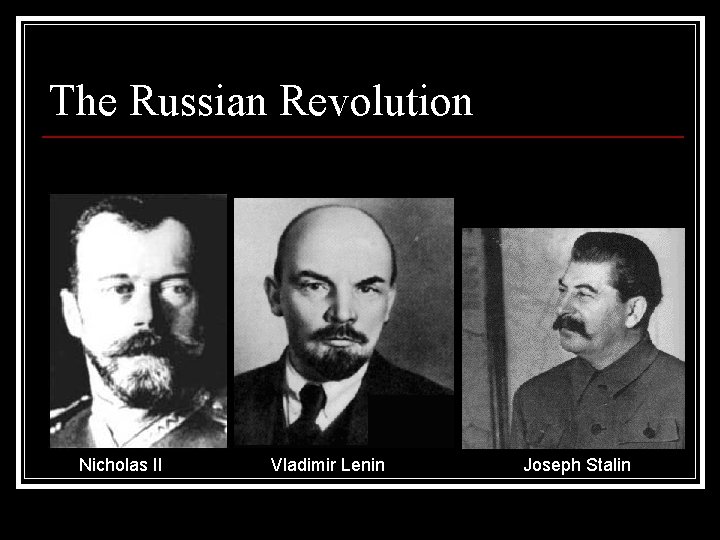
The Russian Revolution Nicholas II Vladimir Lenin Joseph Stalin
- Slides: 37