
Tremors and involuntary Movements The basal ganglia Relation
Tremors and involuntary Movements

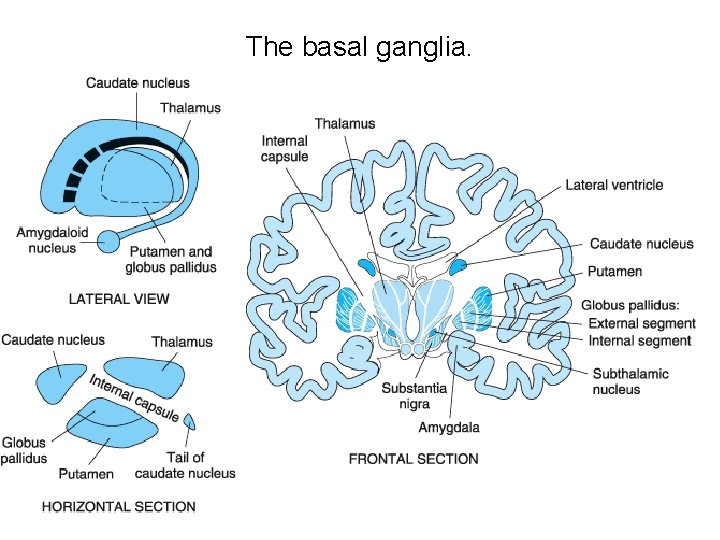
The basal ganglia.
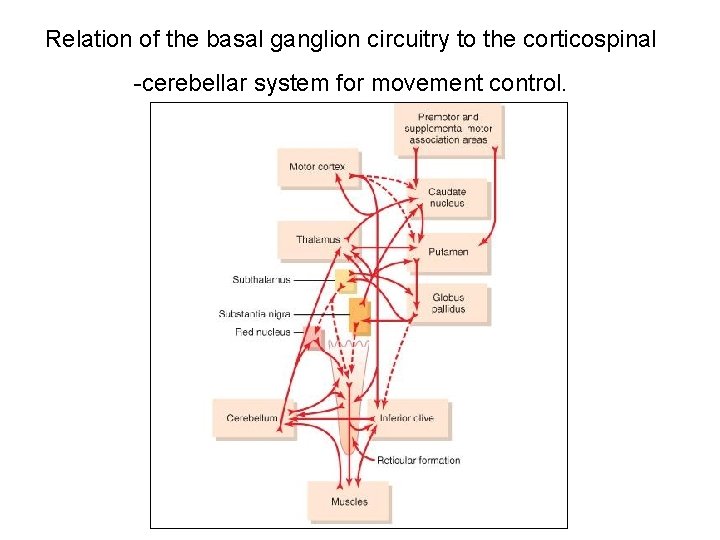
Relation of the basal ganglion circuitry to the corticospinal -cerebellar system for movement control.
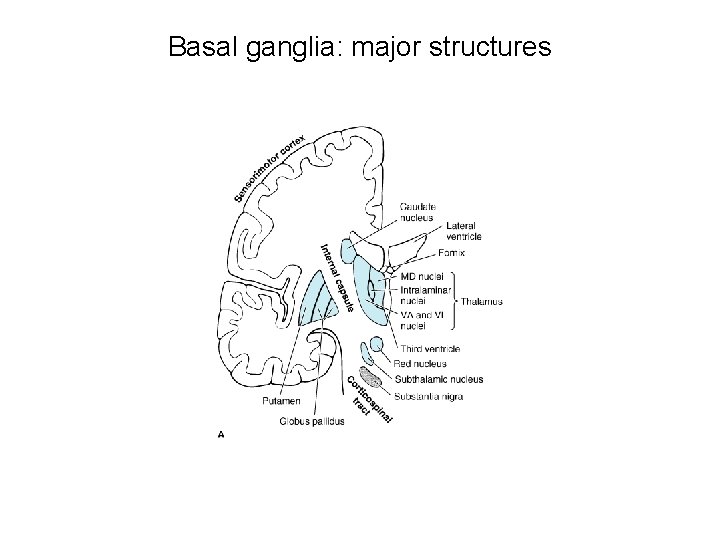
Basal ganglia: major structures
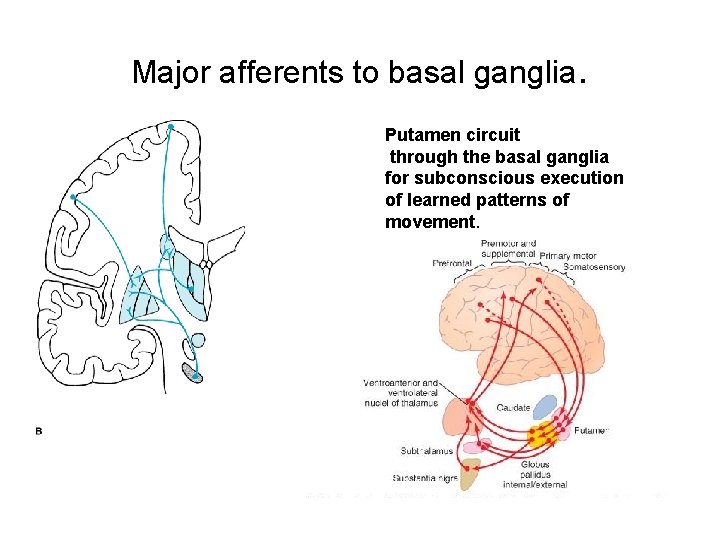
Major afferents to basal ganglia. Putamen circuit through the basal ganglia for subconscious execution of learned patterns of movement.
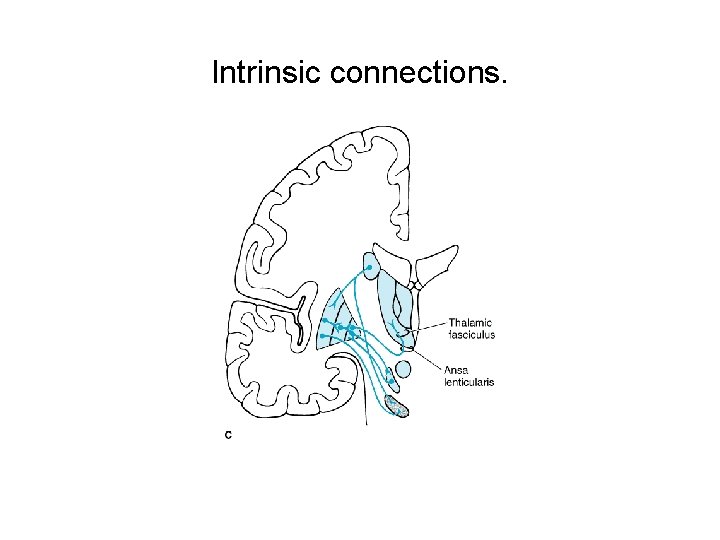
Intrinsic connections.
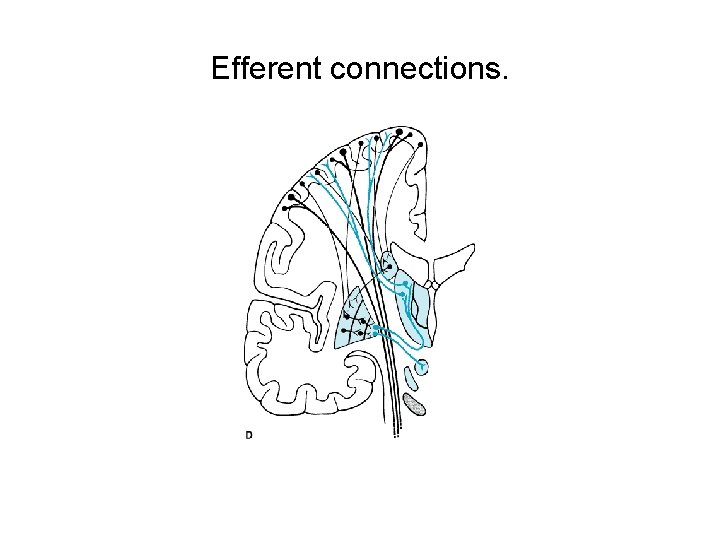
Efferent connections.
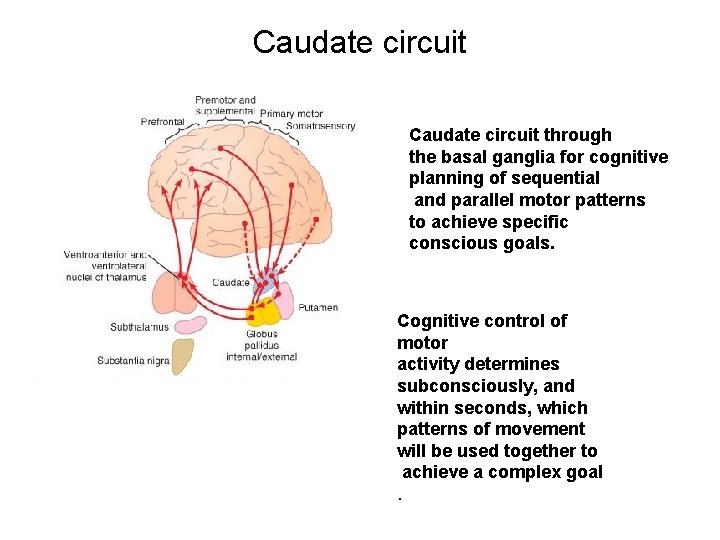
Caudate circuit through the basal ganglia for cognitive planning of sequential and parallel motor patterns to achieve specific conscious goals. Cognitive control of motor activity determines subconsciously, and within seconds, which patterns of movement will be used together to achieve a complex goal.
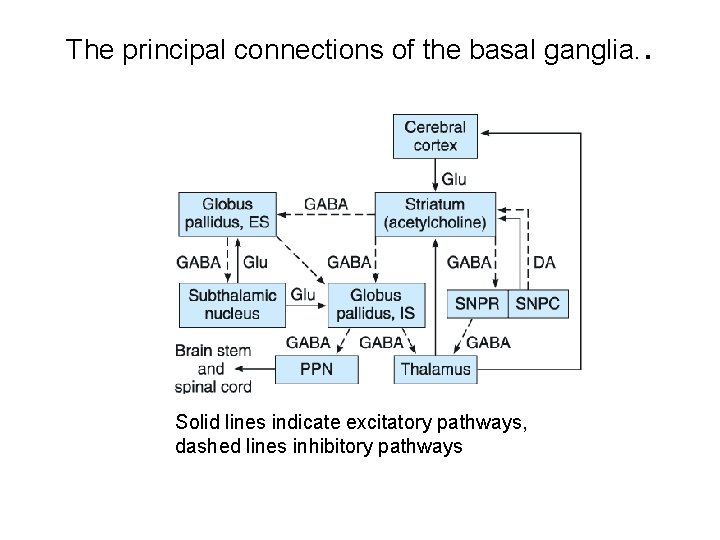
The principal connections of the basal ganglia. . Solid lines indicate excitatory pathways, dashed lines inhibitory pathways
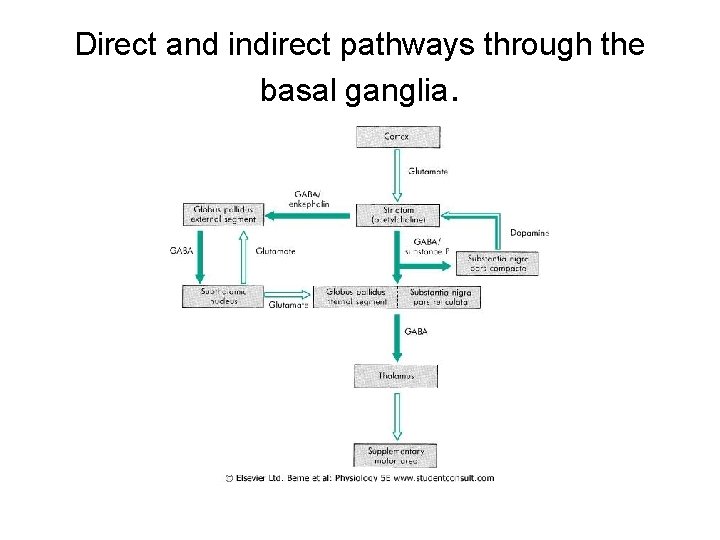
Direct and indirect pathways through the basal ganglia.
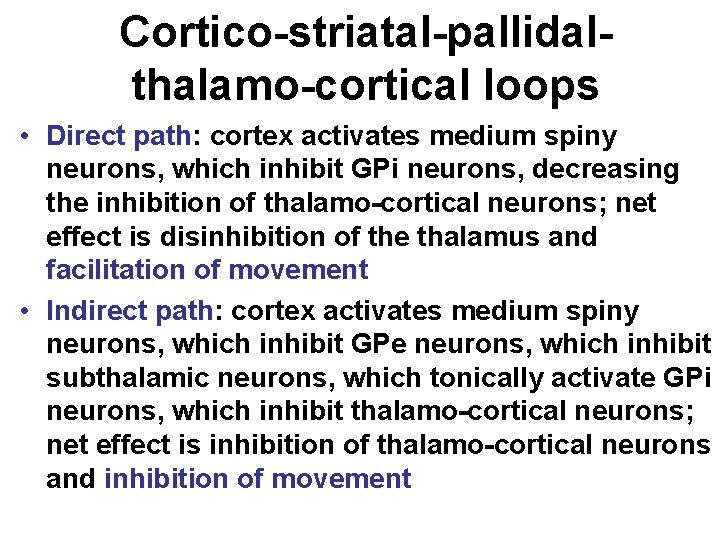
Cortico-striatal-pallidalthalamo-cortical loops • Direct path: cortex activates medium spiny neurons, which inhibit GPi neurons, decreasing the inhibition of thalamo-cortical neurons; net effect is disinhibition of the thalamus and facilitation of movement • Indirect path: cortex activates medium spiny neurons, which inhibit GPe neurons, which inhibit subthalamic neurons, which tonically activate GPi neurons, which inhibit thalamo-cortical neurons; net effect is inhibition of thalamo-cortical neurons and inhibition of movement
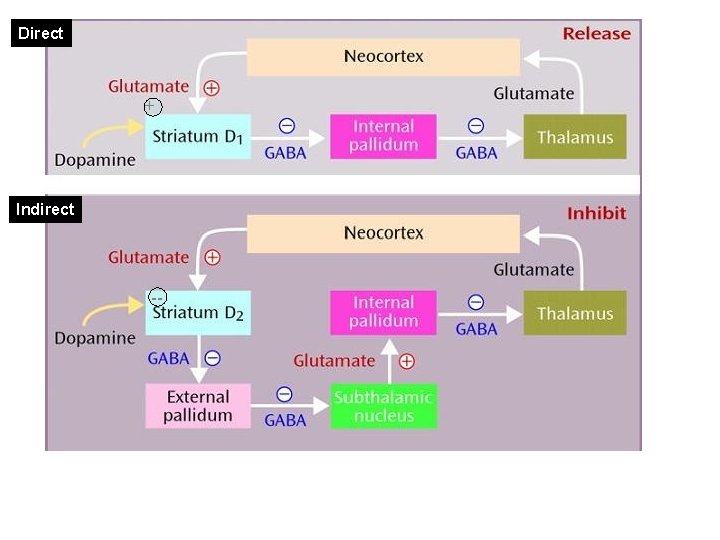
Direct + Indirect --
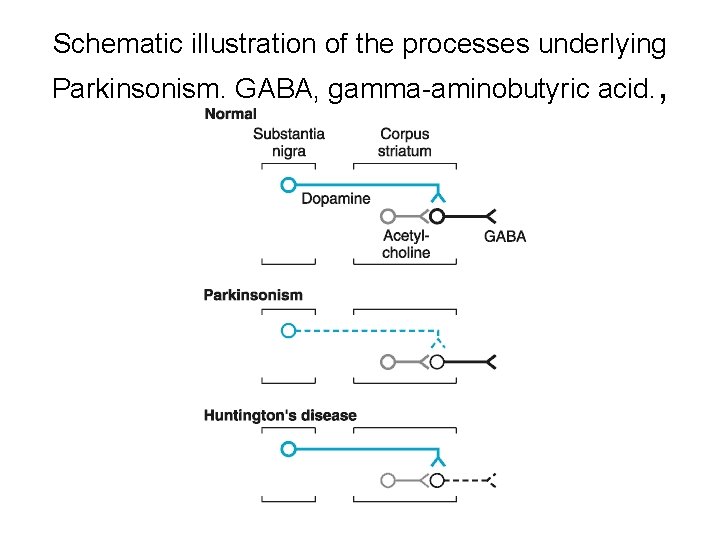
Schematic illustration of the processes underlying Parkinsonism. GABA, gamma-aminobutyric acid. ,
Basic Mechanism of the BG • ‘Disinhibition of proposed actions’ • The basal ganglia output nuclei tonically inhibit the thalamic nuclei and the superior colliculus. • Released when input patterns excite principal neurons of the neostriatum. • Tonic activity regulated by striatal projections to the GPe via the GP (inhibitory principal neurons) and to the subthalamic nucleus (excitatory principal neurons) that increase the activity of the GPi and SNr neurons, producing a balanced opposition of activity.
Functions of Basal Ganglia • Involved in the planning and programming of movement • An abstract thought is converted into voluntary movement • Play a role in cognitive processing • Responsible for many of the associated movements • Assisting setting the background activity of limb and girdle musculature for organized fine manipulatory activity
Basal Ganglia Disease causes Disorder of Movement • Dyskinesia: Some loss of voluntary control and regulation. No paralysis or paresis, NO dysfunction of UMN or LMN. It is not Apraxia.
Abnormal Function in the Putamen Circuit • Hyper. Kinesia: and often continuous writhing movements of a hand, an arm, Involuntary spontaneous movements. • Chorea: Lesion in striatum , continuous series of rapid jerky involuntary movement that are fragments of purposeful movement • Athetosis Lesions in the globus pallidus lead to spontaneous the neck, or the face-movements. • Hemiballismus A lesion in the subthalamus leads to sudden flailing movements of an entire limb, • Ballismus: violent involuntary contractions of proximal muscles- lesion of subthalmic nuclei
Hypokinesia : Bradykinesia • Parkinson’s disease: Lesions of the substantia nigra lead to the extremely severe disease of rigidity, akinesia, and tremors
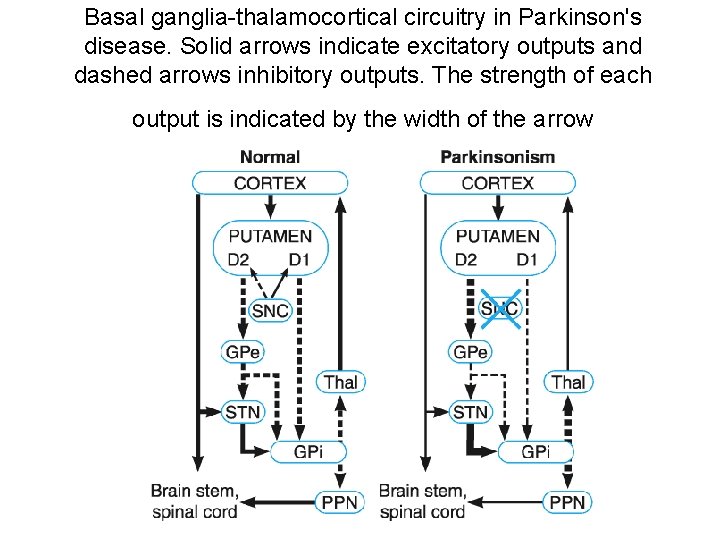
Basal ganglia-thalamocortical circuitry in Parkinson's disease. Solid arrows indicate excitatory outputs and dashed arrows inhibitory outputs. The strength of each output is indicated by the width of the arrow
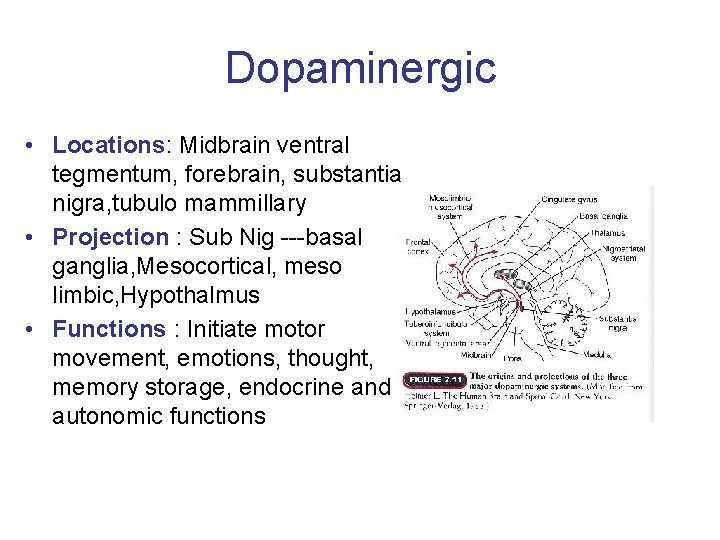
Dopaminergic • Locations: Midbrain ventral tegmentum, forebrain, substantia nigra, tubulo mammillary • Projection : Sub Nig ---basal ganglia, Mesocortical, meso limbic, Hypothalmus • Functions : Initiate motor movement, emotions, thought, memory storage, endocrine and autonomic functions
Major Dopaminergic Tracts in the Brain • Nigrostriatal From substantia nigra to the putamen and caudate. (Important for motor movements. Involved in short term side effects of antipsychotics e. g. tremor and rigidity or long term - tardive dyskinesia) • Tuberoinfundibular - From the arcuate nucleus of the hypothalamus to the pituitary stall (Important for prolactin regulation and may contribute to Neuroendocrine abnormalities) • Mesolimbic - From ventral tegmental area to many components of limbic system. (May be involved in positive symptoms of schizophrenia) • Mesocortical - From ventral tegmental area to the neocortex especially prefrontal areas. (May be involved in the negative symptoms of schizophrenia)
Parkinson's Disease Main Clinical Features • • • Poverty and slowness of movement Fixed posture Facial expression is grim and fixed Less eye blink While walking arms do not swing Takes long to intiate called akinesia or stop a movement Swallowing diminished Rigidity of much of the musculature of the body, Involuntary tremor of the involved areas even when the person is resting at a fixed rate of 3 to 6 cycles per second, • Cognitive disturbances • Affective functions Pathology Widespread destruction of that portion of the substantia nigra (the pars compacta) that sends dopamine-secreting nerve fibers to the caudate nucleus and putamen. •
Sites for surgical intervention in Parkinson disease • Lesion of subthalamic nucleus • or internal segment of globus pallidus
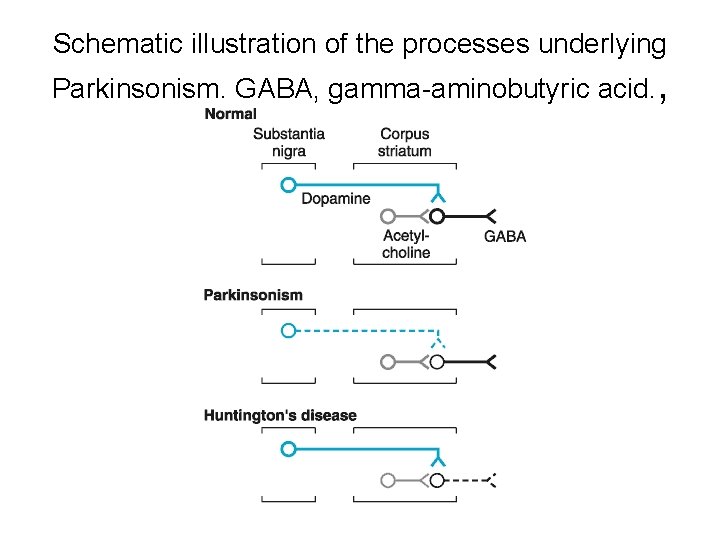
Schematic illustration of the processes underlying Parkinsonism. GABA, gamma-aminobutyric acid. ,

- Slides: 26