
Trees CS 202 Fundamental Structures of Computer Science

- Slides: 83
Trees CS 202 – Fundamental Structures of Computer Science II Bilkent University Computer Engineering Department CS 202, Spring 2003 Fundamental Structures of Computer Science II Bilkent University 1
Outline n Preliminaries n n n Binary Trees Binary Search Trees n n n What is Tree? Implementation of Trees using C++ Tree traversals and applications Structure and operations Analysis AVL Trees Splay Trees B-trees CS 202, Spring 2003 Fundamental Structures of Computer Science II Bilkent University 2
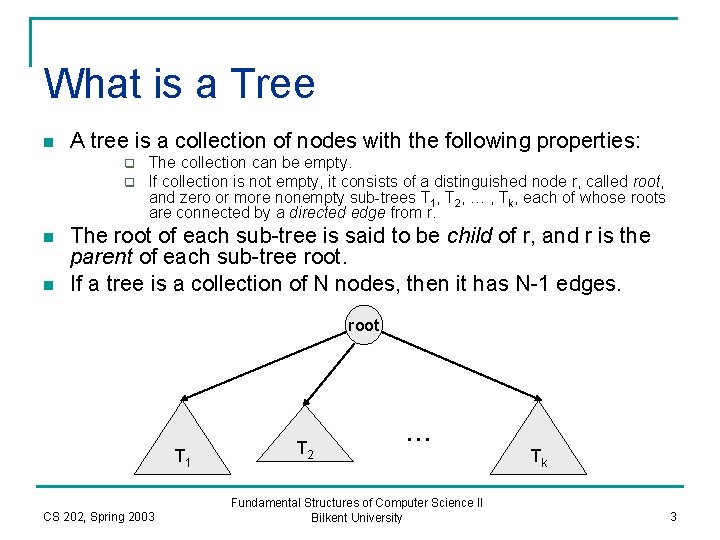
What is a Tree n A tree is a collection of nodes with the following properties: q q n n The collection can be empty. If collection is not empty, it consists of a distinguished node r, called root, and zero or more nonempty sub-trees T 1, T 2, … , Tk, each of whose roots are connected by a directed edge from r. The root of each sub-tree is said to be child of r, and r is the parent of each sub-tree root. If a tree is a collection of N nodes, then it has N-1 edges. root T 1 CS 202, Spring 2003 T 2 . . . Fundamental Structures of Computer Science II Bilkent University Tk 3
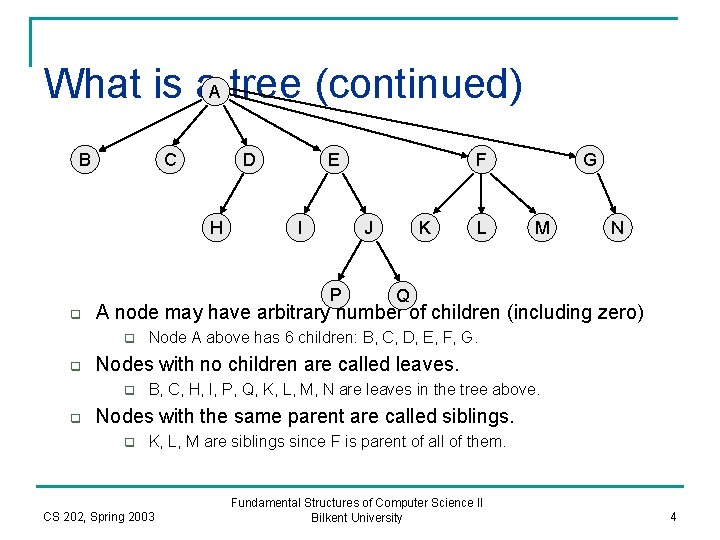
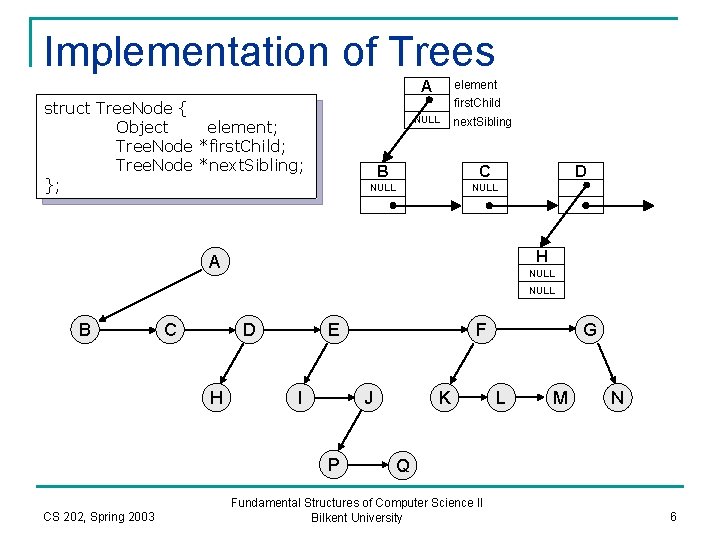
What is a. A tree (continued) B C D H E I J P q L M N Q Node A above has 6 children: B, C, D, E, F, G. Nodes with no children are called leaves. q q K G A node may have arbitrary number of children (including zero) q q F B, C, H, I, P, Q, K, L, M, N are leaves in the tree above. Nodes with the same parent are called siblings. q K, L, M are siblings since F is parent of all of them. CS 202, Spring 2003 Fundamental Structures of Computer Science II Bilkent University 4
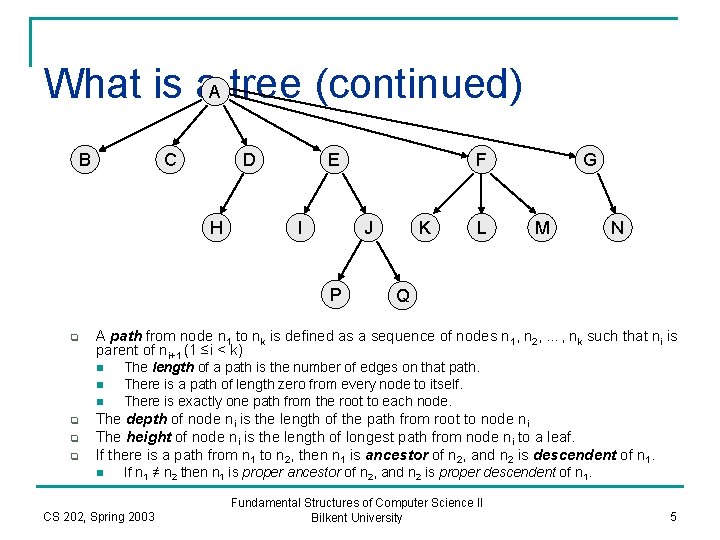
What is a. A tree (continued) B C D H E I J P q n n q q K L G M N Q A path from node n 1 to nk is defined as a sequence of nodes n 1, n 2, …, nk such that ni is parent of ni+1 (1 ≤i < k) n q F The length of a path is the number of edges on that path. There is a path of length zero from every node to itself. There is exactly one path from the root to each node. The depth of node ni is the length of the path from root to node ni The height of node ni is the length of longest path from node ni to a leaf. If there is a path from n 1 to n 2, then n 1 is ancestor of n 2, and n 2 is descendent of n 1. n If n 1 ≠ n 2 then n 1 is proper ancestor of n 2, and n 2 is proper descendent of n 1. CS 202, Spring 2003 Fundamental Structures of Computer Science II Bilkent University 5
Implementation of Trees A struct Tree. Node { Object element; Tree. Node *first. Child; Tree. Node *next. Sibling; }; element first. Child NULL next. Sibling B C NULL D H A NULL B C D H E I J P CS 202, Spring 2003 F K G L M N Q Fundamental Structures of Computer Science II Bilkent University 6
Tree Applications n There many applications of trees in Computer Science and Engineering. q q q Organization of filenames in a Unix File System Indexing large files in Database Management Systems Compiler Design. Routing Table representation for fast lookups of IP addresses Search Trees for fast access to stored items CS 202, Spring 2003 Fundamental Structures of Computer Science II Bilkent University 7
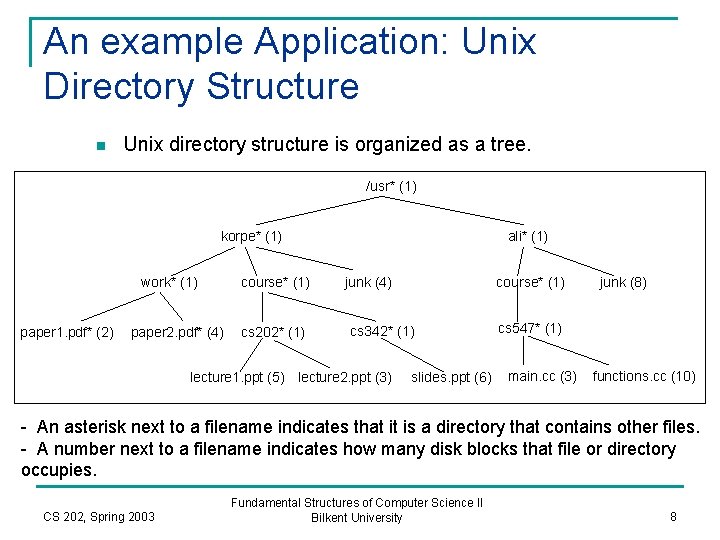
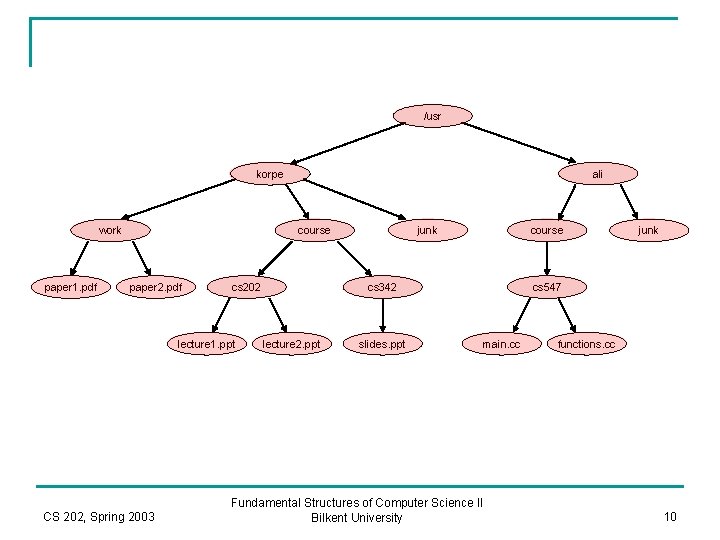
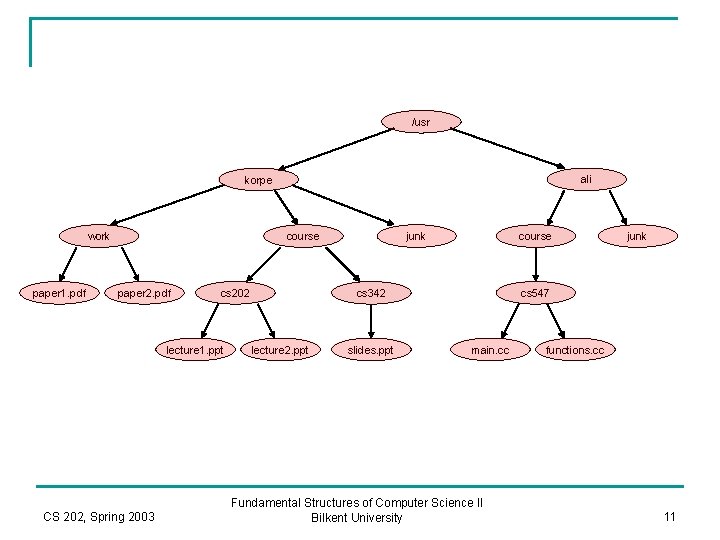
An example Application: Unix Directory Structure n Unix directory structure is organized as a tree. /usr* (1) korpe* (1) work* (1) paper 1. pdf* (2) paper 2. pdf* (4) course* (1) cs 202* (1) ali* (1) junk (4) course* (1) cs 342* (1) lecture 1. ppt (5) lecture 2. ppt (3) slides. ppt (6) junk (8) cs 547* (1) main. cc (3) functions. cc (10) - An asterisk next to a filename indicates that it is a directory that contains other files. - A number next to a filename indicates how many disk blocks that file or directory occupies. CS 202, Spring 2003 Fundamental Structures of Computer Science II Bilkent University 8
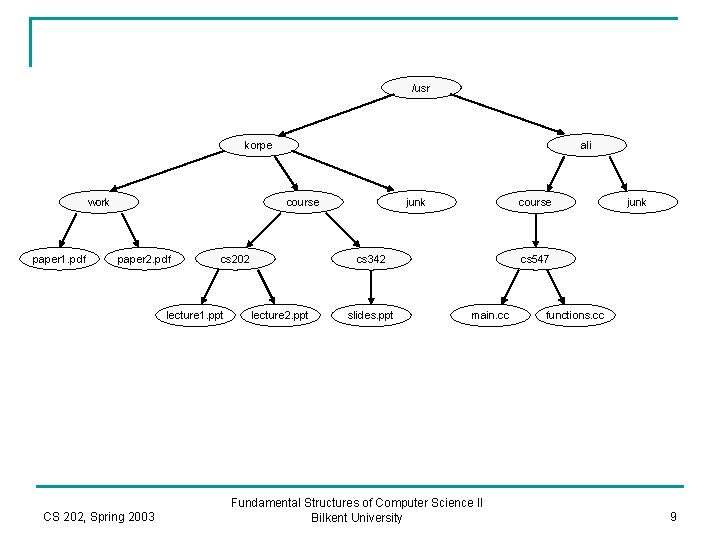
/usr ali korpe work paper 1. pdf course paper 2. pdf cs 202 lecture 1. ppt CS 202, Spring 2003 junk course cs 342 lecture 2. ppt slides. ppt junk cs 547 main. cc Fundamental Structures of Computer Science II Bilkent University functions. cc 9
/usr ali korpe work paper 1. pdf course paper 2. pdf cs 202 lecture 1. ppt CS 202, Spring 2003 junk course cs 342 lecture 2. ppt slides. ppt junk cs 547 main. cc Fundamental Structures of Computer Science II Bilkent University functions. cc 10
/usr ali korpe work paper 1. pdf course paper 2. pdf cs 202 lecture 1. ppt CS 202, Spring 2003 junk course cs 342 lecture 2. ppt slides. ppt junk cs 547 main. cc Fundamental Structures of Computer Science II Bilkent University functions. cc 11
n n We want to list files in the directory We want to computer the size of all files (in a recursive manner) in the directory. CS 202, Spring 2003 Fundamental Structures of Computer Science II Bilkent University 12
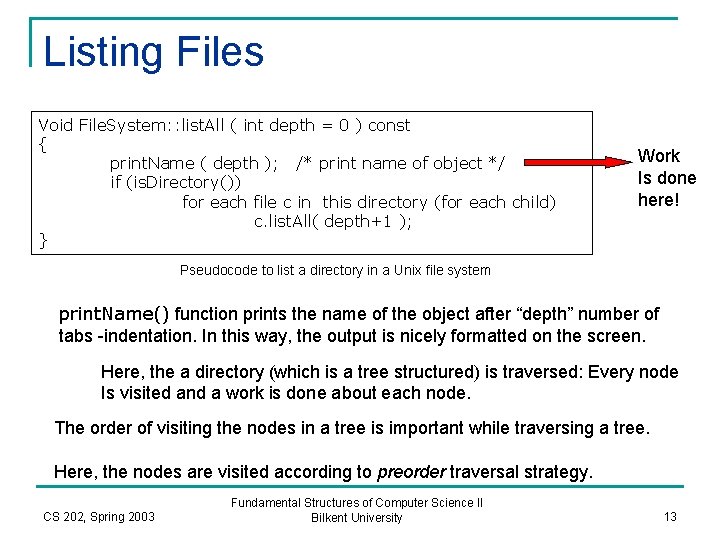
Listing Files Void File. System: : list. All ( int depth = 0 ) const { print. Name ( depth ); /* print name of object */ if (is. Directory()) for each file c in this directory (for each child) c. list. All( depth+1 ); } Work Is done here! Pseudocode to list a directory in a Unix file system print. Name() function prints the name of the object after “depth” number of tabs -indentation. In this way, the output is nicely formatted on the screen. Here, the a directory (which is a tree structured) is traversed: Every node Is visited and a work is done about each node. The order of visiting the nodes in a tree is important while traversing a tree. Here, the nodes are visited according to preorder traversal strategy. CS 202, Spring 2003 Fundamental Structures of Computer Science II Bilkent University 13
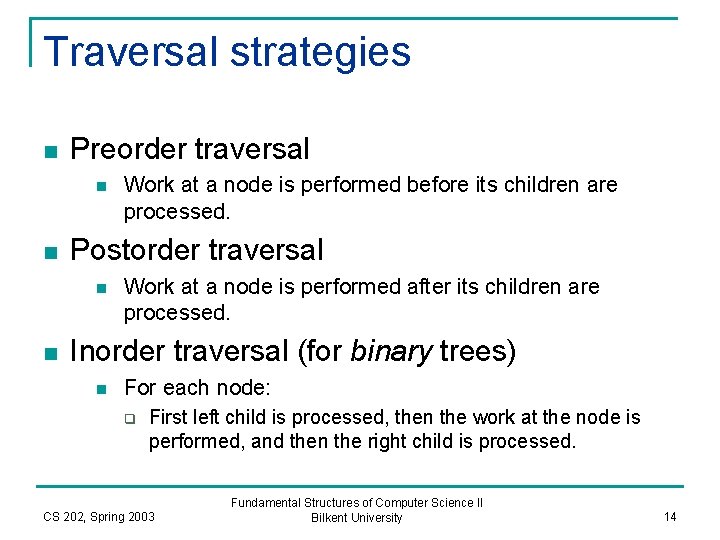
Traversal strategies n Preorder traversal n n Postorder traversal n n Work at a node is performed before its children are processed. Work at a node is performed after its children are processed. Inorder traversal (for binary trees) n For each node: q First left child is processed, then the work at the node is performed, and then the right child is processed. CS 202, Spring 2003 Fundamental Structures of Computer Science II Bilkent University 14
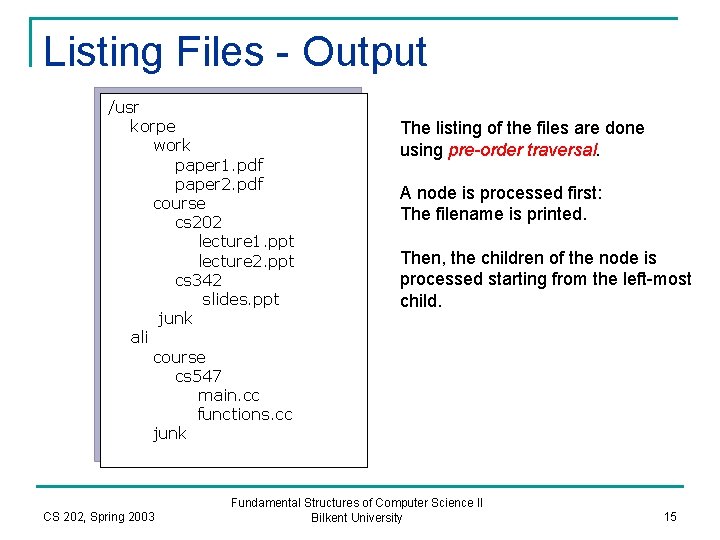
Listing Files - Output /usr korpe work paper 1. pdf paper 2. pdf course cs 202 lecture 1. ppt lecture 2. ppt cs 342 slides. ppt junk ali course cs 547 main. cc functions. cc junk CS 202, Spring 2003 The listing of the files are done using pre-order traversal. A node is processed first: The filename is printed. Then, the children of the node is processed starting from the left-most child. Fundamental Structures of Computer Science II Bilkent University 15
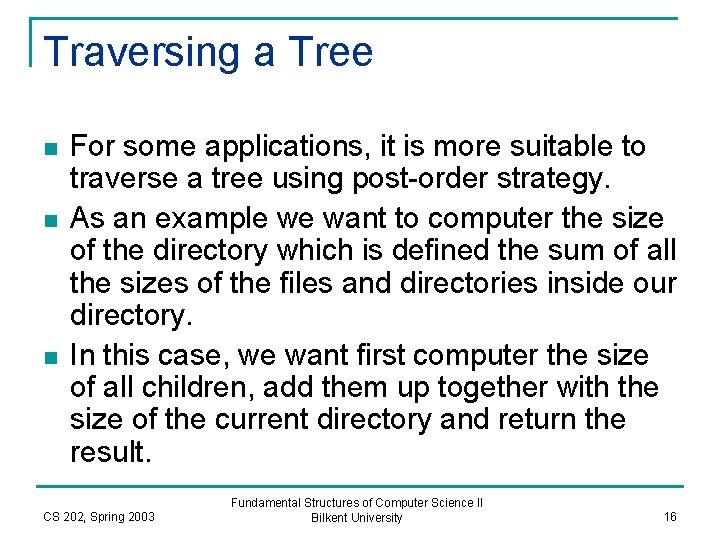
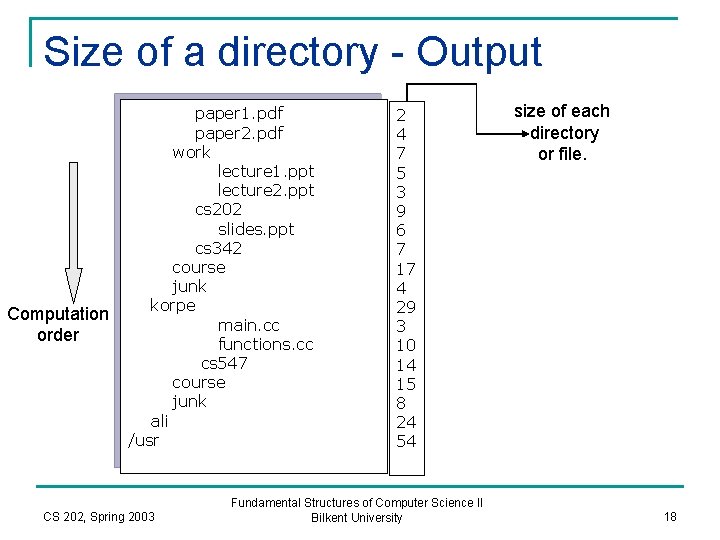
Traversing a Tree n n n For some applications, it is more suitable to traverse a tree using post-order strategy. As an example we want to computer the size of the directory which is defined the sum of all the sizes of the files and directories inside our directory. In this case, we want first computer the size of all children, add them up together with the size of the current directory and return the result. CS 202, Spring 2003 Fundamental Structures of Computer Science II Bilkent University 16
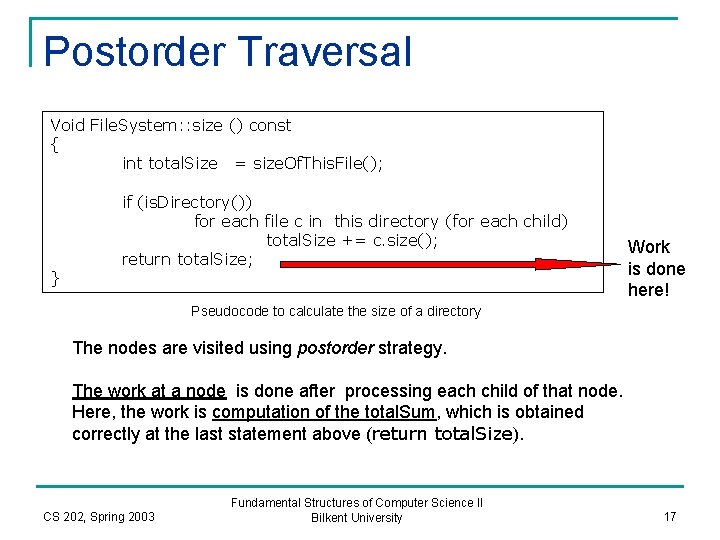
Postorder Traversal Void File. System: : size () const { int total. Size = size. Of. This. File(); } if (is. Directory()) for each file c in this directory (for each child) total. Size += c. size(); return total. Size; Work is done here! Pseudocode to calculate the size of a directory The nodes are visited using postorder strategy. The work at a node is done after processing each child of that node. Here, the work is computation of the total. Sum, which is obtained correctly at the last statement above (return total. Size). CS 202, Spring 2003 Fundamental Structures of Computer Science II Bilkent University 17
Size of a directory - Output Computation order paper 1. pdf paper 2. pdf work lecture 1. ppt lecture 2. ppt cs 202 slides. ppt cs 342 course junk korpe main. cc functions. cc cs 547 course junk ali /usr CS 202, Spring 2003 2 4 7 5 3 9 6 7 17 4 29 3 10 14 15 8 24 54 Fundamental Structures of Computer Science II Bilkent University size of each directory or file. 18
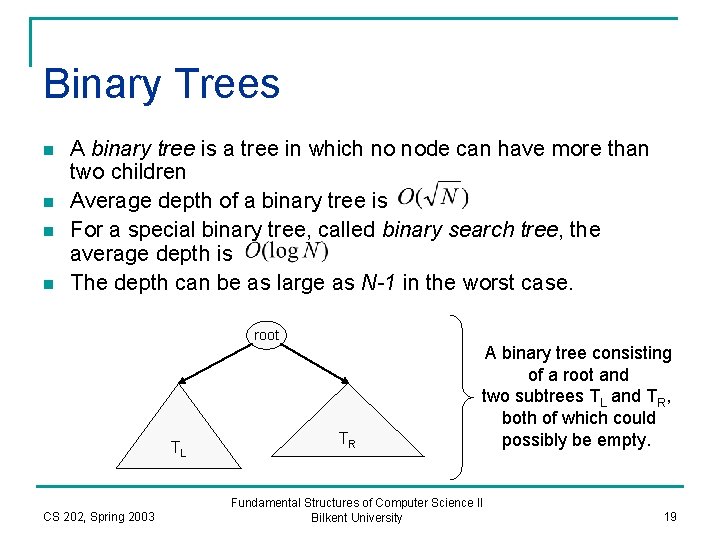
Binary Trees n n A binary tree is a tree in which no node can have more than two children Average depth of a binary tree is For a special binary tree, called binary search tree, the average depth is The depth can be as large as N-1 in the worst case. root TL CS 202, Spring 2003 TR A binary tree consisting of a root and two subtrees TL and TR, both of which could possibly be empty. Fundamental Structures of Computer Science II Bilkent University 19
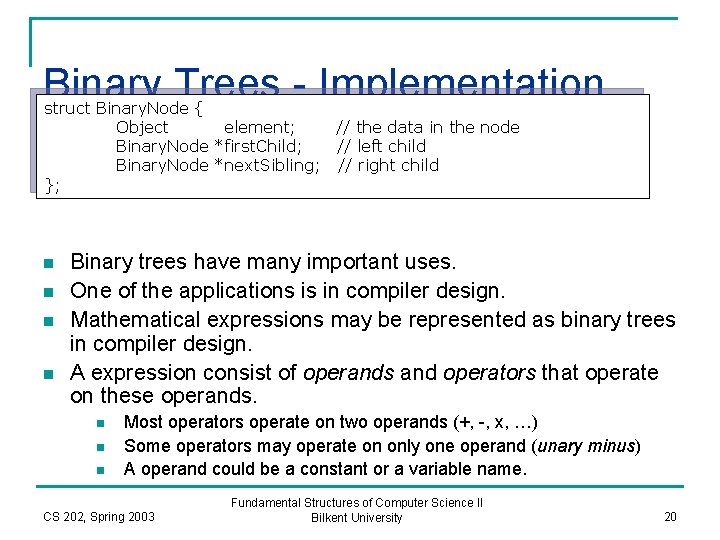
Binary Trees - Implementation struct Binary. Node { Object element; // the data in the node Binary. Node *first. Child; // left child Binary. Node *next. Sibling; // right child }; n n Binary trees have many important uses. One of the applications is in compiler design. Mathematical expressions may be represented as binary trees in compiler design. A expression consist of operands and operators that operate on these operands. n n n Most operators operate on two operands (+, -, x, …) Some operators may operate on only one operand (unary minus) A operand could be a constant or a variable name. CS 202, Spring 2003 Fundamental Structures of Computer Science II Bilkent University 20
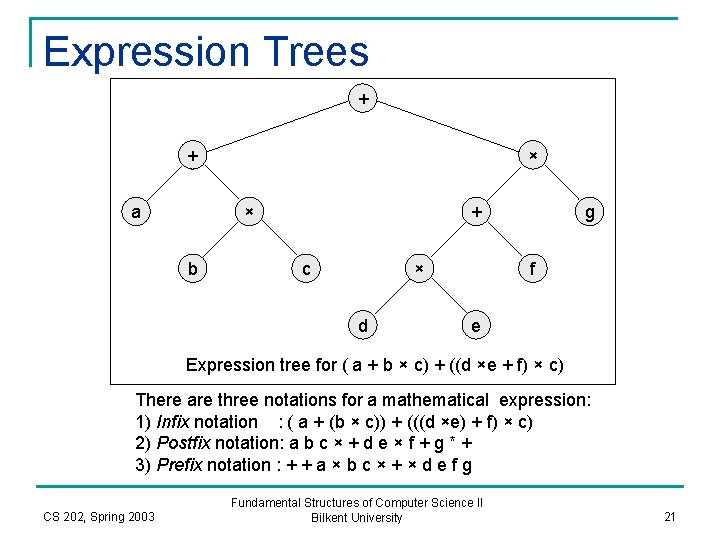
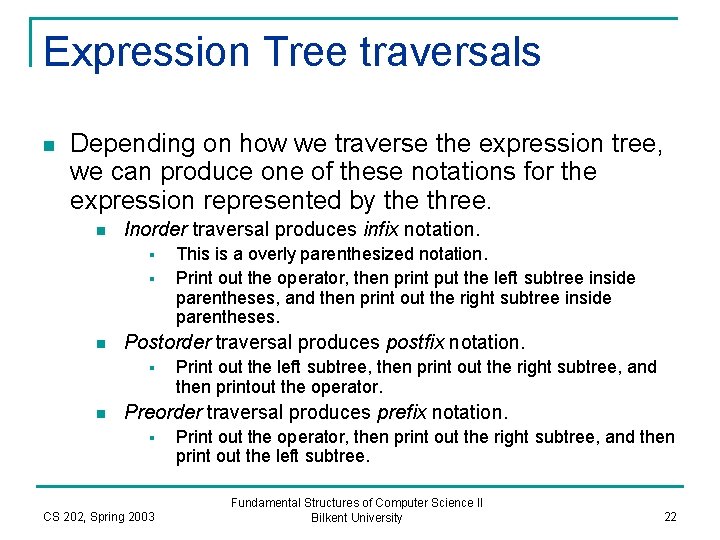
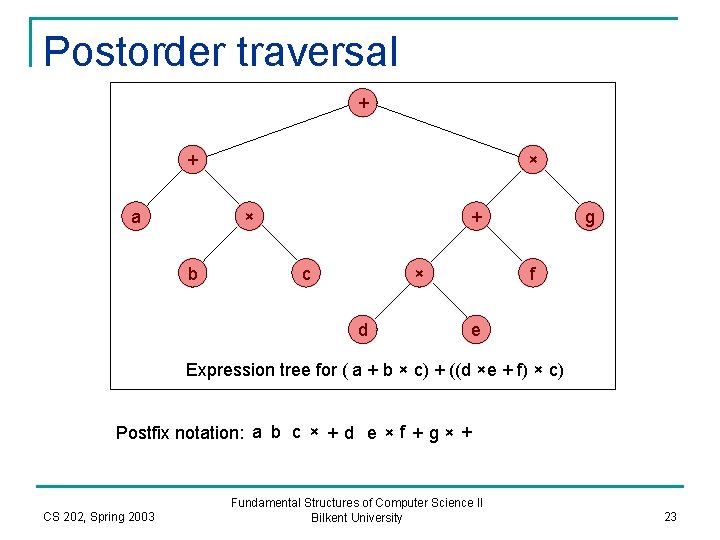
Expression Trees + + a × × b + c × d g f e Expression tree for ( a + b × c) + ((d ×e + f) × c) There are three notations for a mathematical expression: 1) Infix notation : ( a + (b × c)) + (((d ×e) + f) × c) 2) Postfix notation: a b c × + d e × f + g * + 3) Prefix notation : + + a × b c × + × d e f g CS 202, Spring 2003 Fundamental Structures of Computer Science II Bilkent University 21
Expression Tree traversals n Depending on how we traverse the expression tree, we can produce one of these notations for the expression represented by the three. n Inorder traversal produces infix notation. § § n Postorder traversal produces postfix notation. § n This is a overly parenthesized notation. Print out the operator, then print put the left subtree inside parentheses, and then print out the right subtree inside parentheses. Print out the left subtree, then print out the right subtree, and then printout the operator. Preorder traversal produces prefix notation. § CS 202, Spring 2003 Print out the operator, then print out the right subtree, and then print out the left subtree. Fundamental Structures of Computer Science II Bilkent University 22
Postorder traversal + + a × × b + c × d g f e Expression tree for ( a + b × c) + ((d ×e + f) × c) Postfix notation: a b c × + d e × f + g × + CS 202, Spring 2003 Fundamental Structures of Computer Science II Bilkent University 23
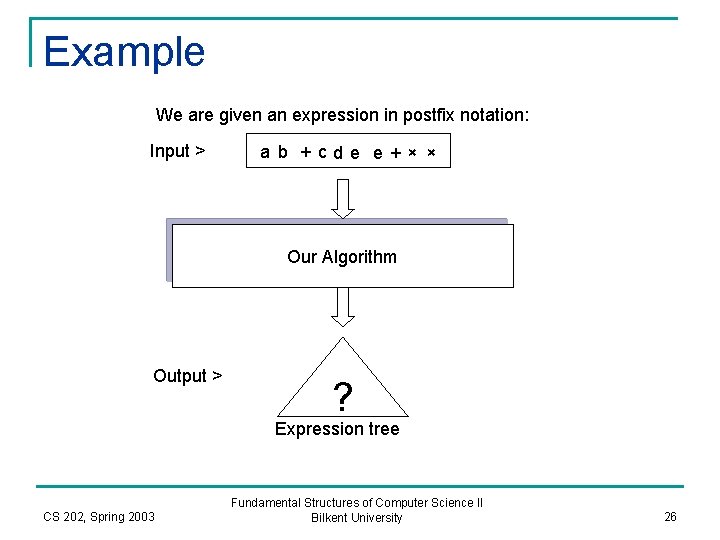
Construction an expression tree n n Given an expression tree, we can obtain the corresponding expression in postfix notation by traversing the expression tree in postorder fashion. Now, given an expression in postfix notation, we will see an algorithm to obtain the corresponding expression tree. CS 202, Spring 2003 Fundamental Structures of Computer Science II Bilkent University 24
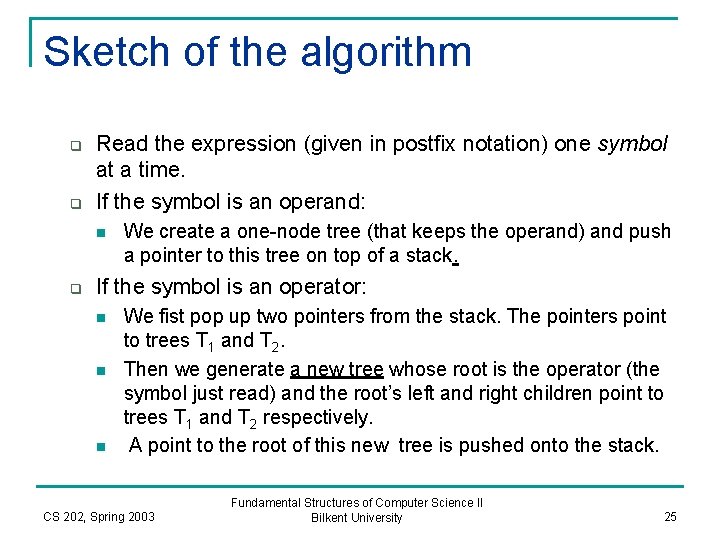
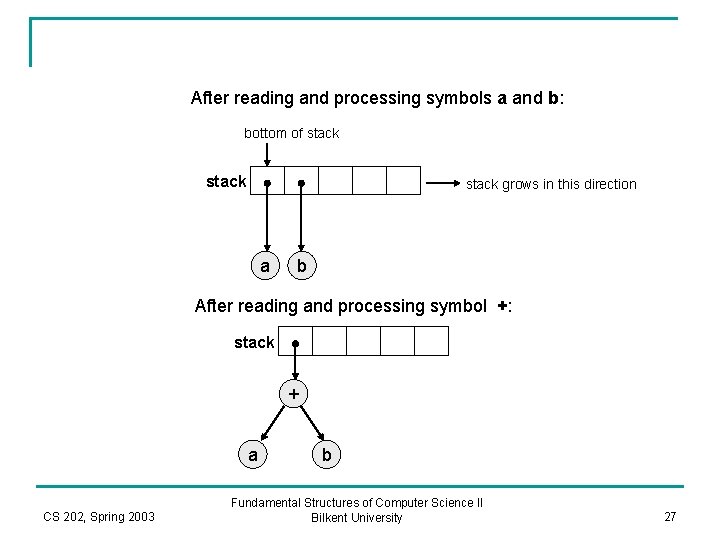
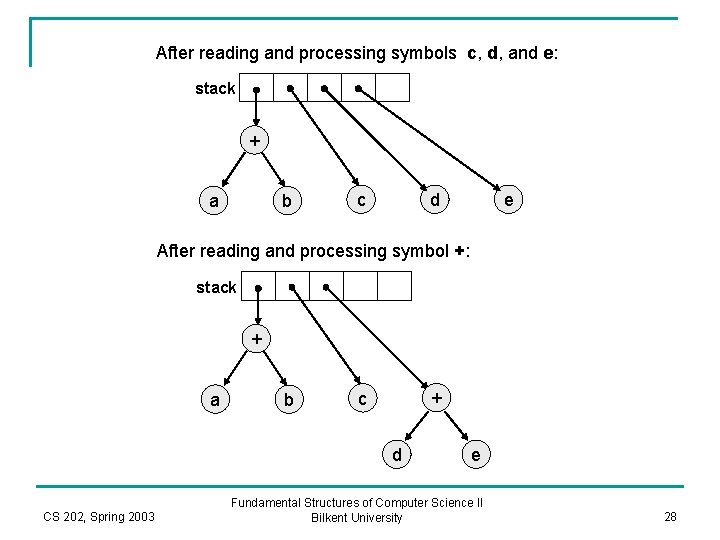
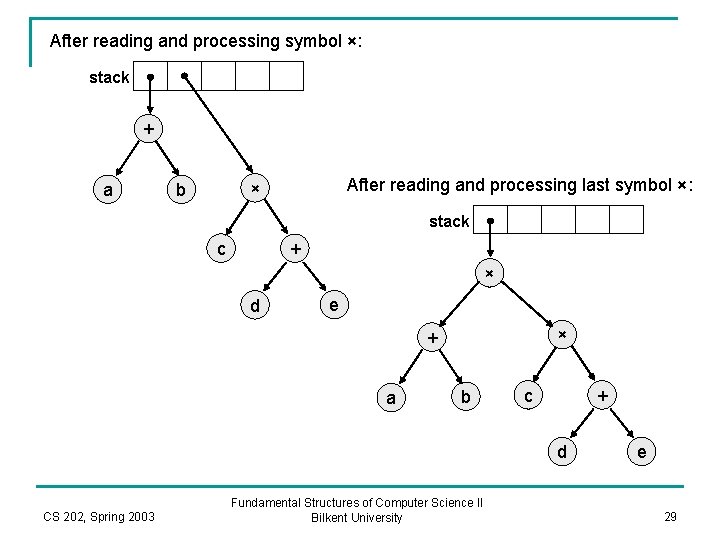
Sketch of the algorithm q q Read the expression (given in postfix notation) one symbol at a time. If the symbol is an operand: n q We create a one-node tree (that keeps the operand) and push a pointer to this tree on top of a stack. If the symbol is an operator: n n n We fist pop up two pointers from the stack. The pointers point to trees T 1 and T 2. Then we generate a new tree whose root is the operator (the symbol just read) and the root’s left and right children point to trees T 1 and T 2 respectively. A point to the root of this new tree is pushed onto the stack. CS 202, Spring 2003 Fundamental Structures of Computer Science II Bilkent University 25
Example We are given an expression in postfix notation: Input > a b + cde e+× × Our Algorithm Output > ? Expression tree CS 202, Spring 2003 Fundamental Structures of Computer Science II Bilkent University 26
After reading and processing symbols a and b: bottom of stack grows in this direction a b After reading and processing symbol +: stack + a CS 202, Spring 2003 b Fundamental Structures of Computer Science II Bilkent University 27
After reading and processing symbols c, d, and e: stack + a b c e d After reading and processing symbol +: stack + a b + c d CS 202, Spring 2003 e Fundamental Structures of Computer Science II Bilkent University 28
After reading and processing symbol ×: stack + a After reading and processing last symbol ×: × b stack c + × d e × + a b c + d CS 202, Spring 2003 Fundamental Structures of Computer Science II Bilkent University e 29
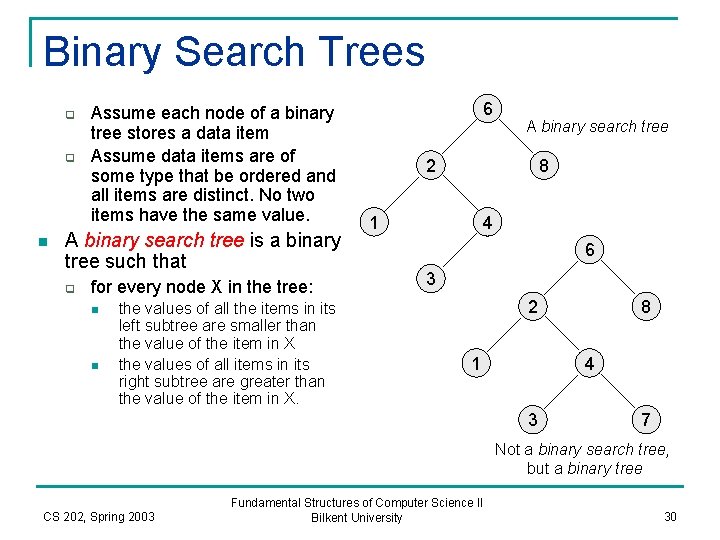
Binary Search Trees q q n Assume each node of a binary tree stores a data item Assume data items are of some type that be ordered and all items are distinct. No two items have the same value. A binary search tree is a binary tree such that q for every node X in the tree: n n the values of all the items in its left subtree are smaller than the value of the item in X the values of all items in its right subtree are greater than the value of the item in X. 6 A binary search tree 2 8 1 4 6 3 2 1 8 4 3 7 Not a binary search tree, but a binary tree CS 202, Spring 2003 Fundamental Structures of Computer Science II Bilkent University 30
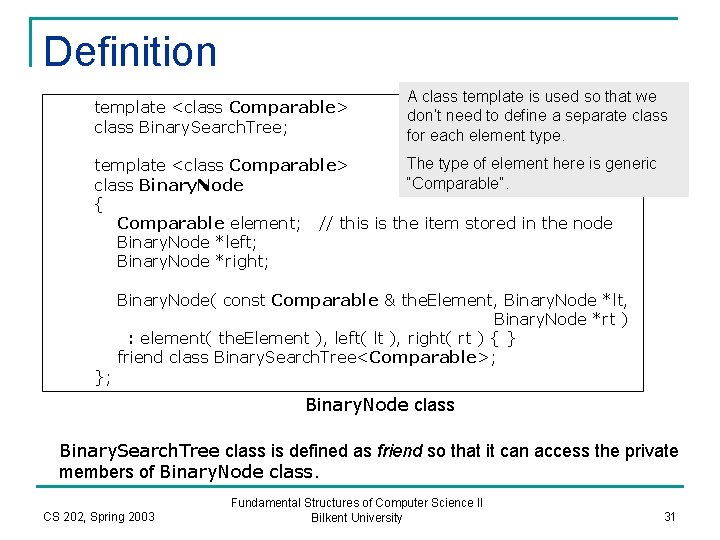
Definition template <class Comparable> class Binary. Search. Tree; A class template is used so that we don’t need to define a separate class for each element type. The type of element here is generic template <class Comparable> “Comparable”. class Binary. Node { Comparable element; // this is the item stored in the node Binary. Node *left; Binary. Node *right; }; Binary. Node( const Comparable & the. Element, Binary. Node *lt, Binary. Node *rt ) : element( the. Element ), left( lt ), right( rt ) { } friend class Binary. Search. Tree<Comparable>; Binary. Node class Binary. Search. Tree class is defined as friend so that it can access the private members of Binary. Node class. CS 202, Spring 2003 Fundamental Structures of Computer Science II Bilkent University 31
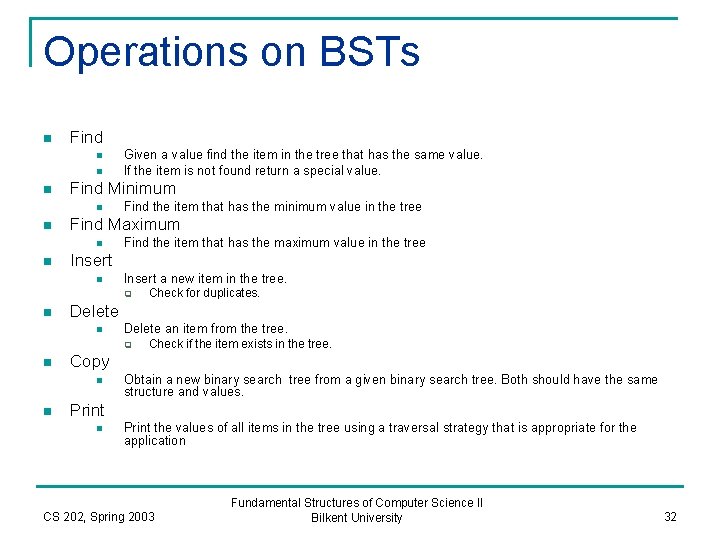
Operations on BSTs n Find n n n Find Minimum n n Find the item that has the minimum value in the tree Find Maximum n n Given a value find the item in the tree that has the same value. If the item is not found return a special value. Find the item that has the maximum value in the tree Insert n Insert a new item in the tree. q n Delete an item from the tree. q n Check if the item exists in the tree. Copy n n Check for duplicates. Obtain a new binary search tree from a given binary search tree. Both should have the same structure and values. Print n Print the values of all items in the tree using a traversal strategy that is appropriate for the application CS 202, Spring 2003 Fundamental Structures of Computer Science II Bilkent University 32
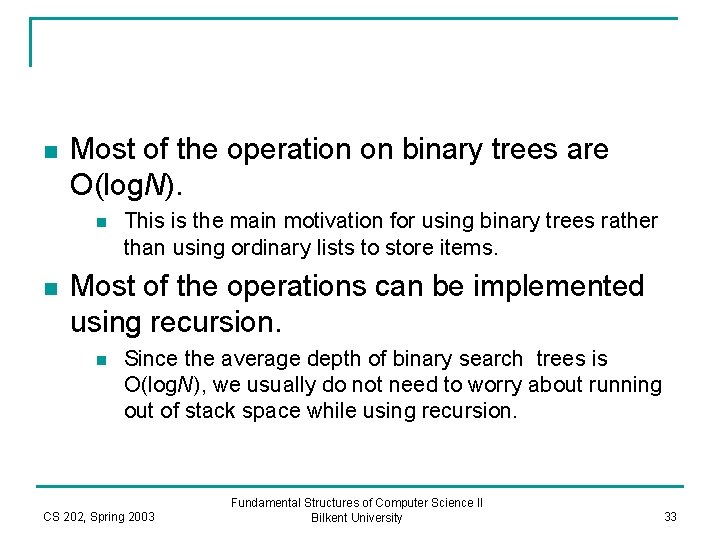
n Most of the operation on binary trees are O(log. N). n n This is the main motivation for using binary trees rather than using ordinary lists to store items. Most of the operations can be implemented using recursion. n Since the average depth of binary search trees is O(log. N), we usually do not need to worry about running out of stack space while using recursion. CS 202, Spring 2003 Fundamental Structures of Computer Science II Bilkent University 33
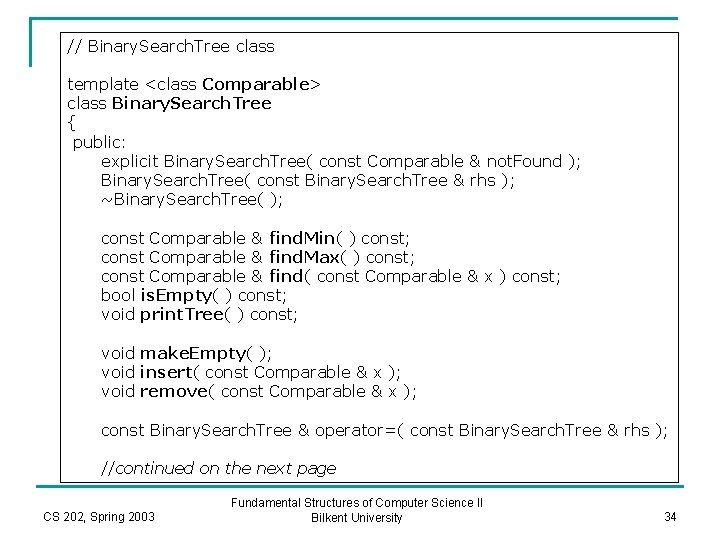
// Binary. Search. Tree class template <class Comparable> class Binary. Search. Tree { public: explicit Binary. Search. Tree( const Comparable & not. Found ); Binary. Search. Tree( const Binary. Search. Tree & rhs ); ~Binary. Search. Tree( ); const Comparable & find. Min( ) const; const Comparable & find. Max( ) const; const Comparable & find( const Comparable & x ) const; bool is. Empty( ) const; void print. Tree( ) const; void make. Empty( ); void insert( const Comparable & x ); void remove( const Comparable & x ); const Binary. Search. Tree & operator=( const Binary. Search. Tree & rhs ); //continued on the next page CS 202, Spring 2003 Fundamental Structures of Computer Science II Bilkent University 34
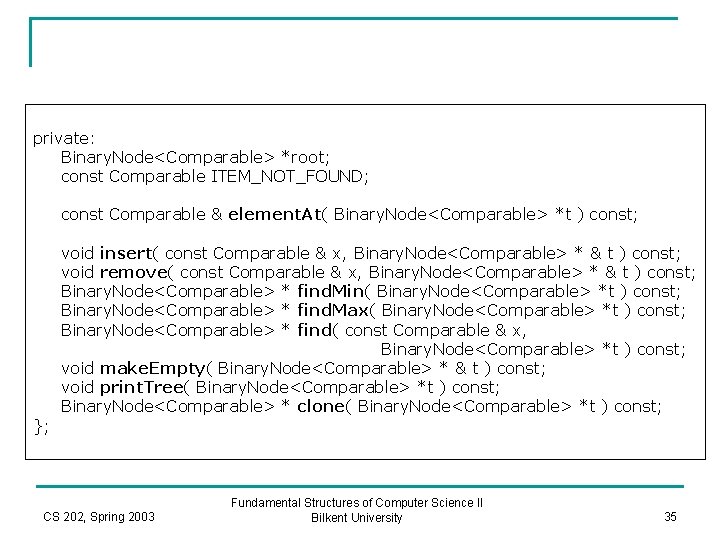
private: Binary. Node<Comparable> *root; const Comparable ITEM_NOT_FOUND; const Comparable & element. At( Binary. Node<Comparable> *t ) const; }; void insert( const Comparable & x, Binary. Node<Comparable> * & t ) const; void remove( const Comparable & x, Binary. Node<Comparable> * & t ) const; Binary. Node<Comparable> * find. Min( Binary. Node<Comparable> *t ) const; Binary. Node<Comparable> * find. Max( Binary. Node<Comparable> *t ) const; Binary. Node<Comparable> * find( const Comparable & x, Binary. Node<Comparable> *t ) const; void make. Empty( Binary. Node<Comparable> * & t ) const; void print. Tree( Binary. Node<Comparable> *t ) const; Binary. Node<Comparable> * clone( Binary. Node<Comparable> *t ) const; CS 202, Spring 2003 Fundamental Structures of Computer Science II Bilkent University 35
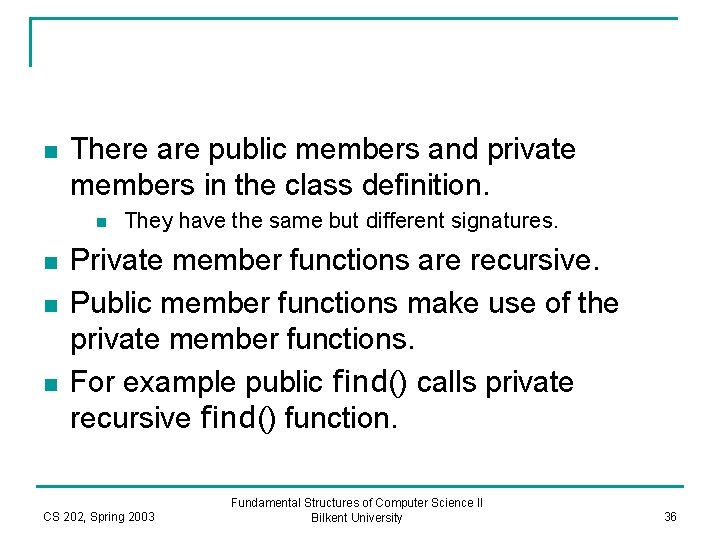
n There are public members and private members in the class definition. n n They have the same but different signatures. Private member functions are recursive. Public member functions make use of the private member functions. For example public find() calls private recursive find() function. CS 202, Spring 2003 Fundamental Structures of Computer Science II Bilkent University 36
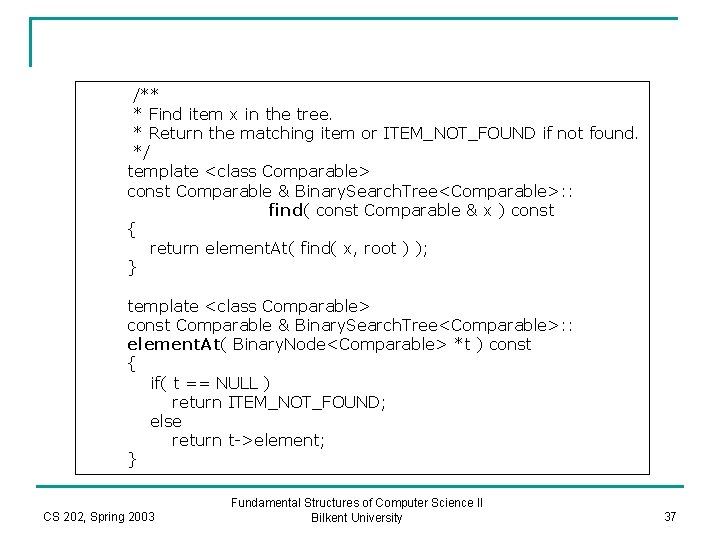
/** * Find item x in the tree. * Return the matching item or ITEM_NOT_FOUND if not found. */ template <class Comparable> const Comparable & Binary. Search. Tree<Comparable>: : find( const Comparable & x ) const { return element. At( find( x, root ) ); } template <class Comparable> const Comparable & Binary. Search. Tree<Comparable>: : element. At( Binary. Node<Comparable> *t ) const { if( t == NULL ) return ITEM_NOT_FOUND; else return t->element; } CS 202, Spring 2003 Fundamental Structures of Computer Science II Bilkent University 37
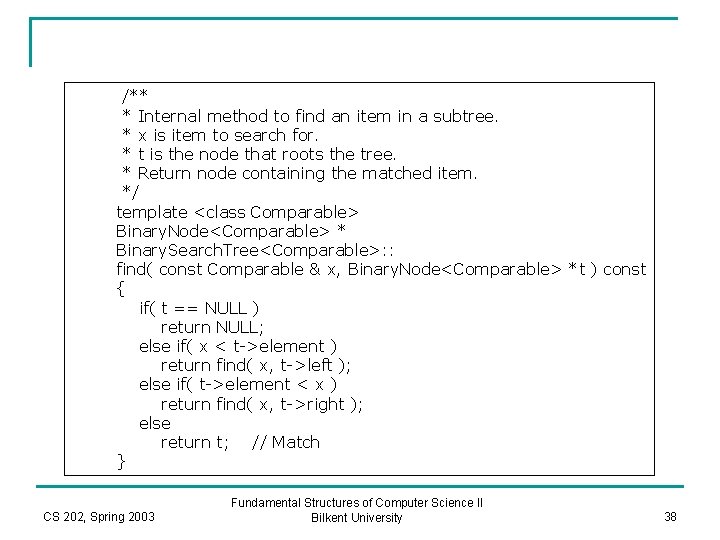
/** * Internal method to find an item in a subtree. * x is item to search for. * t is the node that roots the tree. * Return node containing the matched item. */ template <class Comparable> Binary. Node<Comparable> * Binary. Search. Tree<Comparable>: : find( const Comparable & x, Binary. Node<Comparable> *t ) const { if( t == NULL ) return NULL; else if( x < t->element ) return find( x, t->left ); else if( t->element < x ) return find( x, t->right ); else return t; // Match } CS 202, Spring 2003 Fundamental Structures of Computer Science II Bilkent University 38
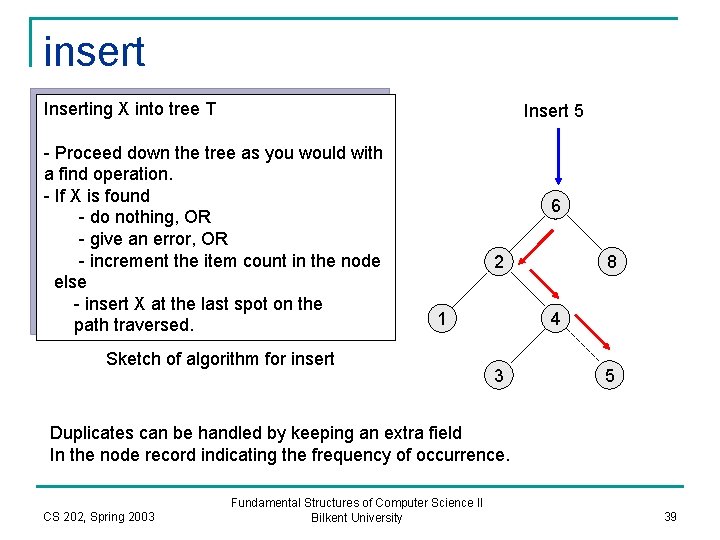
insert Inserting X into tree T Insert 5 - Proceed down the tree as you would with a find operation. - If X is found - do nothing, OR - give an error, OR - increment the item count in the node else - insert X at the last spot on the path traversed. 6 2 1 Sketch of algorithm for insert 8 4 3 5 Duplicates can be handled by keeping an extra field In the node record indicating the frequency of occurrence. CS 202, Spring 2003 Fundamental Structures of Computer Science II Bilkent University 39
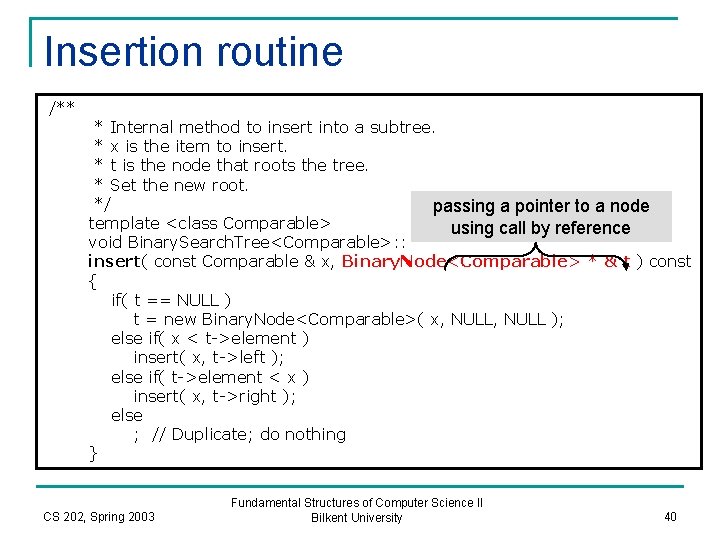
Insertion routine /** * Internal method to insert into a subtree. * x is the item to insert. * t is the node that roots the tree. * Set the new root. */ passing a pointer to a node template <class Comparable> using call by reference void Binary. Search. Tree<Comparable>: : insert( const Comparable & x, Binary. Node<Comparable> * & t ) const { if( t == NULL ) t = new Binary. Node<Comparable>( x, NULL ); else if( x < t->element ) insert( x, t->left ); else if( t->element < x ) insert( x, t->right ); else ; // Duplicate; do nothing } CS 202, Spring 2003 Fundamental Structures of Computer Science II Bilkent University 40
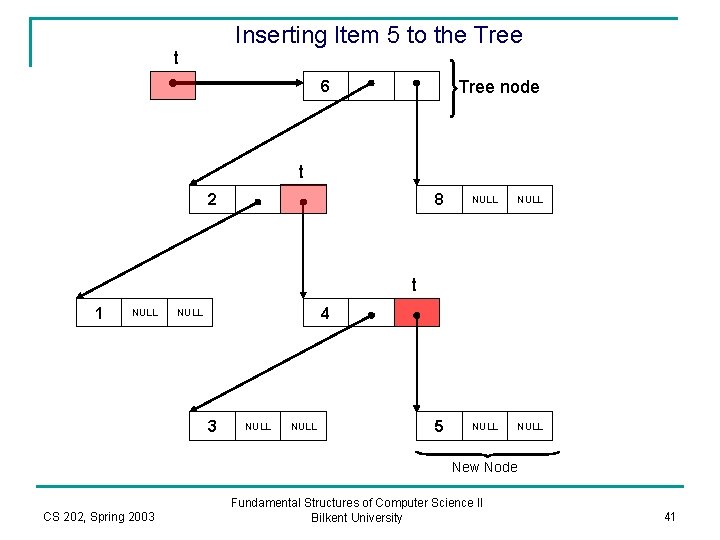
Inserting Item 5 to the Tree t Tree node 6 t 2 8 NULL 5 NULL t 1 NULL 4 NULL 3 NULL New Node CS 202, Spring 2003 Fundamental Structures of Computer Science II Bilkent University 41
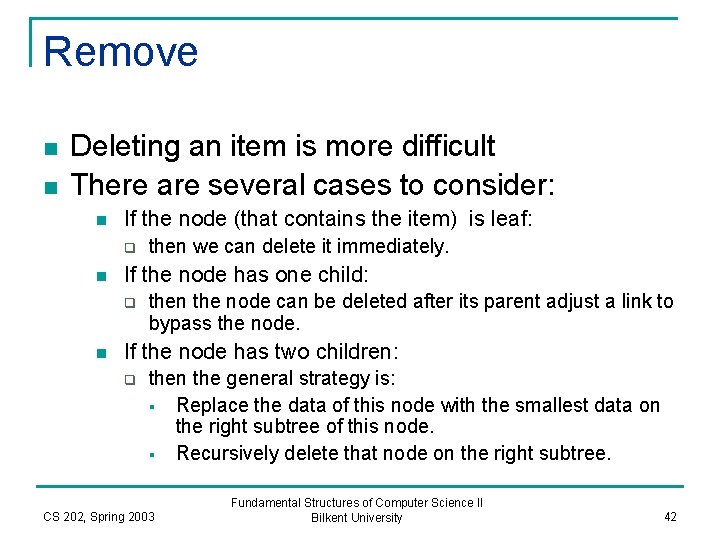
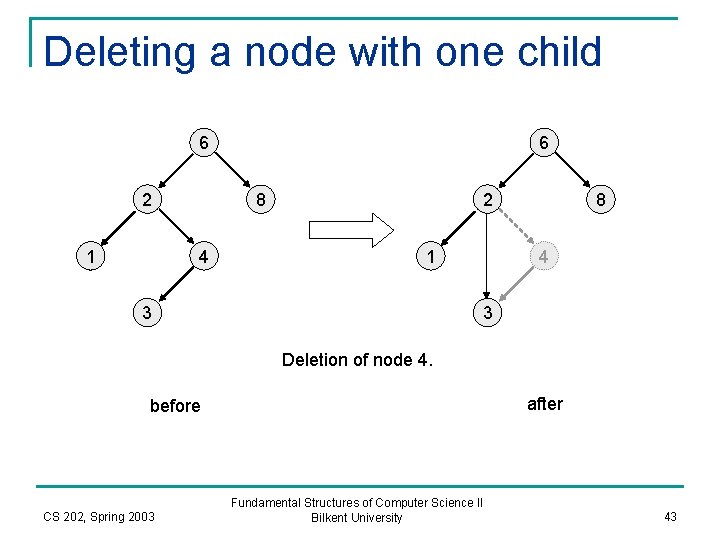
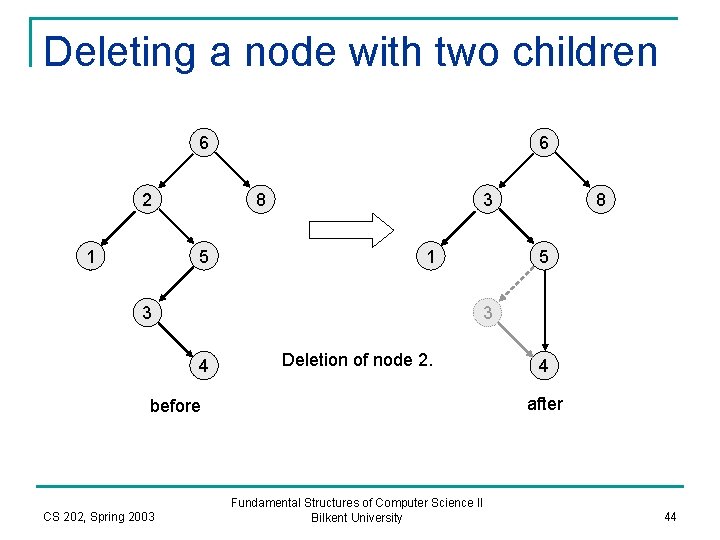
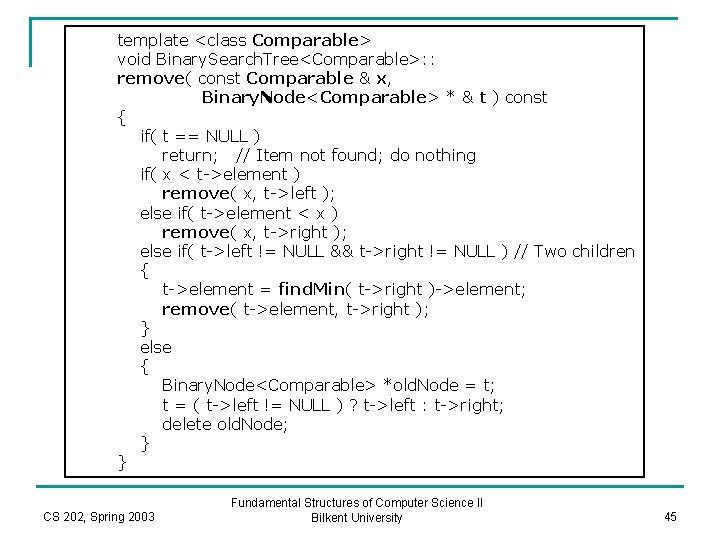
Remove n n Deleting an item is more difficult There are several cases to consider: n If the node (that contains the item) is leaf: q n If the node has one child: q n then we can delete it immediately. then the node can be deleted after its parent adjust a link to bypass the node. If the node has two children: q then the general strategy is: § Replace the data of this node with the smallest data on the right subtree of this node. § Recursively delete that node on the right subtree. CS 202, Spring 2003 Fundamental Structures of Computer Science II Bilkent University 42
Deleting a node with one child 6 2 1 6 2 8 4 1 3 8 4 3 Deletion of node 4. after before CS 202, Spring 2003 Fundamental Structures of Computer Science II Bilkent University 43
Deleting a node with two children 6 2 1 6 3 8 5 1 3 5 3 4 Deletion of node 2. 4 after before CS 202, Spring 2003 8 Fundamental Structures of Computer Science II Bilkent University 44
template <class Comparable> void Binary. Search. Tree<Comparable>: : remove( const Comparable & x, Binary. Node<Comparable> * & t ) const { if( t == NULL ) return; // Item not found; do nothing if( x < t->element ) remove( x, t->left ); else if( t->element < x ) remove( x, t->right ); else if( t->left != NULL && t->right != NULL ) // Two children { t->element = find. Min( t->right )->element; remove( t->element, t->right ); } else { Binary. Node<Comparable> *old. Node = t; t = ( t->left != NULL ) ? t->left : t->right; delete old. Node; } } CS 202, Spring 2003 Fundamental Structures of Computer Science II Bilkent University 45
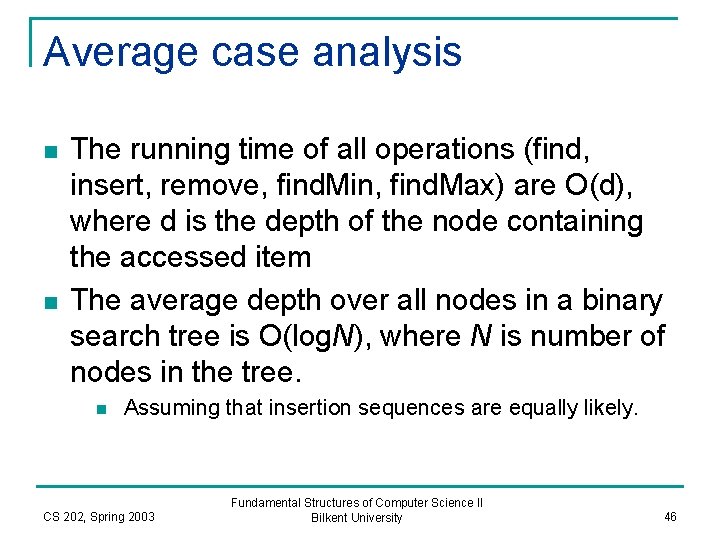
Average case analysis n n The running time of all operations (find, insert, remove, find. Min, find. Max) are O(d), where d is the depth of the node containing the accessed item The average depth over all nodes in a binary search tree is O(log. N), where N is number of nodes in the tree. n Assuming that insertion sequences are equally likely. CS 202, Spring 2003 Fundamental Structures of Computer Science II Bilkent University 46
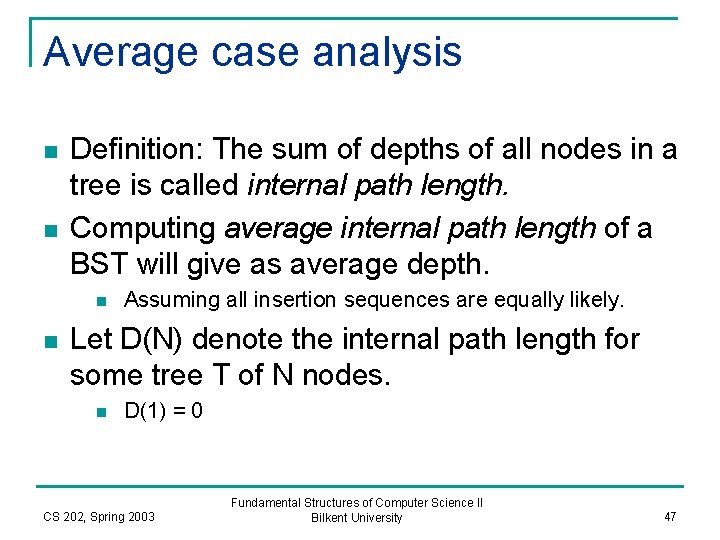
Average case analysis n n Definition: The sum of depths of all nodes in a tree is called internal path length. Computing average internal path length of a BST will give as average depth. n n Assuming all insertion sequences are equally likely. Let D(N) denote the internal path length for some tree T of N nodes. n D(1) = 0 CS 202, Spring 2003 Fundamental Structures of Computer Science II Bilkent University 47
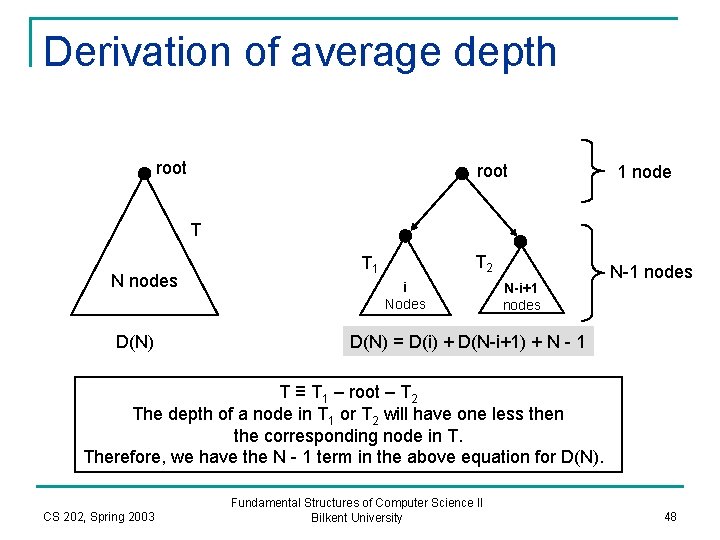
Derivation of average depth root 1 node T N nodes D(N) T 2 T 1 i Nodes N-i+1 nodes N-1 nodes D(N) = D(i) + D(N-i+1) + N - 1 T ≡ T 1 – root – T 2 The depth of a node in T 1 or T 2 will have one less then the corresponding node in T. Therefore, we have the N - 1 term in the above equation for D(N). CS 202, Spring 2003 Fundamental Structures of Computer Science II Bilkent University 48
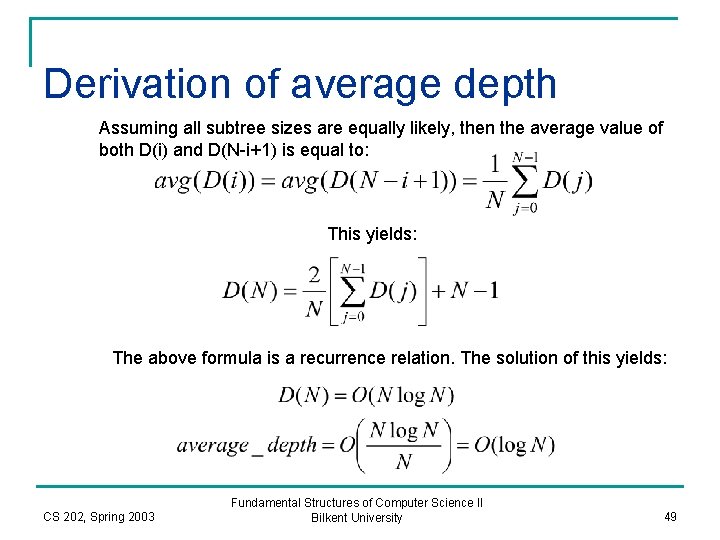
Derivation of average depth Assuming all subtree sizes are equally likely, then the average value of both D(i) and D(N-i+1) is equal to: This yields: The above formula is a recurrence relation. The solution of this yields: CS 202, Spring 2003 Fundamental Structures of Computer Science II Bilkent University 49
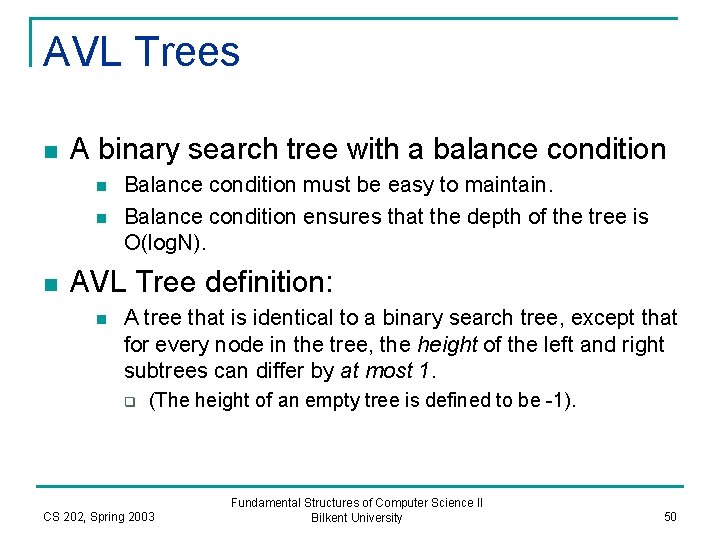
AVL Trees n A binary search tree with a balance condition n Balance condition must be easy to maintain. Balance condition ensures that the depth of the tree is O(log. N). AVL Tree definition: n A tree that is identical to a binary search tree, except that for every node in the tree, the height of the left and right subtrees can differ by at most 1. q (The height of an empty tree is defined to be -1). CS 202, Spring 2003 Fundamental Structures of Computer Science II Bilkent University 50
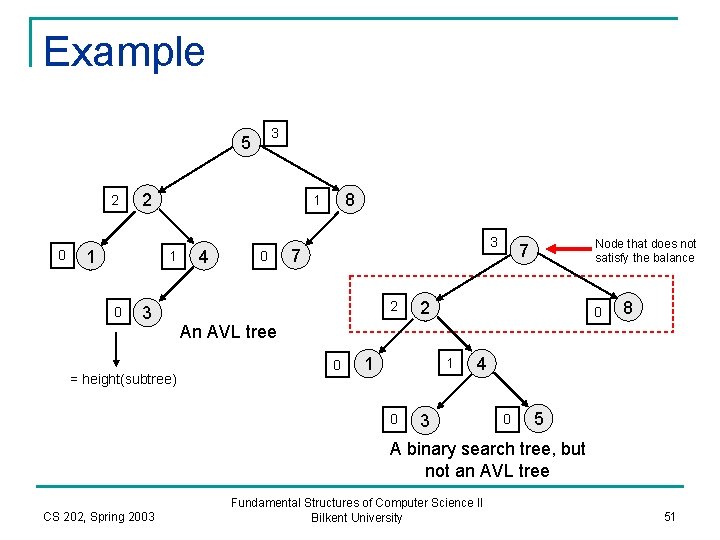
Example 3 5 2 0 2 1 1 0 8 1 3 = height(subtree) 4 0 3 7 2 Node that does not satisfy the balance 7 2 0 8 An AVL tree 0 1 1 0 4 3 0 5 A binary search tree, but not an AVL tree CS 202, Spring 2003 Fundamental Structures of Computer Science II Bilkent University 51
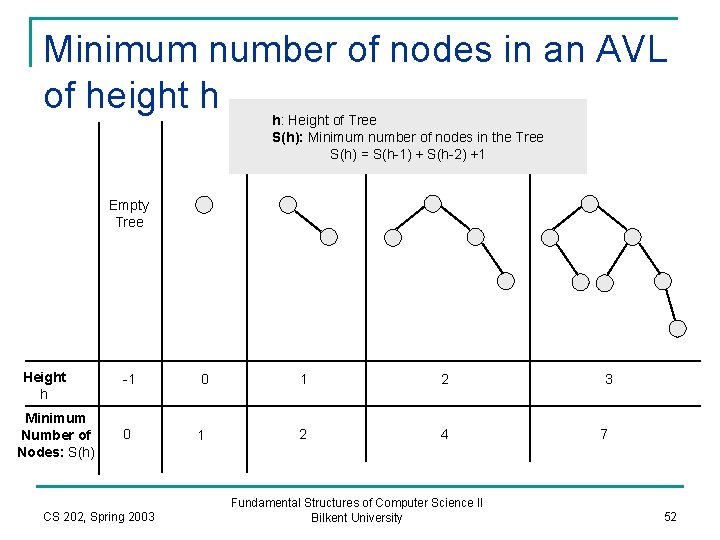
Minimum number of nodes in an AVL of height h h: Height of Tree S(h): Minimum number of nodes in the Tree S(h) = S(h-1) + S(h-2) +1 Empty Tree Height h Minimum Number of Nodes: S(h) -1 0 1 2 4 CS 202, Spring 2003 Fundamental Structures of Computer Science II Bilkent University 3 7 52
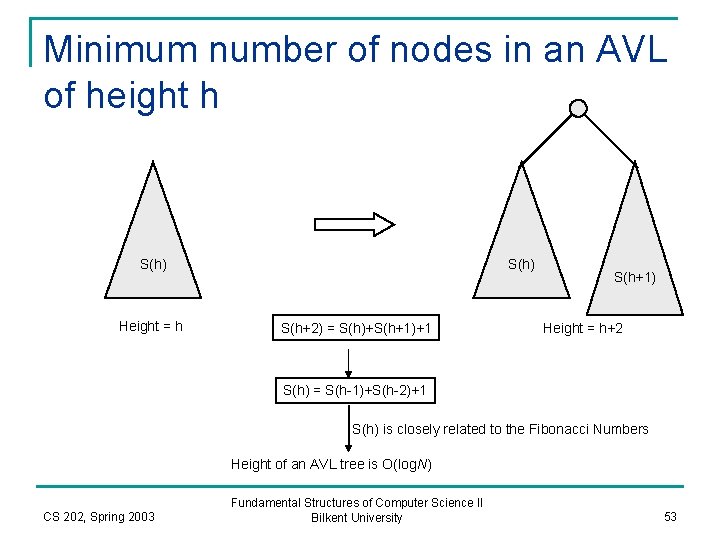
Minimum number of nodes in an AVL of height h S(h) Height = h S(h) S(h+2) = S(h)+S(h+1)+1 S(h+1) Height = h+2 S(h) = S(h-1)+S(h-2)+1 S(h) is closely related to the Fibonacci Numbers Height of an AVL tree is O(log. N) CS 202, Spring 2003 Fundamental Structures of Computer Science II Bilkent University 53
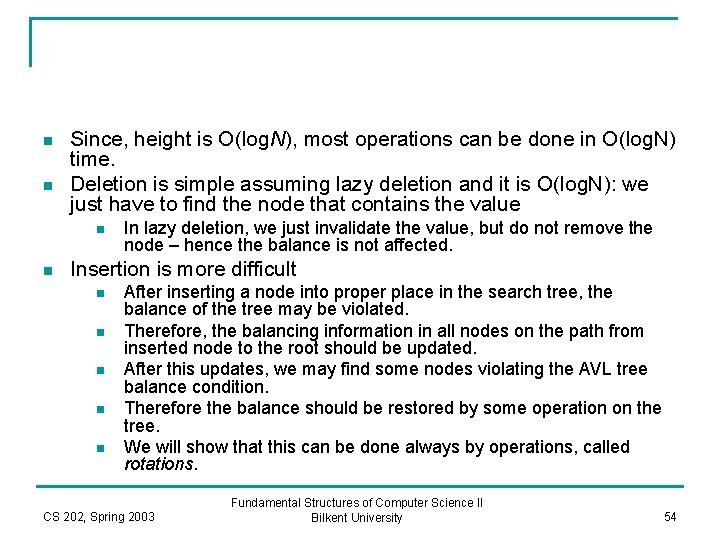
n n Since, height is O(log. N), most operations can be done in O(log. N) time. Deletion is simple assuming lazy deletion and it is O(log. N): we just have to find the node that contains the value n n In lazy deletion, we just invalidate the value, but do not remove the node – hence the balance is not affected. Insertion is more difficult n n n After inserting a node into proper place in the search tree, the balance of the tree may be violated. Therefore, the balancing information in all nodes on the path from inserted node to the root should be updated. After this updates, we may find some nodes violating the AVL tree balance condition. Therefore the balance should be restored by some operation on the tree. We will show that this can be done always by operations, called rotations. CS 202, Spring 2003 Fundamental Structures of Computer Science II Bilkent University 54
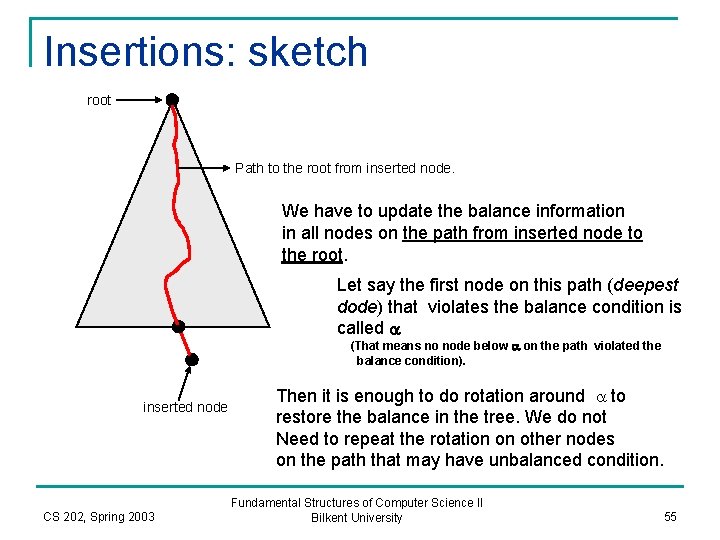
Insertions: sketch root Path to the root from inserted node. We have to update the balance information in all nodes on the path from inserted node to the root. Let say the first node on this path (deepest dode) that violates the balance condition is called a (That means no node below a on the path violated the balance condition). inserted node CS 202, Spring 2003 Then it is enough to do rotation around a to restore the balance in the tree. We do not Need to repeat the rotation on other nodes on the path that may have unbalanced condition. Fundamental Structures of Computer Science II Bilkent University 55
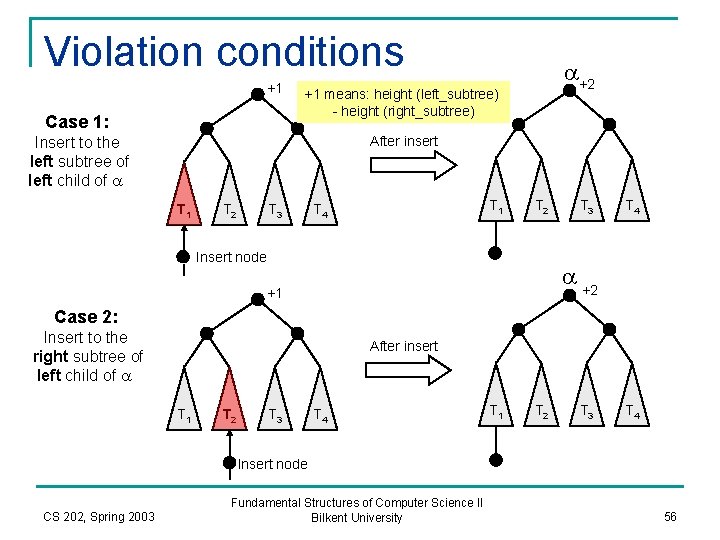
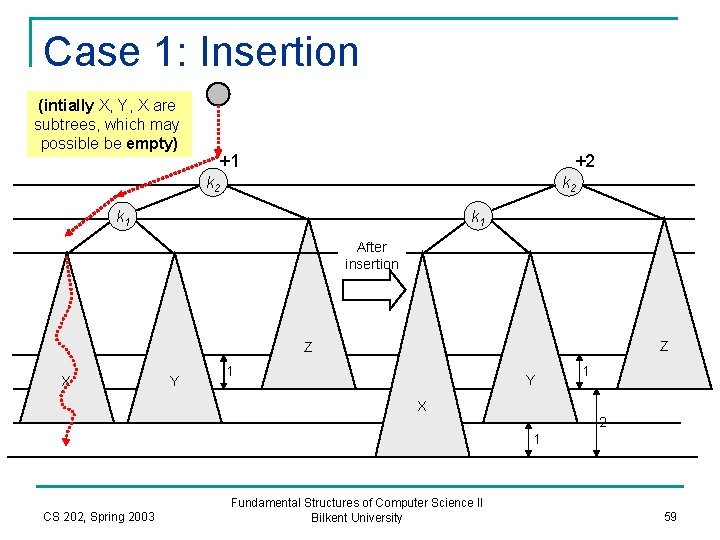
Violation conditions +1 Case 1: a+2 +1 means: height (left_subtree) - height (right_subtree) After insert Insert to the left subtree of left child of a T 1 T 2 T 3 T 1 T 4 T 2 Insert node T 3 T 4 a +2 +1 Case 2: Insert to the right subtree of left child of a After insert T 1 T 2 T 3 T 4 Insert node CS 202, Spring 2003 Fundamental Structures of Computer Science II Bilkent University 56
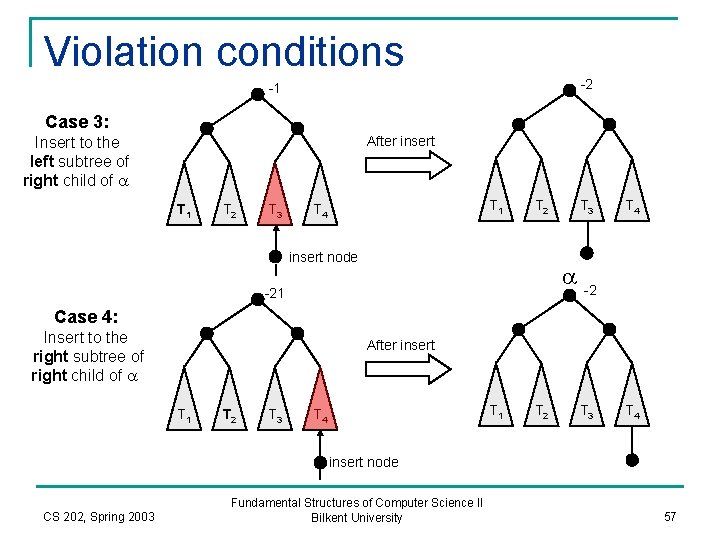
Violation conditions -2 -1 Case 3: After insert Insert to the left subtree of right child of a T 1 T 2 T 3 T 1 T 4 T 2 insert node T 3 T 4 a -2 -21 Case 4: Insert to the right subtree of right child of a After insert T 1 T 2 T 3 T 1 T 4 T 2 T 3 T 4 insert node CS 202, Spring 2003 Fundamental Structures of Computer Science II Bilkent University 57
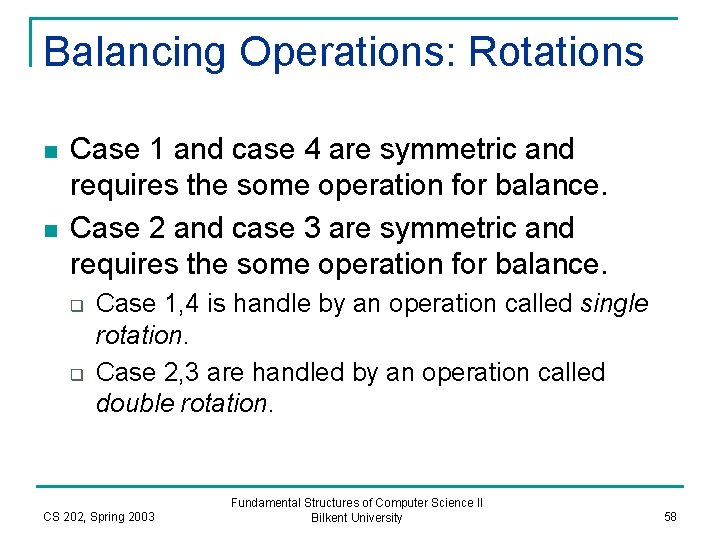
Balancing Operations: Rotations n n Case 1 and case 4 are symmetric and requires the some operation for balance. Case 2 and case 3 are symmetric and requires the some operation for balance. q q Case 1, 4 is handle by an operation called single rotation. Case 2, 3 are handled by an operation called double rotation. CS 202, Spring 2003 Fundamental Structures of Computer Science II Bilkent University 58
Case 1: Insertion (intially X, Y, X are subtrees, which may possible be empty) +2 +1 k 2 k 1 After insertion Z Z X Y 1 Y X 1 2 1 CS 202, Spring 2003 Fundamental Structures of Computer Science II Bilkent University 59
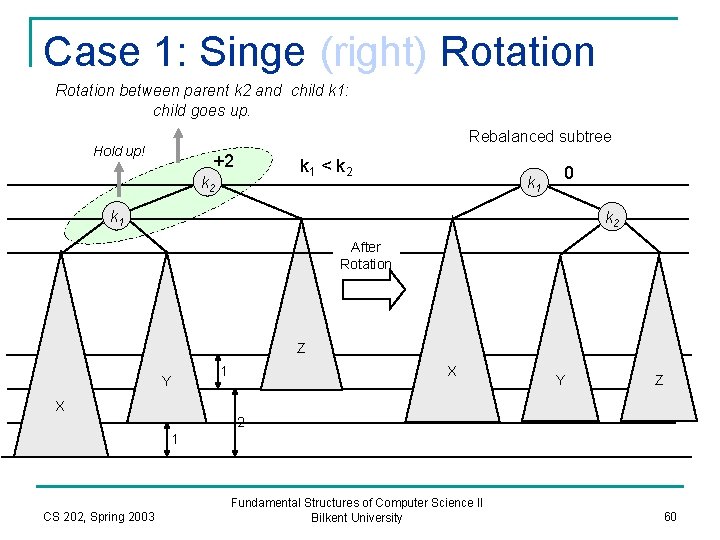
Case 1: Singe (right) Rotation between parent k 2 and child k 1: child goes up. Rebalanced subtree Hold up! +2 k 1 < k 2 k 1 0 k 1 k 2 After Rotation Z Y 1 X Y Z X 2 1 CS 202, Spring 2003 Fundamental Structures of Computer Science II Bilkent University 60
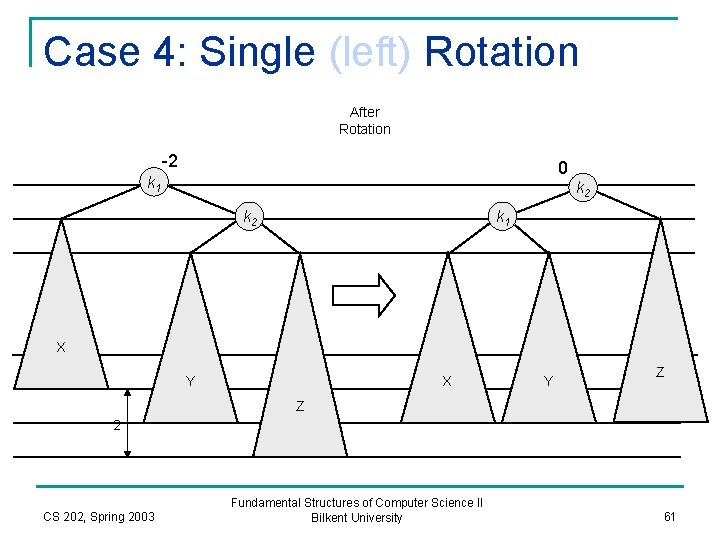
Case 4: Single (left) Rotation After Rotation -2 0 k 1 k 2 k 1 X Y Z Z 2 CS 202, Spring 2003 Fundamental Structures of Computer Science II Bilkent University 61
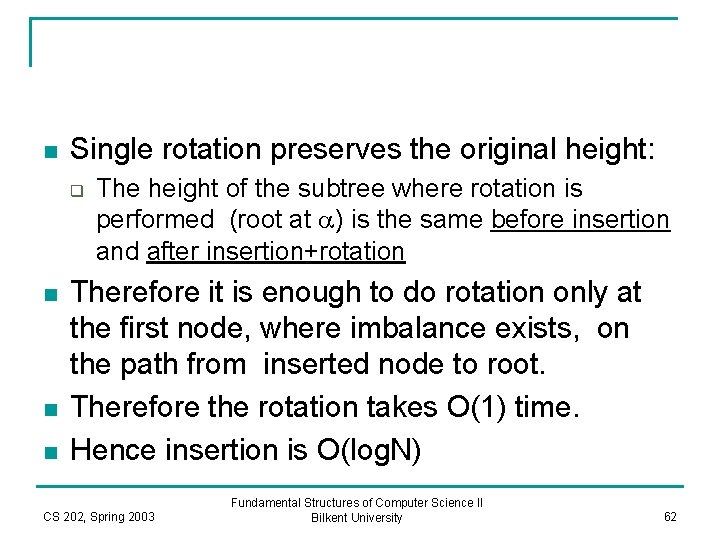
n Single rotation preserves the original height: q n n n The height of the subtree where rotation is performed (root at a) is the same before insertion and after insertion+rotation Therefore it is enough to do rotation only at the first node, where imbalance exists, on the path from inserted node to root. Therefore the rotation takes O(1) time. Hence insertion is O(log. N) CS 202, Spring 2003 Fundamental Structures of Computer Science II Bilkent University 62
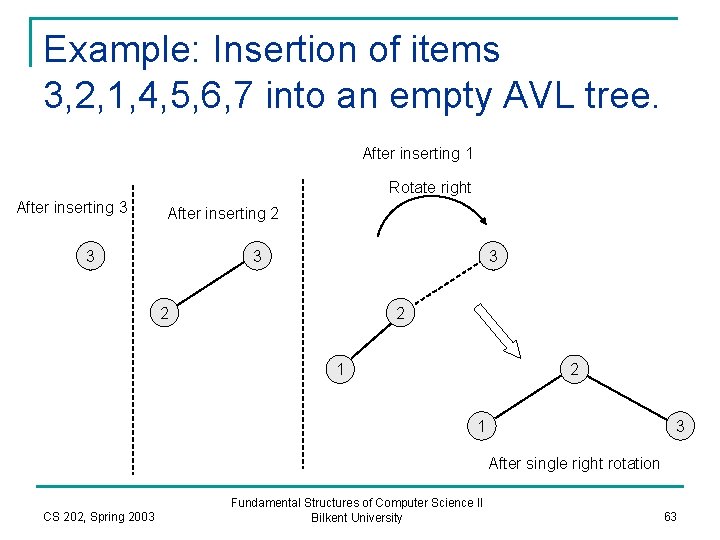
Example: Insertion of items 3, 2, 1, 4, 5, 6, 7 into an empty AVL tree. After inserting 1 Rotate right After inserting 3 After inserting 2 3 3 3 2 2 1 3 After single right rotation CS 202, Spring 2003 Fundamental Structures of Computer Science II Bilkent University 63
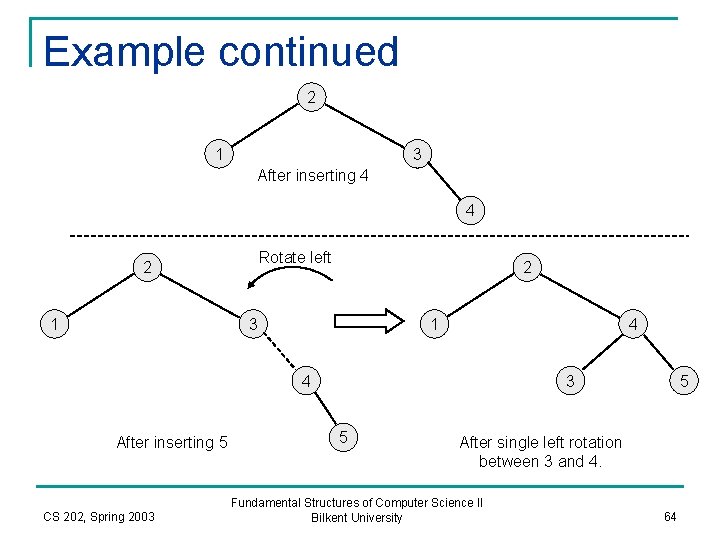
Example continued 2 1 3 After inserting 4 4 Rotate left 2 1 2 3 1 4 4 After inserting 5 CS 202, Spring 2003 3 5 5 After single left rotation between 3 and 4. Fundamental Structures of Computer Science II Bilkent University 64
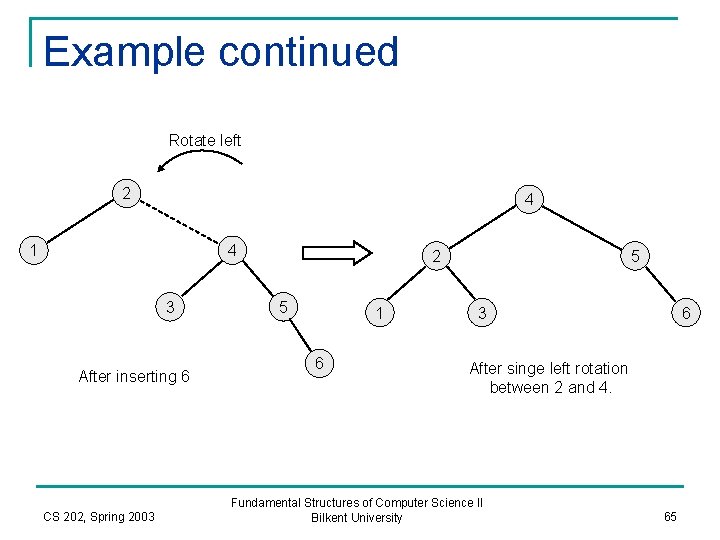
Example continued Rotate left 2 4 1 4 3 After inserting 6 CS 202, Spring 2003 2 5 1 6 5 3 6 After singe left rotation between 2 and 4. Fundamental Structures of Computer Science II Bilkent University 65
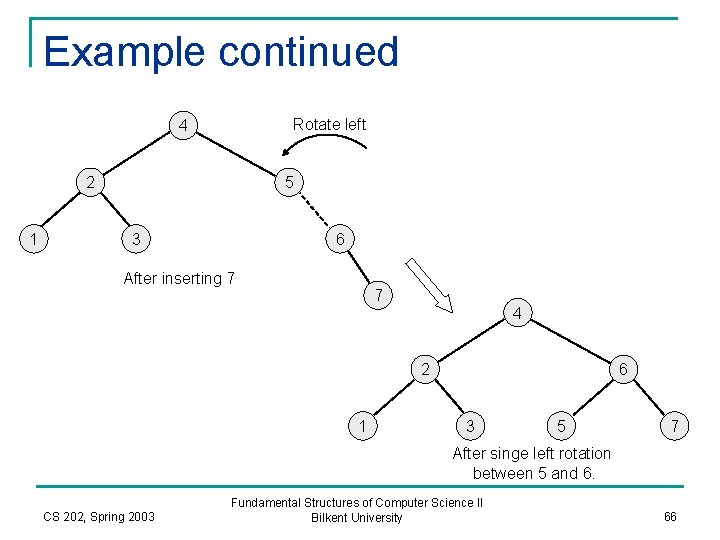
Example continued Rotate left 4 2 1 5 3 6 After inserting 7 7 4 2 1 6 3 5 7 After singe left rotation between 5 and 6. CS 202, Spring 2003 Fundamental Structures of Computer Science II Bilkent University 66
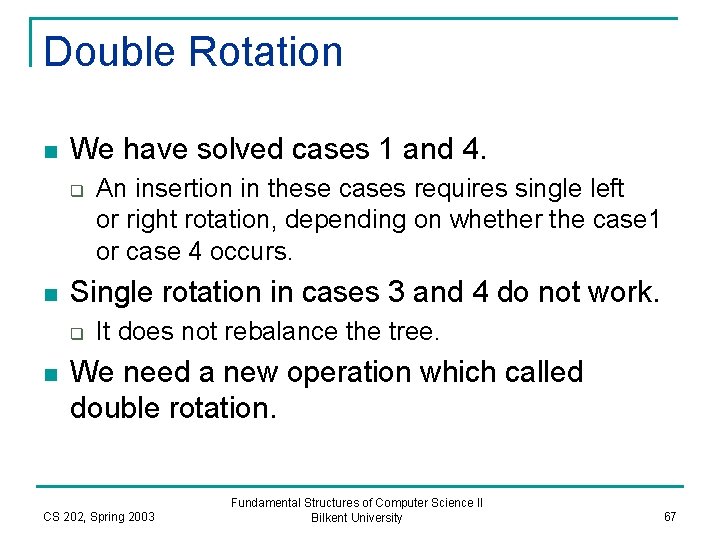
Double Rotation n We have solved cases 1 and 4. q n Single rotation in cases 3 and 4 do not work. q n An insertion in these cases requires single left or right rotation, depending on whether the case 1 or case 4 occurs. It does not rebalance the tree. We need a new operation which called double rotation. CS 202, Spring 2003 Fundamental Structures of Computer Science II Bilkent University 67
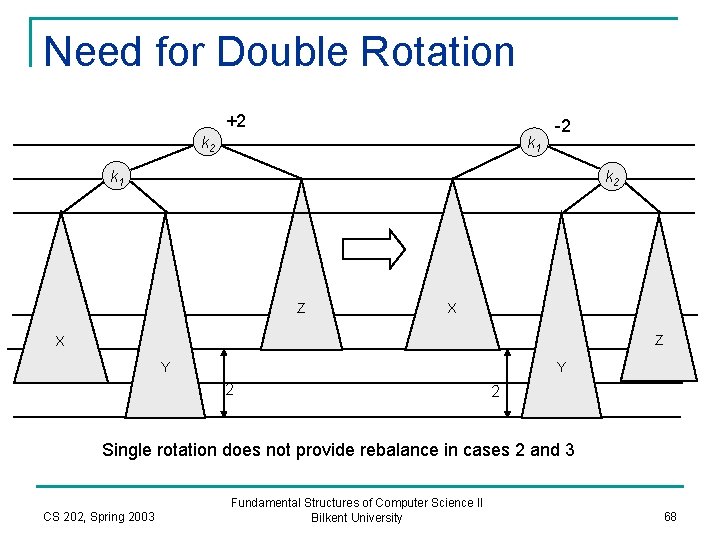
Need for Double Rotation +2 k 1 -2 k 1 k 2 Z X Y Y 2 2 Single rotation does not provide rebalance in cases 2 and 3 CS 202, Spring 2003 Fundamental Structures of Computer Science II Bilkent University 68
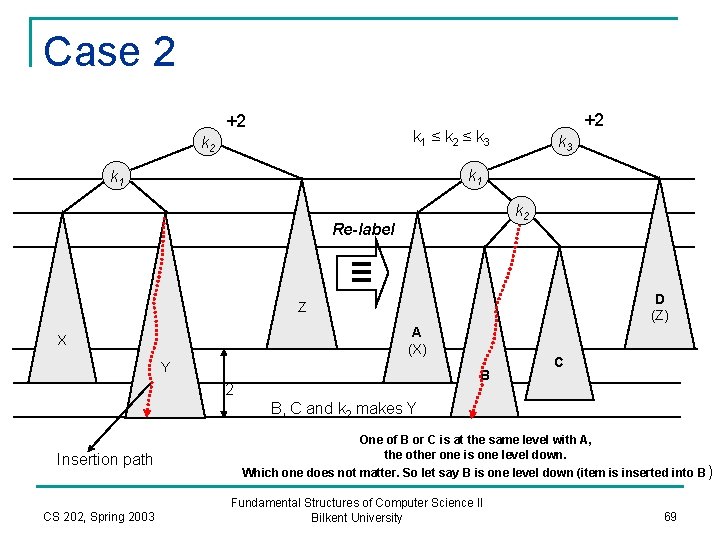
Case 2 +2 +2 k 1 ≤ k 2 ≤ k 3 k 2 k 3 k 1 k 2 Re-label ≡ D (Z) Z A (X) X Y B 2 C B, C and k 2 makes Y Insertion path CS 202, Spring 2003 One of B or C is at the same level with A, the other one is one level down. Which one does not matter. So let say B is one level down (item is inserted into B ) Fundamental Structures of Computer Science II Bilkent University 69
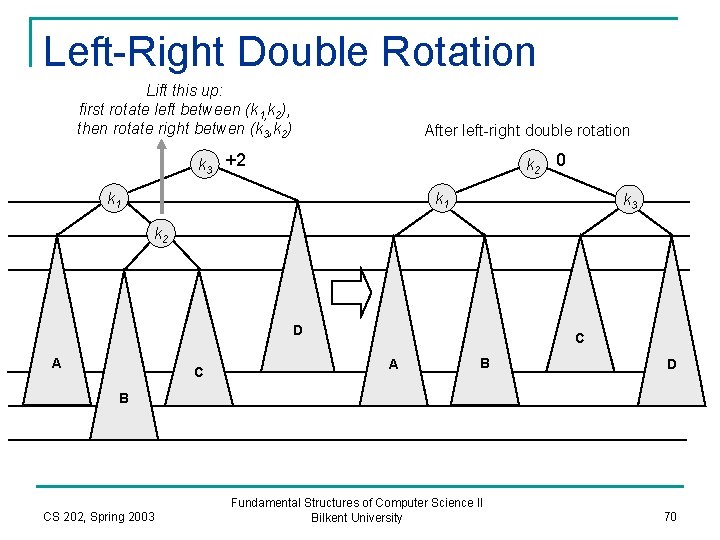
Left-Right Double Rotation Lift this up: first rotate left between (k 1, k 2), then rotate right betwen (k 3, k 2) After left-right double rotation k 3 +2 k 2 0 k 1 k 3 k 2 D A C C A B D B CS 202, Spring 2003 Fundamental Structures of Computer Science II Bilkent University 70
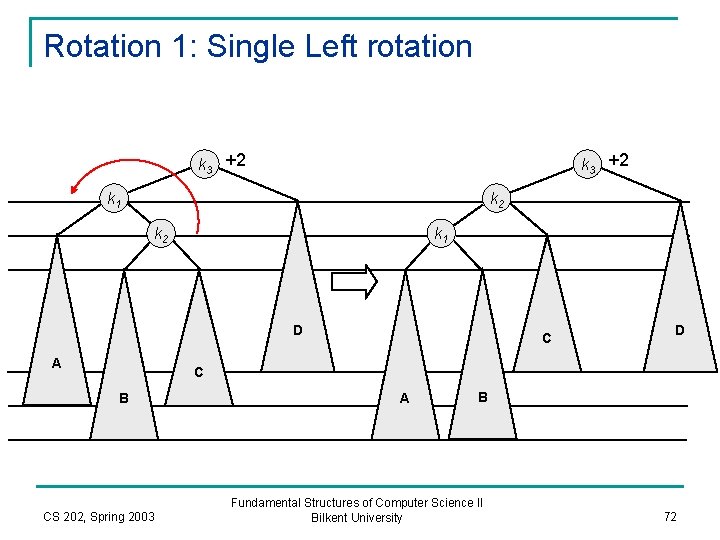
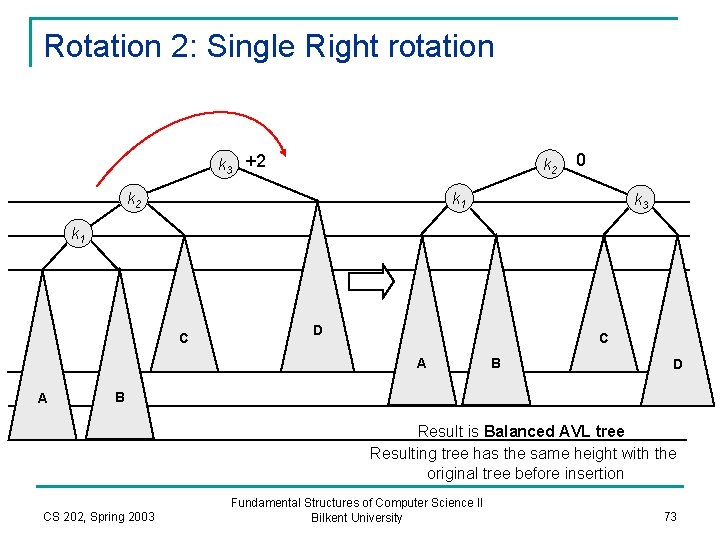
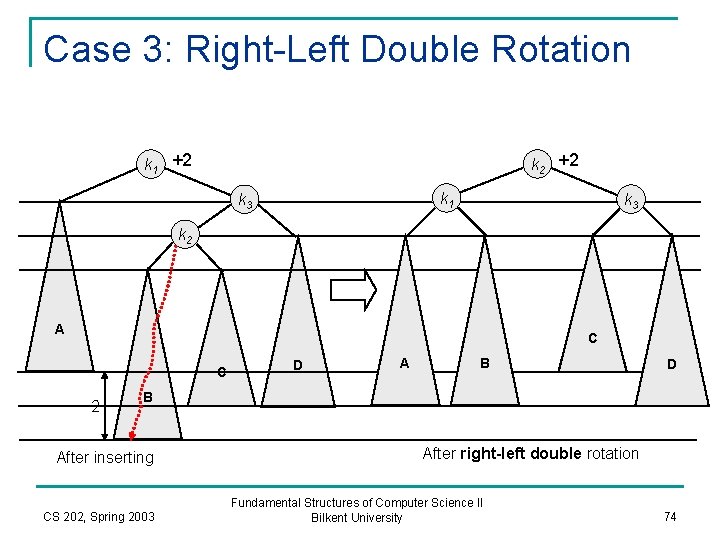
n A left-right double rotation can be done as a sequence of two single rotations: q q 1 st rotation on the original tree: a left rotation between left-child and grandchild 2 nd rotation on the new tree: a right rotation between a node and its left child. CS 202, Spring 2003 Fundamental Structures of Computer Science II Bilkent University 71
Rotation 1: Single Left rotation k 3 +2 k 1 k 2 k 1 D A C D C B CS 202, Spring 2003 A B Fundamental Structures of Computer Science II Bilkent University 72
Rotation 2: Single Right rotation k 3 +2 k 2 0 k 1 k 2 k 3 k 1 C D C A A B D B Result is Balanced AVL tree Resulting tree has the same height with the original tree before insertion CS 202, Spring 2003 Fundamental Structures of Computer Science II Bilkent University 73
Case 3: Right-Left Double Rotation k 2 +2 k 1 k 3 k 2 A C C 2 D A B D B After inserting CS 202, Spring 2003 After right-left double rotation Fundamental Structures of Computer Science II Bilkent University 74
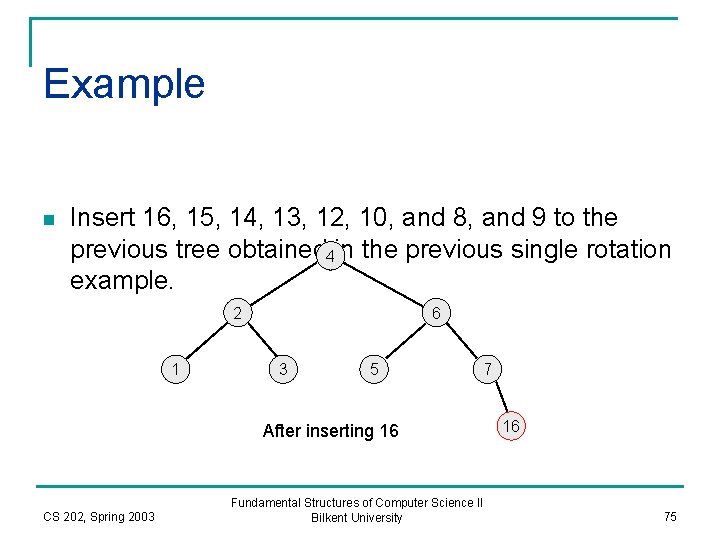
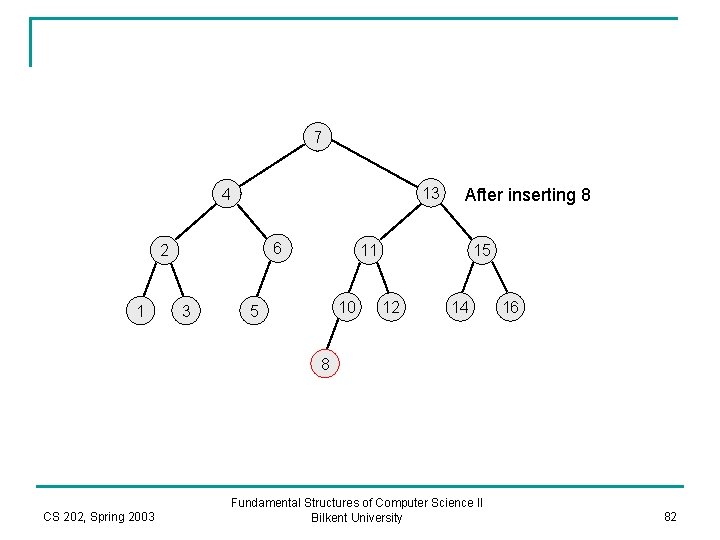
Example n Insert 16, 15, 14, 13, 12, 10, and 8, and 9 to the previous tree obtained 4 in the previous single rotation example. 2 1 6 3 5 7 After inserting 16 CS 202, Spring 2003 Fundamental Structures of Computer Science II Bilkent University 16 75
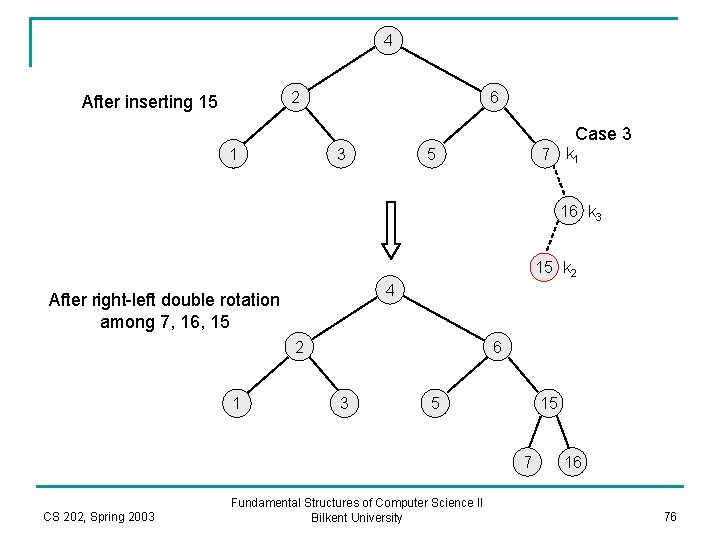
4 2 After inserting 15 6 Case 3 1 3 7 k 1 5 16 k 3 15 k 2 4 After right-left double rotation among 7, 16, 15 2 1 6 3 5 15 7 CS 202, Spring 2003 Fundamental Structures of Computer Science II Bilkent University 16 76
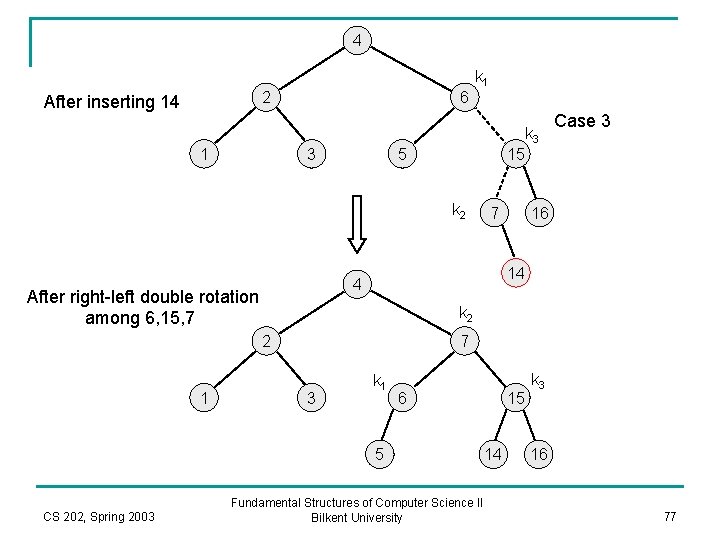
4 k 1 2 After inserting 14 6 k 3 1 3 5 15 k 2 7 3 k 1 6 5 CS 202, Spring 2003 16 14 2 1 7 4 After right-left double rotation among 6, 15, 7 Case 3 Fundamental Structures of Computer Science II Bilkent University 15 14 k 3 16 77
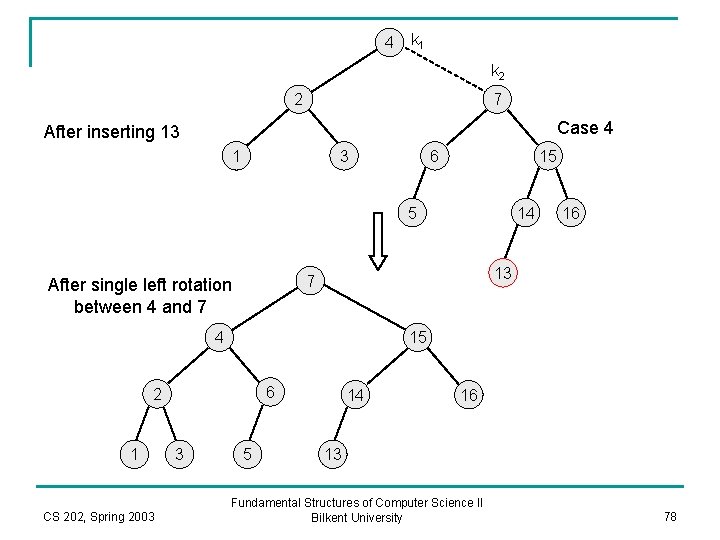
4 k 1 k 2 2 7 Case 4 After inserting 13 1 3 6 15 5 4 15 6 2 CS 202, Spring 2003 3 16 13 7 After single left rotation between 4 and 7 1 14 5 14 16 13 Fundamental Structures of Computer Science II Bilkent University 78
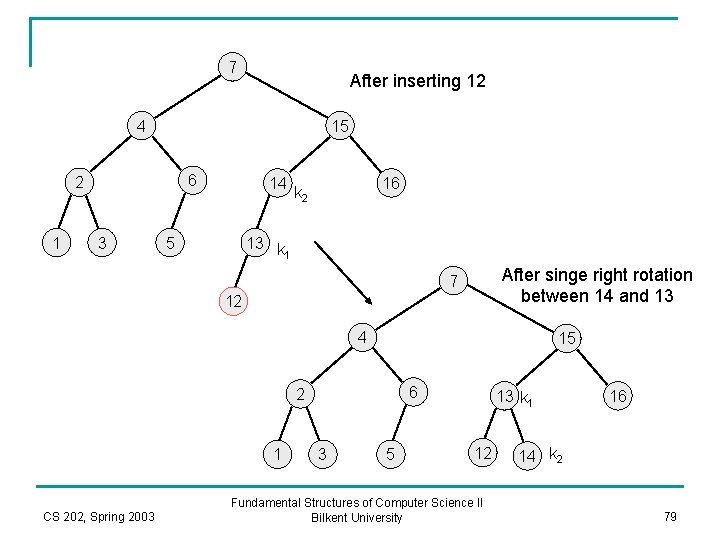
7 After inserting 12 4 15 6 2 1 3 14 5 16 k 2 13 k 1 After singe right rotation between 14 and 13 7 12 4 15 6 2 1 CS 202, Spring 2003 3 5 13 k 1 12 Fundamental Structures of Computer Science II Bilkent University 16 14 k 2 79
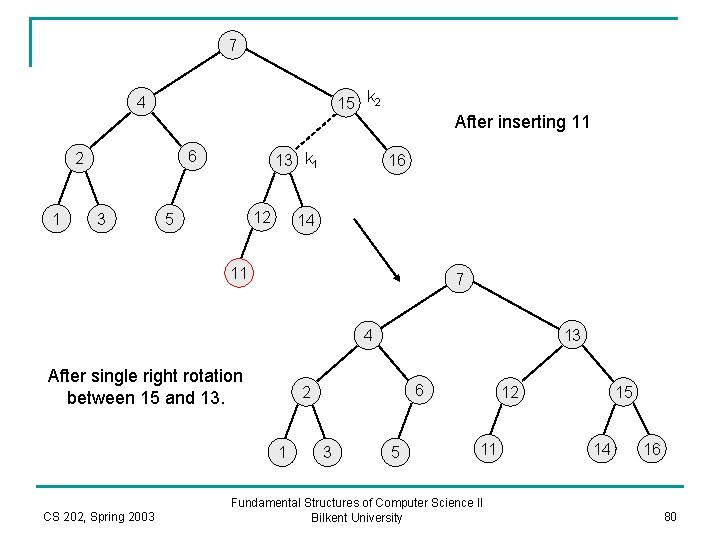
7 15 k 2 4 6 2 1 3 13 k 1 12 5 After inserting 11 16 14 11 7 13 4 After single right rotation between 15 and 13. 1 CS 202, Spring 2003 6 2 3 5 12 11 Fundamental Structures of Computer Science II Bilkent University 15 14 16 80
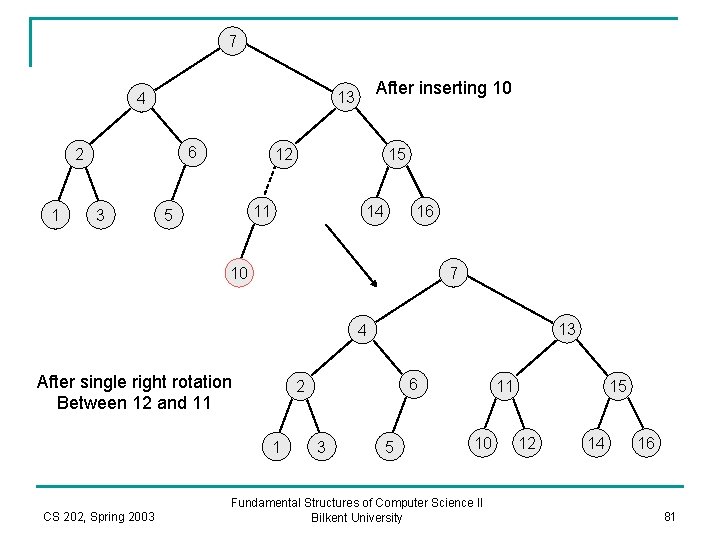
7 6 2 1 3 After inserting 10 13 4 12 15 11 5 14 16 10 7 13 4 After single right rotation Between 12 and 11 1 CS 202, Spring 2003 6 2 3 5 11 10 Fundamental Structures of Computer Science II Bilkent University 15 12 14 16 81
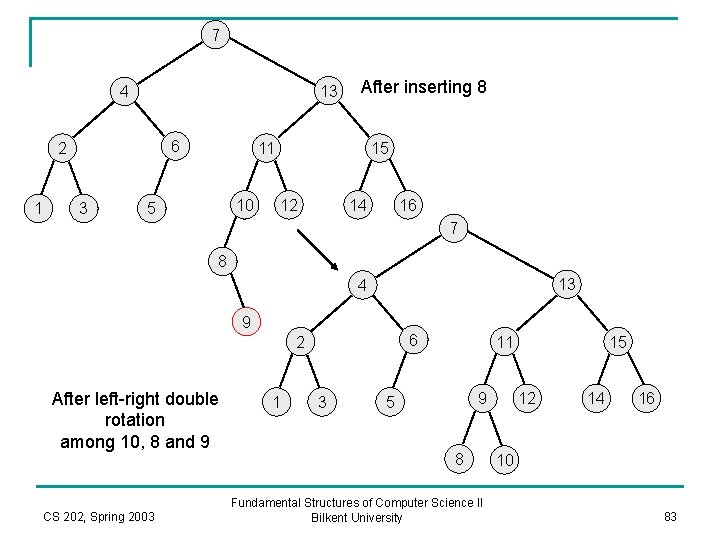
7 13 4 6 2 1 3 After inserting 8 11 10 5 15 12 14 16 8 CS 202, Spring 2003 Fundamental Structures of Computer Science II Bilkent University 82
7 13 4 6 2 1 3 After inserting 8 11 10 5 15 12 14 16 7 8 13 4 9 6 2 After left-right double rotation among 10, 8 and 9 CS 202, Spring 2003 1 3 11 9 5 8 Fundamental Structures of Computer Science II Bilkent University 15 12 14 16 10 83