
Trees Air Pollution Cool Communities October 22 2003
Trees & Air Pollution Cool Communities October 22, 2003 Southern Center for Urban Forestry Research & Information Dudley R. Hartel Technology Transfer Specialist USDA Forest Service Athens, Georgia SRS-4901 October 22, 2003
Trees & Air Pollution • Definitions • Processes • Resources (to understand & answer questions) • New Research October 22, 2003
Trees & Air Pollution • Definitions – VOCs – NOx – Ozone – SMOG – Biogenic & Anthropogenic October 22, 2003
Trees & Air Pollution • VOCs – Volatile Organic Compounds • Evaporate readily (vaporize) • Carbon – Many sources • Vegetation • Solvents, paints • Vehicle emissions (benzene) October 22, 2003
Trees & Air Pollution • VOCs are a Varied Group – Harmful (toxic) to health • Benzene, PAH (polycyclic aromatic hydrocarbons) – Not harmful to health • Biogenic (NASA study indicates these may reduce airborne molds & bacteria) October 22, 2003
Trees & Air Pollution • NOx Emmissions – Nitrogen Oxides • Soil, lightning, & volcanoes • Human activity (combustion) – Cars, trucks, electric generation, industry, gasoline powered lawn equipment – Fire (i. e. prescribed burning) – Heavily fertilized agricultural crops (corn, cotton, wheat) October 22, 2003
Trees & Air Pollution • Ozone – O 3 (3 atoms of Oxygen are combined) – Troposphere (up to 10 miles) – Stratosphere (10 - 30 miles) October 22, 2003
Trees & Air Pollution • Ozone – Ozone has the same chemical structure whether it occurs high above the earth or at ground level and can be good or bad, depending on its location in the atmosphere. – Ozone: Good Up High, Bad Nearby • Protects life on earth from the sun’s harmful ultraviolet rays (UV-b) • Creates health problems October 22, 2003
Trees & Air Pollution • SMOG – Historically: • Industrial SMOG (London 1950 s) • Smoke + Fog – Current: • Photochemical SMOG • Non-smoke producing combustion • NOx & VOCs + Sunlight (Ozone) October 22, 2003
Trees & Air Pollution • Biogenic – Produced by living organisms or biological processes • Trees (woody plants) • Grass (herbaceous plants) • Soil • Anthropogenic – Human activity October 22, 2003 (related to use of fossil fuels)
Trees & Air Pollution • Pollution Process (requirements) – Sunlight – Oxides of nitrogen (NOx) – Volatile organic compounds (VOCs) – Temperatures >18 degrees Celsius October 22, 2003 (64. 4 F)
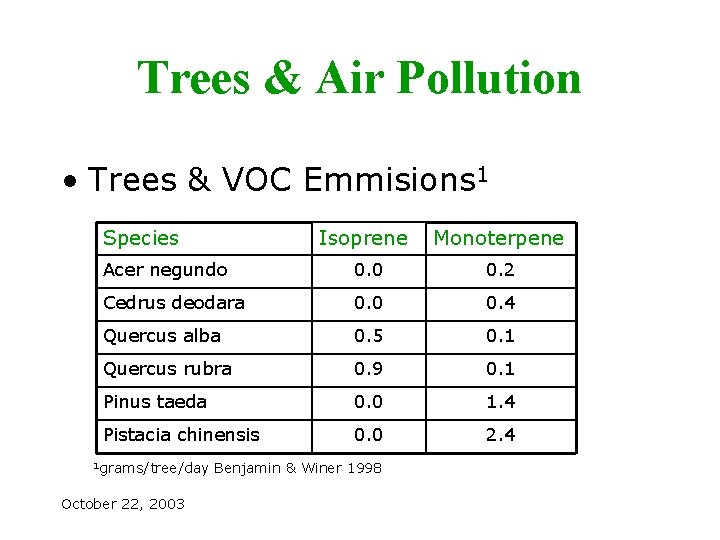
Trees & Air Pollution • Trees & VOC Emmisions 1 Species Isoprene Monoterpene Acer negundo 0. 0 0. 2 Cedrus deodara 0. 0 0. 4 Quercus alba 0. 5 0. 1 Quercus rubra 0. 9 0. 1 Pinus taeda 0. 0 1. 4 Pistacia chinensis 0. 0 2. 4 1 grams/tree/day October 22, 2003 Benjamin & Winer 1998
Trees & Air Pollution • Two VOC Emission Issues – Individual species & trees • Benjamin & Winer – Landscape level (regional) for air pollution studies • Guenther & Geron October 22, 2003
Trees & Air Pollution • Trees & VOC Emissions – Terpenes • Isoprene (oak) & monoterpene (pine) • YES! Trees Emit VOCs – VOCs are not pollutants – VOCs + NOx + Sunlight = Problem October 22, 2003
Trees & Air Pollution • Resources – GHASP • Galveston-Houston Association for Smog Prevention • WWW. GHASP. ORG • Trees & Our Air, 1999 – Researchers • Chris Geron & Alex Guenther – Nat’l Center for Atmospheric Research, Boulder, CO • Michael T. Benjamin & Arthur M. Winer – School of Public Health, UCLA • David J. Nowak – USDA FS, Syracuse, NY October 22, 2003
Trees & Air Pollution • New Research & Questions – VOC emissions: 2 -28 x higher than previously recorded (methodology, lab vs. field) for trees – May not be dependent on age of tree – Canopy level may not be important – Considerable variability reported • More research needed October 22, 2003
Trees & Air Pollution • Despite Uncertainty in VOC Data • Trees: – Do not create pollution! – Have a positive effect on UHI • Evaporative cooling • Shade • Cooler temps mean less ozone, less AC – Remove particulates & CO 2 – Reduce runoff & erosion – Have a positive impact on mental health October 22, 2003
Trees & Air Pollution • Suburban Lawns! – Recent research in Australia (Kirstine) • Grass & cut grass are important sources of VOC emissions • Estimate that about 1/3 of photochemically reactive VOCs in an urban airshed are from grass & grass cutting • These emissions should be part of models October 22, 2003
Trees & Air Pollution • Suburban Lawns! – Unlike trees, turf does not: • Provide as much evaporative cooling • Provide shade (for humans) – Reduce energy demand • Provide an equivalent (any) pervious surface • Provide mental health benefits (no research) October 22, 2003
Trees & Air Pollution • Urbanization effects on tree growth – Jillian W. Gregg, July 10, 2003; Nature – Cottonwood • NYC and surrounding rural sites • Growth better in city • Higher rural O 3 levels reduced growth – NOx scavenging reactions in the city reduce O 3 levels • Urban pollutants effects extend beyond the urban core October 22, 2003
- Slides: 20