
TreeBuilding Methods in Tree Building Phylogenetic trees can
Tree-Building
Methods in Tree Building Phylogenetic trees can be constructed by: clustering method optimality method
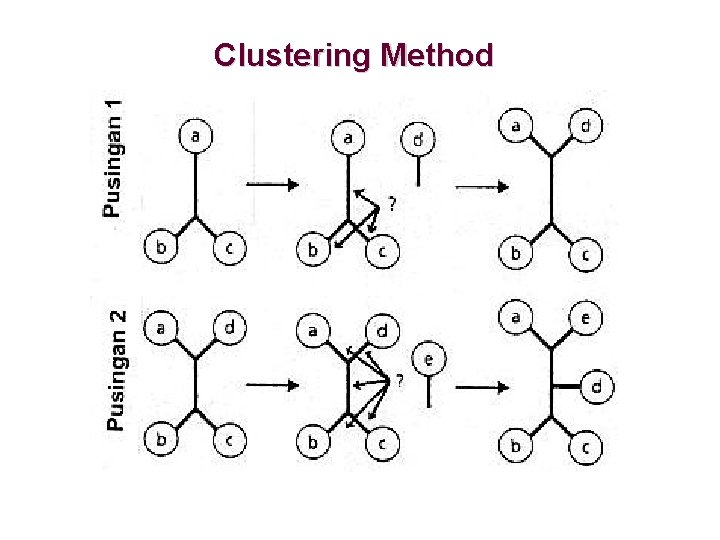
Clustering Method -follows a set of steps (an algorithm) and arrives at a tree. -easy to implement and resulting in very fast computer programmes. -always produces a single tree.
Clustering Method
Clustering Method limitations: -the result obtained from simple clustering algorithms often depends on the order in which the taxa added in a growing tree. -do not allow us to evaluate competing hypotheses (they merely produce a tree).
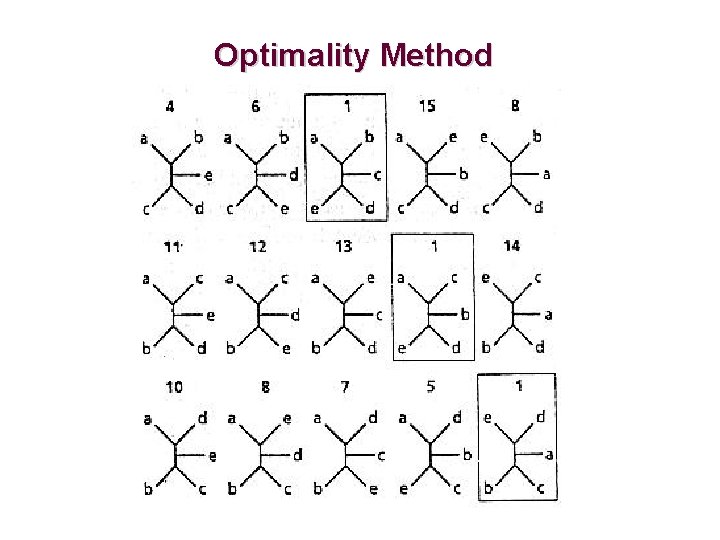
Optimality Method -Chooses among the set of all possible trees. -each tree is assigned a ‘score’ or rank which is function of the relationship between tree and data.
Optimality Method
Optimality Method Advantages: -requires an explicit function that relates data and tree. -allows to evaluate the quality of any tree. Disadvantages: -time consuming (infeasible for a tree with more than 20 taxa). Overcome by heuristic approach.
Heuristic Approach -to explore some subset of all the possible trees, in the hope that the subset will contain the optimal tree. -to start with a tree and rearrange it, keeping any rearrangement that produces a better tree – ‘hill-climbing’. -if a set of possible trees contains more than one island, the heuristic search may land on a suboptimal island, and the optimal island goes undiscovered.
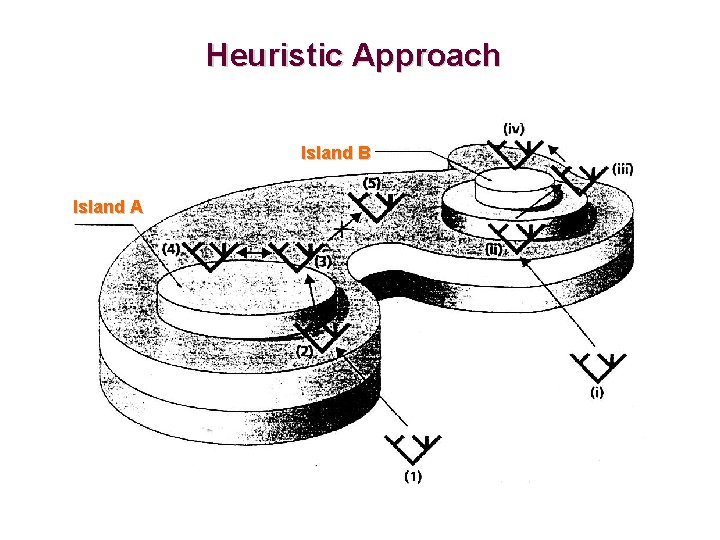
Heuristic Approach Island B Island A
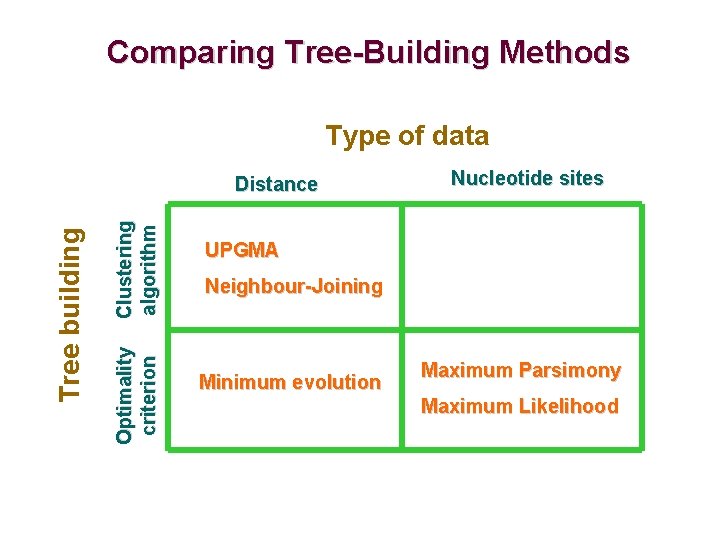
Comparing Tree-Building Methods Type of data Clustering algorithm Optimality criterion Tree building Distance Nucleotide sites UPGMA Neighbour-Joining Minimum evolution Maximum Parsimony Maximum Likelihood
- Slides: 11