
Tree Traversal Traversals of Binary Trees Arrays iterate
Tree. Traversal
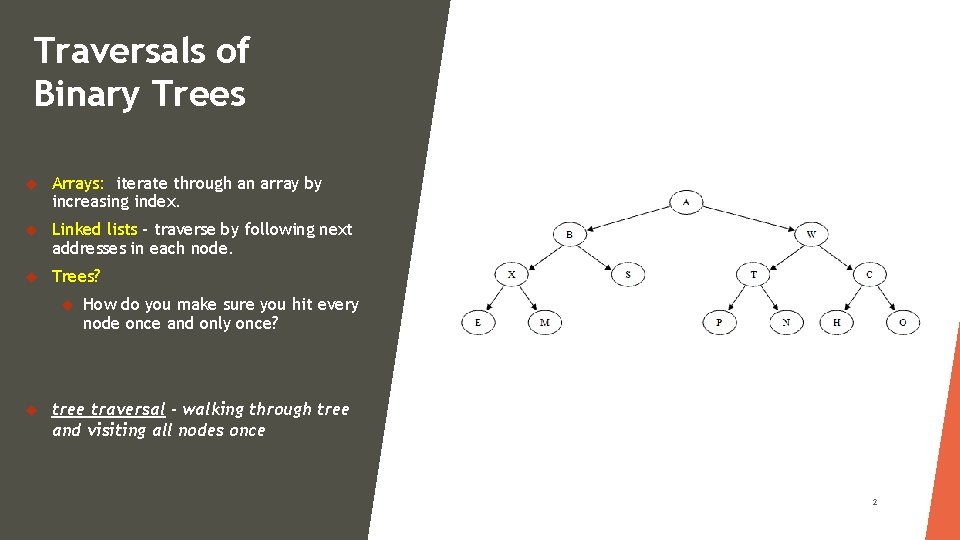
Traversals of Binary Trees Arrays: iterate through an array by increasing index. Linked lists – traverse by following next addresses in each node. Trees? How do you make sure you hit every node once and only once? tree traversal – walking through tree and visiting all nodes once 2
Node Class Definition for a Binary Tree: class Node. T { int data; Node. T *left; //left child Node. T *right; // right child Node. T *parent; //NULL for root of tree //optional: int height; // height up from lowest descendent leaf public: Node. T(int x); ~Node. T(); void print. Node. T(); };
Traversals of Binary Trees tree traversal Three kinds of binary tree traversal: Preorder e. g. , copying Inorder – e. g. , bst (more later) Postorder –e. g. , deleting or freeing nodes order in which we visit the subtree root with respect to its children Why do we worry about traversing in different orders? Trees store data – we may want to find or represent data in different ways depending on the data and the solution we are looking for 4 NOTE: WE ALWAYS START AT THE ROOT!

Tree Traversal: Preorder Used for copying: 1. Visit root, 2. traverse left, 3. traverse right You want to make a copy of the parent before you can make a copy of either of its children. So you can connect everything! Preorder: a, b, d, g, e, h, c, f, i, j <- left right ->
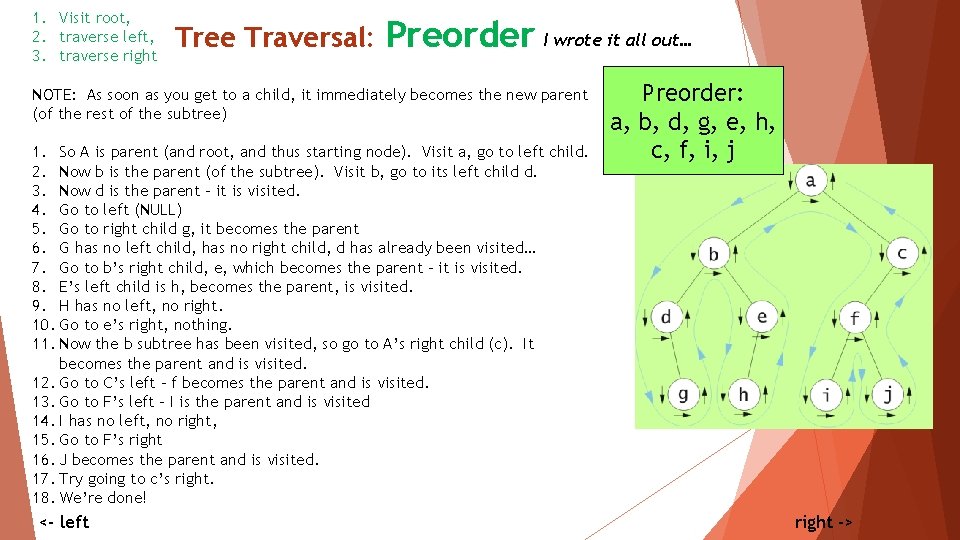
1. Visit root, 2. traverse left, 3. traverse right Tree Traversal: Preorder I wrote it all out… NOTE: As soon as you get to a child, it immediately becomes the new parent (of the rest of the subtree) 1. So A is parent (and root, and thus starting node). Visit a, go to left child. 2. Now b is the parent (of the subtree). Visit b, go to its left child d. 3. Now d is the parent – it is visited. 4. Go to left (NULL) 5. Go to right child g, it becomes the parent 6. G has no left child, has no right child, d has already been visited… 7. Go to b’s right child, e, which becomes the parent – it is visited. 8. E’s left child is h, becomes the parent, is visited. 9. H has no left, no right. 10. Go to e’s right, nothing. 11. Now the b subtree has been visited, so go to A’s right child (c). It becomes the parent and is visited. 12. Go to C’s left – f becomes the parent and is visited. 13. Go to F’s left – I is the parent and is visited 14. I has no left, no right, 15. Go to F’s right 16. J becomes the parent and is visited. 17. Try going to c’s right. 18. We’re done! <- left Preorder: a, b, d, g, e, h, c, f, i, j right ->
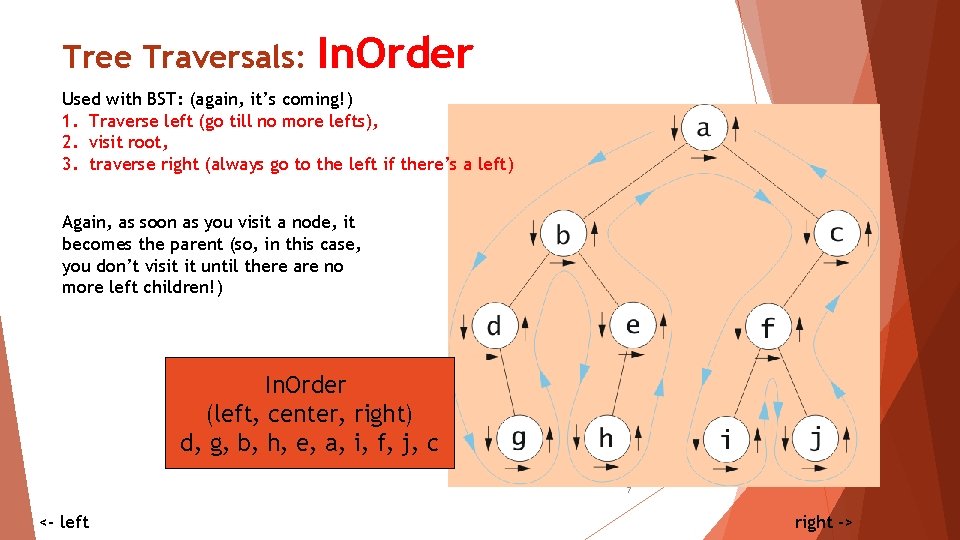
Tree Traversals: In. Order Used with BST: (again, it’s coming!) 1. Traverse left (go till no more lefts), 2. visit root, 3. traverse right (always go to the left if there’s a left) Again, as soon as you visit a node, it becomes the parent (so, in this case, you don’t visit it until there are no more left children!) In. Order (left, center, right) d, g, b, h, e, a, i, f, j, c 7 <- left right ->
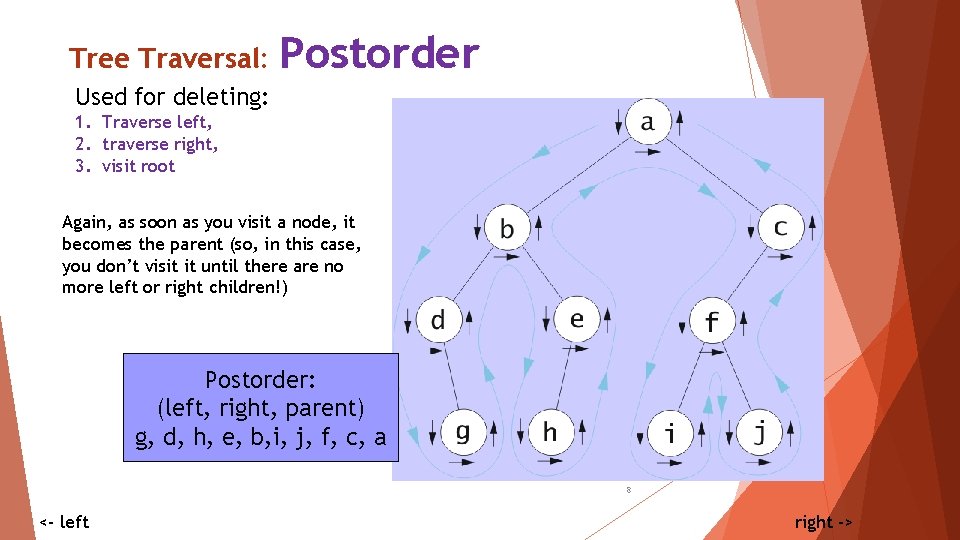
Tree Traversal: Postorder Used for deleting: 1. Traverse left, 2. traverse right, 3. visit root Again, as soon as you visit a node, it becomes the parent (so, in this case, you don’t visit it until there are no more left or right children!) Postorder: (left, right, parent) g, d, h, e, b, i, j, f, c, a 8 <- left right ->
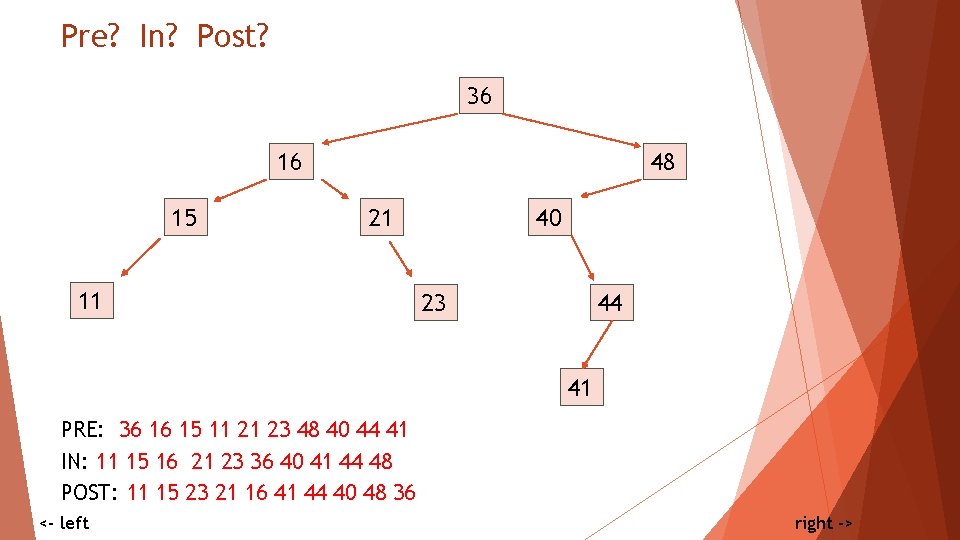
Pre? In? Post? 36 16 15 48 40 21 11 23 44 41 PRE: 36 16 15 11 21 23 48 40 44 41 IN: 11 15 16 21 23 36 40 41 44 48 POST: 11 15 23 21 16 41 44 40 48 36 <- left right ->
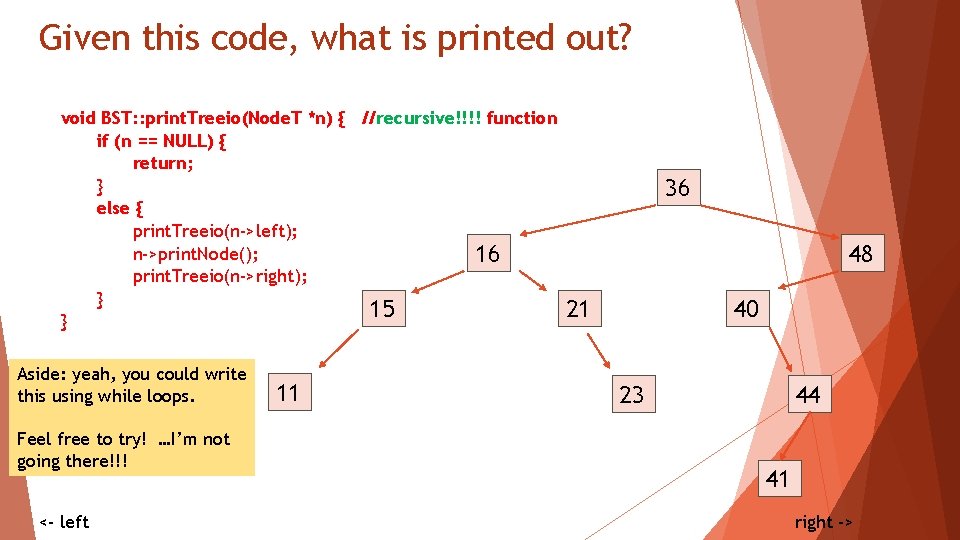
Given this code, what is printed out? void BST: : print. Treeio(Node. T *n) { //recursive!!!! function if (n == NULL) { return; } else { print. Treeio(n->left); n->print. Node(); 16 print. Treeio(n->right); } 15 } Aside: yeah, you could write this using while loops. Feel free to try! …I’m not going there!!! <- left 11 36 48 40 21 23 44 41 right ->

Takeaways: Tree traversal: visiting each node once and only once! Start traversal AT THE ROOT! 3 ways to traverse: Each serves a different purpose Preorder: for copying a tree In. Order: Visit the parent, then left child, then right child Visit left child, then parent, then right child Post. Order: for deleting a tree Visit left child, then right child, then parent
- Slides: 11