
Tree Structures and Functions Tree Parts Crown Branches
Tree Structures and Functions
Tree Parts • Crown • Branches • Leaves • Fruit • Seeds • Flowers • Trunk • Heartwood • Sapwood • Bark • Roots • Root Systems • Primary • Secondary
Branches • Contain vascular tissue (xylem and phloem). • Are the point of connection from the leaves to the trunk of the tree.
Tree Crown • Branches • Contain vascular tissue (xylem and phloem). • Are the point of connection from the leaves to the trunk of the tree. • Leaves will provide food for the tree by turning sunlight into energy through photosynthesis. • Chlorophyll is the substance in leaves that helps with photosynthesis and gives leaves there green color.
Leaf Parts • Petiole • Point of connection to the limb or branch. • Consists of vascular tissue (xylem and phloem) that moves water and nutrients to the leaf cells from the roots. Also move sugar from the leaves to the roots for storage. • Blade • Flat part of the leaf in spring it is green in color and in red, orange or brown in the fall of the year. The rest of leave structures are found in the blade. • Midrib • Has the same vascular tissue as the petiole, it gives support to the leaf and distributes nutrients to the petiole.
Leaf Parts • Spines • Preform the same function as the midrib, move nutrients to the midrib • Veins • Connect the vascular tissues into the leaf spines, move nutrients from leaf cells to the spines. • Margin • Outer edge of the leaf used for identification. The margins of leaves will be different from leaf to leaf.
Seeds • Seeds are the primary reproduction method for trees. • Seeds are another way to identify trees. • Trees that produce seeds that are in cones are called gymnosperms. • Examples are: • Pines, Spruces, Cedars, Firs, Cypresses • Trees that produce seeds that are inside of a ovary or fruit are called angiosperms. • Examples are: • Oaks, Hickories, Maples, and all other trees.
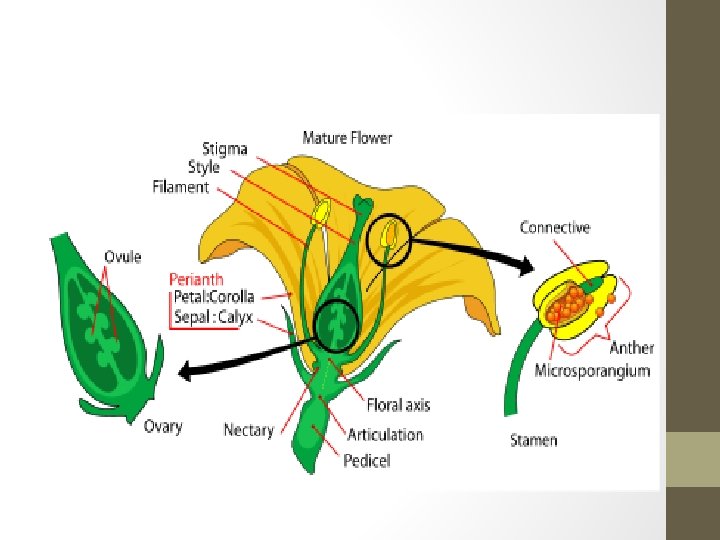
Flower Identification • Complete Flowers • Flowers that have ALL 4 major parts (sepals, petals, stamen, and pistil) • Incomplete Flower • Flowers that lack one of the 4 major parts(sepals, petals, stamen, and pistil) • Female Parts • Stigma, Style, and Ovary (make up the pistil) • Male Parts • Anther and filament (make up the stamen)
Trunk • Main support for the trees. • Heartwood • Dead wood, found in the center of the tree. • Sapwood • Xylem • Upward water transport. Moves water from the roots to the leaves to be used in photosynthesis. • Phloem • Downward sugar transport. Moves glucose around the tree to where it is needed.
Trunk • Cambium • Layer where tree growth takes place. Layer that holds the xylem and phloem. Only layer in the tree that is “living tissue”. • Annual Rings • Show the amount of growth that a tree will undergo in one year. Growth rates are higher in the spring and summer so rings are wider and white in color. Where as rings in the fall and winter will be narrower and darker in color. • Bark • Inner Bark- Where living tissue is located the cambium layer • Outer Bark- Surrounds the outer layer of the tree, is dead cells.
Roots • Roots play four roles in trees • • Absorption of water and inorganic nutrients. Anchoring of the plant body to the ground. Storage of food and nutrients. To prevent soil erosion. In response to the concentration of nutrients. • There are 4 main structures found on roots • Primary, Secondary, Root Hairs, and Root Caps • There are 2 main types of roots • Tap and Fibrous
Root System Parts • Primary Root • First structure to emerge from the germinating seed and it immediately begins absorbing water and minerals for growth. • Main root that all others grow from • Secondary Root • Arises from the primary root. • Seedlings survive best when secondary roots have formed. • Root Hairs • Root Cap
Secondary Root Systems • Root Hairs • Both primary and secondary roots have root hairs found near the growing tip of the root. • These are single root cells that are located a few millimeters back from the root tip. • The greatest amount of water and mineral absorption occurs through the root hairs which is transported in the xylem tissue throughout the plant. • Root hairs can be easily damaged through improper handling of plants. This typically occurs when plants are lifted by the stem of leaves. • Root Cap • Mass of cells that protects root tips from coarse soil. • The area directly behind the root cap is where new cells are formed. • When a root cap comes in contact with an object it will grow around it.
Root Types • Taproot • Primary root grows down from the stem with some small secondary roots forming. • Examples: • Walnut trees • Pine trees • Fibrous • Roots that branch into a number of small primary and secondary roots. • Root systems grow shallow near the soil line and are subjected to drought and mineral deficiencies. • Examples • Oak Trees
- Slides: 15