
Tree species identification in aerial image data using



- Slides: 16
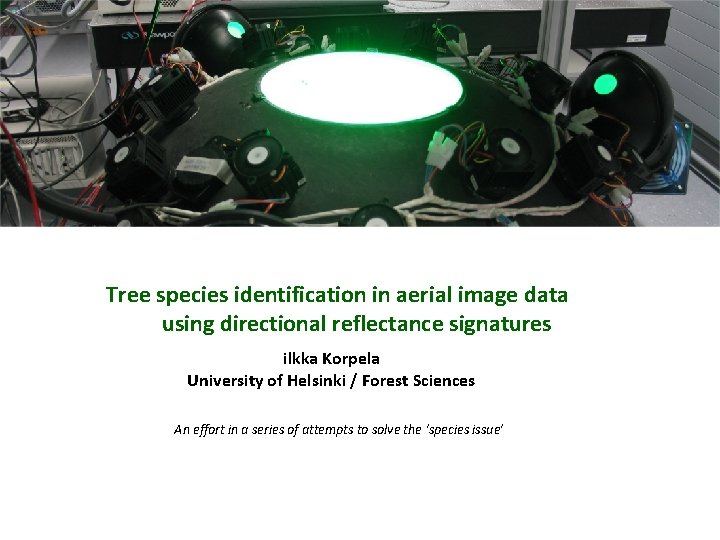
Tree species identification in aerial image data using directional reflectance signatures ilkka Korpela University of Helsinki / Forest Sciences An effort in a series of attempts to solve the ‘species issue’
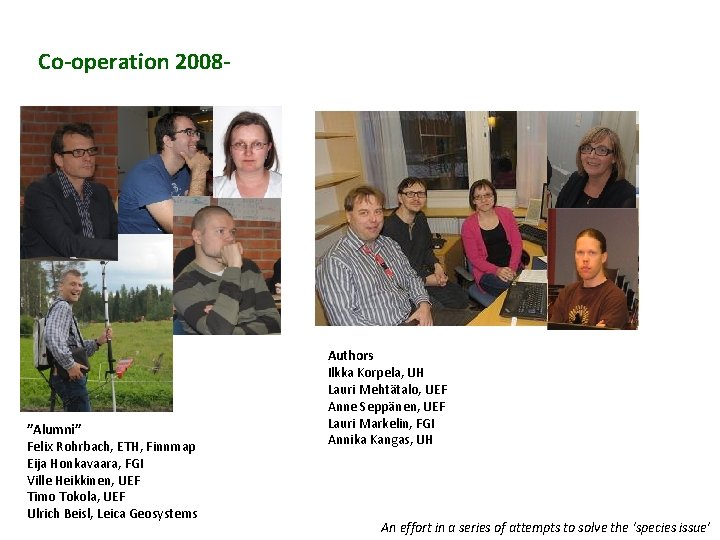
Co-operation 2008 - B P ”Alumni” Felix Rohrbach, ETH, Finnmap Eija Honkavaara, FGI Ville Heikkinen, UEF Timo Tokola, UEF Ulrich Beisl, Leica Geosystems Authors Ilkka Korpela, UH Lauri Mehtätalo, UEF Anne Seppänen, UEF Lauri Markelin, FGI Annika Kangas, UH S An effort in a series of attempts to solve the ‘species issue’
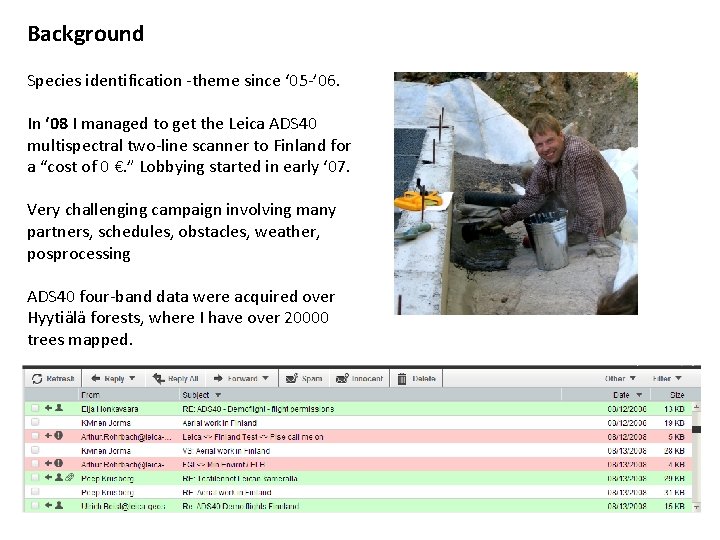
Background Species identification -theme since ‘ 05 -’ 06. In ‘ 08 I managed to get the Leica ADS 40 multispectral two-line scanner to Finland for a “cost of 0 €. ” Lobbying started in early ‘ 07. Very challenging campaign involving many partners, schedules, obstacles, weather, posprocessing ADS 40 four-band data were acquired over Hyytiälä forests, where I have over 20000 trees mapped.
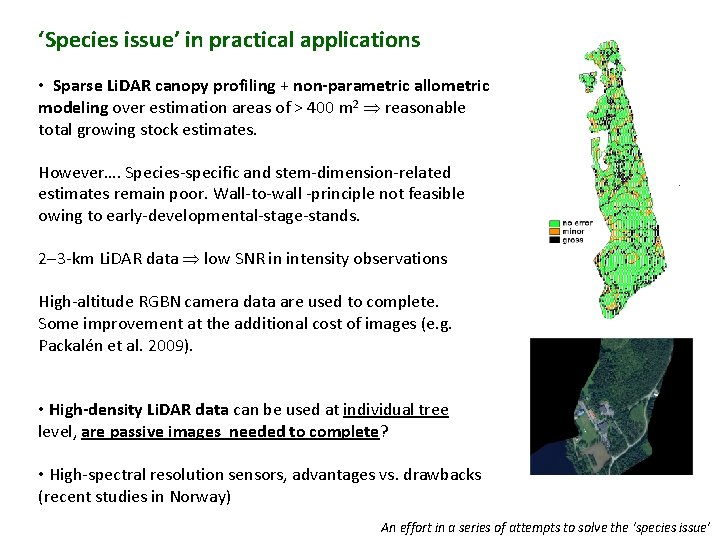
‘Species issue’ in practical applications • Sparse Li. DAR canopy profiling + non-parametric allometric modeling over estimation areas of > 400 m 2 reasonable total growing stock estimates. However…. Species-specific and stem-dimension-related estimates remain poor. Wall-to-wall -principle not feasible owing to early-developmental-stage-stands. 2 3 -km Li. DAR data low SNR in intensity observations High-altitude RGBN camera data are used to complete. Some improvement at the additional cost of images (e. g. Packalén et al. 2009). • High-density Li. DAR data can be used at individual tree level, are passive images needed to complete? • High-spectral resolution sensors, advantages vs. drawbacks (recent studies in Norway) An effort in a series of attempts to solve the ‘species issue’
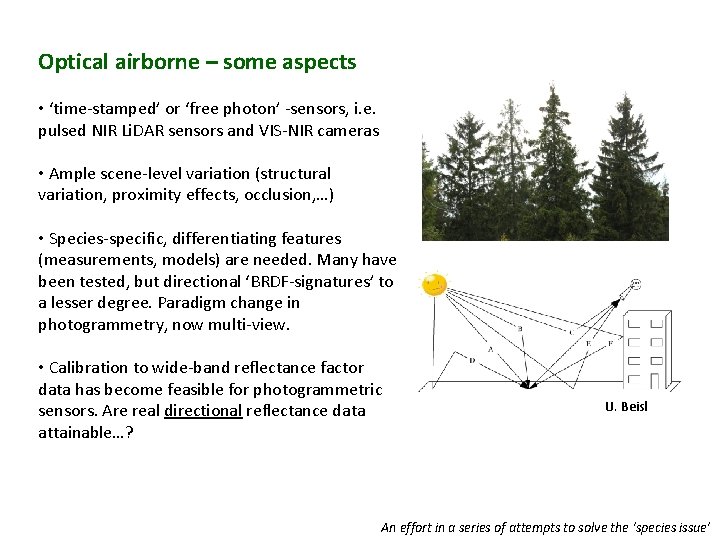
Optical airborne – some aspects • ‘time-stamped’ or ‘free photon’ -sensors, i. e. pulsed NIR Li. DAR sensors and VIS-NIR cameras • Ample scene-level variation (structural variation, proximity effects, occlusion, …) • Species-specific, differentiating features (measurements, models) are needed. Many have been tested, but directional ‘BRDF-signatures’ to a lesser degree. Paradigm change in photogrammetry, now multi-view. • Calibration to wide-band reflectance factor data has become feasible for photogrammetric sensors. Are real directional reflectance data attainable…? U. Beisl An effort in a series of attempts to solve the ‘species issue’
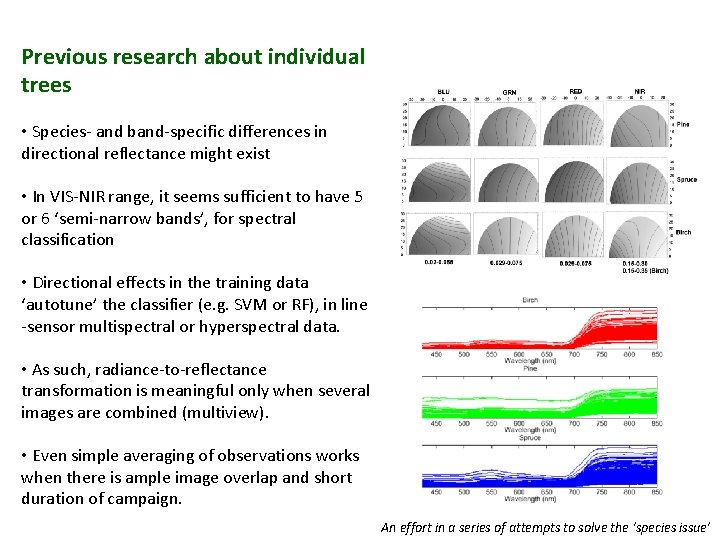
Previous research about individual trees • Species- and band-specific differences in directional reflectance might exist • In VIS-NIR range, it seems sufficient to have 5 or 6 ‘semi-narrow bands’, for spectral classification • Directional effects in the training data ‘autotune’ the classifier (e. g. SVM or RF), in line -sensor multispectral or hyperspectral data. • As such, radiance-to-reflectance transformation is meaningful only when several images are combined (multiview). • Even simple averaging of observations works when there is ample image overlap and short duration of campaign. An effort in a series of attempts to solve the ‘species issue’
My Hypotheses • Reflectance calibration is so accurate that the data can be used for measuring wide-band directional reflectance (still just HDRF) within and between images and acquisitions (repeatable measurements, semi-fixed interpretation models). for a given solar elevation it becomes feasible to define an ‘approximate BRDF of tree species X’ for some band (SRF) in some sensor (settings). • Tree species show directional signatures that are somewhat spectrally variant and differ slightly between species. Multi-view observations can be contrasted with the species-and-band-specific reflectance anisotropy models for ‘pattern matching’ –based species classification. Species differentiate in directional spectral reflectance. An effort in a series of attempts to solve the ‘species issue’
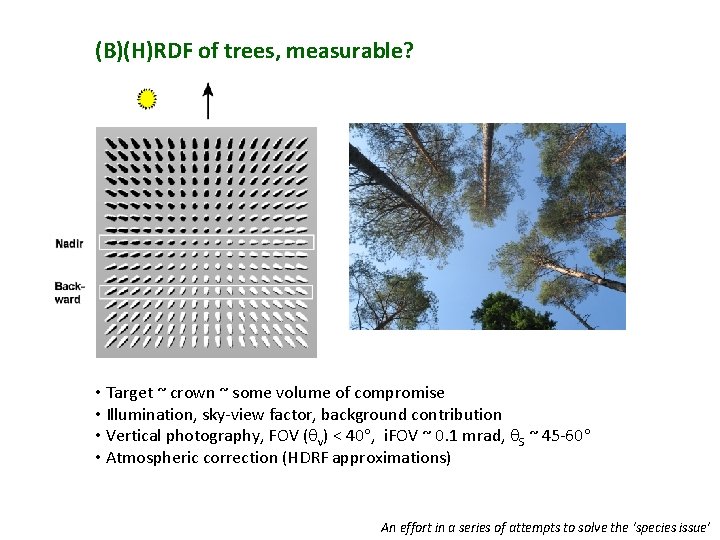
(B)(H)RDF of trees, measurable? • Target ~ crown ~ some volume of compromise • Illumination, sky-view factor, background contribution • Vertical photography, FOV ( v) < 40 , i. FOV ~ 0. 1 mrad, S ~ 45 -60 • Atmospheric correction (HDRF approximations) An effort in a series of attempts to solve the ‘species issue’
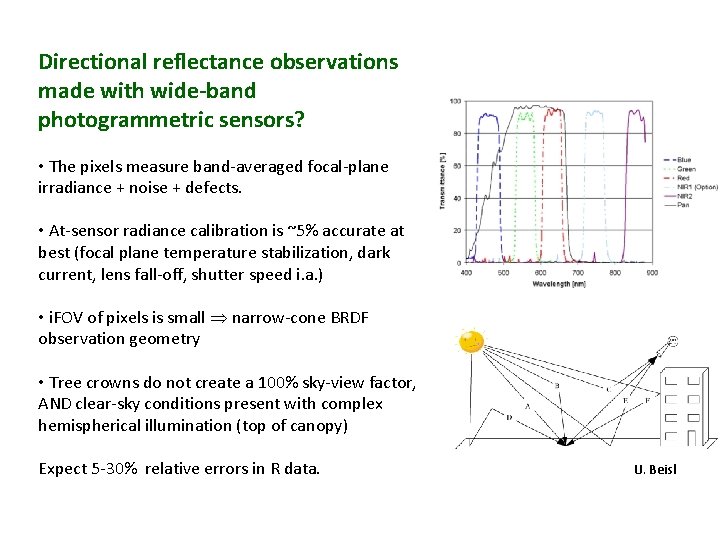
Directional reflectance observations made with wide-band photogrammetric sensors? • The pixels measure band-averaged focal-plane irradiance + noise + defects. • At-sensor radiance calibration is ~5% accurate at best (focal plane temperature stabilization, dark current, lens fall-off, shutter speed i. a. ) • i. FOV of pixels is small narrow-cone BRDF observation geometry • Tree crowns do not create a 100% sky-view factor, AND clear-sky conditions present with complex hemispherical illumination (top of canopy) Expect 5 -30% relative errors in R data. U. Beisl
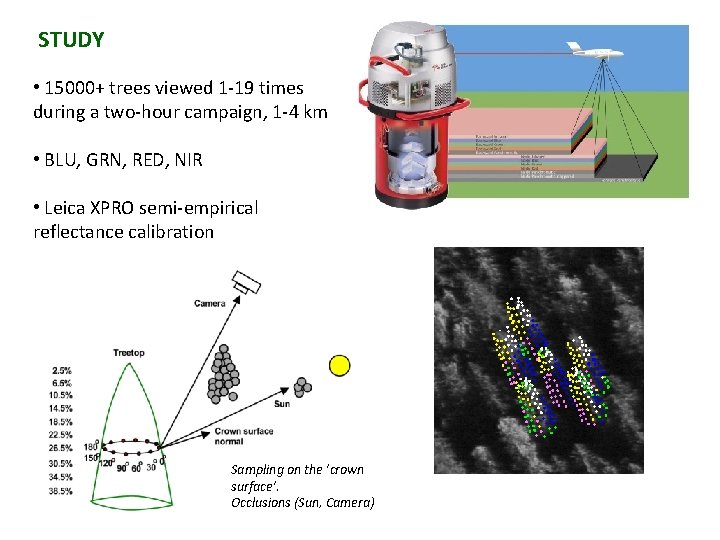
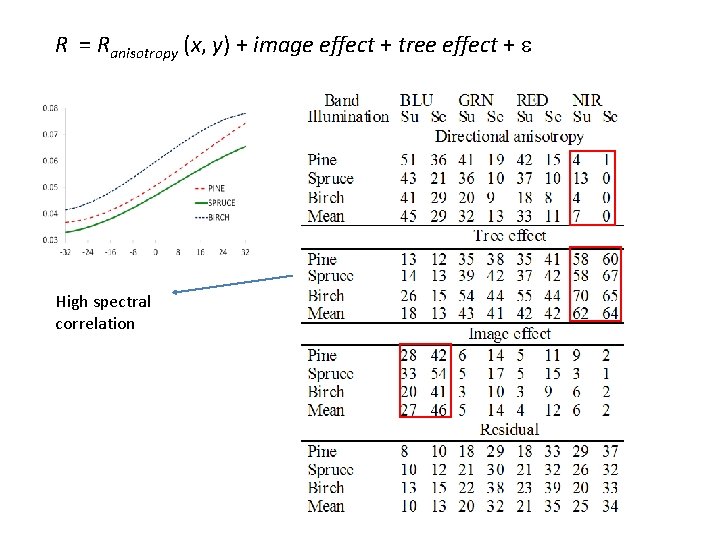
STUDY • 15000+ trees viewed 1 -19 times during a two-hour campaign, 1 -4 km • BLU, GRN, RED, NIR • Leica XPRO semi-empirical reflectance calibration Sampling on the ’crown surface’. Occlusions (Sun, Camera)
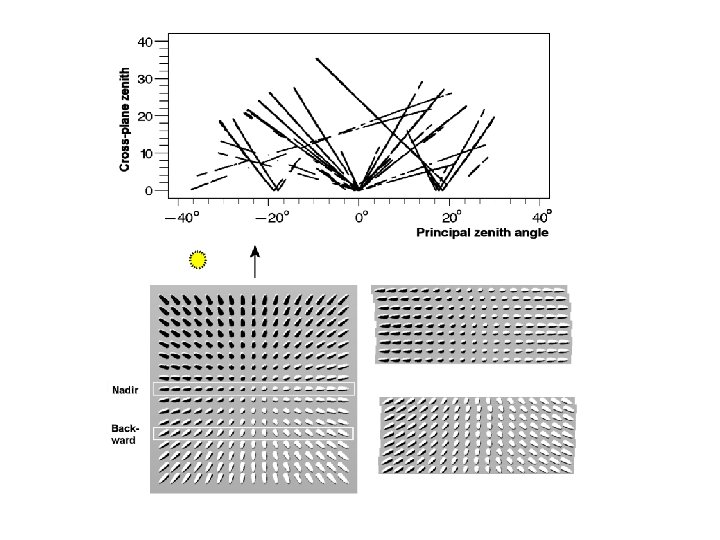
R = Ranisotropy (x, y) + image effect + tree effect + High spectral correlation
Classification tests with real and simulated data