
Tree nutrient status by bark analysis first results
Tree nutrient status by bark analysis: first results from a soil moisture site gradient across Switzerland Jörg Luster, Angélique Herzig, Antonia Ulmann, Stephan Zimmermann, Lorenz Walthert, Katrin Meusburger Forest Soils and Biogeochemistry, WSL Pfynwald meeting 17. 9. 2020 – Bark analysis

Tree nutrient status by bark analysis – why? • Thresholds of foliar nutrient concentrations are often used as diagnostic tool to assess the nutritional status of trees. • As such they have been employed to interpret monitoring results (e. g. Jonard et al. (2015), Global Change Biol 21, 418) or as decision support for protective measures (e. g. Hüttl (1992), Freib. Bodenkundl. Abh. 30, 31; Moore et al. (2000) Can J For Res 30, 725) • The tresholds are based on empirical relationships between nutrient concentrations in leaves or needles and phenological deficiency symptoms or plant growth. • Often used values published by Mellert and Göttlein (2012; Eur J For Res 131, 1461), mainly based on a data compilation by van den Burg (1985, 1990) Pfynwald meeting 17. 9. 2020 – Bark analysis
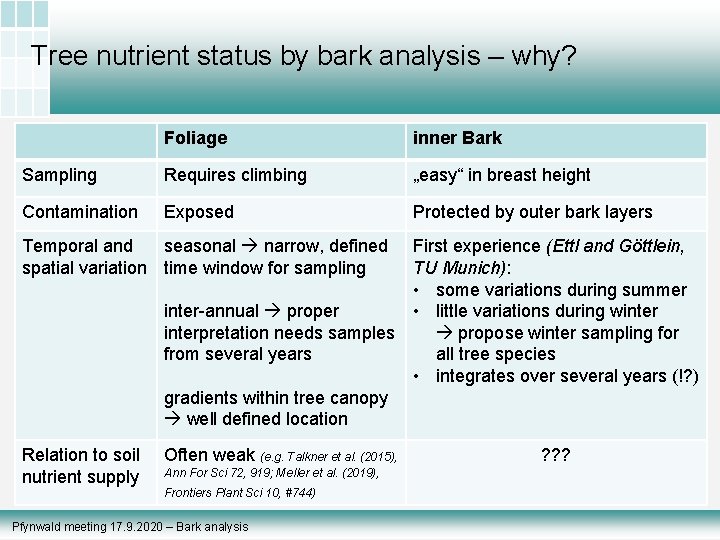
Tree nutrient status by bark analysis – why? Foliage inner Bark Sampling Requires climbing „easy“ in breast height Contamination Exposed Protected by outer bark layers seasonal narrow, defined Temporal and spatial variation time window for sampling inter-annual proper interpretation needs samples from several years First experience (Ettl and Göttlein, TU Munich): • some variations during summer • little variations during winter propose winter sampling for all tree species • integrates over several years (!? ) gradients within tree canopy well defined location Relation to soil nutrient supply Often weak (e. g. Talkner et al. (2015), Ann For Sci 72, 919; Meller et al. (2019), Frontiers Plant Sci 10, #744) Pfynwald meeting 17. 9. 2020 – Bark analysis ? ? ?
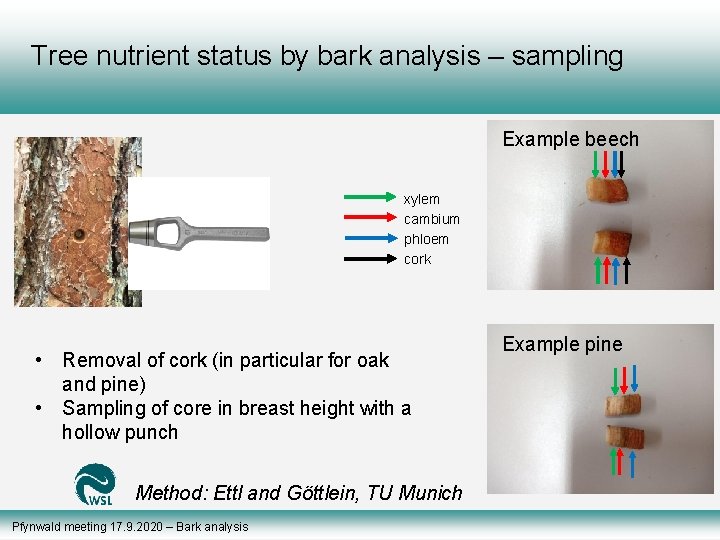
Tree nutrient status by bark analysis – sampling Example beech xylem cambium phloem cork • Removal of cork (in particular for oak and pine) • Sampling of core in breast height with a hollow punch Method: Ettl and Göttlein, TU Munich Pfynwald meeting 17. 9. 2020 – Bark analysis Example pine
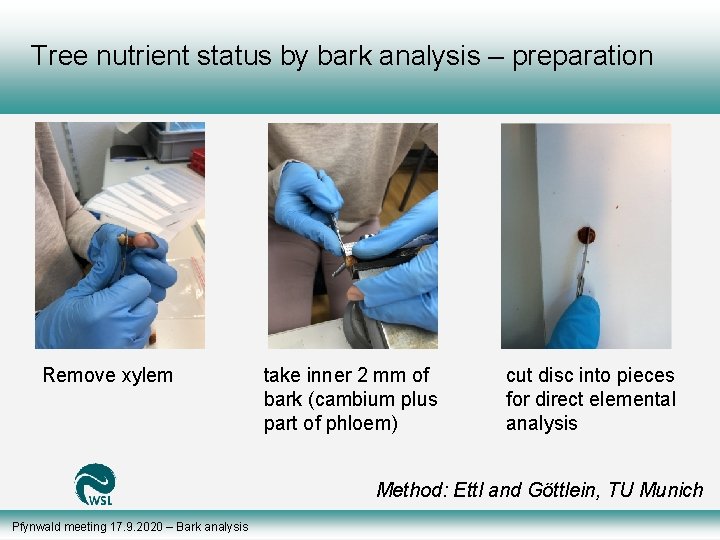
Tree nutrient status by bark analysis – preparation Remove xylem take inner 2 mm of bark (cambium plus part of phloem) cut disc into pieces for direct elemental analysis Method: Ettl and Göttlein, TU Munich Pfynwald meeting 17. 9. 2020 – Bark analysis
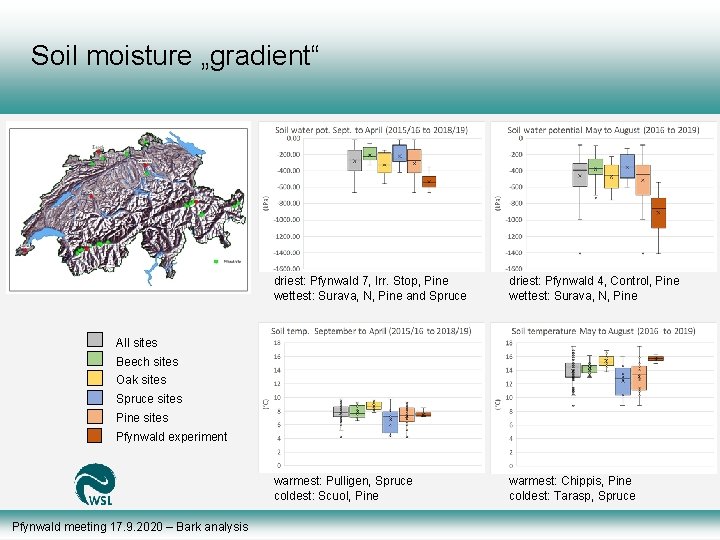
Soil moisture „gradient“ driest: Pfynwald 7, Irr. Stop, Pine wettest: Surava, N, Pine and Spruce driest: Pfynwald 4, Control, Pine wettest: Surava, N, Pine warmest: Pulligen, Spruce coldest: Scuol, Pine warmest: Chippis, Pine coldest: Tarasp, Spruce All sites Beech sites Oak sites Spruce sites Pine sites Pfynwald experiment Pfynwald meeting 17. 9. 2020 – Bark analysis
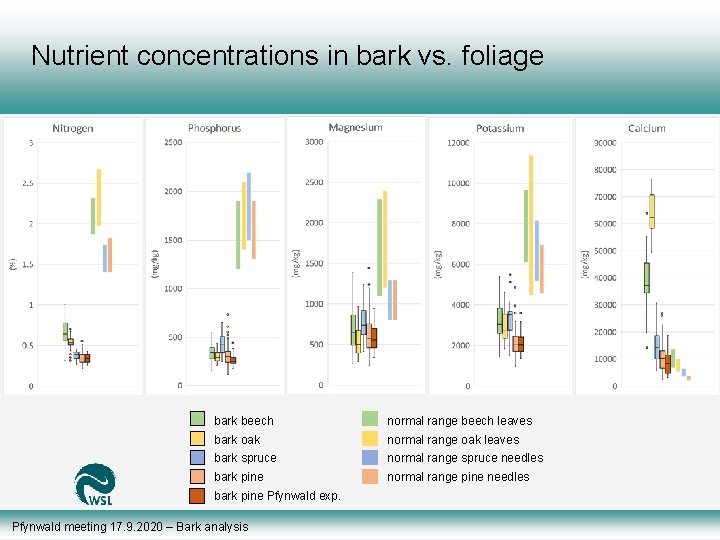
Nutrient concentrations in bark vs. foliage bark beech normal range beech leaves bark oak normal range oak leaves bark spruce normal range spruce needles bark pine normal range pine needles bark pine Pfynwald exp. Pfynwald meeting 17. 9. 2020 – Bark analysis
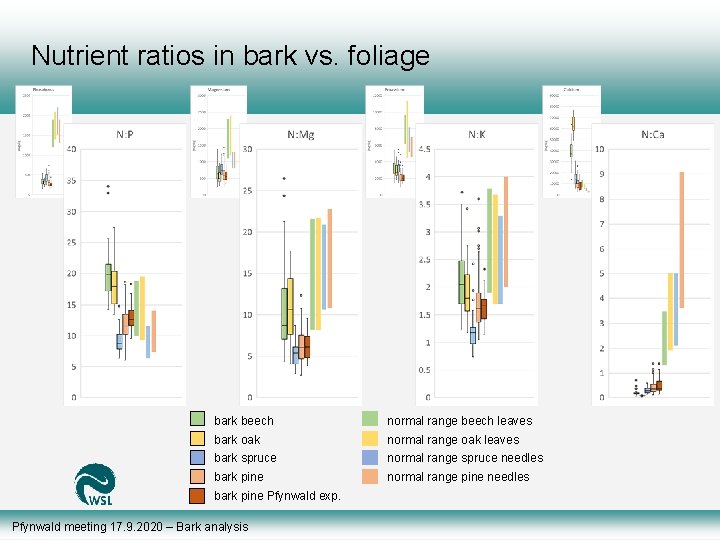
Nutrient ratios in bark vs. foliage bark beech normal range beech leaves bark oak normal range oak leaves bark spruce normal range spruce needles bark pine normal range pine needles bark pine Pfynwald exp. Pfynwald meeting 17. 9. 2020 – Bark analysis
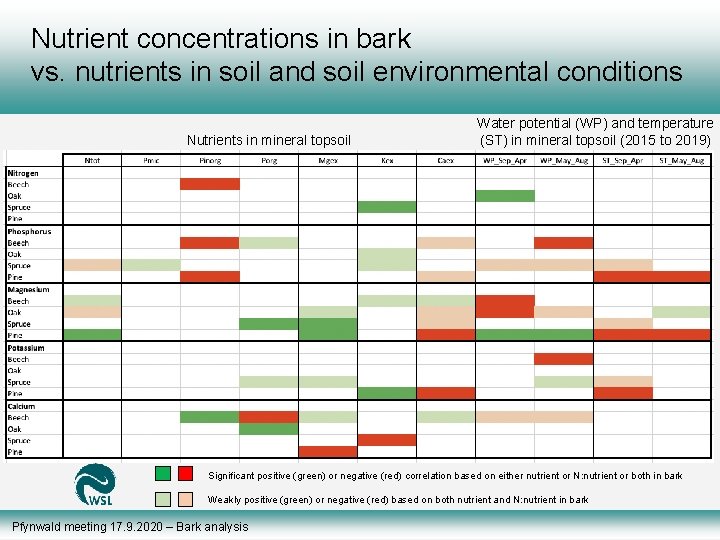
Nutrient concentrations in bark vs. nutrients in soil and soil environmental conditions Nutrients in mineral topsoil Water potential (WP) and temperature (ST) in mineral topsoil (2015 to 2019) Significant positive (green) or negative (red) correlation based on either nutrient or N: nutrient or both in bark Weakly positive (green) or negative (red) based on both nutrient and N: nutrient in bark Pfynwald meeting 17. 9. 2020 – Bark analysis
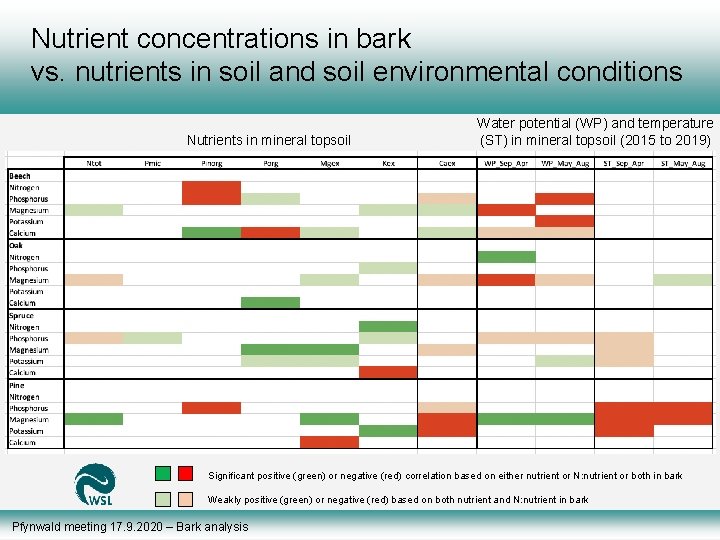
Nutrient concentrations in bark vs. nutrients in soil and soil environmental conditions Nutrients in mineral topsoil Water potential (WP) and temperature (ST) in mineral topsoil (2015 to 2019) Significant positive (green) or negative (red) correlation based on either nutrient or N: nutrient or both in bark Weakly positive (green) or negative (red) based on both nutrient and N: nutrient in bark Pfynwald meeting 17. 9. 2020 – Bark analysis
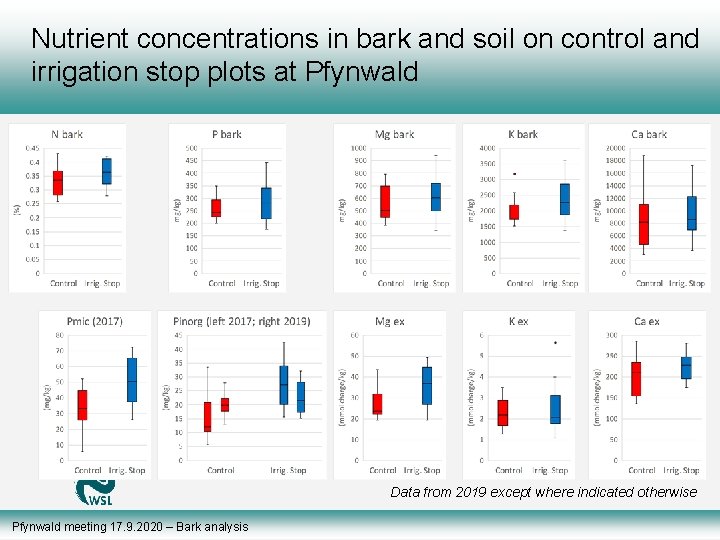
Nutrient concentrations in bark and soil on control and irrigation stop plots at Pfynwald Data from 2019 except where indicated otherwise Pfynwald meeting 17. 9. 2020 – Bark analysis
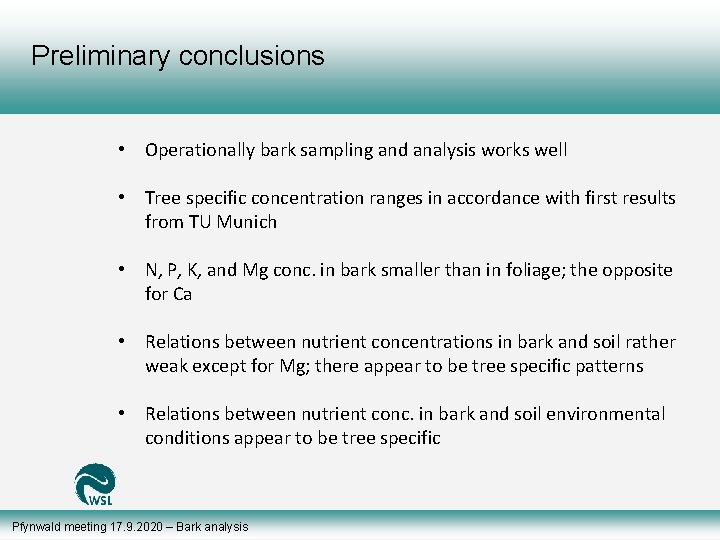
Preliminary conclusions • Operationally bark sampling and analysis works well • Tree specific concentration ranges in accordance with first results from TU Munich • N, P, K, and Mg conc. in bark smaller than in foliage; the opposite for Ca • Relations between nutrient concentrations in bark and soil rather weak except for Mg; there appear to be tree specific patterns • Relations between nutrient conc. in bark and soil environmental conditions appear to be tree specific Pfynwald meeting 17. 9. 2020 – Bark analysis
- Slides: 12