
Tree Data Structures There a number of applications
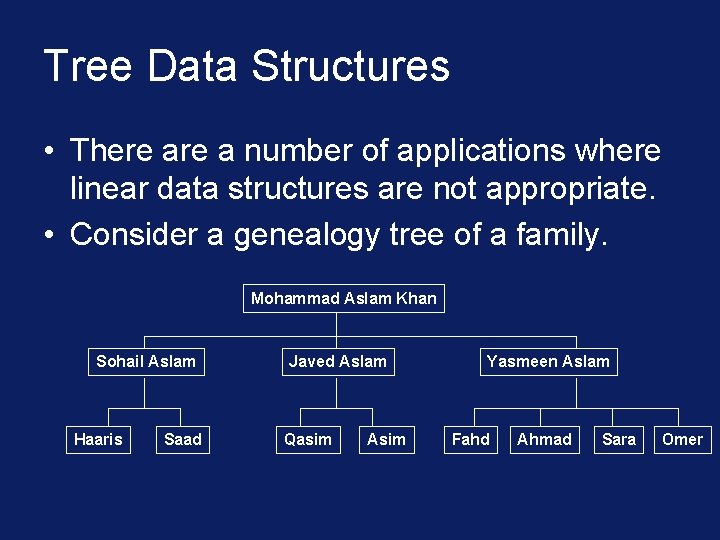
Tree Data Structures • There a number of applications where linear data structures are not appropriate. • Consider a genealogy tree of a family. Mohammad Aslam Khan Sohail Aslam Haaris Saad Javed Aslam Qasim Asim Yasmeen Aslam Fahd Ahmad Sara Omer
Tree Data Structure • A linear linked list will not be able to capture the tree-like relationship with ease. • Shortly, we will see that for applications that require searching, linear data structures are not suitable. • We will focus our attention on binary trees.
Binary Tree • A binary tree is a finite set of elements that is either empty or is partitioned into three disjoint subsets. • The first subset contains a single element called the root of the tree. • The other two subsets are themselves binary trees called the left and right subtrees. • Each element of a binary tree is called a node of the tree.
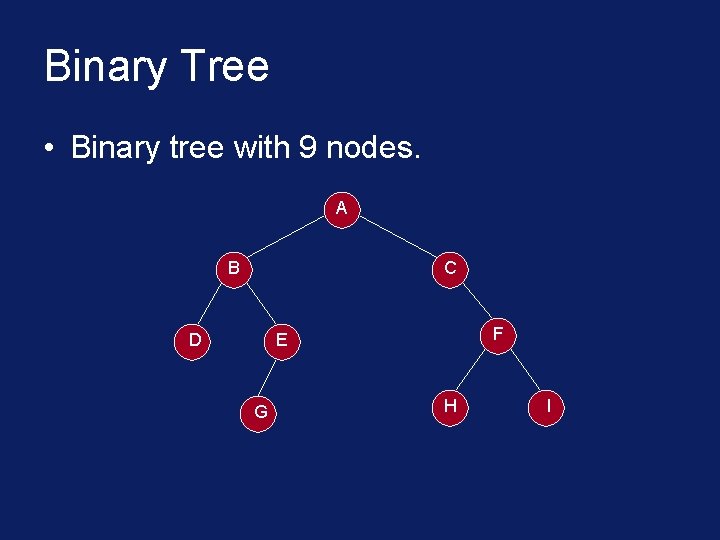
Binary Tree • Binary tree with 9 nodes. A B C D F E G H I
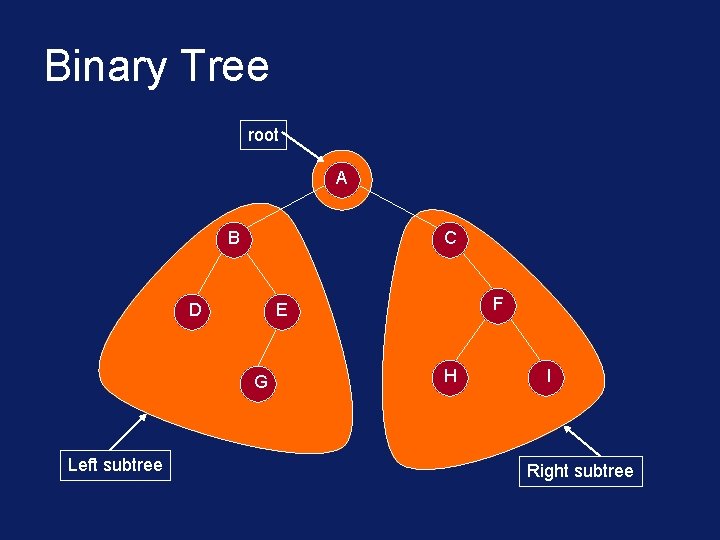
Binary Tree root A B C D G Left subtree F E H I Right subtree
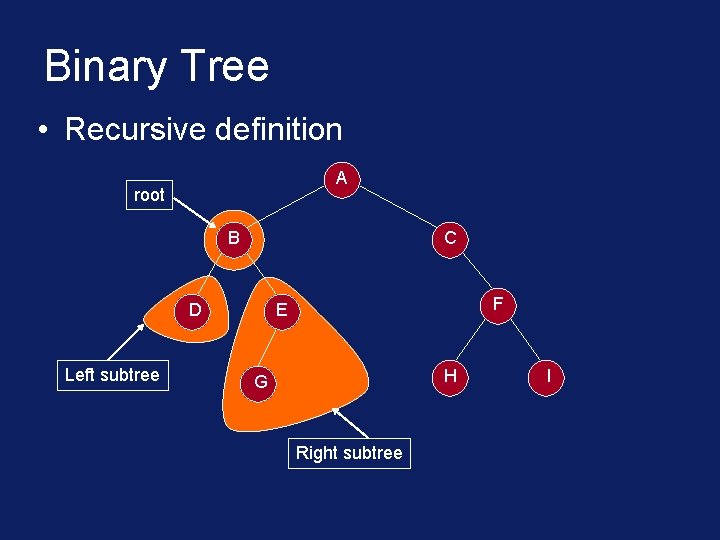
Binary Tree • Recursive definition A root B C D Left subtree F E H G Right subtree I
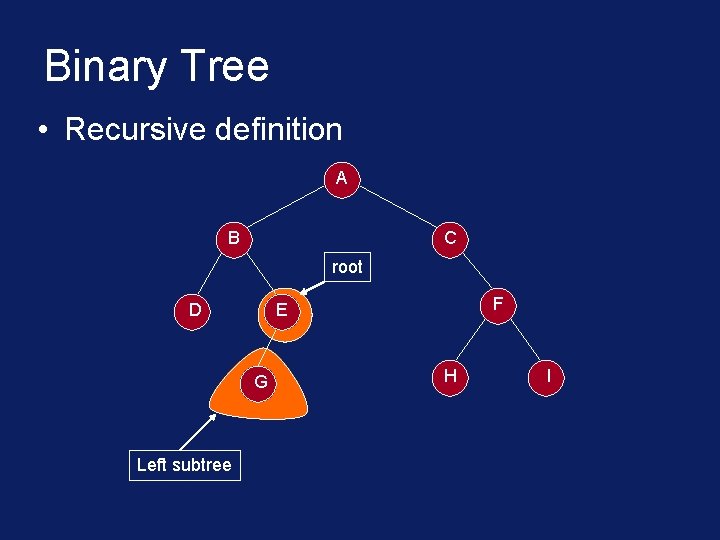
Binary Tree • Recursive definition A B C root D G Left subtree F E H I
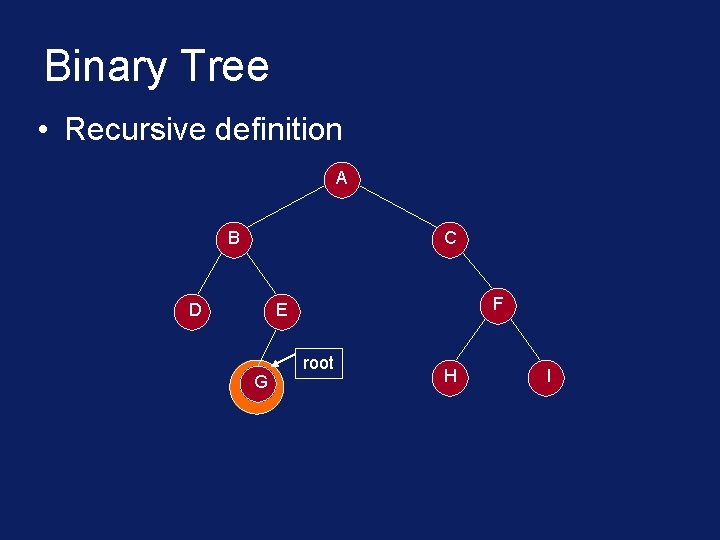
Binary Tree • Recursive definition A B C D F E G root H I
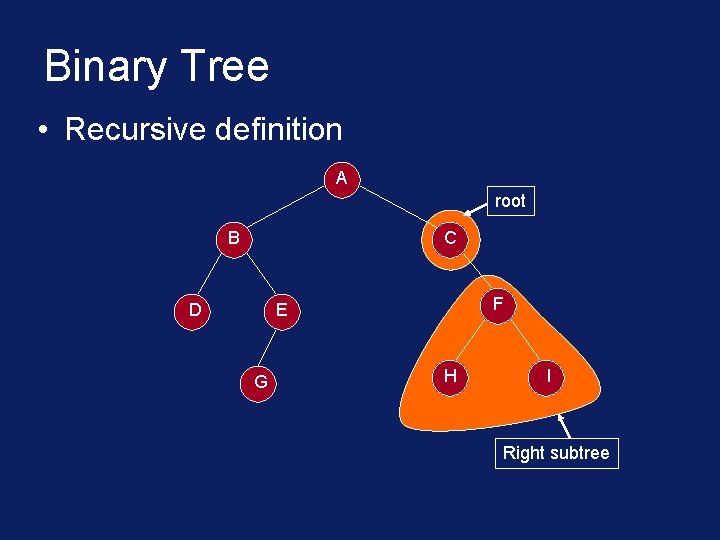
Binary Tree • Recursive definition A root B C D F E G H I Right subtree
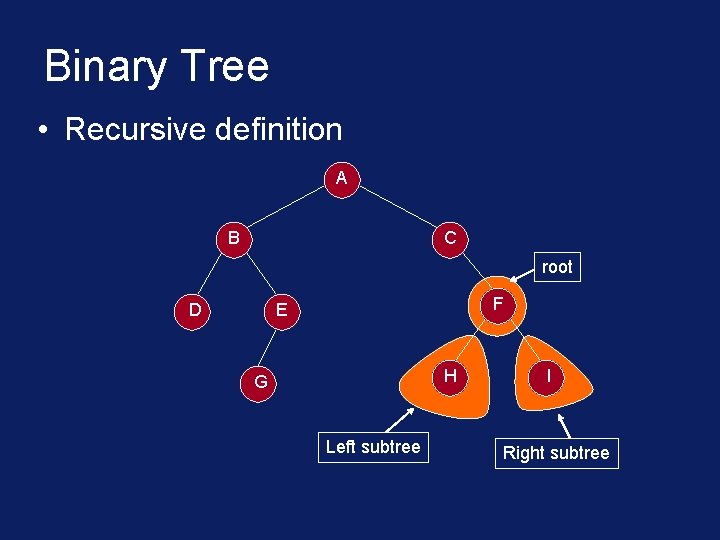
Binary Tree • Recursive definition A B C root D F E H G Left subtree I Right subtree
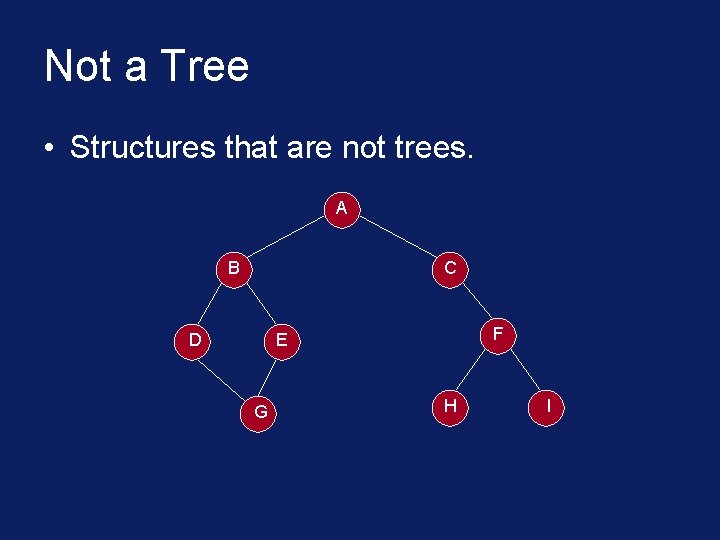
Not a Tree • Structures that are not trees. A B C D F E G H I
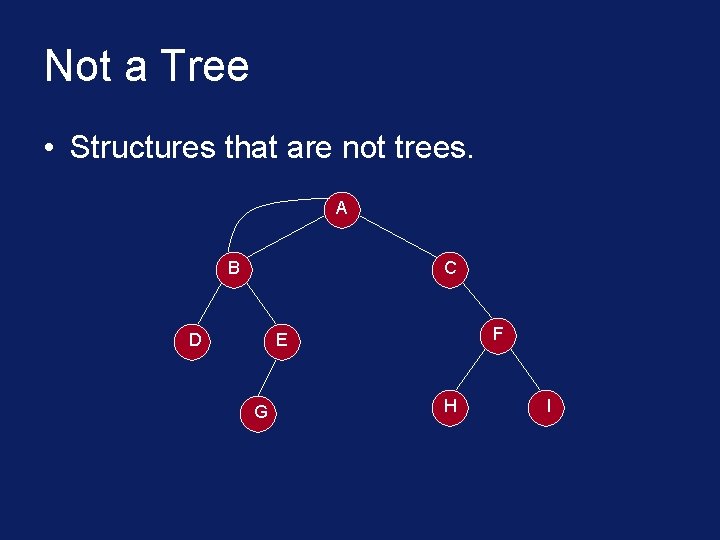
Not a Tree • Structures that are not trees. A B C D F E G H I
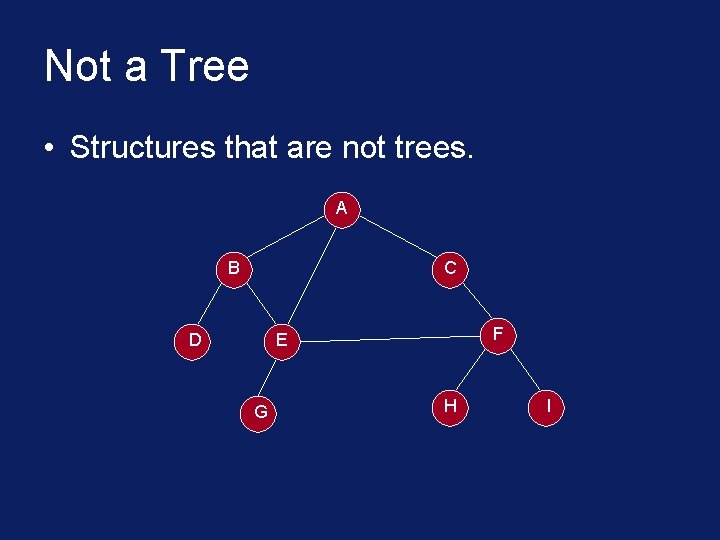
Not a Tree • Structures that are not trees. A B C D F E G H I
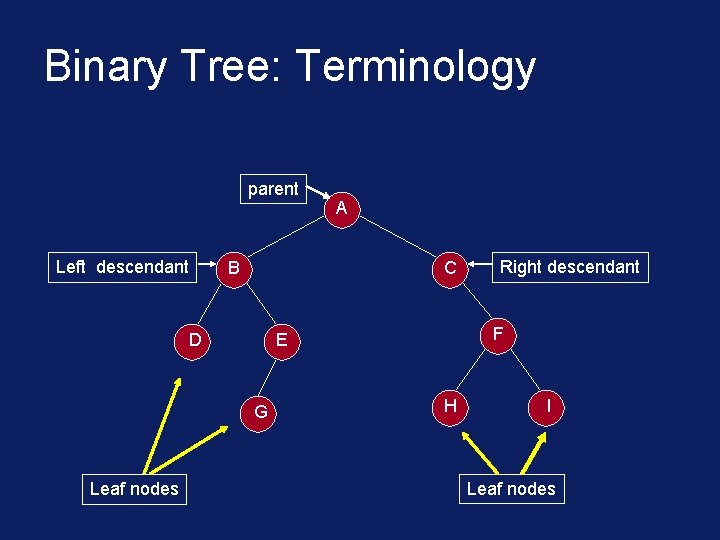
Binary Tree: Terminology parent Left descendant B C D Right descendant F E G Leaf nodes A H I Leaf nodes
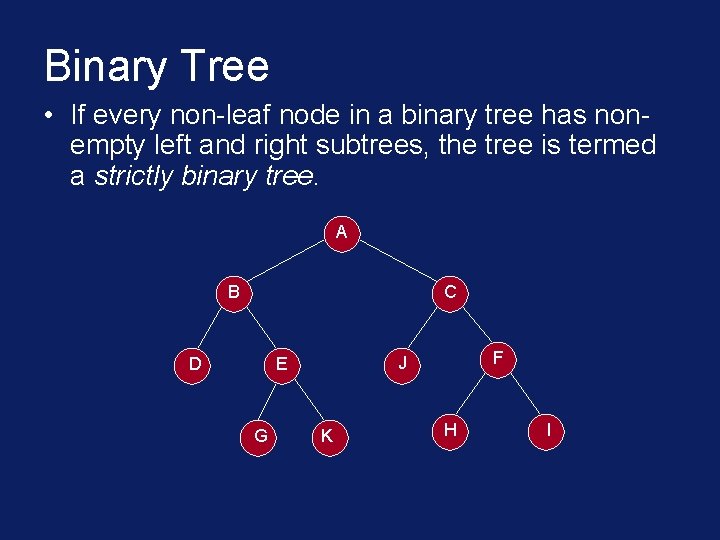
Binary Tree • If every non-leaf node in a binary tree has nonempty left and right subtrees, the tree is termed a strictly binary tree. A B C D G F J E K H I
Level of a Binary Tree Node • The level of a node in a binary tree is defined as follows: § Root has level 0, § Level of any other node is one more than the level its parent (father). • The depth of a binary tree is the maximum level of any leaf in the tree.
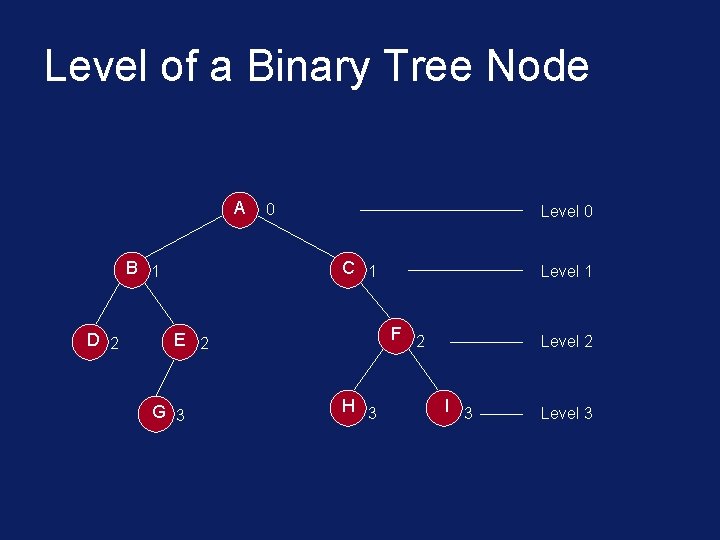
Level of a Binary Tree Node A B 1 D 2 0 Level 0 C 1 F 2 E 2 G 3 Level 1 H 3 Level 2 I 3 Level 3
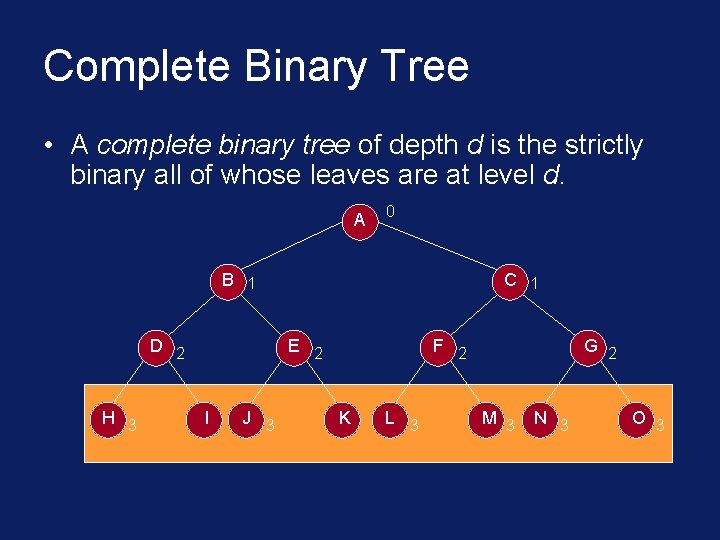
Complete Binary Tree • A complete binary tree of depth d is the strictly binary all of whose leaves are at level d. A 0 B 1 D 2 H 3 C 1 E 2 I J 3 F 2 K L 3 G 2 M 3 N 3 O 3
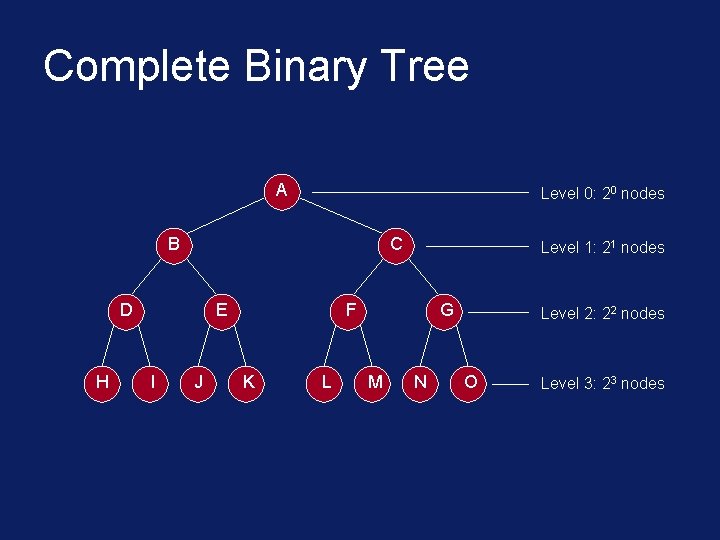
Complete Binary Tree A Level 0: 20 nodes B C D H E I J Level 1: 21 nodes F K L G M N Level 2: 22 nodes O Level 3: 23 nodes
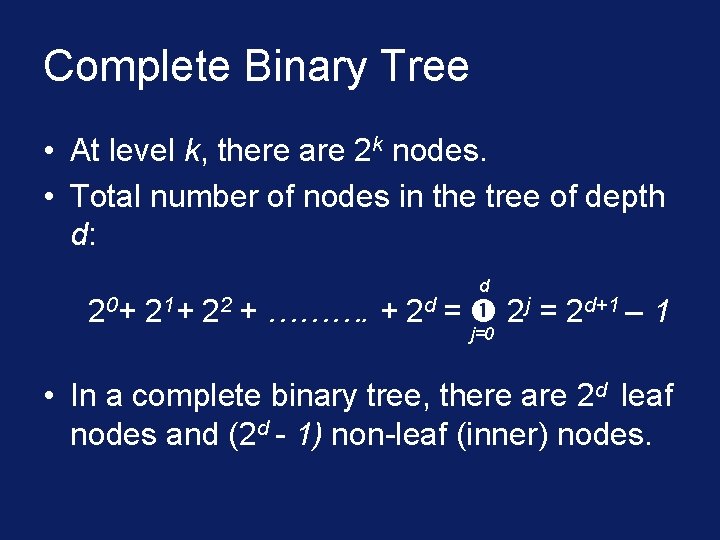
Complete Binary Tree • At level k, there are 2 k nodes. • Total number of nodes in the tree of depth d: d 20+ 21+ 22 + ………. + 2 d = 2 j = 2 d+1 – 1 j=0 • In a complete binary tree, there are 2 d leaf nodes and (2 d - 1) non-leaf (inner) nodes.
Complete Binary Tree • If the tree is built out of ‘n’ nodes then n = 2 d+1 – 1 or log 2(n+1) = d+1 or d = log 2(n+1) – 1 • I. e. , the depth of the complete binary tree built using ‘n’ nodes will be log 2(n+1) – 1. • For example, for n=100, 000, log 2(100001) is less than 20; the tree would be 20 levels deep. • The significance of this shallowness will become evident later.
Operations on Binary Tree • There a number of operations that can be defined for a binary tree. • If p is pointing to a node in an existing tree then § § § left(p) returns pointer to the left subtree right(p) returns pointer to right subtree parent(p) returns the father of p brother(p) returns brother of p. info(p) returns content of the node.
- Slides: 22