
Tree CAM Decoupling Updates and Lookups in Packet


- Slides: 23
Tree. CAM: Decoupling Updates and Lookups in Packet Classification Balajee Vamanan and T. N. Vijaykumar School of Electrical & Computer Engineering Co. NEXT 2011
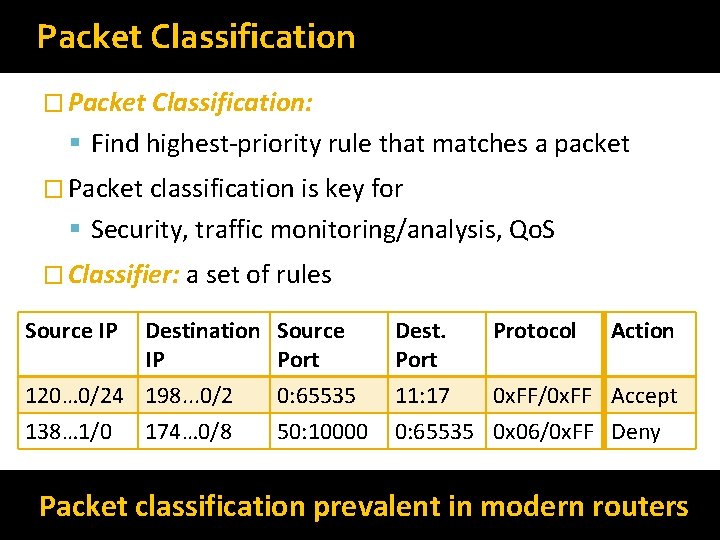
Packet Classification � Packet Classification: Find highest-priority rule that matches a packet � Packet classification is key for Security, traffic monitoring/analysis, Qo. S � Classifier: a set of rules Source IP Destination Source IP Port 120… 0/24 198. . . 0/2 138… 1/0 174… 0/8 0: 65535 50: 10000 Dest. Port Protocol Action 11: 17 0 x. FF/0 x. FF Accept 0: 65535 0 x 06/0 x. FF Deny Packet classification prevalent in modern routers 2
Trends in Packet Classification � Line rates increasing (40 Gbps now, 160 Gbps soon) � Classifier size (number of rules) increasing Custom rules for VPNs, Qo. S � Rules are getting more dynamic too Larger classifiers at faster lookup & update rates � Much work on lookups, but not on updates Must perform well in lookups and updates at low power 3
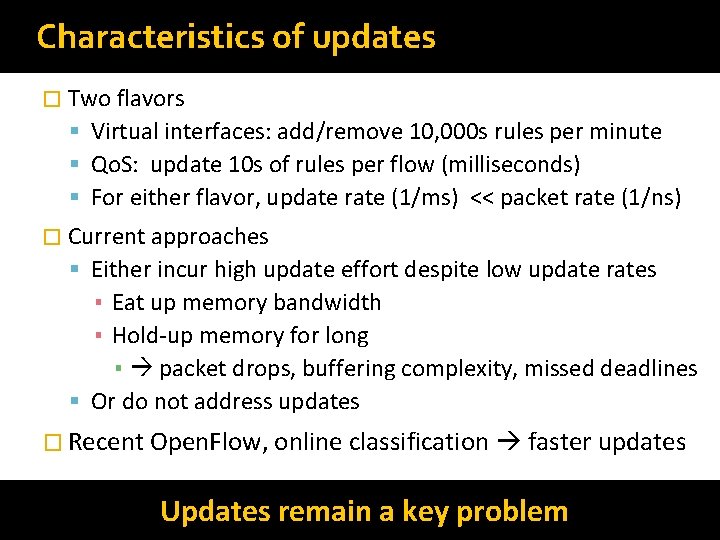
Characteristics of updates � Two flavors Virtual interfaces: add/remove 10, 000 s rules per minute Qo. S: update 10 s of rules per flow (milliseconds) For either flavor, update rate (1/ms) << packet rate (1/ns) � Current approaches Either incur high update effort despite low update rates ▪ Eat up memory bandwidth ▪ Hold-up memory for long ▪ packet drops, buffering complexity, missed deadlines Or do not address updates � Recent Open. Flow, online classification faster updates Updates remain a key problem 4
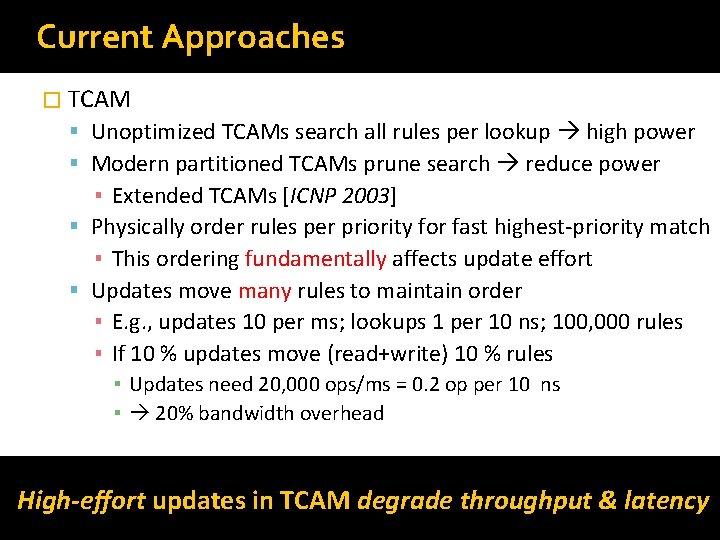
Current Approaches � TCAM Unoptimized TCAMs search all rules per lookup high power Modern partitioned TCAMs prune search reduce power ▪ Extended TCAMs [ICNP 2003] Physically order rules per priority for fast highest-priority match ▪ This ordering fundamentally affects update effort Updates move many rules to maintain order ▪ E. g. , updates 10 per ms; lookups 1 per 10 ns; 100, 000 rules ▪ If 10 % updates move (read+write) 10 % rules ▪ Updates need 20, 000 ops/ms = 0. 2 op per 10 ns ▪ 20% bandwidth overhead High-effort updates in TCAM degrade throughput & latency 5
Current Approaches (Contd. ) � Decision Trees: Build decision trees to prune search per lookup Do not address updates No ordering like TCAMs but updates may cause tree imbalance ▪ Imbalance increase lookup accesses ▪ Re-balancing is costly Previous schemes are not good in both lookups and updates 6
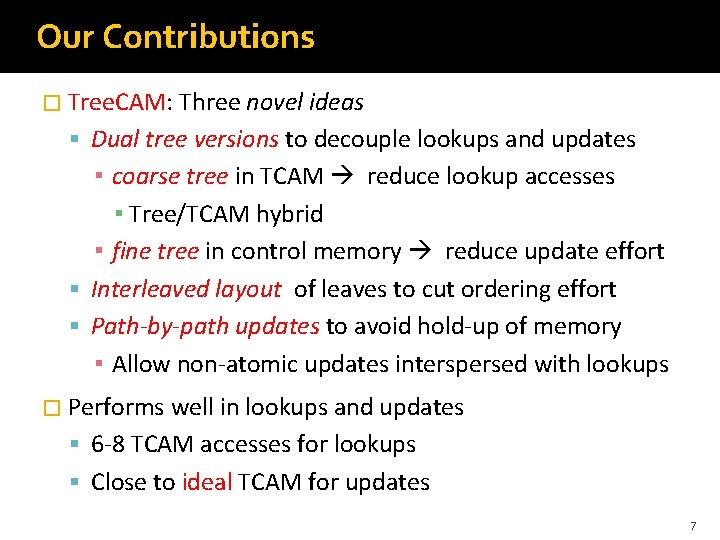
Our Contributions � Tree. CAM: Three novel ideas Dual tree versions to decouple lookups and updates ▪ coarse tree in TCAM reduce lookup accesses ▪ Tree/TCAM hybrid ▪ fine tree in control memory reduce update effort Interleaved layout of leaves to cut ordering effort Path-by-path updates to avoid hold-up of memory ▪ Allow non-atomic updates interspersed with lookups � Performs well in lookups and updates 6 -8 TCAM accesses for lookups Close to ideal TCAM for updates 7
Outline � � � ▪ ▪ � � Introduction Background: Decision Trees Dual tree versions Coarse Tree Fine Tree Updates using Interleaved Layout Path-by-path updates Results Conclusion 8
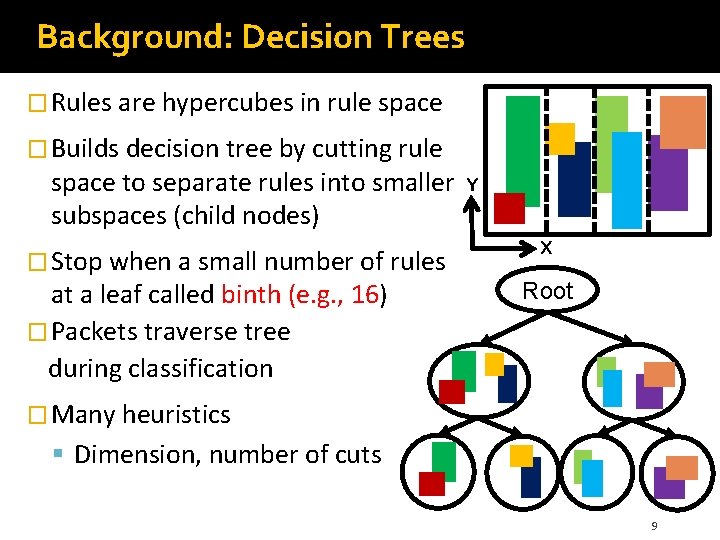
Background: Decision Trees � Rules are hypercubes in rule space � Builds decision tree by cutting rule space to separate rules into smaller subspaces (child nodes) � Stop when a small number of rules at a leaf called binth (e. g. , 16) � Packets traverse tree during classification Y X Root � Many heuristics Dimension, number of cuts 9
Outline � � � ▪ ▪ � � Introduction Background: Decision Trees Dual tree versions Coarse Tree Fine Tree Updates using Interleaved Layout Path-by-path updates Results Conclusion 10
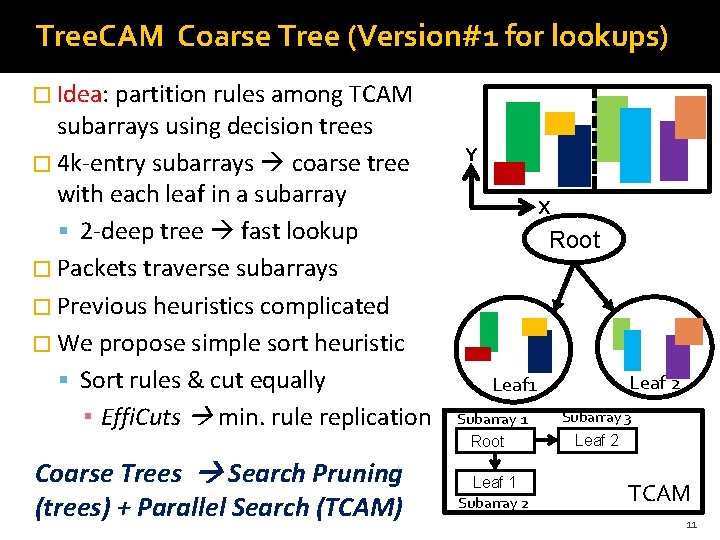
Tree. CAM Coarse Tree (Version#1 for lookups) � Idea: partition rules among TCAM subarrays using decision trees � 4 k-entry subarrays coarse tree with each leaf in a subarray 2 -deep tree fast lookup � Packets traverse subarrays � Previous heuristics complicated � We propose simple sort heuristic Sort rules & cut equally ▪ Effi. Cuts min. rule replication Coarse Trees Search Pruning (trees) + Parallel Search (TCAM) Y X Root Leaf 1 Subarray 1 Rootot Leaf 1 Subarray 2 Leaf 2 Subarray 3 Leaf 2 TCAM 11
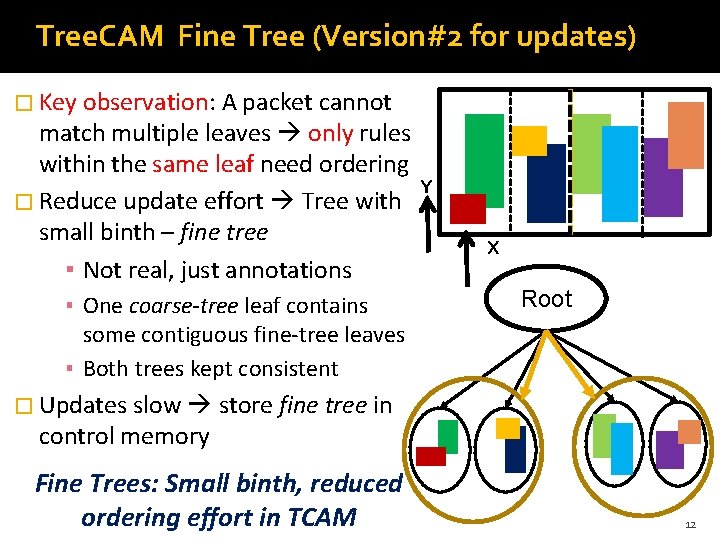
Tree. CAM Fine Tree (Version#2 for updates) � Key observation: A packet cannot match multiple leaves only rules within the same leaf need ordering � Reduce update effort Tree with small binth – fine tree ▪ Not real, just annotations ▪ One coarse-tree leaf contains some contiguous fine-tree leaves ▪ Both trees kept consistent Y X Root � Updates slow store fine tree in control memory Fine Trees: Small binth, reduced ordering effort in TCAM 12
Outline � � � ▪ ▪ � � Introduction Background: Decision Trees Dual tree versions Coarse Tree Fine Tree Updates using Interleaved Layout Path-by-path updates Results Conclusion 13
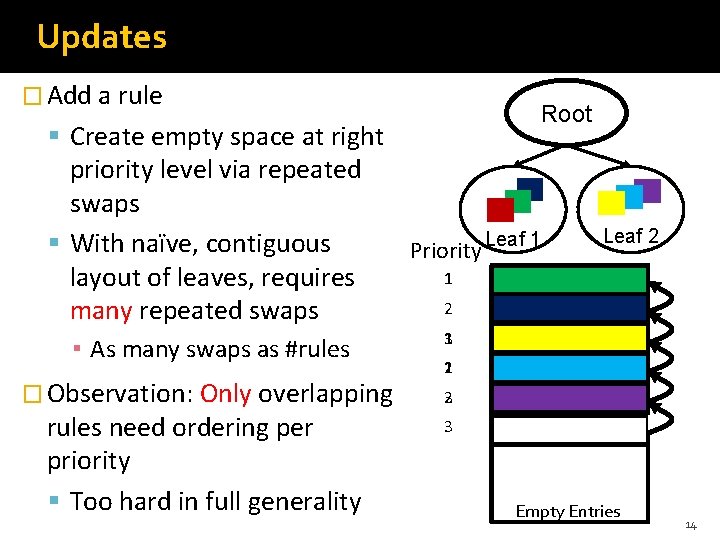
Updates � Add a rule Root Create empty space at right priority level via repeated swaps With naïve, contiguous layout of leaves, requires many repeated swaps ▪ As many swaps as #rules � Observation: Only overlapping rules need ordering per priority Too hard in full generality 1 Priority Leaf 1 Leaf 2 1 3 2. 3 Empty Entries 14
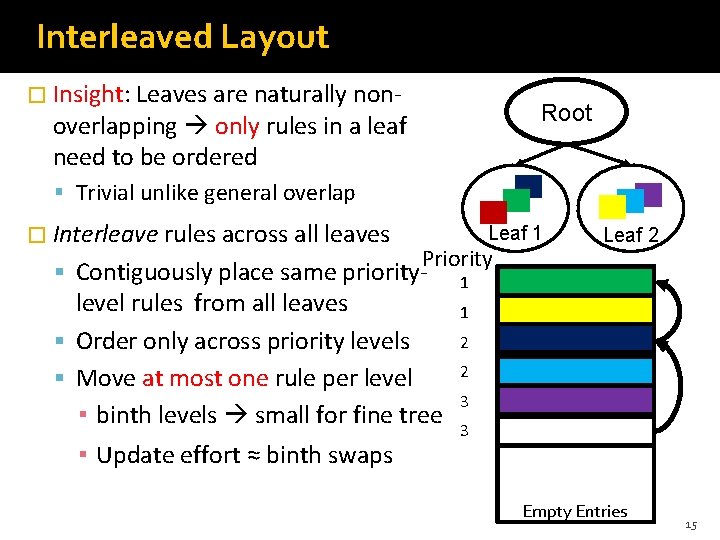
Interleaved Layout � Insight: Leaves are naturally non- Root overlapping only rules in a leaf need to be ordered Trivial unlike general overlap � Interleave rules across all leaves Leaf 1 Priority Contiguously place same priority- 1 level rules from all leaves Order only across priority levels Move at most one rule per level ▪ binth levels small for fine tree ▪ Update effort ≈ binth swaps Leaf 2 1 2 2 3. 3 Empty Entries 15
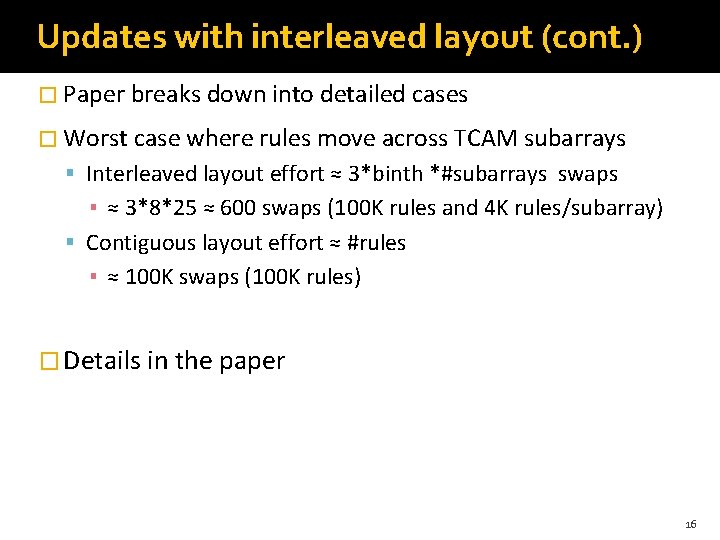
Updates with interleaved layout (cont. ) � Paper breaks down into detailed cases � Worst case where rules move across TCAM subarrays Interleaved layout effort ≈ 3*binth *#subarrays swaps ▪ ≈ 3*8*25 ≈ 600 swaps (100 K rules and 4 K rules/subarray) Contiguous layout effort ≈ #rules ▪ ≈ 100 K swaps (100 K rules) � Details in the paper 16
Path-by-path Updates � Problem: Update moves hold up memory for long � Make updates non-atomic Packet lookups can be interspersed between updates � Details in the paper 17
Outline � � � ▪ ▪ � � Introduction Background: Decision Trees Dual tree versions Coarse Tree Fine Tree Updates using Interleaved Layout Path-by-path updates Results Conclusion 18
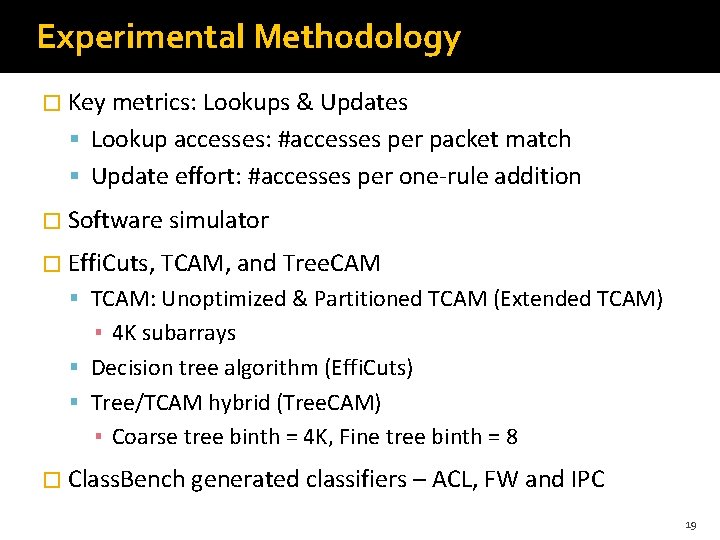
Experimental Methodology � Key metrics: Lookups & Updates Lookup accesses: #accesses per packet match Update effort: #accesses per one-rule addition � Software simulator � Effi. Cuts, TCAM, and Tree. CAM TCAM: Unoptimized & Partitioned TCAM (Extended TCAM) ▪ 4 K subarrays Decision tree algorithm (Effi. Cuts) Tree/TCAM hybrid (Tree. CAM) ▪ Coarse tree binth = 4 K, Fine tree binth = 8 � Class. Bench generated classifiers – ACL, FW and IPC 19
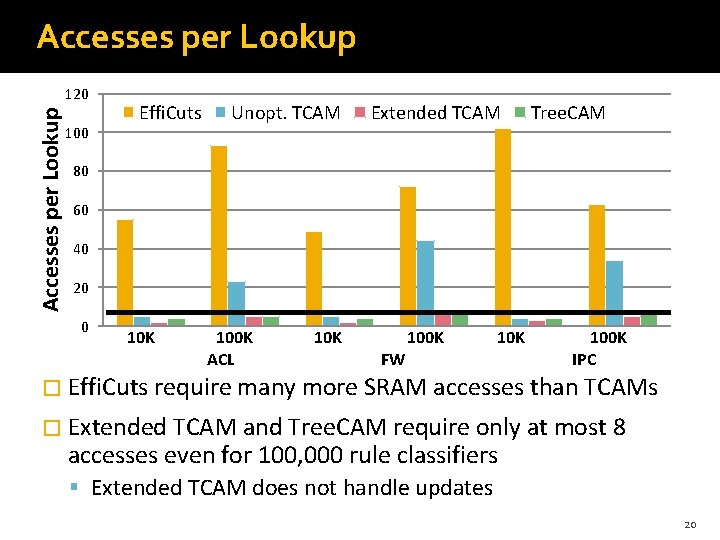
Accesses per Lookup 120 100 Effi. Cuts Unopt. TCAM Extended TCAM Tree. CAM 80 60 40 20 0 10 K 100 K ACL 10 K FW 100 K IPC � Effi. Cuts require many more SRAM accesses than TCAMs � Extended TCAM and Tree. CAM require only at most 8 accesses even for 100, 000 rule classifiers Extended TCAM does not handle updates 20
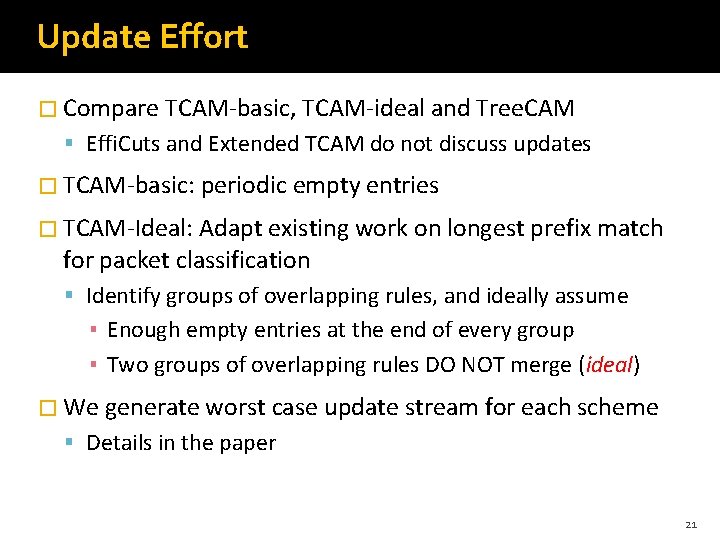
Update Effort � Compare TCAM-basic, TCAM-ideal and Tree. CAM Effi. Cuts and Extended TCAM do not discuss updates � TCAM-basic: periodic empty entries � TCAM-Ideal: Adapt existing work on longest prefix match for packet classification Identify groups of overlapping rules, and ideally assume ▪ Enough empty entries at the end of every group ▪ Two groups of overlapping rules DO NOT merge (ideal) � We generate worst case update stream for each scheme Details in the paper 21
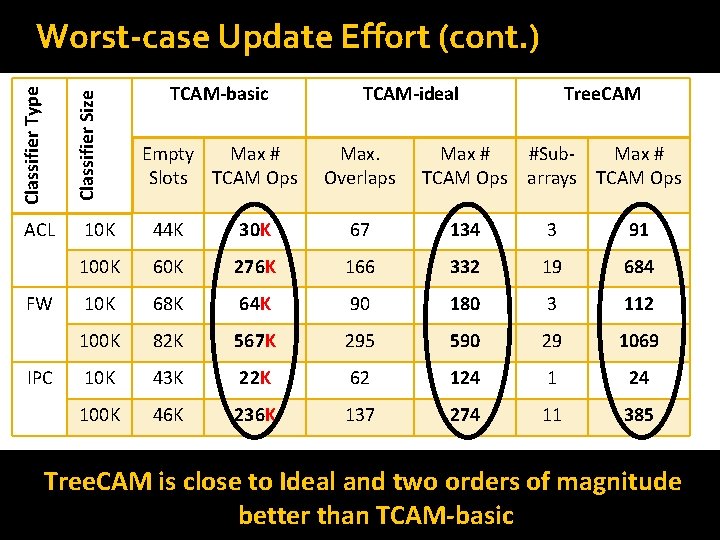
Classifier Size Classifier Type Worst-case Update Effort (cont. ) ACL FW IPC TCAM-basic Empty Max # Slots TCAM Ops TCAM-ideal Max. Overlaps Tree. CAM Max # #Sub. Max # TCAM Ops arrays TCAM Ops 10 K 44 K 30 K 67 134 3 91 100 K 60 K 276 K 166 332 19 684 10 K 68 K 64 K 90 180 3 112 100 K 82 K 567 K 295 590 29 1069 10 K 43 K 22 K 62 124 100 K 46 K 236 K 137 274 11 385 Tree. CAM is close to Ideal and two orders of magnitude better than TCAM-basic 22
Conclusion � Previous schemes do not perform well in both lookups and updates � Tree. CAM uses three techniques to address this challenge: Dual tree versions: Decouples lookups and updates ▪ Coarse trees for lookups and fine trees for updates Interleaved layout bounds the update effort Path-by-path update enables non-atomic updates which can be interspersed with packet lookups � Tree. CAM achieves 6 – 8 lookup accesses and close to ideal TCAM for updates, even for large classifiers (100 K rules) Tree. CAM scales well with classifier size, line rate, and update rate 23