
Treaty of Versailles Who What Where When Impact
- Slides: 38
Treaty of Versailles Who? What? Where? When? Impact!
QUICK REVIEW § Archduke Franz Ferdinand § Belgium § Vladimir Lenin § 3 Cause for US Involvement § Trench Warfare § Propaganda
1. What did the Allies want at the Treaty of Versailles? 2. What was Germany’s punishment? 3. What are reparations? 4. What was the League of Nations?
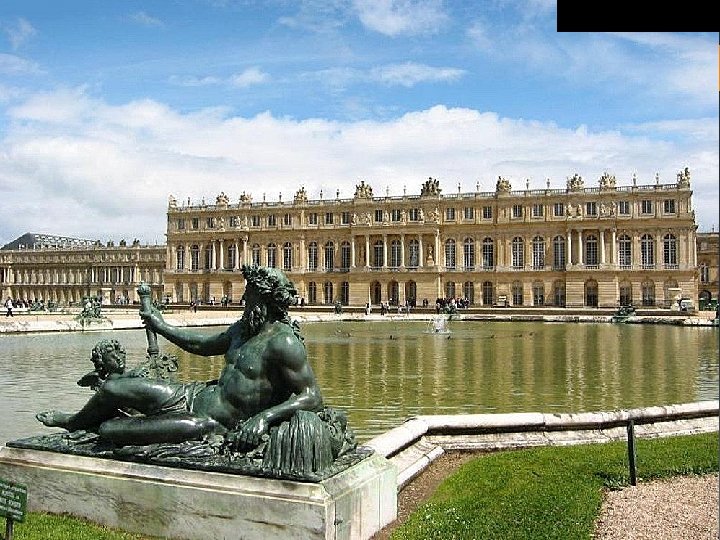
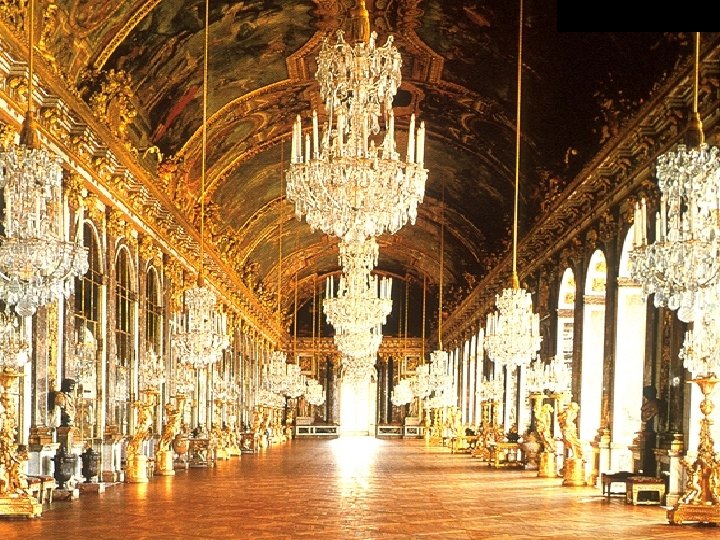
Versailles Today
Versailles Today
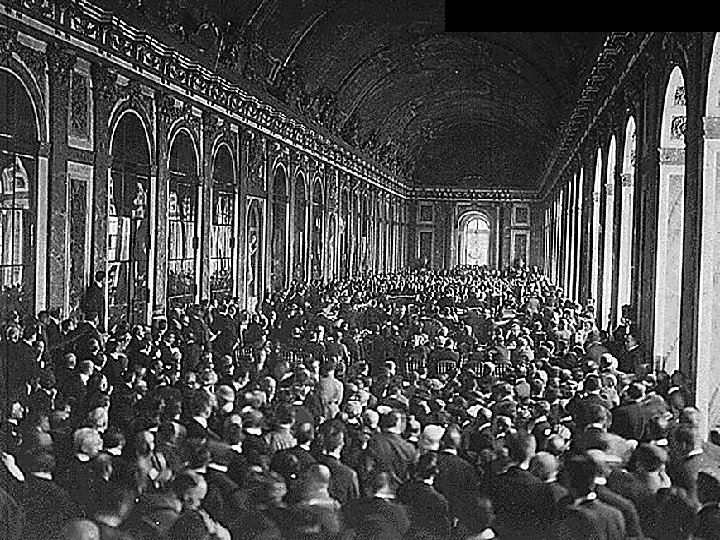
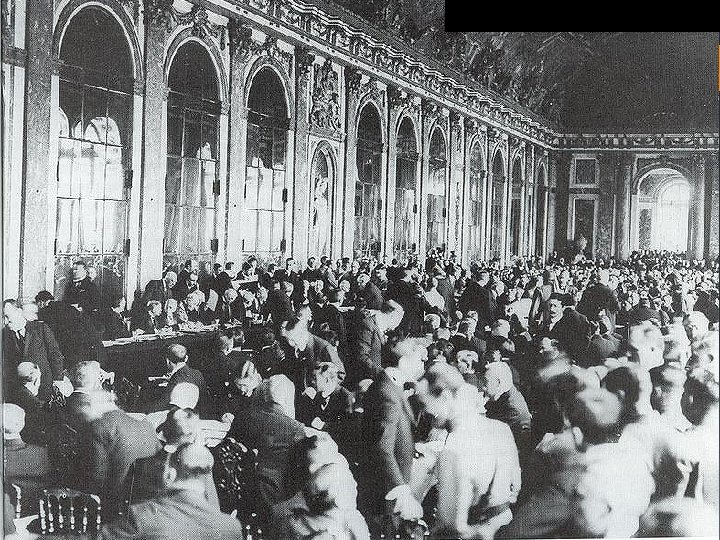
Delegates at Versailles, 1919
Delegates at Versailles, 1919
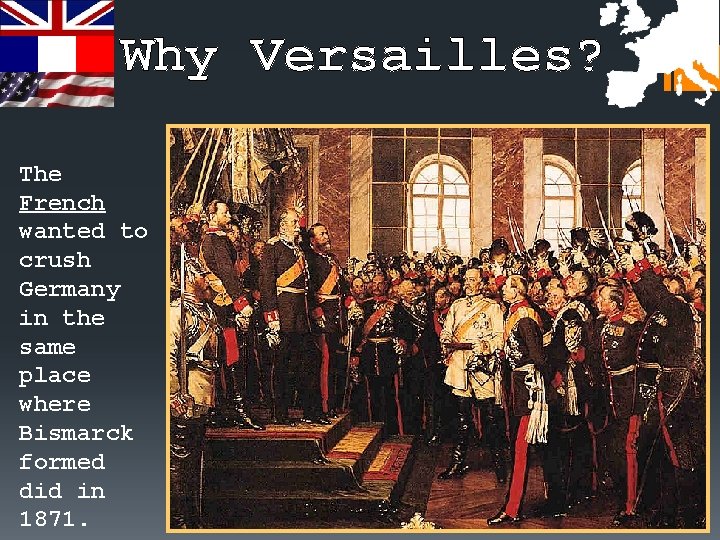
Why Versailles? The French wanted to crush Germany in the same place where Bismarck formed did in 1871.
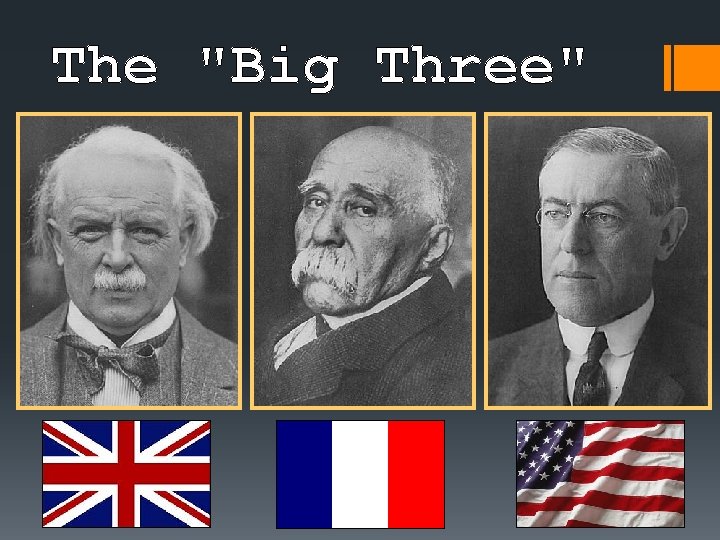
The "Big Three"
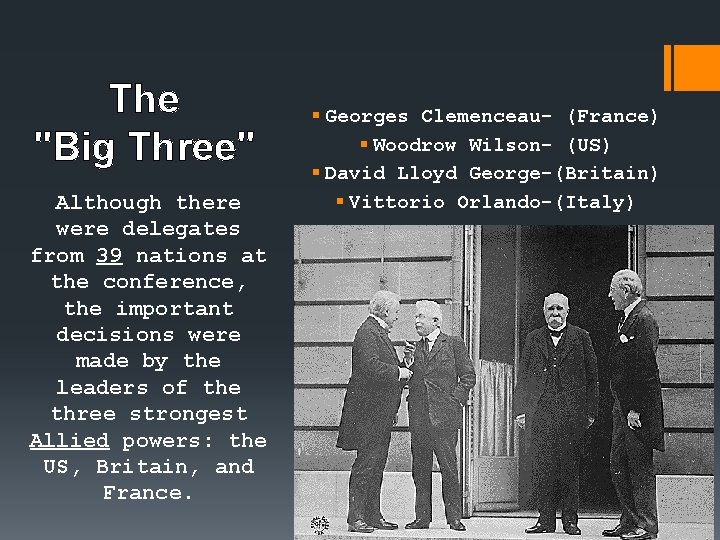
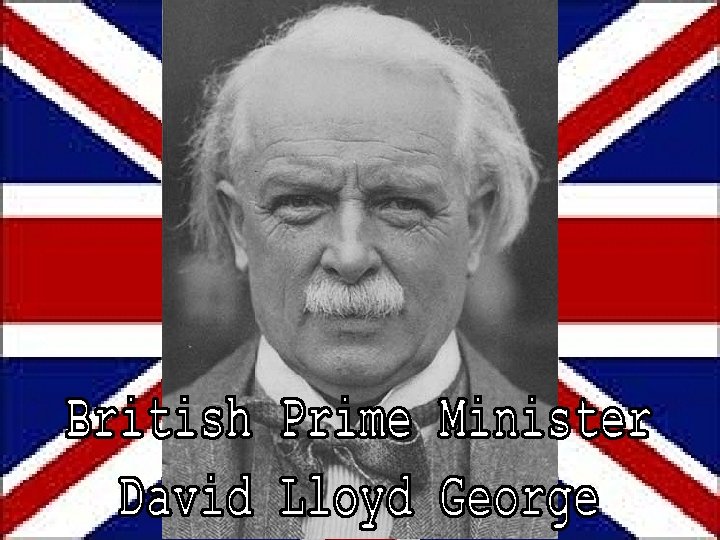
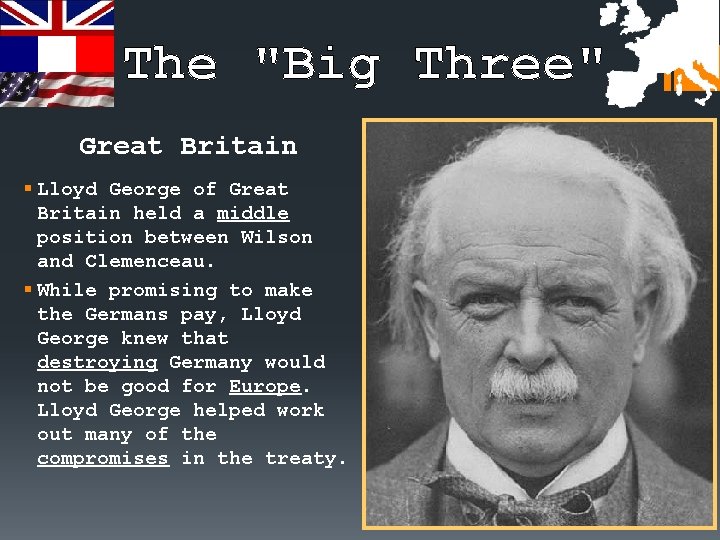
The "Big Three" Although there were delegates from 39 nations at the conference, the important decisions were made by the leaders of the three strongest Allied powers: the US, Britain, and France. § Georges Clemenceau- (France) § Woodrow Wilson- (US) § David Lloyd George-(Britain) § Vittorio Orlando-(Italy)
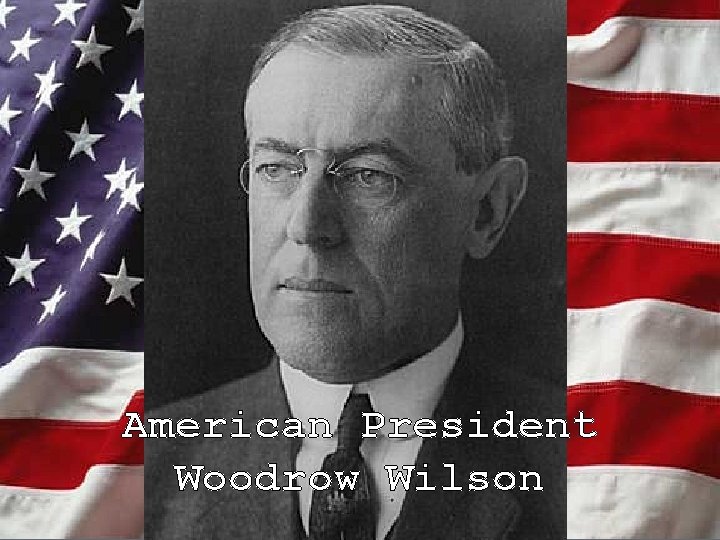
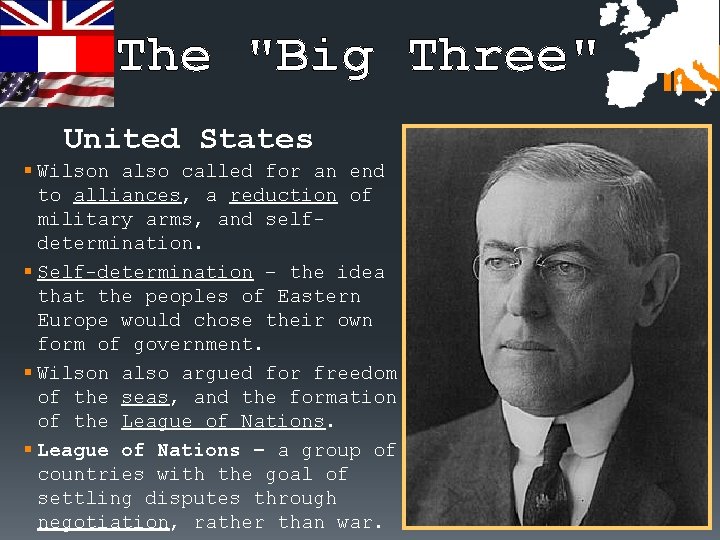
American President Woodrow Wilson
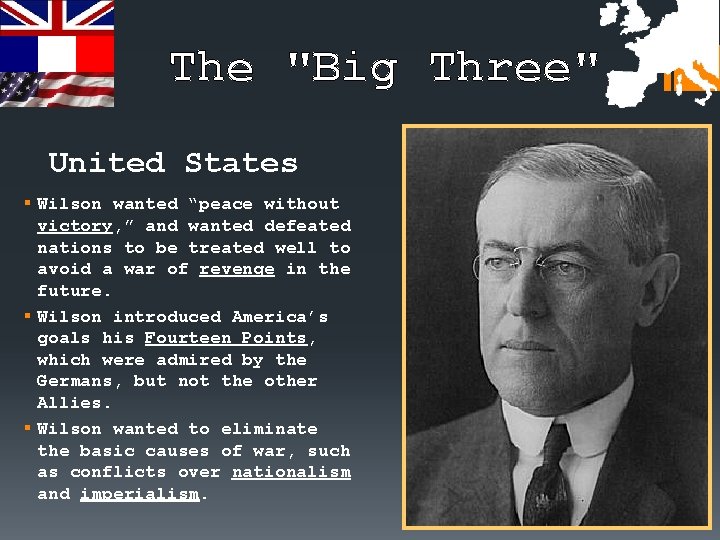
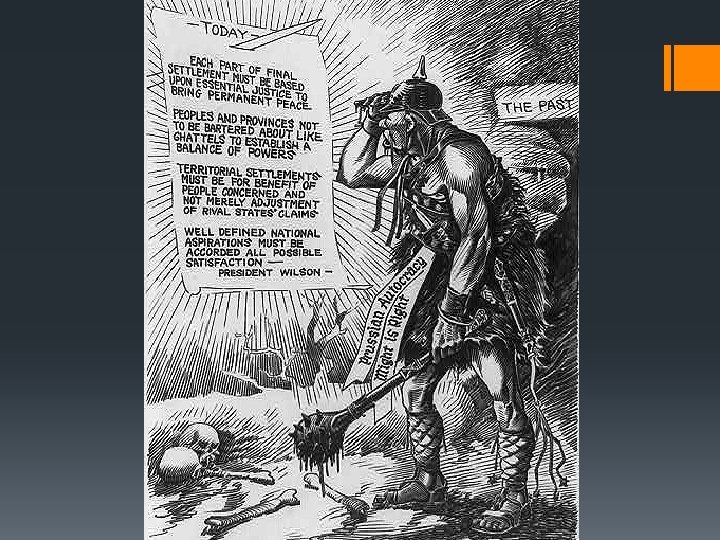
The "Big Three" United States § Wilson wanted “peace without victory, ” and wanted defeated nations to be treated well to avoid a war of revenge in the future. § Wilson introduced America’s goals his Fourteen Points, which were admired by the Germans, but not the other Allies. § Wilson wanted to eliminate the basic causes of war, such as conflicts over nationalism and imperialism.
The "Big Three" United States § Wilson also called for an end to alliances, a reduction of military arms, and selfdetermination. § Self-determination – the idea that the peoples of Eastern Europe would chose their own form of government. § Wilson also argued for freedom of the seas, and the formation of the League of Nations. § League of Nations – a group of countries with the goal of settling disputes through negotiation, rather than war.
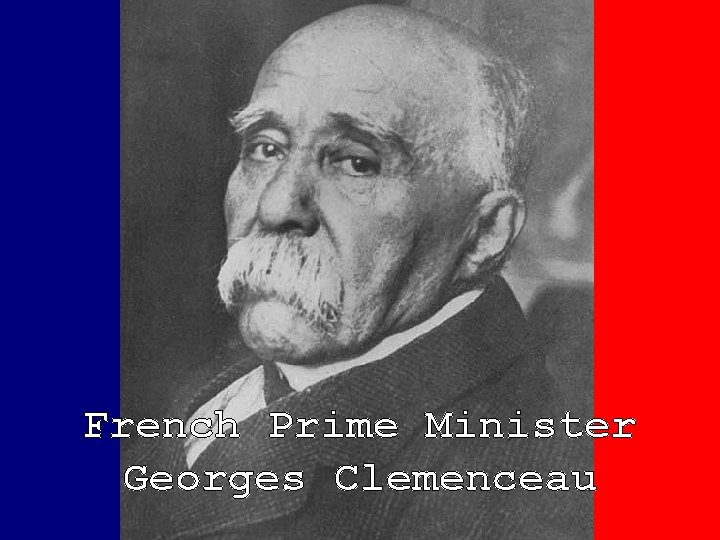
French Prime Minister Georges Clemenceau
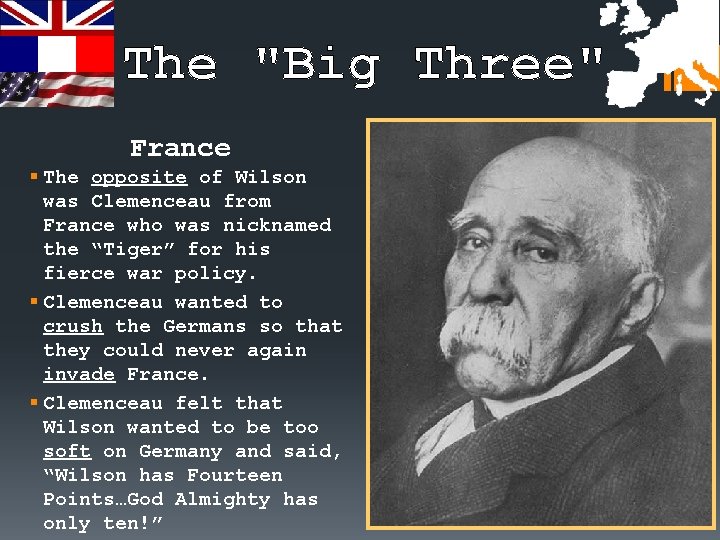
The "Big Three" France § The opposite of Wilson was Clemenceau from France who was nicknamed the “Tiger” for his fierce war policy. § Clemenceau wanted to crush the Germans so that they could never again invade France. § Clemenceau felt that Wilson wanted to be too soft on Germany and said, “Wilson has Fourteen Points…God Almighty has only ten!”
The "Big Three" Great Britain § Lloyd George of Great Britain held a middle position between Wilson and Clemenceau. § While promising to make the Germans pay, Lloyd George knew that destroying Germany would not be good for Europe. Lloyd George helped work out many of the compromises in the treaty.
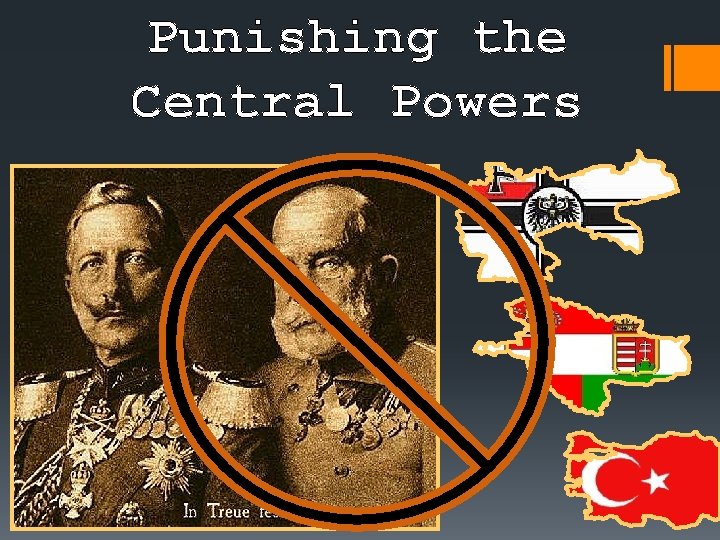
Punishing the Central Powers
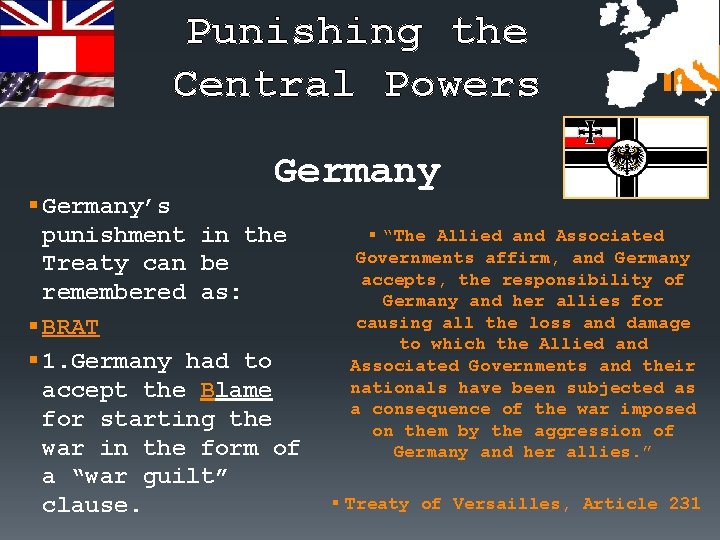
Punishing the Central Powers Germany § Germany’s punishment in the Treaty can be remembered as: § BRAT § 1. Germany had to accept the Blame for starting the war in the form of a “war guilt” clause. § “The Allied and Associated Governments affirm, and Germany accepts, the responsibility of Germany and her allies for causing all the loss and damage to which the Allied and Associated Governments and their nationals have been subjected as a consequence of the war imposed on them by the aggression of Germany and her allies. ” § Treaty of Versailles, Article 231
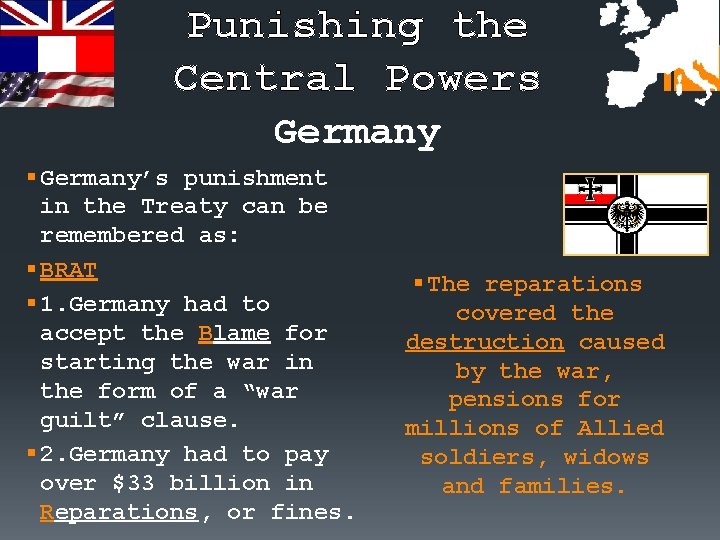
Punishing the Central Powers Germany § Germany’s punishment in the Treaty can be remembered as: § BRAT § 1. Germany had to accept the Blame for starting the war in the form of a “war guilt” clause. § 2. Germany had to pay over $33 billion in Reparations, or fines. § The reparations covered the destruction caused by the war, pensions for millions of Allied soldiers, widows and families.
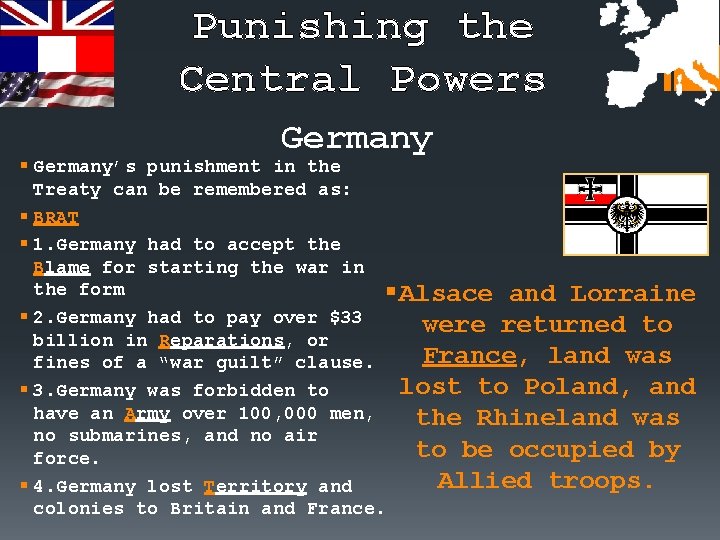
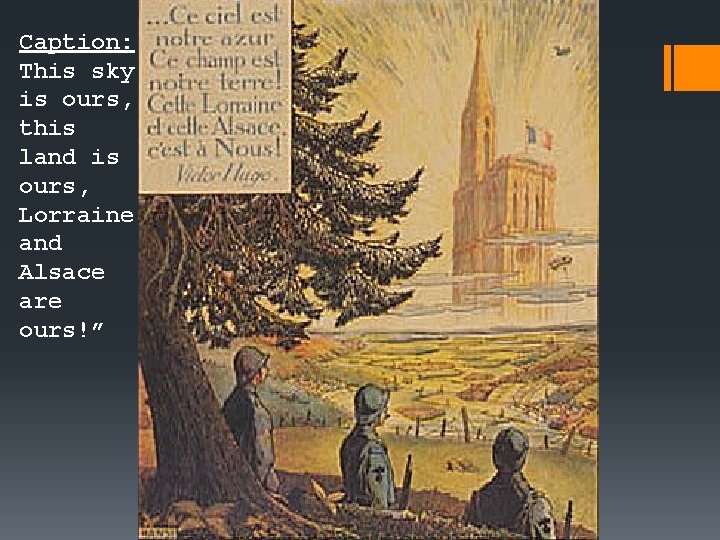
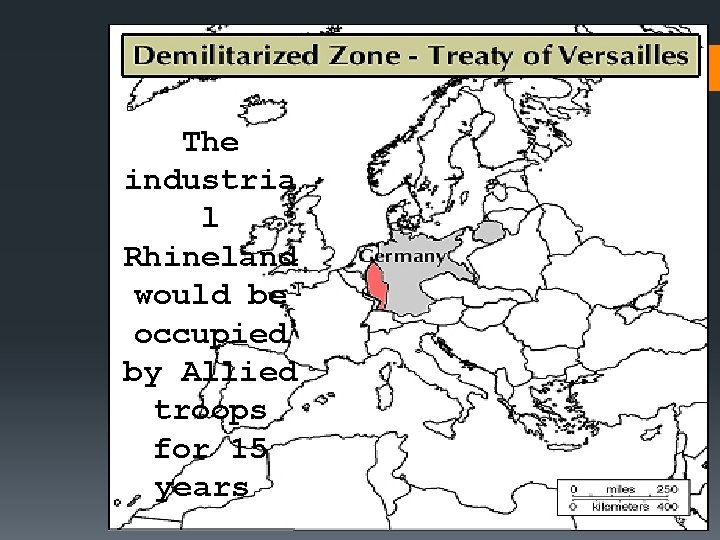
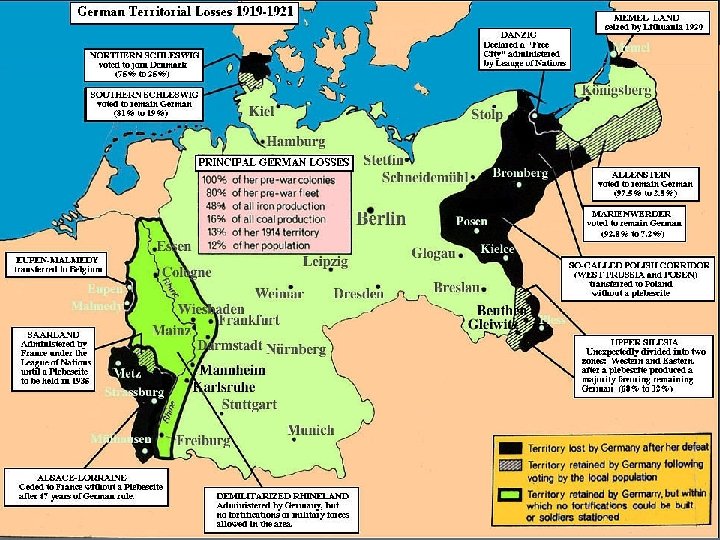
Punishing the Central Powers Germany § Germany’s punishment in the Treaty can be remembered as: § BRAT § 1. Germany had to accept the Blame for starting the war in the form § Alsace and Lorraine § 2. Germany had to pay over $33 were returned to billion in Reparations, or France, land was fines of a “war guilt” clause. lost to Poland, and § 3. Germany was forbidden to have an Army over 100, 000 men, the Rhineland was no submarines, and no air to be occupied by force. Allied troops. § 4. Germany lost Territory and colonies to Britain and France.
QUICK REVIEW § David Lloyd George § Palace of Versailles § Georges Clemenceau § Woodrow Wilson § Treating Germany like a B. R. A. T.
Caption: This sky is ours, this land is ours, Lorraine and Alsace are ours!”
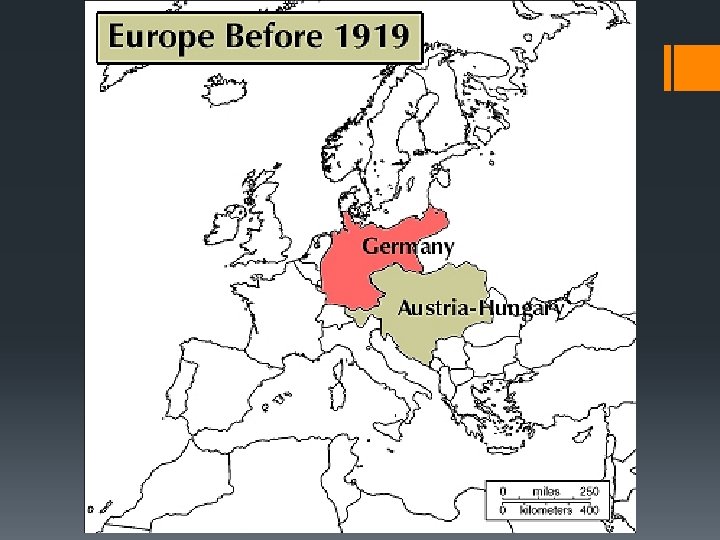
Europe Before 1919
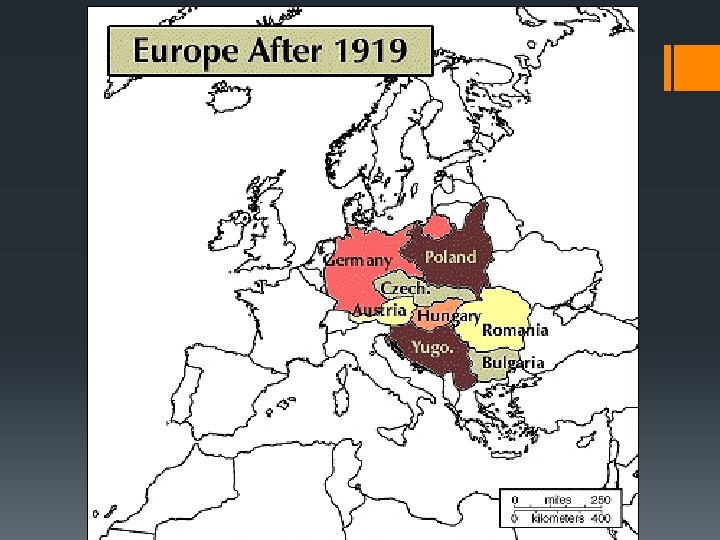
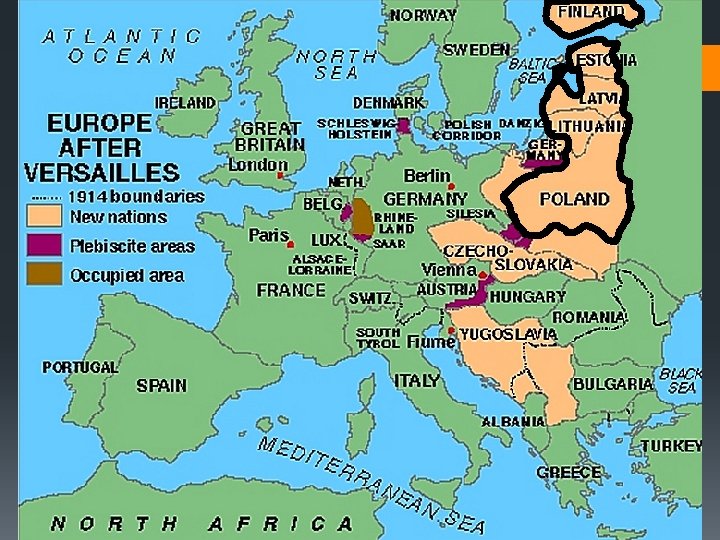
Europe After 1919 List the new Countries 1. 2. 3. 4. 5. 6. 7.
The industria l Rhineland would be occupied by Allied troops for 15 years.
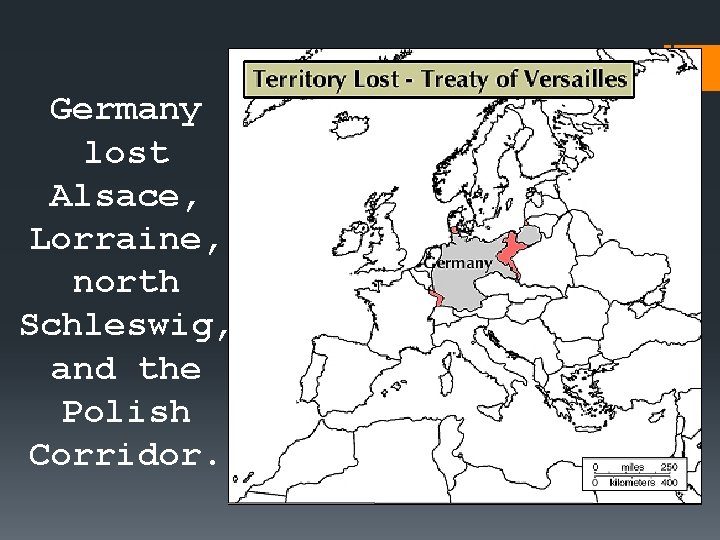
Germany lost Alsace, Lorraine, north Schleswig, and the Polish Corridor.
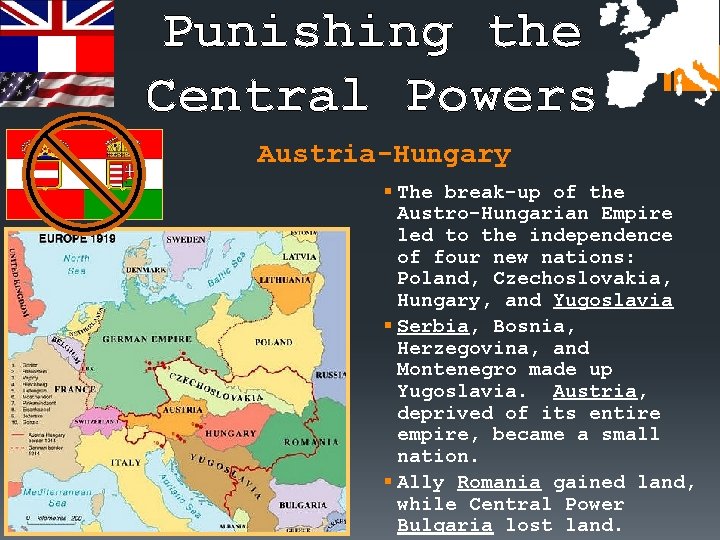
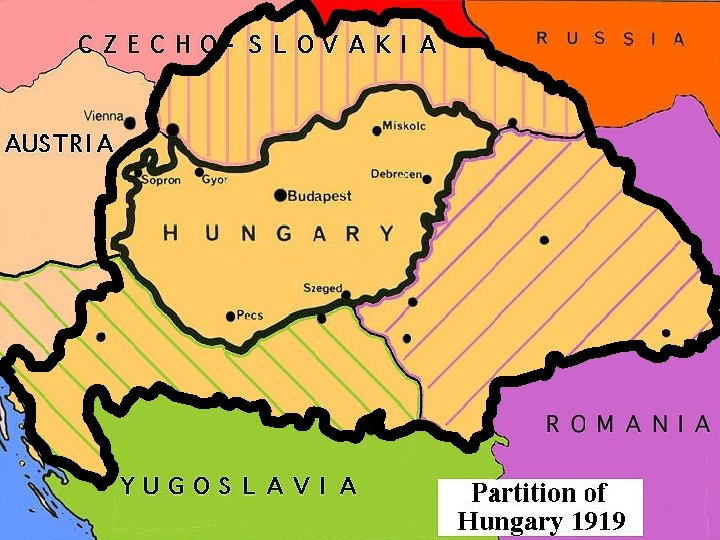
Punishing the Central Powers Austria-Hungary § The break-up of the Austro-Hungarian Empire led to the independence of four new nations: Poland, Czechoslovakia, Hungary, and Yugoslavia § Serbia, Bosnia, Herzegovina, and Montenegro made up Yugoslavia. Austria, deprived of its entire empire, became a small nation. § Ally Romania gained land, while Central Power Bulgaria lost land.
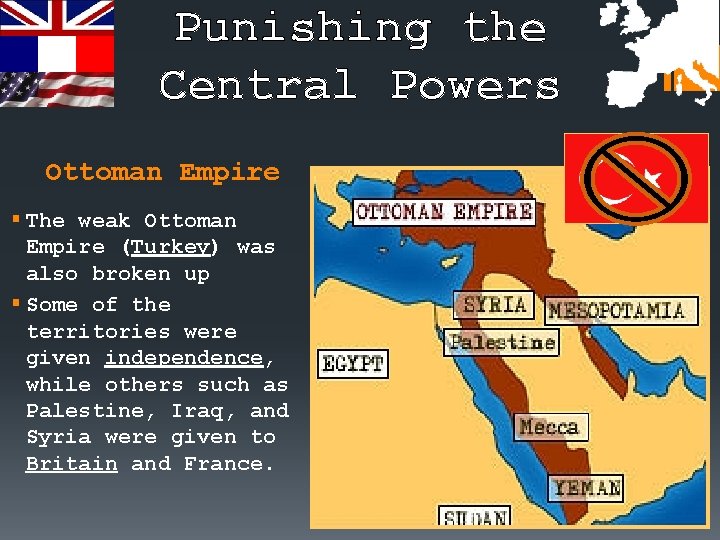
Punishing the Central Powers Ottoman Empire § The weak Ottoman Empire (Turkey) was also broken up § Some of the territories were given independence, while others such as Palestine, Iraq, and Syria were given to Britain and France.
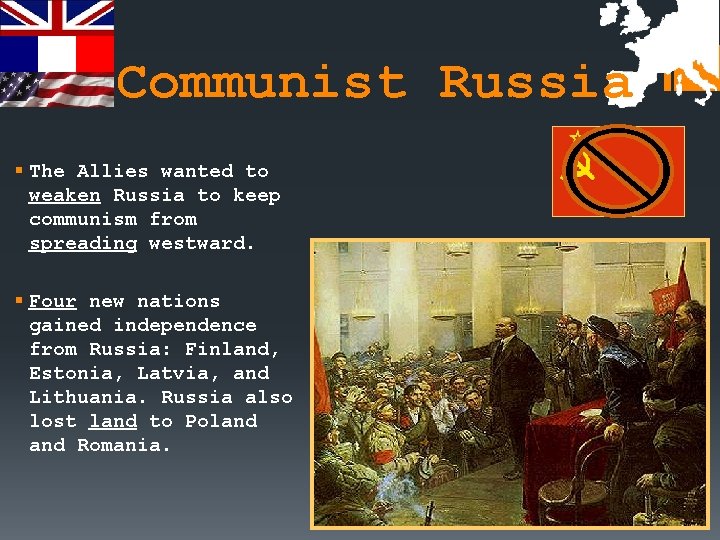
Communist Russia § The Allies wanted to weaken Russia to keep communism from spreading westward. § Four new nations gained independence from Russia: Finland, Estonia, Latvia, and Lithuania. Russia also lost land to Poland Romania.
Land Russia Lost: List the countries that gained independence
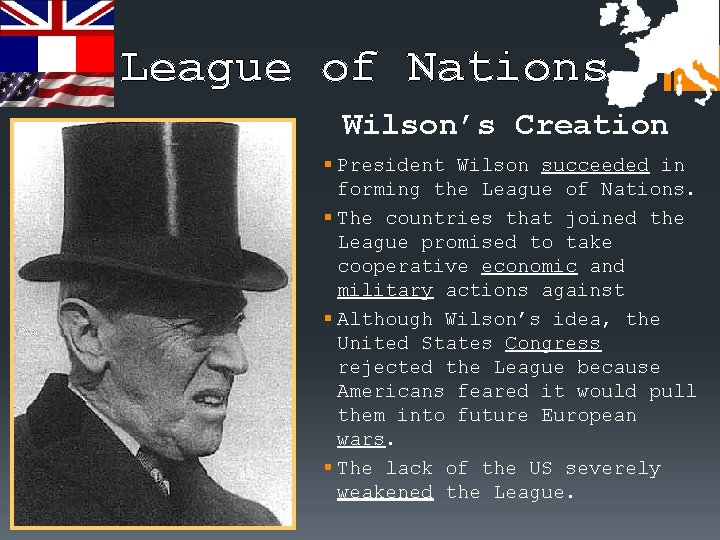
League of Nations Wilson’s Creation § President Wilson succeeded in forming the League of Nations. § The countries that joined the League promised to take cooperative economic and military actions against § Although Wilson’s idea, the United States Congress rejected the League because Americans feared it would pull them into future European wars. § The lack of the US severely weakened the League.
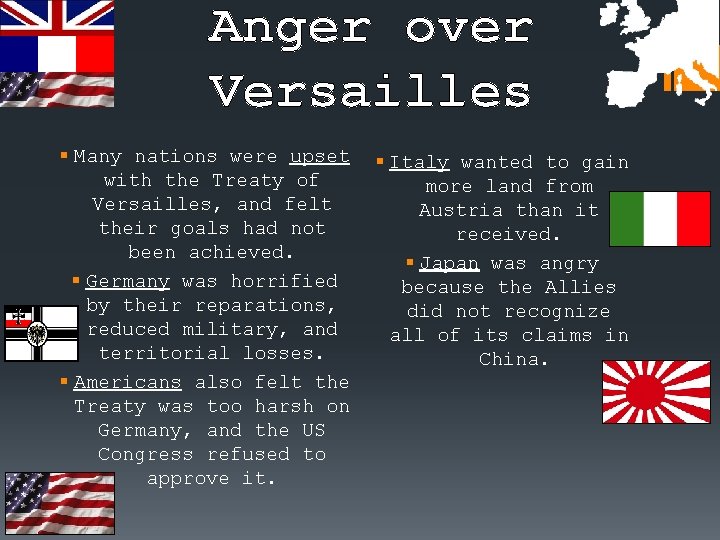
Anger over Versailles § Many nations were upset with the Treaty of Versailles, and felt their goals had not been achieved. § Germany was horrified by their reparations, reduced military, and territorial losses. § Americans also felt the Treaty was too harsh on Germany, and the US Congress refused to approve it. § Italy wanted to gain more land from Austria than it received. § Japan was angry because the Allies did not recognize all of its claims in China.
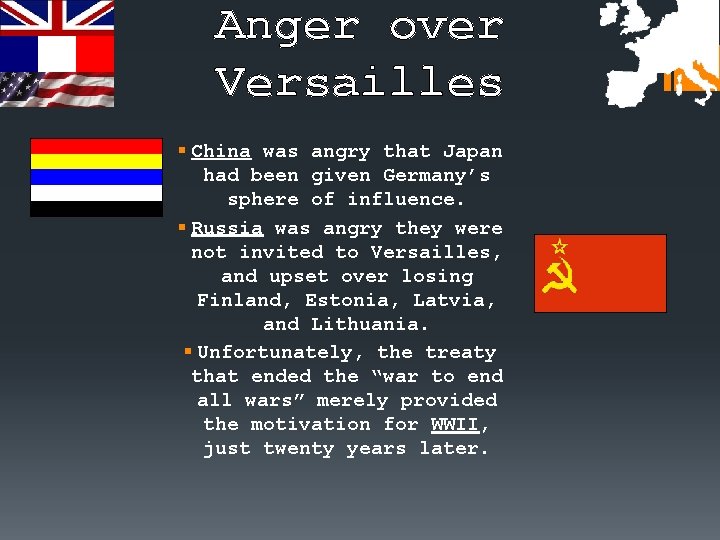
Anger over Versailles § China was angry that Japan had been given Germany’s sphere of influence. § Russia was angry they were not invited to Versailles, and upset over losing Finland, Estonia, Latvia, and Lithuania. § Unfortunately, the treaty that ended the “war to end all wars” merely provided the motivation for WWII, just twenty years later.