
Treaty of Versailles After Germany lost WWI the


- Slides: 12
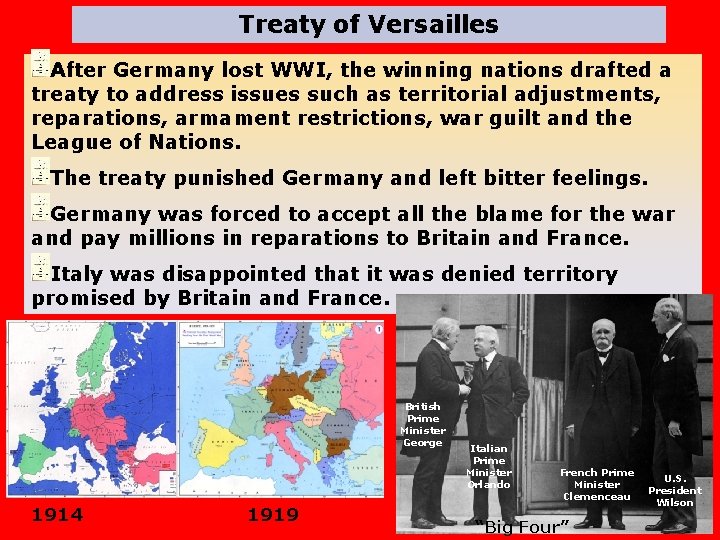
Treaty of Versailles After Germany lost WWI, the winning nations drafted a treaty to address issues such as territorial adjustments, reparations, armament restrictions, war guilt and the League of Nations. The treaty punished Germany and left bitter feelings. Germany was forced to accept all the blame for the war and pay millions in reparations to Britain and France. Italy was disappointed that it was denied territory promised by Britain and France. British Prime Minister George 1914 1919 Italian Prime Minister Orlando French Prime Minister Clemenceau “Big Four” U. S. President Wilson
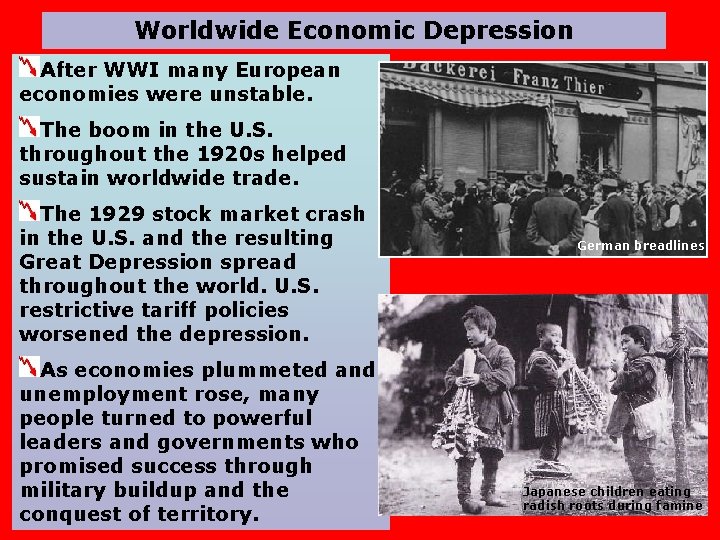
Worldwide Economic Depression After WWI many European economies were unstable. The boom in the U. S. throughout the 1920 s helped sustain worldwide trade. The 1929 stock market crash in the U. S. and the resulting Great Depression spread throughout the world. U. S. restrictive tariff policies worsened the depression. As economies plummeted and unemployment rose, many people turned to powerful leaders and governments who promised success through military buildup and the conquest of territory. German breadlines Japanese children eating radish roots during famine
Ch 30. 1 Notes “Threats to World Peace”
I. Japanese Aggression in Asia 1. Kellogg-Briand Pact- Japan challenged pact, and no powers enforced it. 2. Hamaguchi’s assassination led to military take over. 3. Japan took Manchuria, and ¼ of all Chinese land. 4. League of Nations only condemned Japan for this act, they had no army to help the Chinese.
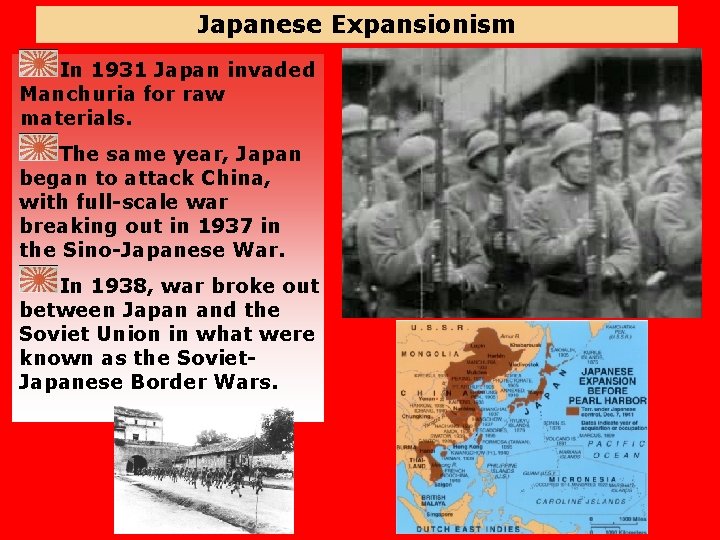
Japanese Expansionism In 1931 Japan invaded Manchuria for raw materials. The same year, Japan began to attack China, with full-scale war breaking out in 1937 in the Sino-Japanese War. In 1938, war broke out between Japan and the Soviet Union in what were known as the Soviet. Japanese Border Wars.
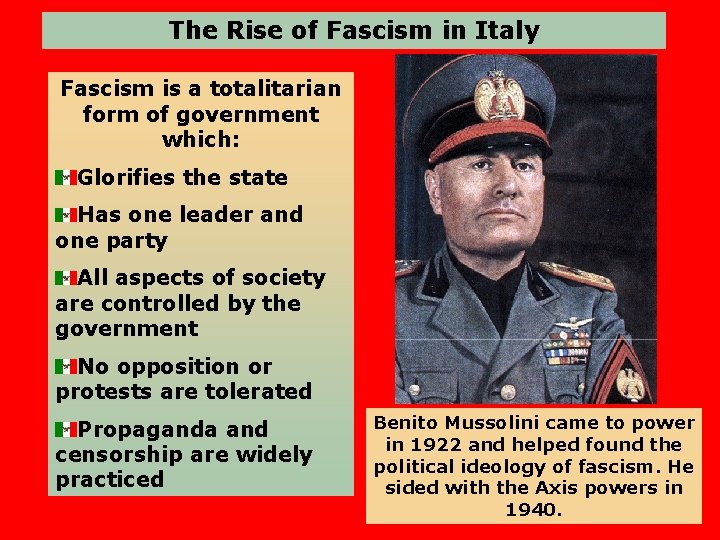
The Rise of Fascism in Italy Fascism is a totalitarian form of government which: Glorifies the state Has one leader and one party All aspects of society are controlled by the government No opposition or protests are tolerated Propaganda and censorship are widely practiced Benito Mussolini came to power in 1922 and helped found the political ideology of fascism. He sided with the Axis powers in 1940.
II. Italy’s Conquest of Ethiopia 1. Benito Mussolini- held power in Italy and decided to invade Ethiopia to lessen economic problems of Italy. 2. League of Nations placed economic sanctions on Italy, but they were weak and were not enforced.
III. Civil War in Spain A. Nationalist vs. Loyalists 1. Franco was the leader of the Nationalist, Falange in the war. 2. 2 nd Spanish Republic- loyalists B. Foreign Assistance to Spain 1. Germany & Italy (Fascist regimes) saw Sp. as key to surround Fr. , they aided the Nationalists. 2. International Brigade aided the 2 nd Sp. Republic 3. Nationalists were able to defeat the loyalists in 1939, b/c International Brigade was afraid that another WW would be started. a. Franco-military dictator
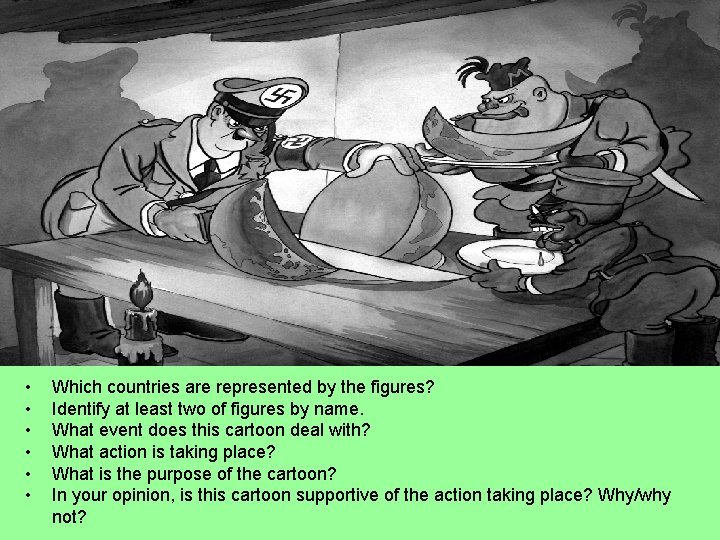
• • • Which countries are represented by the figures? Identify at least two of figures by name. What event does this cartoon deal with? What action is taking place? What is the purpose of the cartoon? In your opinion, is this cartoon supportive of the action taking place? Why/why not?
In-class activity: • Students will draw a political cartoon comparing the behavior of Japan or Italy to that of a BULLY. The cartoon should indicate how other nations responded.