
Treatmentmanagement in Kleine Levin syndrome Isabelle Arnulf and
Treatment/management in Kleine. Levin syndrome Isabelle Arnulf and Smaranda Leu-Semenescu National Reference Center for Kleine-Levin Syndrome Pitié-Salpêtrière Hospital Sorbonne University, Paris, France
The experience of Paris center • A national KLS reference center (Orphan Disease National Plan, BRAINTEAM network) • Clinical and research center • Growing cohort: 220 patients with KLS (mostly primary cases), 20 new cases/y • At first visit: neurologist, psychiatrist, TEP scan, biology and cognitive tests • Most are followed up every year, with same neurologist, psychiatrist and cognitive tests • Frequent e-mail/phone contacts in-between • Network with competence centers in the France areas • A patient/family support group: KLS-France
Sharing experience for • Management during the episodes • Management during asymptomatic periods • Prevention of relapses • Based on experience in a large cohort – « Expert opinion » – Two « case-controlled » retrospective studies – No placebo-controlled double blind study
During the episodes
During the episodes: need to rest • During the episodes, most subjects with KLS – – – Are apathetic Need to rest and sleep Rude and exhausted if prevented to sleep Fear novelty, contact with unknown people Ashamed to be seen by their grand parents or friends in this condition Afraid of being left alone The best choice is to keep them at home (rather than in hospital), in a safe environment, asleep or simply resting in a dark room, under the family supervision Limit the noises around (can be painful) Do not try to stimulate them (it is useless, the brain is suffering)
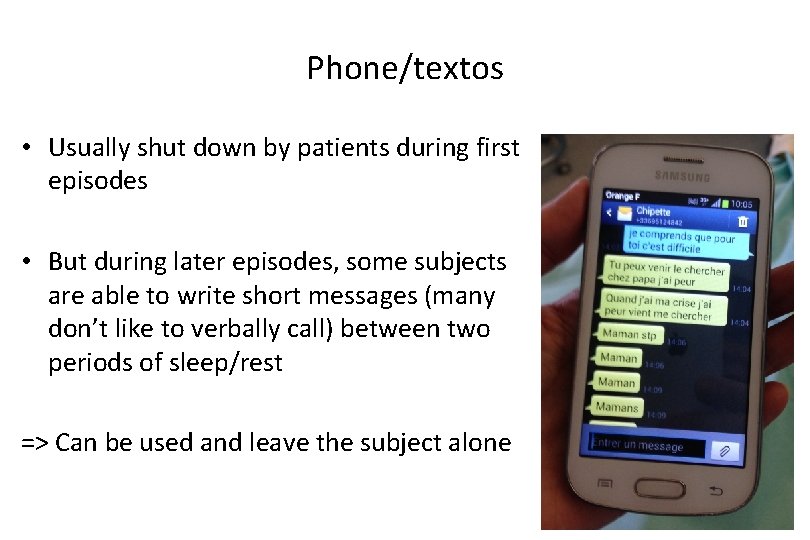
Phone/textos • Usually shut down by patients during first episodes • But during later episodes, some subjects are able to write short messages (many don’t like to verbally call) between two periods of sleep/rest => Can be used and leave the subject alone
Reduced cognition: safety • During the episodes, all subjects are cognitively impaired, sleepy, and have altered perception and automatic behaviors => Never let them drive a bike, motorbike or car during an episode (high risk of car accident, 2 cases). Hide the key !
During the episode: Reduced cognition • No homework! • Typical medical certificate for the school: “I hereby certify that the patient is affected by a rare disorder characterized by episodes of several days/weeks during which he must rest in his bedroom and cannot work. Please excuse him in case of missed school and help him catching back the missed lessons after the episode. ”
During the episodes: anxiety, low mood • During the episodes, some patients may have a decreased mood, cry, experience high frustration, feeling that the episode will never end, and that «in this case, one will die or getting mad» Check regularly their mood, hug, appease, repeat them that it will end soon (depressed mood is brief and frequently announces the end of the episode), that you are there. If too severe, consider using a mild benzodiazepine (Bromazepam 1/4 tablet under the tongue) or a sedative antihistaminic (hydroxyzine). If watching them is insufficient, bring them to the hospital for permanent supervision. Antidepressants seem useless at this point
Stimulants during episodes • Modafinil (Provigil), Ritalin, Pitolisant (Wakix) • Suggested by some patients/physicians • Our experience: – Poor benefit on sleepiness and fatigue – No effect (or possible worsening) on the other symptoms (derealization, apathy, confusion) – KLS episodes are not limited to the « hypersomnia » symptom => avoid, rather let patients sleep
Headaches during episodes • Classical pain killers (paracetamol, ibuprofen except if on lithium) • If they fail, consider acetazolamide (Diamox) 500 mg, a diuretic which decreased brain edema in other disorders => well tolerated, may help
During episodes: emergencies • Problems that require hospitalization : – Major behavioral disorders (anger outburst, agitation) – Suicidal projects – Severe delusions => risperidone > other neuroleptics – Major autonomic disorders (urine retention, high blood pressure): exceptional – Seizures: exceptional
Episodes starting when abroad/in a field trip • Have a plan • Sometimes not a big problem: patient sleeps… • If abroad alone: assistance for being brought back home (we communicate with the medical assistance, explain KLS and the patient’s case: usually, a simple flight back with somebody bringing back the patient at home is sufficient) • Rare cases needing to be hospitalized abroad
The problem of long episodes In the series of Stanford, n = 108 (Arnulf, Ann Neurol 2008), as well as in the series of Paris, n = 120 (Lavault, Ann Neurol 2015) • 28% of patients have long (>30 d) episodes • Difficult to predict who and when • Except if first episode was long • => Once an episode has started, is there any mean to stop it?
The problem of long episodes • Amantadine: antiviral and mild stimulant properties => some mild benefit: worth trying at least once, even if episodes last< 30 d • IV steroids: Rationale for trying: one boy with a long (> 4 months) episode => debating during 2 weeks with parents => OK to try IV steroids => end of episode 3 days after the infusion
IV steroids during long episodes of KLS • IV series: Same protocol as in relapses of multiple sclerosis • Methylprednisolone 1 g/d, repeated during 3 consecutive days • After checking for absence of current infection • With an oral gastric protection and potassium supplementation during 3 days Léotard, Neurology 2018
IV steroids during long episodes of KLS • Retrospective (last 3 years), single center study • Case-control study: treated patients are compared to a twice greater number of untreated controls: KLS patients matched for age, sex, age at KLS onset, disease course (mean 5 y) Léotard, Neurology 2018
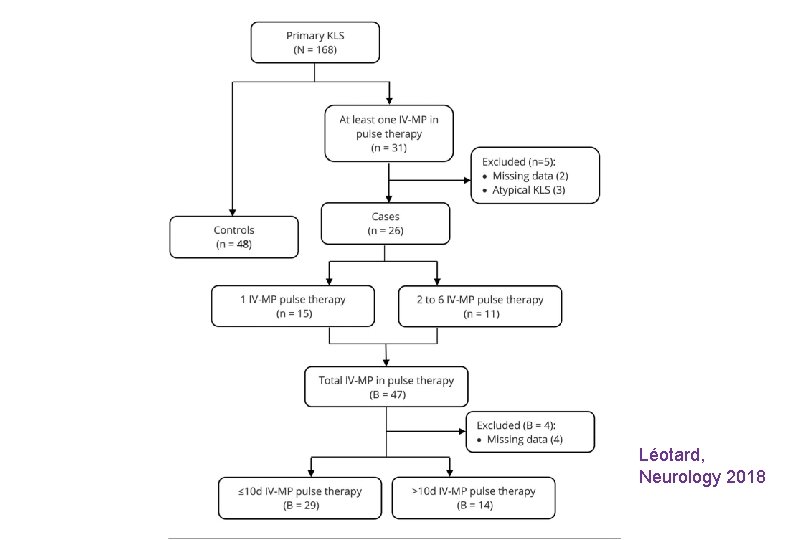
Léotard, Neurology 2018
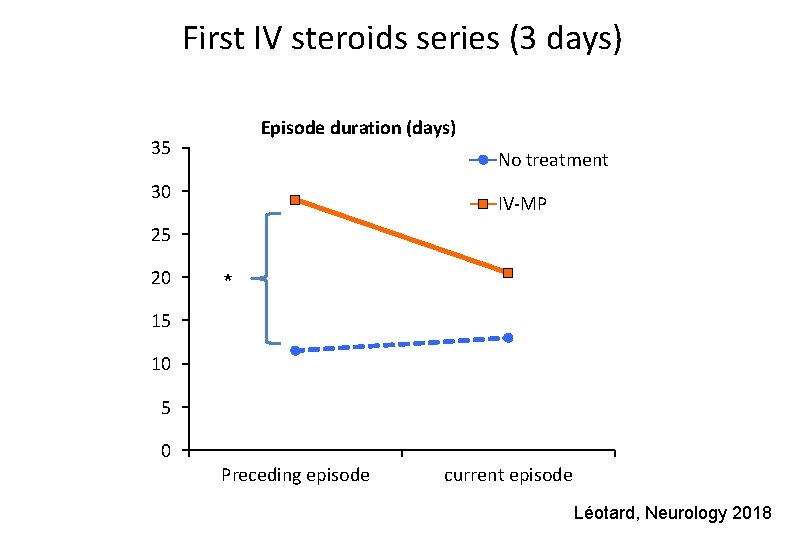
First IV steroids series (3 days) Episode duration (days) 35 No treatment 30 IV-MP 25 20 * 15 10 5 0 Preceding episode current episode Léotard, Neurology 2018
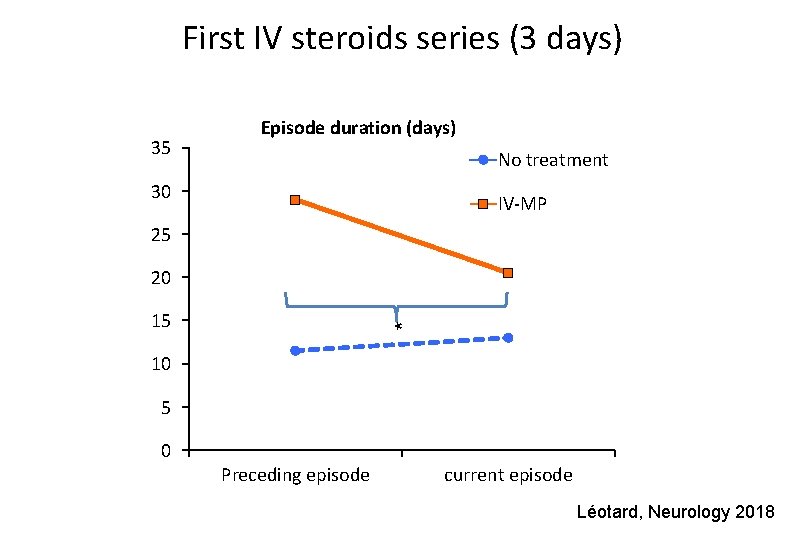
First IV steroids series (3 days) 35 Episode duration (days) No treatment 30 IV-MP 25 20 * 15 10 5 0 Preceding episode current episode Léotard, Neurology 2018
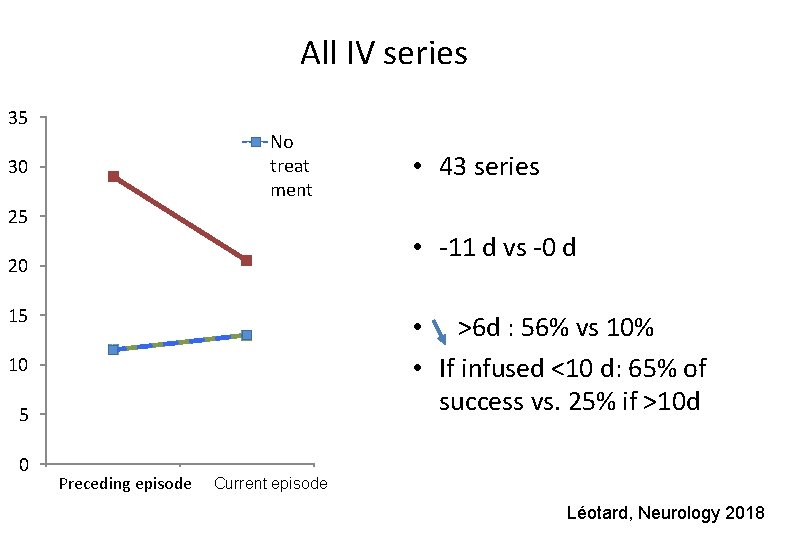
All IV series 35 30 No treat ment • 43 series 25 • -11 d vs -0 d 20 15 • >6 d : 56% vs 10% • If infused <10 d: 65% of success vs. 25% if >10 d 10 5 0 Preceding episode Current episode Léotard, Neurology 2018
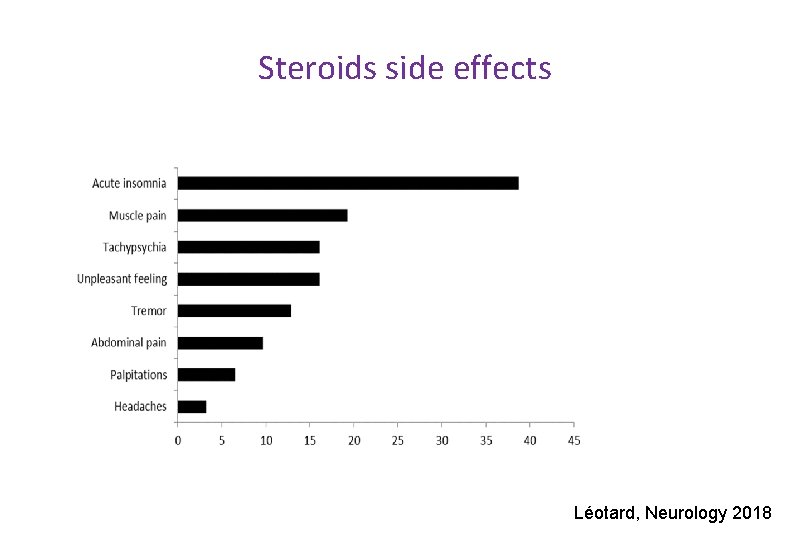
Steroids side effects Léotard, Neurology 2018
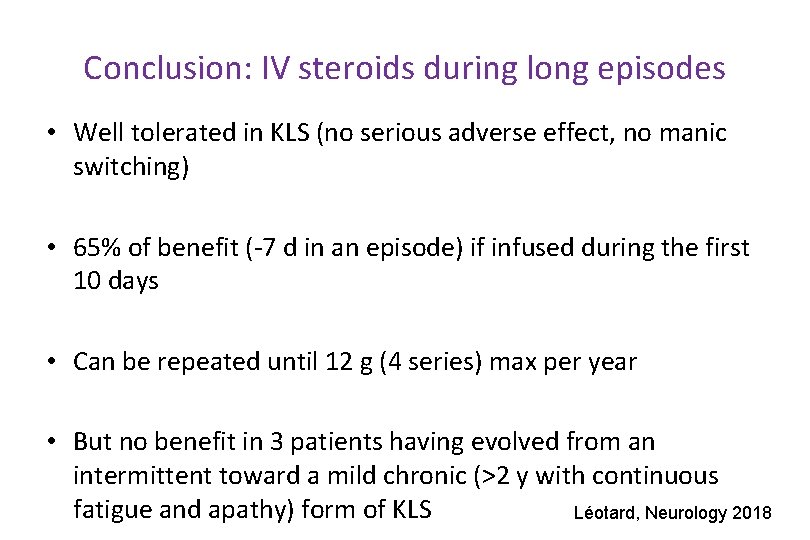
Conclusion: IV steroids during long episodes • Well tolerated in KLS (no serious adverse effect, no manic switching) • 65% of benefit (-7 d in an episode) if infused during the first 10 days • Can be repeated until 12 g (4 series) max per year • But no benefit in 3 patients having evolved from an intermittent toward a mild chronic (>2 y with continuous fatigue and apathy) form of KLS Léotard, Neurology 2018
During asymptomatic periods
During asymptomatic periods: what to check? • Sleep • Cognition • Mood/anxiety/adjustement => Some patients may have « mild residual symptoms »
Sleep during « asymptomatic » periods • Patients declare longer usual sleep time than controls (on average 30 min) • They go to bed earlier than controls Lavault, Ann Neurol 2015 => This could be residual from episodes, or could be an adaptation to prevent new episodes (because sleep deprivation can trigger episodes)
Cognition: what was known before • Individual reports of occasional cognitive difficulties • A single series of 8 -18 patients altered working memory, use different networks in f. MRI Engstrom, Sleep 2009, 2014 • In our patients, 50% report academic decline since KLS onset Uguccioni, Sleep 2015
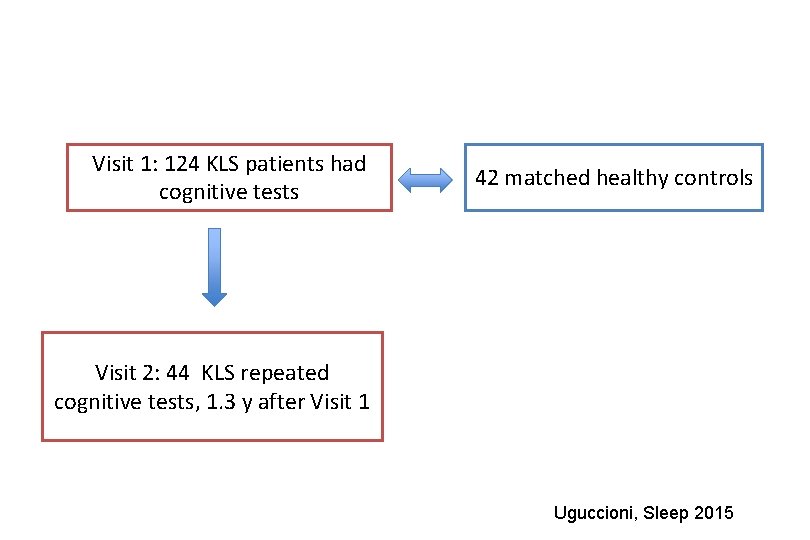
Visit 1: 124 KLS patients had cognitive tests 42 matched healthy controls Visit 2: 44 KLS repeated cognitive tests, 1. 3 y after Visit 1 Uguccioni, Sleep 2015
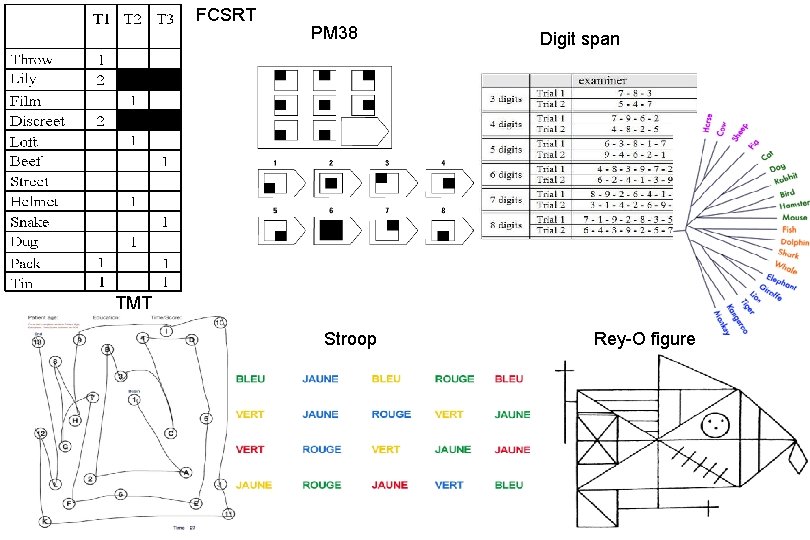
FCSRT PM 38 Digit span TMT Stroop Rey-O figure
* Attention and executive functions

Stroop color word test * * * Uguccioni, submitted
FCSRT: Immediate free retrieval * * Uguccioni, Sleep 2015
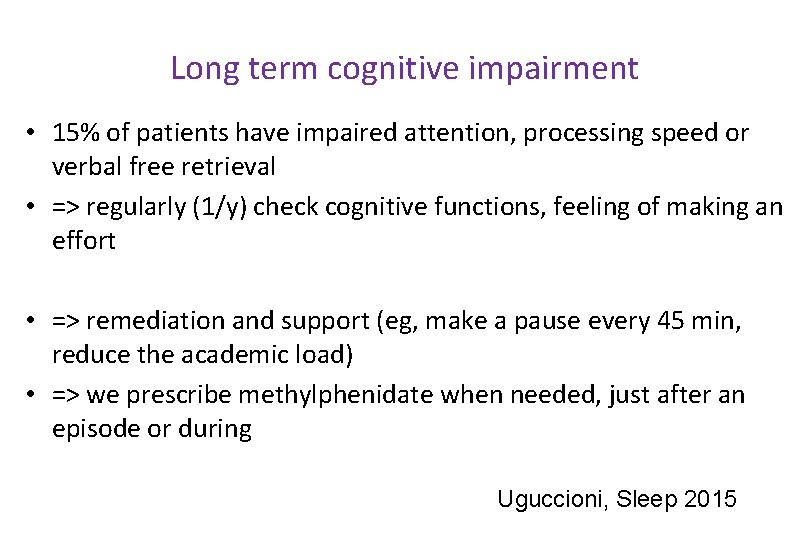
Long term cognitive impairment • 15% of patients have impaired attention, processing speed or verbal free retrieval • => regularly (1/y) check cognitive functions, feeling of making an effort • => remediation and support (eg, make a pause every 45 min, reduce the academic load) • => we prescribe methylphenidate when needed, just after an episode or during Uguccioni, Sleep 2015
Mental status during « asymptomatic » periods • On average, patients score almost as controls do on anxiety/depression scale • Their psychiatric history is similar to what is seen in the general teenager population (16% with a history, mostly child anxiety)
Mental status during « asymptomatic » periods • Long term psychological follow up in the reference center identified emerging psychiatric problems in 20% of the patients • Mostly mood disorders and adjustement disorders Groos, J Sleep Res 2018
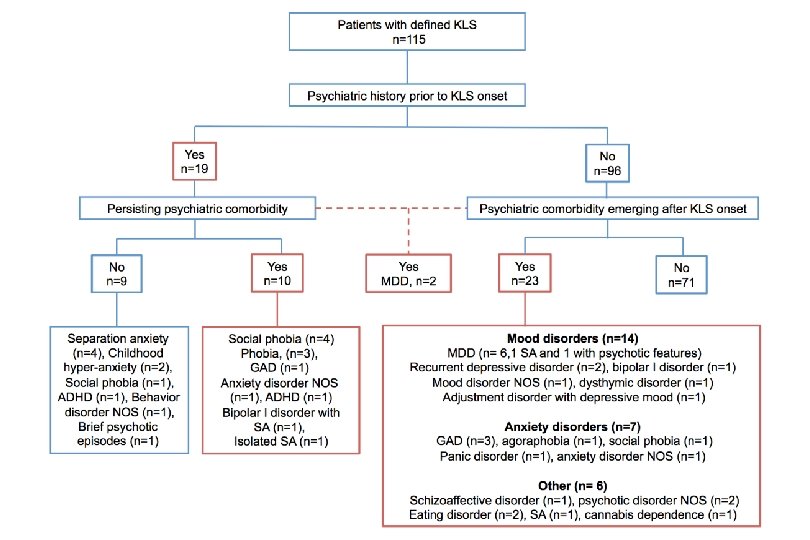
Risk factors for long term psychiatric comorbidities • 20% of patients (25 vs 90) – Female sex – Number of episodes (20 vs. 13) and time spent in episodes (366 d vs 155 d) – Psychiatric symptoms during episodes Identifying vulnerable patients, psychological support Groos, J Sleep Res 2018
Preventing new relapses
Disease duration Arnulf, Lancet Neurol 2012
General recommendations 1 • Relapses frequently occur after an infection => Avoid infections ++ – Avoid contact with infected persons (distance, mask) – Treat immediately any tonsillitis – Vaccination: usual vaccinations do not seem to trigger relapses (Stanford and France series: no relapse after vaccination) – Seasonal flu vaccination is recommended
General recommendations 2 • Some relapses occur after alcohol intake => Stop any form of alcohol intake for at least three years
General recommendations 3 • Some relapses occur after sleep deprivation Avoid sleep deprivation, have regular sleep and wake rhythm Beware of Eve, birthday and graduation parties, when alcohol, sleep deprivation and close contact with infected persons are combined
General recommendations 4 • The KLS course is unpredictable • When considering to try a drug with the aim of preventing KLS new episodes, check for the “baseline” frequency and duration of episodes • If episodes recur frequently (e. g. 4 -12 times/year) or are long (e. g. 2 -6 months) or contain psychotic symptoms, it seems beneficial to try a drug • Benefit/risk of the drug should be regularly re-evaluated: stop or go rule
What was known • Individual trials of lithium, Dr’s report : – complete benefit in 41%, – partial in 26% Arnulf, Brain 2005 • Individual trials of lithium, patients’ report – Complete benefit 7% – Partial benefit 17% Arnulf, Ann Neurol 2008 => No idea of lithium serum levels, compliance => No series
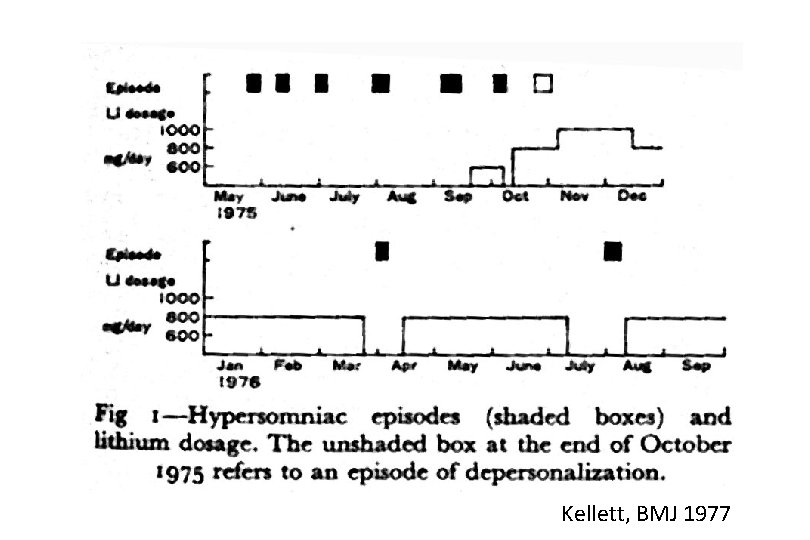
Kellett, BMJ 1977
Methods • Among 131 patients in Paris – 71 received and took lithium (serum levels of 0. 8 -1. 2 mmol/L) – 49 took nothing – 10 took valproate or contraceptive pill • We compared the frequency and duration of episodes – before treatment/abstention (mean 5 years) – vs. after a mean 2 years of follow-up Leu-Semenescu, Neurology 2015
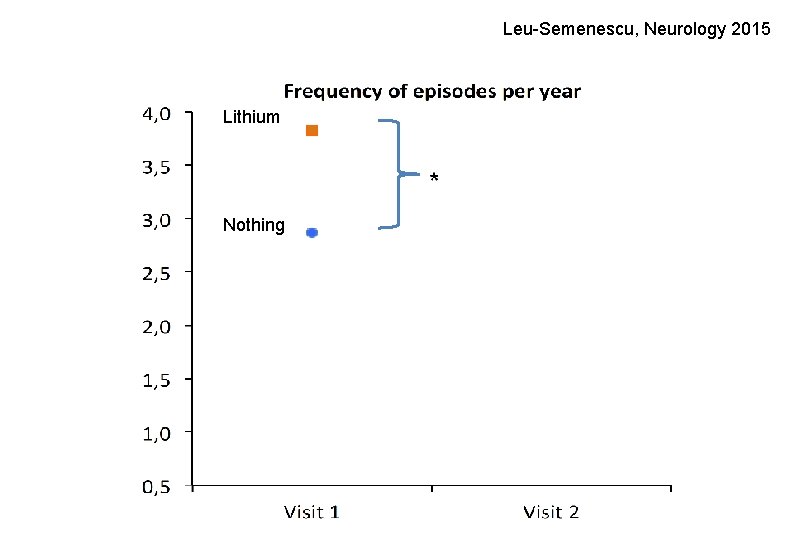
Leu-Semenescu, Neurology 2015 Lithium * Nothing
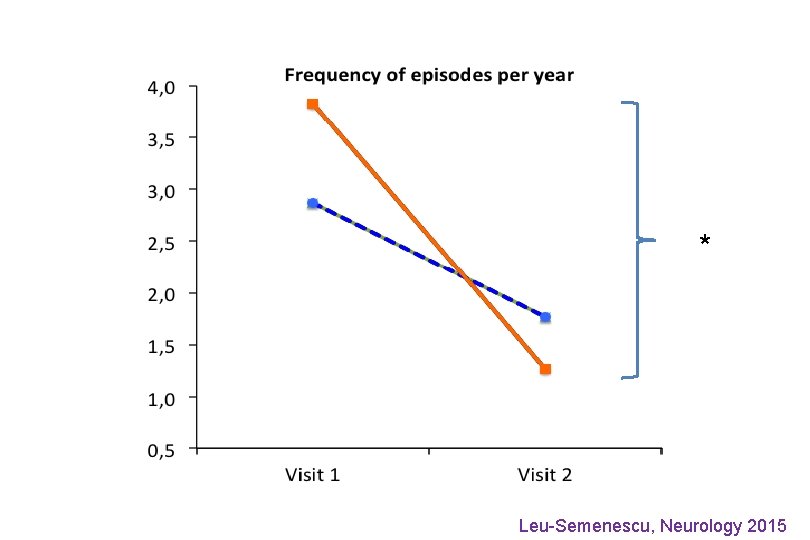
* Leu-Semenescu, Neurology 2015

Leu-Semenescu, Neurology 2015 * *
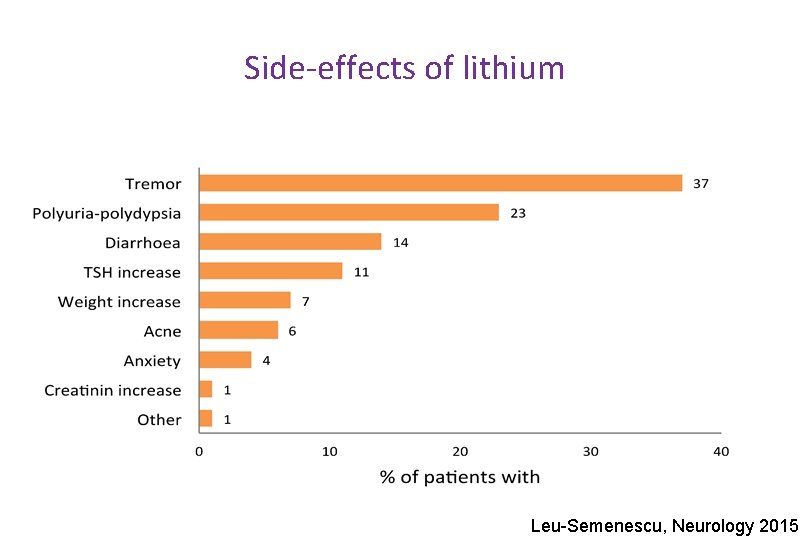
Side-effects of lithium Leu-Semenescu, Neurology 2015
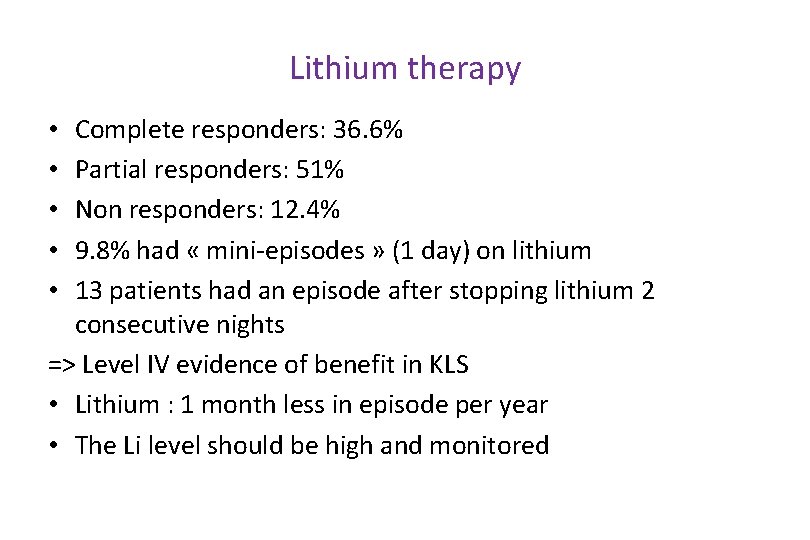
Lithium therapy Complete responders: 36. 6% Partial responders: 51% Non responders: 12. 4% 9. 8% had « mini-episodes » (1 day) on lithium 13 patients had an episode after stopping lithium 2 consecutive nights => Level IV evidence of benefit in KLS • Lithium : 1 month less in episode per year • The Li level should be high and monitored • • •
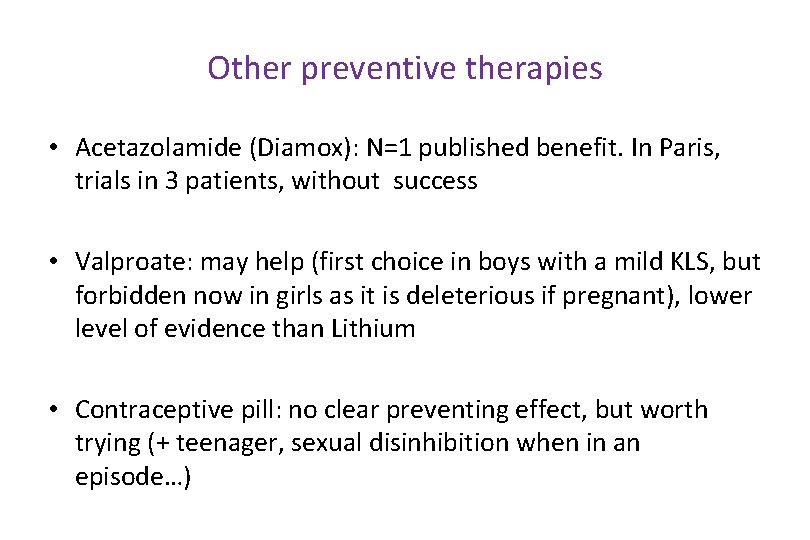
Other preventive therapies • Acetazolamide (Diamox): N=1 published benefit. In Paris, trials in 3 patients, without success • Valproate: may help (first choice in boys with a mild KLS, but forbidden now in girls as it is deleterious if pregnant), lower level of evidence than Lithium • Contraceptive pill: no clear preventing effect, but worth trying (+ teenager, sexual disinhibition when in an episode…)
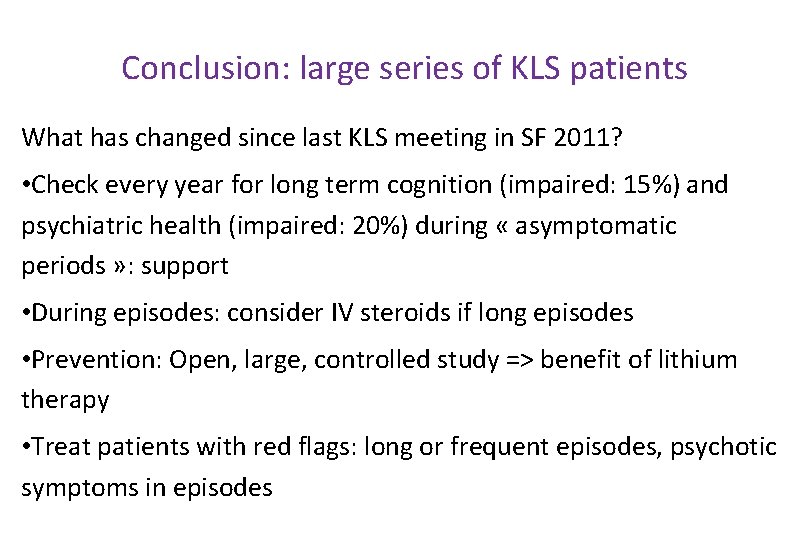
Conclusion: large series of KLS patients What has changed since last KLS meeting in SF 2011? • Check every year for long term cognition (impaired: 15%) and psychiatric health (impaired: 20%) during « asymptomatic periods » : support • During episodes: consider IV steroids if long episodes • Prevention: Open, large, controlled study => benefit of lithium therapy • Treat patients with red flags: long or frequent episodes, psychotic symptoms in episodes
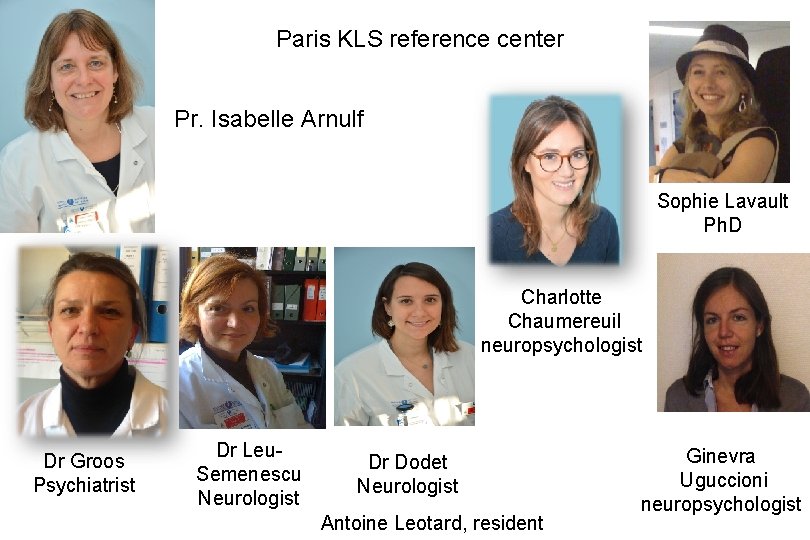
Paris KLS reference center Pr. Isabelle Arnulf Sophie Lavault Ph. D Charlotte Chaumereuil neuropsychologist Dr Groos Psychiatrist Dr Leu. Semenescu Neurologist Dr Dodet Neurologist Antoine Leotard, resident Ginevra Uguccioni neuropsychologist
Thank you! • Health Ministry: French Orphan Disease Program • KLS Foundation (supported the functional imaging study) • KLS-France (supported the retrospective study on steroid)
- Slides: 55