
Treatment Reverse Osmosis Desalination DWQR Risk Assessment Training
- Slides: 6
Treatment –Reverse Osmosis (Desalination) DWQR Risk Assessment Training 2018
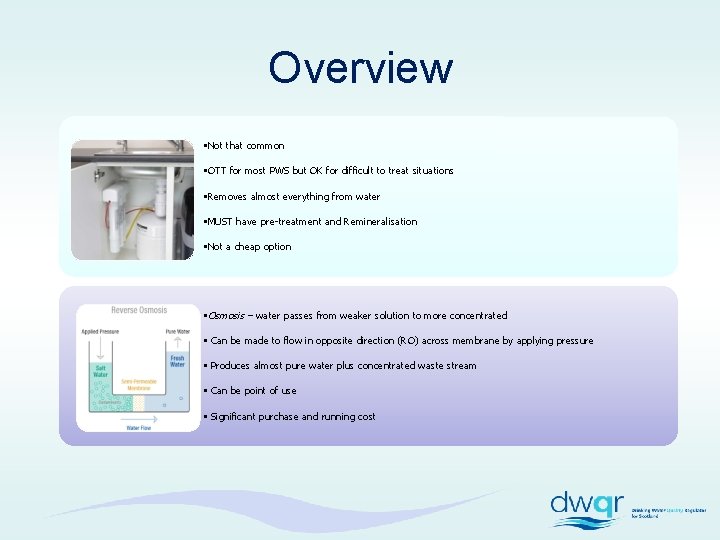
Overview • Not that common • OTT for most PWS but OK for difficult to treat situations • Removes almost everything from water • MUST have pre-treatment and Remineralisation • Not a cheap option • Osmosis – water passes from weaker solution to more concentrated • Can be made to flow in opposite direction (RO) across membrane by applying pressure • Produces almost pure water plus concentrated waste stream • Can be point of use • Significant purchase and running cost
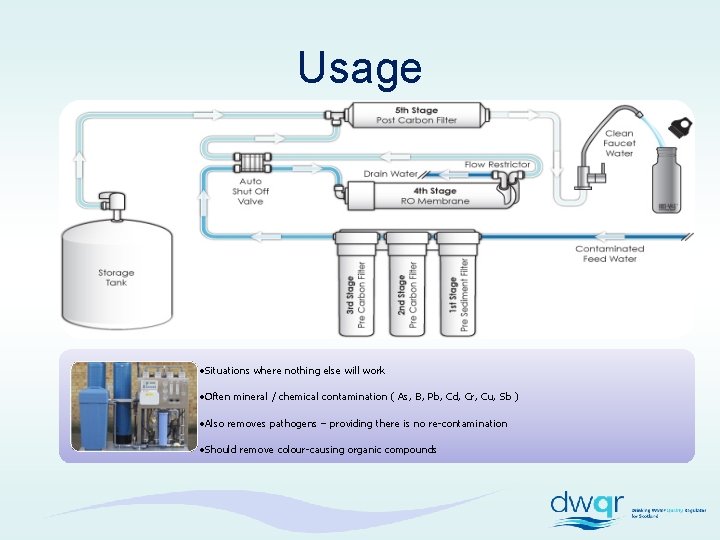
Usage • Situations where nothing else will work • Often mineral / chemical contamination ( As, B, Pb, Cd, Cr, Cu, Sb ) • Also removes pathogens – providing there is no re-contamination • Should remove colour-causing organic compounds
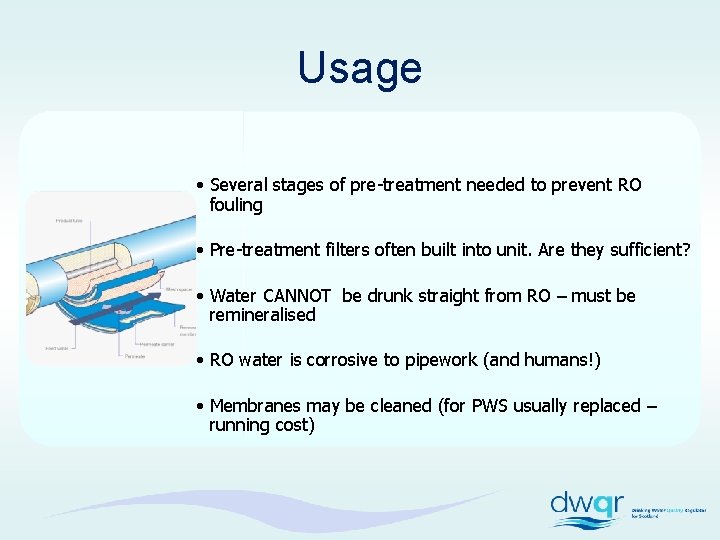
Usage • Several stages of pre-treatment needed to prevent RO fouling • Pre-treatment filters often built into unit. Are they sufficient? • Water CANNOT be drunk straight from RO – must be remineralised • RO water is corrosive to pipework (and humans!) • Membranes may be cleaned (for PWS usually replaced – running cost)
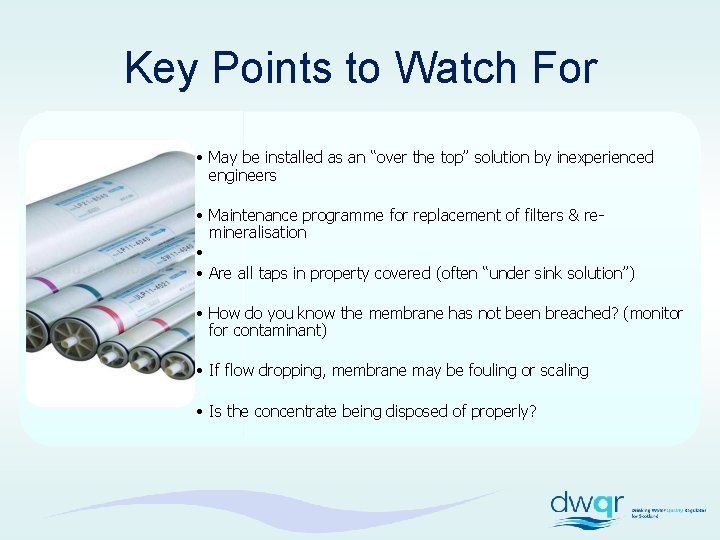
Key Points to Watch For • May be installed as an “over the top” solution by inexperienced engineers • Maintenance programme for replacement of filters & remineralisation • • Are all taps in property covered (often “under sink solution”) • How do you know the membrane has not been breached? (monitor for contaminant) • If flow dropping, membrane may be fouling or scaling • Is the concentrate being disposed of properly?
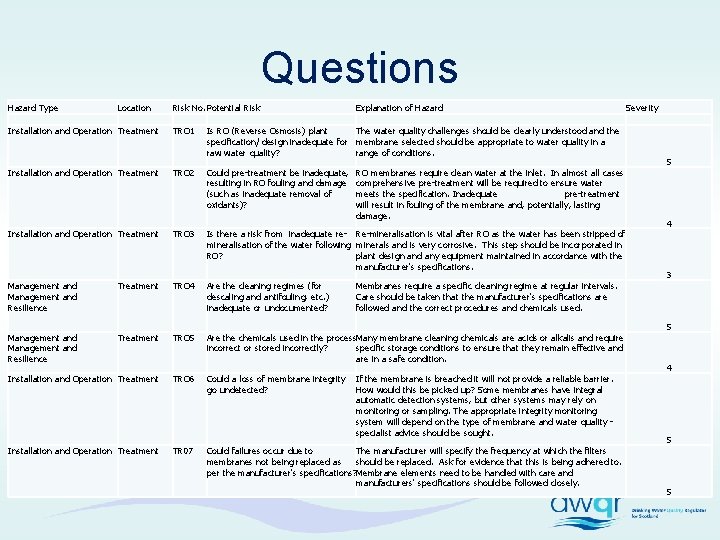
Questions Hazard Type Location Installation and Operation Treatment Risk No. Potential Risk TRO 1 Is RO (Reverse Osmosis) plant specification/ design inadequate for raw water quality? Explanation of Hazard Severity The water quality challenges should be clearly understood and the membrane selected should be appropriate to water quality in a range of conditions. Installation and Operation Treatment TRO 2 Could pre-treatment be inadequate, resulting in RO fouling and damage (such as inadequate removal of oxidants)? RO membranes require clean water at the inlet. In almost all cases comprehensive pre-treatment will be required to ensure water meets the specification. Inadequate pre-treatment will result in fouling of the membrane and, potentially, lasting damage. Installation and Operation Treatment TRO 3 Is there a risk from inadequate re- Re-mineralisation is vital after RO as the water has been stripped of mineralisation of the water following minerals and is very corrosive. This step should be incorporated in RO? plant design and any equipment maintained in accordance with the manufacturer's specifications. Management and Resilience Treatment TRO 4 Are the cleaning regimes (for descaling and antifouling, etc. ) inadequate or undocumented? Management and Resilience Treatment TRO 5 Are the chemicals used in the process Many membrane cleaning chemicals are acids or alkalis and require incorrect or stored incorrectly? specific storage conditions to ensure that they remain effective and are in a safe condition. Installation and Operation Treatment TRO 6 Could a loss of membrane integrity If the membrane is breached it will not provide a reliable barrier. go undetected? How would this be picked up? Some membranes have integral automatic detection systems, but other systems may rely on monitoring or sampling. The appropriate integrity monitoring system will depend on the type of membrane and water quality - specialist advice should be sought. Installation and Operation Treatment TR 07 Could failures occur due to The manufacturer will specify the frequency at which the filters membranes not being replaced as should be replaced. Ask for evidence that this is being adhered to. per the manufacturer's specifications? Membrane elements need to be handled with care and manufacturers' specifications should be followed closely. Membranes require a specific cleaning regime at regular intervals. Care should be taken that the manufacturer's specifications are followed and the correct procedures and chemicals used. 5 4 3 5 4 5 5