
Treatment options for traumatized primary teeth Treatment options
- Slides: 26
Treatment options for traumatized primary teeth
Treatment options for traumatized primary teeth O Introduction O Etiology O Predisposing factors O Types of injuries O History and examination O Advise and treatment O Sequeles
Introduction O Dental injury is a common injury O 1/3 preschool children sufford O Trauma results in pain, loss of function, esthetic & psychological O Peak incidence of dental trauma between 1 -3 years O Most affected teeth maxillary incisors
Etiology 1. Accidents & sprots 2. Oro tracheal intubation /premature infants 3. Non accidental injury or physical abuse
Predisposing factors 1. Increase over jet 2. Anterior open bite 3. Protrusion upper incisors 4. Hyperactivity 5. Epilipsy
Types of injuries depends on: O Direction, intensity of force O Luxation more common than fracture / primary dentition
Types of injuries 1. crown fracture 2. Root fracture 3. Crown root fracture 4. Concussion 5. subluxation 6. Luxation 7. Avulsion 8. Alveolar process
History and Examination O Time, cause O Patient Medical history O Head injuries O Lost teeth, tooth fragments A. Extra oral examination: Facial lacerations, haematomas, bleeding, facial bone injury or fracture B. Intra oral examination: soft tissue injury, teeth, alveolar bone C. Radiographic examination: reproducible long cone technique periapicals, occlusal view, extra oral lateral view
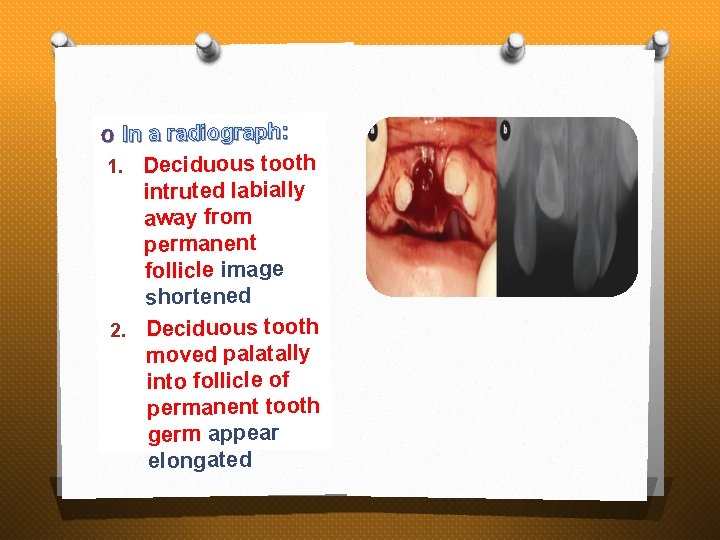
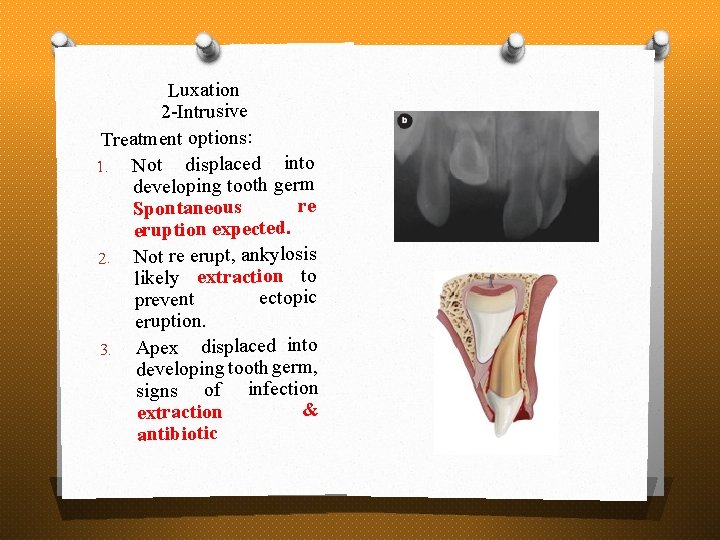
O In a radiograph: Deciduous tooth intruted labially away from permanent follicle image shortened 2. Deciduous tooth moved palatally into follicle of permanent tooth germ appear elongated 1.
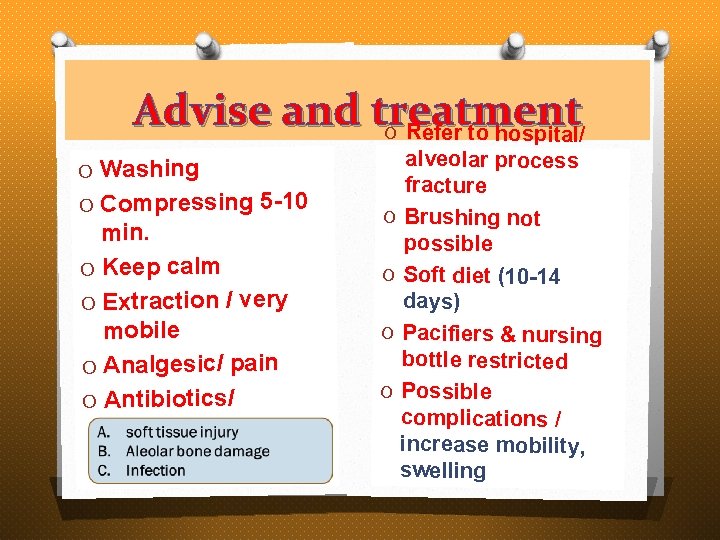
Advise and treatment O Refer to hospital/ O Washing O Compressing 5 -10 min. O Keep calm O Extraction / very mobile O Analgesic/ pain O Antibiotics/ alveolar process fracture O Brushing not possible O Soft diet (10 -14 days) O Pacifiers & nursing bottle restricted O Possible complications / increase mobility, swelling
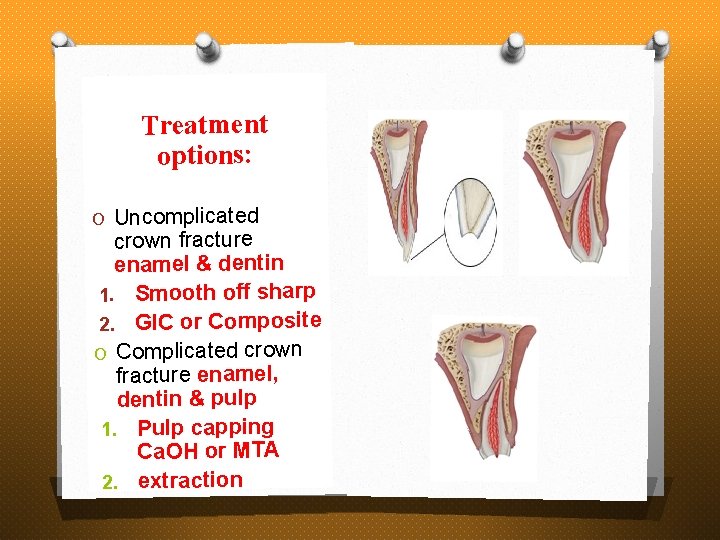
Treatment options: O Uncomplicated crown fracture enamel & dentin 1. Smooth off sharp 2. GIC or Composite O Complicated crown fracture enamel, dentin & pulp 1. Pulp capping Ca. OH or MTA 2. extraction
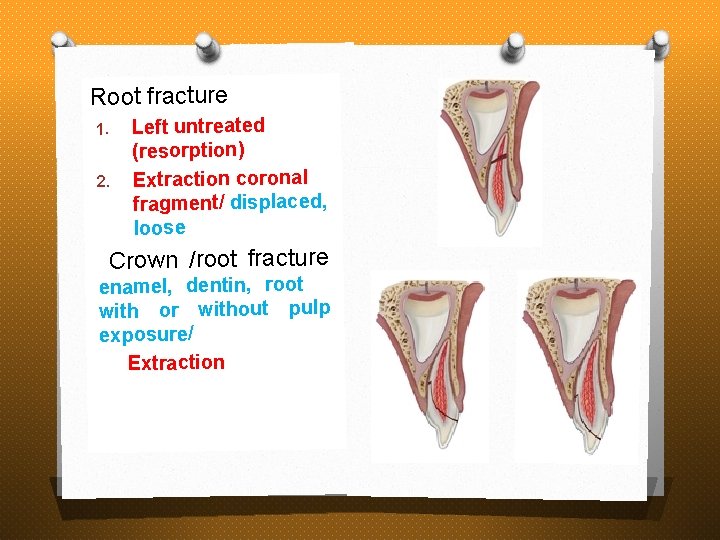
Root fracture 1. 2. Left untreated (resorption) Extraction coronal fragment/ displaced, loose Crown /root fracture enamel, dentin, root with or without pulp exposure/ Extraction
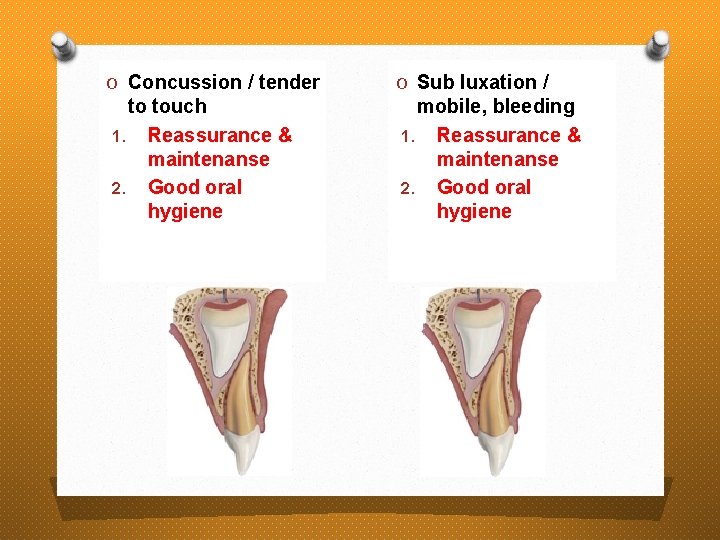
O Concussion / tender to touch 1. Reassurance & maintenanse 2. Good oral hygiene O Sub luxation / mobile, bleeding 1. Reassurance & maintenanse 2. Good oral hygiene
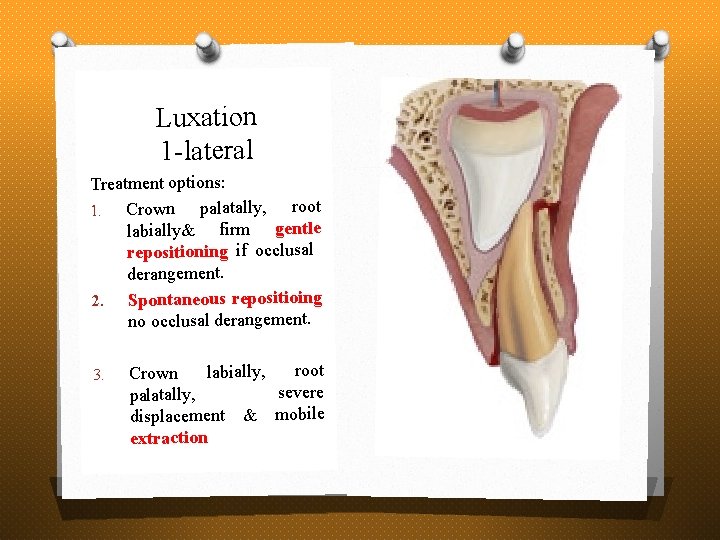
Luxation 1 -lateral Treatment options: Crown palatally, root 1. labially& firm gentle repositioning if occlusal derangement. Spontaneous repositioing 2. no occlusal derangement. 3. root labially, Crown severe palatally, displacement & mobile extraction
Luxation 2 -Intrusive Treatment options: 1. Not displaced into developing tooth germ re Spontaneous eruption expected. 2. Not re erupt, ankylosis likely extraction to ectopic prevent eruption. 3. Apex displaced into developing tooth germ, signs of infection & extraction antibiotic
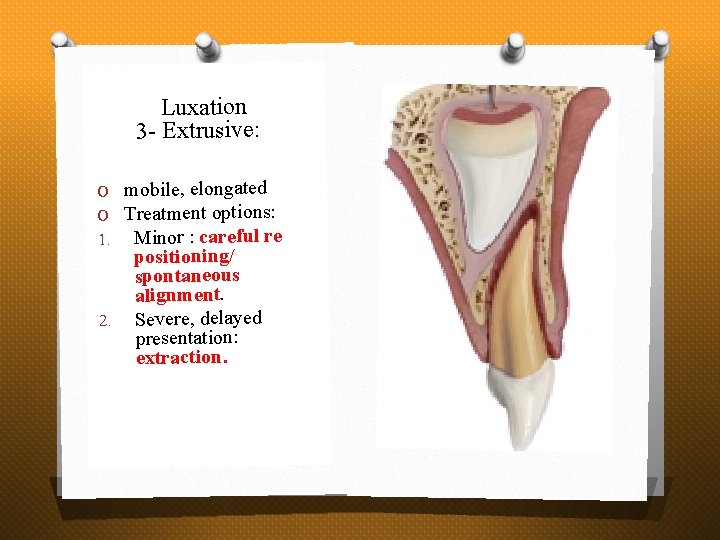
Luxation 3 - Extrusive: O mobile, elongated O Treatment options: 1. Minor : careful re 2. positioning/ spontaneous alignment. Severe, delayed presentation: extraction.
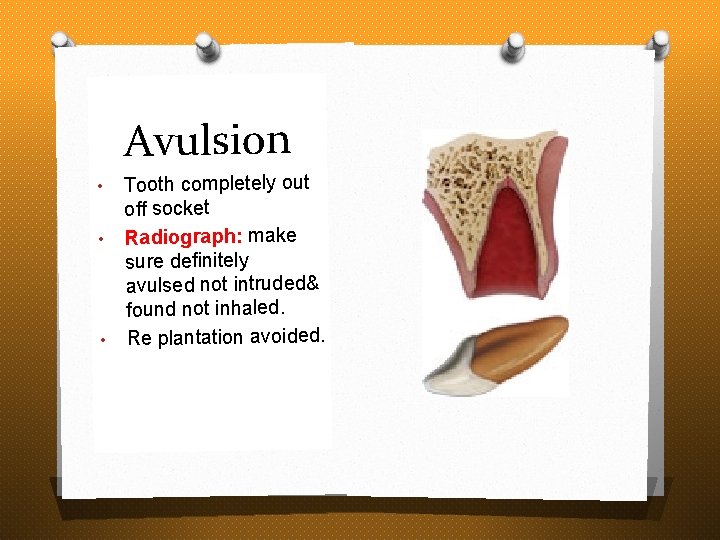
Avulsion Tooth completely out off socket • Radiograph: make sure definitely avulsed not intruded& found not inhaled. • Re plantation avoided. •
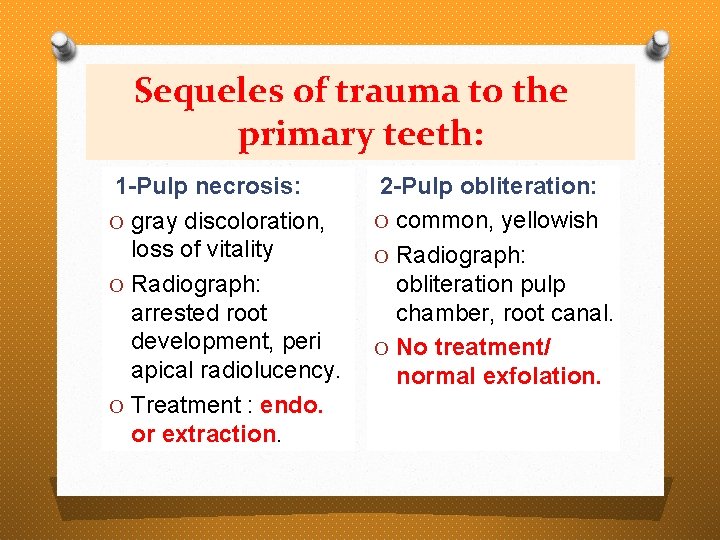
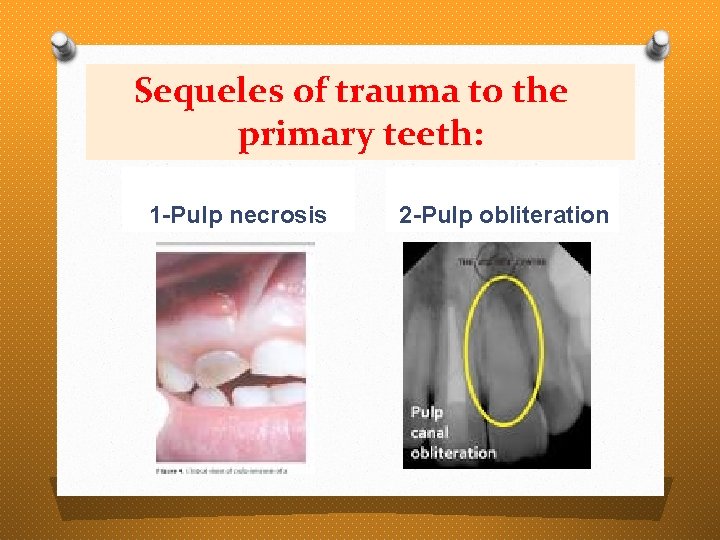
Sequeles of trauma to the primary teeth: 1 -Pulp necrosis: O gray discoloration, loss of vitality O Radiograph: arrested root development, peri apical radiolucency. O Treatment : endo. or extraction. 2 -Pulp obliteration: O common, yellowish O Radiograph: obliteration pulp chamber, root canal. O No treatment/ normal exfolation.
Sequeles of trauma to the primary teeth: 1 -Pulp necrosis 2 -Pulp obliteration
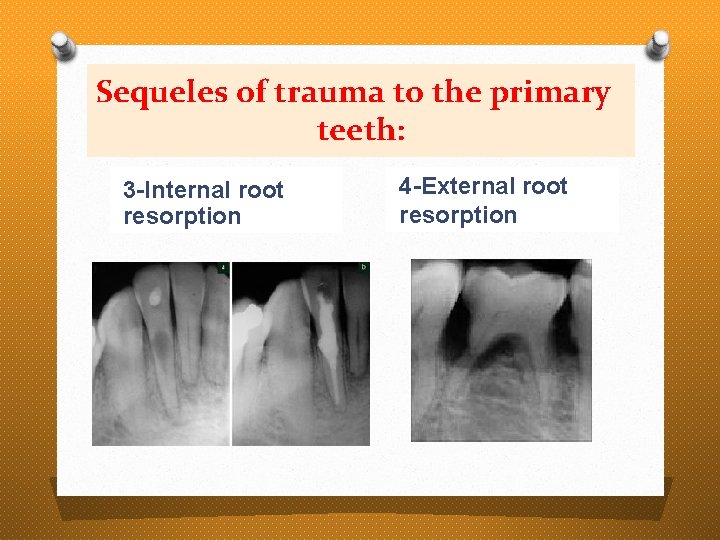
Sequeles of trauma to the primary teeth: 3 -Internal root resorption: O Uncommon, signs of infection O Radiograph: oval shape pulp chamber O Treatment: endo. or extraction 4 -External root resorption: O inflammatory, Signs of infection O Radiograph: loss tooth substance with R. L. Adjacent alveolar bone. O Treatment: extraction
Sequeles of trauma to the primary teeth: 3 -Internal root resorption 4 -External root resorption
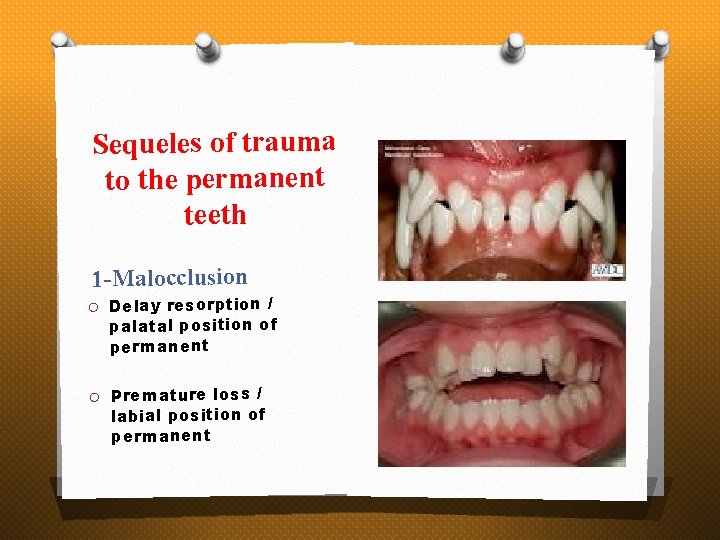
Sequeles of trauma to the permanent teeth 1 -Malocclusion O Delay resorption / palatal position of permanent O Premature loss / labial position of permanent
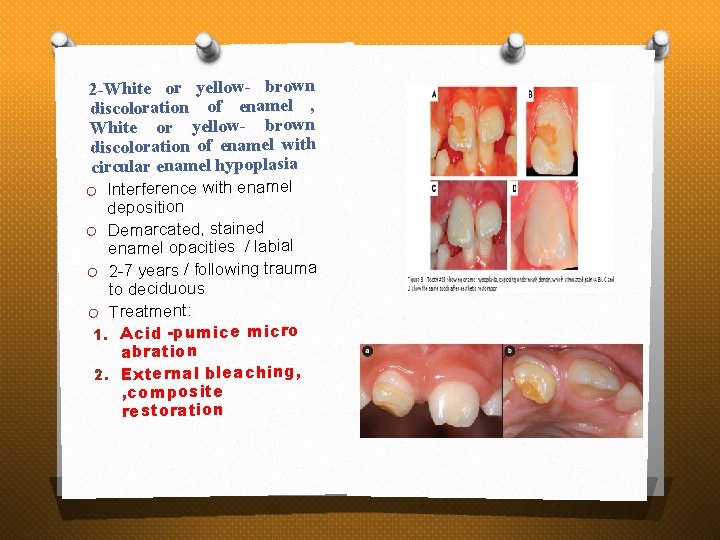
2 -White or yellow- brown discoloration of enamel , White or yellow- brown discoloration of enamel with circular enamel hypoplasia O Interference with enamel deposition O Demarcated, stained enamel opacities / labial O 2 -7 years / following trauma to deciduous O Treatment: 1. Acid -pumice micro abration 2. External bleaching, , composite restoration
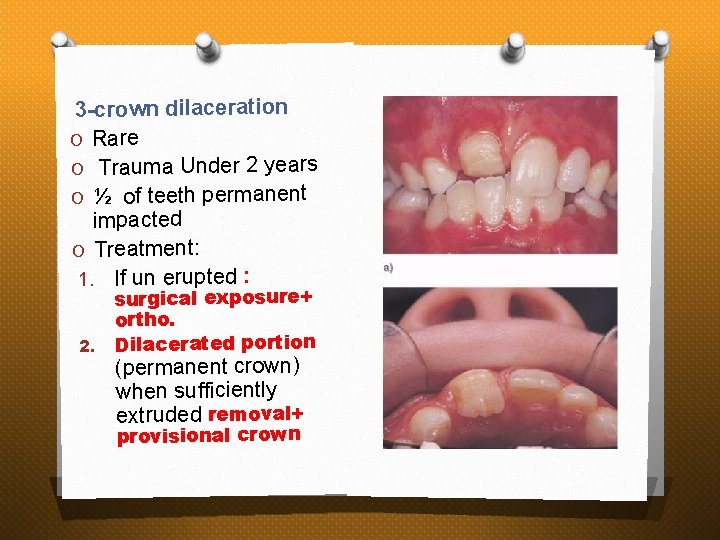
3 -crown dilaceration O Rare O Trauma Under 2 years O ½ of teeth permanent impacted O Treatment: 1. If un erupted : surgical exposure+ ortho. 2. Dilacerated portion (permanent crown) when sufficiently extruded removal+ provisional crown
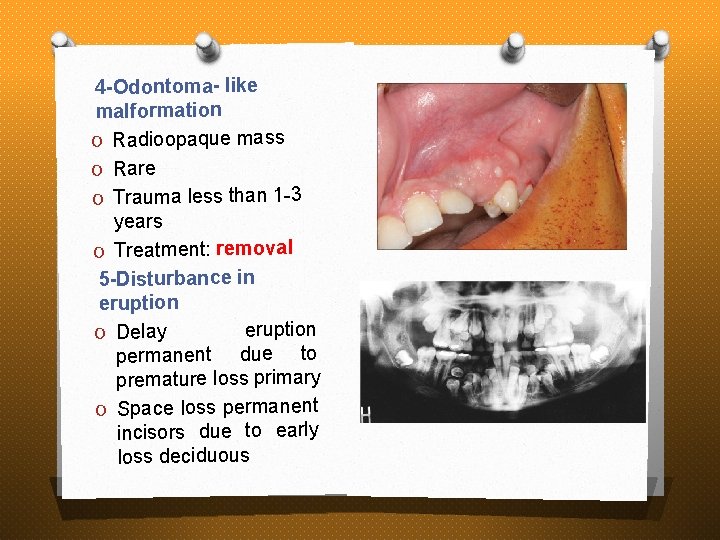
4 -Odontoma- like malformation O Radioopaque mass O Rare O Trauma less than 1 -3 years O Treatment: removal 5 -Disturbance in eruption O Delay permanent due to premature loss primary O Space loss permanent incisors due to early loss deciduous
Other (Rare) 1. Dentigerous cyst formation 2. Root duplication 3. Sequestration permanent tooth germ 4. Partial or complete arrest of root formation