
Treatment of patient with periodontal disease Dr Kadhim
- Slides: 52
Treatment of patient with periodontal disease Dr. Kadhim Jawad 1
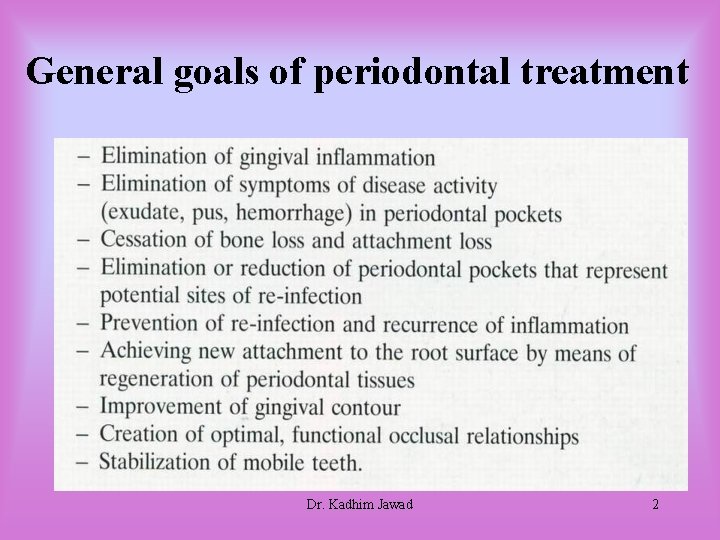
General goals of periodontal treatment Dr. Kadhim Jawad 2
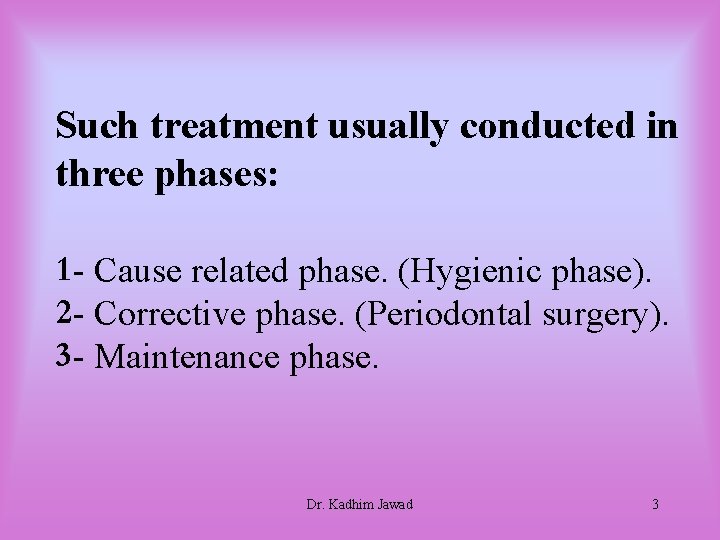
Such treatment usually conducted in three phases: 1 - Cause related phase. (Hygienic phase). 2 - Corrective phase. (Periodontal surgery). 3 - Maintenance phase. Dr. Kadhim Jawad 3
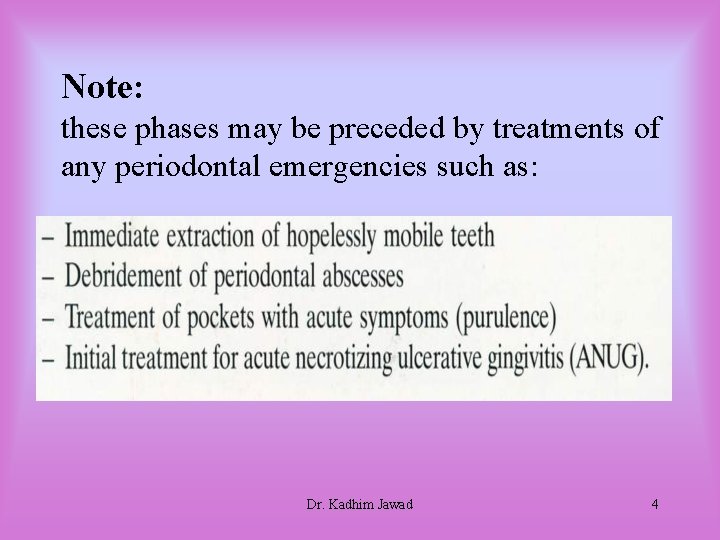
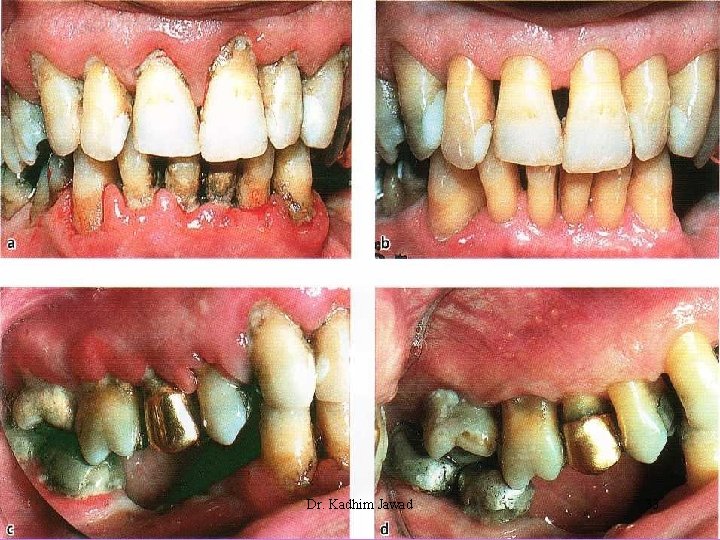
Note: these phases may be preceded by treatments of any periodontal emergencies such as: Dr. Kadhim Jawad 4
Cause related phase of periodontal therapy Dr. Kadhim Jawad 5
This phase directed toward prevention of MDP through several means: 1 - Patient information & motivation. 2 - Self performed PLCM. 3 - Scaling & root planing. 4 - Removal of PL retentive factors. Dr. Kadhim Jawad 6
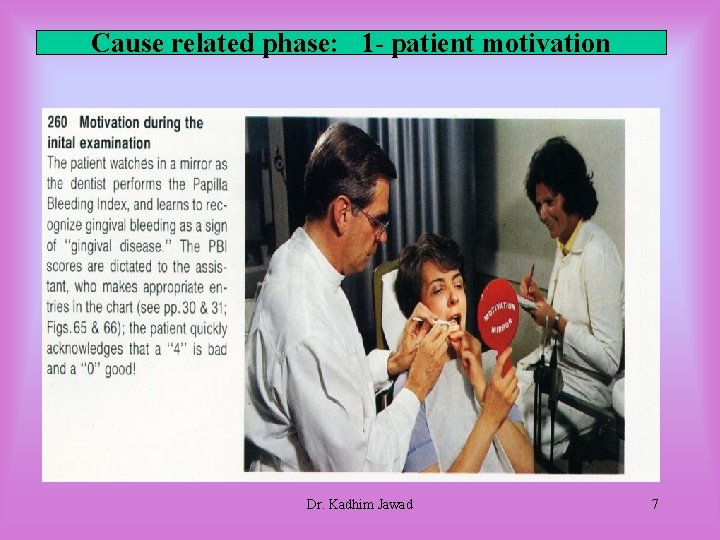
Cause related phase: 1 - patient motivation Dr. Kadhim Jawad 7
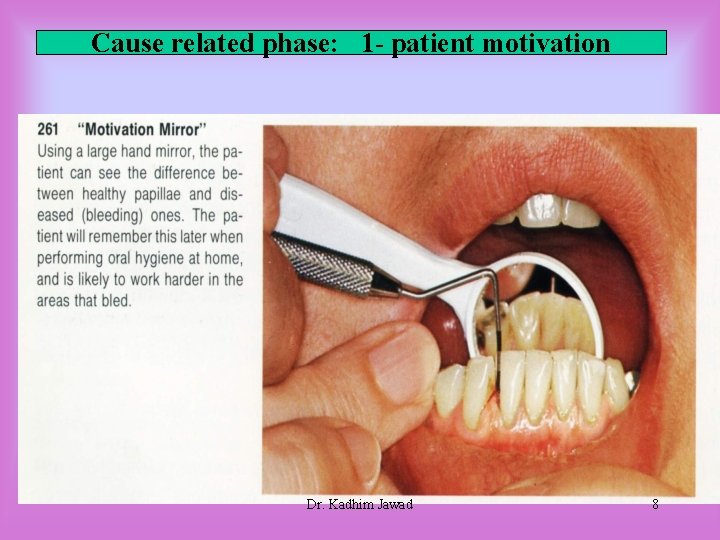
Cause related phase: 1 - patient motivation Dr. Kadhim Jawad 8
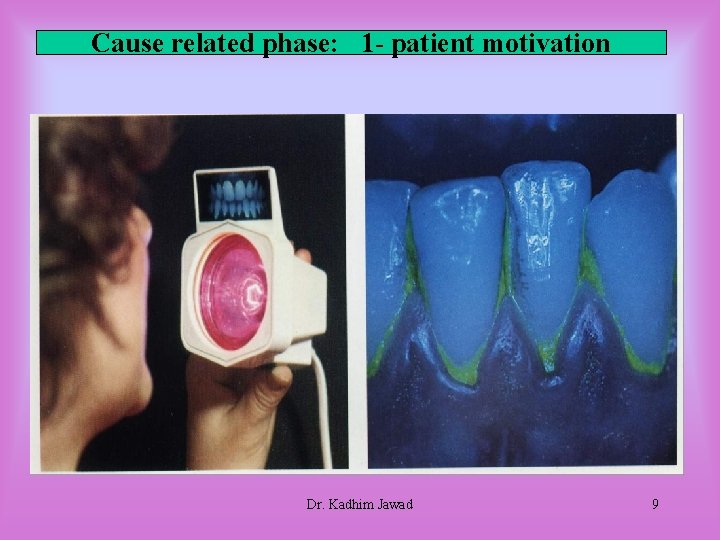
Cause related phase: 1 - patient motivation Dr. Kadhim Jawad 9
Cause related phase: 2 -SPPLCM 2 - Self performed PLCM : A- Tooth brushing(manual & electrical) B- IDCAS(floss, picks, IPB, STB & IRR). Dr. Kadhim Jawad 10
Cause related phase: 2 -SPPLCM: brushing Important note: The most important point in relation to tooth brushing is not the method or frequency of brushing but its efficiency in plaque removal. Dr. Kadhim Jawad 11
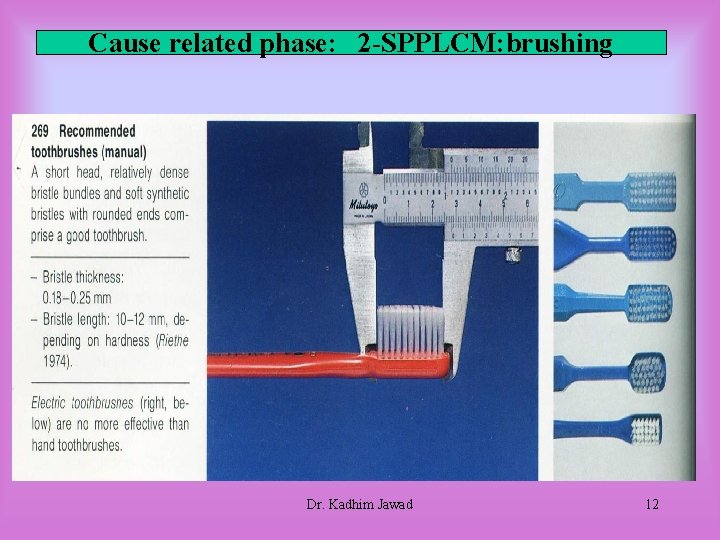
Cause related phase: 2 -SPPLCM: brushing Dr. Kadhim Jawad 12
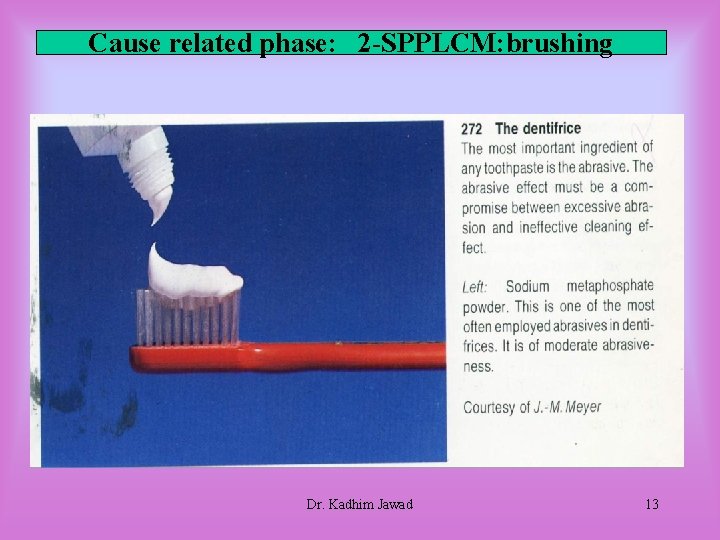
Cause related phase: 2 -SPPLCM: brushing Dr. Kadhim Jawad 13
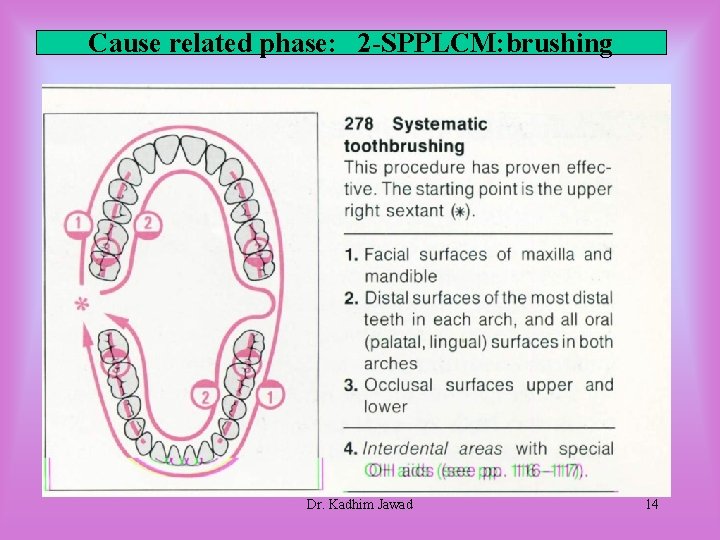
Cause related phase: 2 -SPPLCM: brushing Dr. Kadhim Jawad 14
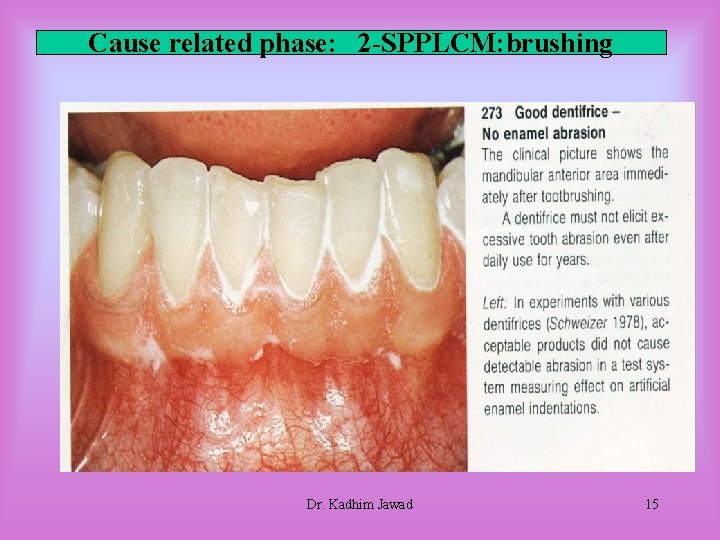
Cause related phase: 2 -SPPLCM: brushing Dr. Kadhim Jawad 15
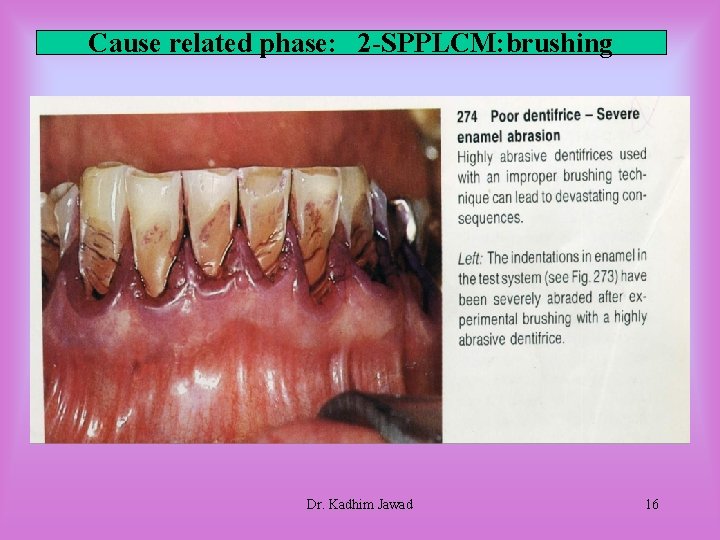
Cause related phase: 2 -SPPLCM: brushing Dr. Kadhim Jawad 16
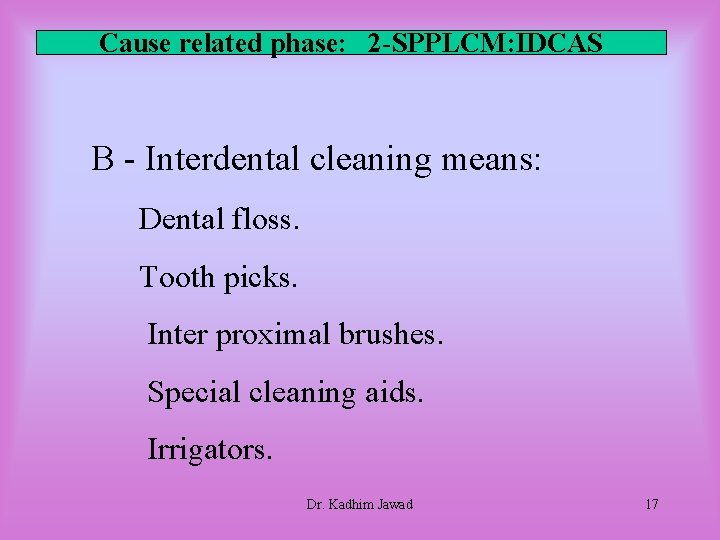
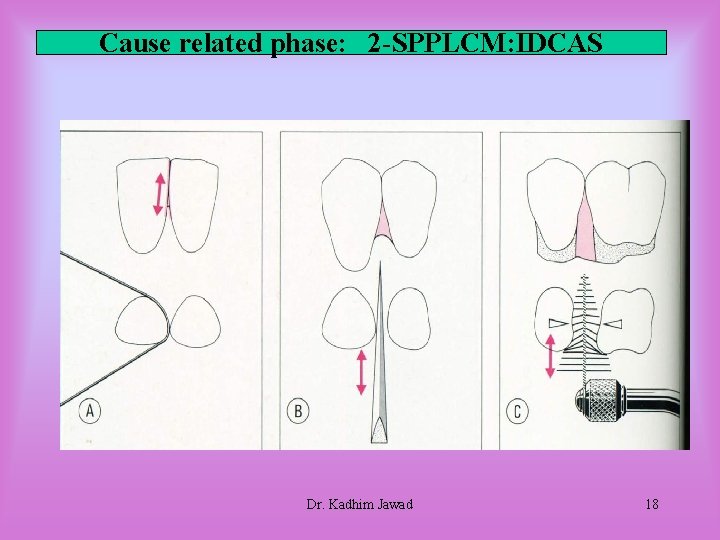
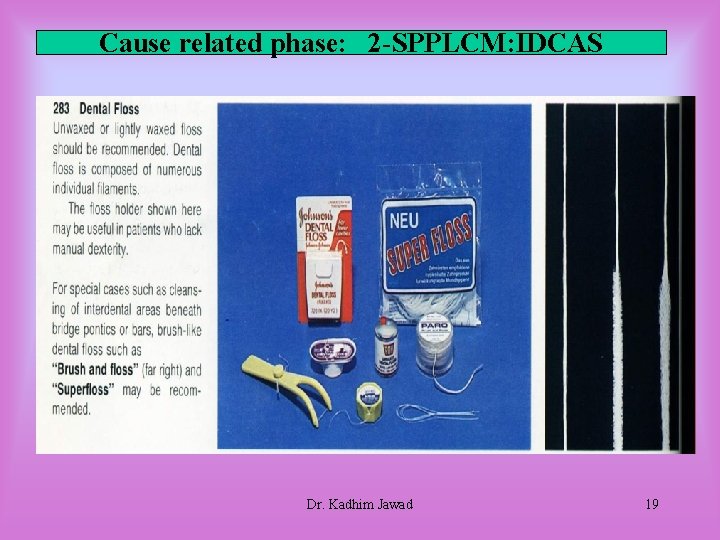
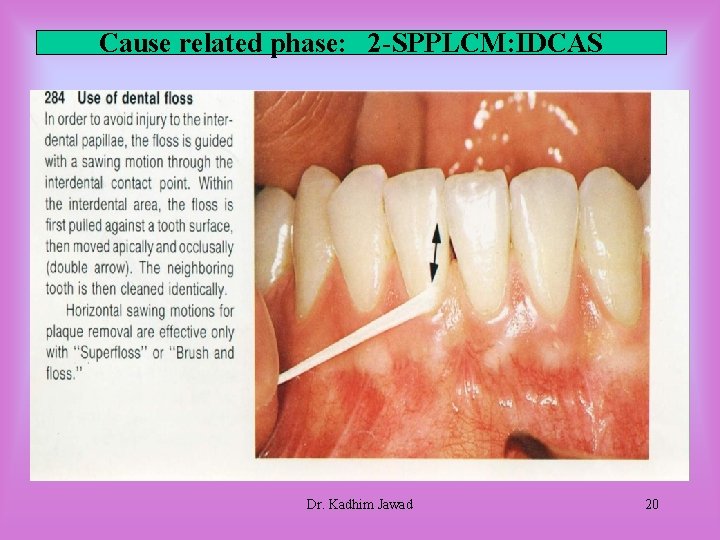
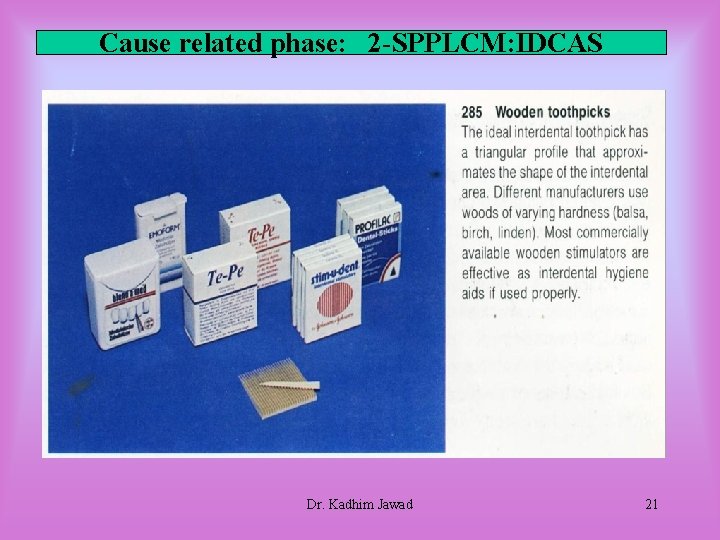
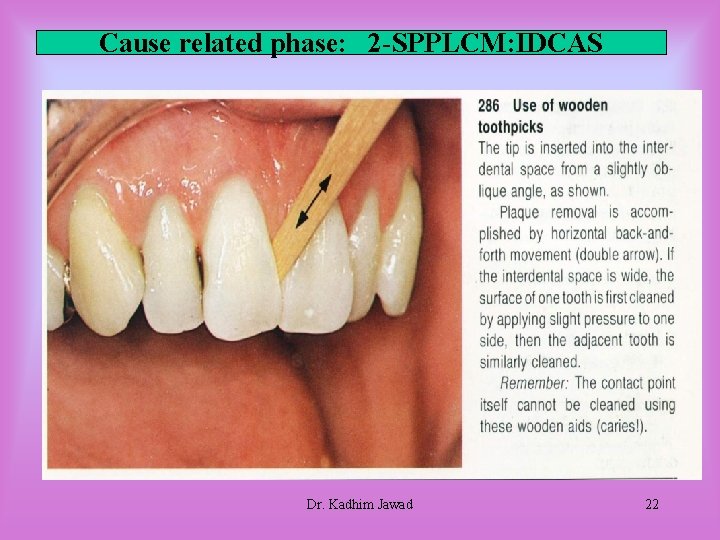
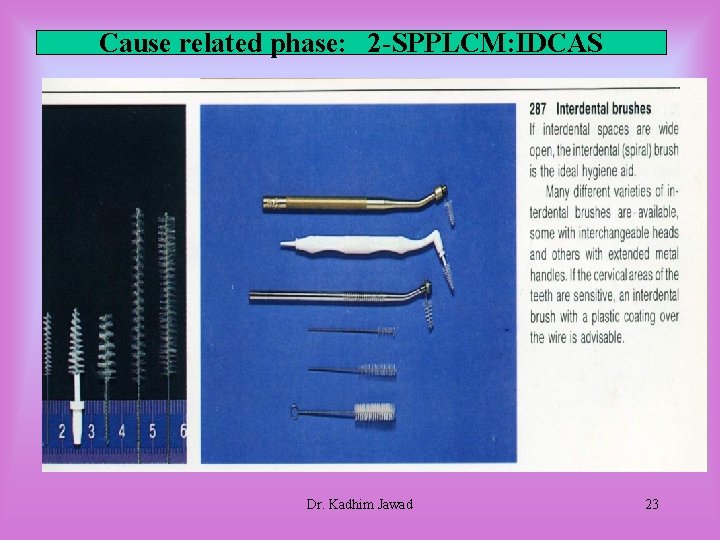
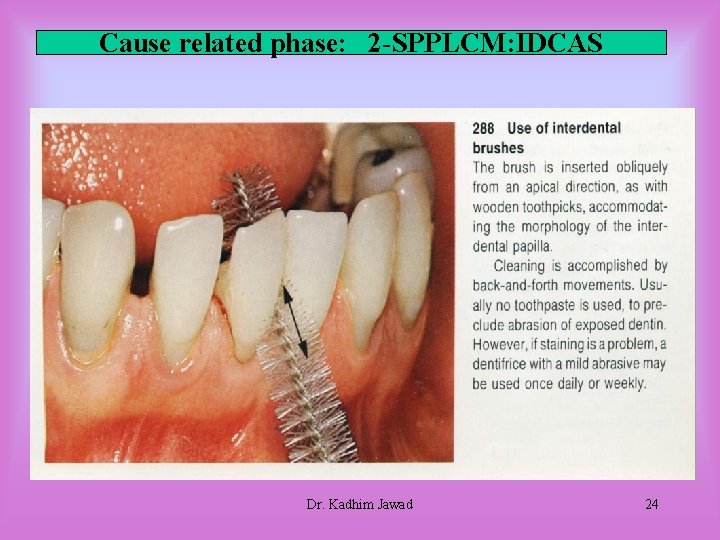
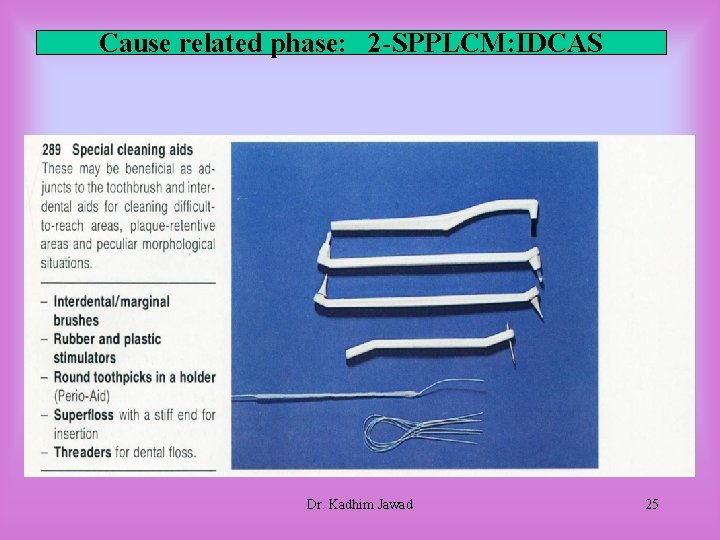
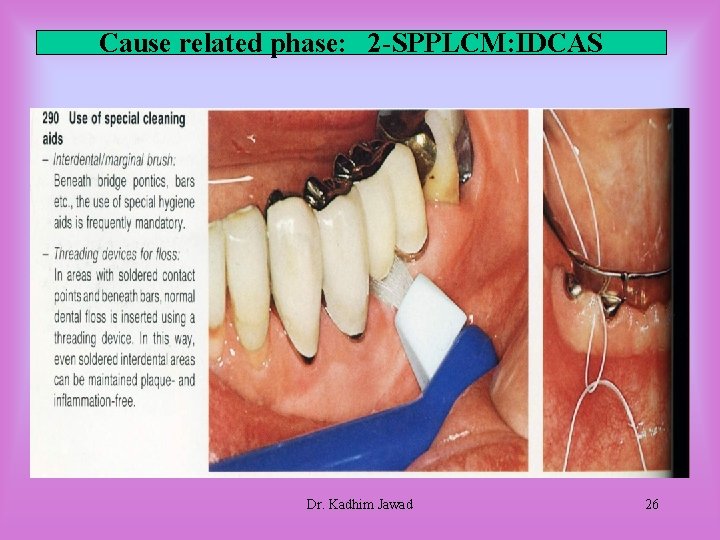
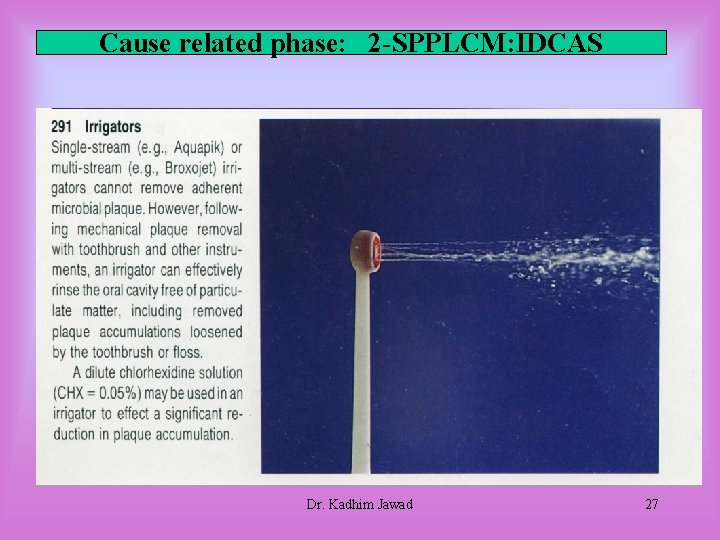
Cause related phase: 2 -SPPLCM: IDCAS B - Interdental cleaning means: Dental floss. Tooth picks. Inter proximal brushes. Special cleaning aids. Irrigators. Dr. Kadhim Jawad 17
Cause related phase: 2 -SPPLCM: IDCAS Dr. Kadhim Jawad 18
Cause related phase: 2 -SPPLCM: IDCAS Dr. Kadhim Jawad 19
Cause related phase: 2 -SPPLCM: IDCAS Dr. Kadhim Jawad 20
Cause related phase: 2 -SPPLCM: IDCAS Dr. Kadhim Jawad 21
Cause related phase: 2 -SPPLCM: IDCAS Dr. Kadhim Jawad 22
Cause related phase: 2 -SPPLCM: IDCAS Dr. Kadhim Jawad 23
Cause related phase: 2 -SPPLCM: IDCAS Dr. Kadhim Jawad 24
Cause related phase: 2 -SPPLCM: IDCAS Dr. Kadhim Jawad 25
Cause related phase: 2 -SPPLCM: IDCAS Dr. Kadhim Jawad 26
Cause related phase: 2 -SPPLCM: IDCAS Dr. Kadhim Jawad 27
Cause related phase: 3 - Scaling &Root planing 3 - Scaling & root planing: Scaling: It is a procedure aims at removal of plaque and calculus from the tooth surface, they are of two types sub gingival or supra gingival (depend on the location of the dental deposits). Root planning: It is a technique of instrumentation by which the softened cementum is removed and making the root surface smooth and hard. Root planning can be performed either in opened or closed procedures. Dr. Kadhim Jawad 28
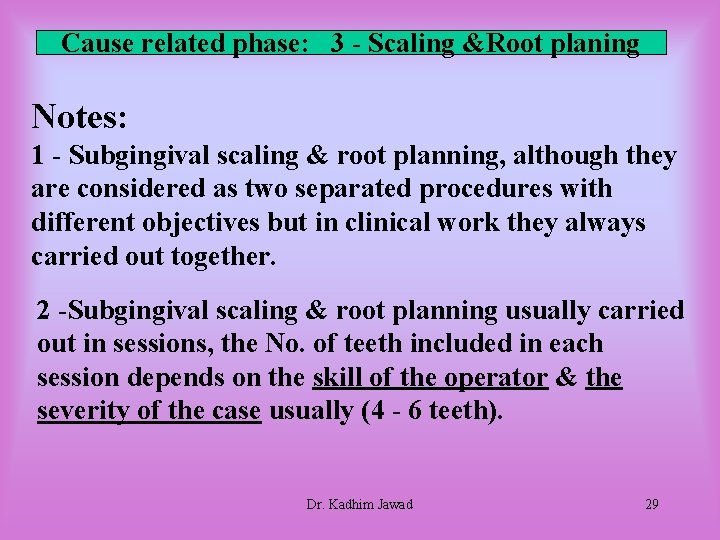
Cause related phase: 3 - Scaling &Root planing Notes: 1 - Subgingival scaling & root planning, although they are considered as two separated procedures with different objectives but in clinical work they always carried out together. 2 -Subgingival scaling & root planning usually carried out in sessions, the No. of teeth included in each session depends on the skill of the operator & the severity of the case usually (4 - 6 teeth). Dr. Kadhim Jawad 29
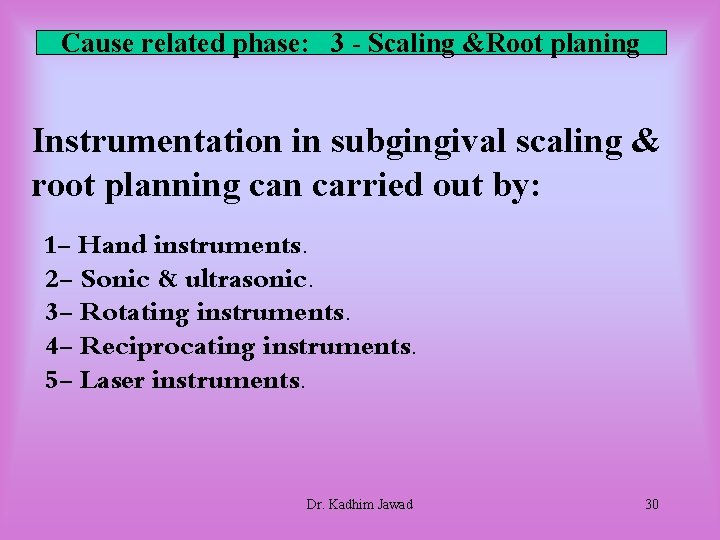
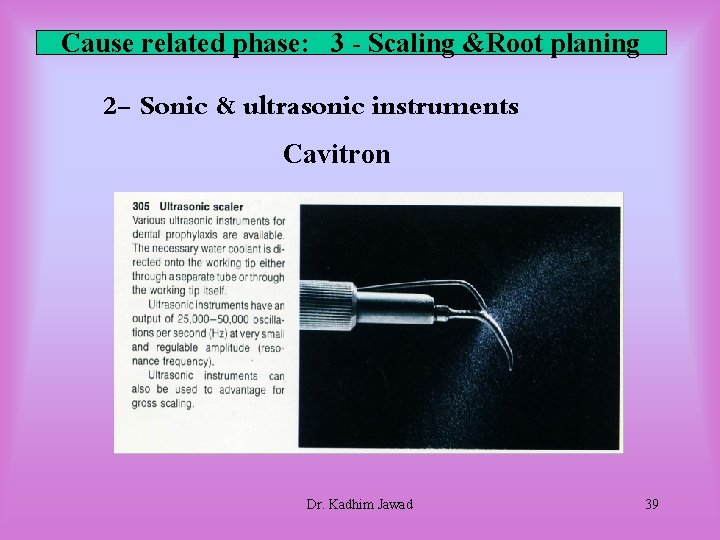
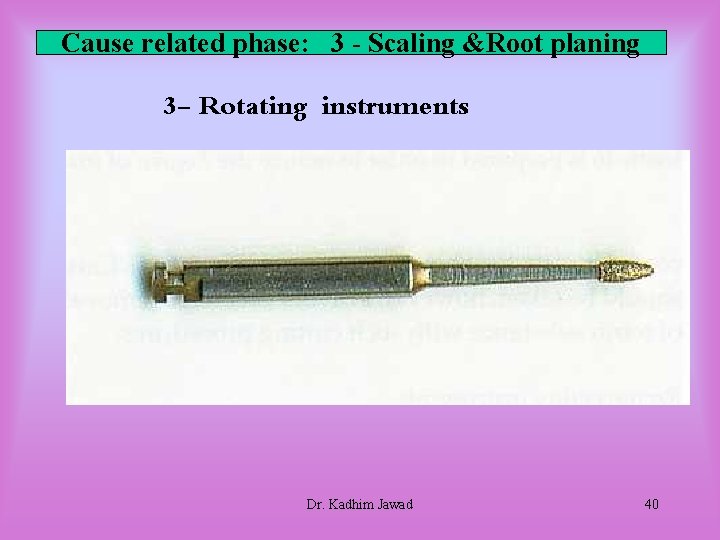
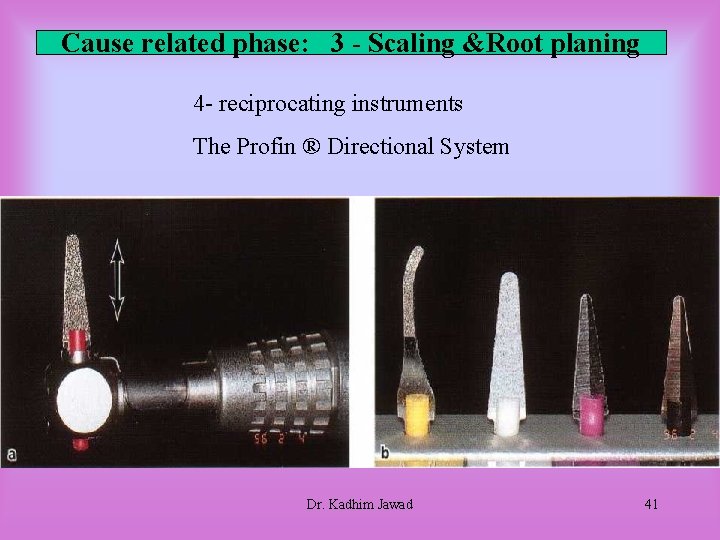
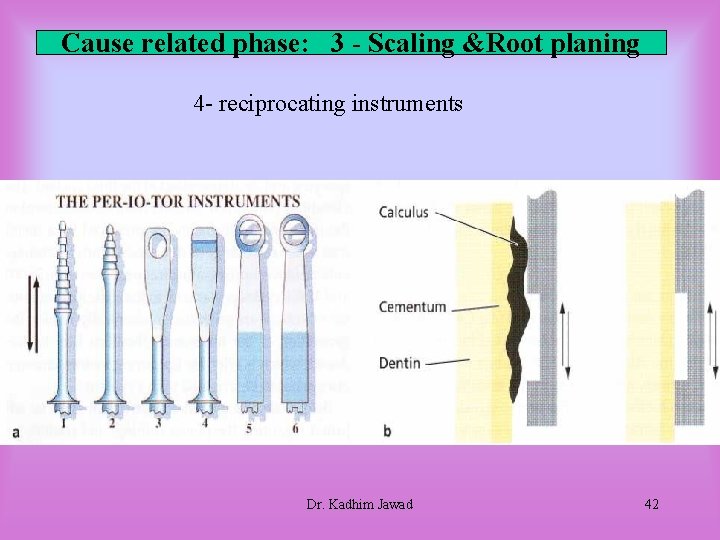
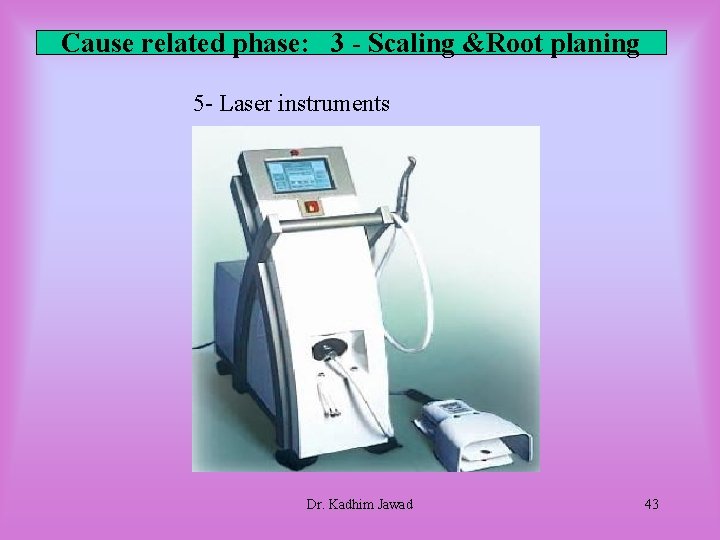
Cause related phase: 3 - Scaling &Root planing Instrumentation in subgingival scaling & root planning can carried out by: 1 - Hand instruments. 2 - Sonic & ultrasonic. 3 - Rotating instruments. 4 - Reciprocating instruments. 5 - Laser instruments. Dr. Kadhim Jawad 30
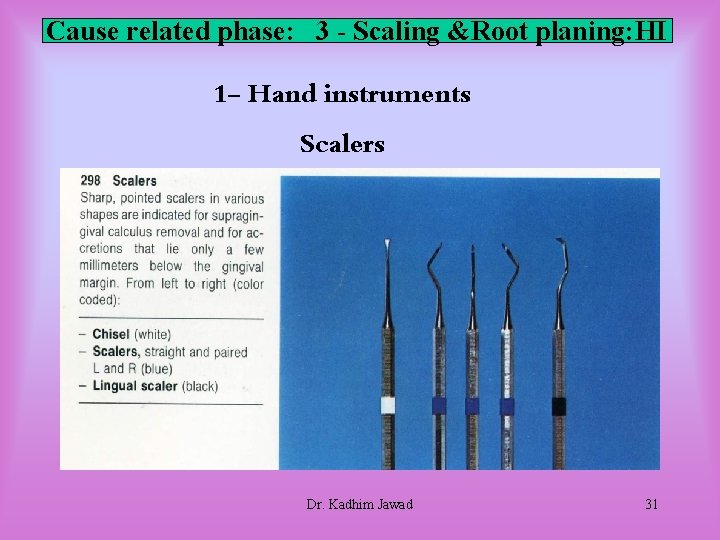
Cause related phase: 3 - Scaling &Root planing: HI 1 - Hand instruments Scalers Dr. Kadhim Jawad 31
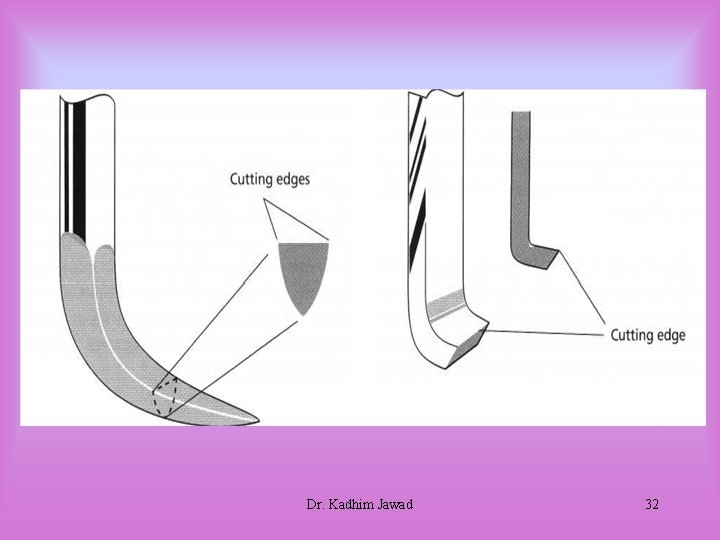
Dr. Kadhim Jawad 32
Dr. Kadhim Jawad 33
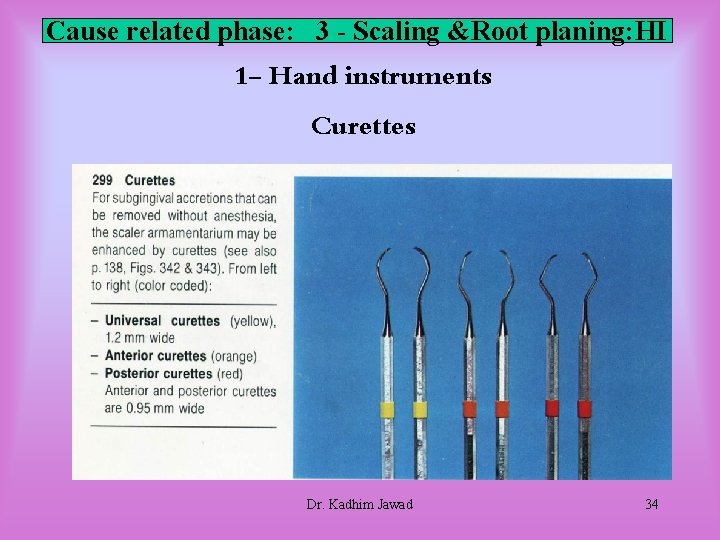
Cause related phase: 3 - Scaling &Root planing: HI 1 - Hand instruments Curettes Dr. Kadhim Jawad 34
Dr. Kadhim Jawad 35
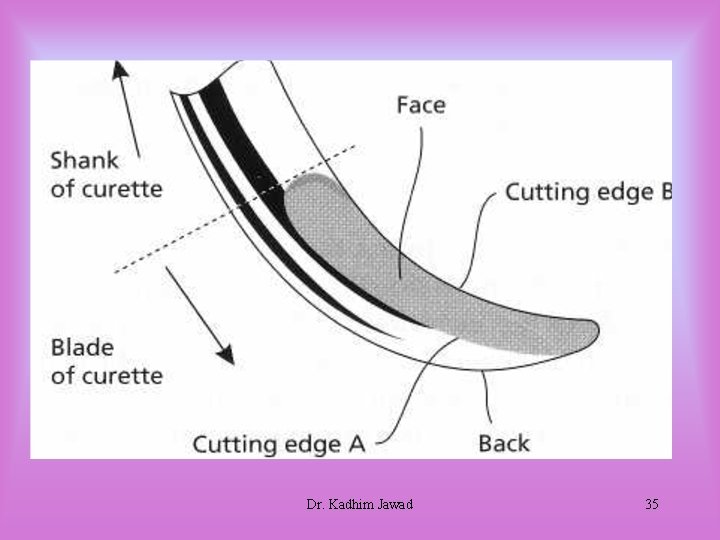
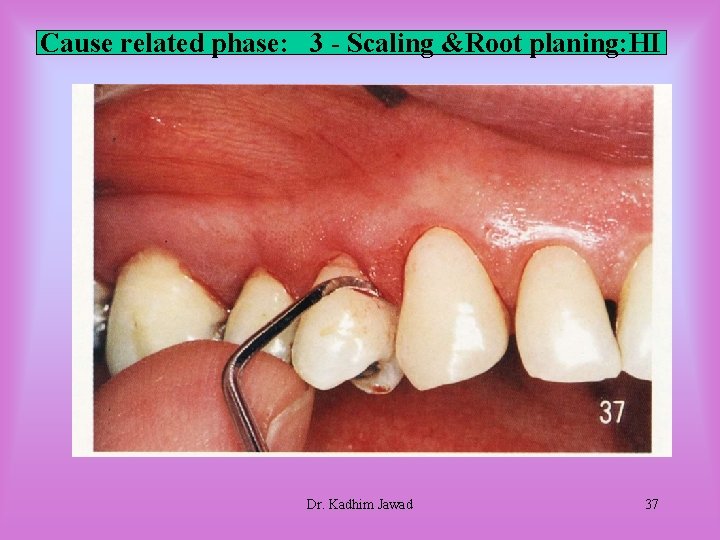
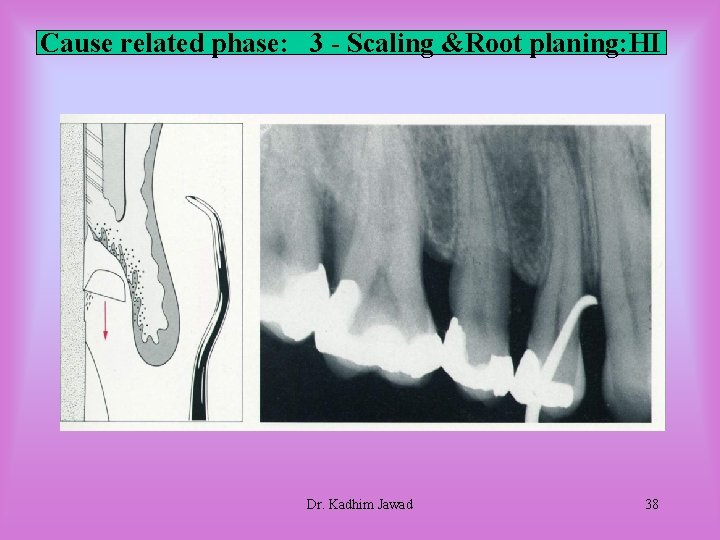
Cause related phase: 3 - Scaling &Root planing: HI When dental curette is used it should be hold in modified pen grasp with finger rest support, the curette is gently inserted into the pocket with its distal end facing the soft tissues, when the instrument reach the base of the pocket, it turned to cutting position and moved coronaly with power full pull stroke (scaling stroke), that followed by moderate to light pull stroke (finishing stroke) to produce a smooth surface these two alternative strokes will continue until we obtain hard & smooth root surface. Dr. Kadhim Jawad 36
Cause related phase: 3 - Scaling &Root planing: HI Dr. Kadhim Jawad 37
Cause related phase: 3 - Scaling &Root planing: HI Dr. Kadhim Jawad 38
Cause related phase: 3 - Scaling &Root planing 2 - Sonic & ultrasonic instruments Cavitron Dr. Kadhim Jawad 39
Cause related phase: 3 - Scaling &Root planing 3 - Rotating instruments Dr. Kadhim Jawad 40
Cause related phase: 3 - Scaling &Root planing 4 - reciprocating instruments The Profin ® Directional System Dr. Kadhim Jawad 41
Cause related phase: 3 - Scaling &Root planing 4 - reciprocating instruments Dr. Kadhim Jawad 42
Cause related phase: 3 - Scaling &Root planing 5 - Laser instruments Dr. Kadhim Jawad 43
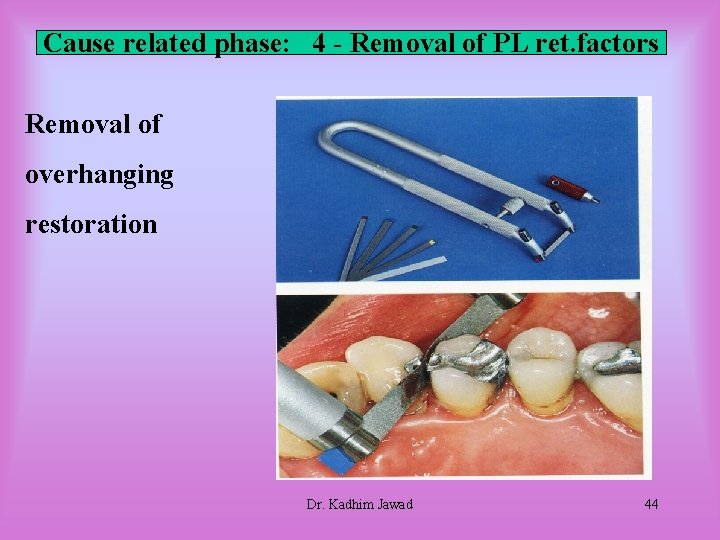
Cause related phase: 4 - Removal of PL ret. factors Removal of overhanging restoration Dr. Kadhim Jawad 44
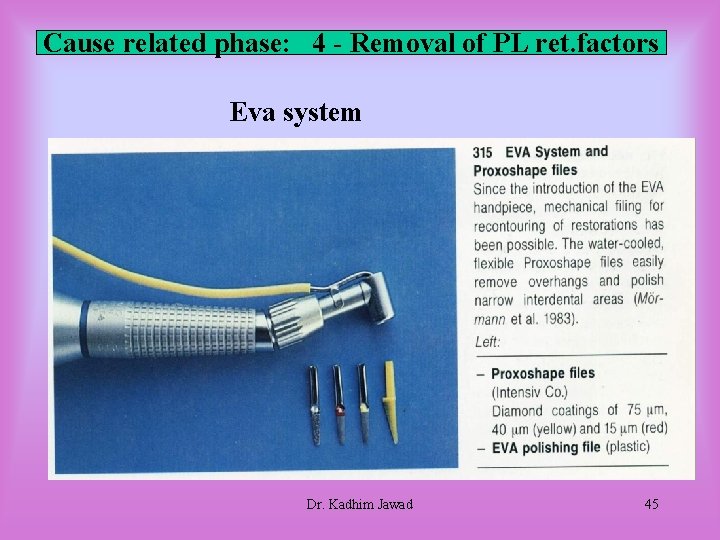
Cause related phase: 4 - Removal of PL ret. factors Eva system Dr. Kadhim Jawad 45
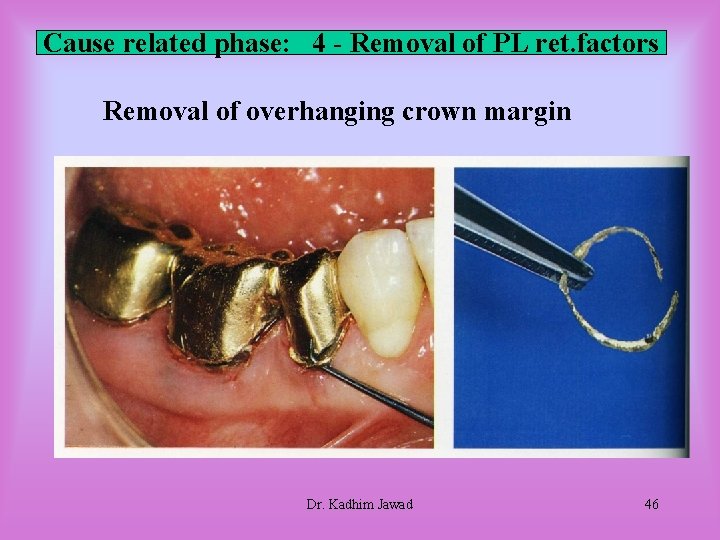
Cause related phase: 4 - Removal of PL ret. factors Removal of overhanging crown margin Dr. Kadhim Jawad 46
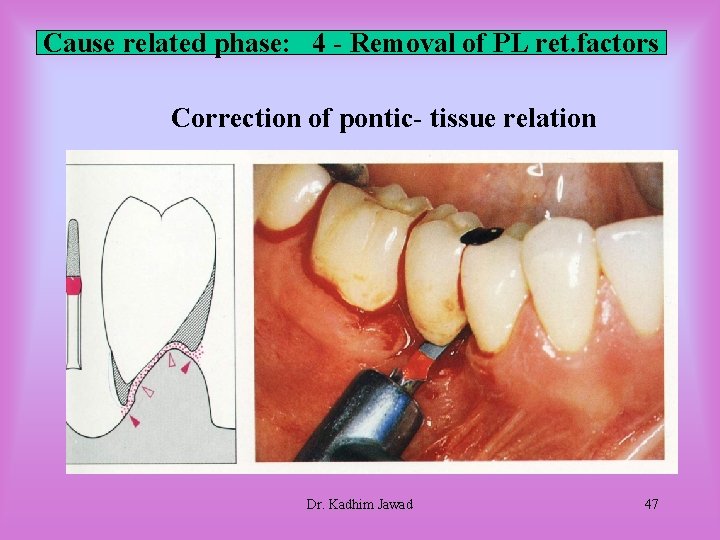
Cause related phase: 4 - Removal of PL ret. factors Correction of pontic- tissue relation Dr. Kadhim Jawad 47
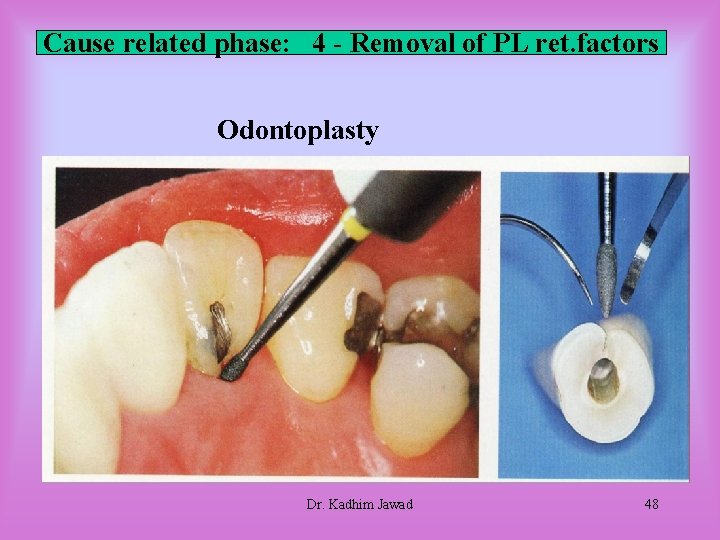
Cause related phase: 4 - Removal of PL ret. factors Odontoplasty Dr. Kadhim Jawad 48
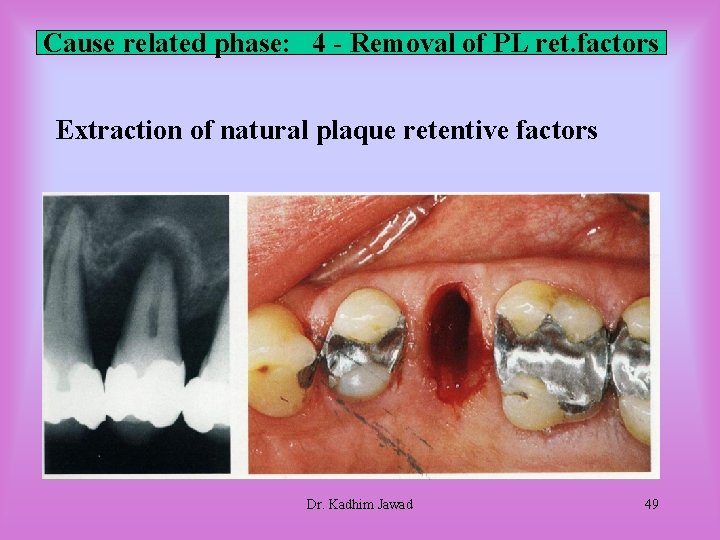
Cause related phase: 4 - Removal of PL ret. factors Extraction of natural plaque retentive factors Dr. Kadhim Jawad 49
Cause related phase: Re-evaluation Evaluation of the cause related phase This evaluation usually described in term of the following points: 1 - Degree of resolution of gingival inflammation. 2 - Degree of reduction in probing depth. 3 - Degree of reduction in tooth mobility. 4 - Degree of improvement of oral hygiene. Dr. Kadhim Jawad 50
Cause related phase: Re-evaluation Results: 1 -Patient with improved oral hygiene, no gingival inflammation; no bleeding on probing , with marked reduction in probing pocket depth. in such situation no further treatment is required. 2 -Patient with proper standard of oral hygiene but having some sites of bleeding on probing with no significant reduction in probing depth. Such patient may need periodontal surgery. Dr. Kadhim Jawad 51
Cause related phase: Re-evaluation 3 - Patient with inadequate oral hygiene due to lack of motivation or lack ability to do proper home care, such patient should be re motivated because if the patient oral hygiene not improved the periodontal disease will recurrent even after conducting periodontal surgery. Dr. Kadhim Jawad 52