
TREATMENT OF INVENTORIES AND DEVELOPMENT COSTS Inventory Methods
- Slides: 11
TREATMENT OF INVENTORIES AND DEVELOPMENT COSTS
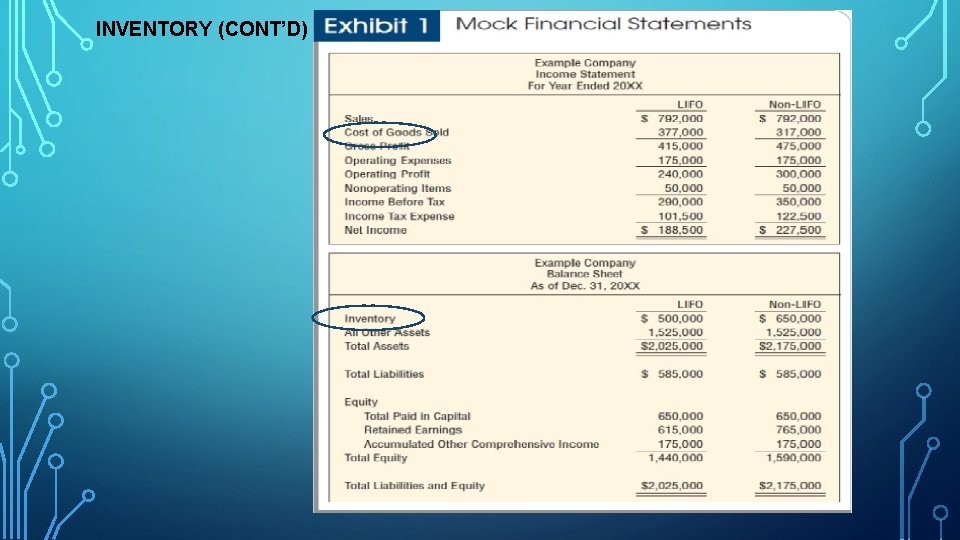
Inventory Methods Under GAAP, a company is allowed to use the Last In, First Out (LIFO) method for inventory estimates. However, under IFRS, the LIFO method for inventory is not allowed. The Last In, First Out valuation for inventory does not reflect an accurate flow of inventory in most cases, and thus results in reports of unusually low income levels. Inventory Reversal In addition to having different methods for tracking inventory, IFRS and GAAP accounting also differ when it comes to inventory write-down reversals. GAAP specifies that if the market value of the asset increases, the amount of the writedown cannot be reversed. Under IFRS, however, in this same situation, the amount of the write-down can be reversed. In other words, GAAP is overly cautious of inventory reversal and does not reflect any positive changes in the marketplace. Development Costs A company’s development costs can be capitalized under IFRS, as long as certain criteria are met. This allows a business to leverage depreciation on fixed assets. With GAAP, development costs must be expensed the year they occur and are not allowed to be capitalized.
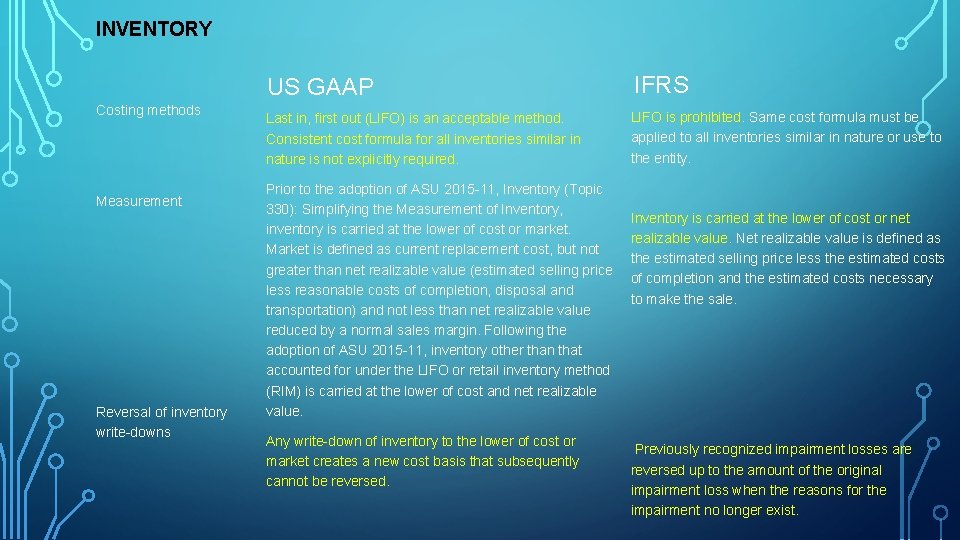
INVENTORY Costing methods Measurement Reversal of inventory write-downs US GAAP IFRS Last in, first out (LIFO) is an acceptable method. Consistent cost formula for all inventories similar in nature is not explicitly required. LIFO is prohibited. Same cost formula must be applied to all inventories similar in nature or use to the entity. Prior to the adoption of ASU 2015 -11, Inventory (Topic 330): Simplifying the Measurement of Inventory, inventory is carried at the lower of cost or market. Market is defined as current replacement cost, but not greater than net realizable value (estimated selling price less reasonable costs of completion, disposal and transportation) and not less than net realizable value reduced by a normal sales margin. Following the adoption of ASU 2015 -11, inventory other than that accounted for under the LIFO or retail inventory method (RIM) is carried at the lower of cost and net realizable value. Any write-down of inventory to the lower of cost or market creates a new cost basis that subsequently cannot be reversed. Inventory is carried at the lower of cost or net realizable value. Net realizable value is defined as the estimated selling price less the estimated costs of completion and the estimated costs necessary to make the sale. Previously recognized impairment losses are reversed up to the amount of the original impairment loss when the reasons for the impairment no longer exist.
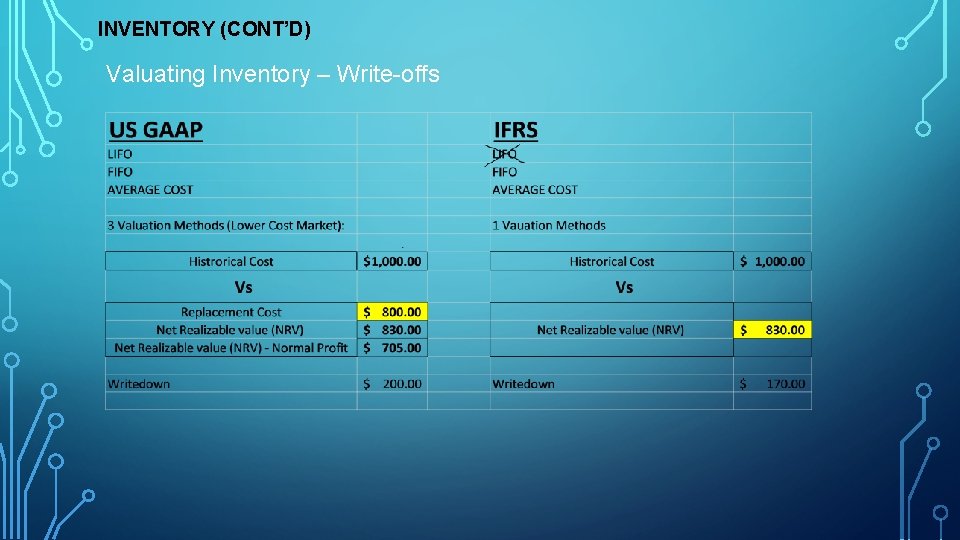
INVENTORY (CONT’D) Valuating Inventory – Write-offs
INVENTORY (CONT’D)
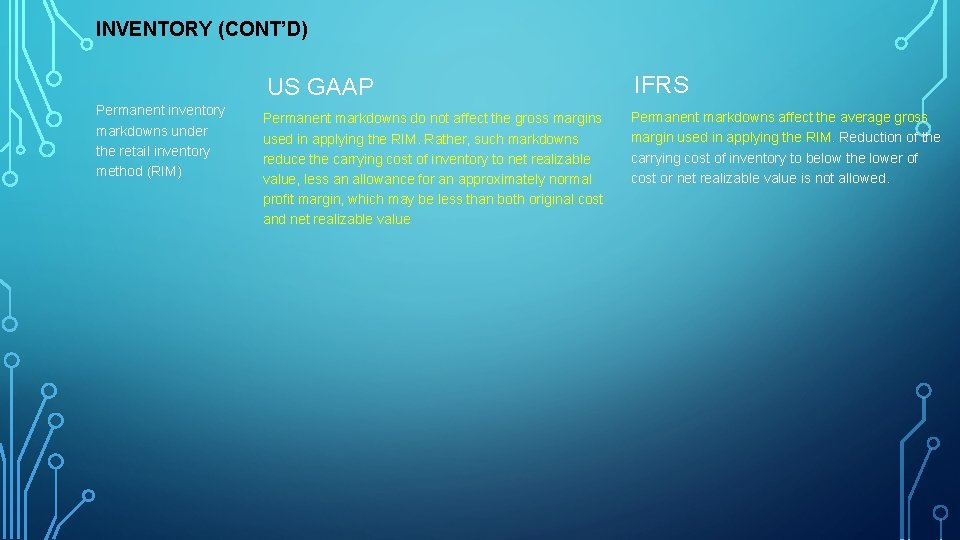
INVENTORY (CONT’D) US GAAP Permanent inventory markdowns under the retail inventory method (RIM) Permanent markdowns do not affect the gross margins used in applying the RIM. Rather, such markdowns reduce the carrying cost of inventory to net realizable value, less an allowance for an approximately normal profit margin, which may be less than both original cost and net realizable value IFRS Permanent markdowns affect the average gross margin used in applying the RIM. Reduction of the carrying cost of inventory to below the lower of cost or net realizable value is not allowed.
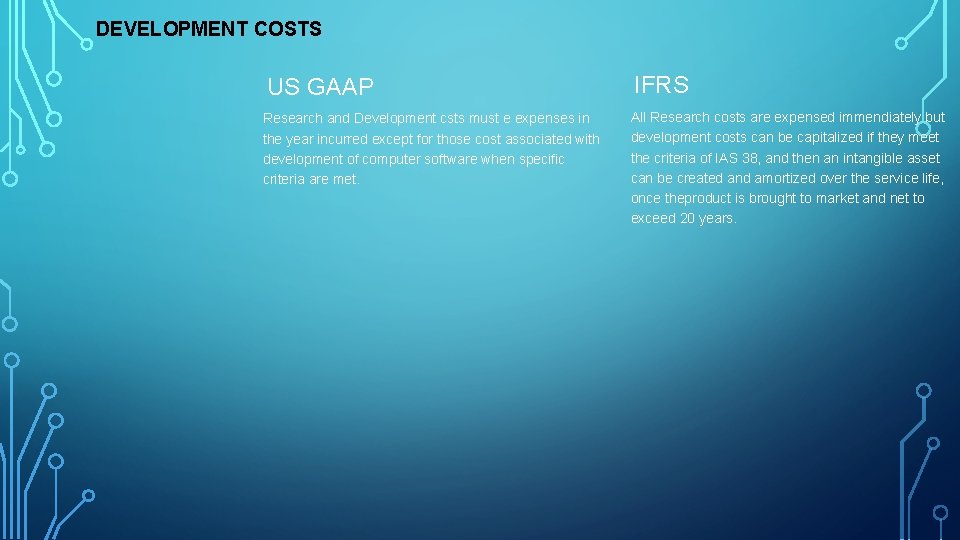
DEVELOPMENT COSTS US GAAP Research and Development csts must e expenses in the year incurred except for those cost associated with development of computer software when specific criteria are met. IFRS All Research costs are expensed immendiately but development costs can be capitalized if they meet the criteria of IAS 38, and then an intangible asset can be created and amortized over the service life, once theproduct is brought to market and net to exceed 20 years.
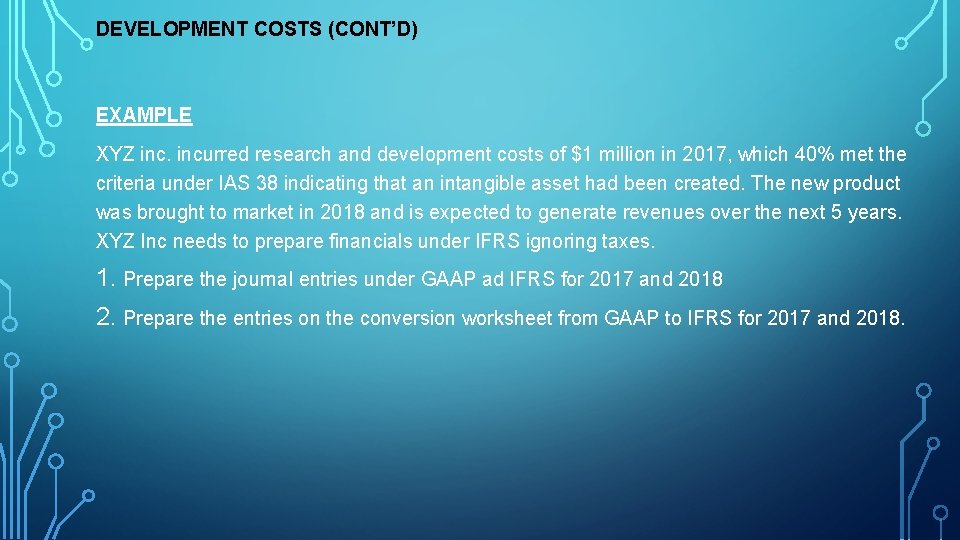
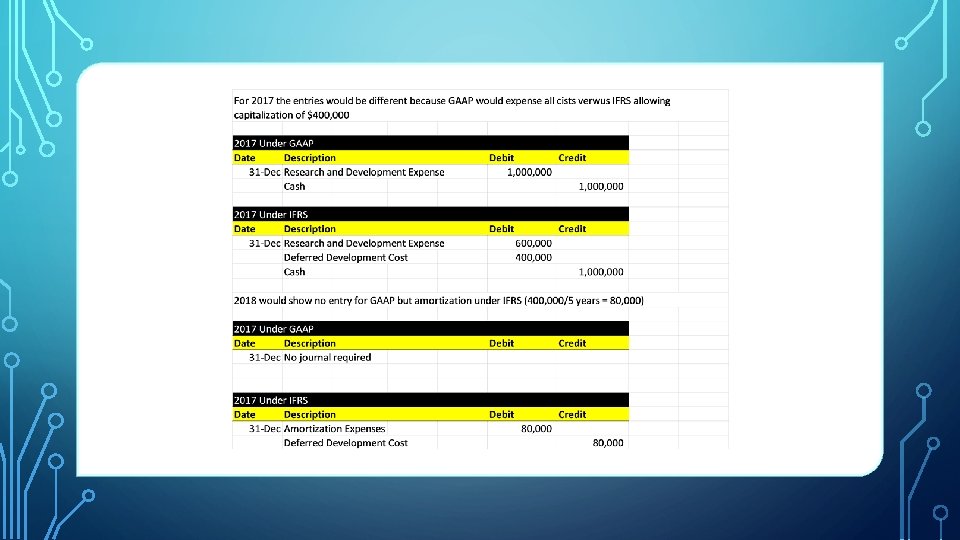
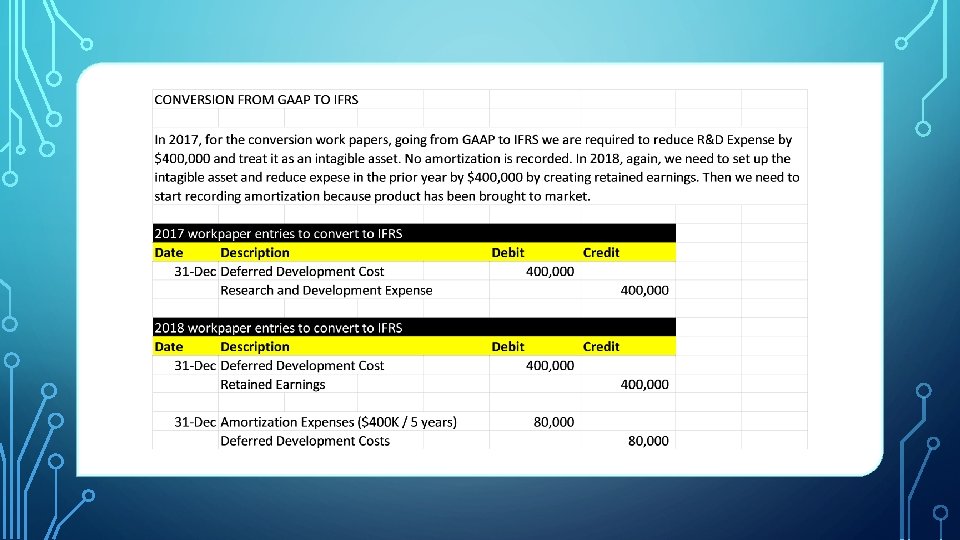
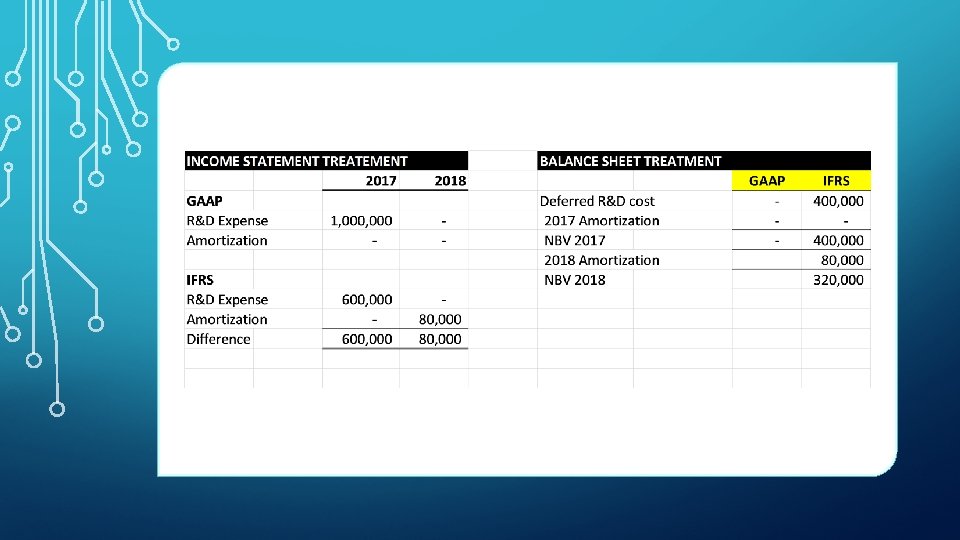
DEVELOPMENT COSTS (CONT’D) EXAMPLE XYZ incurred research and development costs of $1 million in 2017, which 40% met the criteria under IAS 38 indicating that an intangible asset had been created. The new product was brought to market in 2018 and is expected to generate revenues over the next 5 years. XYZ Inc needs to prepare financials under IFRS ignoring taxes. 1. Prepare the journal entries under GAAP ad IFRS for 2017 and 2018 2. Prepare the entries on the conversion worksheet from GAAP to IFRS for 2017 and 2018.