
Treatment of Alcohol Related Liver Disease ARLD by
Treatment of Alcohol Related Liver Disease (ARLD) by Acute Trusts in Wessex A report for Wessex AHSN ‘Reducing Harm from Alcohol’ Programme Dr Brad Keogh Centre for Implementation Science brad. keogh@soton. ac. uk @Keogh. Data Wessex AHSN alcohol programme clinical leads: Dr Julia Sinclair & Dr Leonie Grellier Wessex AHSN senior programme manager: Kathy Wallis alcohol@wessexahsn. net

Contents 2 • Introduction & key findings: Pages 3 -5 • Headline figures & trends over time: pages 6 -9 • Patient survival, demographics, repeat attendances & length of stay: pages 1013 • Variation across Wessex Acute Trusts: pages 14 -18 • Variation across Wessex CCGs: pages 19 -20 • Estimations of cost avoidance from earlier intervention: pages 21 -25 • What must YOU do now? pages 26 -28 • Appendix A: Data limitations page 29 • Appendix B: Liver Disease ICD-10 codes pages 30 -32 • Appendix C: Alcohol-specific ICD-10 codes page 33 • Appendix D: Estimating early intervention cost avoidance in Wessex pages 34 -40
Key findings in Wessex Data from the 6 Acute NHS Trusts in Wessex shows: • The number of Liver Disease admissions are increasing each year • In 2015: Across Wessex an average of 37% of Liver Disease admissions were for alcohol-specific conditions, this increased to 45% at one Acute Trust • Alcohol Related Liver Disease (ARLD) patients are on average 10 years younger and more likely to be male • The probability of death for an ARLD diagnosed patient 3 -years after diagnosis is 45%, compared with 26% for a non-ARLD patient* • ARLD patients have a greater number of admissions and longer lengths of stay than other Liver Disease patients • An audit from Hampshire Hospitals Foundation Trust suggests that at least an additional 13% of Liver Disease admissions have alcohol use disorders but are not coded as such. Further audits are being completed at other Trusts across Wessex • It is estimated that improving patient management in Acute Trust settings could save at least £ 10 m-£ 13. 3 m per year** across the 6 Acute Trusts 3 * Figures based on Trust recorded data only, hence probability of death may be under-reported here **Range determined by ARLD diagnosis either 1 or 2 years earlier
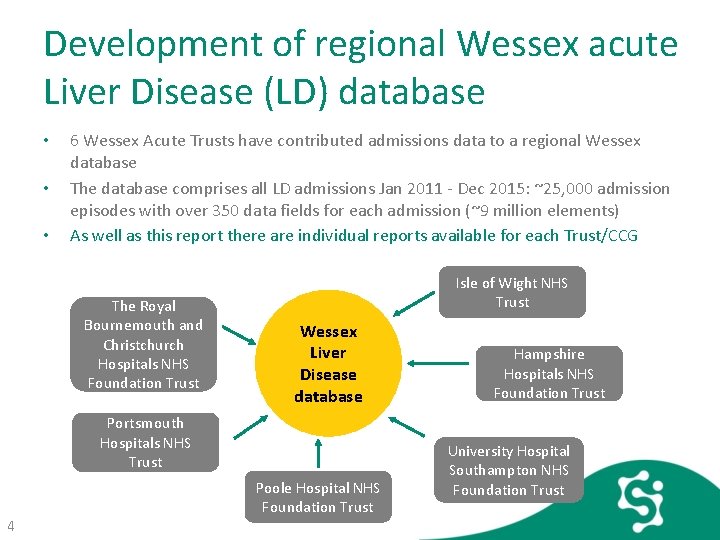
Development of regional Wessex acute Liver Disease (LD) database • • • 6 Wessex Acute Trusts have contributed admissions data to a regional Wessex database The database comprises all LD admissions Jan 2011 - Dec 2015: ~25, 000 admission episodes with over 350 data fields for each admission (~9 million elements) As well as this report there are individual reports available for each Trust/CCG The Royal Bournemouth and Christchurch Hospitals NHS Foundation Trust Isle of Wight NHS Trust Wessex Liver Disease database Portsmouth Hospitals NHS Trust 4 Poole Hospital NHS Foundation Trust Hampshire Hospitals NHS Foundation Trust University Hospital Southampton NHS Foundation Trust

This data does not include: • Any hospital admission where Liver Disease is not coded (even if present) • Any admission occurring outside of the 6 Acute Trusts ARLD and alcohol-specific admissions are underestimated where: • Patients have not been screened for alcohol • Patients screened but not coded in Trust electronic records • Patients where ARLD is obscured by obesity-related Liver Disease 5
Headline numbers: Wessex (6 Acute Trusts) • During Jan 2011 – Dec 2015: – – – There were 21, 400 LD admissions There were over 9, 100 ARLD admissions (from 4, 150 ARLD patients) On average there were ~660 new diagnoses of ARLD per year 42% of all LD admissions had an alcohol-specific condition recorded 84% of all LD admissions were emergency Definitions of admissions: • Between Jan-Dec 2015: – There were 3, 960 LD patients LD: patient with Liver Disease diagnosis ARLD: patient with Alcohol-Related Liver Disease diagnosis Alcohol-specific: admission with ARLD or other alcohol diagnosed conditions For full definitions see Appendix A • Who had 5, 200 admissions • Of which 1, 900 were alcohol-specific admissions • There were 1, 260 LD patients who had at least one admission for an alcohol-specific condition – Of the LD patients there were 1, 000 patients diagnosed with ARLD • Who had 1, 600 admissions • Using 17, 500 bed days • At a Pb. R cost of over £ 4, 440, 000* 6 * Cost may be under-reported by up to 10%, as some admissions could not be assigned to a HRG tariff
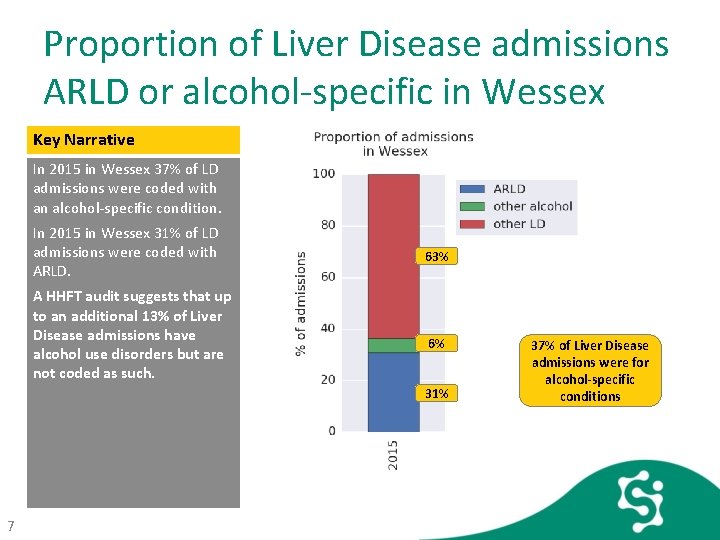
Proportion of Liver Disease admissions ARLD or alcohol-specific in Wessex Key Narrative In 2015 in Wessex 37% of LD admissions were coded with an alcohol-specific condition. In 2015 in Wessex 31% of LD admissions were coded with ARLD. A HHFT audit suggests that up to an additional 13% of Liver Disease admissions have alcohol use disorders but are not coded as such. 63% 6% 31% 7 37% of Liver Disease admissions were for alcohol-specific conditions
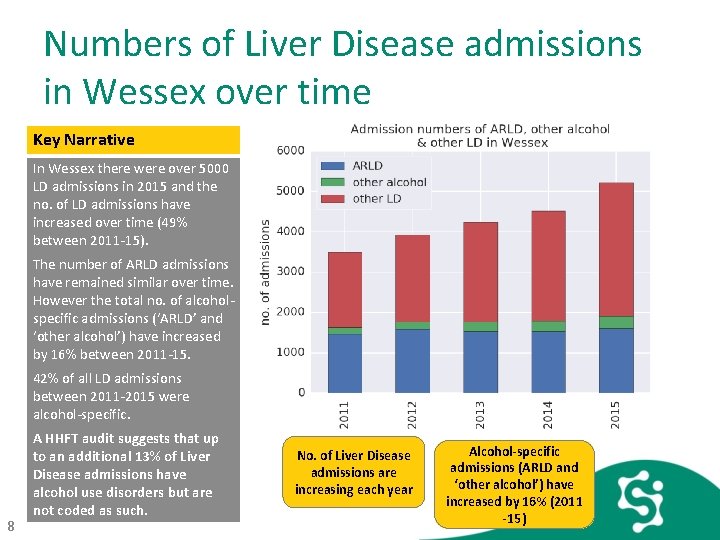
Numbers of Liver Disease admissions in Wessex over time Key Narrative In Wessex there were over 5000 LD admissions in 2015 and the no. of LD admissions have increased over time (49% between 2011 -15). The number of ARLD admissions have remained similar over time. However the total no. of alcoholspecific admissions (‘ARLD’ and ‘other alcohol’) have increased by 16% between 2011 -15. 42% of all LD admissions between 2011 -2015 were alcohol-specific. 8 A HHFT audit suggests that up to an additional 13% of Liver Disease admissions have alcohol use disorders but are not coded as such. No. of Liver Disease admissions are increasing each year Alcohol-specific admissions (ARLD and ‘other alcohol’) have increased by 16% (2011 -15)
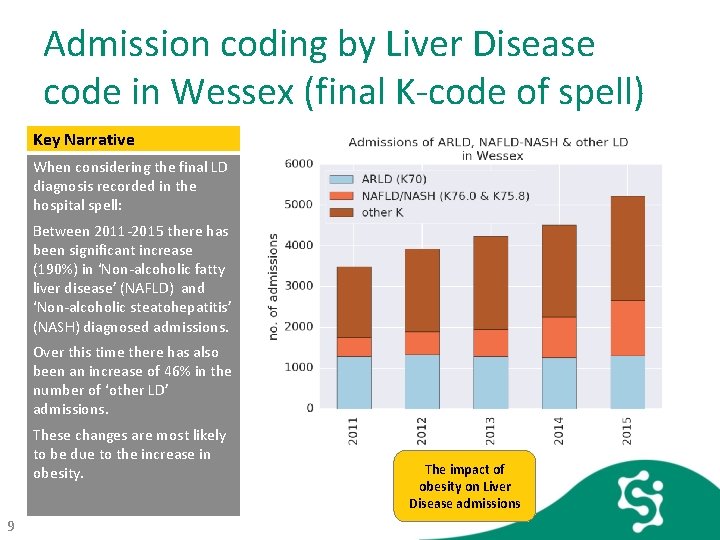
Admission coding by Liver Disease code in Wessex (final K-code of spell) Key Narrative When considering the final LD diagnosis recorded in the hospital spell: Between 2011 -2015 there has been significant increase (190%) in ‘Non-alcoholic fatty liver disease’ (NAFLD) and ‘Non-alcoholic steatohepatitis’ (NASH) diagnosed admissions. Over this time there has also been an increase of 46% in the number of ‘other LD’ admissions. These changes are most likely to be due to the increase in obesity. 9 The impact of obesity on Liver Disease admissions
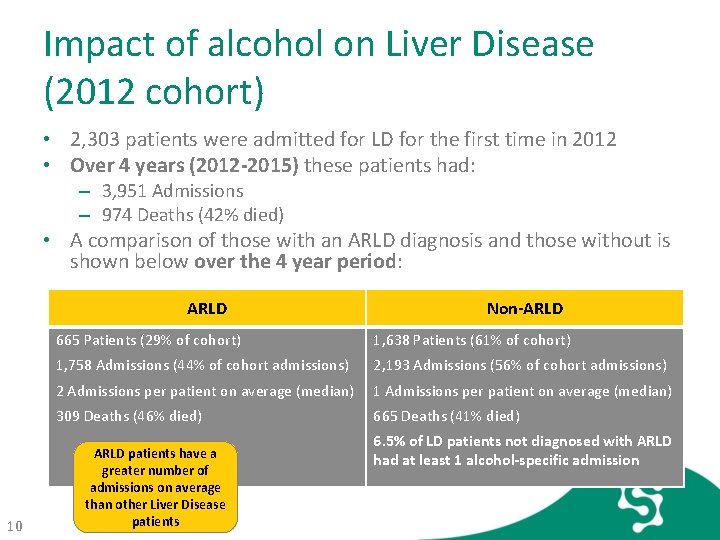
Impact of alcohol on Liver Disease (2012 cohort) • 2, 303 patients were admitted for LD for the first time in 2012 • Over 4 years (2012 -2015) these patients had: – 3, 951 Admissions – 974 Deaths (42% died) • A comparison of those with an ARLD diagnosis and those without is shown below over the 4 year period: ARLD 10 Non-ARLD 665 Patients (29% of cohort) 1, 638 Patients (61% of cohort) 1, 758 Admissions (44% of cohort admissions) 2, 193 Admissions (56% of cohort admissions) 2 Admissions per patient on average (median) 1 Admissions per patient on average (median) 309 Deaths (46% died) 665 Deaths (41% died) ARLD patients have a greater number of admissions on average than other Liver Disease patients 6. 5% of LD patients not diagnosed with ARLD had at least 1 alcohol-specific admission
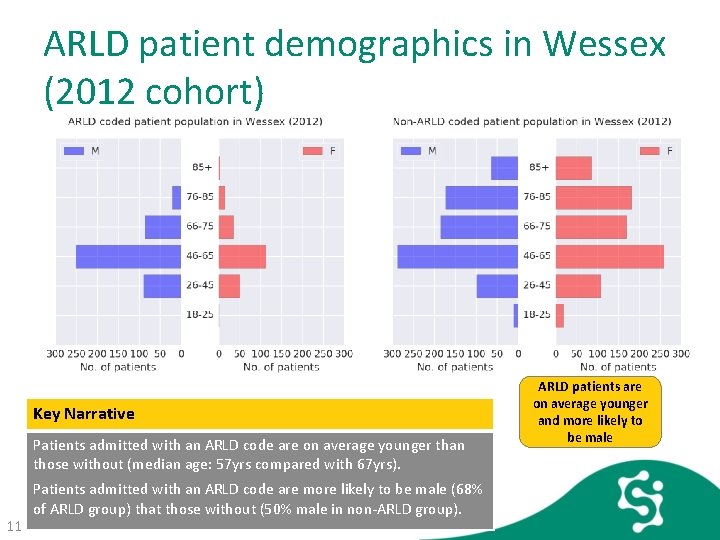
ARLD patient demographics in Wessex (2012 cohort) Key Narrative Patients admitted with an ARLD code are on average younger than those without (median age: 57 yrs compared with 67 yrs). 11 Patients admitted with an ARLD code are more likely to be male (68% of ARLD group) that those without (50% male in non-ARLD group). ARLD patients are on average younger and more likely to be male

Liver Disease survival in Wessex: 2012 cohort, ages 46 -65 years Key Narrative Based on those admitted for the first time with a LD diagnosis in 2012 (age 45 -65): The probability of a LD patient surviving after first diagnosis (of any LD) in Wessex is much lower for those who have ARLD diagnosed. Within 3 years of first LD diagnosis the probability of death for an ARLD diagnosed patient is 45%, compared with 26% for a non-ARLD patient. Note: deaths only include those recorded on Trust data systems. 12 There is increased mortality in patients diagnosed with ARLD
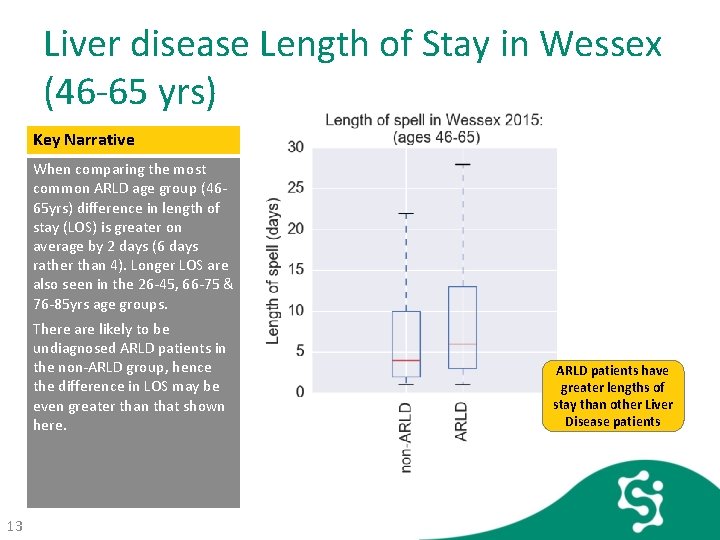
Liver disease Length of Stay in Wessex (46 -65 yrs) Key Narrative When comparing the most common ARLD age group (4665 yrs) difference in length of stay (LOS) is greater on average by 2 days (6 days rather than 4). Longer LOS are also seen in the 26 -45, 66 -75 & 76 -85 yrs age groups. There are likely to be undiagnosed ARLD patients in the non-ARLD group, hence the difference in LOS may be even greater than that shown here. 13 ARLD patients have greater lengths of stay than other Liver Disease patients
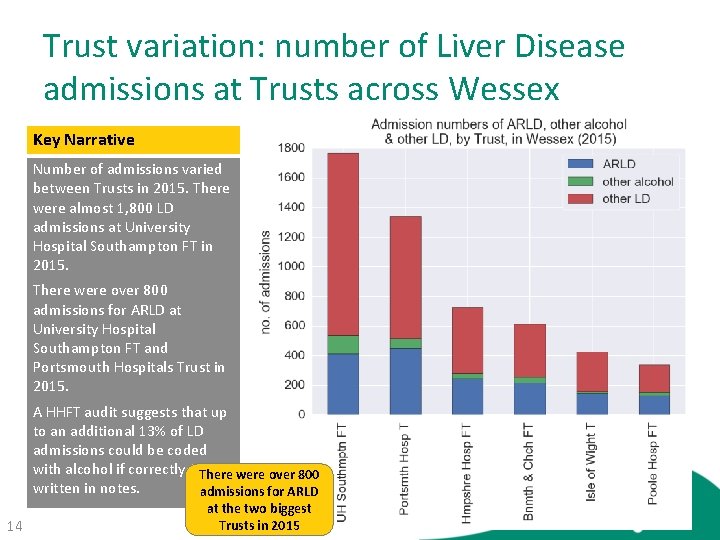
Trust variation: number of Liver Disease admissions at Trusts across Wessex Key Narrative Number of admissions varied between Trusts in 2015. There were almost 1, 800 LD admissions at University Hospital Southampton FT in 2015. There were over 800 admissions for ARLD at University Hospital Southampton FT and Portsmouth Hospitals Trust in 2015. A HHFT audit suggests that up to an additional 13% of LD admissions could be coded with alcohol if correctly There were over 800 written in notes. admissions for ARLD 14 at the two biggest Trusts in 2015
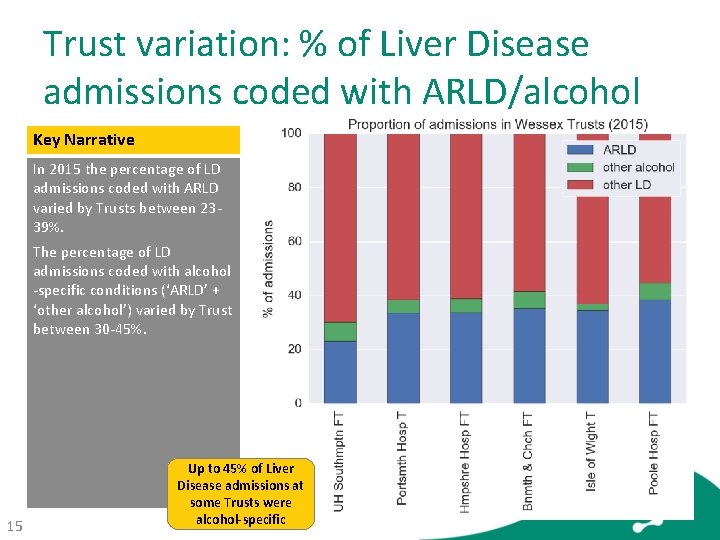
Trust variation: % of Liver Disease admissions coded with ARLD/alcohol Key Narrative In 2015 the percentage of LD admissions coded with ARLD varied by Trusts between 2339%. The percentage of LD admissions coded with alcohol -specific conditions (‘ARLD’ + ‘other alcohol’) varied by Trust between 30 -45%. 15 Up to 45% of Liver Disease admissions at some Trusts were alcohol-specific
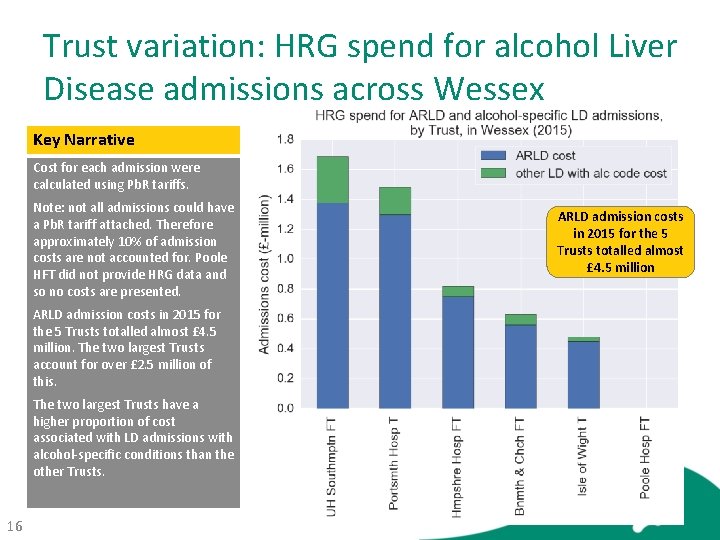
Trust variation: HRG spend for alcohol Liver Disease admissions across Wessex Key Narrative Cost for each admission were calculated using Pb. R tariffs. Note: not all admissions could have a Pb. R tariff attached. Therefore approximately 10% of admission costs are not accounted for. Poole HFT did not provide HRG data and so no costs are presented. ARLD admission costs in 2015 for the 5 Trusts totalled almost £ 4. 5 million. The two largest Trusts account for over £ 2. 5 million of this. The two largest Trusts have a higher proportion of cost associated with LD admissions with alcohol-specific conditions than the other Trusts. 16 ARLD admission costs in 2015 for the 5 Trusts totalled almost £ 4. 5 million
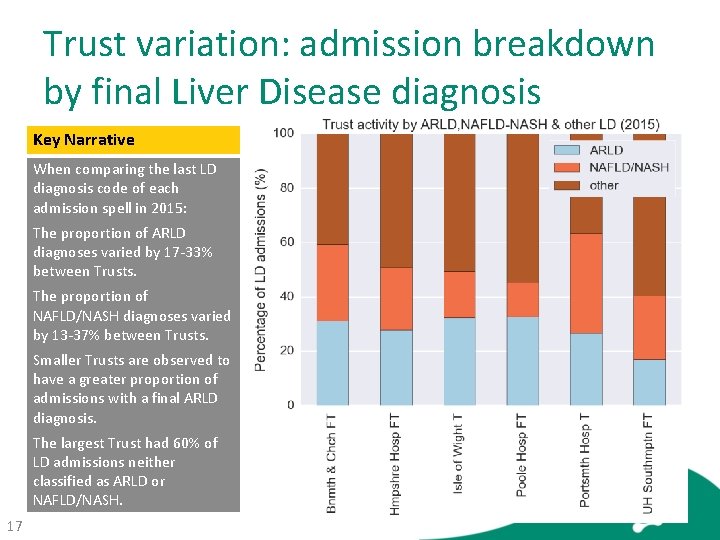
Trust variation: admission breakdown by final Liver Disease diagnosis Key Narrative When comparing the last LD diagnosis code of each admission spell in 2015: The proportion of ARLD diagnoses varied by 17 -33% between Trusts. The proportion of NAFLD/NASH diagnoses varied by 13 -37% between Trusts. Smaller Trusts are observed to have a greater proportion of admissions with a final ARLD diagnosis. The largest Trust had 60% of LD admissions neither classified as ARLD or NAFLD/NASH. 17
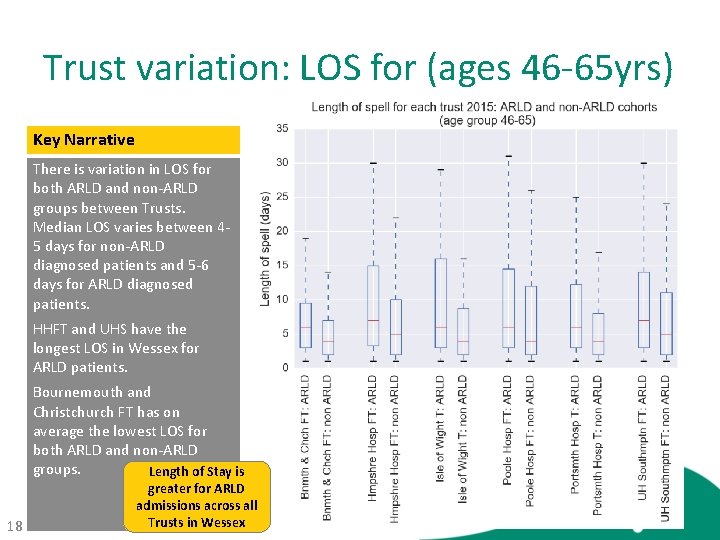
Trust variation: LOS for (ages 46 -65 yrs) Key Narrative There is variation in LOS for both ARLD and non-ARLD groups between Trusts. Median LOS varies between 45 days for non-ARLD diagnosed patients and 5 -6 days for ARLD diagnosed patients. HHFT and UHS have the longest LOS in Wessex for ARLD patients. Bournemouth and Christchurch FT has on average the lowest LOS for both ARLD and non-ARLD groups. Length of Stay is 18 greater for ARLD admissions across all Trusts in Wessex
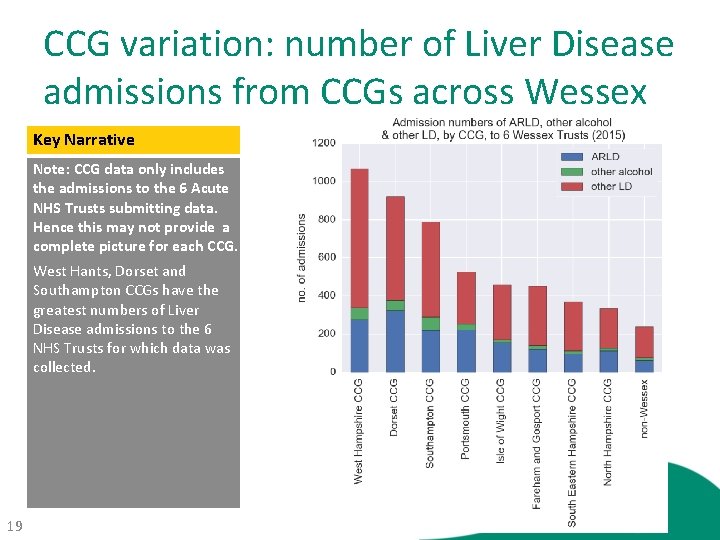
CCG variation: number of Liver Disease admissions from CCGs across Wessex Key Narrative Note: CCG data only includes the admissions to the 6 Acute NHS Trusts submitting data. Hence this may not provide a complete picture for each CCG. West Hants, Dorset and Southampton CCGs have the greatest numbers of Liver Disease admissions to the 6 NHS Trusts for which data was collected. 19
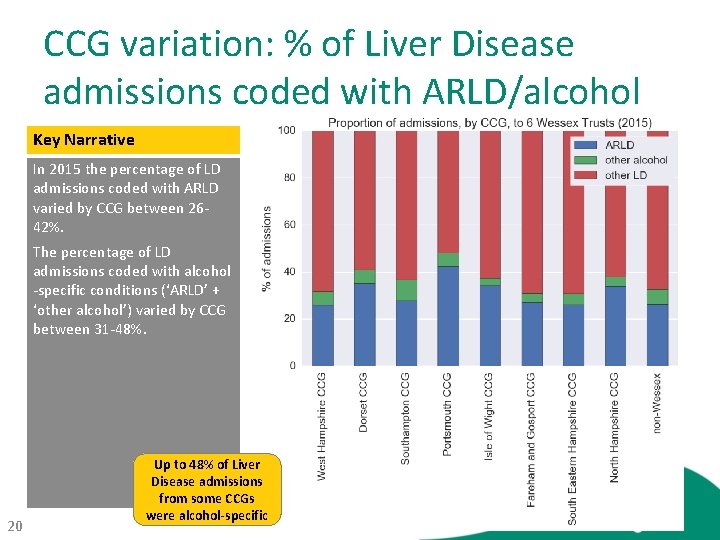
CCG variation: % of Liver Disease admissions coded with ARLD/alcohol Key Narrative In 2015 the percentage of LD admissions coded with ARLD varied by CCG between 2642%. The percentage of LD admissions coded with alcohol -specific conditions (‘ARLD’ + ‘other alcohol’) varied by CCG between 31 -48%. 20 Up to 48% of Liver Disease admissions from some CCGs were alcohol-specific
Estimating early intervention cost avoidance in Wessex • Nuffield Trust report on “Alcohol-specific activity in hospitals in England” (published Dec 2015) showed: – rising burden of alcohol on A&E departments (attendance rates doubled between 2008/092013/14) – highlighted the possibility for earlier intervention: ¾ of those diagnosed with ARLD during 2009/2010 had contact with hospital services the year before diagnosis. Source: 21 http: //www. nuffieldtrust. org. uk/node/4483
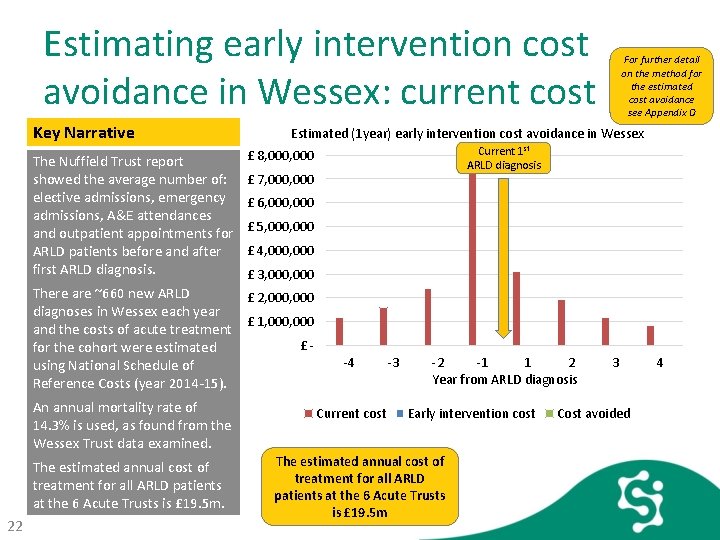
Estimating early intervention cost avoidance in Wessex: current cost Key Narrative The Nuffield Trust report showed the average number of: elective admissions, emergency admissions, A&E attendances and outpatient appointments for ARLD patients before and after first ARLD diagnosis. Estimated (1 year) early intervention cost avoidance in Wessex The estimated annual cost of treatment for all ARLD patients at the 6 Acute Trusts is £ 19. 5 m. 22 Current 1 st ARLD diagnosis £ 8, 000 £ 7, 000 £ 6, 000 £ 5, 000 £ 4, 000 £ 3, 000 There are ~660 new ARLD £ 2, 000 diagnoses in Wessex each year £ 1, 000 and the costs of acute treatment £ for the cohort were estimated using National Schedule of Reference Costs (year 2014 -15). An annual mortality rate of 14. 3% is used, as found from the Wessex Trust data examined. For further detail on the method for the estimated cost avoidance see Appendix D -4 Current cost -3 -2 -1 1 2 Year from ARLD diagnosis Early intervention cost The estimated annual cost of treatment for all ARLD patients at the 6 Acute Trusts is £ 19. 5 m 3 Cost avoided 4
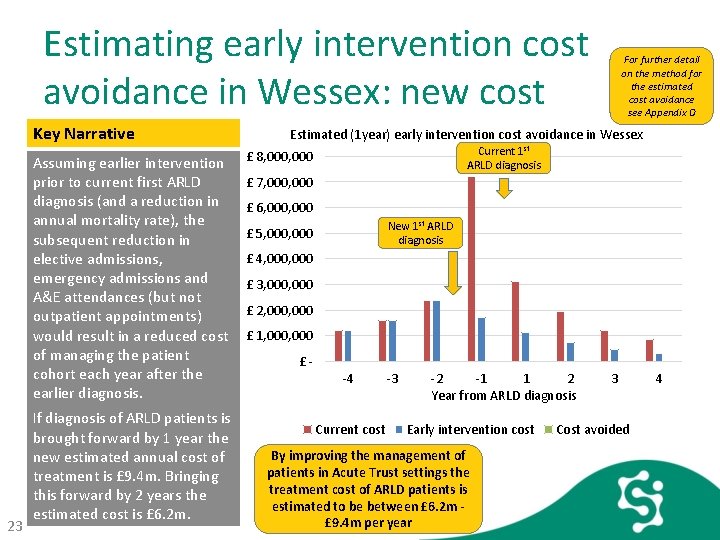
Estimating early intervention cost avoidance in Wessex: new cost Key Narrative Assuming earlier intervention prior to current first ARLD diagnosis (and a reduction in annual mortality rate), the subsequent reduction in elective admissions, emergency admissions and A&E attendances (but not outpatient appointments) would result in a reduced cost of managing the patient cohort each year after the earlier diagnosis. 23 If diagnosis of ARLD patients is brought forward by 1 year the new estimated annual cost of treatment is £ 9. 4 m. Bringing this forward by 2 years the estimated cost is £ 6. 2 m. For further detail on the method for the estimated cost avoidance see Appendix D Estimated (1 year) early intervention cost avoidance in Wessex Current 1 st ARLD diagnosis £ 8, 000 £ 7, 000 £ 6, 000 New 1 st ARLD diagnosis £ 5, 000 £ 4, 000 £ 3, 000 £ 2, 000 £ 1, 000 £ -4 Current cost -3 -2 -1 1 2 Year from ARLD diagnosis Early intervention cost By improving the management of patients in Acute Trust settings the treatment cost of ARLD patients is estimated to be between £ 6. 2 m £ 9. 4 m per year 3 Cost avoided 4
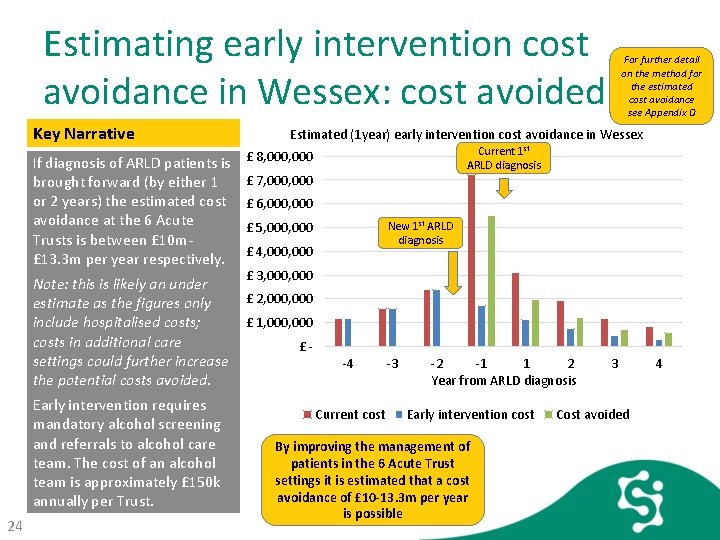
Estimating early intervention cost avoidance in Wessex: cost avoided Key Narrative Estimated (1 year) early intervention cost avoidance in Wessex Current 1 st ARLD diagnosis If diagnosis of ARLD patients is £ 8, 000 brought forward (by either 1 £ 7, 000 or 2 years) the estimated cost avoidance at the 6 Acute Trusts is between £ 10 m£ 13. 3 m per year respectively. Note: this is likely an under estimate as the figures only include hospitalised costs; costs in additional care settings could further increase the potential costs avoided. Early intervention requires mandatory alcohol screening and referrals to alcohol care team. The cost of an alcohol team is approximately £ 150 k annually per Trust. 24 For further detail on the method for the estimated cost avoidance see Appendix D £ 6, 000 New 1 st ARLD diagnosis £ 5, 000 £ 4, 000 £ 3, 000 £ 2, 000 £ 1, 000 £ -4 Current cost -3 -2 -1 1 2 Year from ARLD diagnosis Early intervention cost By improving the management of patients in the 6 Acute Trust settings it is estimated that a cost avoidance of £ 10 -13. 3 m per year is possible 3 Cost avoided 4
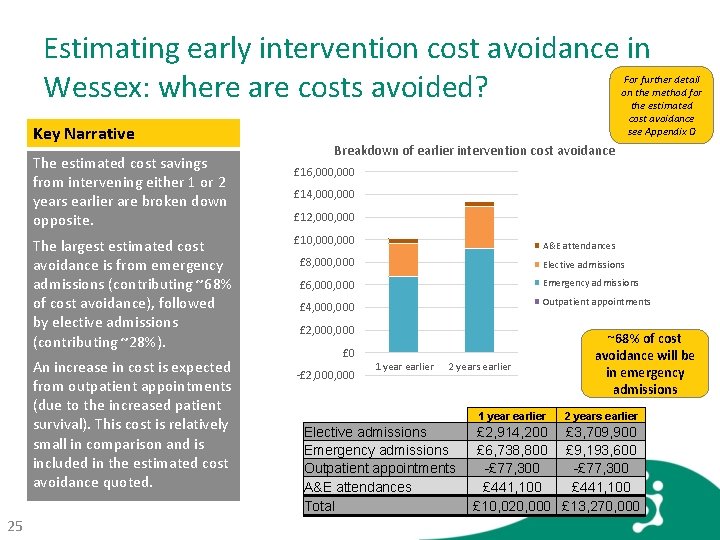
Estimating early intervention cost avoidance in Wessex: where are costs avoided? For further detail on the method for the estimated cost avoidance see Appendix D Key Narrative The estimated cost savings from intervening either 1 or 2 years earlier are broken down opposite. The largest estimated cost avoidance is from emergency admissions (contributing ~68% of cost avoidance), followed by elective admissions (contributing ~28%). An increase in cost is expected from outpatient appointments (due to the increased patient survival). This cost is relatively small in comparison and is included in the estimated cost avoidance quoted. 25 Breakdown of earlier intervention cost avoidance £ 16, 000 £ 14, 000 £ 12, 000 £ 10, 000 A&E attendances £ 8, 000 Elective admissions £ 6, 000 Emergency admissions £ 4, 000 Outpatient appointments £ 2, 000 £ 0 -£ 2, 000 1 year earlier 2 years earlier Elective admissions Emergency admissions Outpatient appointments A&E attendances Total 1 year earlier ~68% of cost avoidance will be in emergency admissions 2 years earlier £ 2, 914, 200 £ 3, 709, 900 £ 6, 738, 800 £ 9, 193, 600 -£ 77, 300 £ 441, 100 £ 10, 020, 000 £ 13, 270, 000
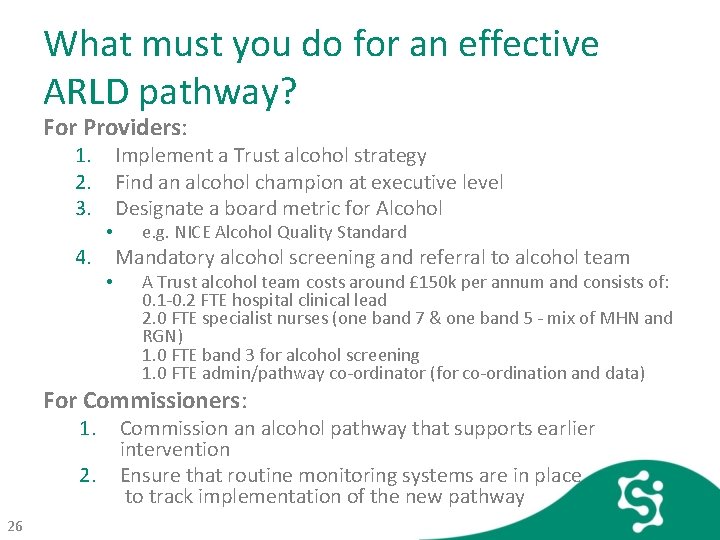
What must you do for an effective ARLD pathway? For Providers: 1. 2. 3. 4. • • Implement a Trust alcohol strategy Find an alcohol champion at executive level Designate a board metric for Alcohol e. g. NICE Alcohol Quality Standard Mandatory alcohol screening and referral to alcohol team A Trust alcohol team costs around £ 150 k per annum and consists of: 0. 1 -0. 2 FTE hospital clinical lead 2. 0 FTE specialist nurses (one band 7 & one band 5 - mix of MHN and RGN) 1. 0 FTE band 3 for alcohol screening 1. 0 FTE admin/pathway co-ordinator (for co-ordination and data) For Commissioners: 1. 2. 26 Commission an alcohol pathway that supports earlier intervention Ensure that routine monitoring systems are in place to track implementation of the new pathway
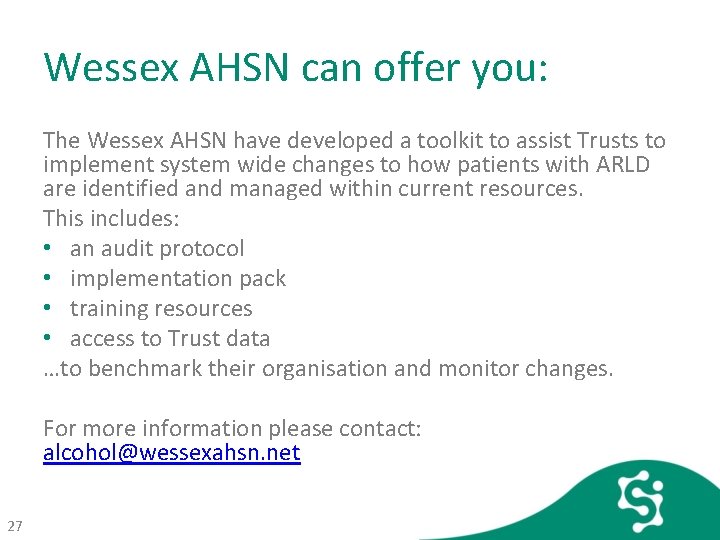
Wessex AHSN can offer you: The Wessex AHSN have developed a toolkit to assist Trusts to implement system wide changes to how patients with ARLD are identified and managed within current resources. This includes: • an audit protocol • implementation pack • training resources • access to Trust data …to benchmark their organisation and monitor changes. For more information please contact: alcohol@wessexahsn. net 27

Contacts & Acknowledgements Data and analysis produced by: Dr Brad Keogh brad. keogh@soton. ac. uk @Keogh. Data Wessex Centre for Implementation Science Faculty of Health Sciences University of Southampton Wessex. CIS@soton. ac. uk @Wessex. CIS On behalf of Wessex Academic Health Science Network: alcohol@wessexahsn. net @Wessex. AHSN 28 With thanks to: • Dr Julia Sinclair • Dr Leonie Grellier • Cathy Rule • Kathy Wallis • Prof Paul Roderick • Dr Harriet Gordon • Dr Richard Aspinall • Dr Safa Al-Shamma • Dr Nick Sharer • Matt Winker • Caroline Powell • Bill Gillespie
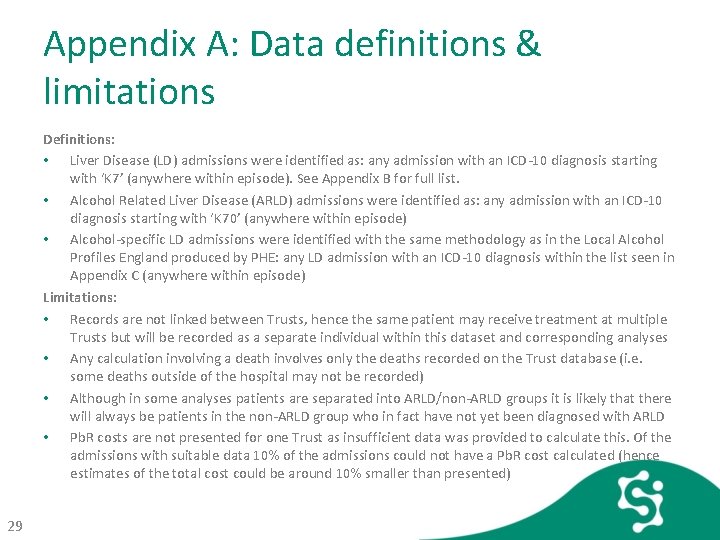
Appendix A: Data definitions & limitations Definitions: • Liver Disease (LD) admissions were identified as: any admission with an ICD-10 diagnosis starting with ‘K 7’ (anywhere within episode). See Appendix B for full list. • Alcohol Related Liver Disease (ARLD) admissions were identified as: any admission with an ICD-10 diagnosis starting with ‘K 70’ (anywhere within episode) • Alcohol-specific LD admissions were identified with the same methodology as in the Local Alcohol Profiles England produced by PHE: any LD admission with an ICD-10 diagnosis within the list seen in Appendix C (anywhere within episode) Limitations: • Records are not linked between Trusts, hence the same patient may receive treatment at multiple Trusts but will be recorded as a separate individual within this dataset and corresponding analyses • Any calculation involving a death involves only the deaths recorded on the Trust database (i. e. some deaths outside of the hospital may not be recorded) • Although in some analyses patients are separated into ARLD/non-ARLD groups it is likely that there will always be patients in the non-ARLD group who in fact have not yet been diagnosed with ARLD • Pb. R costs are not presented for one Trust as insufficient data was provided to calculate this. Of the admissions with suitable data 10% of the admissions could not have a Pb. R cost calculated (hence estimates of the total cost could be around 10% smaller than presented) 29

Appendix B: ICD-10 Liver Disease diagnosis codes (1/3) ICD-10 code Description K 70 Alcoholic liver disease K 70. 0 Alcoholic fatty liver K 70. 1 Alcoholic hepatitis K 70. 2 Alcoholic fibrosis and sclerosis of liver K 70. 3 Alcoholic cirrhosis of liver K 70. 4 Alcoholic hepatic failure K 70. 9 Alcoholic liver disease, unspecified K 71 Toxic liver disease K 71. 0 Toxic liver disease with cholestasis K 71. 1 Toxic liver disease with hepatic necrosis K 71. 2 Toxic liver disease with acute hepatitis K 71. 3 Toxic liver disease with chronic persistent hepatitis K 71. 4 Toxic liver disease with chronic lobular hepatitis K 71. 5 Toxic liver disease with chronic active hepatitis K 71. 6 Toxic liver disease with hepatitis, not elsewhere classified K 71. 7 Toxic liver disease with fibrosis and cirrhosis of liver K 71. 8 Toxic liver disease with other disorders of liver K 71. 9 Toxic liver disease, unspecified K 72 Hepatic failure, not elsewhere classified K 72. 0 Acute and subacute hepatic failure K 72. 1 Chronic hepatic failure K 72. 9 Hepatic failure, unspecified Source: WHO ICD-10 classifications http: //apps. who. int/classifications/icd 10/browse/2016/en#/K 70 -K 77 30
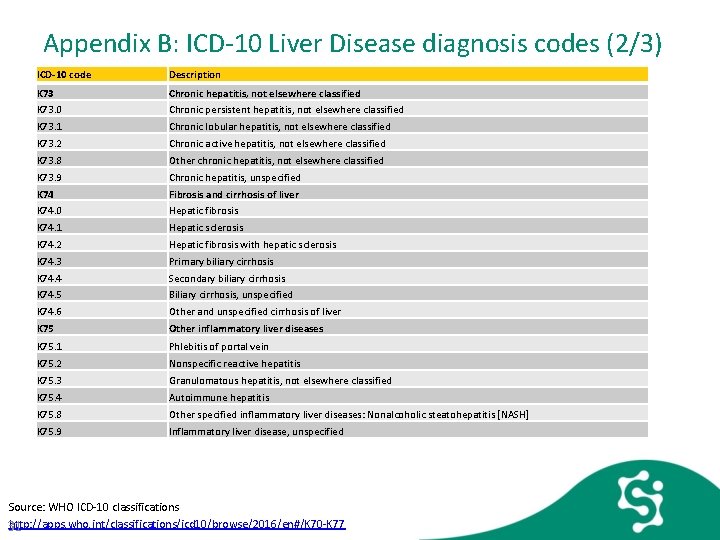
Appendix B: ICD-10 Liver Disease diagnosis codes (2/3) ICD-10 code Description K 73 Chronic hepatitis, not elsewhere classified K 73. 0 Chronic persistent hepatitis, not elsewhere classified K 73. 1 Chronic lobular hepatitis, not elsewhere classified K 73. 2 Chronic active hepatitis, not elsewhere classified K 73. 8 Other chronic hepatitis, not elsewhere classified K 73. 9 Chronic hepatitis, unspecified K 74 Fibrosis and cirrhosis of liver K 74. 0 Hepatic fibrosis K 74. 1 Hepatic sclerosis K 74. 2 Hepatic fibrosis with hepatic sclerosis K 74. 3 Primary biliary cirrhosis K 74. 4 Secondary biliary cirrhosis K 74. 5 Biliary cirrhosis, unspecified K 74. 6 Other and unspecified cirrhosis of liver K 75 Other inflammatory liver diseases K 75. 1 Phlebitis of portal vein K 75. 2 Nonspecific reactive hepatitis K 75. 3 Granulomatous hepatitis, not elsewhere classified K 75. 4 Autoimmune hepatitis K 75. 8 Other specified inflammatory liver diseases: Nonalcoholic steatohepatitis [NASH] K 75. 9 Inflammatory liver disease, unspecified Source: WHO ICD-10 classifications http: //apps. who. int/classifications/icd 10/browse/2016/en#/K 70 -K 77 31

Appendix B: ICD-10 Liver Disease diagnosis codes (3/3) ICD-10 code Description K 76 Other diseases of liver K 76. 0 Fatty (change of) liver, not elsewhere classified (Non-alcoholic fatty liver disease [NAFLD]) K 76. 1 Chronic passive congestion of liver K 76. 2 Central haemorrhagic necrosis of liver K 76. 3 Infarction of liver K 76. 4 Peliosis hepatis K 76. 5 Hepatic veno-occlusive disease K 76. 6 Portal hypertension K 76. 7 Hepatorenal syndrome K 76. 8 Other specified diseases of liver K 76. 9 Liver disease, unspecified K 77* Liver disorders in diseases classified elsewhere K 77. 0* Liver disorders in infectious and parasitic diseases classified elsewhere K 77. 8* Liver disorders in other diseases classified elsewhere Source: WHO ICD-10 classifications http: //apps. who. int/classifications/icd 10/browse/2016/en#/K 70 -K 77 32
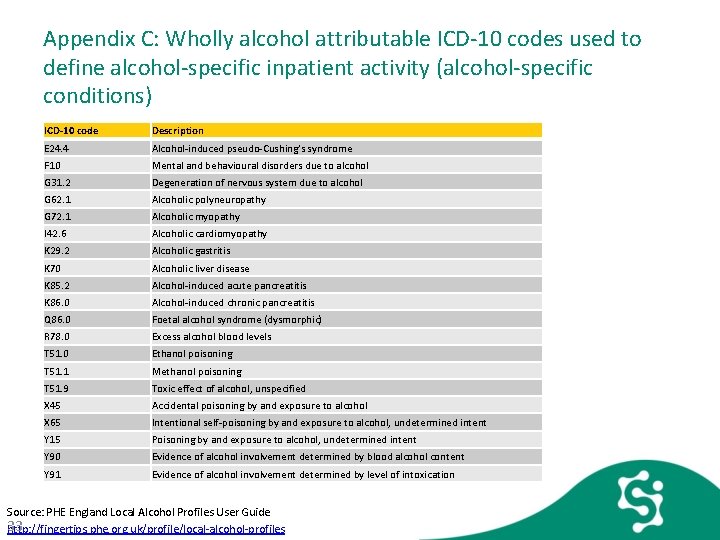
Appendix C: Wholly alcohol attributable ICD-10 codes used to define alcohol-specific inpatient activity (alcohol-specific conditions) ICD-10 code Description E 24. 4 Alcohol-induced pseudo-Cushing’s syndrome F 10 Mental and behavioural disorders due to alcohol G 31. 2 Degeneration of nervous system due to alcohol G 62. 1 Alcoholic polyneuropathy G 72. 1 Alcoholic myopathy I 42. 6 Alcoholic cardiomyopathy K 29. 2 Alcoholic gastritis K 70 Alcoholic liver disease K 85. 2 Alcohol-induced acute pancreatitis K 86. 0 Alcohol-induced chronic pancreatitis Q 86. 0 Foetal alcohol syndrome (dysmorphic) R 78. 0 Excess alcohol blood levels T 51. 0 Ethanol poisoning T 51. 1 Methanol poisoning T 51. 9 Toxic effect of alcohol, unspecified X 45 Accidental poisoning by and exposure to alcohol X 65 Intentional self-poisoning by and exposure to alcohol, undetermined intent Y 15 Poisoning by and exposure to alcohol, undetermined intent Y 90 Evidence of alcohol involvement determined by blood alcohol content Y 91 Evidence of alcohol involvement determined by level of intoxication Source: PHE England Local Alcohol Profiles User Guide 33 http: //fingertips. phe. org. uk/profile/local-alcohol-profiles

Appendix D: Estimating early intervention cost avoidance in Wessex (1/7) Introduction The estimation of ‘early intervention cost avoidance in Wessex’ was calculated using data from a variety of sources: • Wessex AHSN Acute Liver Disease database • “Alcohol-specific activity in hospitals in England” (2015), Nuffield Trust report • NHS reference costs 2014 to 2015* • “The Epidemiology of Alcoholic Liver Disease” (2004), Mann R. E. , Smart, R. G. & Govoni, R. , Publication from the National Institute on Alcohol Abuse and Alcoholism The method and assumptions made in the calculations are outlined in this appendix. The inputs and assumptions within the cost estimation model are summarised in the following slide with further detail surrounding the method following. All cost estimates are at 2014/15 values. 34 *Available here: https: //www. gov. uk/government/collections/nhs-reference-costs
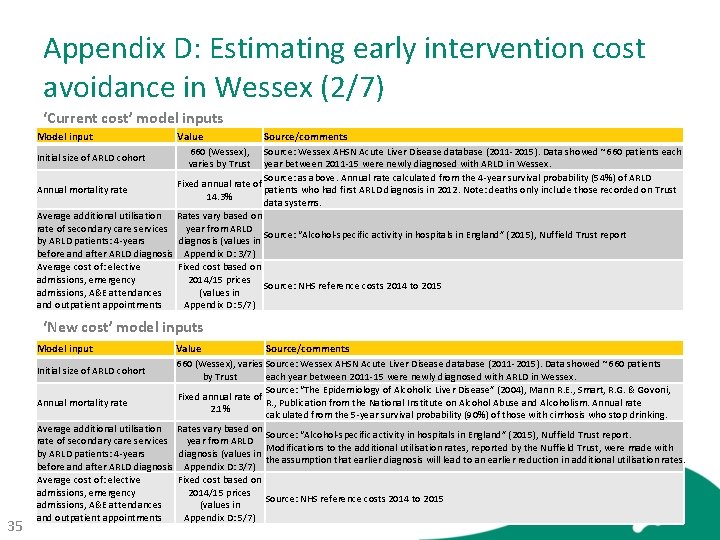
Appendix D: Estimating early intervention cost avoidance in Wessex (2/7) ‘Current cost’ model inputs Model input Value 660 (Wessex), varies by Trust Source/comments Source: Wessex AHSN Acute Liver Disease database (2011 -2015). Data showed ~660 patients each Initial size of ARLD cohort year between 2011 -15 were newly diagnosed with ARLD in Wessex. Source: as above. Annual rate calculated from the 4 -year survival probability (54%) of ARLD Fixed annual rate of Annual mortality rate patients who had first ARLD diagnosis in 2012. Note: deaths only include those recorded on Trust 14. 3% data systems. Average additional utilisation Rates vary based on rate of secondary care services year from ARLD Source: “Alcohol-specific activity in hospitals in England” (2015), Nuffield Trust report by ARLD patients: 4 -years diagnosis (values in before and after ARLD diagnosis Appendix D: 3/7) Average cost of: elective Fixed cost based on admissions, emergency 2014/15 prices Source: NHS reference costs 2014 to 2015 admissions, A&E attendances (values in and outpatient appointments Appendix D: 5/7) ‘New cost’ model inputs Model input 35 Value Source/comments 660 (Wessex), varies Source: Wessex AHSN Acute Liver Disease database (2011 -2015). Data showed ~660 patients Initial size of ARLD cohort by Trust each year between 2011 -15 were newly diagnosed with ARLD in Wessex. Source: “The Epidemiology of Alcoholic Liver Disease” (2004), Mann R. E. , Smart, R. G. & Govoni, Fixed annual rate of Annual mortality rate R. , Publication from the National Institute on Alcohol Abuse and Alcoholism. Annual rate 2. 1% calculated from the 5 -year survival probability (90%) of those with cirrhosis who stop drinking. Average additional utilisation Rates vary based on Source: “Alcohol-specific activity in hospitals in England” (2015), Nuffield Trust report. rate of secondary care services year from ARLD Modifications to the additional utilisation rates, reported by the Nuffield Trust, were made with by ARLD patients: 4 -years diagnosis (values in the assumption that earlier diagnosis will lead to an earlier reduction in additional utilisation rates. before and after ARLD diagnosis Appendix D: 3/7) Average cost of: elective Fixed cost based on admissions, emergency 2014/15 prices Source: NHS reference costs 2014 to 2015 admissions, A&E attendances (values in and outpatient appointments Appendix D: 5/7)
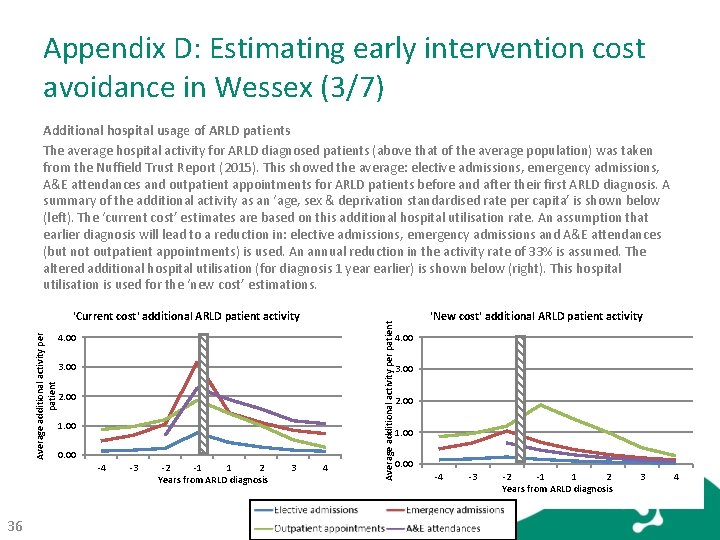
Appendix D: Estimating early intervention cost avoidance in Wessex (3/7) Average additional activity per patient 'Current cost' additional ARLD patient activity 4. 00 3. 00 2. 00 1. 00 0. 00 -4 36 -3 -2 -1 1 2 Years from ARLD diagnosis 3 4 Average additional activity per patient Additional hospital usage of ARLD patients The average hospital activity for ARLD diagnosed patients (above that of the average population) was taken from the Nuffield Trust Report (2015). This showed the average: elective admissions, emergency admissions, A&E attendances and outpatient appointments for ARLD patients before and after their first ARLD diagnosis. A summary of the additional activity as an ‘age, sex & deprivation standardised rate per capita’ is shown below (left). The ‘current cost’ estimates are based on this additional hospital utilisation rate. An assumption that earlier diagnosis will lead to a reduction in: elective admissions, emergency admissions and A&E attendances (but not outpatient appointments) is used. An annual reduction in the activity rate of 33% is assumed. The altered additional hospital utilisation (for diagnosis 1 year earlier) is shown below (right). This hospital utilisation is used for the ‘new cost’ estimations. 'New cost' additional ARLD patient activity 4. 00 3. 00 2. 00 1. 00 0. 00 -4 -3 -2 -1 1 2 Years from ARLD diagnosis 3 4
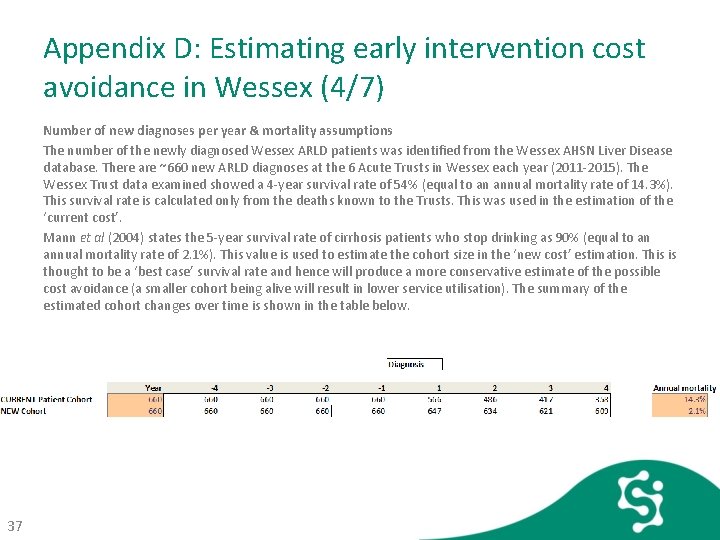
Appendix D: Estimating early intervention cost avoidance in Wessex (4/7) Number of new diagnoses per year & mortality assumptions The number of the newly diagnosed Wessex ARLD patients was identified from the Wessex AHSN Liver Disease database. There are ~660 new ARLD diagnoses at the 6 Acute Trusts in Wessex each year (2011 -2015). The Wessex Trust data examined showed a 4 -year survival rate of 54% (equal to an annual mortality rate of 14. 3%). This survival rate is calculated only from the deaths known to the Trusts. This was used in the estimation of the ‘current cost’. Mann et al (2004) states the 5 -year survival rate of cirrhosis patients who stop drinking as 90% (equal to an annual mortality rate of 2. 1%). This value is used to estimate the cohort size in the ‘new cost’ estimation. This is thought to be a ‘best case’ survival rate and hence will produce a more conservative estimate of the possible cost avoidance (a smaller cohort being alive will result in lower service utilisation). The summary of the estimated cohort changes over time is shown in the table below. 37
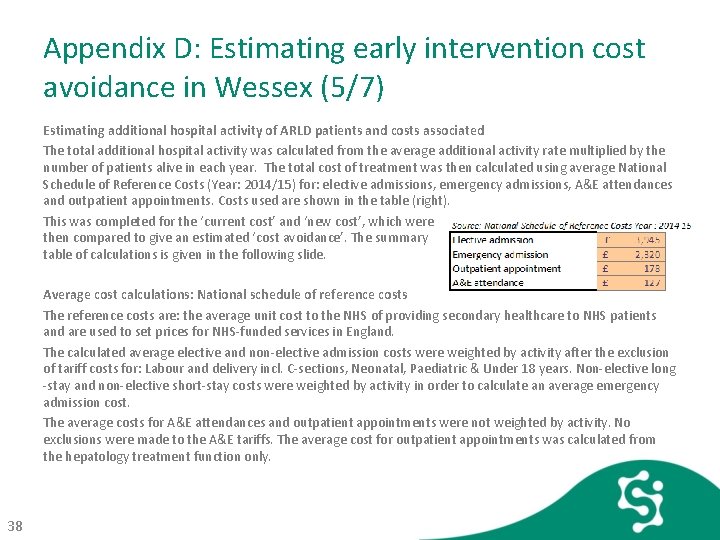
Appendix D: Estimating early intervention cost avoidance in Wessex (5/7) Estimating additional hospital activity of ARLD patients and costs associated The total additional hospital activity was calculated from the average additional activity rate multiplied by the number of patients alive in each year. The total cost of treatment was then calculated using average National Schedule of Reference Costs (Year: 2014/15) for: elective admissions, emergency admissions, A&E attendances and outpatient appointments. Costs used are shown in the table (right). This was completed for the ‘current cost’ and ‘new cost’, which were then compared to give an estimated ‘cost avoidance’. The summary table of calculations is given in the following slide. Average cost calculations: National schedule of reference costs The reference costs are: the average unit cost to the NHS of providing secondary healthcare to NHS patients and are used to set prices for NHS-funded services in England. The calculated average elective and non-elective admission costs were weighted by activity after the exclusion of tariff costs for: Labour and delivery incl. C-sections, Neonatal, Paediatric & Under 18 years. Non-elective long -stay and non-elective short-stay costs were weighted by activity in order to calculate an average emergency admission cost. The average costs for A&E attendances and outpatient appointments were not weighted by activity. No exclusions were made to the A&E tariffs. The average cost for outpatient appointments was calculated from the hepatology treatment function only. 38
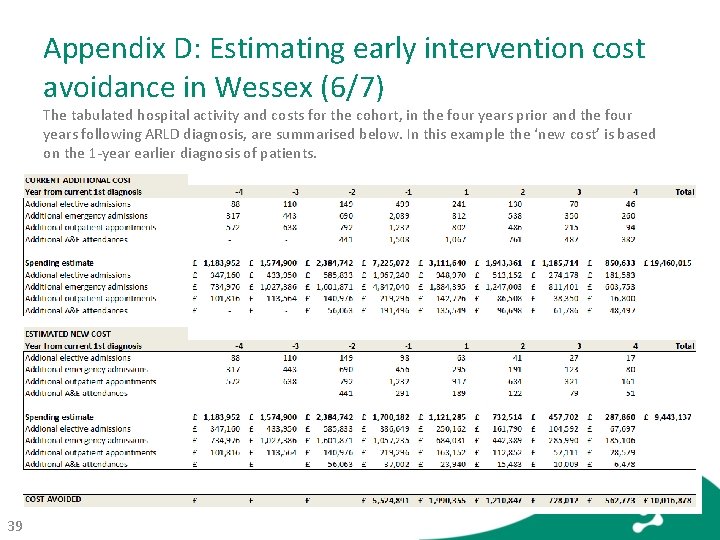
Appendix D: Estimating early intervention cost avoidance in Wessex (6/7) The tabulated hospital activity and costs for the cohort, in the four years prior and the four years following ARLD diagnosis, are summarised below. In this example the ‘new cost’ is based on the 1 -year earlier diagnosis of patients. 39
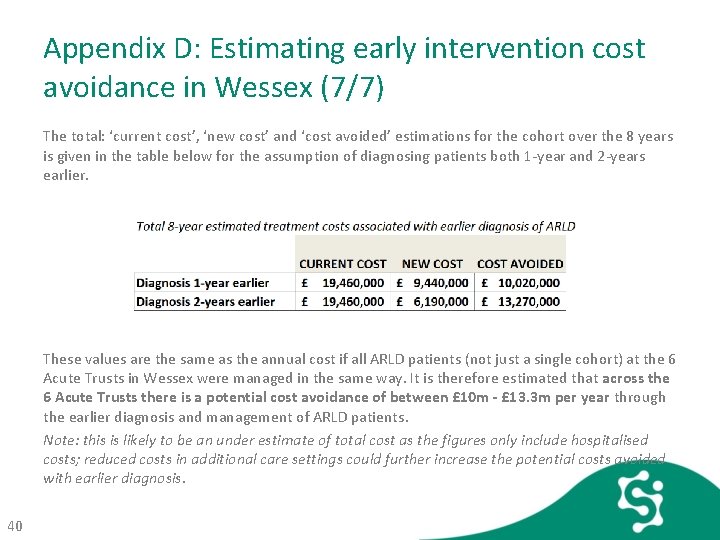
Appendix D: Estimating early intervention cost avoidance in Wessex (7/7) The total: ‘current cost’, ‘new cost’ and ‘cost avoided’ estimations for the cohort over the 8 years is given in the table below for the assumption of diagnosing patients both 1 -year and 2 -years earlier. These values are the same as the annual cost if all ARLD patients (not just a single cohort) at the 6 Acute Trusts in Wessex were managed in the same way. It is therefore estimated that across the 6 Acute Trusts there is a potential cost avoidance of between £ 10 m - £ 13. 3 m per year through the earlier diagnosis and management of ARLD patients. Note: this is likely to be an under estimate of total cost as the figures only include hospitalised costs; reduced costs in additional care settings could further increase the potential costs avoided with earlier diagnosis. 40
- Slides: 40