
Treatment modalities to support soft tissue repair LO

- Slides: 23
Treatment modalities to support soft tissue repair LO 1: Understand treatments to support soft tissue repair
Assessment criteria • Explain the aims of treatments to support soft tissue repair during the acute stage of injury • Describe treatment protocols to use with clients during the acute stage of injury • Explain the aims of treatments to support soft tissue repair during sub-acute stage of injury • Explain which treatment options support the sub-acute stage of injury • Explain the aims of treatments to support soft tissue repair during the chronic stage of injury • Explain which treatment options support the chronic stage of injury
Process of soft tissue repair • Soft tissue will prepare without intervention • The aim of sports massage is to improve the process • The timescale for healing of tissue will vary • Healing time will be affected by: § The severity of the injury § The treatment provided to care for the injury
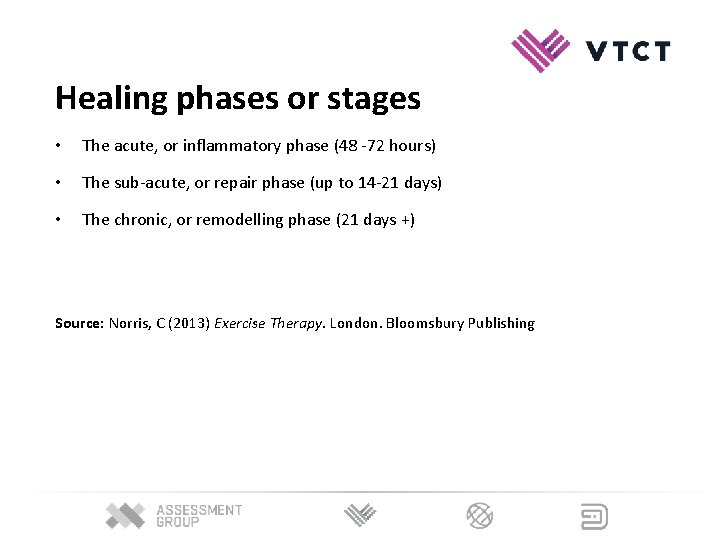
Healing phases or stages • The acute, or inflammatory phase (48 -72 hours) • The sub-acute, or repair phase (up to 14 -21 days) • The chronic, or remodelling phase (21 days +) Source: Norris, C (2013) Exercise Therapy. London. Bloomsbury Publishing
Activity Describe the following stages of healing: • The acute, or inflammatory phase • The sub-acute, or repair phase • The chronic, or remodelling phase
Acute phase • Tissues are damaged • Tissues are reacting to the damage (muscle, connective tissue, lymphatic and blood capillaries, sensory and motor nerves) • Bleeding, swelling, inflammation, heat, redness • Aim to reduce any further damage • Stop activity!
Tissue response to Injury • Local tissues react to the damage • Vasoconstriction - to reduce blood flow and minimise blood loss • Reduced blood flow and oxygen to other cells causes secondary cell death. • Platelets activated - to create a blood clot (thrombin) to catch debris and bacteria • Histamine release by dying cells - to dilate the undamaged blood and lymphatic vessels and increase permeability of cell membrane • Muscle spasm to restrict movement of the local tissues • Lymphocytes directed to injured area to clear waste
Treatment aims Acute phase • Haemostasis • Protect against further injury • Immobilise if necessary • Prevent excessive oedema • Pain relief • Reduce swelling • Reduce muscle spasm • Reduce bleeding • Minimise secondary cell death Please note: Injuries in the ACUTE stage are contra-indicated and require referral.
Acute phase treatment P R I C E • Protect § Referral for diagnosis § Support injured limb § First aid • Rest • Ice • Compress • Elevate • Mobilise within pain free range Only cold therapy during the acute stage to limit blood flow to the area.
Sub acute phase When healing tissues begin to form and there is no further bleeding or swelling. • Tissue regrowth around the area § Collagen fibres are laid down to form scar tissue • New lymphatic and blood vessels form • Blood vessels - to deliver oxygen and nutrients to aid healing • Lymphatic vessels - drainage system, to reduce oedema
Scar tissue • Collagen fibres are orientated along lines of stress • Haphazard, disorganised formation of fibres can lead to suboptimal repair • Tissues must align with original tissue for optimal functioning • Tissues have to be stressed slightly to enable this – progressive movement and exercise at the correct level (Davis’s law)
Treatment aims Sub-acute stage • To improve proprioception and restore neurological function • To increase ROM and flexibility • To reduce pain • To improve mobility and restore range of motion • To restore strength • To improve blood flow to damaged tissues • To minimise scar tissue formation • To encourage blood flow and lymphatic drainage Formation of collagen fibres can be manipulated to optimise scar tissue formation.
Sub-acute phase treatment • Massage – some techniques – to client tolerance • Mobilisation techniques • Heat • Ice • Gentle stretching • Muscle Energy Techniques • Prescribed medications (NSAIDS)
Mobilisation methods 1. Passive - therapist physically assists the client to move injured limb 2. Active assisted - the client actively moves the affected limb with the aid of an external support/aid 3. Active - the client moves the affected limb using a non-weight bearing exercise - pain free and tolerable range
Chronic phase • Scar tissue contracts and strengthens at injury site • Progressive movement and exercise essential to provide stress to tissue and enable functional healing • Graded rehabilitation specific to the damaged structure • Tissue can be virtually healed and pain free, but is susceptible to further injury, if stress excessive (e. g. sport)
Chronic phase • To restore functional capabilities of ligaments, tendons, muscles and other tissues • To facilitate maturation of collagen • To reduce adhesions • To regain and improve mobility and flexibility • To improve proprioception • To regain strength • To facilitate sports specific function
Chronic phase treatments • Massage • Stretching techniques • Proprioceptive neuromuscular facilitation (PNF) • Soft tissue release (STR) • Heat • Progressive strength-building exercises • Functional/sport specific rehabilitation • Frictions (last resort – if nothing else has worked!)
Chronic phase treatments • Static stretching § • • Active and passive Dynamic § Active § Ballistic Pre-contraction § PNF § MET
Methods for developing strength • Resisted exercises using progressive overload • Static (isometric) § Good for stabilisation § Can be used in the early stages of healing • Concentric § Shortening of muscle fibres § Used in the mid an late stages of rehab
Methods for developing strength • Eccentric exercises § Lengthening contractions can begin when concentric contractions are pain free § Concentric-eccentric combinations can be integrated • Late stage exercises need to be developed to be: § Functional § Individual § Sport specific
Activity Discuss the appropriateness of various treatments for each stage of: • The acute, or inflammatory phase • The sub-acute, or repair phase • The chronic, or remodelling phase Techniques: • PRICE • HEAT • Effleurage. Tapotement. Petrissage • Assisted stretches. Static stretches. PNF stretches • Connective tissue massage. Soft tissue release • Frictions. Trigger points. Muscle energy techniques
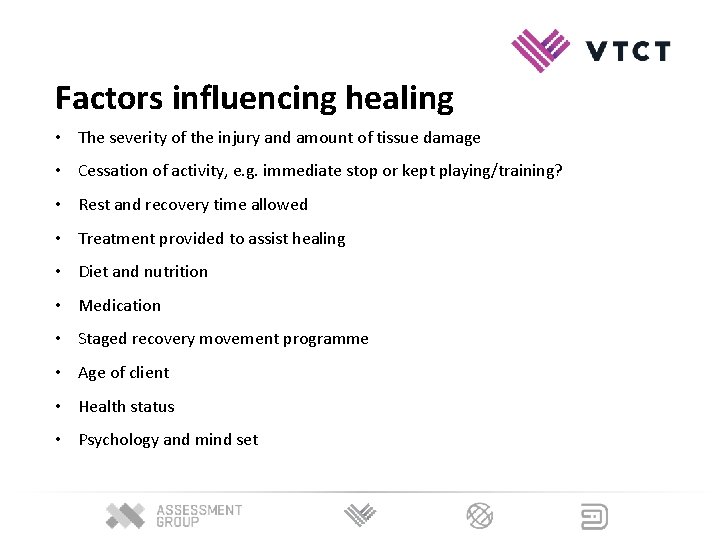
Factors influencing healing • The severity of the injury and amount of tissue damage • Cessation of activity, e. g. immediate stop or kept playing/training? • Rest and recovery time allowed • Treatment provided to assist healing • Diet and nutrition • Medication • Staged recovery movement programme • Age of client • Health status • Psychology and mind set
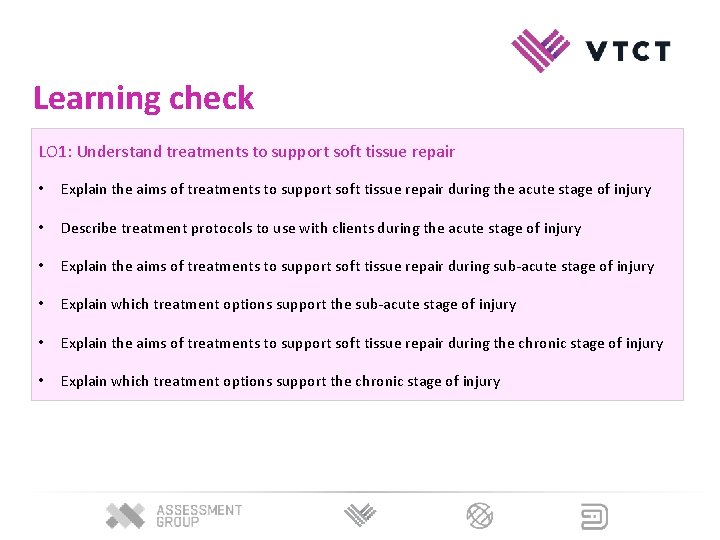
Learning check LO 1: Understand treatments to support soft tissue repair • Explain the aims of treatments to support soft tissue repair during the acute stage of injury • Describe treatment protocols to use with clients during the acute stage of injury • Explain the aims of treatments to support soft tissue repair during sub-acute stage of injury • Explain which treatment options support the sub-acute stage of injury • Explain the aims of treatments to support soft tissue repair during the chronic stage of injury • Explain which treatment options support the chronic stage of injury