
Treatment Membranes Matt Bower DWQR Risk Assessment Training
Treatment – Membranes Matt Bower DWQR Risk Assessment Training 2018
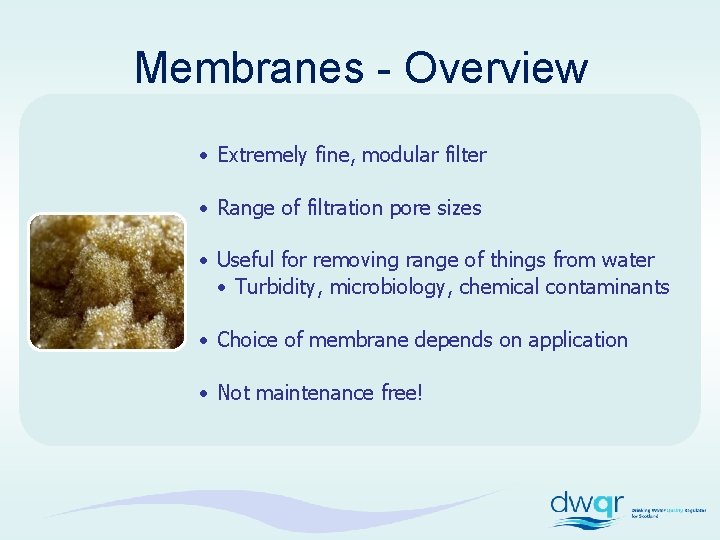
Membranes - Overview • Extremely fine, modular filter • Range of filtration pore sizes • Useful for removing range of things from water • Turbidity, microbiology, chemical contaminants • Choice of membrane depends on application • Not maintenance free!
Membranes - Overview

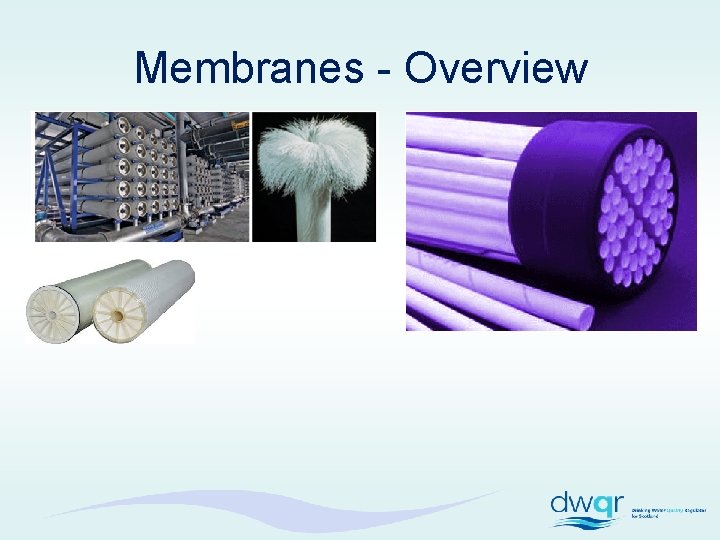
Membranes - Overview a) Plate and frame / flat sheet c) Spiral Wound b) Tubular d) Hollow Fibre
Membranes - Overview
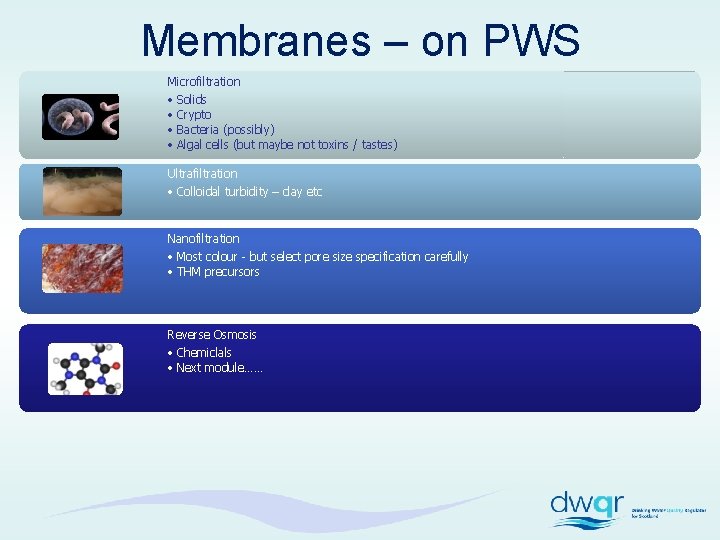
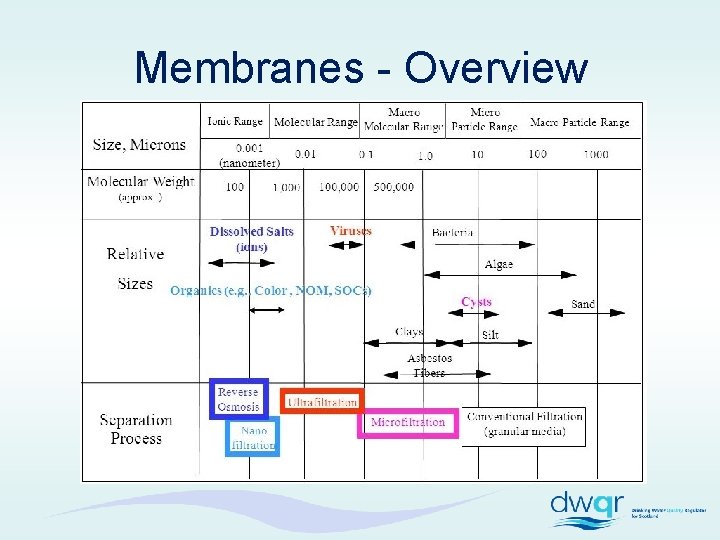
Membranes – on PWS Microfiltration • Solids • Crypto • Bacteria (possibly) • Algal cells (but maybe not toxins / tastes) Ultrafiltration • Colloidal turbidity – clay etc Nanofiltration • Most colour - but select pore size specification carefully • THM precursors Reverse Osmosis • Chemiclals • Next module……
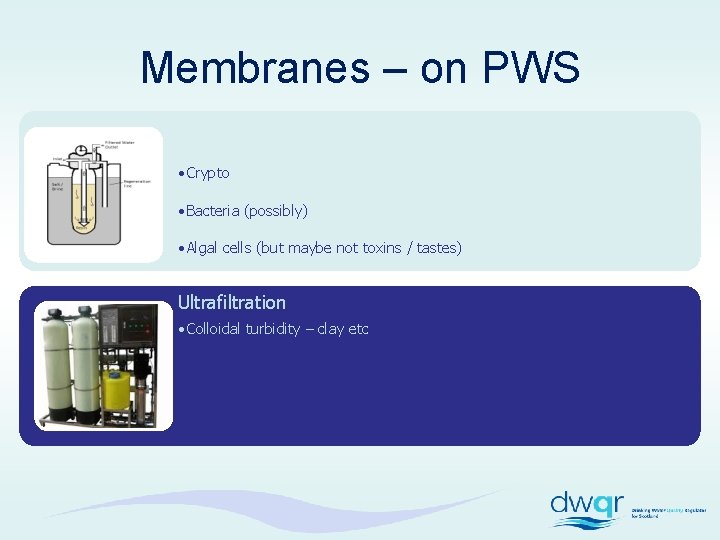
Membranes – on PWS • Crypto • Bacteria (possibly) • Algal cells (but maybe not toxins / tastes) Ultrafiltration • Colloidal turbidity – clay etc
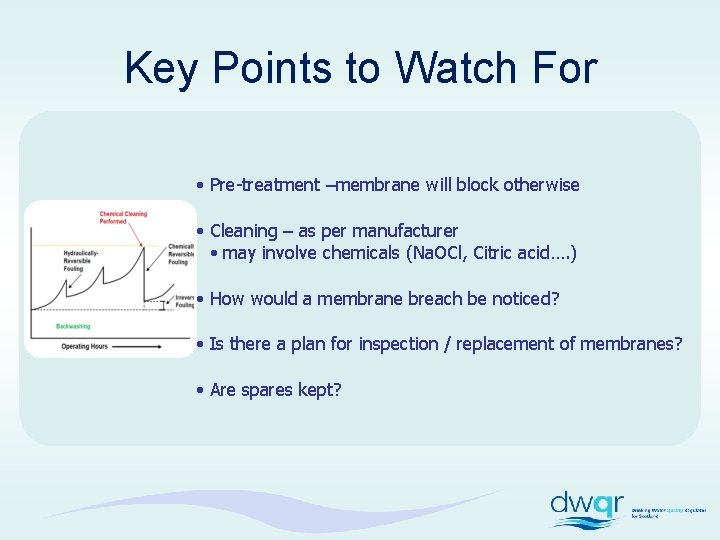
Key Points to Watch For • Pre-treatment –membrane will block otherwise • Cleaning – as per manufacturer • may involve chemicals (Na. OCl, Citric acid…. ) • How would a membrane breach be noticed? • Is there a plan for inspection / replacement of membranes? • Are spares kept?
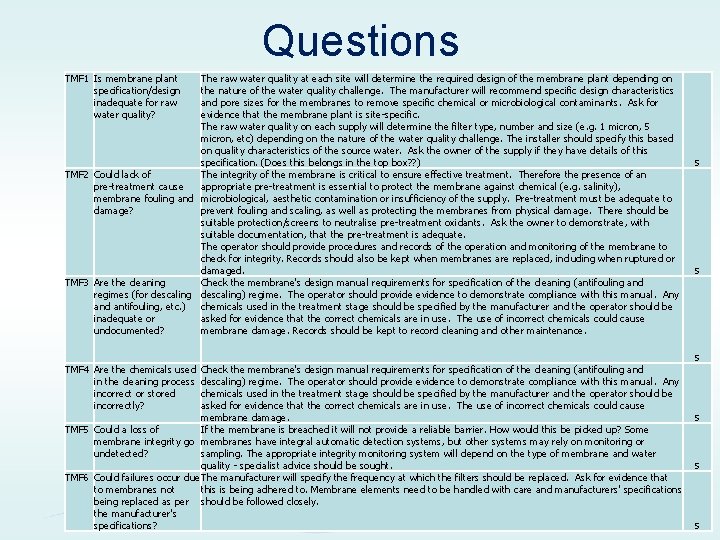
Questions TMF 1 Is membrane plant specification/design inadequate for raw water quality? The raw water quality at each site will determine the required design of the membrane plant depending on the nature of the water quality challenge. The manufacturer will recommend specific design characteristics and pore sizes for the membranes to remove specific chemical or microbiological contaminants. Ask for evidence that the membrane plant is site-specific. The raw water quality on each supply will determine the filter type, number and size (e. g. 1 micron, 5 micron, etc) depending on the nature of the water quality challenge. The installer should specify this based on quality characteristics of the source water. Ask the owner of the supply if they have details of this specification. (Does this belongs in the top box? ? ) TMF 2 Could lack of The integrity of the membrane is critical to ensure effective treatment. Therefore the presence of an pre-treatment cause appropriate pre-treatment is essential to protect the membrane against chemical (e. g. salinity), membrane fouling and microbiological, aesthetic contamination or insufficiency of the supply. Pre-treatment must be adequate to damage? prevent fouling and scaling, as well as protecting the membranes from physical damage. There should be suitable protection/screens to neutralise pre-treatment oxidants. Ask the owner to demonstrate, with suitable documentation, that the pre-treatment is adequate. The operator should provide procedures and records of the operation and monitoring of the membrane to check for integrity. Records should also be kept when membranes are replaced, including when ruptured or damaged. TMF 3 Are the cleaning Check the membrane's design manual requirements for specification of the cleaning (antifouling and regimes (for descaling) regime. The operator should provide evidence to demonstrate compliance with this manual. Any and antifouling, etc. ) chemicals used in the treatment stage should be specified by the manufacturer and the operator should be inadequate or asked for evidence that the correct chemicals are in use. The use of incorrect chemicals could cause undocumented? membrane damage. Records should be kept to record cleaning and other maintenance. TMF 4 Are the chemicals used in the cleaning process incorrect or stored incorrectly? Check the membrane's design manual requirements for specification of the cleaning (antifouling and descaling) regime. The operator should provide evidence to demonstrate compliance with this manual. Any chemicals used in the treatment stage should be specified by the manufacturer and the operator should be asked for evidence that the correct chemicals are in use. The use of incorrect chemicals could cause membrane damage. TMF 5 Could a loss of If the membrane is breached it will not provide a reliable barrier. How would this be picked up? Some membrane integrity go membranes have integral automatic detection systems, but other systems may rely on monitoring or undetected? sampling. The appropriate integrity monitoring system will depend on the type of membrane and water quality - specialist advice should be sought. TMF 6 Could failures occur due The manufacturer will specify the frequency at which the filters should be replaced. Ask for evidence that to membranes not this is being adhered to. Membrane elements need to be handled with care and manufacturers' specifications being replaced as per should be followed closely. the manufacturer's specifications? 5 5 5
- Slides: 9