
Treatment for Anal fistula Dr Wong Siu Wang
- Slides: 37
Treatment for Anal fistula Dr. Wong Siu Wang North District Hospital Joint Hospital Surgical Grand Round Sept 2006
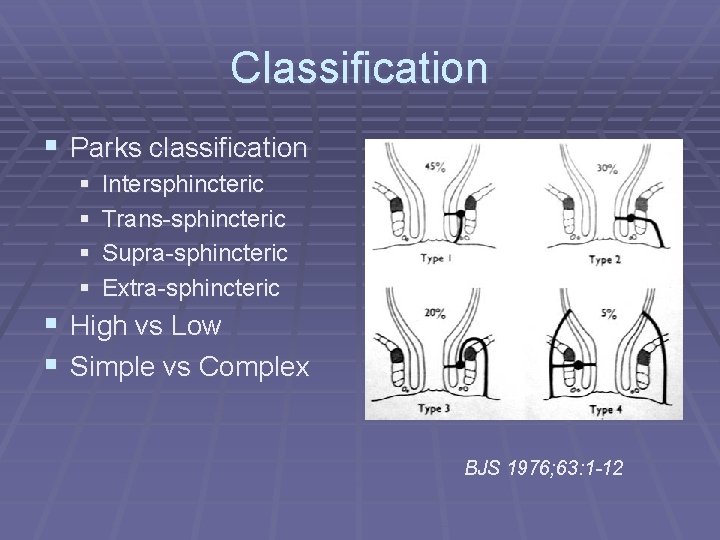
Classification § Parks classification § § § Intersphincteric Trans-sphincteric Supra-sphincteric Extra-sphincteric High vs Low Simple vs Complex BJS 1976; 63: 1 -12
Etiology § Crytogenic § Inflammatory bowel disease § Malignancy § Tuberculosis § Pelvic sepsis
Etiology § Crytogenic § Inflammatory bowel disease § Malignancy § Tuberculosis § Pelvic sepsis
Treatment of Anal fistula 1. Fistulotomy 2. Fistulectomy 3. Advancement flaps 4. Seton (loose, cutting, chemical) 5. Fibrin glue 6. Radiofrequency
1. Fistulotomy § Standard treatment for low type fistula § Recurrence rate ~5% - 10% § Minor incontinence rate ~6% - 26% § Stage fistulotomy for high type fistula § Recurrence rate ~5% – 8% § Minor incontinence rate ~50% BJS 1995; 82: 895 -7 BJS 1991; 78: 1159 -61
Fistulotomy (New Modification) § Marsupialisation § Suturing the divided wound edge to the edges of the curetted fibrous track § Results in smaller wound and faster healing Colorectal Dis 2006; 8: 11 -4 BJS 1998; 85: 105 -107
2. Fistulectomy § Argument against fistulectomy § RCT of Fistulectomy vs Fistulotomy § Greater tissue loss leads to delayed healing § Similar recurrence rates BJS 1985; 55: 23 -7
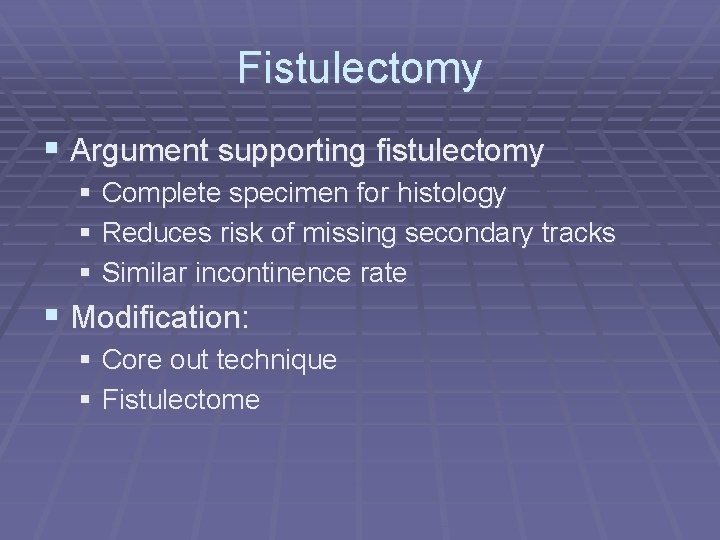
Fistulectomy § Argument supporting fistulectomy § Complete specimen for histology § Reduces risk of missing secondary tracks § Similar incontinence rate § Modification: § Core out technique § Fistulectome
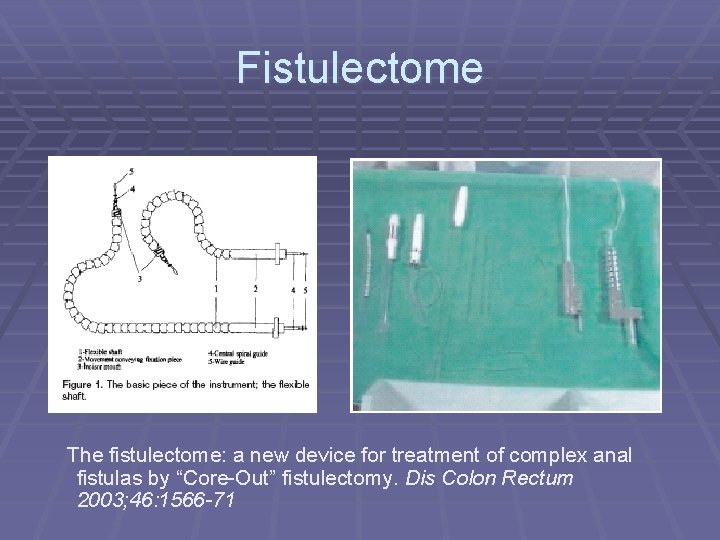
Fistulectome The fistulectome: a new device for treatment of complex anal fistulas by “Core-Out” fistulectomy. Dis Colon Rectum 2003; 46: 1566 -71
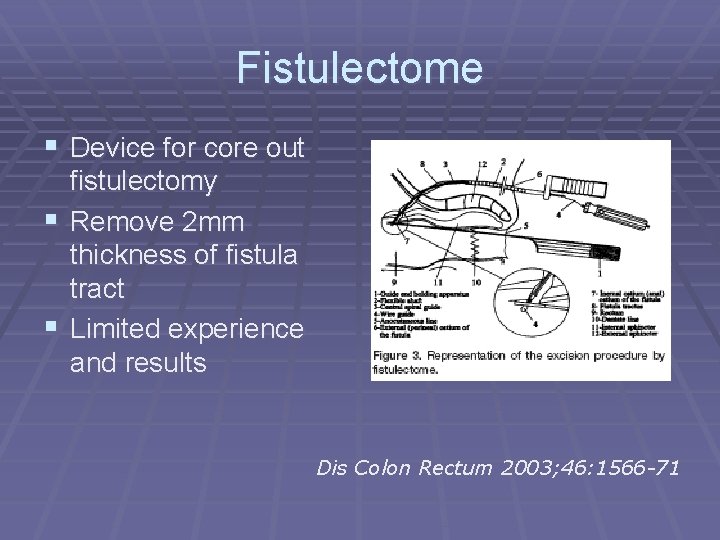
Fistulectome § Device for core out fistulectomy § Remove 2 mm thickness of fistula tract § Limited experience and results Dis Colon Rectum 2003; 46: 1566 -71
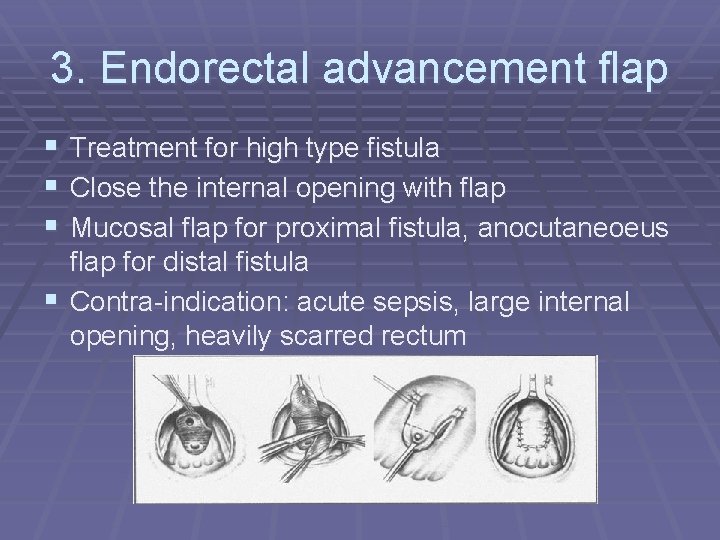
3. Endorectal advancement flap § Treatment for high type fistula § Close the internal opening with flap § Mucosal flap for proximal fistula, anocutaneoeus flap for distal fistula § Contra-indication: acute sepsis, large internal opening, heavily scarred rectum
Endorectal advancement flap § Results in high type fistula § Heterogenous, depend on length of FU § Recurrence rate ~20% - 60% § Incontinence rate ~18. 7% Int J Colorectal Dis 1994; 9: 153 -7 Int J Colorectal Dis 2006 Mar 15
4. Seton i. Loose Seton ii. Cutting Seton iii. Chemical Seton
i. Loose Seton § Drainage of sepsis before definitive treatment (eg. Staged fistulotomy) § Primary treatment for complex fistula
Loose Seton § Procedure in St Mark’s Hospital § Tracks and extensions outside sphincter laid open § passage of Seton thro’ primary track across the external sphincter and tied loosely § Outpatient review, remove Seton at 2 -3 months if wound healed
Loose Seton § Result for treatment of complex fistula § Success rate 44% - 78% § Minor incontinence rate 17% - 36% Int J Colorectal Dis 1989; 4: 247 -50 BJS 1990; 77: 898 -901
ii. Cutting Seton § Analog to staged fistulotomy § Cutting the fistula track with tightening of Seton § Balance between healing speed vs continence § Material: silk, braided polyester, rubber band, Penrose drain
Cutting Seton § Results are heterogenous § Average cutting time ~14 -20 wks § Recurrence rate ~5% (0 -29%) § Minor incontinence rate ~50% § New Modification § Snug Seton
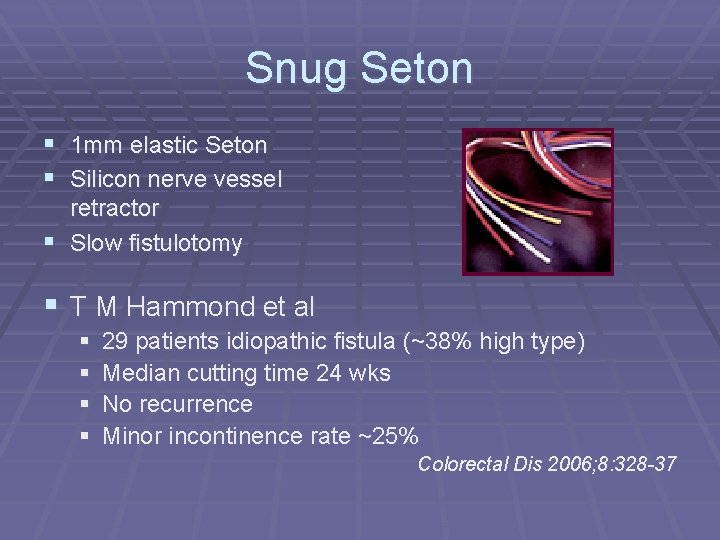
Snug Seton § 1 mm elastic Seton § Silicon nerve vessel retractor § Slow fistulotomy § T M Hammond et al § § 29 patients idiopathic fistula (~38% high type) Median cutting time 24 wks No recurrence Minor incontinence rate ~25% Colorectal Dis 2006; 8: 328 -37
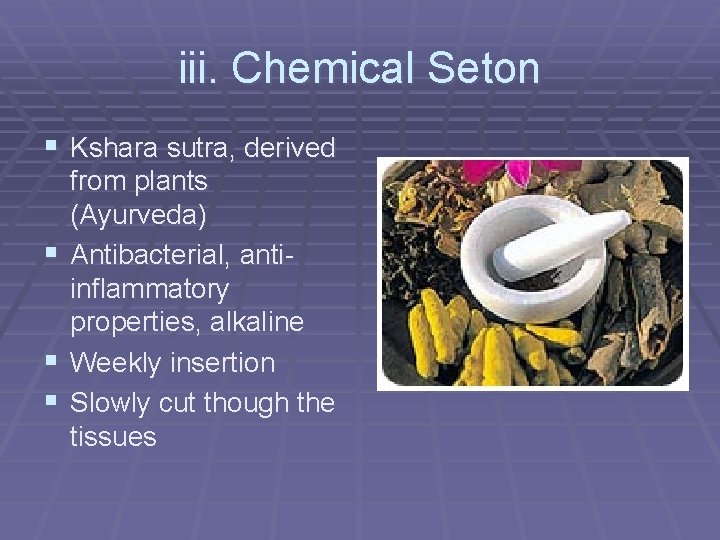
iii. Chemical Seton § Kshara sutra, derived § § § from plants (Ayurveda) Antibacterial, antiinflammatory properties, alkaline Weekly insertion Slowly cut though the tissues
Chemical Seton § RCT comparing chemical Seton with fistulotomy in low type fistula § More painful with chemical Seton but no difference in healing time, complications or functional outcome Tech Coloproctol 2001; 5: 137 -41
5. Fibrin glue § Fibrinogen solution +/- antibiotics § Promote healing thro’ fibroblast migration and activation, formation of collagen meshwork § Before injection § Curettage all granulation tissue and debris § Contraindication: acute sepsis
Fibrin glue § Results variable § For complex fistula § Successful rate ~50% § Septic complication 3% § For simple fistula Dis Colon Rectum 2005; 48: 2167 -72 § RCT fibrin glue vs conventional treatment for anal fistula § 42 patients § No advantage for fibrin glue over fistulotomy in simple fistula Dis Colon Rectum 2002; 45: 1608 -15
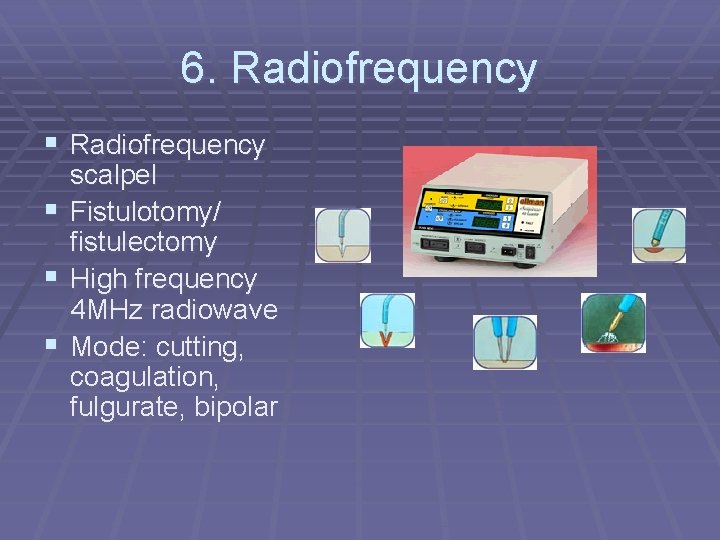
6. Radiofrequency § § § scalpel Fistulotomy/ fistulectomy High frequency 4 MHz radiowave Mode: cutting, coagulation, fulgurate, bipolar
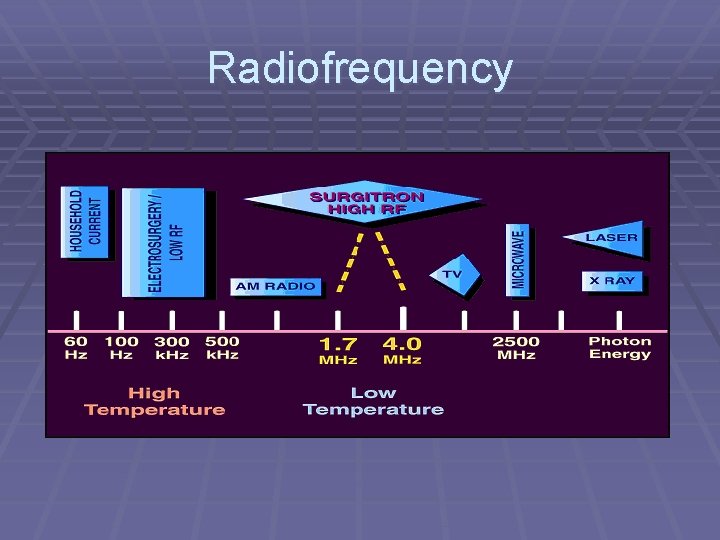
Radiofrequency
Radiofrequency § Principle § Transmit radio wave to tissue § Cause tissue damage by intracellular heating § Low cutting temperature 60 – 900 C (vs 750 – 9000 C in diathermy) § More precise cutting, less surrounding tissue damage, less tissue edema and pain
Radiofrequency § Two small scale randomized trial § Diathermy fistulotomy vs Radiofrequency fistulotomy/ fistulectomy in low type fistula § Less post-operative pain § Earlier return to work § Shorter wound healing time § No difference in complication & recurrence Eur Rev Med Pharmacol Sci 2004; 8: 111 -6 Rom J Gastroenterol. 2003; 12: 287 -91
Treatment of Anal fistula SUMMARY
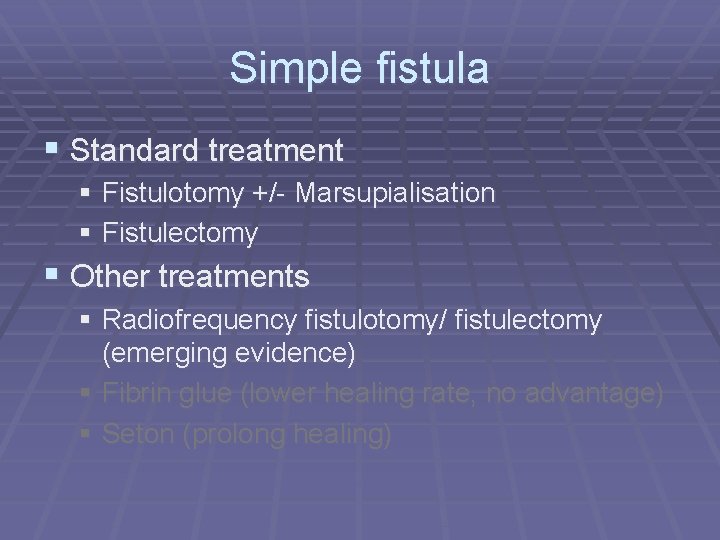
Simple fistula § Standard treatment § Fistulotomy +/- Marsupialisation § Fistulectomy § Other treatments § Radiofrequency fistulotomy/ fistulectomy (emerging evidence) § Fibrin glue (lower healing rate, no advantage) § Seton (prolong healing)
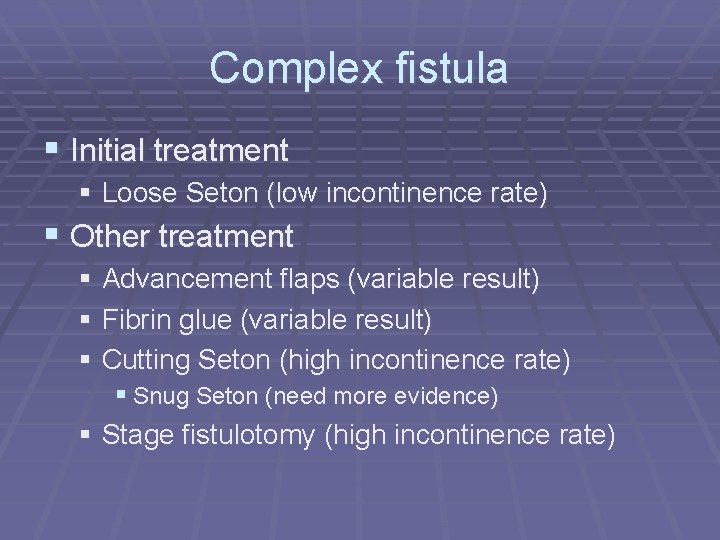
Complex fistula § Initial treatment § Loose Seton (low incontinence rate) § Other treatment § Advancement flaps (variable result) § Fibrin glue (variable result) § Cutting Seton (high incontinence rate) § Snug Seton (need more evidence) § Stage fistulotomy (high incontinence rate)
Treatment for Anal fistula ~ End of presentation ~
Treatment of anal fistula Question and Answer
Definition (variable) § High type § Involving the anorectal ring § Internal opening above dentate line § Complex type § High type § Multiple side branches § Chronic inflammatory disease (Chron’s) § Previous operation/ irridation
Incontinence scoring system § Cleveland Clinic scoring system § Wexner Continence grading scale § Material: solid, liquid, gas § Frequency: rare to always
Fistulotomy and immediate reconstruction § Reconstruct the divided musculature and primary wound closure § For low type fistula § Study from Parkash et al § 120 patients § 98% low type fistula § 88% wound healed by 2 weeks § Recurrence rate 4% ANZJ Surg 1985; 55: 23 -7
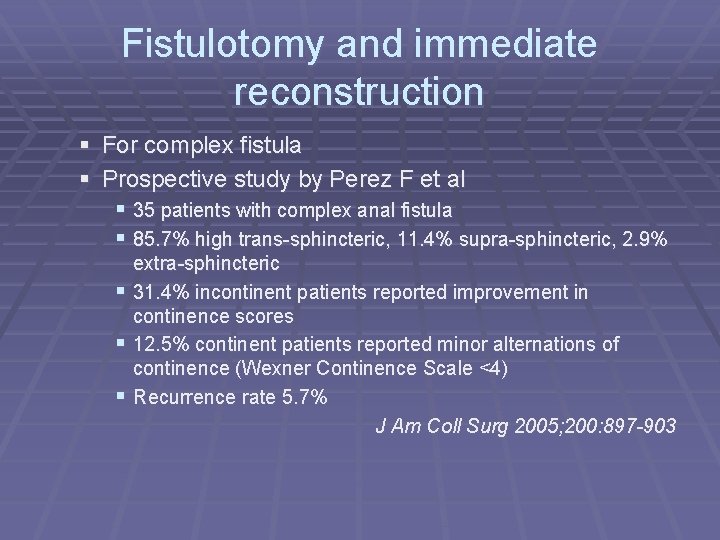
Fistulotomy and immediate reconstruction § For complex fistula § Prospective study by Perez F et al § 35 patients with complex anal fistula § 85. 7% high trans-sphincteric, 11. 4% supra-sphincteric, 2. 9% § § § extra-sphincteric 31. 4% incontinent patients reported improvement in continence scores 12. 5% continent patients reported minor alternations of continence (Wexner Continence Scale <4) Recurrence rate 5. 7% J Am Coll Surg 2005; 200: 897 -903