
Treatment and Therapies What is therapy What are
- Slides: 29
Treatment and Therapies What is therapy? What are the different types of therapy? How does each type address cause of behavior and focus of treatment.
Think of a Bad Habit you have… How would you acquire it using the following approaches? ü Behavioralist. ü Cognitive Approach ü Biological Approach ü Social-Cultural How would you treat it using the same approaches?
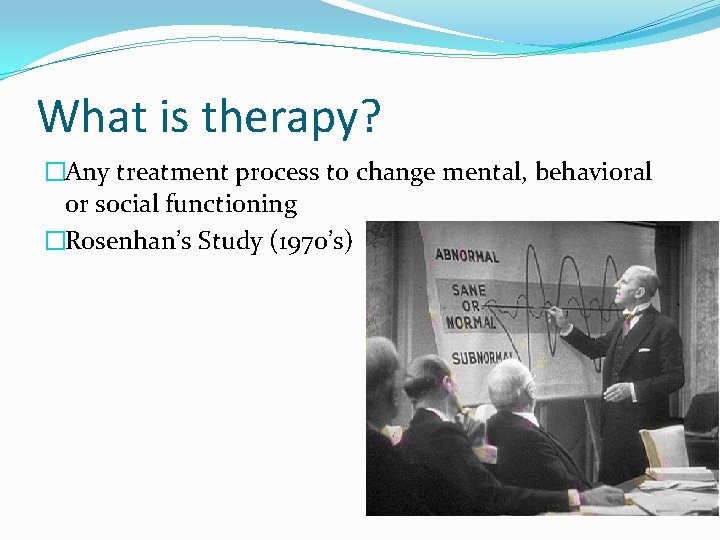
What is therapy? �Any treatment process to change mental, behavioral or social functioning �Rosenhan’s Study (1970’s)
Goals of Therapy �Identify the problem (Diagnosis) �Identify the cause of the problem (Etiology) �Decide on a form of treatment �Best treatment for diagnosis
Who goes to therapy? �severe, or persist for an extended amount of time �MUUDI
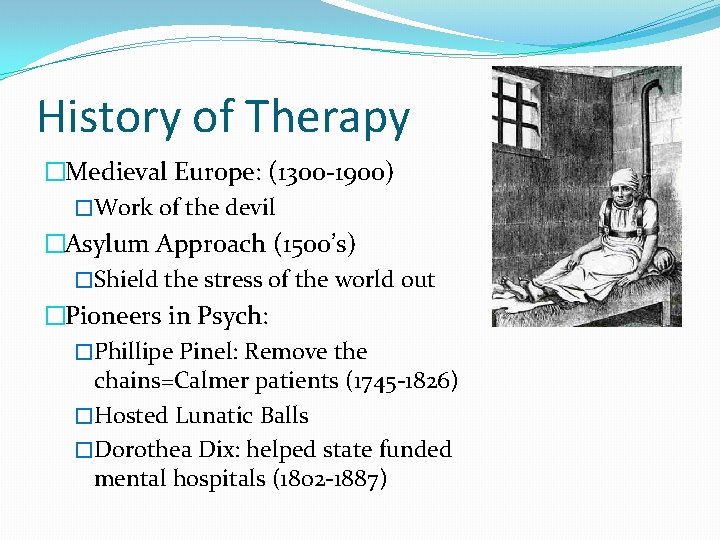
History of Therapy �Medieval Europe: (1300 -1900) �Work of the devil �Asylum Approach (1500’s) �Shield the stress of the world out �Pioneers in Psych: �Phillipe Pinel: Remove the chains=Calmer patients (1745 -1826) �Hosted Lunatic Balls �Dorothea Dix: helped state funded mental hospitals (1802 -1887)
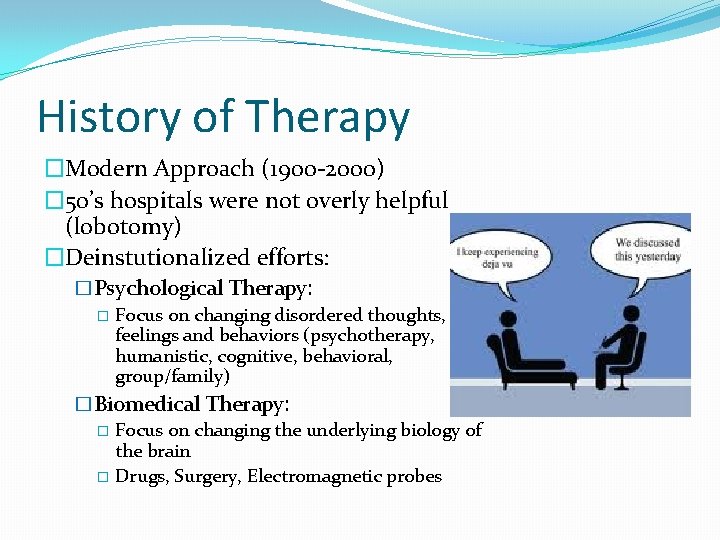
History of Therapy �Modern Approach (1900 -2000) � 50’s hospitals were not overly helpful (lobotomy) �Deinstutionalized efforts: �Psychological Therapy: � Focus on changing disordered thoughts, feelings and behaviors (psychotherapy, humanistic, cognitive, behavioral, group/family) �Biomedical Therapy: � Focus on changing the underlying biology of the brain � Drugs, Surgery, Electromagnetic probes
Culture influences Treatments �Different religious and spiritual beliefs
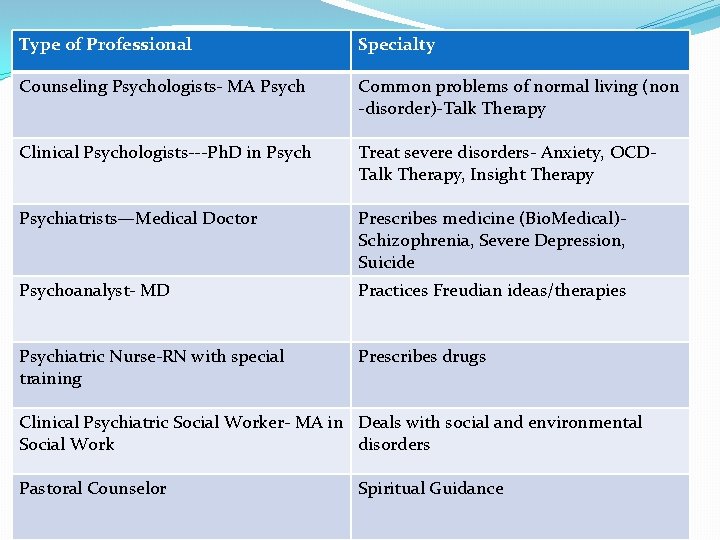
Type of Professional Specialty Counseling Psychologists- MA Psych Common problems of normal living (non -disorder)-Talk Therapy Clinical Psychologists---Ph. D in Psych Treat severe disorders- Anxiety, OCDTalk Therapy, Insight Therapy Psychiatrists—Medical Doctor Prescribes medicine (Bio. Medical)Schizophrenia, Severe Depression, Suicide Psychoanalyst- MD Practices Freudian ideas/therapies Psychiatric Nurse-RN with special training Prescribes drugs Clinical Psychiatric Social Worker- MA in Deals with social and environmental Social Work disorders Pastoral Counselor Spiritual Guidance
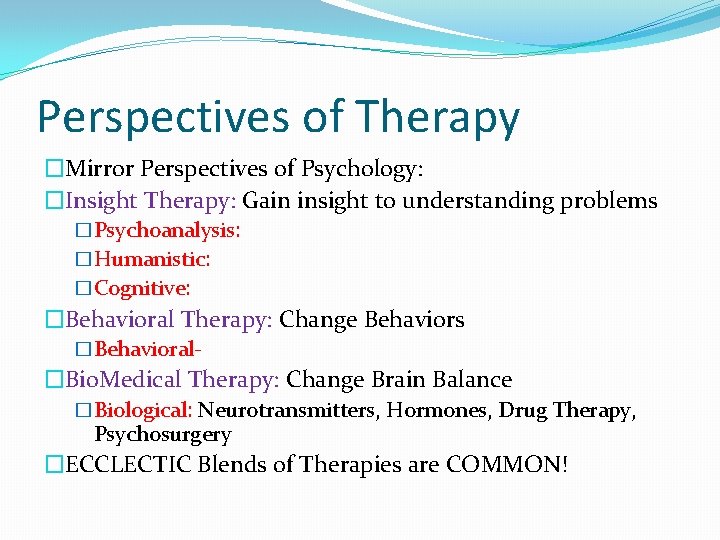
Perspectives of Therapy �Mirror Perspectives of Psychology: �Insight Therapy: Gain insight to understanding problems �Psychoanalysis: �Humanistic: �Cognitive: �Behavioral Therapy: Change Behaviors �Behavioral- �Bio. Medical Therapy: Change Brain Balance �Biological: Neurotransmitters, Hormones, Drug Therapy, Psychosurgery �ECCLECTIC Blends of Therapies are COMMON!
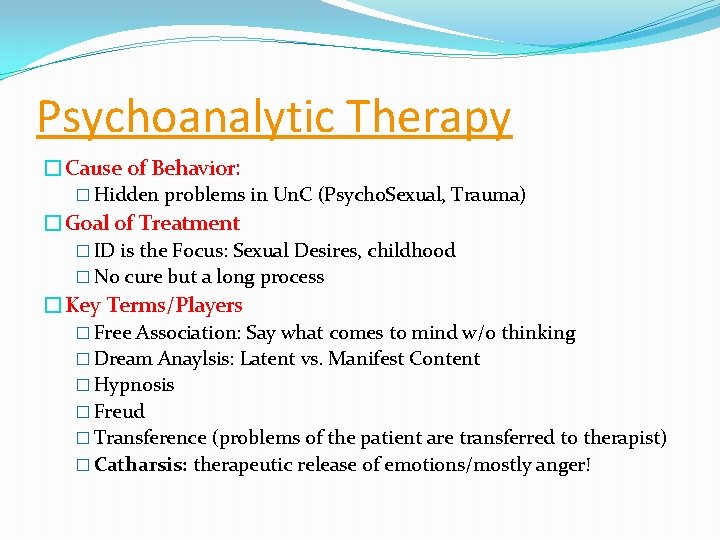
Psychoanalytic Therapy �Cause of Behavior: � Hidden problems in Un. C (Psycho. Sexual, Trauma) �Goal of Treatment � ID is the Focus: Sexual Desires, childhood � No cure but a long process �Key Terms/Players � Free Association: Say what comes to mind w/o thinking � Dream Anaylsis: Latent vs. Manifest Content � Hypnosis � Freud � Transference (problems of the patient are transferred to therapist) � Catharsis: therapeutic release of emotions/mostly anger!
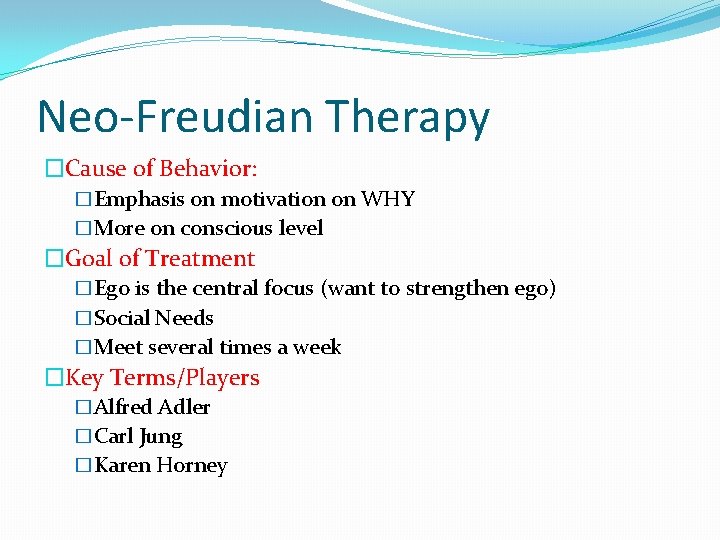
Neo-Freudian Therapy �Cause of Behavior: �Emphasis on motivation on WHY �More on conscious level �Goal of Treatment �Ego is the central focus (want to strengthen ego) �Social Needs �Meet several times a week �Key Terms/Players �Alfred Adler �Carl Jung �Karen Horney
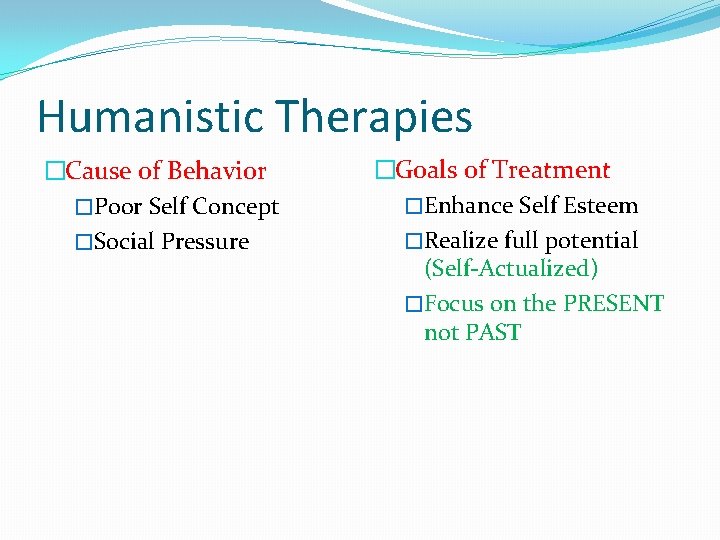
Humanistic Therapies �Cause of Behavior �Poor Self Concept �Social Pressure �Goals of Treatment �Enhance Self Esteem �Realize full potential (Self-Actualized) �Focus on the PRESENT not PAST
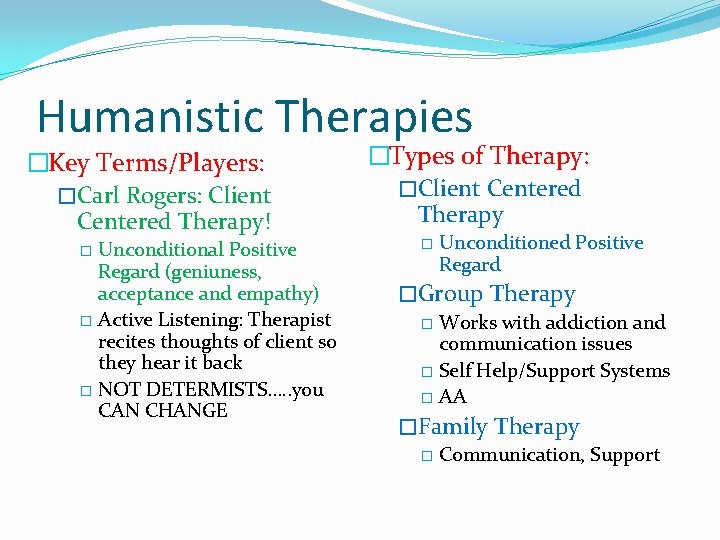
Humanistic Therapies �Key Terms/Players: �Carl Rogers: Client Centered Therapy! Unconditional Positive Regard (geniuness, acceptance and empathy) � Active Listening: Therapist recites thoughts of client so they hear it back � NOT DETERMISTS…. . you CAN CHANGE � �Types of Therapy: �Client Centered Therapy � Unconditioned Positive Regard �Group Therapy � Works with addiction and communication issues � Self Help/Support Systems � AA �Family Therapy � Communication, Support
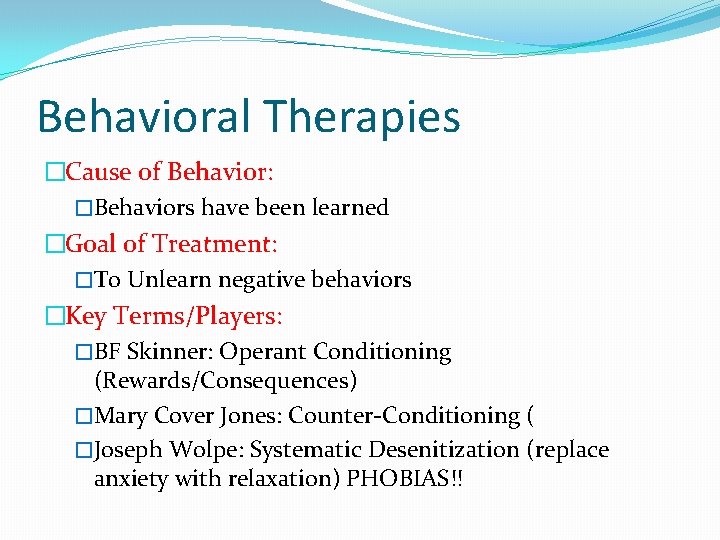
Behavioral Therapies �Cause of Behavior: �Behaviors have been learned �Goal of Treatment: �To Unlearn negative behaviors �Key Terms/Players: �BF Skinner: Operant Conditioning (Rewards/Consequences) �Mary Cover Jones: Counter-Conditioning ( �Joseph Wolpe: Systematic Desenitization (replace anxiety with relaxation) PHOBIAS!!
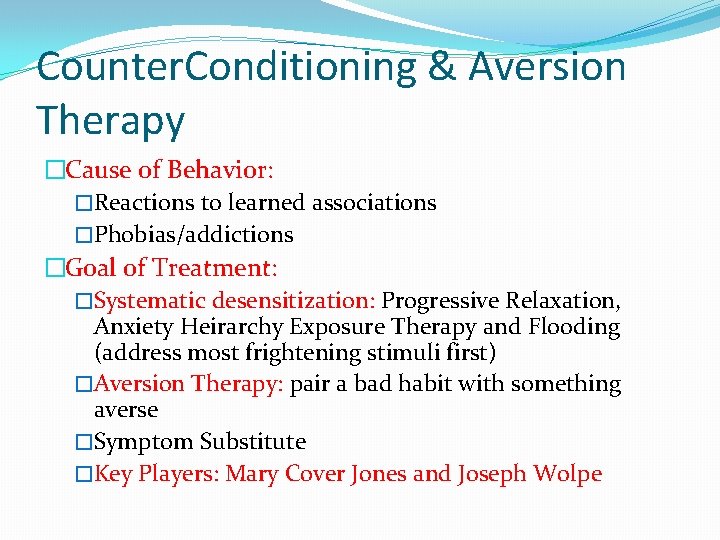
Counter. Conditioning & Aversion Therapy �Cause of Behavior: �Reactions to learned associations �Phobias/addictions �Goal of Treatment: �Systematic desensitization: Progressive Relaxation, Anxiety Heirarchy Exposure Therapy and Flooding (address most frightening stimuli first) �Aversion Therapy: pair a bad habit with something averse �Symptom Substitute �Key Players: Mary Cover Jones and Joseph Wolpe
Operant Conditioning & Token Economies �Cause of Behavior �Behavior is a result of consequences “learned behaviors” �Goal of Treatment: �Shape new behaviors �Token Economies: Desired behaviors awarded with tokens � Reward system used in prisons �Key Terms/Players �Skinner �Thorndike
Observational Learning �Cause of Behavior �Learned from watching others (racism, fear of birds) �Goal of Treatment �Two Types � Symbolic: provide models indirectly through movies, etc � Desensitization Therapy: direct exposure �Key Terms/Players �Bandura
Cognitive Therapy �Cause of Behavior: �Negative “Self Talk”(“I’m stupid”, “I’m ugly”, “I can’t”) �Irrational or Faulty thought processes/perceptions �Goal of Treatment �Ask questions in a way to solve problems �Attributional Style: Internal or External Locus of Control? �Key Terms/Players �Aaron Beck’ s Cognitive Triad
Aaron Beck �Similar to Ellis with RET �Believed Depressed people have a cognitive triad that needed to be treated �Depressed people have “dark sunglasses” and they have negative views of � Self � World � Future �Must treat all three views
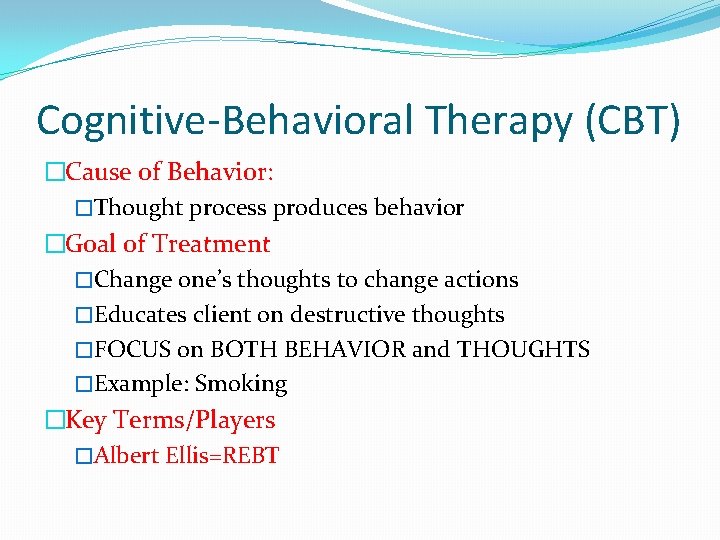
Cognitive-Behavioral Therapy (CBT) �Cause of Behavior: �Thought process produces behavior �Goal of Treatment �Change one’s thoughts to change actions �Educates client on destructive thoughts �FOCUS on BOTH BEHAVIOR and THOUGHTS �Example: Smoking �Key Terms/Players �Albert Ellis=REBT
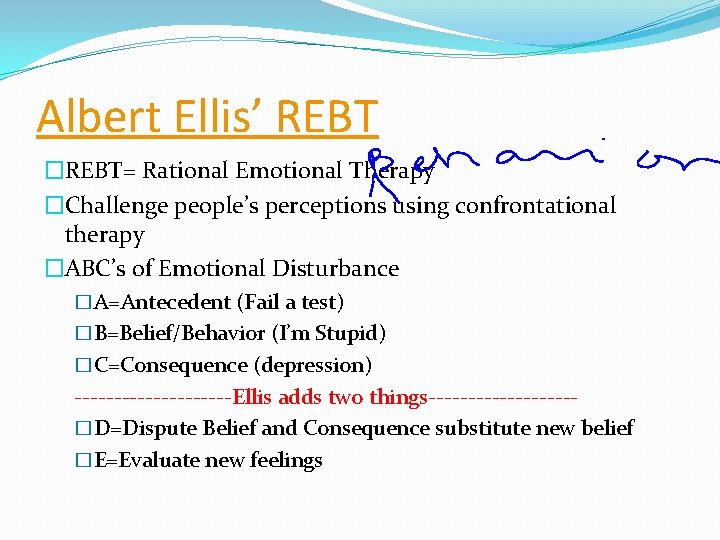
Albert Ellis’ REBT �REBT= Rational Emotional Therapy �Challenge people’s perceptions using confrontational therapy �ABC’s of Emotional Disturbance �A=Antecedent (Fail a test) �B=Belief/Behavior (I’m Stupid) �C=Consequence (depression) ----------Ellis adds two things---------�D=Dispute Belief and Consequence substitute new belief �E=Evaluate new feelings
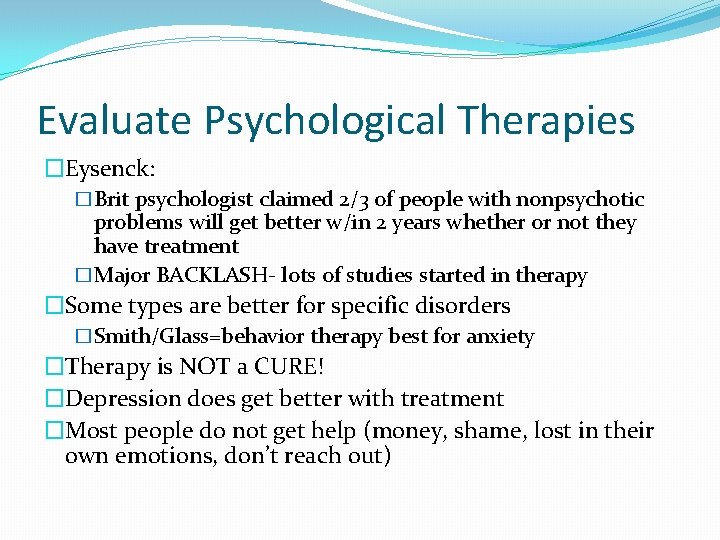
Evaluate Psychological Therapies �Eysenck: �Brit psychologist claimed 2/3 of people with nonpsychotic problems will get better w/in 2 years whether or not they have treatment �Major BACKLASH- lots of studies started in therapy �Some types are better for specific disorders �Smith/Glass=behavior therapy best for anxiety �Therapy is NOT a CURE! �Depression does get better with treatment �Most people do not get help (money, shame, lost in their own emotions, don’t reach out)
Eclectic is BEST! �The BEST therapy is one which is eclectic or mixes various aspects of perspectives to meet the needs of the patients.
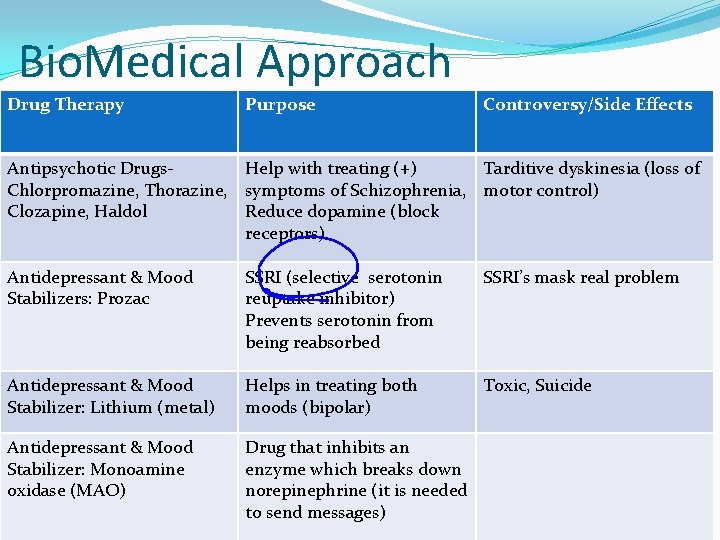
Bio. Medical Approach Drug Therapy Purpose Controversy/Side Effects Antipsychotic Drugs. Help with treating (+) Tarditive dyskinesia (loss of Chlorpromazine, Thorazine, symptoms of Schizophrenia, motor control) Clozapine, Haldol Reduce dopamine (block receptors) Antidepressant & Mood Stabilizers: Prozac SSRI (selective serotonin reuptake inhibitor) Prevents serotonin from being reabsorbed SSRI’s mask real problem Antidepressant & Mood Stabilizer: Lithium (metal) Helps in treating both moods (bipolar) Toxic, Suicide Antidepressant & Mood Stabilizer: Monoamine oxidase (MAO) Drug that inhibits an enzyme which breaks down norepinephrine (it is needed to send messages)
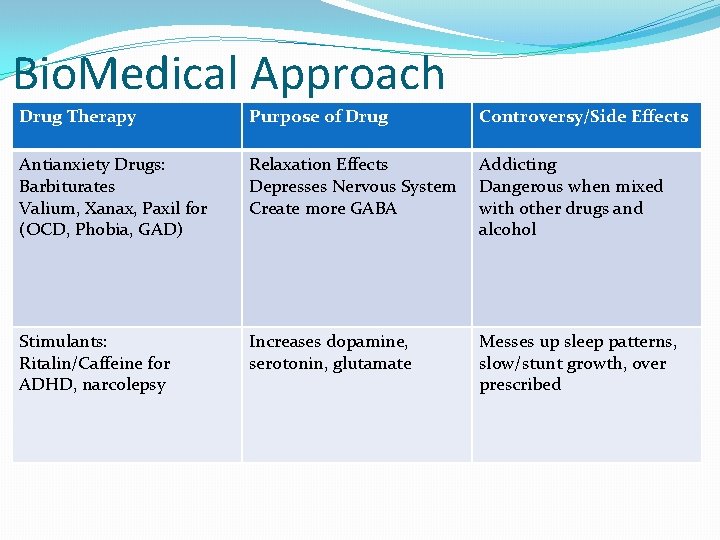
Bio. Medical Approach Drug Therapy Purpose of Drug Controversy/Side Effects Antianxiety Drugs: Barbiturates Valium, Xanax, Paxil for (OCD, Phobia, GAD) Relaxation Effects Depresses Nervous System Create more GABA Addicting Dangerous when mixed with other drugs and alcohol Stimulants: Ritalin/Caffeine for ADHD, narcolepsy Increases dopamine, serotonin, glutamate Messes up sleep patterns, slow/stunt growth, over prescribed
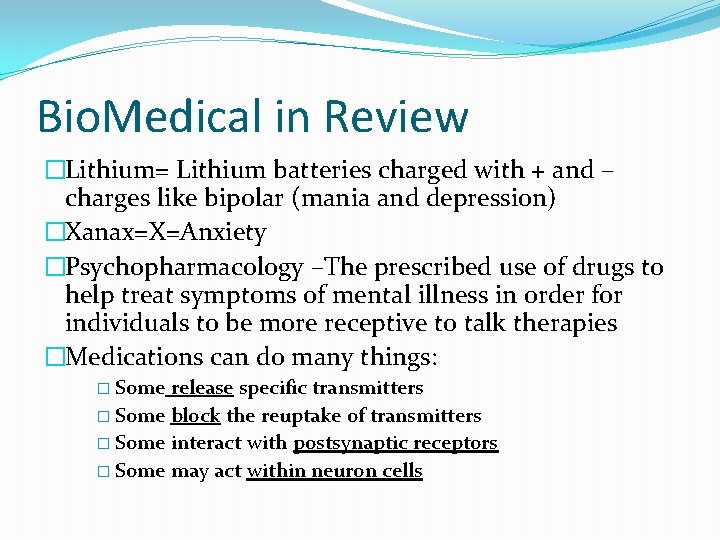
Bio. Medical in Review �Lithium= Lithium batteries charged with + and – charges like bipolar (mania and depression) �Xanax=X=Anxiety �Psychopharmacology –The prescribed use of drugs to help treat symptoms of mental illness in order for individuals to be more receptive to talk therapies �Medications can do many things: � Some release specific transmitters � Some block the reuptake of transmitters � Some interact with postsynaptic receptors � Some may act within neuron cells
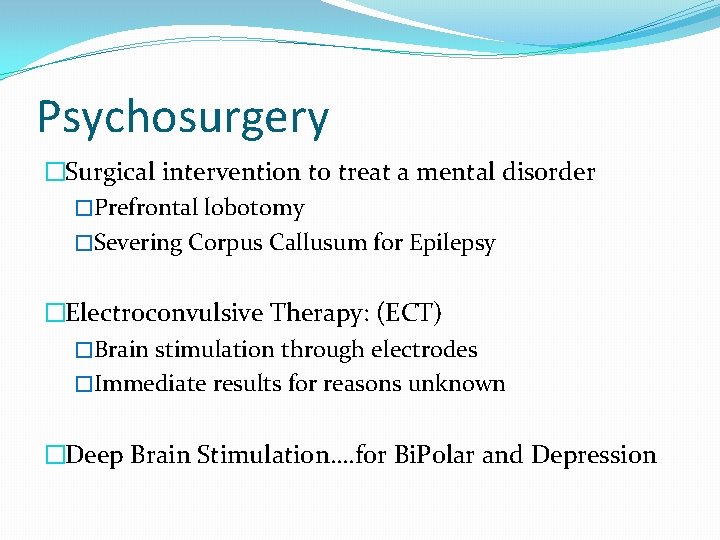
Psychosurgery �Surgical intervention to treat a mental disorder �Prefrontal lobotomy �Severing Corpus Callusum for Epilepsy �Electroconvulsive Therapy: (ECT) �Brain stimulation through electrodes �Immediate results for reasons unknown �Deep Brain Stimulation…. for Bi. Polar and Depression
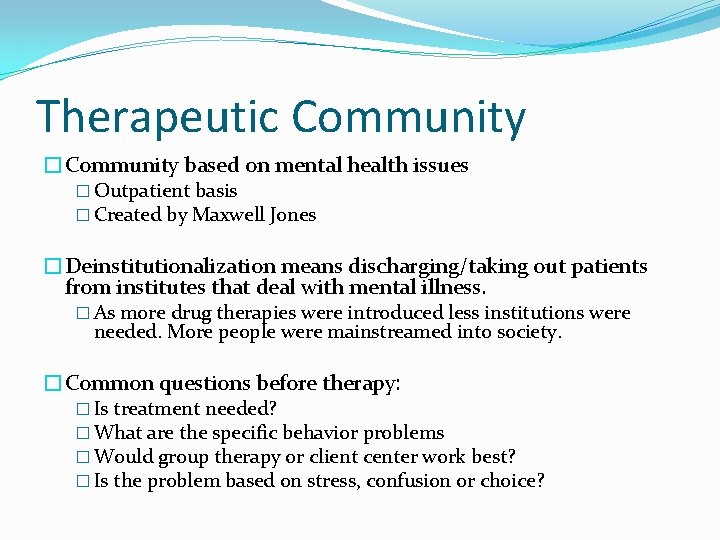
Therapeutic Community �Community based on mental health issues � Outpatient basis � Created by Maxwell Jones �Deinstitutionalization means discharging/taking out patients from institutes that deal with mental illness. � As more drug therapies were introduced less institutions were needed. More people were mainstreamed into society. �Common questions before therapy: � Is treatment needed? � What are the specific behavior problems � Would group therapy or client center work best? � Is the problem based on stress, confusion or choice?