
Treatment and Rehabilitation Immediate Responses What should you
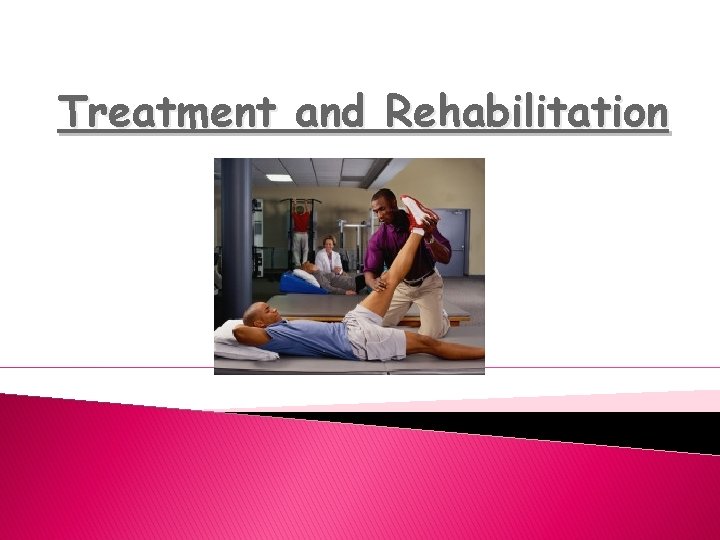
Treatment and Rehabilitation
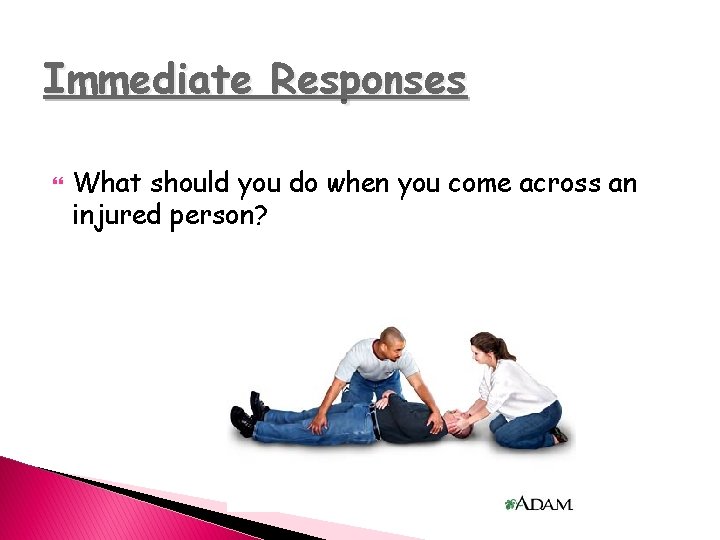
Immediate Responses What should you do when you come across an injured person?

Immediate Responses Priorities – Are you safe? Are they safe? Start to assess the casualty (SALTAPS) - Do they need Resuscitation? - Are they in Shock? - Are they Bleeding? - Any Fractures? - Are they an Unconscious casualty? Summon assistance – First Aider, 999 Start to prevent infection (First Aid Box)
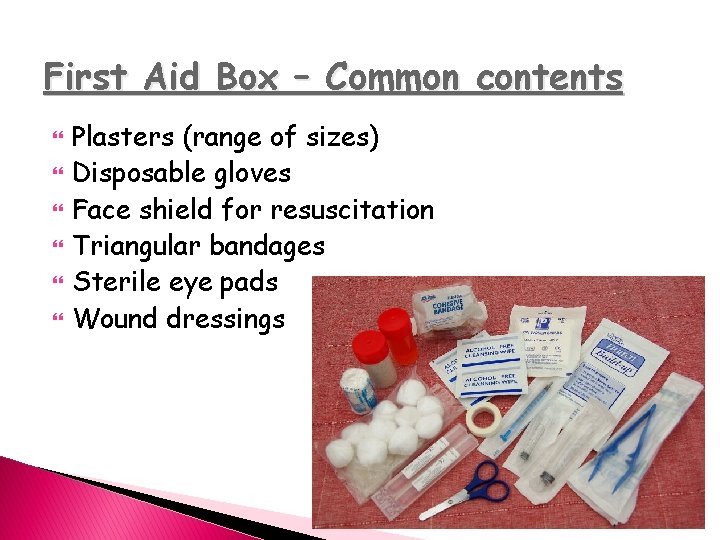
First Aid Box – Common contents Plasters (range of sizes) Disposable gloves Face shield for resuscitation Triangular bandages Sterile eye pads Wound dressings
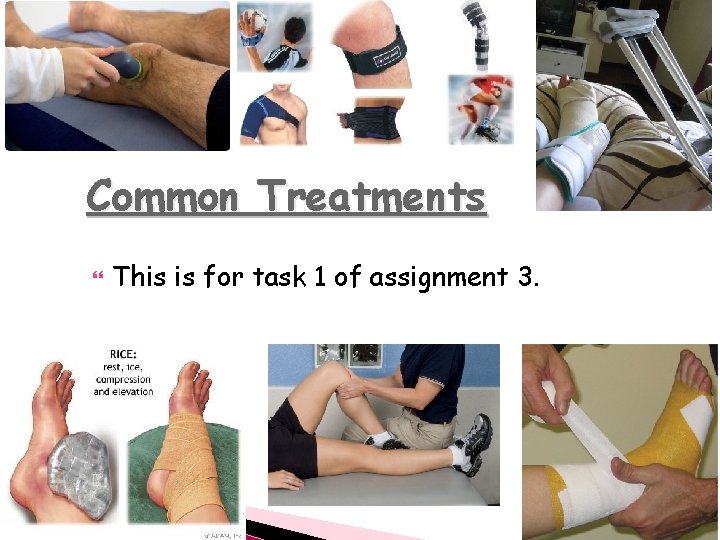
Common Treatments This is for task 1 of assignment 3.

PRICED Medical referral Common treatments Hot/ Cold treatments SALTAPS Support mechanisms
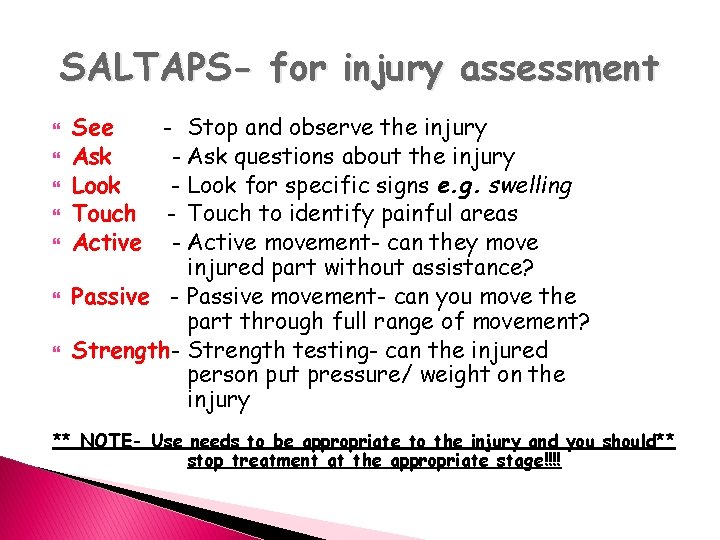
SALTAPS- for injury assessment See - Stop and observe the injury Ask - Ask questions about the injury Look - Look for specific signs e. g. swelling Touch - Touch to identify painful areas Active - Active movement- can they move injured part without assistance? Passive - Passive movement- can you move the part through full range of movement? Strength- Strength testing- can the injured person put pressure/ weight on the injury ** NOTE- Use needs to be appropriate to the injury and you should** stop treatment at the appropriate stage!!!!
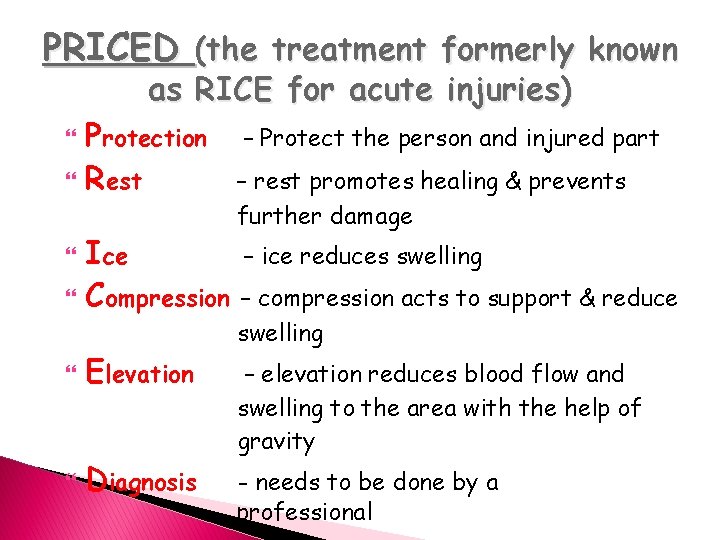
PRICED (the treatment formerly known as RICE for acute injuries) Protection Rest Ice Compression Elevation Diagnosis – Protect the person and injured part – rest promotes healing & prevents further damage – ice reduces swelling – compression acts to support & reduce swelling – elevation reduces blood flow and swelling to the area with the help of gravity - needs to be done by a professional
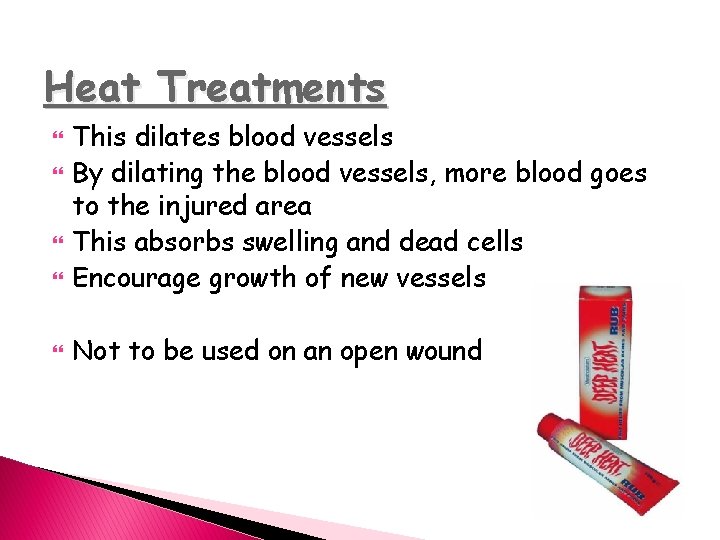
Heat Treatments This dilates blood vessels By dilating the blood vessels, more blood goes to the injured area This absorbs swelling and dead cells Encourage growth of new vessels Not to be used on an open wound
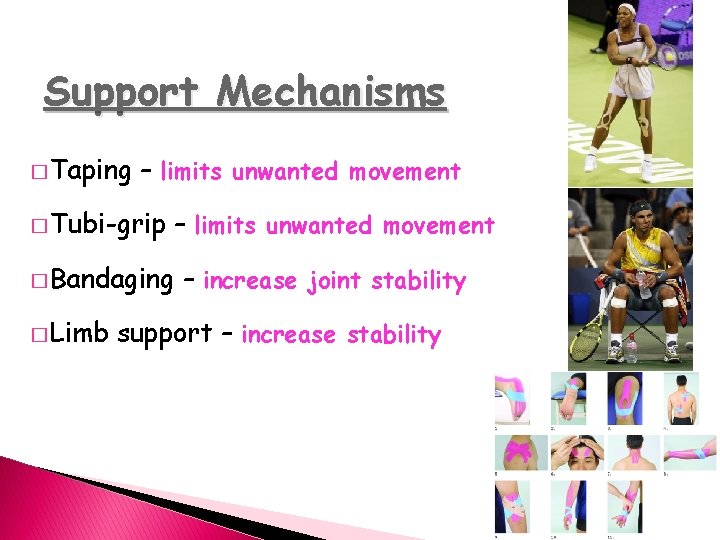
Support Mechanisms � Taping – limits unwanted movement � Tubi-grip – limits unwanted movement � Bandaging � Limb – increase joint stability support – increase stability
Cold Applications Cold compress – these are so that the blood vessels constrict, causing a reduction in the flow of blood to the injured area. This is to reduce swelling and also the pain felt by stopping the nerve endings from conducting impulses It is best used directly after an injury but also for 48 -72 hours afterwards.
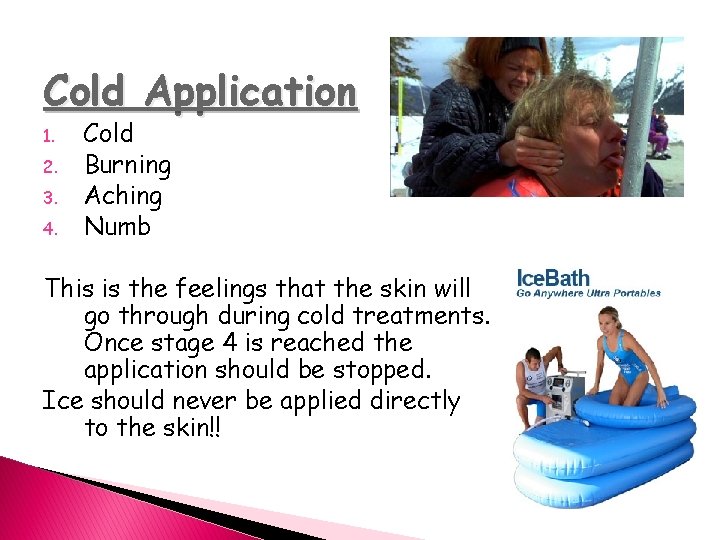
Cold Application 1. 2. 3. 4. Cold Burning Aching Numb This is the feelings that the skin will go through during cold treatments. Once stage 4 is reached the application should be stopped. Ice should never be applied directly to the skin!!
Medical Referral Why refer? Who? ◦ GP ◦ Physiotherapist ◦ Consultant ◦ Surgeon ◦ Strength and Conditioning Coach ◦ Nutritionist
Assignment 3 Task 1: Dealing With Casualties (Pass) P 3: Demonstrate how to deal with casualties suffering from three different injuries and/or illnesses, with tutor support (P 3) Task 2: Dealing With Casualties (Merit) M 2: Independently deal with casualties suffering from three different injuries and/or illnesses (M 2)
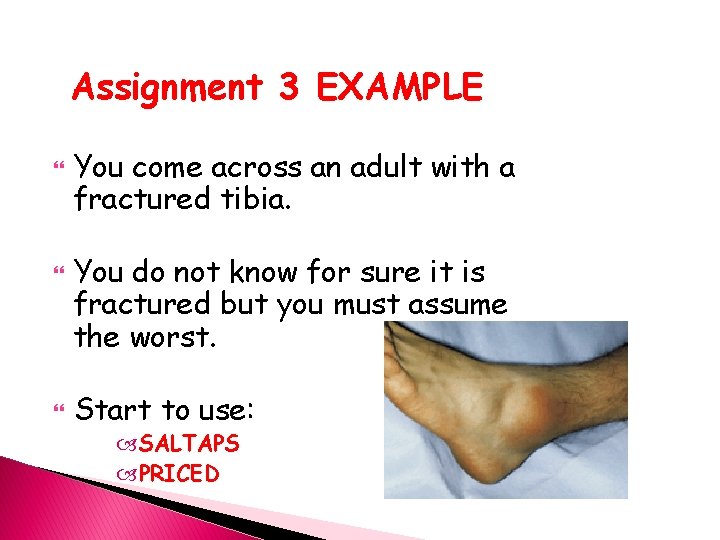
Assignment 3 EXAMPLE You come across an adult with a fractured tibia. You do not know for sure it is fractured but you must assume the worst. Start to use: SALTAPS PRICED
EXAMPLE : Fractured Tibia. Ring 999 for emergency help Prevent – excessive swelling. Keep footwear on for now. Protect – remove the person from the pitch or situation. If this is not possible halt the game immediately. Control – if the leg is also bleeding, cover this up. Relieve – pain. Move in to comfortable position and raise the leg.
- Slides: 16