
TREATMENT ADHERENCE AMONG PATIENTS UNDERGOING HEMODIALYSIS scenario in




- Slides: 43
TREATMENT ADHERENCE AMONG PATIENTS UNDERGOING HEMODIALYSIS: scenario in Nepal 1 Presentation By: Ms. Niru Khatiwada BSc Nursing (BPKIHS), MN (IOM, TU) Lecturer, Nepal Medical College (Affiliated to Kathmandu University) Kathmandu, Nepal
OVERVIEW
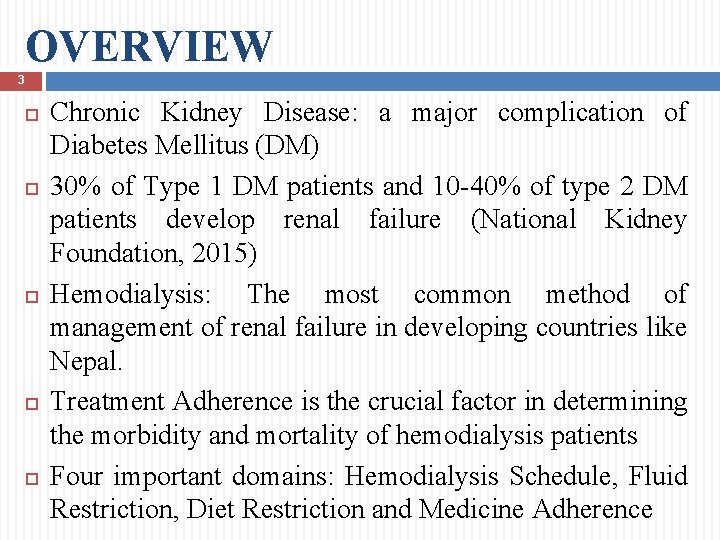
OVERVIEW 3 Chronic Kidney Disease: a major complication of Diabetes Mellitus (DM) 30% of Type 1 DM patients and 10 -40% of type 2 DM patients develop renal failure (National Kidney Foundation, 2015) Hemodialysis: The most common method of management of renal failure in developing countries like Nepal. Treatment Adherence is the crucial factor in determining the morbidity and mortality of hemodialysis patients Four important domains: Hemodialysis Schedule, Fluid Restriction, Diet Restriction and Medicine Adherence
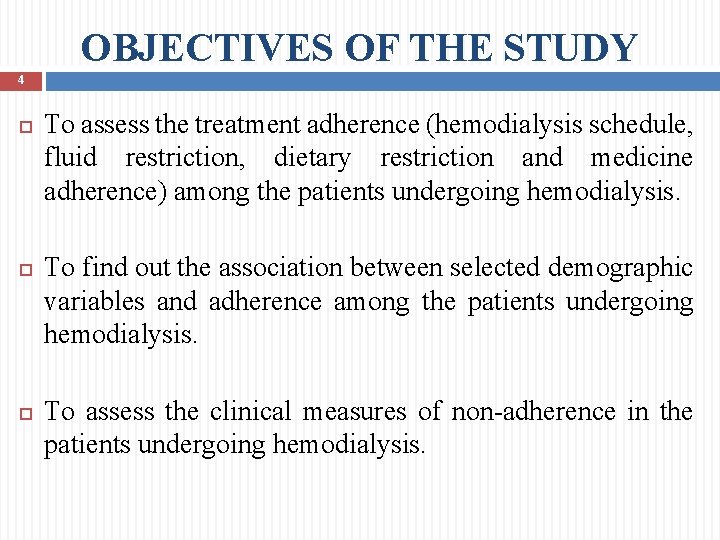
OBJECTIVES OF THE STUDY 4 To assess the treatment adherence (hemodialysis schedule, fluid restriction, dietary restriction and medicine adherence) among the patients undergoing hemodialysis. To find out the association between selected demographic variables and adherence among the patients undergoing hemodialysis. To assess the clinical measures of non-adherence in the patients undergoing hemodialysis.
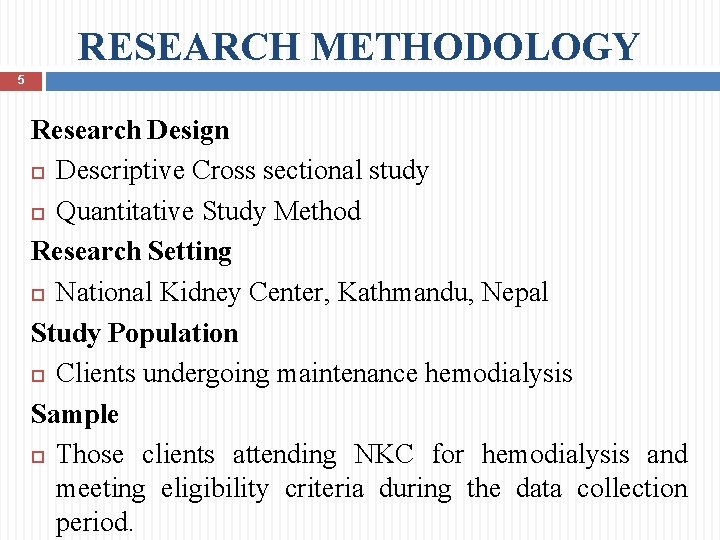
RESEARCH METHODOLOGY 5 Research Design Descriptive Cross sectional study Quantitative Study Method Research Setting National Kidney Center, Kathmandu, Nepal Study Population Clients undergoing maintenance hemodialysis Sample Those clients attending NKC for hemodialysis and meeting eligibility criteria during the data collection period.
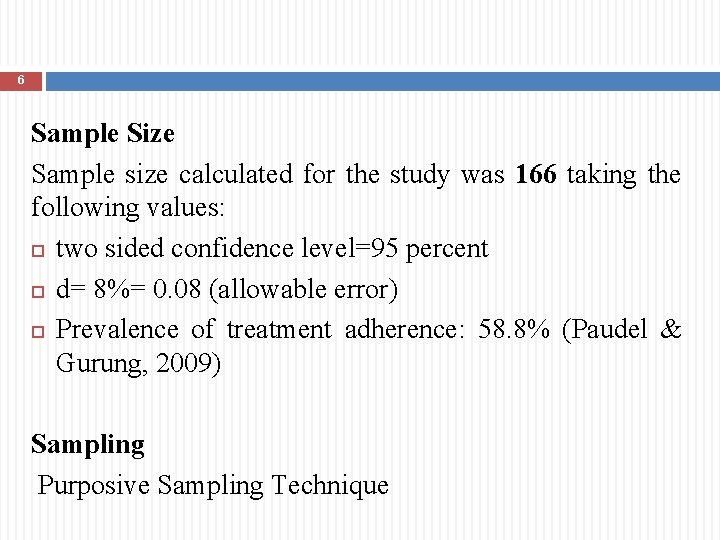
6 Sample Size Sample size calculated for the study was 166 taking the following values: two sided confidence level=95 percent d= 8%= 0. 08 (allowable error) Prevalence of treatment adherence: 58. 8% (Paudel & Gurung, 2009) Sampling Purposive Sampling Technique
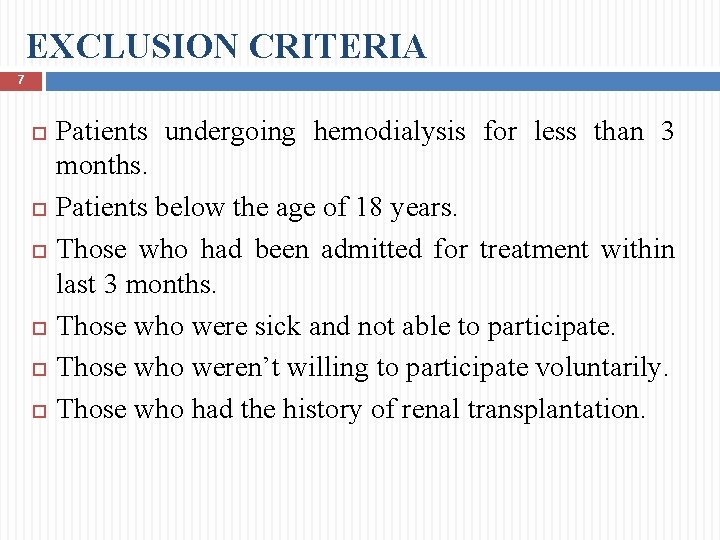
EXCLUSION CRITERIA 7 Patients undergoing hemodialysis for less than 3 months. Patients below the age of 18 years. Those who had been admitted for treatment within last 3 months. Those who were sick and not able to participate. Those who weren’t willing to participate voluntarily. Those who had the history of renal transplantation.
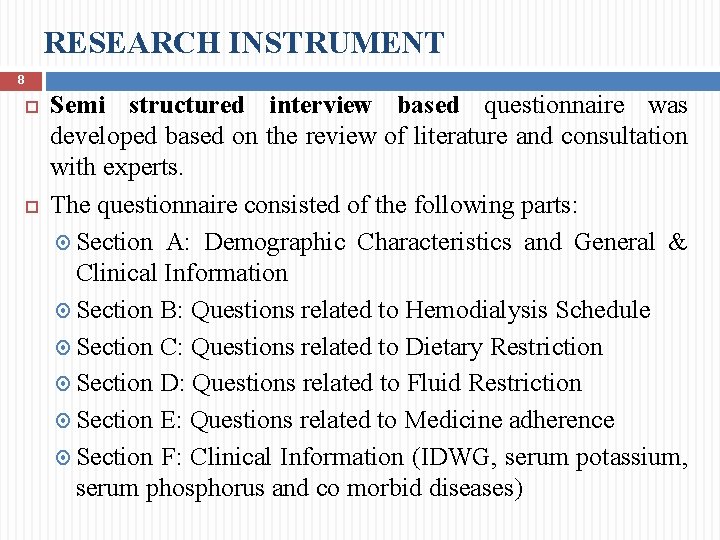
RESEARCH INSTRUMENT 8 Semi structured interview based questionnaire was developed based on the review of literature and consultation with experts. The questionnaire consisted of the following parts: Section A: Demographic Characteristics and General & Clinical Information Section B: Questions related to Hemodialysis Schedule Section C: Questions related to Dietary Restriction Section D: Questions related to Fluid Restriction Section E: Questions related to Medicine adherence Section F: Clinical Information (IDWG, serum potassium, serum phosphorus and co morbid diseases)
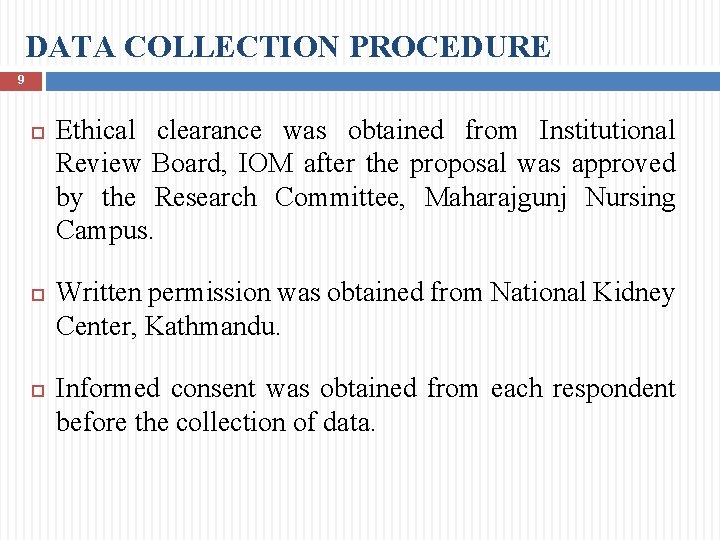
DATA COLLECTION PROCEDURE 9 Ethical clearance was obtained from Institutional Review Board, IOM after the proposal was approved by the Research Committee, Maharajgunj Nursing Campus. Written permission was obtained from National Kidney Center, Kathmandu. Informed consent was obtained from each respondent before the collection of data.
Contd. . 10 Clients undergoing HD were interviewed during their HD session and immediately stopped if any complications aroused. Confidentiality was maintained by coding the filled questionnaires. Repetition of respondents was avoided by noting the names and patient number in a separate sheet. Respondents found to be non adherent to treatment were informed about the importance of adherence.
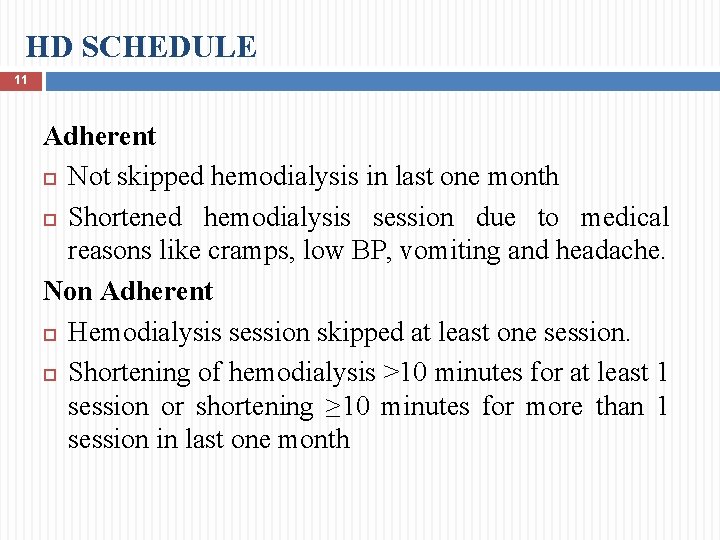
HD SCHEDULE 11 Adherent Not skipped hemodialysis in last one month Shortened hemodialysis session due to medical reasons like cramps, low BP, vomiting and headache. Non Adherent Hemodialysis session skipped at least one session. Shortening of hemodialysis >10 minutes for at least 1 session or shortening ≥ 10 minutes for more than 1 session in last one month
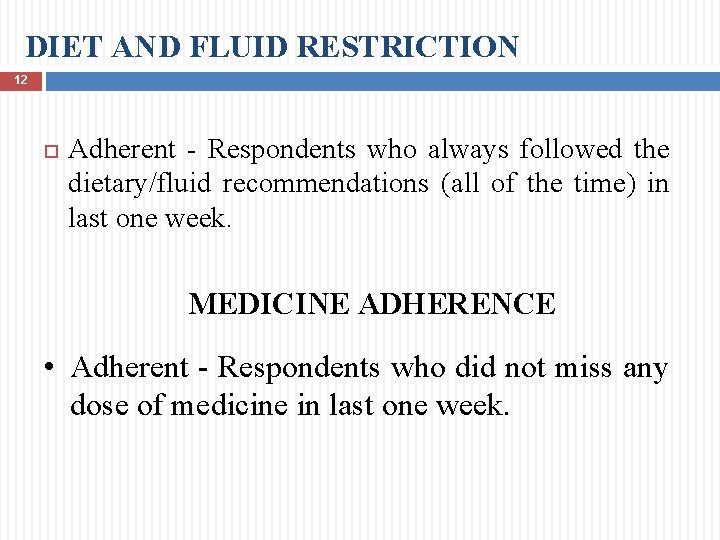
DIET AND FLUID RESTRICTION 12 Adherent - Respondents who always followed the dietary/fluid recommendations (all of the time) in last one week. MEDICINE ADHERENCE • Adherent - Respondents who did not miss any dose of medicine in last one week.
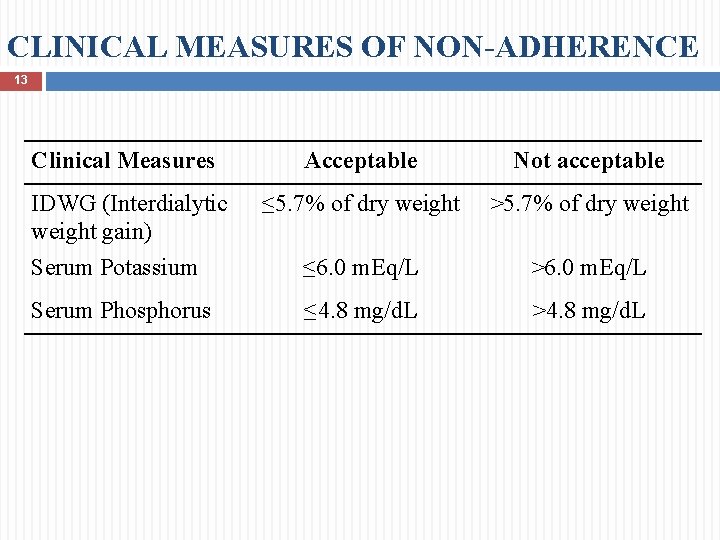
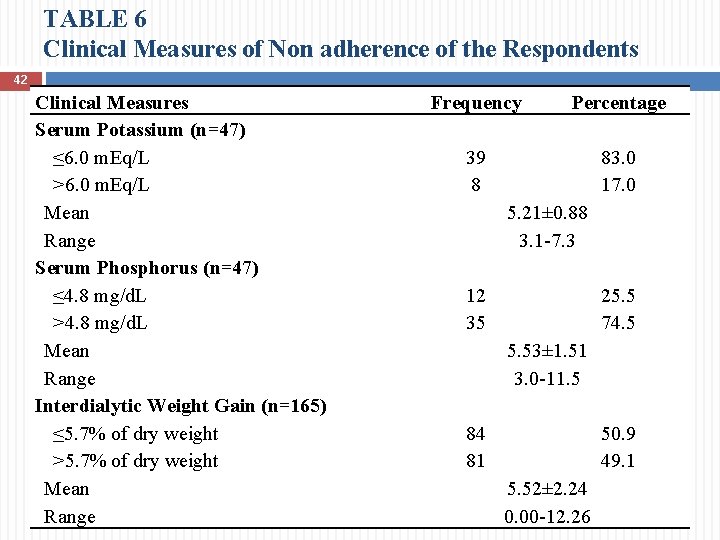
CLINICAL MEASURES OF NON-ADHERENCE 13 Clinical Measures Acceptable Not acceptable ≤ 5. 7% of dry weight >5. 7% of dry weight Serum Potassium ≤ 6. 0 m. Eq/L >6. 0 m. Eq/L Serum Phosphorus ≤ 4. 8 mg/d. L >4. 8 mg/d. L IDWG (Interdialytic weight gain)
MAJOR FINDINGS
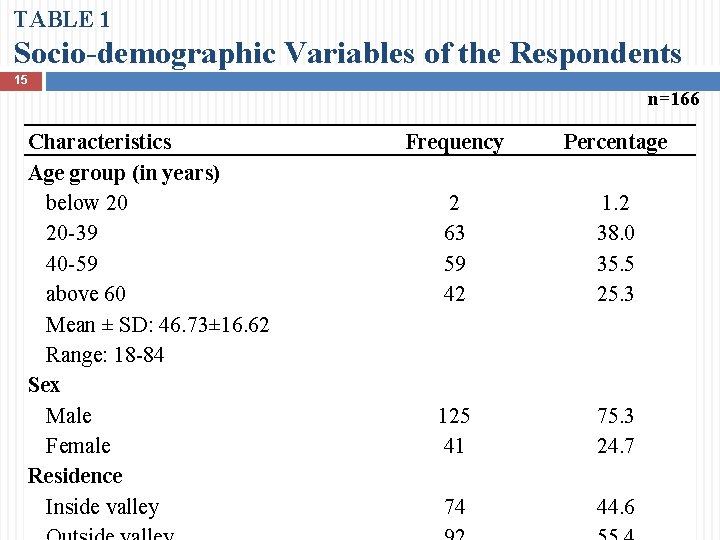
TABLE 1 Socio-demographic Variables of the Respondents 15 n=166 Characteristics Age group (in years) below 20 20 -39 40 -59 above 60 Mean ± SD: 46. 73± 16. 62 Range: 18 -84 Sex Male Female Residence Inside valley Frequency 2 63 59 42 125 41 74 Percentage 1. 2 38. 0 35. 5 25. 3 75. 3 24. 7 44. 6
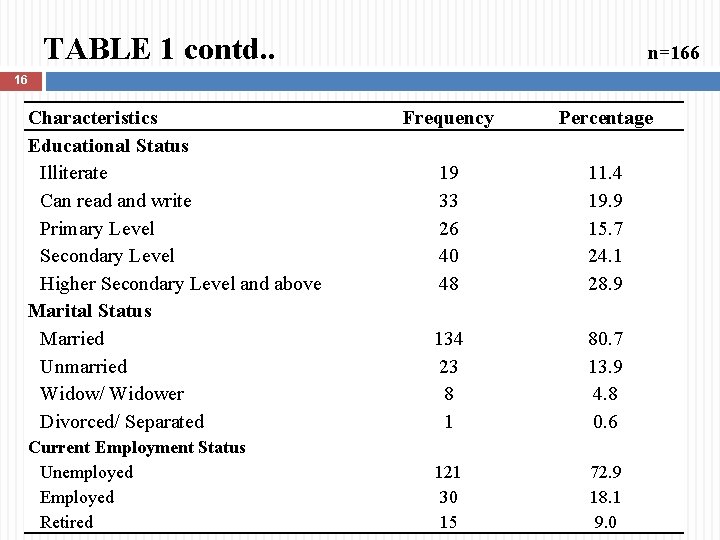
TABLE 1 contd. . n=166 16 Characteristics Educational Status Illiterate Can read and write Primary Level Secondary Level Higher Secondary Level and above Marital Status Married Unmarried Widow/ Widower Divorced/ Separated Current Employment Status Unemployed Employed Retired Frequency 19 33 26 40 48 134 23 8 1 Percentage 11. 4 19. 9 15. 7 24. 1 28. 9 80. 7 13. 9 4. 8 0. 6 121 30 15 72. 9 18. 1 9. 0
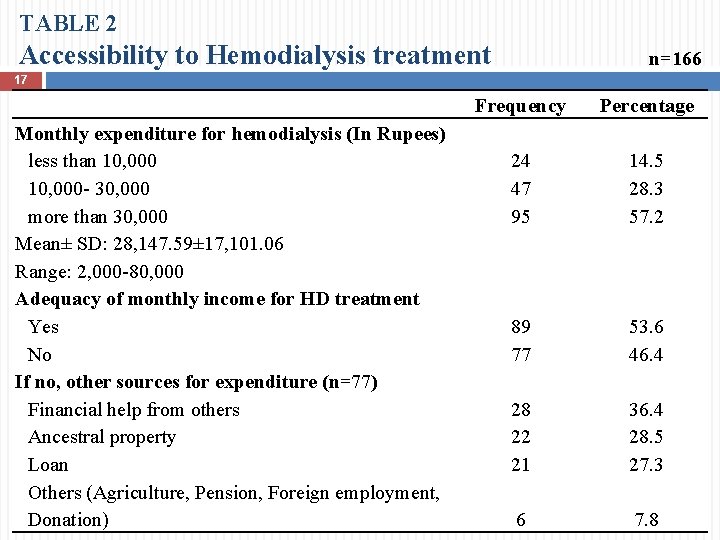
TABLE 2 Accessibility to Hemodialysis treatment n=166 17 Monthly expenditure for hemodialysis (In Rupees) less than 10, 000 - 30, 000 more than 30, 000 Mean± SD: 28, 147. 59± 17, 101. 06 Range: 2, 000 -80, 000 Adequacy of monthly income for HD treatment Yes No If no, other sources for expenditure (n=77) Financial help from others Ancestral property Loan Others (Agriculture, Pension, Foreign employment, Donation) Frequency 24 47 95 Percentage 14. 5 28. 3 57. 2 89 77 28 22 21 53. 6 46. 4 36. 4 28. 5 27. 3 6 7. 8
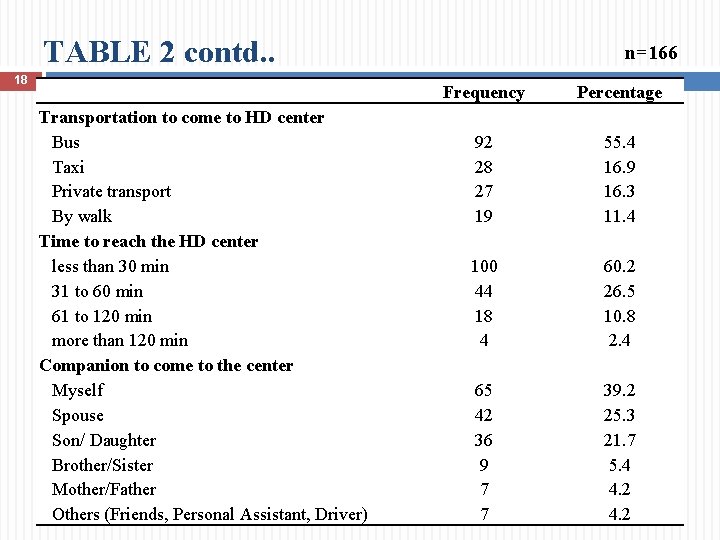
TABLE 2 contd. . 18 Transportation to come to HD center Bus Taxi Private transport By walk Time to reach the HD center less than 30 min 31 to 60 min 61 to 120 min more than 120 min Companion to come to the center Myself Spouse Son/ Daughter Brother/Sister Mother/Father Others (Friends, Personal Assistant, Driver) n=166 Frequency 92 28 27 19 100 44 18 4 65 42 36 9 7 7 Percentage 55. 4 16. 9 16. 3 11. 4 60. 2 26. 5 10. 8 2. 4 39. 2 25. 3 21. 7 5. 4 4. 2
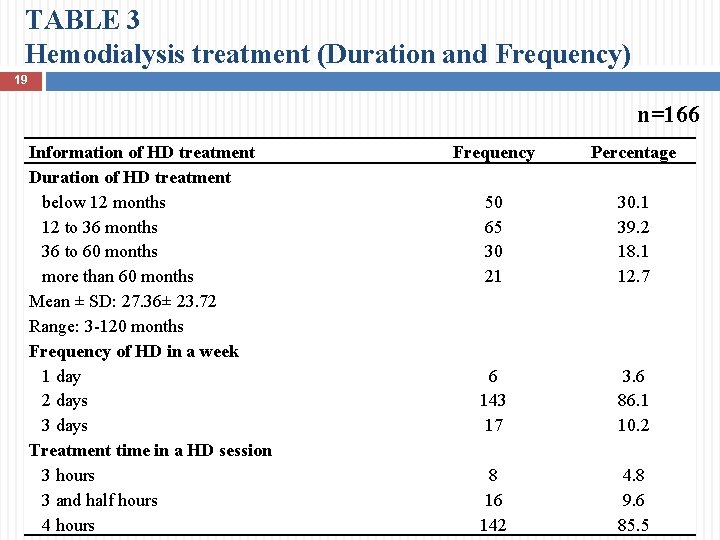
TABLE 3 Hemodialysis treatment (Duration and Frequency) 19 n=166 Information of HD treatment Duration of HD treatment below 12 months 12 to 36 months 36 to 60 months more than 60 months Mean ± SD: 27. 36± 23. 72 Range: 3 -120 months Frequency of HD in a week 1 day 2 days 3 days Treatment time in a HD session 3 hours 3 and half hours 4 hours Frequency 50 65 30 21 Percentage 30. 1 39. 2 18. 1 12. 7 6 143 17 8 16 142 3. 6 86. 1 10. 2 4. 8 9. 6 85. 5
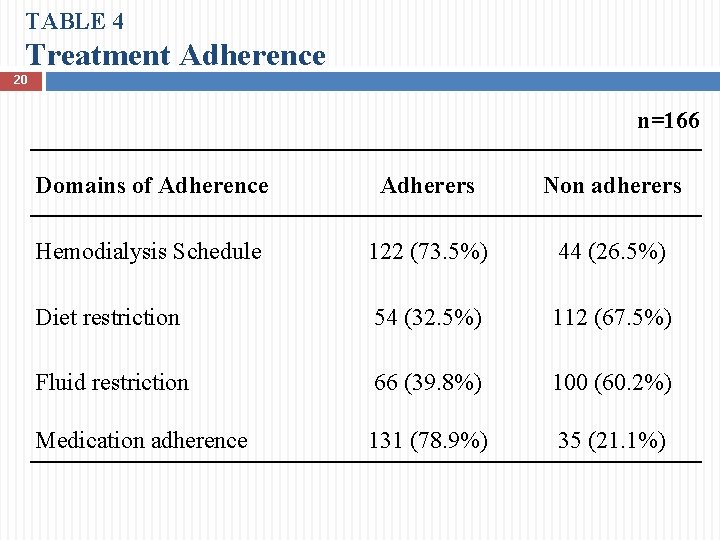
TABLE 4 Treatment Adherence 20 n=166 Domains of Adherence Adherers Non adherers Hemodialysis Schedule 122 (73. 5%) 44 (26. 5%) Diet restriction 54 (32. 5%) 112 (67. 5%) Fluid restriction 66 (39. 8%) 100 (60. 2%) Medication adherence 131 (78. 9%) 35 (21. 1%)
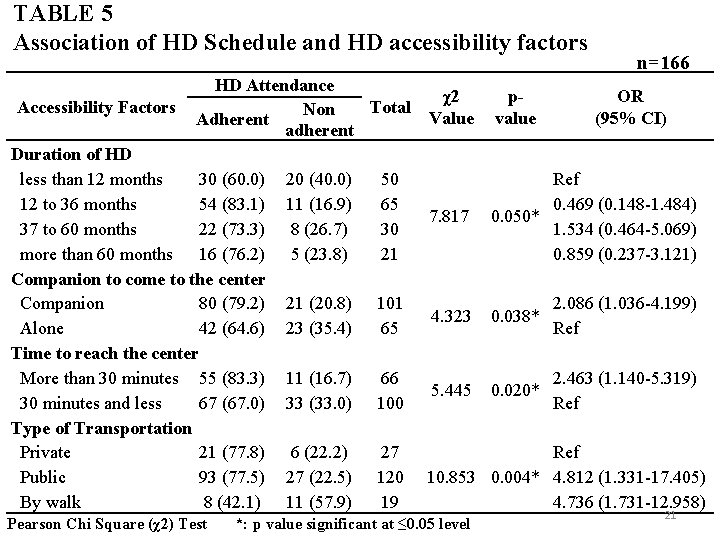
TABLE 5 Association of HD Schedule and HD accessibility factors HD Attendance χ2 Accessibility Factors Total Non Value Adherent adherent Duration of HD less than 12 months 30 (60. 0) 20 (40. 0) 50 12 to 36 months 54 (83. 1) 11 (16. 9) 65 7. 817 37 to 60 months 22 (73. 3) 8 (26. 7) 30 more than 60 months 16 (76. 2) 5 (23. 8) 21 Companion to come to the center Companion 80 (79. 2) 21 (20. 8) 101 4. 323 Alone 42 (64. 6) 23 (35. 4) 65 Time to reach the center More than 30 minutes 55 (83. 3) 11 (16. 7) 66 5. 445 30 minutes and less 67 (67. 0) 33 (33. 0) 100 Type of Transportation Private 21 (77. 8) 6 (22. 2) 27 Public 93 (77. 5) 27 (22. 5) 120 10. 853 By walk 8 (42. 1) 11 (57. 9) 19 Pearson Chi Square (χ2) Test *: p value significant at ≤ 0. 05 level n=166 p- value OR (95% CI) Ref 0. 469 (0. 148 -1. 484) 1. 534 (0. 464 -5. 069) 0. 859 (0. 237 -3. 121) 2. 086 (1. 036 -4. 199) Ref 2. 463 (1. 140 -5. 319) Ref 4. 812 (1. 331 -17. 405) 4. 736 (1. 731 -12. 958) 0. 050* 0. 038* 0. 020* 0. 004* 21
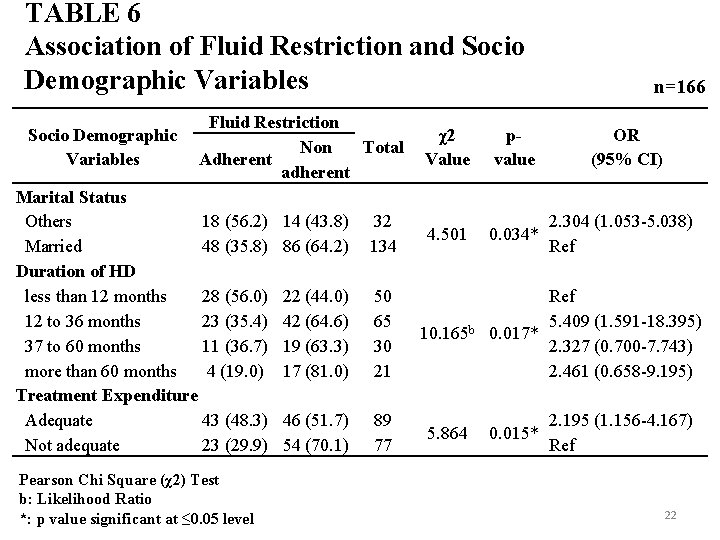
TABLE 6 Association of Fluid Restriction and Socio Demographic Variables n=166 Fluid Restriction Socio Demographic χ2 p- OR Non Total Adherent Variables Value value (95% CI) adherent Marital Status Others 18 (56. 2) 14 (43. 8) 32 2. 304 (1. 053 -5. 038) 4. 501 0. 034* Married 48 (35. 8) 86 (64. 2) 134 Ref Duration of HD less than 12 months 28 (56. 0) 22 (44. 0) 50 Ref 12 to 36 months 23 (35. 4) 42 (64. 6) 65 5. 409 (1. 591 -18. 395) 10. 165 b 0. 017* 37 to 60 months 11 (36. 7) 19 (63. 3) 30 2. 327 (0. 700 -7. 743) more than 60 months 4 (19. 0) 17 (81. 0) 21 2. 461 (0. 658 -9. 195) Treatment Expenditure Adequate 43 (48. 3) 46 (51. 7) 89 2. 195 (1. 156 -4. 167) 5. 864 0. 015* Not adequate 23 (29. 9) 54 (70. 1) 77 Ref Pearson Chi Square (χ2) Test b: Likelihood Ratio *: p value significant at ≤ 0. 05 level 22
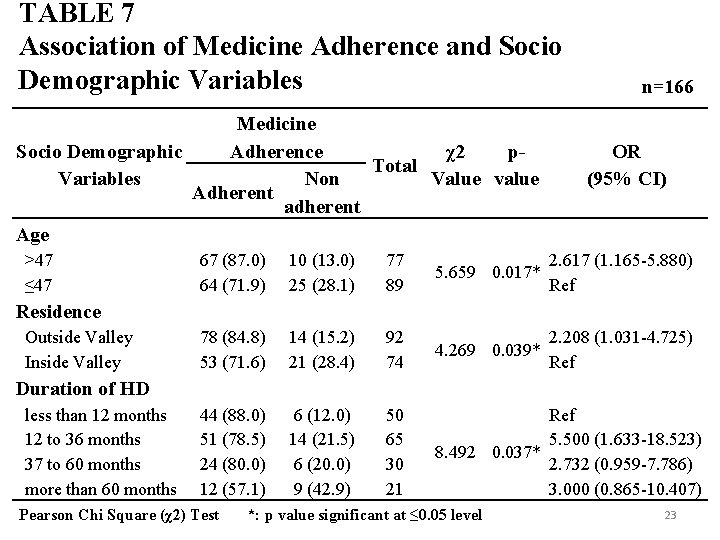
TABLE 7 Association of Medicine Adherence and Socio Demographic Variables Medicine Socio Demographic Adherence χ2 p- Total Variables Value value Non Adherent adherent Age >47 ≤ 47 67 (87. 0) 64 (71. 9) 10 (13. 0) 25 (28. 1) 77 89 Outside Valley Inside Valley 78 (84. 8) 53 (71. 6) 14 (15. 2) 21 (28. 4) 92 74 Duration of HD 44 (88. 0) 51 (78. 5) 24 (80. 0) 12 (57. 1) 6 (12. 0) 14 (21. 5) 6 (20. 0) 9 (42. 9) 50 65 30 21 Residence less than 12 months 12 to 36 months 37 to 60 months more than 60 months 5. 659 0. 017* 4. 269 0. 039* n=166 OR (95% CI) 2. 617 (1. 165 -5. 880) Ref 2. 208 (1. 031 -4. 725) Ref 5. 500 (1. 633 -18. 523) 8. 492 0. 037* 2. 732 (0. 959 -7. 786) 3. 000 (0. 865 -10. 407) Pearson Chi Square (χ2) Test *: p value significant at ≤ 0. 05 level 23
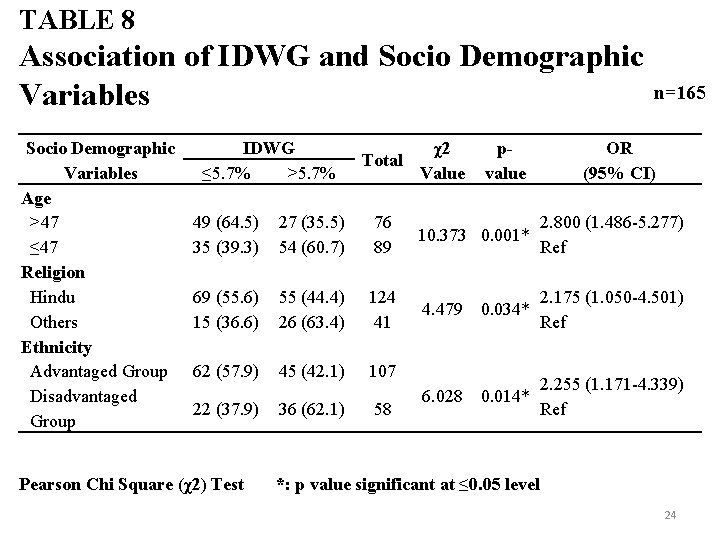
TABLE 8 Association of IDWG and Socio Demographic n=165 Variables Socio Demographic Variables Age >47 ≤ 47 Religion Hindu Others Ethnicity Advantaged Group Disadvantaged Group IDWG χ2 p- OR Total ≤ 5. 7% >5. 7% Value value (95% CI) 49 (64. 5) 27 (35. 5) 76 2. 800 (1. 486 -5. 277) 10. 373 0. 001* 35 (39. 3) 54 (60. 7) 89 Ref 69 (55. 6) 55 (44. 4) 124 2. 175 (1. 050 -4. 501) 4. 479 0. 034* 15 (36. 6) 26 (63. 4) 41 Ref 62 (57. 9) 45 (42. 1) 107 2. 255 (1. 171 -4. 339) 6. 028 0. 014* 22 (37. 9) 36 (62. 1) 58 Ref Pearson Chi Square (χ2) Test *: p value significant at ≤ 0. 05 level 24
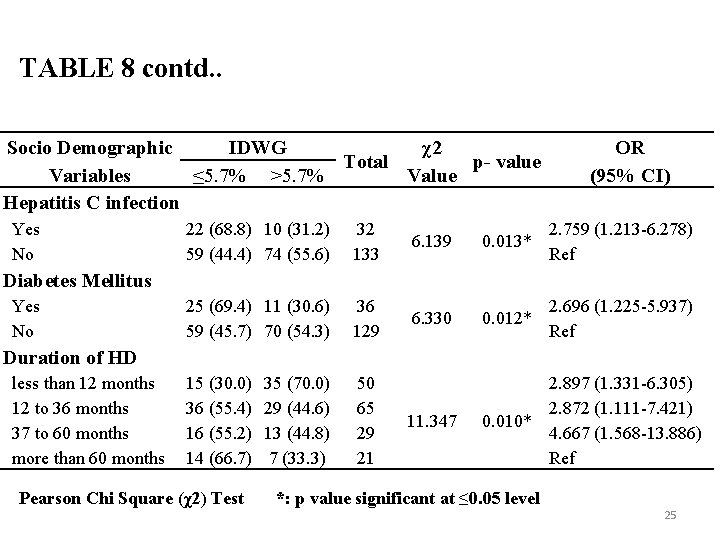
TABLE 8 contd. . Socio Demographic IDWG χ2 Total p- value ≤ 5. 7% >5. 7% Variables Value Hepatitis C infection Yes No Diabetes Mellitus Yes No Duration of HD less than 12 months 12 to 36 months 37 to 60 months more than 60 months 22 (68. 8) 10 (31. 2) 59 (44. 4) 74 (55. 6) 25 (69. 4) 11 (30. 6) 59 (45. 7) 70 (54. 3) 32 133 6. 139 0. 013* 36 129 6. 330 0. 012* 15 (30. 0) 36 (55. 4) 16 (55. 2) 14 (66. 7) 35 (70. 0) 29 (44. 6) 13 (44. 8) 7 (33. 3) 50 65 29 21 11. 347 OR (95% CI) 2. 759 (1. 213 -6. 278) Ref 2. 696 (1. 225 -5. 937) Ref 2. 897 (1. 331 -6. 305) 2. 872 (1. 111 -7. 421) 0. 010* 4. 667 (1. 568 -13. 886) Ref Pearson Chi Square (χ2) Test *: p value significant at ≤ 0. 05 level 25
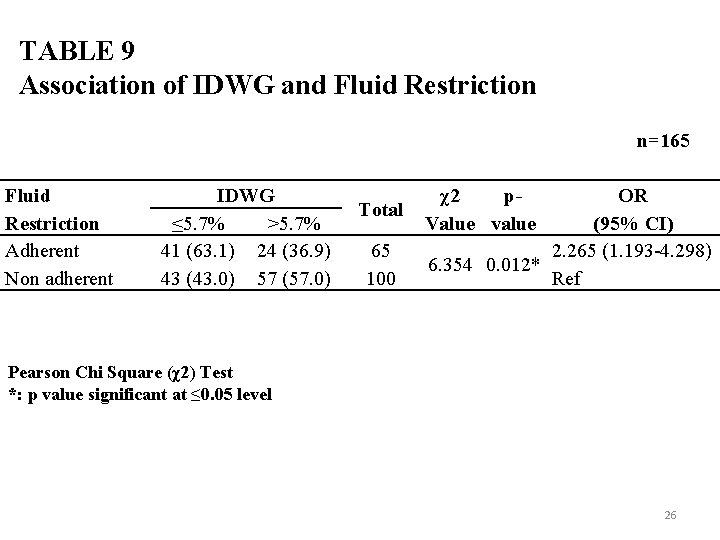
TABLE 9 Association of IDWG and Fluid Restriction n=165 Fluid Restriction Adherent Non adherent IDWG ≤ 5. 7% >5. 7% 41 (63. 1) 24 (36. 9) 43 (43. 0) 57 (57. 0) Total 65 100 χ2 p- Value value OR (95% CI) 2. 265 (1. 193 -4. 298) 6. 354 0. 012* Ref Pearson Chi Square (χ2) Test *: p value significant at ≤ 0. 05 level 26
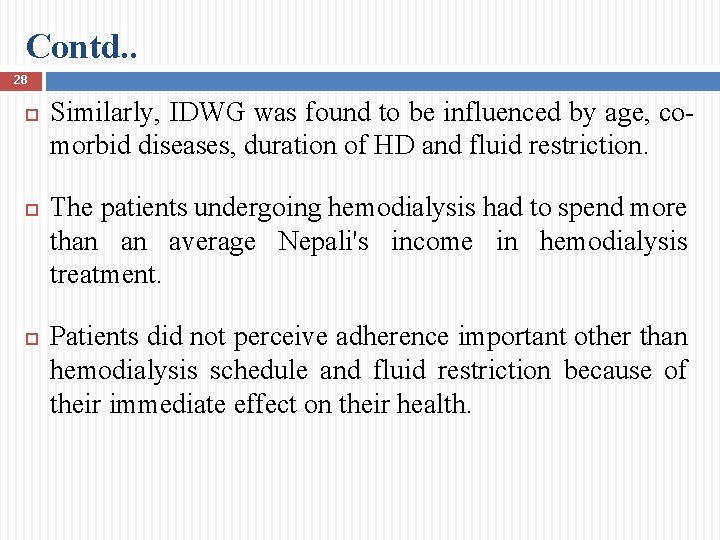
CONCLUSION 27 About three fourth of the respondents were adherent to hemodialysis schedule and medicine whereas only about one third of them were adherent to fluid restriction and diet restriction. It has been identified that duration of HD, hemodialysis accessibility factors influenced adherence to hemodialysis schedule; marital status, duration of HD and adequacy for treatment expenditure influenced fluid restriction whereas counseling affected dietary adherence and duration of HD influenced medicine adherence.
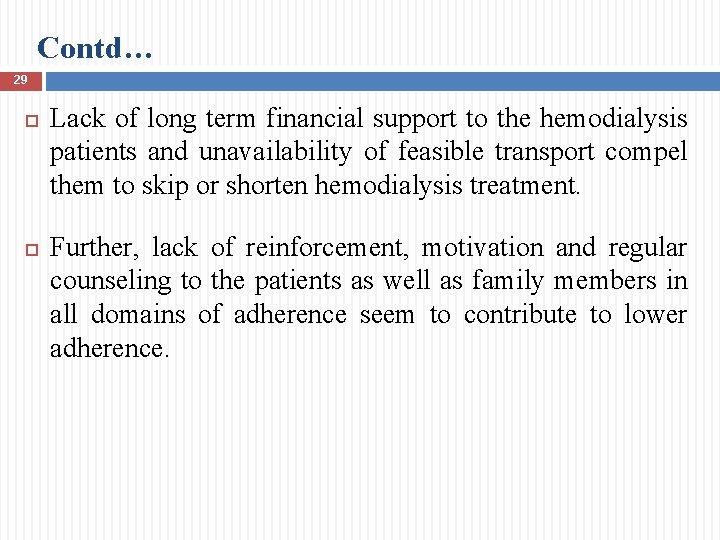
Contd. . 28 Similarly, IDWG was found to be influenced by age, comorbid diseases, duration of HD and fluid restriction. The patients undergoing hemodialysis had to spend more than an average Nepali's income in hemodialysis treatment. Patients did not perceive adherence important other than hemodialysis schedule and fluid restriction because of their immediate effect on their health.
Contd… 29 Lack of long term financial support to the hemodialysis patients and unavailability of feasible transport compel them to skip or shorten hemodialysis treatment. Further, lack of reinforcement, motivation and regular counseling to the patients as well as family members in all domains of adherence seem to contribute to lower adherence.
REFERENCES 30 Alkatheri, A. M. , Alyousif, S. M. , Alshabanah, N. , Albekairy, A. M. , Alharbi, S. , Alhejaili, F. , . . . Qandil, A. M. (2014). Medication adherence among adult patients on hemodialysis. Saudi Journal of Kidney Diseases and Transplantation, 25(4), 762. Retrieved from http: //www. sjkdt. org Arenas, M. D. , Malek, T. , Gil, M. T. , Moledous, A. , Alvarez-Ude, F. , & Reig-Ferrer, A. (2010). Challenge of phosphorus control in hemodialysis patients: a problem of adherence. J Nephrol, 23(5), 525 -534. Retrieved from http: //www. sin-italy. org/jnonline Chan, Y. M. , Zalilah, M. S. , & Hii, S. Z. (2012). Determinants of compliance behaviours among patients undergoing hemodialysis in Malaysia. Plo. S one, 7(8), e 41362. doi: 10. 1371/journal. pone. 0041362 Al-Khattabi, G. H. (2014). Prevalence of treatment adherence among attendance at hemodialysis in Makah. International Journal of Medical Science and Public Health, 3(5), 592 -598. doi: 10. 5455/ijmsph. 2014. 170320141 Kim, Y. , Evangelista, L. S. , Phillips, L. R. , Pavlish, C. , & Kopple, J. D. (2010). The End-Stage Renal Disease Adherence Questionnaire (ESRD-AQ): testing the psychometric properties in patients receiving in-center hemodialysis. Nephrology nursing journal: journal of the American Nephrology Nurses' Association, 37(4), 377. Retrieved from http: //www. ncbi. nlm. nih. gov/pmc/articles/PMC 3077091/
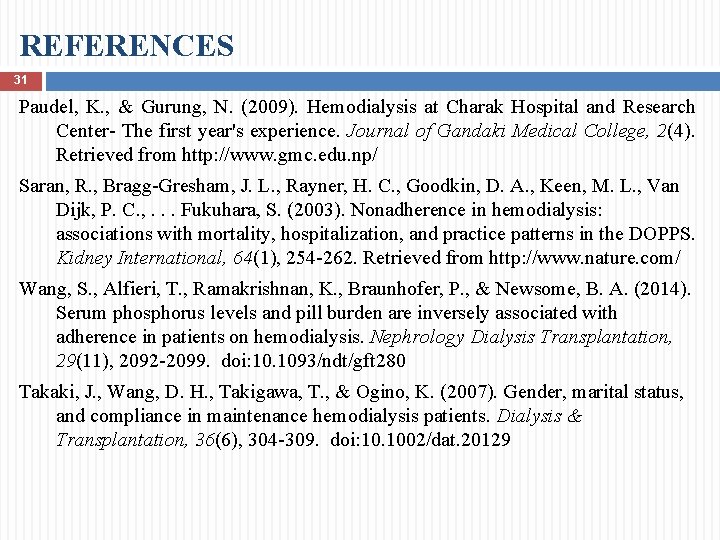
REFERENCES 31 Paudel, K. , & Gurung, N. (2009). Hemodialysis at Charak Hospital and Research Center- The first year's experience. Journal of Gandaki Medical College, 2(4). Retrieved from http: //www. gmc. edu. np/ Saran, R. , Bragg-Gresham, J. L. , Rayner, H. C. , Goodkin, D. A. , Keen, M. L. , Van Dijk, P. C. , . . . Fukuhara, S. (2003). Nonadherence in hemodialysis: associations with mortality, hospitalization, and practice patterns in the DOPPS. Kidney International, 64(1), 254 -262. Retrieved from http: //www. nature. com/ Wang, S. , Alfieri, T. , Ramakrishnan, K. , Braunhofer, P. , & Newsome, B. A. (2014). Serum phosphorus levels and pill burden are inversely associated with adherence in patients on hemodialysis. Nephrology Dialysis Transplantation, 29(11), 2092 -2099. doi: 10. 1093/ndt/gft 280 Takaki, J. , Wang, D. H. , Takigawa, T. , & Ogino, K. (2007). Gender, marital status, and compliance in maintenance hemodialysis patients. Dialysis & Transplantation, 36(6), 304 -309. doi: 10. 1002/dat. 20129
32 THANK YOU !!!
33 TABLES
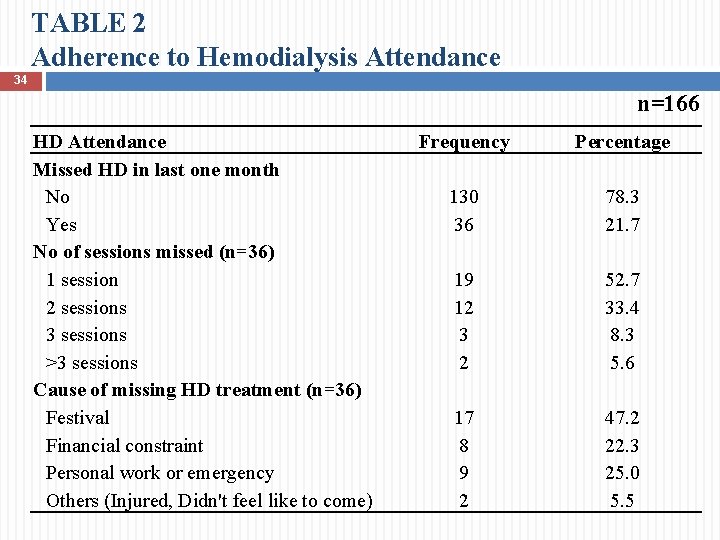
TABLE 2 Adherence to Hemodialysis Attendance 34 n=166 HD Attendance Missed HD in last one month No Yes No of sessions missed (n=36) 1 session 2 sessions 3 sessions >3 sessions Cause of missing HD treatment (n=36) Festival Financial constraint Personal work or emergency Others (Injured, Didn't feel like to come) Frequency 130 36 19 12 3 2 17 8 9 2 Percentage 78. 3 21. 7 52. 7 33. 4 8. 3 5. 6 47. 2 22. 3 25. 0 5. 5
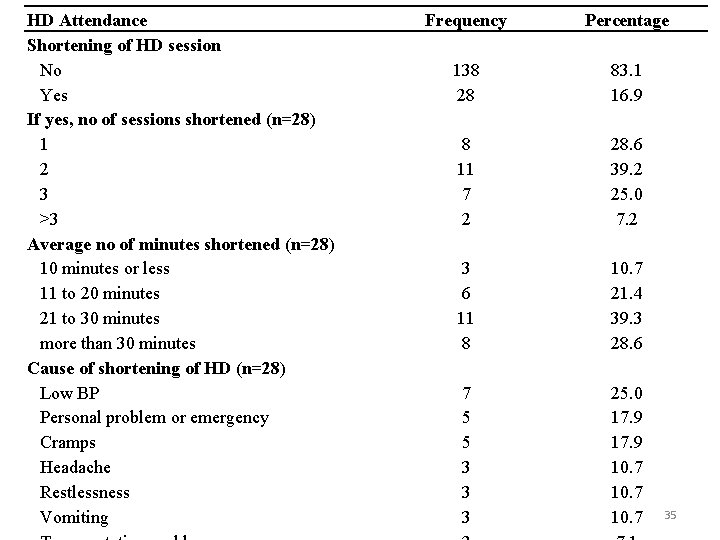
HD Attendance Shortening of HD session No Yes If yes, no of sessions shortened (n=28) 1 2 3 >3 Average no of minutes shortened (n=28) 10 minutes or less 11 to 20 minutes 21 to 30 minutes more than 30 minutes Cause of shortening of HD (n=28) Low BP Personal problem or emergency Cramps Headache Restlessness Vomiting Frequency 138 28 8 11 7 2 3 6 11 8 7 5 5 3 3 3 Percentage 83. 1 16. 9 28. 6 39. 2 25. 0 7. 2 10. 7 21. 4 39. 3 28. 6 25. 0 17. 9 10. 7 35
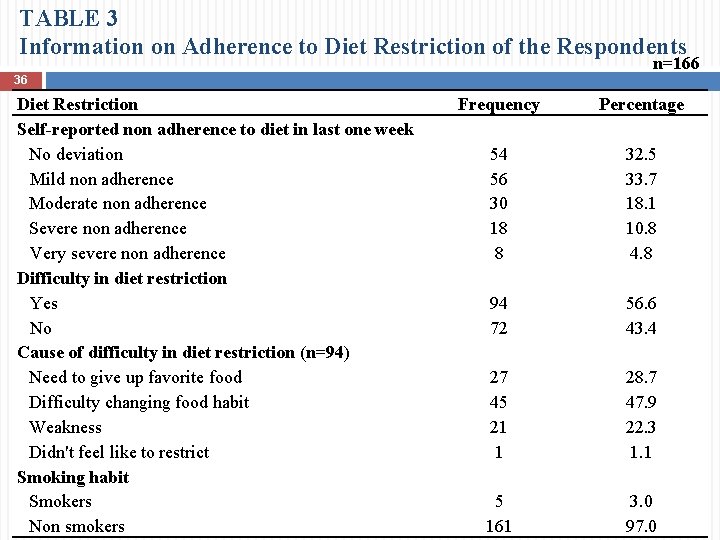
TABLE 3 Information on Adherence to Diet Restriction of the Respondents n=166 36 Diet Restriction Self-reported non adherence to diet in last one week No deviation Mild non adherence Moderate non adherence Severe non adherence Very severe non adherence Difficulty in diet restriction Yes No Cause of difficulty in diet restriction (n=94) Need to give up favorite food Difficulty changing food habit Weakness Didn't feel like to restrict Smoking habit Smokers Non smokers Frequency Percentage 54 56 30 18 8 94 72 27 45 21 1 5 161 32. 5 33. 7 18. 1 10. 8 4. 8 56. 6 43. 4 28. 7 47. 9 22. 3 1. 1 3. 0 97. 0
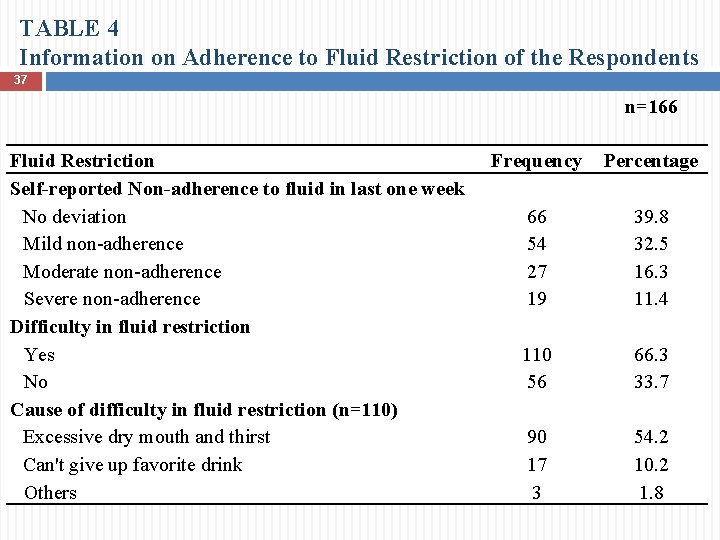
TABLE 4 Information on Adherence to Fluid Restriction of the Respondents 37 n=166 Fluid Restriction Frequency Percentage Self-reported Non-adherence to fluid in last one week No deviation 66 39. 8 Mild non-adherence 54 32. 5 Moderate non-adherence 27 16. 3 Severe non-adherence 19 11. 4 Difficulty in fluid restriction Yes 110 66. 3 No 56 33. 7 Cause of difficulty in fluid restriction (n=110) Excessive dry mouth and thirst 90 54. 2 Can't give up favorite drink 17 10. 2 Others 3 1. 8
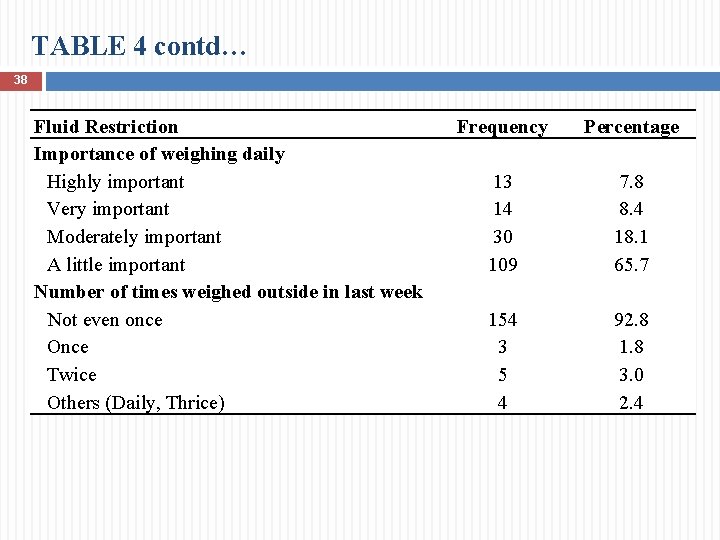
TABLE 4 contd… 38 Fluid Restriction Frequency Importance of weighing daily Highly important 13 Very important 14 Moderately important 30 A little important 109 Number of times weighed outside in last week Not even once 154 Once 3 Twice 5 Others (Daily, Thrice) 4 Percentage 7. 8 8. 4 18. 1 65. 7 92. 8 1. 8 3. 0 2. 4
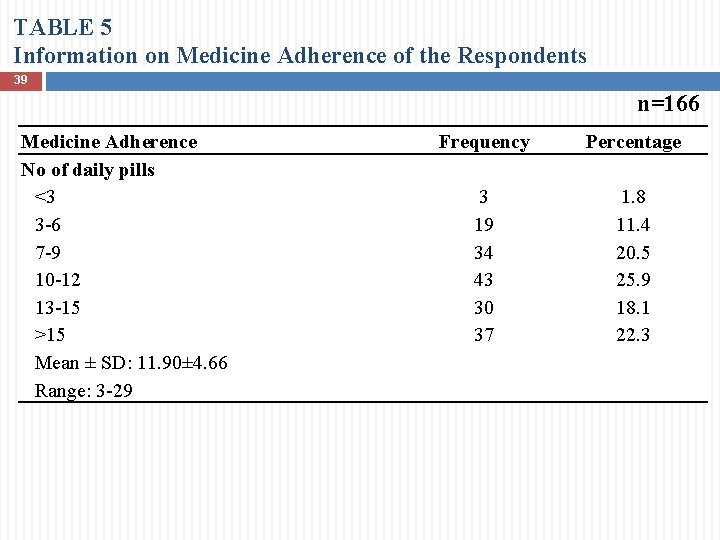
TABLE 5 Information on Medicine Adherence of the Respondents 39 n=166 Medicine Adherence No of daily pills <3 3 -6 7 -9 10 -12 13 -15 >15 Mean ± SD: 11. 90± 4. 66 Range: 3 -29 Frequency 3 19 34 43 30 37 Percentage 1. 8 11. 4 20. 5 25. 9 18. 1 22. 3
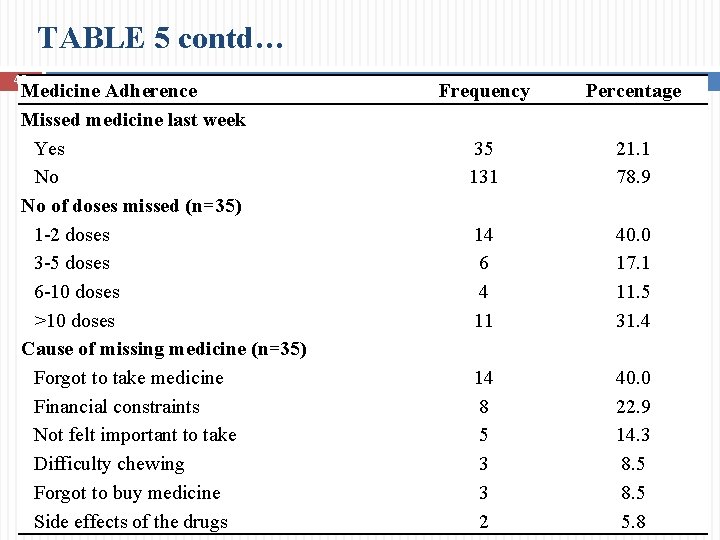
TABLE 5 contd… 40 Medicine Adherence Missed medicine last week Yes No No of doses missed (n=35) 1 -2 doses 3 -5 doses 6 -10 doses >10 doses Cause of missing medicine (n=35) Forgot to take medicine Financial constraints Not felt important to take Difficulty chewing Forgot to buy medicine Side effects of the drugs Frequency 35 131 14 6 4 11 14 8 5 3 3 2 Percentage 21. 1 78. 9 40. 0 17. 1 11. 5 31. 4 40. 0 22. 9 14. 3 8. 5 5. 8
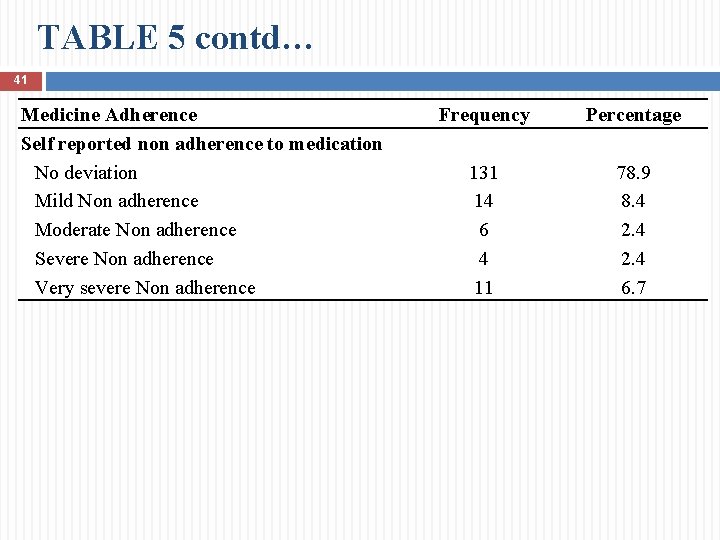
TABLE 5 contd… 41 Medicine Adherence Self reported non adherence to medication No deviation Mild Non adherence Moderate Non adherence Severe Non adherence Very severe Non adherence Frequency 131 14 6 4 11 Percentage 78. 9 8. 4 2. 4 6. 7
TABLE 6 Clinical Measures of Non adherence of the Respondents 42 Clinical Measures Serum Potassium (n=47) ≤ 6. 0 m. Eq/L >6. 0 m. Eq/L Mean Range Serum Phosphorus (n=47) ≤ 4. 8 mg/d. L >4. 8 mg/d. L Mean Range Interdialytic Weight Gain (n=165) ≤ 5. 7% of dry weight >5. 7% of dry weight Mean Range Frequency Percentage 39 83. 0 8 17. 0 5. 21± 0. 88 3. 1 -7. 3 12 25. 5 35 74. 5 5. 53± 1. 51 3. 0 -11. 5 84 50. 9 81 49. 1 5. 52± 2. 24 0. 00 -12. 26
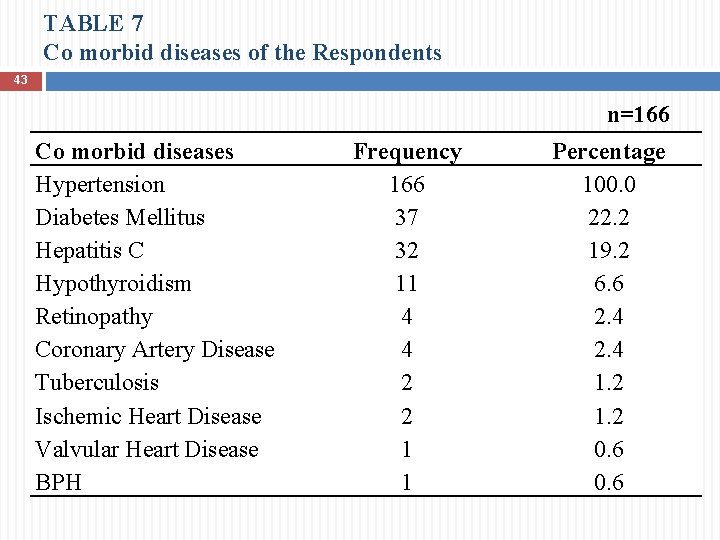
TABLE 7 Co morbid diseases of the Respondents 43 n=166 Co morbid diseases Hypertension Diabetes Mellitus Hepatitis C Hypothyroidism Retinopathy Coronary Artery Disease Tuberculosis Ischemic Heart Disease Valvular Heart Disease BPH Frequency 166 37 32 11 4 4 2 2 1 1 Percentage 100. 0 22. 2 19. 2 6. 6 2. 4 1. 2 0. 6