
Treating Infrapopliteal Disease Using a Primarily Retrograde Technique



- Slides: 9
Treating Infrapopliteal Disease Using a Primarily Retrograde Technique Authors: Amit Nanavati, MD, Sarang Mangalmurti, MD Presented by: Amit Nanavati, MD Cardiology Fellow No disclosures
Case Presentation 56 year-old male with HTN, DM, dyslipidemia and a non-healing ulcer at the site of a previous right 3 rd-5 th digit amputation presents for salvage options ■ Previous angiogram demonstrates right 95% SFA stenosis with poor distal runoff. ■ PTA was previously performed to the SFA, however an antegrade attempt to revascularize the anterior tibial artery failed. ■ Thus, a retrograde approach was undertaken. ■
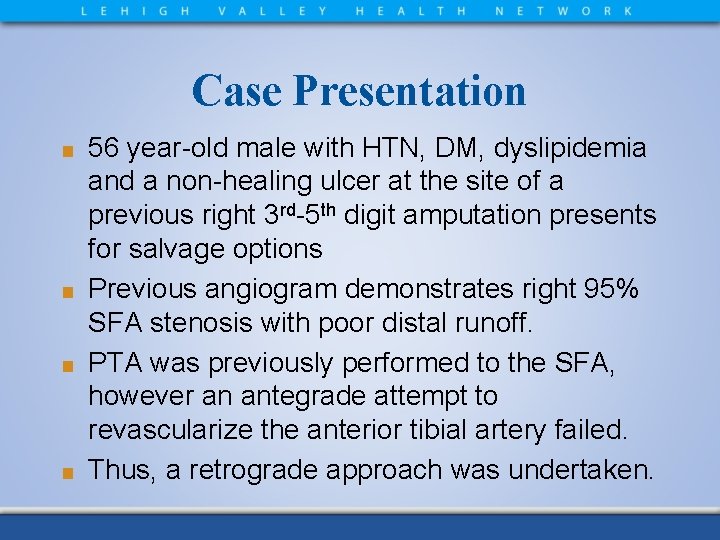
Initial Angiogram Left: Angiogram demonstrates proximal anterior tibial occlusion with distal reconstitution. Significant collateralization of the mid and distal anterior tibial artery is seen. The findings correspond to the angiosomal distribution of patient’s non-healing ulcers Right: The distal anterior tibial artery and dorsalis pedis artery are free of severe stenosis
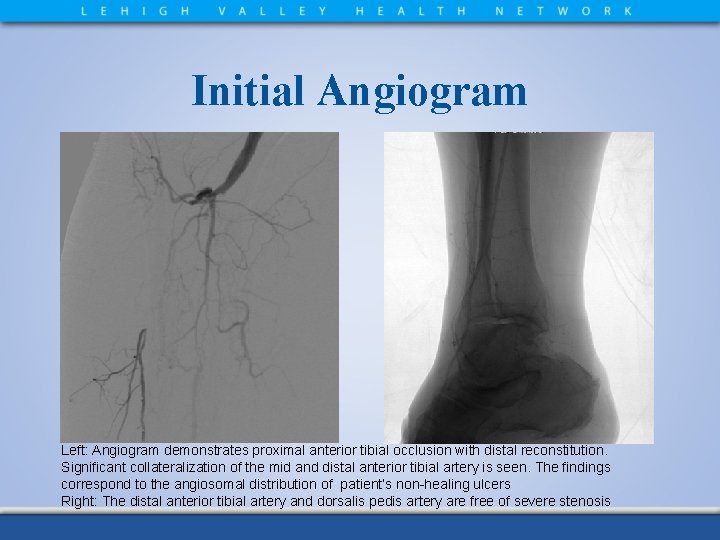
Retrograde Access Left: Roadmapping was used to obtain dorsalis pedis access. Right: A 0. 014” Asahi Confianza Pro 12 (Abbott) wire was advanced through the dorsalis pedis artery into the anterior tibial artery. No sheath was used.
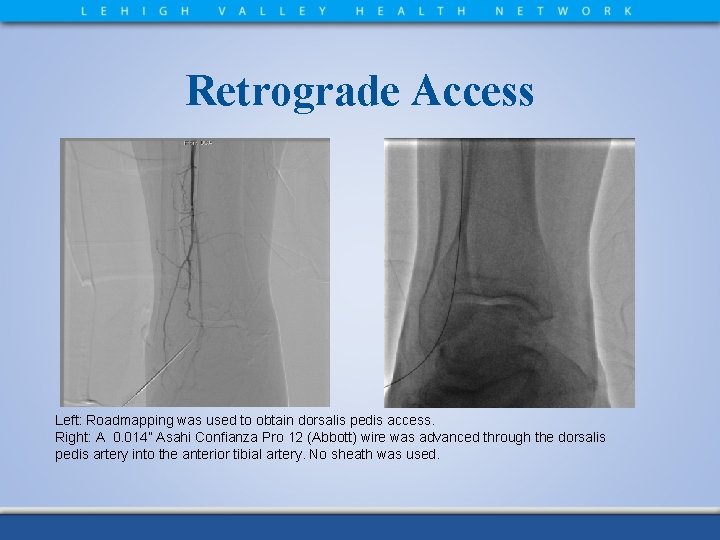
Crossing the Lesion Left: A Quick-Cross (Spectranetics) support catheter was advanced both antegrade and retrograde. The retrograde wire entered the subintimal space. However, the antegrade wire did not. Right: A Crosser 14 S (Bard) atherectomy device was then inserted sheathlessly into the pedal access and used to cross the anterior tibial occlusion retrograde after a stiff wire was unsuccessful. The wire then re-entered the lumen proximal to the lesion and was exteriorized via the femoral access.
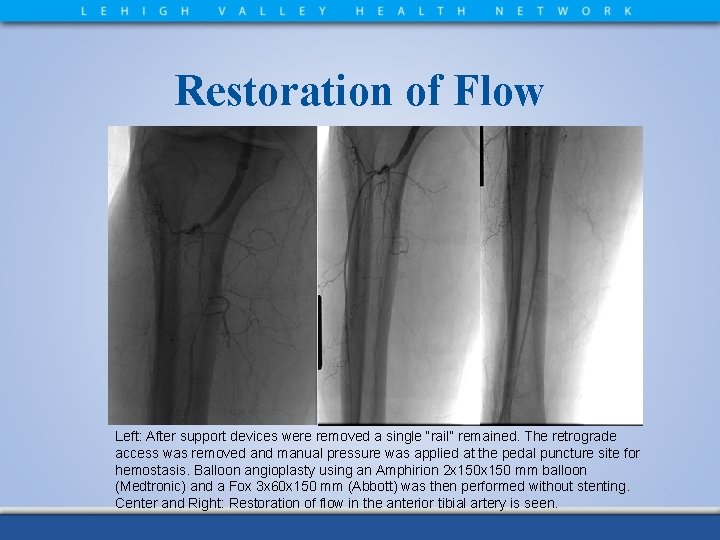
Restoration of Flow Left: After support devices were removed a single “rail” remained. The retrograde access was removed and manual pressure was applied at the pedal puncture site for hemostasis. Balloon angioplasty using an Amphirion 2 x 150 mm balloon (Medtronic) and a Fox 3 x 60 x 150 mm (Abbott) was then performed without stenting. Center and Right: Restoration of flow in the anterior tibial artery is seen.
Discussion An ambiguous or calcified proximal cap and the presence of multiple lesions 1 can contribute to the known 20% failure rate 2 of antegrade access. ■ Crossing lesions distally can also prove challenging■ – Subintimal approaches including SAFARI, CART, access via transcollaterals and an antegrade-retrograde approach have all been described. 3, 4 – However, most conventional approaches require subintimal antegrade access, which in this case was not possible – thus a primary retrograde approach was used. – Crossing devices can be used from a retrograde approach ■ Few complications are seen with pedal access 2 1. Endovascular Today. Jan 2012. 2. J Endovasc Ther. 2008; 15 (5). 3. Cath Cardio Int. 2011 (77). 4. Rev in Card Med 2011: 12 (1).
Conclusions When an antegrade approach is anatomically unfavorable, a primary retrograde approach can be successfully and safely used. ■ Treatment should be directed at the angiosome responsible for symptoms ■ Thus, a directed retrograde approach, as described here, can be an effective means to limb salvage ■
Contact Information Amit Nanavati Cardiology Fellow Lehigh Valley Health Network Allentown, PA Amit_N. Nanavati@lvh. com