
TREATIES THE INDIAN ACT TREATIES First Nations people
- Slides: 8
TREATIES & THE INDIAN ACT
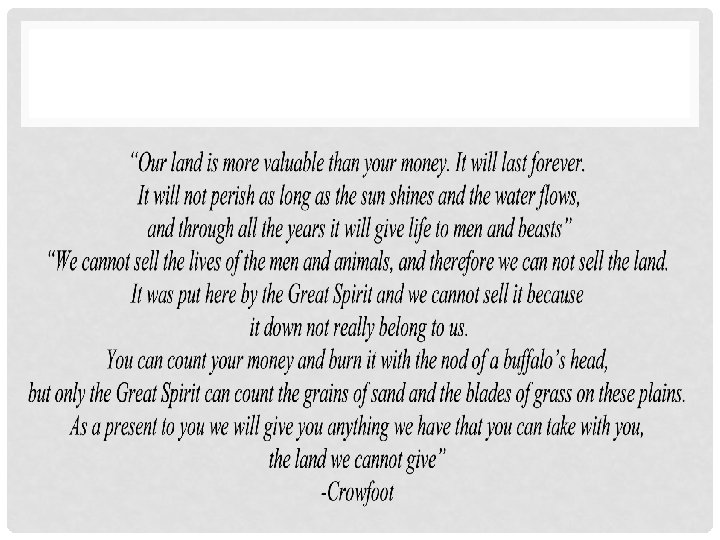
TREATIES • -First Nations people believe that the land is alive, their “mother” who feeds and shelters them • -When The First Nations people signed Treaties with the Canadian Government they thought that they were ‘sharing’ the land resources and to live and trade in friendship and peace. • -Many treaties were made of “verbal promises”. • Therefore, one sided because in Aboriginal customs Oral contracts were valid, which was not the case with Europeans.
• -Small portions of land were set aside as their new “homeland”. • They were called “Reserves” • -Reserves served 2 purposes: • 1) to free up large land areas from First Nation’s control • 2) provide a place of ‘regulated’ settlement where they could be ‘made over’ into Europeanized people. • -With the help of missionaries, teachers and businesses, Government officials • took ‘charge’ of the lives of the First Nations people. • -Change, once voluntary, was now being forced upon them – Assimilation
THE INDIAN ACT 1876 • Most First Nations people across Canada were enrolled in First Nations communities or bands and reserves • The BNA Act of 1867 made the Federal Govt. responsible for the F. N. ’s people and lands. • The Govt. then passed the Indian Act in order to have one overriding law to govern and control F. N. ’s. This law gave a means to manage Indian Affairs throughout the Country. (It was meant to consolidate all pre-existing laws concerning First Nations people into a single document. )
• The Act promoted Assimilation and was reflective of a very “Eurocentric” attitude that traditional culture should be abandoned in favour of European based culture. • The Act was a “paternalistic” act in which the government could make changes to the act without consultation from the First Nations along with providing no rights.
MAIN PROVISIONS • The First Nations were considered `wards`of the state meaning they would not have the same rights to citizenship as other Canadians. • First Nations leadership was discouraged • Defined Ìndian Status`- defined as a person who legally enrolled as Aboriginal belonged, belonged to a band lived on reserve land • Women who married non-Aboriginal lost their status (as did their children) • Children and later generations had to be direct descendants on the father’s side of the family to have `Indian Status` • • Government controlled financial matters on the reserve Children were required to attend residential schools Some traditional ceremonies were banned Indian Agents had authority to manage reserves and enforce Indian Act policies.
GOALS OF THE ACT • The assimilation of the First Nations through enfranchisement http: //www. thecanadianencyclopedia. com/articles/enfranchisement • To manage First Nation communities and reserves • To define who could and could not be classified as a First Nations person