
Treasure Defense By Jordan Ben Jiawen Rilun Libbi
Treasure Defense By Jordan, Ben, Jiawen, Rilun, & Libbi
Agenda 1. Game Overview ● Class relationships - UML Diagram 2. Game Demonstration ● ● How to play Backdoor to show cool features 3. Analysis ● ● Completed requirements C++11 Features 4. Summary/Suggestions ● Reflection
About the Game ● Setting: a tower defense type game where the background is a grid of a beach. The left side is a cave with treasure, and enemies approach from the right. ● Goal: the overall goal of the game is to protect the treasure as long as possible against the waves of enemies by placing cannons. ● Currency: coins are gained by killing monsters. The coins will be used for purchase of more cannons or upgraded cannons. ● Points: points are related to the length of survival. Every thirty seconds, players reach new levels where the game becomes more difficult.
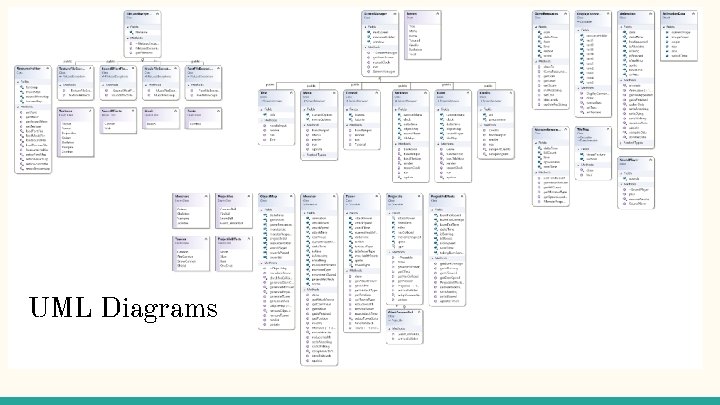
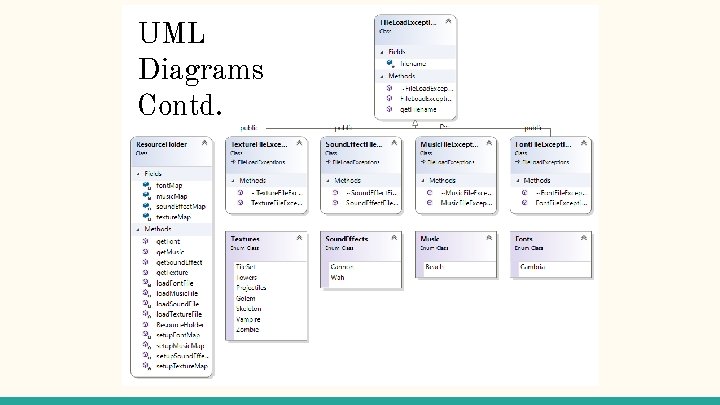
UML Diagrams
UML Diagrams Contd.
UML Diagrams Contd.
UML Diagrams Contd.
UML Diagrams Contd.
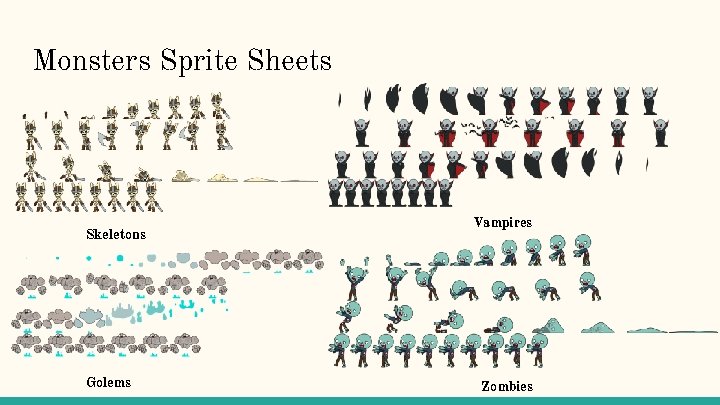
Monsters Sprite Sheets Skeletons Golems Vampires Zombies
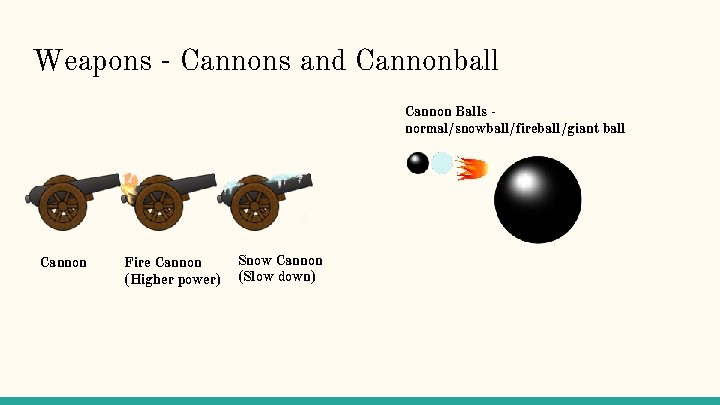
Weapons - Cannons and Cannonball Cannon Balls normal/snowball/fireball/giant ball Cannon Fire Cannon (Higher power) Snow Cannon (Slow down)
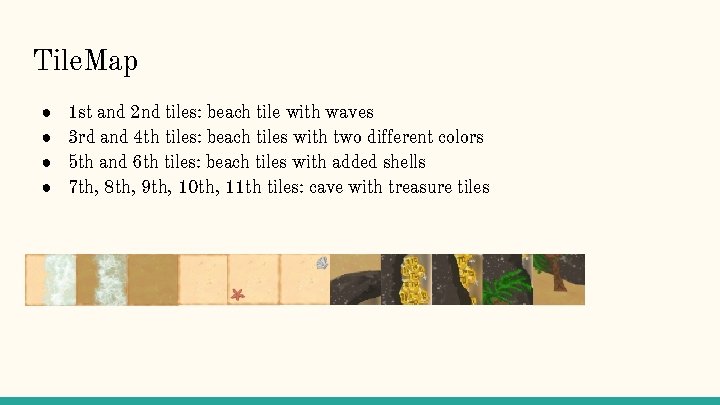
Tile. Map ● ● 1 st and 2 nd tiles: beach tile with waves 3 rd and 4 th tiles: beach tiles with two different colors 5 th and 6 th tiles: beach tiles with added shells 7 th, 8 th, 9 th, 10 th, 11 th tiles: cave with treasure tiles
Backdoor Option ● Debugging ○ ○ Jump to different game states Two game loops ● Game balance ○ ○ Resource management Difficulty ■ Enemy movement speed ■ Enemy frequency
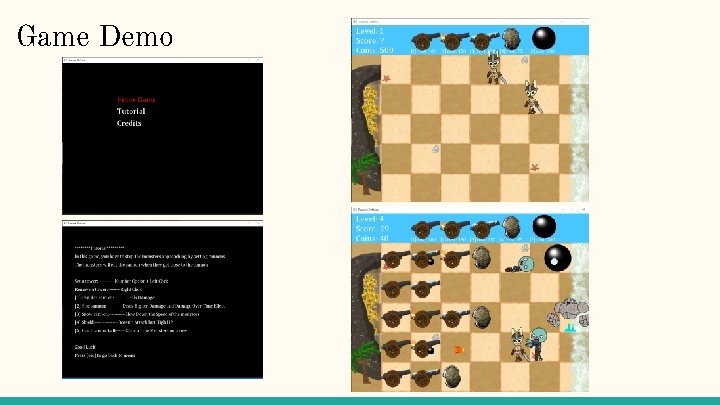
Game Demo
Completed Requirements ● ● ● ● Libraries & Exceptions Polymorphism Namespaces Sound STL Containers - Vector, List, Map Overloaded Insertion Operators C++11 Features Style Guidelines
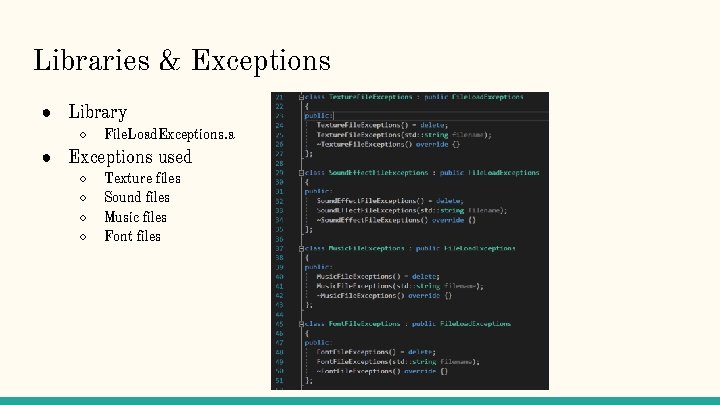
Libraries & Exceptions ● Library ○ File. Load. Exceptions. a ● Exceptions used ○ ○ Texture files Sound files Music files Font files
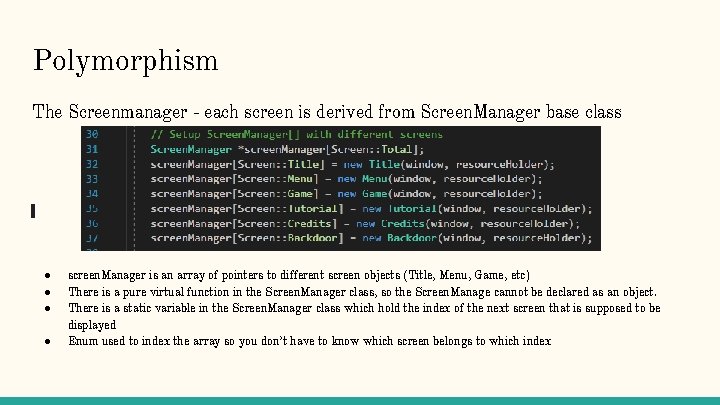
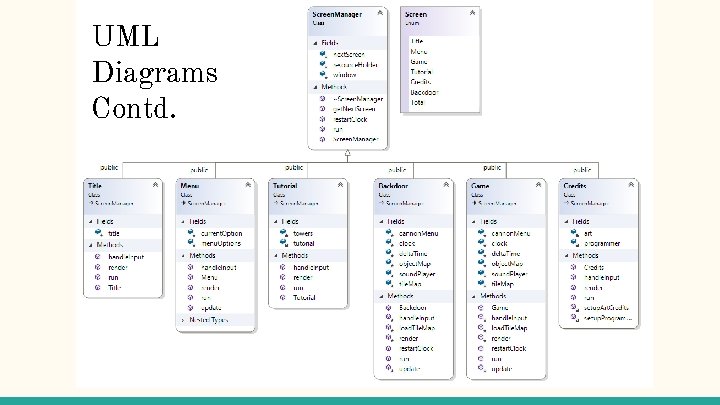
Polymorphism The Screenmanager - each screen is derived from Screen. Manager base class ● ● screen. Manager is an array of pointers to different screen objects (Title, Menu, Game, etc) There is a pure virtual function in the Screen. Manager class, so the Screen. Manage cannot be declared as an object. There is a static variable in the Screen. Manager class which hold the index of the next screen that is supposed to be displayed Enum used to index the array so you don’t have to know which screen belongs to which index
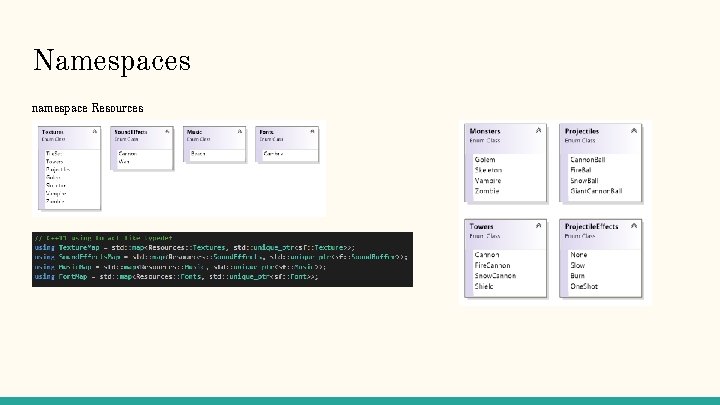
Namespaces namespace Resources namespace Game. Objects
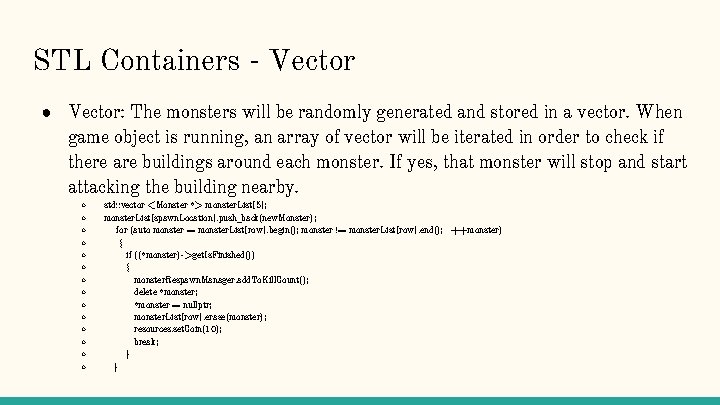
STL Containers - Vector ● Vector: The monsters will be randomly generated and stored in a vector. When game object is running, an array of vector will be iterated in order to check if there are buildings around each monster. If yes, that monster will stop and start attacking the building nearby. ○ ○ ○ ○ std: : vector <Monster *> monster. List[5]; monster. List[spawn. Location]. push_back(new. Monster); for (auto monster = monster. List[row]. begin(); monster != monster. List[row]. end(); ++monster) { if ((*monster)->get. Is. Finished()) { monster. Respawn. Manager. add. To. Kill. Count(); delete *monster; *monster = nullptr; monster. List[row]. erase(monster); resources. set. Coin(10); break; } }
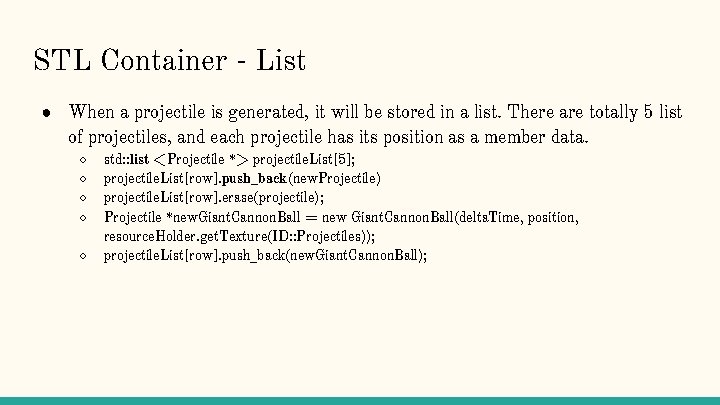
STL Container - List ● When a projectile is generated, it will be stored in a list. There are totally 5 list of projectiles, and each projectile has its position as a member data. ○ ○ ○ std: : list <Projectile *> projectile. List[5]; projectile. List[row]. push_back(new. Projectile) projectile. List[row]. erase(projectile); Projectile *new. Giant. Cannon. Ball = new Giant. Cannon. Ball(delta. Time, position, resource. Holder. get. Texture(ID: : Projectiles)); projectile. List[row]. push_back(new. Giant. Cannon. Ball);
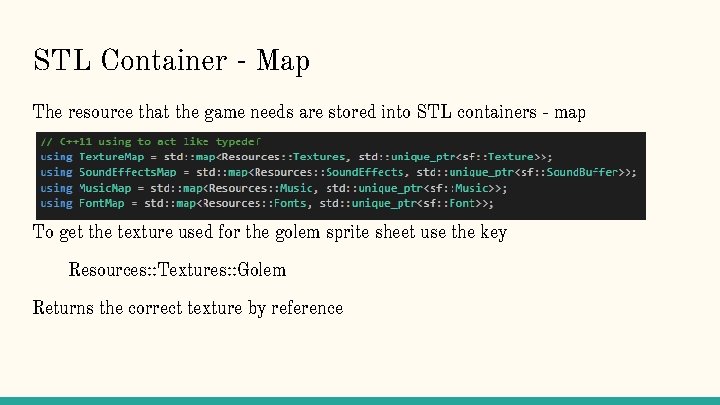
STL Container - Map The resource that the game needs are stored into STL containers - map To get the texture used for the golem sprite sheet use the key Resources: : Textures: : Golem Returns the correct texture by reference
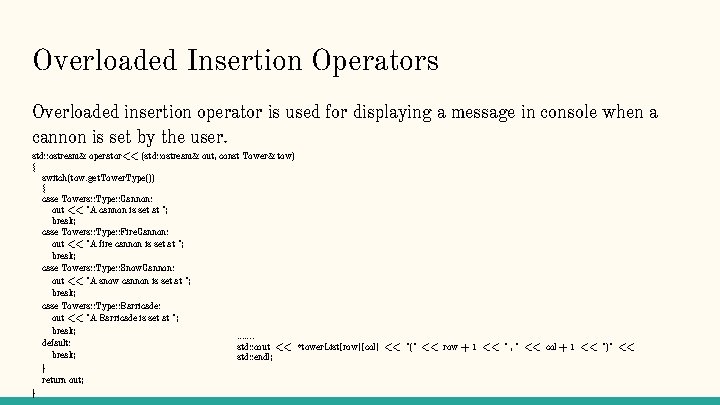
Overloaded Insertion Operators Overloaded insertion operator is used for displaying a message in console when a cannon is set by the user. std: : ostream& operator<< (std: : ostream& out, const Tower& tow) { switch(tow. get. Tower. Type()) { case Towers: : Type: : Cannon: out << "A cannon is set at "; break; case Towers: : Type: : Fire. Cannon: out << "A fire cannon is set at "; break; case Towers: : Type: : Snow. Cannon: out << "A snow cannon is set at "; break; case Towers: : Type: : Barricade: out << "A Barricade is set at "; break; ……. default: std: : cout << *tower. List[row][col] << "(" << row + 1 << " , " << col + 1 << ")" << break; std: : endl; } return out; }
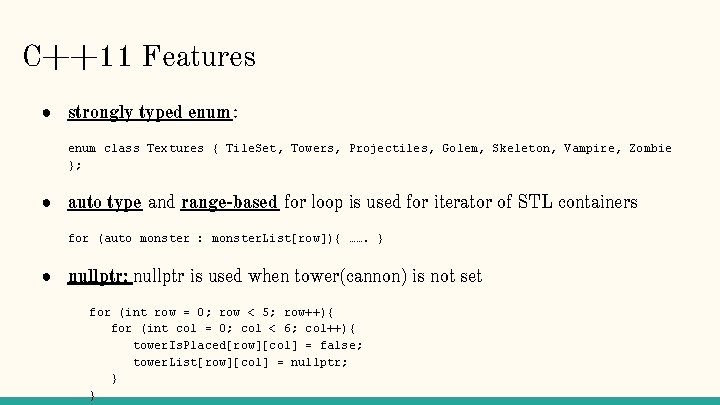
C++11 Features ● strongly typed enum : enum class Textures { Tile. Set, Towers, Projectiles, Golem, Skeleton, Vampire, Zombie }; ● auto type and range-based for loop is used for iterator of STL containers for (auto monster : monster. List[row]){ ……. } ● nullptr: nullptr is used when tower(cannon) is not set for (int row = 0; row < 5; row++){ for (int col = 0; col < 6; col++){ tower. Is. Placed[row][col] = false; tower. List[row][col] = nullptr; } }
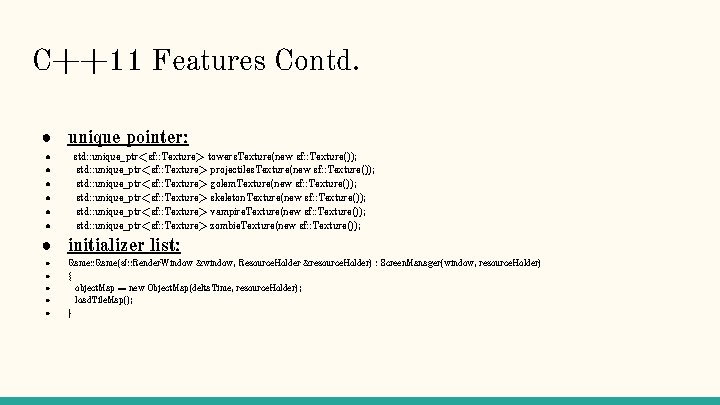
C++11 Features Contd. ● unique pointer: ● ● ● std: : unique_ptr<sf: : Texture> towers. Texture(new sf: : Texture()); std: : unique_ptr<sf: : Texture> projectiles. Texture(new sf: : Texture()); std: : unique_ptr<sf: : Texture> golem. Texture(new sf: : Texture()); std: : unique_ptr<sf: : Texture> skeleton. Texture(new sf: : Texture()); std: : unique_ptr<sf: : Texture> vampire. Texture(new sf: : Texture()); std: : unique_ptr<sf: : Texture> zombie. Texture(new sf: : Texture()); ● initializer list: ● ● ● Game: : Game(sf: : Render. Window &window, Resource. Holder &resource. Holder) : Screen. Manager(window, resource. Holder) { object. Map = new Object. Map(delta. Time, resource. Holder); load. Tile. Map(); }
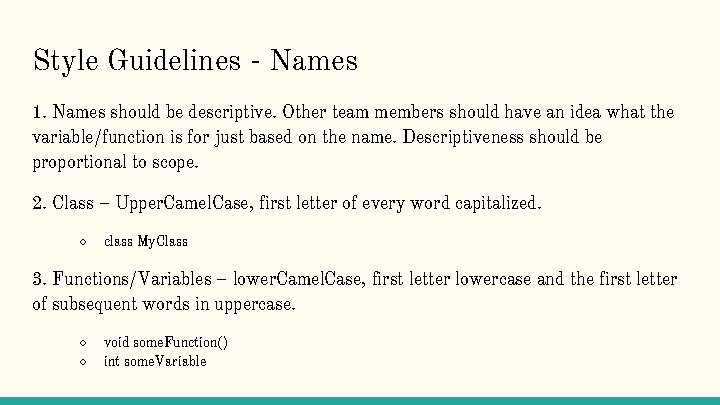
Style Guidelines - Names 1. Names should be descriptive. Other team members should have an idea what the variable/function is for just based on the name. Descriptiveness should be proportional to scope. 2. Class – Upper. Camel. Case, first letter of every word capitalized. ○ class My. Class 3. Functions/Variables – lower. Camel. Case, first letter lowercase and the first letter of subsequent words in uppercase. ○ ○ void some. Function() int some. Variable
Style Guidelines - Names Contd. 4. Constants – written in uppercase and characters separated by underscores. ○ int SOME_CONSTANT 5. Exdented indentation style - This style puts the brace associated with a control statement on the next line, indented to the same level as the control statement. Statements within the braces are indented to the next level.
Style Guidelines - Indentation and Spacing 6. Use curly braces for one statement loops/conditional statements. ○ ○ while (x==y) { something(); ○ } Optional to put short if statements body on the same line 7. Braces without any contents may be placed on the same line. ○ Thing: : ~Thing() {}
Style Guidelines - Files 8. C++ sources files must have a “. cpp” extension. C++ header files must have a “. h” extension. 9. Header files must have include guards. ○ ○ ○ #ifndef #define #endif 10. System header files must be included with <>; and project headers files with “”. 11. Use static_cast, const_cast, reinterpret_cast, and static_cast. Do not use C style casts.
Summary & Suggestions ● What worked? ● What didn't work? ● What did you learn? Github, SFML, Read different codes, Use group member’s code, Get used to different coding style. . . ● What to improve on? better graphics, more sound effects, tracking high score, ● Was the project a good idea? Worth the time? YES! ● What do you thinking of working in a group and depending on others? ● What are you most proud of?
- Slides: 28