
Travelling overseas on the Big Experience Australian Customs
Travelling overseas on the Big Experience
Australian Customs and Border Protection
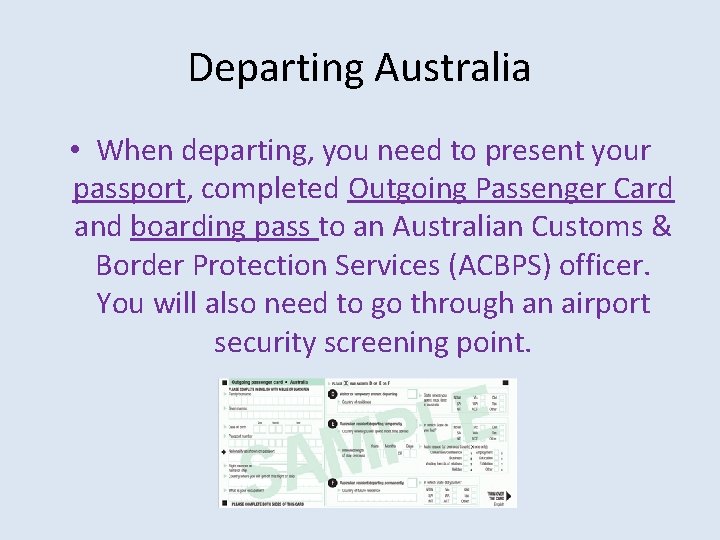
Departing Australia • When departing, you need to present your passport, completed Outgoing Passenger Card and boarding pass to an Australian Customs & Border Protection Services (ACBPS) officer. You will also need to go through an airport security screening point.
Before you go on each international flight § Liquids and gels – pack in your checked luggage wherever possible. Pack antibacterial hand wash, eg Aquium gel in your checked luggage. Avoid aerosols altogether. § Pack sharp items in your checked luggage. (nail scissors, nail files etc) § Medication – pack enough for the flight (plus possible delays) in your carry-on luggage, the rest in your checked luggage (good idea to have prescription or doctor’s letter).
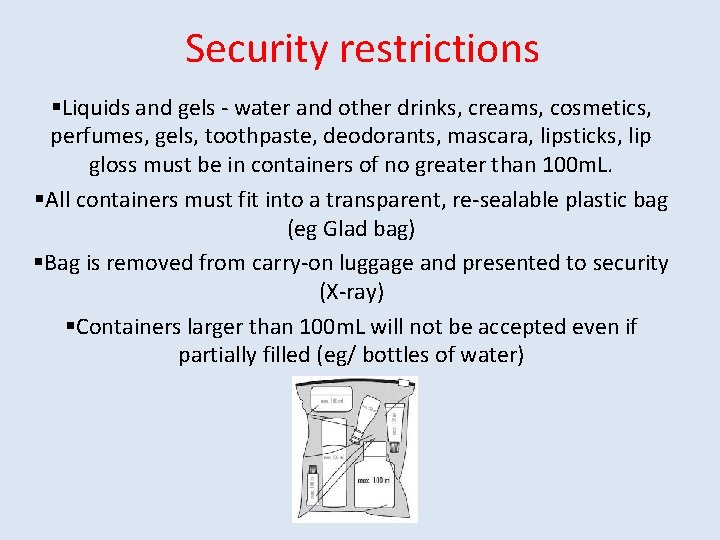
Security restrictions §Liquids and gels - water and other drinks, creams, cosmetics, perfumes, gels, toothpaste, deodorants, mascara, lipsticks, lip gloss must be in containers of no greater than 100 m. L. §All containers must fit into a transparent, re-sealable plastic bag (eg Glad bag) §Bag is removed from carry-on luggage and presented to security (X-ray) §Containers larger than 100 m. L will not be accepted even if partially filled (eg/ bottles of water)
Arrival back in Australia All arriving passengers must complete an Incoming Passenger Card. Once you arrive in Australia, there are three key steps before you leave the airport: • Clear passport control • Collect your baggage • Proceed to the ACBPS and Department of Agriculture checkpoint
CUSTOMS & BORDER PROTECTION • Techniques used to target travellers include using intelligence, computer-based profiling and analysis, detector dogs, Smartgate, Closed Circuit Television (CCTV) monitoring, basic questioning and other means. • Customs officers at airports, in addition to performing basic immigration control, assess passengers’ arrival and departure cards, and have the authority to scan and search passenger baggage. Quarantine risk material may be referred to Australian Quarantine and Inspection Service officers.
CUSTOMS & BORDER PROTECTION What you can’t bring into Australia • Narcotics • Firearms, weapons and ammunition (including real and replica firearms and BB air guns. Also real or replica paintball markers, blowpipes, all knives, nunchucks, slingshots, crossbows, electric shock devices, knuckle dusters, laser pointers, fireworks). Refillable cigarette lighters (eg Zippo) purchased as gifts overseas have been confiscated in the past. BE WARNED • Dangerous goods such as BB guns, laser pointers, and electric shock devices will be confiscated and you could be fined or sent to jail. If you can’t buy it legally in Australia, you can’t bring it in.
ALSO PROHIBITED • Protected wildlife - eg coral and conch shells • Under 18 – alcohol and tobacco (cannot buy duty-free for parents) • Counterfeit goods…from past experience it is okay if you have a few DVDs, a couple of watches and handbags etc. Just make sure they are not in commercial quantities!
YOU MUST DECLARE the following; that is tick Yes on your incoming passenger card: § Goods that may be prohibited or subject to restrictions. (such as medicines, steroids, weapons etc. ) Customs will check the following items. They will only be confiscated if they are perceived as a threat to Australia. However customs officers become VERY upset if they find items in your luggage that you should have declared. § Any food - includes dried, fresh, preserved, cooked, uncooked. § Wooden articles, plants, parts of plants, traditional medicines, herbs, seeds, bulbs, straw, nuts. Also bamboo or anything made from plant material. § Animals, parts of animals, animal products including equipment, pet food, eggs, birds, fish, insects, shells, bee products. §Pack items you will have to declare at the top of your suitcase so you don’t have to empty it to find the declared items.
ADVICE FOR BEHAVIOUR IN AIRPORTS §Some countries are very strict about what you can carry in your luggage, both checked and carry-on. Your luggage may be X-rayed. Carry no replica weapons, cigarette lighters etc that may look as if they pose a threat to security. §Never lie to customs or security agents overseas or in Australia. §Never make jokes about security matters to airline staff, customs or security agents. §Never leave your luggage unattended in an airport. §It is sensible to lock your luggage and to carry a spare lock. §Year 9 students expect to be protected by their parents, or in this case your teachers if they do anything wrong. We can do little to help you if you breach customs regulations here or overseas.
Some top tips for the B. E. 1. Wash your hands, particularly before you eat. Carry your Aquium or similar gel with you and use it regularly. 2. Keep your mouth closed in the shower. 3. Be open minded; try different foods. 4. Be flexible with room mates. You might meet your new best friend. 5. Budget carefully. It can take a few days to top up your cash card. Don’t withdraw several small amounts as you are charged each time.
Top Tips 6. Travel lightly. Follow the packing list. Pack your own luggage! 7. Wash clothes, but don’t wash them the night before you are due to move on. Check your itinerary and plan. Learn how to wash by hand or find out how much the hotel charges. 8. Drink plenty of bottled water. 9. Get plenty of sleep.
Top Tips 10. Look after each other and your teachers. 11. Travel as unobtrusively as possible. 12. When shopping, if you see something you wish to buy, purchase it. Don’t wait to ‘get it later’…you may not have that opportunity. 13. Make the most of every moment – chances are you may never be there again.
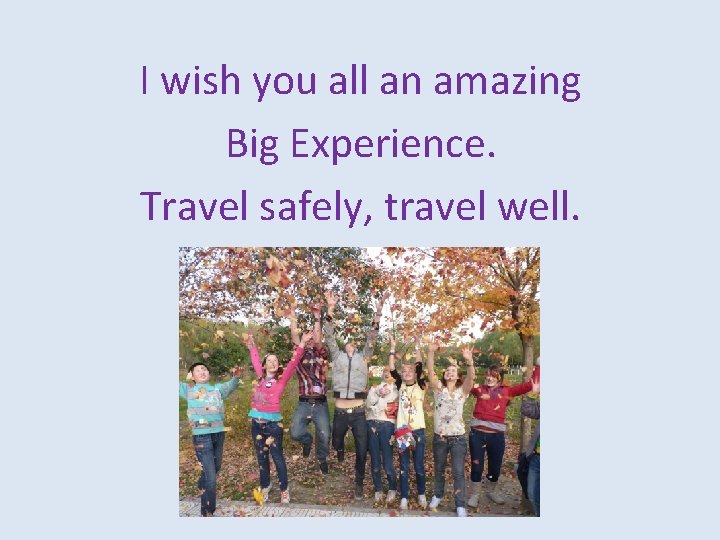
I wish you all an amazing Big Experience. Travel safely, travel well.
- Slides: 15