
Traumatic Brain Injury Zara Melikyan Ph D Fall
Traumatic Brain Injury Zara Melikyan, Ph. D. Fall 2015

Lecture Plan • • • TBI problem significance TBI causes Definitions: TBI, concussion, DAI TBI mechanism TBI classification TBI symptoms TBI diagnosis TBI treatment, rehabilitation TBI prognosis TBI prevention

TBI Problem Significance • TBI is a major social, economic, health problem • Major cause of death and disability – Epidemiology in the US • • 52, 000 deaths 1. 5 million head injuries reported in ER 5. 3 million (2%) with TBI-related disabilities Moderate & severe head injury associated with increased risk of AD
TBI Problem Significance – Mostly affects children and young adults – Males > females sustain TBI – Milder cases undiagnosed and untreated – May cause long-lasting/disabling deficits
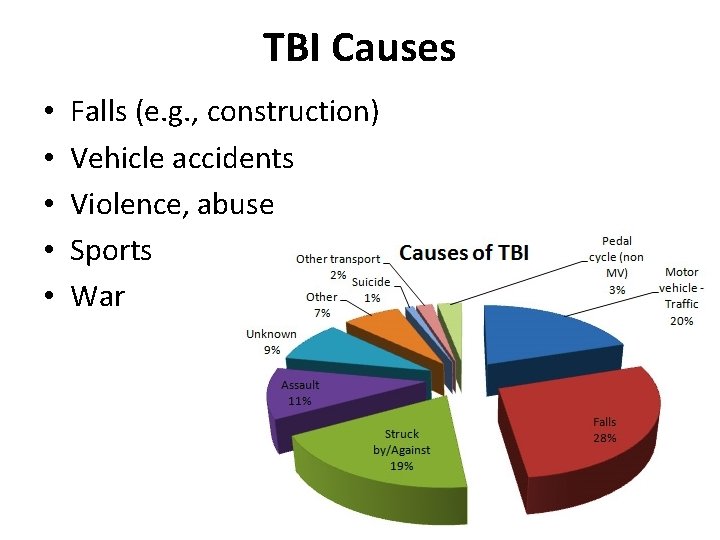
TBI Causes • • • Falls (e. g. , construction) Vehicle accidents Violence, abuse Sports War
Definitions • Traumatic brain injury = intracranial injury – injury to the brain • Head injury – injury to the brain + other parts of the head (i. e. scalp, scull) • Concussion – (from “concutere” = shake violently) most common type of TBI • Diffuse axonal injury – brain injury, damage to white matter, brain tracts
TBI Mechanism External force injures the brain: • Sudden acceleration/deceleration within the cranium – Impact – Blast waives – Penetration • Impact + acceleration
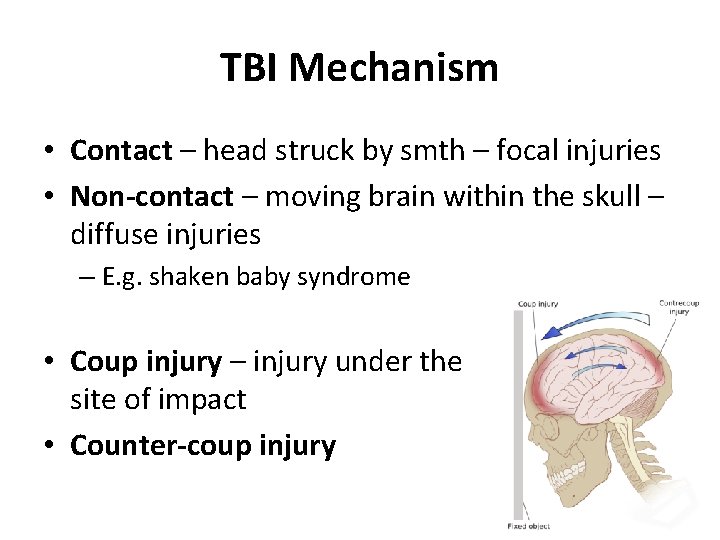
TBI Mechanism • Contact – head struck by smth – focal injuries • Non-contact – moving brain within the skull – diffuse injuries – E. g. shaken baby syndrome • Coup injury – injury under the site of impact • Counter-coup injury
TBI Mechanism • • Type of force Direction of forces Intensity of forces Duration of forces Types of forces: • Angular • Rotational • Shear • Translational

Lecture Plan • • • TBI problem significance TBI causes Definitions: TBI, concussion, DAI TBI mechanism TBI classification TBI symptoms TBI diagnosis TBI treatment, rehabilitation TBI prognosis TBI prevention
Primary and Secondary TBI • Primary injury – damage that occurs at the moment of trauma (tissues and blood vessels stretched, compressed, torn) • Secondary injury – biochemical cascade of events minutes – days following injury: – Alterations in cerebral blood flow: ischemia, hypoxia – Edema – Changes of pressure within the scull – BBB damage
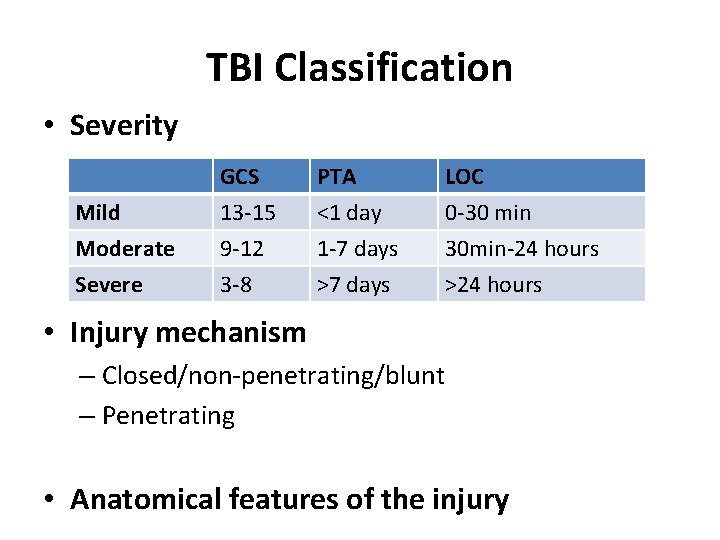
TBI Classification • Severity Mild Moderate Severe GCS 13 -15 9 -12 3 -8 PTA <1 day 1 -7 days >7 days LOC 0 -30 min 30 min-24 hours >24 hours • Injury mechanism – Closed/non-penetrating/blunt – Penetrating • Anatomical features of the injury
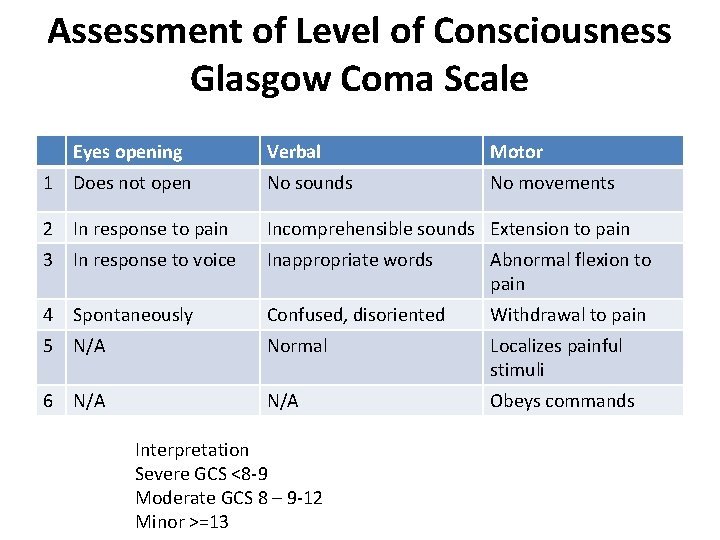
Assessment of Level of Consciousness Glasgow Coma Scale Eyes opening Verbal Motor 1 Does not open No sounds No movements 2 In response to pain Incomprehensible sounds Extension to pain 3 In response to voice Inappropriate words Abnormal flexion to pain 4 Spontaneously Confused, disoriented Withdrawal to pain 5 N/A Normal Localizes painful stimuli 6 N/A Obeys commands Interpretation Severe GCS <8 -9 Moderate GCS 8 – 9 -12 Minor >=13
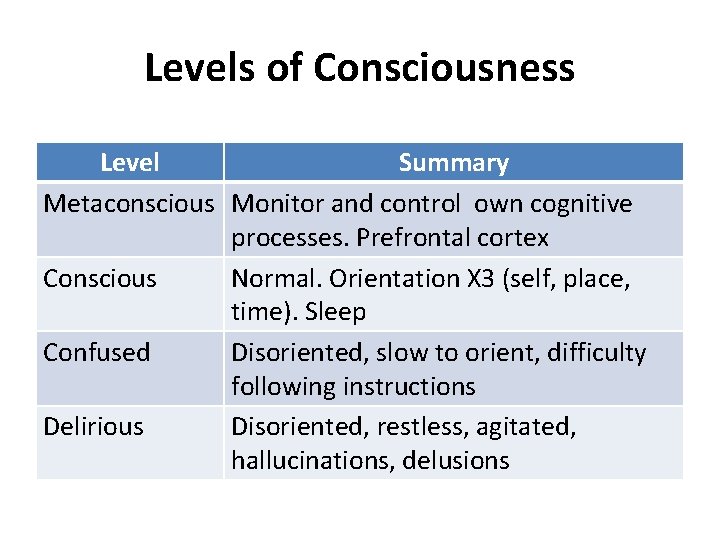
Levels of Consciousness Level Summary Metaconscious Monitor and control own cognitive processes. Prefrontal cortex Conscious Normal. Orientation X 3 (self, place, time). Sleep Confused Disoriented, slow to orient, difficulty following instructions Delirious Disoriented, restless, agitated, hallucinations, delusions
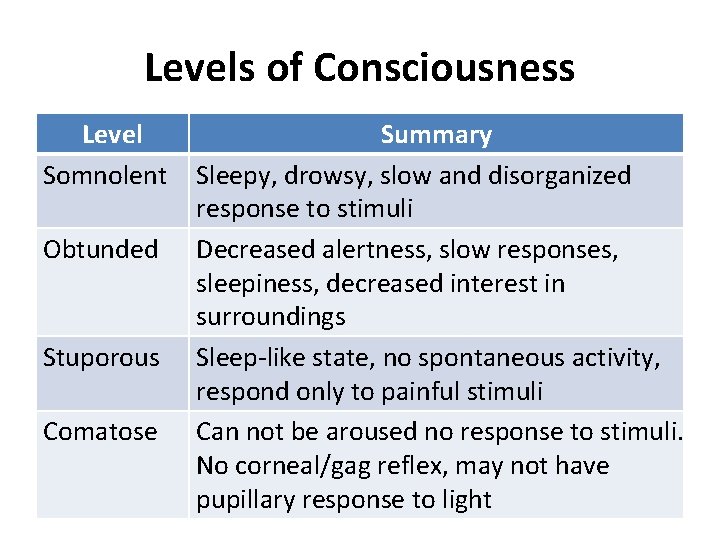
Levels of Consciousness Level Somnolent Obtunded Stuporous Comatose Summary Sleepy, drowsy, slow and disorganized response to stimuli Decreased alertness, slow responses, sleepiness, decreased interest in surroundings Sleep-like state, no spontaneous activity, respond only to painful stimuli Can not be aroused no response to stimuli. No corneal/gag reflex, may not have pupillary response to light
First/Transient Symptoms After TBI • • • Loss of consciousness (LOC) Headache Vomiting Nausea Dizziness Balance problems Lack of motor coordination Lightheadedness Blurred vision Tinnitus (ringing in ears) Fatigue, lethargy Change in sleep pattern
Longer Lasting Impairments Following TBI • Physical – – – – Damage of the brain – intra-axial Damage in the skull but outside of the brain – extra-axial Swelling (edema) Increased intracranial pressure Hematoma (blood collection): epidural. subdural Hemorrhage (bleeding): subarachnoid, intraventricular Focal lesions • Orbitofrontal cortex • Anterior temporal lobes – Diffuse injury - DTI
Longer Lasting Impairments Following TBI • Cognitive – Memory: PTA, short-term memory – Language – Executive function: decision making – Alexithymia • • Motor Social Emotional (regulation) Behavioral
Diagnosis • Neurological examination • Neuroimaging – Computerized tomography (CT) – Magnetic resonance imaging (MRI) • Neuropsychological testing of cognitive, emotional, behavioral changes after TBI
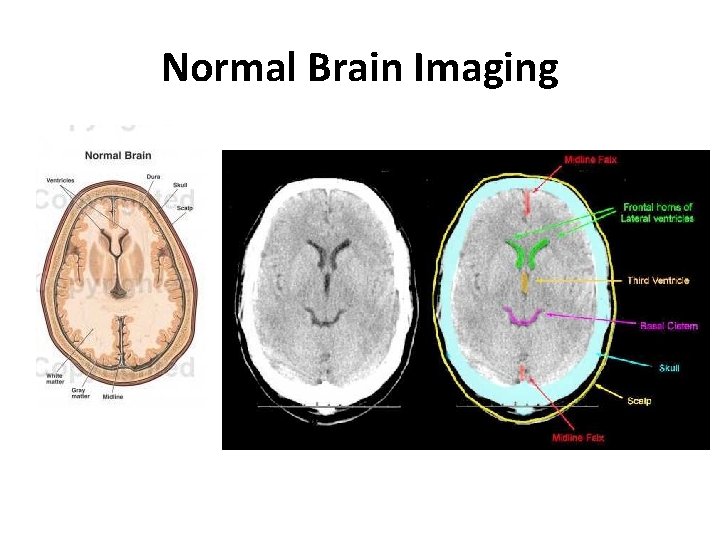
Normal Brain Imaging
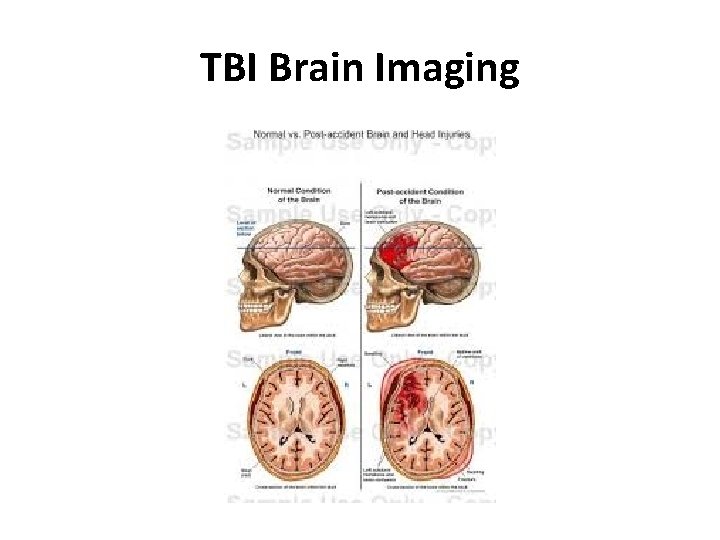
TBI Brain Imaging
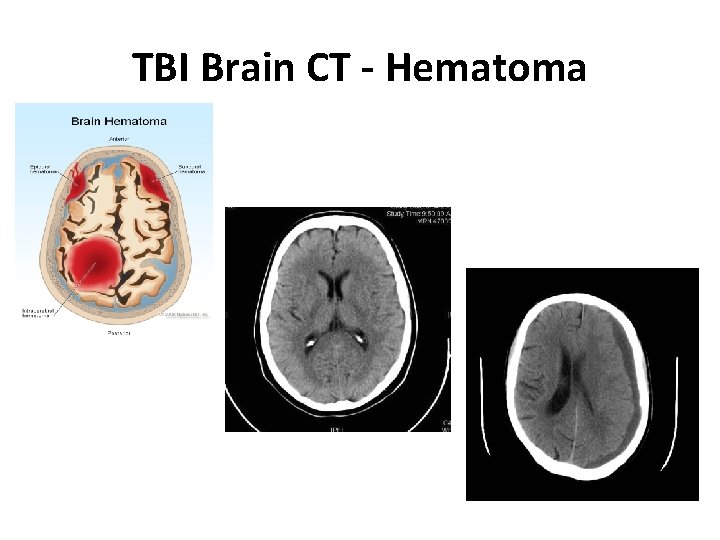
TBI Brain CT - Hematoma
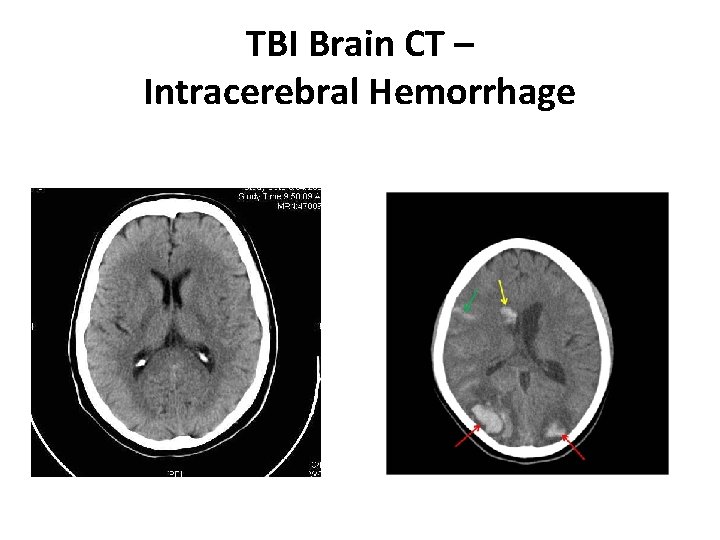
TBI Brain CT – Intracerebral Hemorrhage
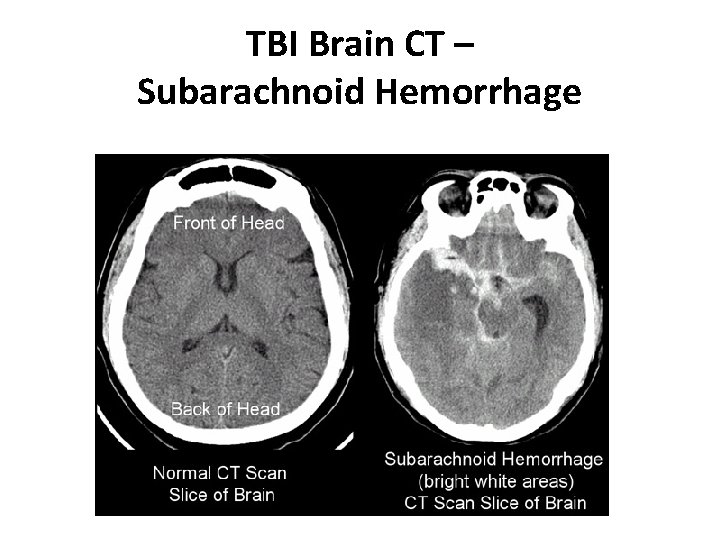
TBI Brain CT – Subarachnoid Hemorrhage
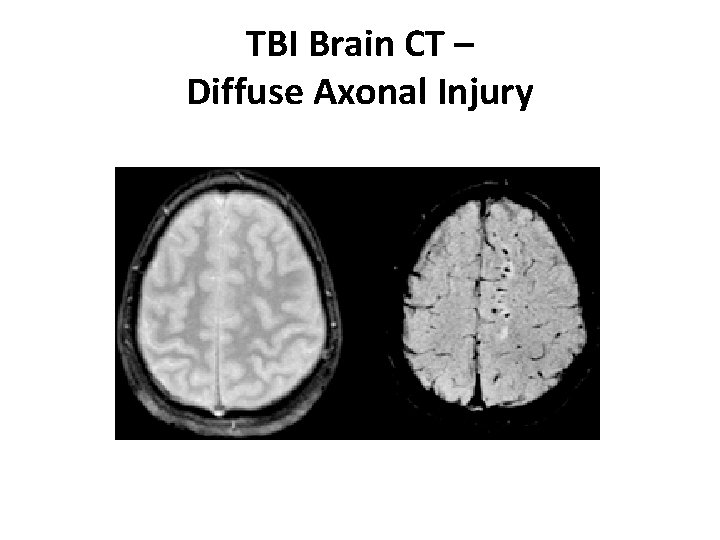
TBI Brain CT – Diffuse Axonal Injury
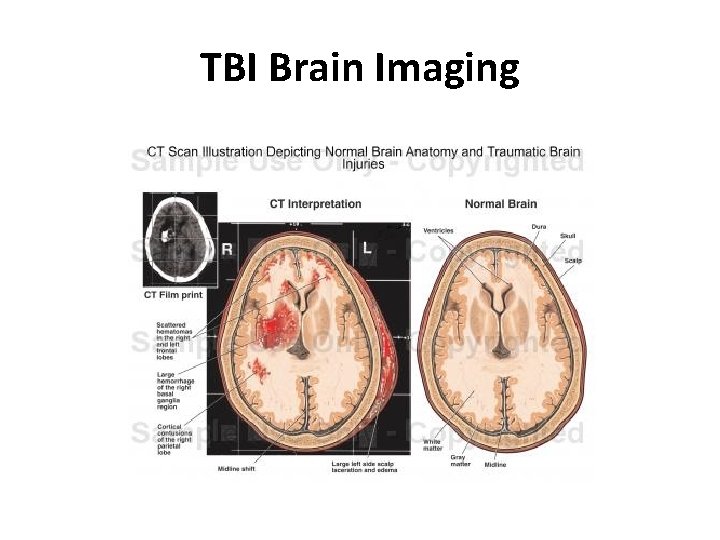
TBI Brain Imaging
TBI Treatment & Rehabilitation • Acute stage, “golden hour”: – Stabilize: O 2, blood flow, ICP – Prevent further injury • • Surgery Medications Rest Prevent seizures
TBI Treatment & Rehabilitation • Subacute, chronic stages: Multidisciplinary team: impatient/outpatient – Neurology – Psychiatry – Physical therapy – Speech therapy – Recreation therapy – Occupational therapy – Cognitive rehabilitation – Counseling – Supported employment
Prognosis • The more severe the injury the worse the prognosis • Permanent disability: – Mild injuries – 10% – Moderate injuries – 66% – Severe injuries – 100%
TBI Prevention • Protection from accidents: belts, helmets • Changes in sports practice – helmets • Environmental changes – For elderly: grab bars in bathroom, rails; remove tripping hazards – For children: safety gates, shock-absorbing surfaces • Safety education • Enforcement of law • Abuse prevention

Thank you!
- Slides: 31