
Traumatic Brain Injury Blast Versus NonBlast Trauma Julie
Traumatic Brain Injury: Blast Versus Non-Blast Trauma Julie C. Chapman, Psy. D Your Post-Deployment Health Resource
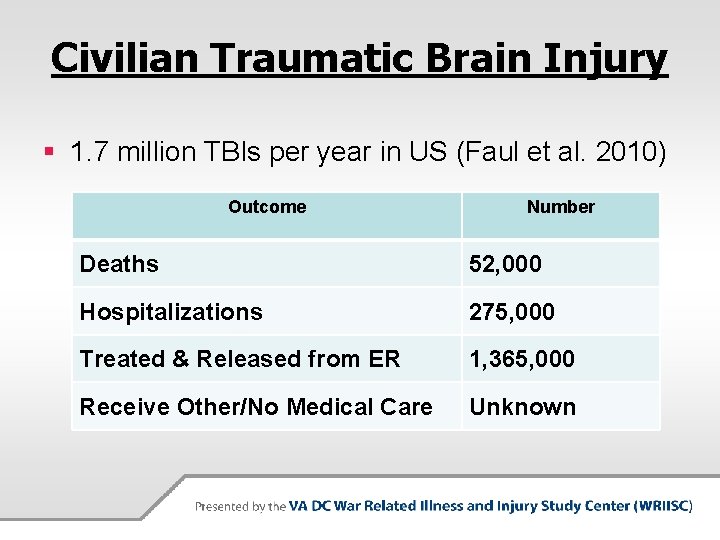
Civilian Traumatic Brain Injury § 1. 7 million TBIs per year in US (Faul et al. 2010) Outcome Number Deaths 52, 000 Hospitalizations 275, 000 Treated & Released from ER 1, 365, 000 Receive Other/No Medical Care Unknown
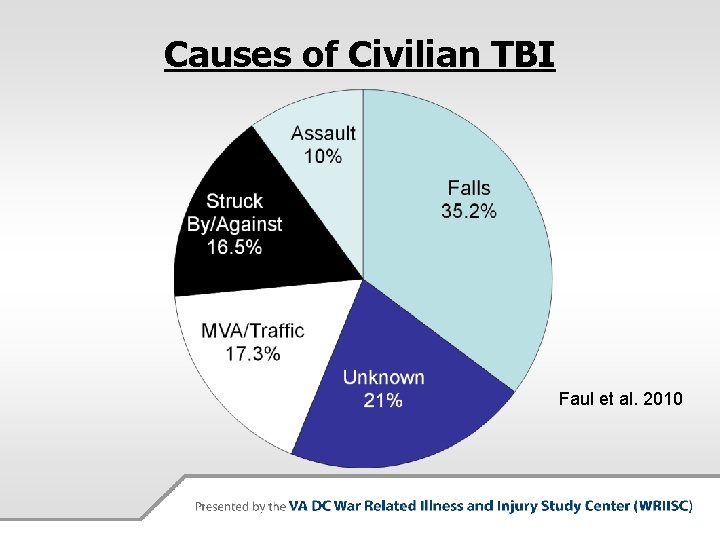
Causes of Civilian TBI Faul et al. 2010
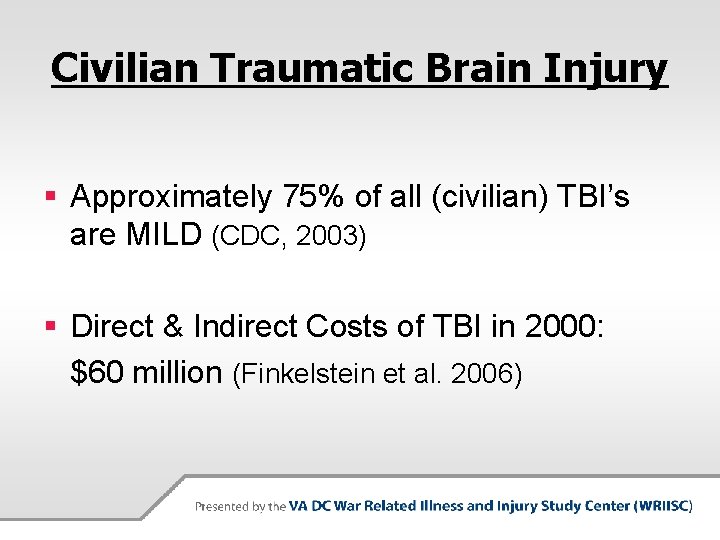
Civilian Traumatic Brain Injury § Approximately 75% of all (civilian) TBI’s are MILD (CDC, 2003) § Direct & Indirect Costs of TBI in 2000: $60 million (Finkelstein et al. 2006)
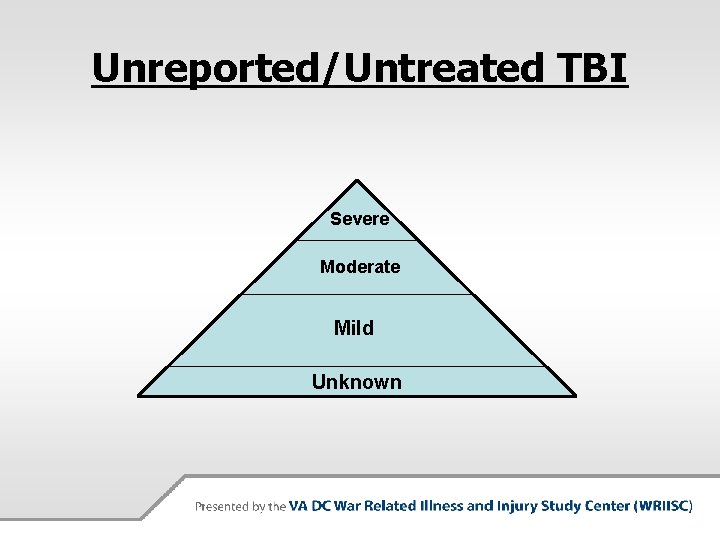
Unreported/Untreated TBI Severe Moderate Mild Unknown
Characterization of Non-Blast TBI § Type: § Closed vs. Penetrating § Mechanisms: § Focal vs. Diffuse (Traumatic Axonal Injury ) § Timing: § Primary (mechanical) vs. Secondary (chemical cascade)

Mechanisms of Non-Blast TBI § Focal Injuries § Traumatic Axonal Injury (Diffuse Axonal Injury) § Multiple Mechanisms (most common)

Coup/Contrecoup Injury

Acceleration/Deceleration

Traumatic Axonal Injury

Multiple Mechanisms of Injury § Mix of focal and diffuse injuries § Most common
Timing of Injury § Primary Injury: § “Mechanical” injury § Small window for intervention § Secondary Injury: § Cascade of molecular, cellular, biochemical events § Occurs over hours, days, weeks § Larger window for intervention

Cascades in Secondary Injury Marklund et al. 2006 r. CBF Ischemia Excessive Glutamate Glucose Depolarization EDEMA ATP Large Ca 2+ influx Oxidative Processes AXONAL DAMAGE NECROSIS APOPTOSIS Proteolytic enzymes (caspases, calpains) ICP
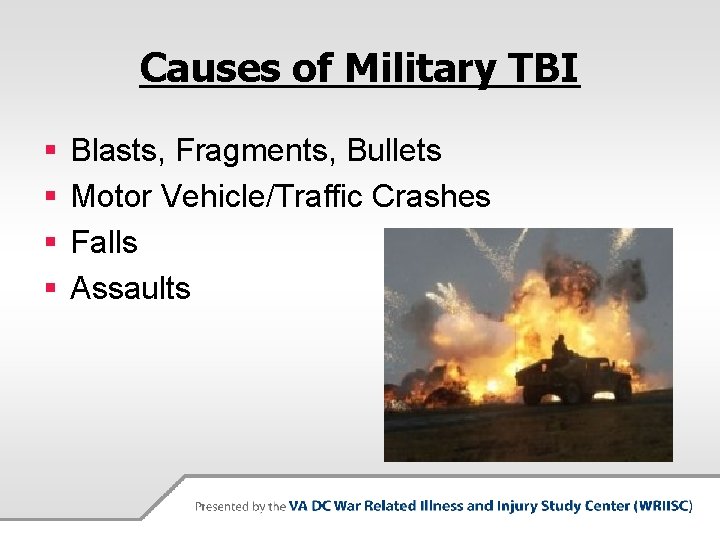
Causes of Military TBI § § Blasts, Fragments, Bullets Motor Vehicle/Traffic Crashes Falls Assaults
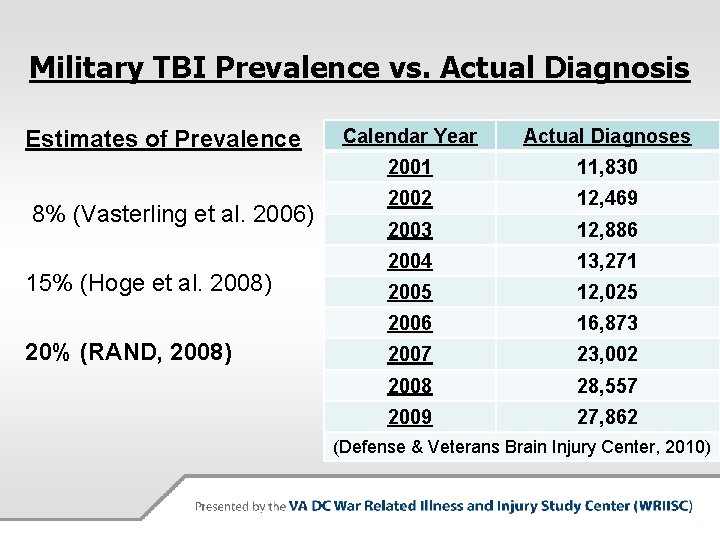
Military TBI Prevalence vs. Actual Diagnosis Estimates of Prevalence 8% (Vasterling et al. 2006) 15% (Hoge et al. 2008) 20% (RAND, 2008) Calendar Year Actual Diagnoses 2001 11, 830 2002 12, 469 2003 12, 886 2004 13, 271 2005 12, 025 2006 16, 873 2007 23, 002 2008 28, 557 2009 27, 862 (Defense & Veterans Brain Injury Center, 2010)
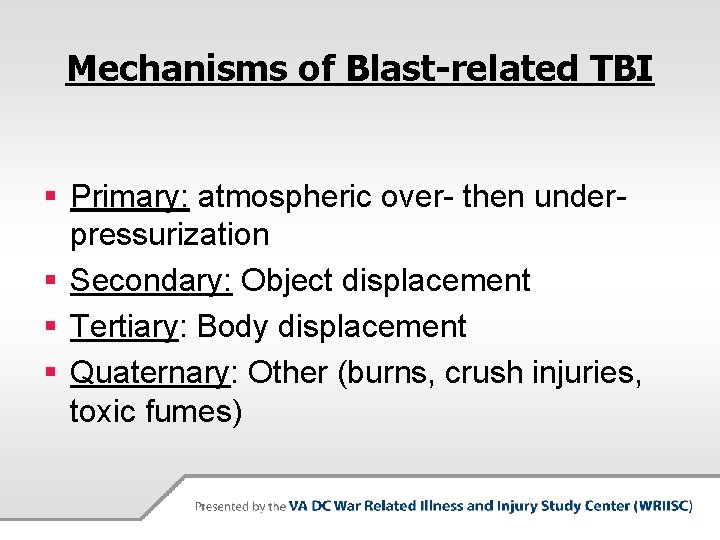
Mechanisms of Blast-related TBI § Primary: atmospheric over- then underpressurization § Secondary: Object displacement § Tertiary: Body displacement § Quaternary: Other (burns, crush injuries, toxic fumes)
Military Operational Medicine Research Program (MOMRP) § US Army Medical Research & Materiel Command § More than 25 years of blast injury research data (Blast Overpressure Database) § Mathematical models, experimental methods and occupational records.
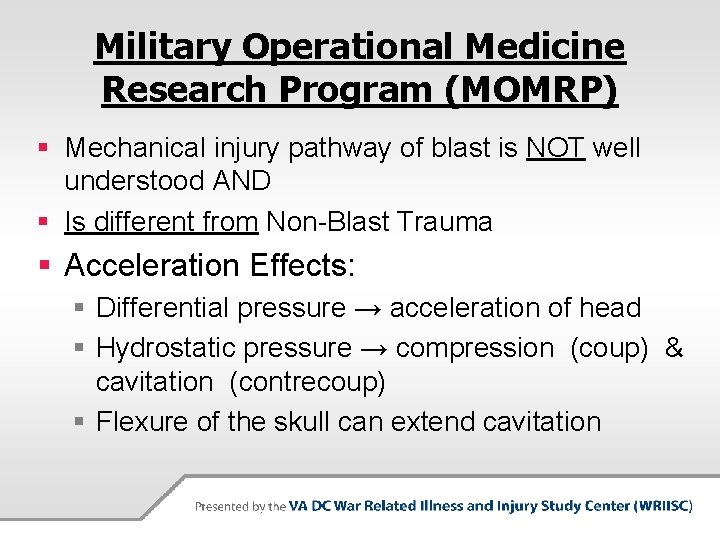
Military Operational Medicine Research Program (MOMRP) § Mechanical injury pathway of blast is NOT well understood AND § Is different from Non-Blast Trauma § Acceleration Effects: § Differential pressure → acceleration of head § Hydrostatic pressure → compression (coup) & cavitation (contrecoup) § Flexure of the skull can extend cavitation
Military Operational Medicine Research Program (MOMRP) § Vascular Surge: § Experimental models → brain injury when the head was protected from blast. § Air-filled organs in thorax, abdomen become distorted (compressed) when exposed to blast § Blast loading to thorax , abdomen → compressive force to heart → blood surge (eventually) reaches brain → increase in pressure
The Predictive Model of the TBI Project § 4 th Generation Injury Modeling integrates: § Mechanical, physiologic & systemic responses § To predict performance outcomes, beyond pathology
Repeated Concussions § Chronic Traumatic Encephalopathy (CTE) (Dementia Pugilistica) § “…neuropathologically distinct slowly progressive tauopathy with a clear environmental etiology” Mc. Kee et al. 2009 § Can be latent for long periods before clinical symptoms manifest
Chronic Traumatic Encephalopathy (CTE) -CAVEATOnly 51 neuropathologically confirmed cases in the literature at this time.
Chronic Traumatic Encephalopathy (CTE) Clinical Symptoms: § § § Memory disturbance Behavioral/Personality change Affective disturbance Parkinsonism Speech abnormalities Gait abnormalities
Chronic Traumatic Encephalopathy (CTE) Neuropathological Symptoms: § § Atrophy: Cerebrum & Medial Temporal Lobe Ventriculomegaly Enlarged: Cavum septum pellucidum Extensive tau-immunoreactive pathology: § § § Neocortex Medial temporal lobe Diencephalon Brainstem Spinal cord Mc. Kee et al. 2009
Chronic Traumatic Encephalopathy (CTE) Apolipoprotein E: § Apo. E genotyping reported in 10 of the 51 cases of CTE: § 5 cases carried at least 1 Apo. E ε 4 allele § 1 case was homozygous for Apo. E ε 4 § General population carriers of Apo. E ε 4 is approximately 15%. Mc. Kee et al. 2009
VA/DOD Definition of TBI At least one of the following clinical signs immediately following the event: § Any period of loss of consciousness § Any loss of memory for events immediately before or after injury § Any alteration in mental state at the time of injury § Neurological deficits § Intracranial lesion

Contact Us ADDRESS: Washington, DC Veterans Affairs Medical Center PHONE: (202) 745 -8249 EMAIL: Julie. Chapman@va. gov VISIT OUR WEBSITE: www. warrelatedillness. va. gov/dc/
- Slides: 27