
Trauma Informed Positive Behavioural Support Dr Keith Bowden
Trauma Informed Positive Behavioural Support Dr Keith Bowden Head of Programme – Specialist Psychology (Learning Disabilities), NHS Education for Scotland & Honorary Senior Lecturer, University of St Andrews School of Psychology & Neuroscience
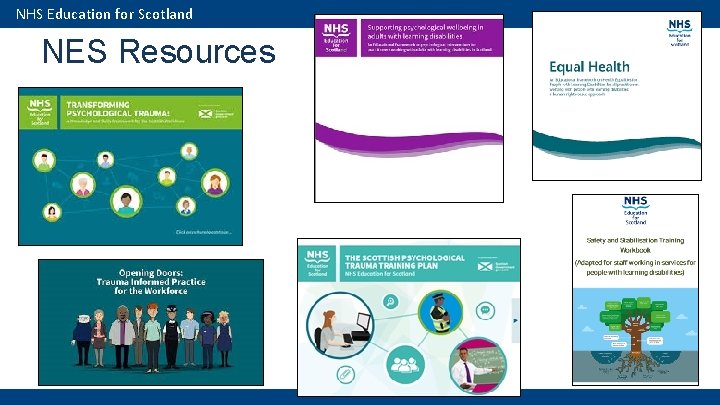
NHS Education for Scotland NES Resources

NHS Education for Scotland Trauma & people with learning disabilities • • • Neglect Sexual, physical, emotional, financial abuse Being bullied Witnessing the above Being removed from home Accidents Serious illness Exposure and awareness of cognitive impairment Models of Care Inappropriate psychological ‘treatment’

NHS Education for Scotland Key Messages about Positive Behavioural Support • A PBS Framework: – Considers the person and his or her life circumstances as a whole including physical health and emotional needs such as the impact of any traumatic or adverse life events and mental illness BILD, NHS Health Education England, Skills for Care, Challenging Behaviour Foundation, PBS Academy (2017)
NHS Education for Scotland Key Messages about Positive Behavioural Support • A PBS Framework: – Is likely to involve input from different professionals and include multiple evidence based approaches and treatments that come from a shared value base and are provided in a coordinated and person centred manner. These may include trauma informed care, autism specific approaches, active support and other appropriate interventions that support physical, mental health and wellbeing BILD, NHS Health Education England, Skills for Care, Challenging Behaviour Foundation, PBS Academy (2017)

NHS Education for Scotland Principles of Trauma Informed Care • • • Safety Empowerment Choice Collaboration Trust
NHS Education for Scotland Integrating PBS & Trauma Informed Care • Relationships • Resisting re-traumatisation • What has happened? Rather than what is wrong? • Behaviour as survival strategies rather than symptoms or problems
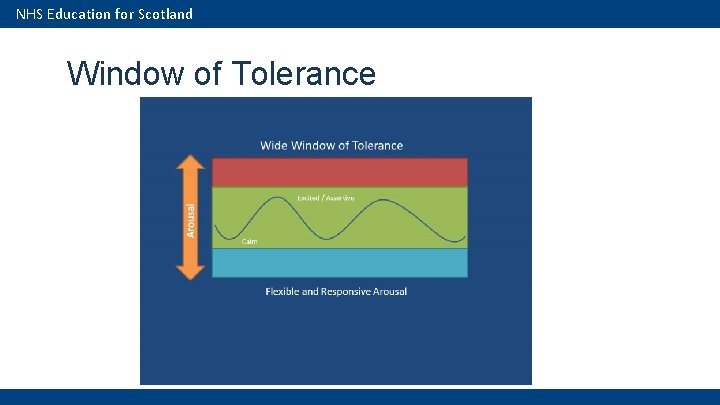
NHS Education for Scotland Window of Tolerance
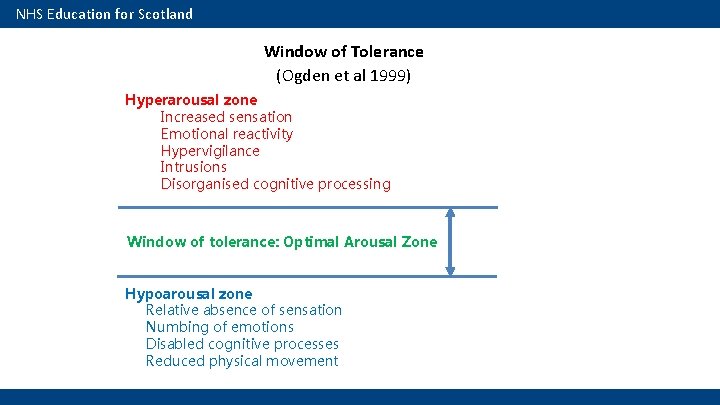
NHS Education for Scotland Window of Tolerance (Ogden et al 1999) Hyperarousal zone Increased sensation Emotional reactivity Hypervigilance Intrusions Disorganised cognitive processing Window of tolerance: Optimal Arousal Zone Hypoarousal zone Relative absence of sensation Numbing of emotions Disabled cognitive processes Reduced physical movement
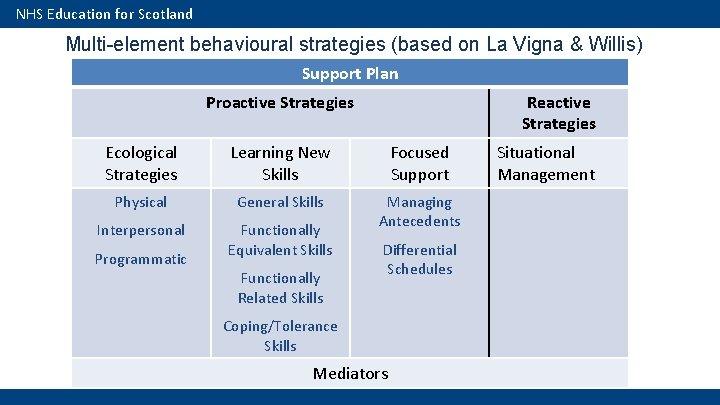
NHS Education for Scotland Multi-element behavioural strategies (based on La Vigna & Willis) Support Plan Proactive Strategies Reactive Strategies Ecological Strategies Learning New Skills Focused Support Physical General Skills Interpersonal Functionally Equivalent Skills Managing Antecedents Programmatic Functionally Related Skills Differential Schedules Coping/Tolerance Skills Mediators Situational Management
NHS Education for Scotland Evans & Gore (2016) Staff behaviours valued by service users: Views of people whose behaviour challenges • “…the participants said that staff should be kind, polite and focused on the practical and emotional help they wanted and needed from staff” • Participants were very clear that some of the staff behaviours they described contributed to behaviour that challenges, as well as leading to them feeling unvalued and of less worth.

NHS Education for Scotland Mapping Trauma Strategies to the Multi-Element Model – adapted from Crates et al. Proactive Strategies Ecological Strategies Physical Low Arousal Sensory Strategies Learning New Skills Play Therapy Dyadic Developmental Psychotherapy Reactive Strategies Focused Support Managing Antecedents Attunement and Co-regulation Low Arousal Sensory Strategies Interpersonal Attachment Theory Interpersonal relationships are critical CBT Life Story Therapy Differential Schedules Attunement and Co-regulation EMDR Life Story Therapy Mindfulness Suppressing Problems and Engaging with Services Programmatic Consistent, predictable and patterned repeated experiences Dialectical Behaviour Therapy Psycho-education Explicit teaching strategies for staff to follow: shaping, fading Non-Functionally Based Attunement and Coregulation Low Arousal Sensory Strategies NARS Functionally Based NARS Traditional Methods - (Not Recommended in the MEM*) * - Might be considered Last Resort Mediators Attunement and Co-regulation Mindfulness and COAL Blocked Care Parallel Process Shared Framework Shared Language Consistency Trauma Informed Culture Biopsychosocial Approach to Understanding Action Affect Awareness Non-Linear Understanding
© NHS Education for Scotland 2019. You can copy or reproduce the information in this resource for use within NHSScotland for non-commercial educational purposes. Use of this document for commercial purposes is permitted only with the written Permission of NES.
- Slides: 13