
Trauma Informed Care for African Immigrant Women Victims


- Slides: 39
Trauma Informed Care for African Immigrant Women Victims of Domestic Violence Wednesday, May 18, 2016 IDVAAC Webinar Obianuju Obi Berry, MD, MPH Child/Adolescent Psychiatry Fellow New York Presbyterian Hospital
Outline • What is Trauma? • African Immigrants and Trauma – IPV and Mental Health Effects – IPV in the African Immigrant Community • Reasons/speculations • Rates? • Recent literature • Trauma Informed Care Responses 2
3 What is Trauma • Intense physical and psychological stress – Affects functioning, social, emotional, spiritual well-being • Exposure to actual or threatened death, serious injury, or sexual violence (DSM-V) 6/14/2021 3
4 Intimate Partner Violence CDC definition: “Intimate partner violence includes physical violence, sexual violence, stalking and psychological aggression (including coercive tactics) by a current or former intimate partner (i. e. , spouse, boyfriend/girlfriend, dating partner, or ongoing sexual partner). ”
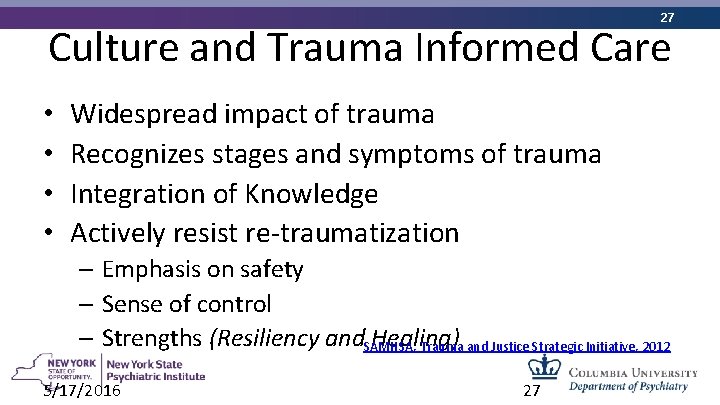
Trauma Informed Model of Care • • 5 Widespread impact of trauma Recognizes stages and symptoms of trauma Integrate knowledge about trauma Actively resist re-traumatization SAMHSA, Trauma and Justice Strategic Initiative, 2012 5/17/2016 5
6 Trauma Informed Care: Stages and Symptoms of IPV
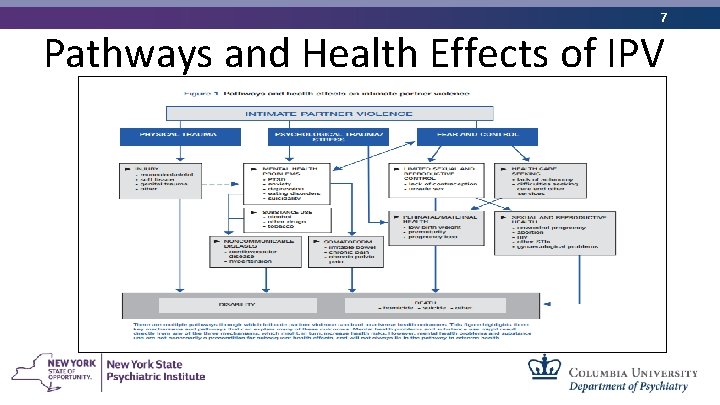
7 Pathways and Health Effects of IPV
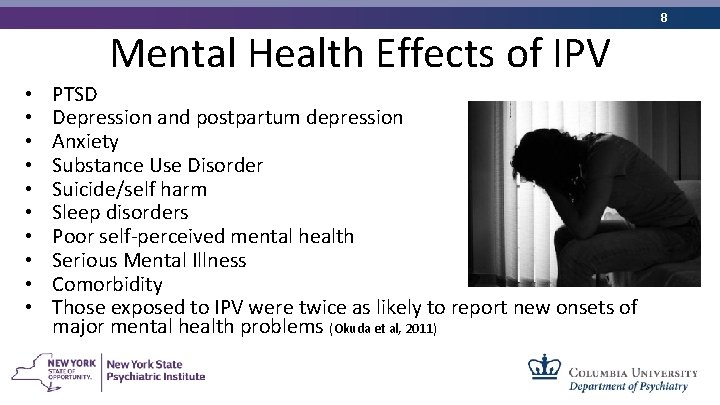
8 Mental Health Effects of IPV • • • PTSD Depression and postpartum depression Anxiety Substance Use Disorder Suicide/self harm Sleep disorders Poor self-perceived mental health Serious Mental Illness Comorbidity Those exposed to IPV were twice as likely to report new onsets of major mental health problems (Okuda et al, 2011)
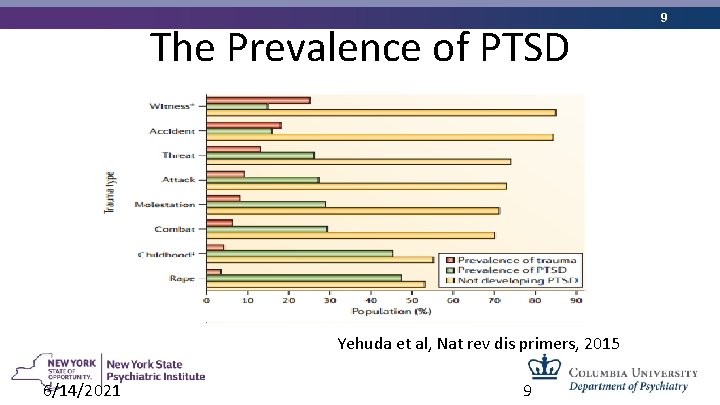
The Prevalence of PTSD Yehuda et al, Nat rev dis primers, 2015 6/14/2021 9 9
10 Trauma Informed Care: Widespread Impact of Trauma
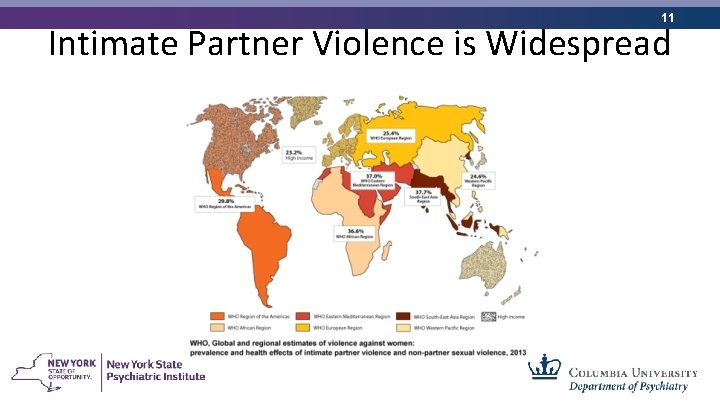
11 Intimate Partner Violence is Widespread
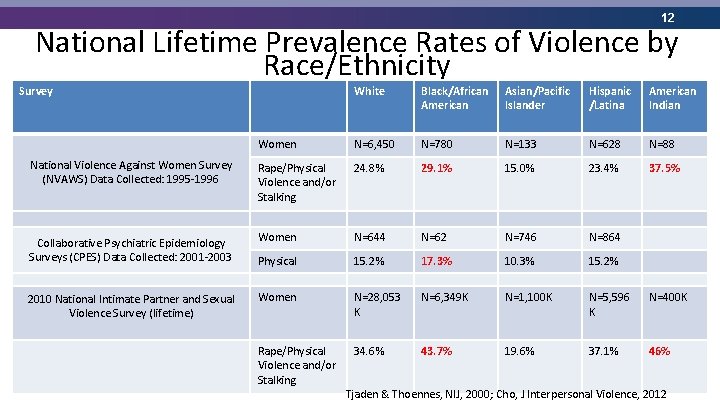
12 National Lifetime Prevalence Rates of Violence by Race/Ethnicity Survey White Black/African American Asian/Pacific Islander Hispanic /Latina American Indian Women N=6, 450 N=780 N=133 N=628 N=88 National Violence Against Women Survey (NVAWS) Data Collected: 1995 -1996 Rape/Physical Violence and/or Stalking 24. 8% 29. 1% 15. 0% 23. 4% 37. 5% Collaborative Psychiatric Epidemiology Surveys (CPES) Data Collected: 2001 -2003 Women N=644 N=62 N=746 N=864 Physical 15. 2% 17. 3% 10. 3% 15. 2% 2010 National Intimate Partner and Sexual Violence Survey (lifetime) Women N=28, 053 K N=6, 349 K N=1, 100 K N=5, 596 K N=400 K Rape/Physical Violence and/or Stalking 34. 6% 43. 7% 19. 6% 37. 1% 46% Tjaden & Thoennes, NIJ, 2000; Cho, J Interpersonal Violence, 2012
Does Race/Ethnicity Matter? 13 • Differences can be accounted for by SES, demographics • Race/Ethnicity ≠ IPV, but experiences are different – What is abuse – Help seeking behavior
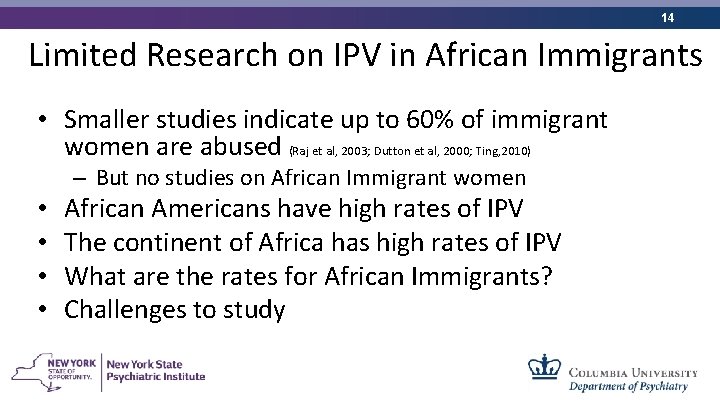
14 Limited Research on IPV in African Immigrants • Smaller studies indicate up to 60% of immigrant women are abused (Raj et al, 2003; Dutton et al, 2000; Ting, 2010) – But no studies on African Immigrant women • • African Americans have high rates of IPV The continent of Africa has high rates of IPV What are the rates for African Immigrants? Challenges to study
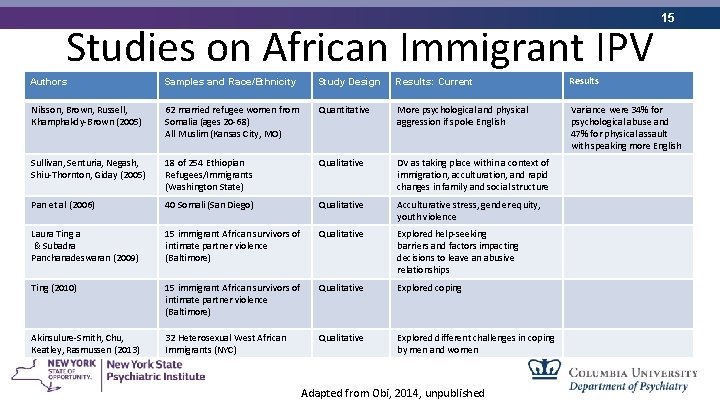
Studies on African Immigrant IPV 15 Authors Samples and Race/Ethnicity Study Design Results: Current Results Nilsson, Brown, Russell, Khamphakdy-Brown (2005) 62 married refugee women from Somalia (ages 20 -68) All Muslim (Kansas City, MO) Quantitative More psychological and physical aggression if spoke English Variance were 34% for psychological abuse and 47% for physical assault with speaking more English Sullivan, Senturia, Negash, Shiu-Thornton, Giday (2005) 18 of 254 Ethiopian Refugees/Immigrants (Washington State) Qualitative DV as taking place within a context of immigration, acculturation, and rapid changes in family and social structure Pan et al (2006) 40 Somali (San Diego) Qualitative Acculturative stress, gender equity, youth violence Laura Ting a & Subadra Panchanadeswaran (2009) 15 immigrant African survivors of intimate partner violence (Baltimore) Qualitative Explored help-seeking barriers and factors impacting decisions to leave an abusive relationships Ting (2010) 15 immigrant African survivors of intimate partner violence (Baltimore) Qualitative Explored coping Akinsulure-Smith, Chu, Keatley, Rasmussen (2013) 32 Heterosexual West African Immigrants (NYC) Qualitative Explored different challenges in coping by men and women Adapted from Obi, 2014, unpublished
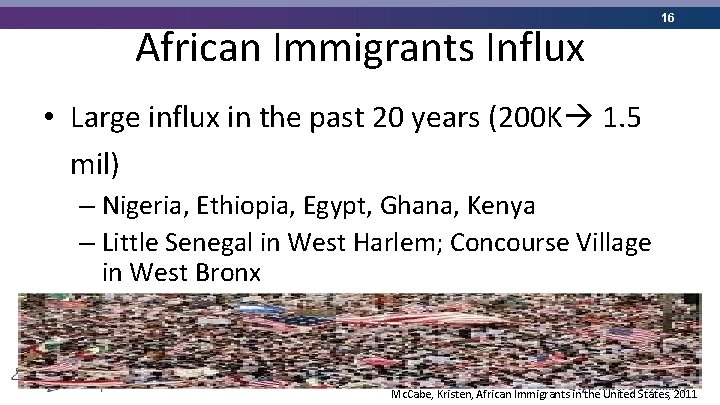
African Immigrants Influx 16 • Large influx in the past 20 years (200 K 1. 5 mil) – Nigeria, Ethiopia, Egypt, Ghana, Kenya – Little Senegal in West Harlem; Concourse Village in West Bronx Mc. Cabe, Kristen, African Immigrants in the United States, 2011
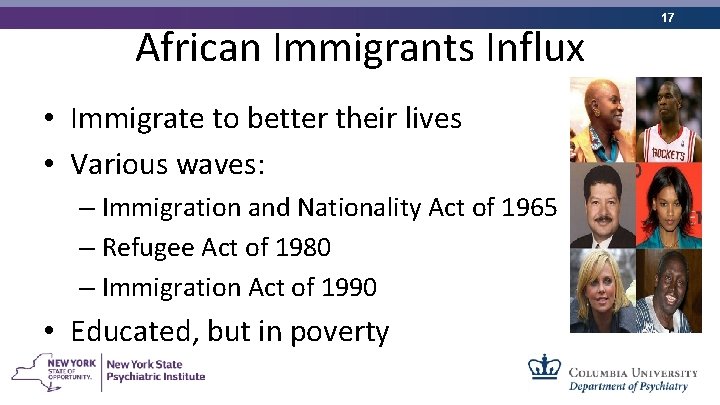
African Immigrants Influx • Immigrate to better their lives • Various waves: – Immigration and Nationality Act of 1965 – Refugee Act of 1980 – Immigration Act of 1990 • Educated, but in poverty 17
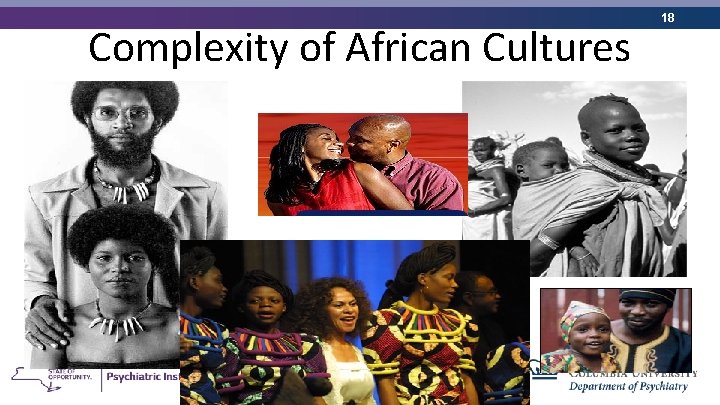
Complexity of African Cultures 18
19 Trauma Informed Care: Integrate Knowledge about IPV and African Immigrant Culture
Factors that Influence IPV in African Immigrant Communities 1) Cultural Acceptability of Violence 2) Social Isolation 3) Immigrant/Refugee Status and Legal Vulnerability 4) Economic Insecurity 5) Ethnic Identification Adapted from Obi, 2011 20
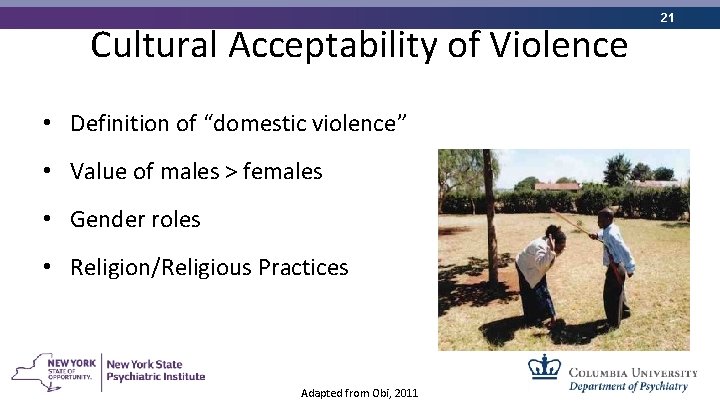
Cultural Acceptability of Violence • Definition of “domestic violence” • Value of males > females • Gender roles • Religion/Religious Practices Adapted from Obi, 2011 21
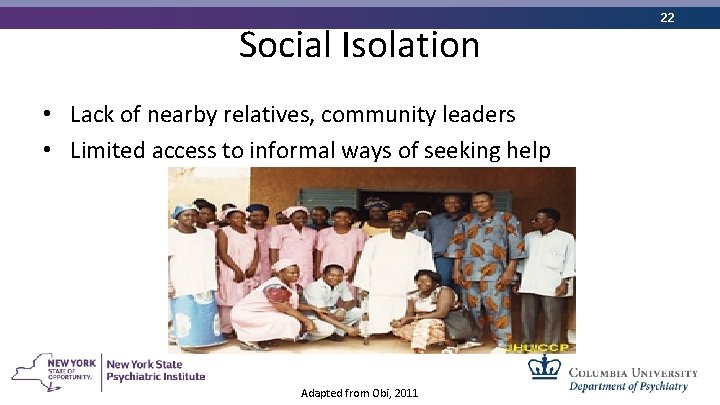
Social Isolation • Lack of nearby relatives, community leaders • Limited access to informal ways of seeking help Adapted from Obi, 2011 22
Immigrant/Refugee Status • Language • Unaware of available resources • Fear of police • Refugee/PTSD • Acculturation Stress Adapted from Obi, 2011 23
Lack of Financial Resources • Poverty • Economic hardships (Adjusting to a new community) • Financial dependency Adapted from Obi, 2011 24
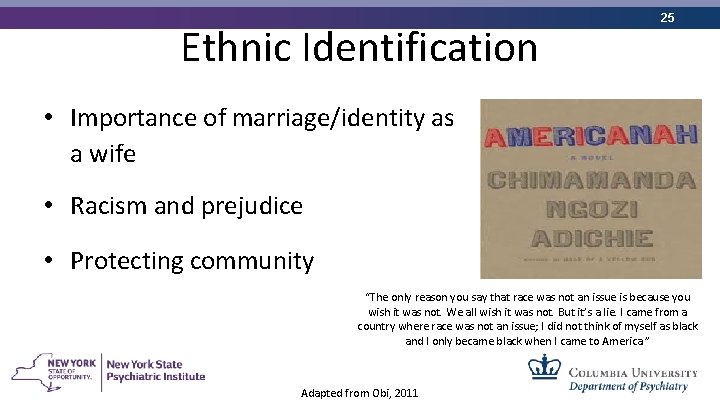
Ethnic Identification 25 • Importance of marriage/identity as a wife • Racism and prejudice • Protecting community “The only reason you say that race was not an issue is because you wish it was not. We all wish it was not. But it’s a lie. I came from a country where race was not an issue; I did not think of myself as black and I only became black when I came to America. ” Adapted from Obi, 2011
26 Trauma Informed Care: Resist Retraumatization
27 Culture and Trauma Informed Care • • Widespread impact of trauma Recognizes stages and symptoms of trauma Integration of Knowledge Actively resist re-traumatization – Emphasis on safety – Sense of control – Strengths (Resiliency and. SAMHSA, Healing) Trauma and Justice Strategic Initiative, 2012 5/17/2016 27
Culturally Sensitive Interventions • Culture can impact disclosure, help seeking, trust with providers – What are her basic values about herself as a mother and spouse? – Not everyone wants/can leave 28
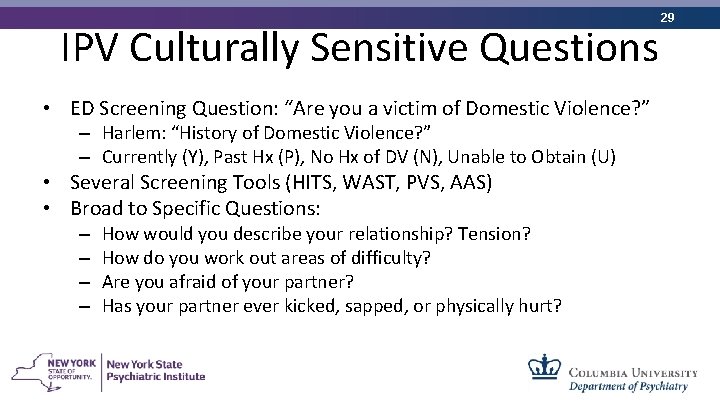
IPV Culturally Sensitive Questions • ED Screening Question: “Are you a victim of Domestic Violence? ” – Harlem: “History of Domestic Violence? ” – Currently (Y), Past Hx (P), No Hx of DV (N), Unable to Obtain (U) • Several Screening Tools (HITS, WAST, PVS, AAS) • Broad to Specific Questions: – – How would you describe your relationship? Tension? How do you work out areas of difficulty? Are you afraid of your partner? Has your partner ever kicked, sapped, or physically hurt? 29
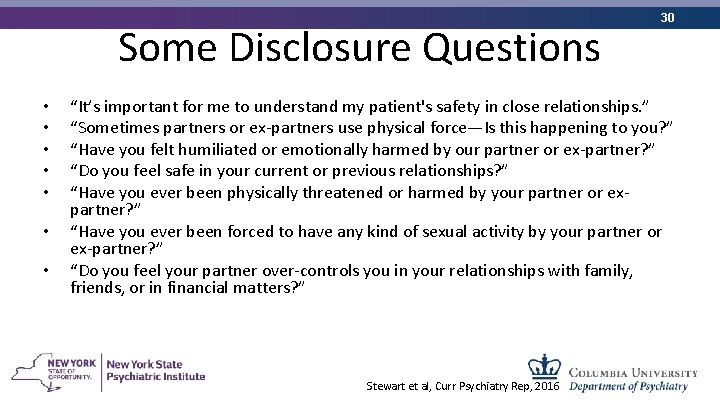
Some Disclosure Questions • • 30 “It’s important for me to understand my patient's safety in close relationships. ” “Sometimes partners or ex-partners use physical force—Is this happening to you? ” “Have you felt humiliated or emotionally harmed by our partner or ex-partner? ” “Do you feel safe in your current or previous relationships? ” “Have you ever been physically threatened or harmed by your partner or expartner? ” “Have you ever been forced to have any kind of sexual activity by your partner or ex-partner? ” “Do you feel your partner over-controls you in your relationships with family, friends, or in financial matters? ” Stewart et al, Curr Psychiatry Rep, 2016
When IPV is disclosed 31 • Validation: “Unfortunately, this is common in our society. ” • Affirmation: “Violence is unacceptable—you deserve to feel safe at home. ” • Support: “There are things we can discuss that can help” • Ask about safety and plan as needed • No critical remarks: “Why don’t you just leave? ” • Respect the individual’s concerns and decisions • Know local legislation and services • Refer appropriately to other services • Document carefully Stewart et al, Curr Psychiatry Rep, 2016
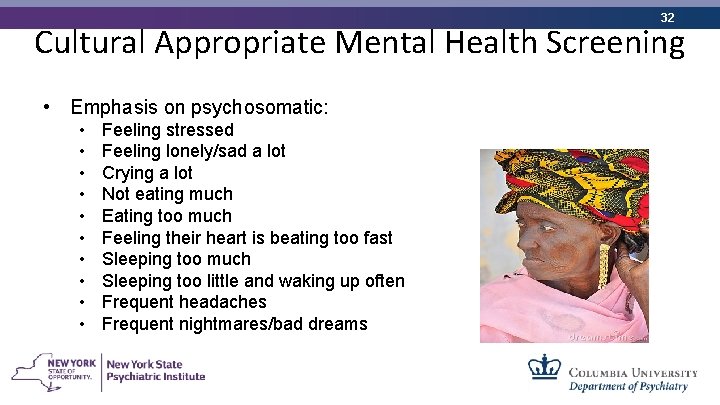
32 Cultural Appropriate Mental Health Screening • Emphasis on psychosomatic: • • • Feeling stressed Feeling lonely/sad a lot Crying a lot Not eating much Eating too much Feeling their heart is beating too fast Sleeping too much Sleeping too little and waking up often Frequent headaches Frequent nightmares/bad dreams
Protective Factors and Healing • • Self-esteem Trust Resourcefulness Self-efficacy Internal locus of control Secure attachments Sense of humor 6/14/2021 • • Self-sufficiency Sense of mastery Optimism Interpersonal abilities Sense of safety Religious affiliation Strong role models Emotional sustenance 33 33
34 Thank You
35 6/14/2021 35
Works Cited • • • • 36 Bowman, Cynthia. “Domestic Violence: Does the African context demand a different approach? ” International Journal of Law and Psychiatry 26 (2003) 473 -491. Devries et al, “Intimate Partner Violence and Incident Depressive Symptoms and Suicide Attempts: A Systematic Review of Longitudinal Studies. ” PLOS, 2013 Gondolf, E. W. , & Williams, O. J. (2001). Culturally focused batterer counseling for African American men. Trauma, Violence, & Abuse: A Review Journal, 2(4), 283 -295 Gupta, J. , et al. (2009). "Premigration exposure to political violence and perpetration of intimate partner violence among immigrant men in Boston. " Am J Public Health 99(3): 462 -469. Ibrahim, Halima. Interview. 7/17/06 The Immigrant Power and Control Wheel was adapted from the Power and Control Wheel developed by the Domestic Abuse Intervention Project, Duluth, MN. Immigrant Wheel: http: //www. endabuse. org/content/features/detail/778/ International Self-Reliance Agency for Women (www. isaw. org) Mc. Cabe, Kristen, “African Immigrants in the United States. ” Migration Information Source. 2011. Raj, A. , & Silverman, J. (2002). Violence against immigrant women: The roles of culture, context, and legal immigrant status on intimate partner violence. Violence Against Women, 8 (3), 367 -398 Rutgers University School of Social Work, Center on Violence Against Women & Children. Immigrant Domestic Violence. Presentation. Obtained May 2014. Stockl et al, “The Global Prevalence of Intimate Partner Homicide: a systematic review. ” Lancet, 2013 Ting, Laura. “Out of Africa: Coping Strategies of African Immigrant Women Survivors of Intimate Partner Violence. ” Health Care for Women International, 2010. Ting & Panchanadeswaran. ‘Barriers to Help-Seeking Among Immigrant African Women Survivors of Partner Abuse: Listening to Women’s Own Voices. ” Journal of Aggression, Maltreatment & Trauma, 2009. World Health Organization. “Summary Report: WHO Multi-country Study on Women’s Health and Domestic Violence against Women. ” Switzerland: World Health Organization, 2005 World Health Organization, London School of Hygiene and Tropical Medicine, South African Medical Research Council. Global and regional estimates of violence against women. 2013
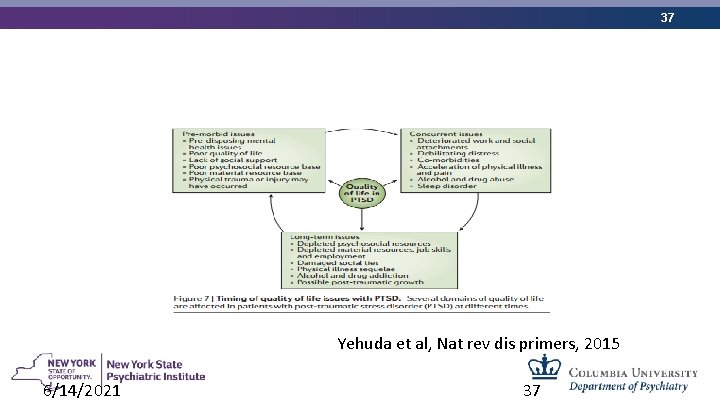
37 Yehuda et al, Nat rev dis primers, 2015 6/14/2021 37
Complex Trauma 38
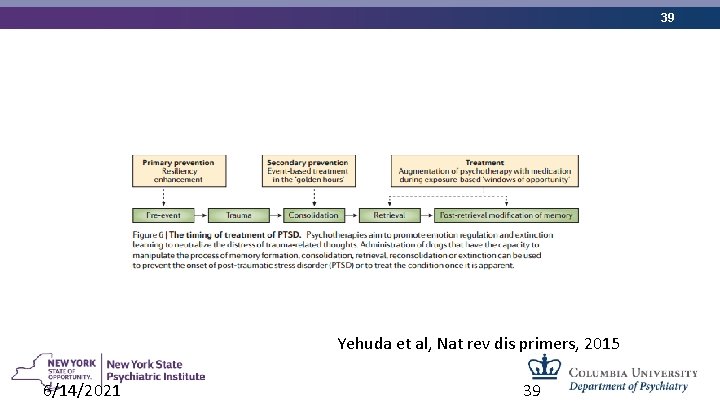
39 Yehuda et al, Nat rev dis primers, 2015 6/14/2021 39