
Trauma Informed Care at CMMHC Taking an inside
- Slides: 12
Trauma Informed Care at CMMHC Taking an inside look at creating sanctuary for clients, staff and our community. (Bloom and Farragher, 2011
Overview • • • Three Levels of Trauma Why Trauma Informed Care at CMMHC? Introduction to the Organizational Self-Assessment Customized Action Plan Seven Domains of Trauma Informed Care (Bloom and Farragher, 2011
Client Trauma • Adverse Childhood Experiences (ACES) suggest 2/3 of the population has at least one adverse experience • ACES score increases drastically when sexual orientation, gender, ethnicity and socioeconomic status are factored in • ACES scores are associated with both psychological and medical conditions • Trauma Symptoms are adaptive and protect them from subsequent abuse (Bloom and Farragher, 2011
Staff Trauma • CMMHC hires from the general population, thus many of us have experienced our own ACES • Staff can be triggered by our clients and out client’s stories • Secondary Traumatization or Compassion Fatigue • Countertransference and the stress of our work can hinder our ability to be present with clients (Bloom and Farragher, 2011
Organizational Trauma • Organizations are not machines and can also be traumatized • Reflect on how your work environment has impacted your stress during the past 6 months • Work stress decreases innovation, creativity, morale and professional development • It also can influence how present we are with our clients • The Leadership Team at CMMHC believes that staff have been attempting to communicate this to us both directly and indirectly- it is time toandlisten (Bloom Farragher, 2011
Expert Model- National Council for Behavioral Health • CMMHC was personally invited to participate in the TIC Learning Community • The board fully funded and supports this initiative • Cheryl Sharp, MSW, ALWF, Senior TIC Consultant has assisted over 800 organizations in implementing Trauma Informed Care (Bloom and Farragher, 2011
Organizational Self-Assessment • The National Council recommends using the OSA with the implementation team to create a shared definition of Trauma Informed Care, gather baseline data and assess the culture of the agency • Steps to sustainability • CMMHC has decided to give everyone the opportunity to take the assessment • We want to hear both what we are doing well to create sanctuary and what we need to work on (Bloom and Farragher, 2011
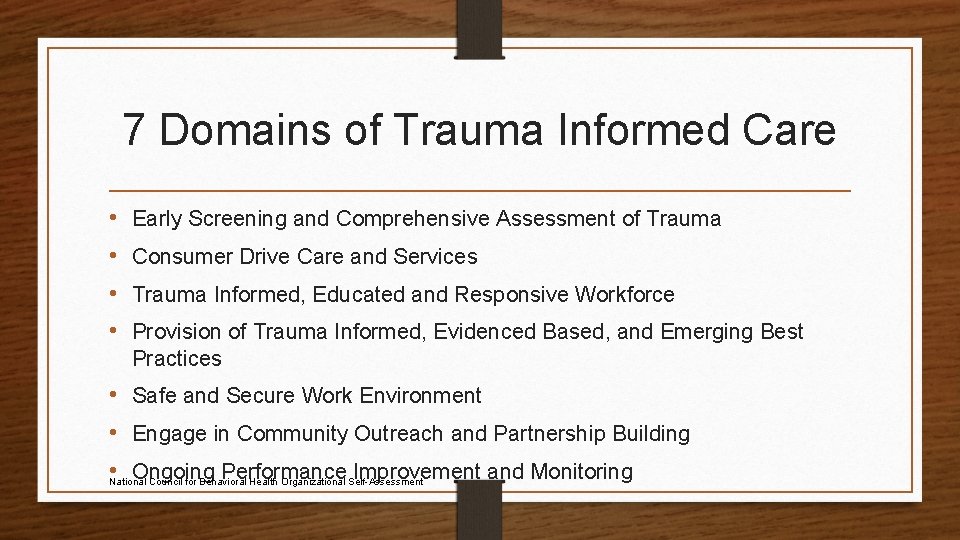
7 Domains of Trauma Informed Care • • Early Screening and Comprehensive Assessment of Trauma Consumer Drive Care and Services Trauma Informed, Educated and Responsive Workforce Provision of Trauma Informed, Evidenced Based, and Emerging Best Practices • Safe and Secure Work Environment • Engage in Community Outreach and Partnership Building • Ongoing Performance Improvement and Monitoring National Council for Behavioral Health Organizational Self-Assessment
Action Plan • CMMHC TIC Tip of the Week • Development of Subcommittees • Invitation to Share the work (Bloom and Farragher, 2011
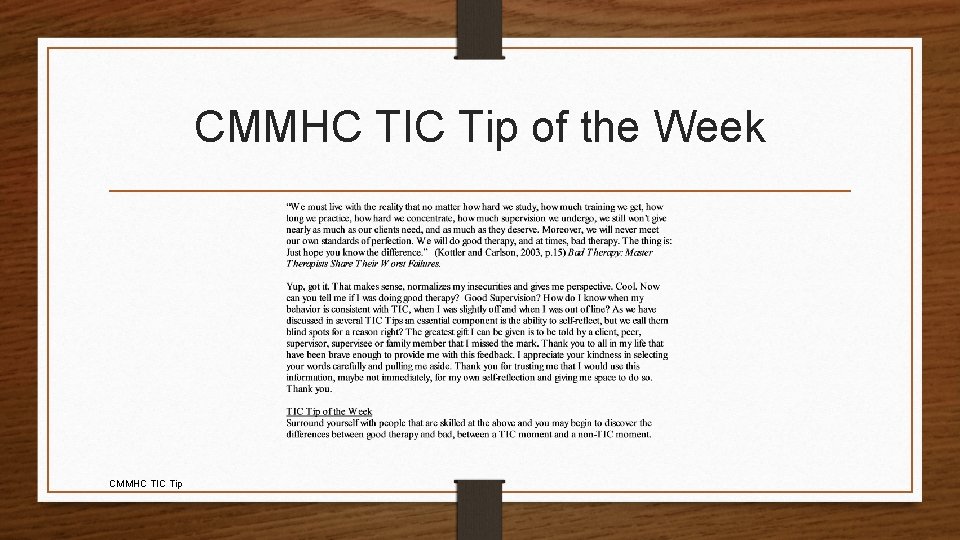
CMMHC TIC Tip of the Week CMMHC TIC Tip
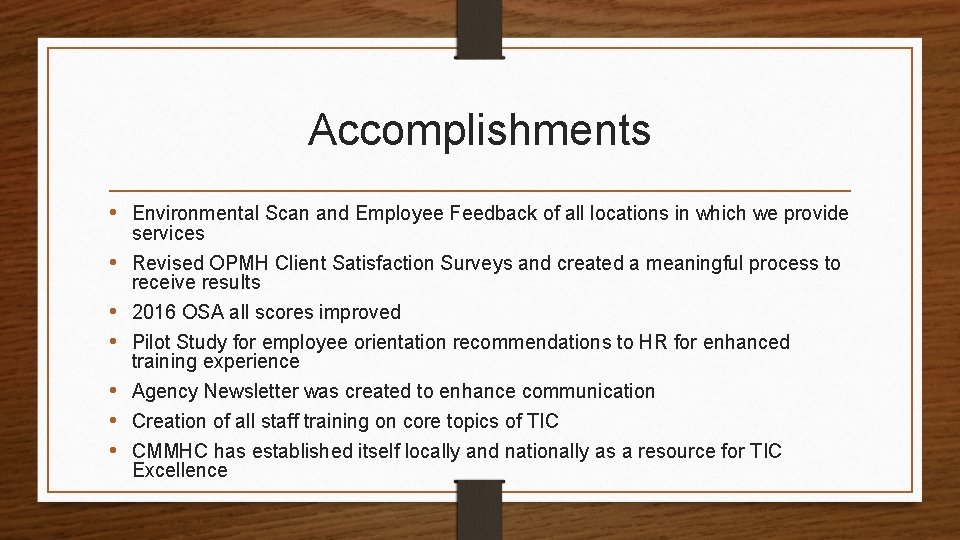
Accomplishments • Environmental Scan and Employee Feedback of all locations in which we provide services • Revised OPMH Client Satisfaction Surveys and created a meaningful process to receive results • 2016 OSA all scores improved • Pilot Study for employee orientation recommendations to HR for enhanced training experience • Agency Newsletter was created to enhance communication • Creation of all staff training on core topics of TIC • CMMHC has established itself locally and nationally as a resource for TIC Excellence
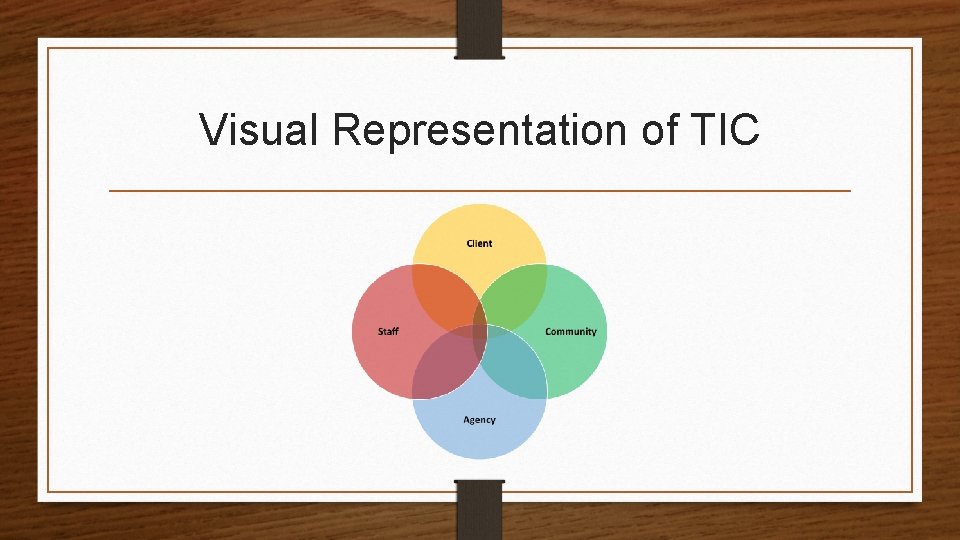
Visual Representation of TIC