
Trauma Informed Advising Facilitated by Dominique Hammonds Ph
Trauma Informed Advising Facilitated by Dominique Hammonds, Ph. D. , LCMHC, QS, NCC, BC-TMH Joined by North Carolina Student Success Center July 15, 2020 1 -2: 30 pm Via Zoom

Webinar Hosts
Agenda Welcome/Introductions Goals Presentation Q&A Resources
Dominique Hammonds Thank you for being our presenter today!
§ Define trauma and the impact it can have on individuals § Identify strategies on how to support the Goals social emotional needs of students in a virtual space § Define bandwidth and it's connection to student success both inside and outside of the classroom
What are some of the challenges that you’ve run into in your work with students online in a post-COVID world? Challenges of a Post-COVID World § Lack of control § Uncertainty § Changing policies and procedures § Discomfort with virtual environment § Lack of knowledge of online pedagogies/virtual strategies § Being task oriented while acknowledging student social-emotional needs

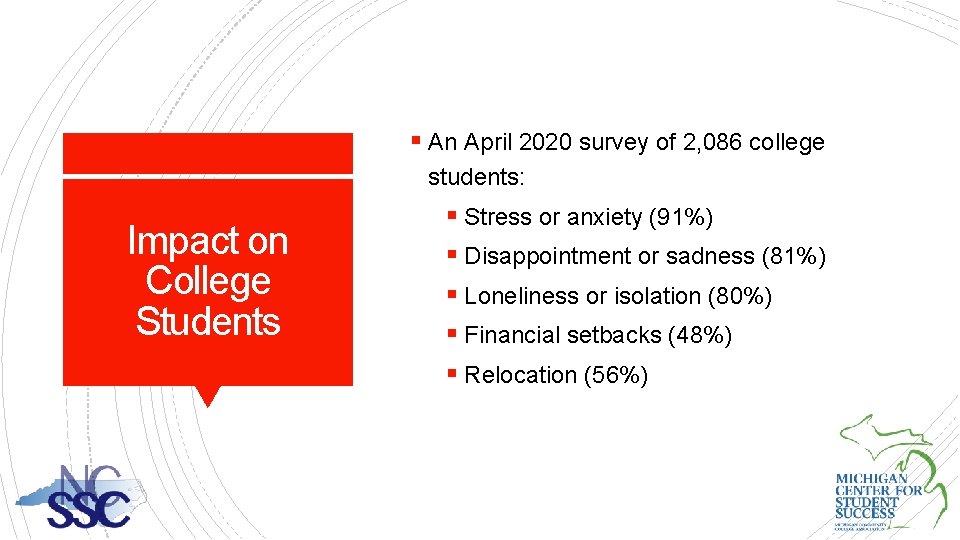
§ An April 2020 survey of 2, 086 college students: Impact on College Students § Stress or anxiety (91%) § Disappointment or sadness (81%) § Loneliness or isolation (80%) § Financial setbacks (48%) § Relocation (56%)
§ Derives from the Greek word for ”wound” § The Diagnostic and Statistical Manual (5 th Edition) defines trauma as “actual or threatened death, serious injury, or sexual violence” [10] (p. 271). § Stressful events not involving an immediate What is Trauma? threat to life or physical injury such as psychosocial stressors [4] (e. g. , divorce or job loss) are not considered trauma in this definition. § Can threats to sense of psychological safety still be considered “traumatic”? Uncertainty and threatened danger is traumatizing
§ Substance Abuse and Mental Health Services Administration (SAMHSA) Trauma Responses § Emotional § Cognitive § Behavioral § Physical
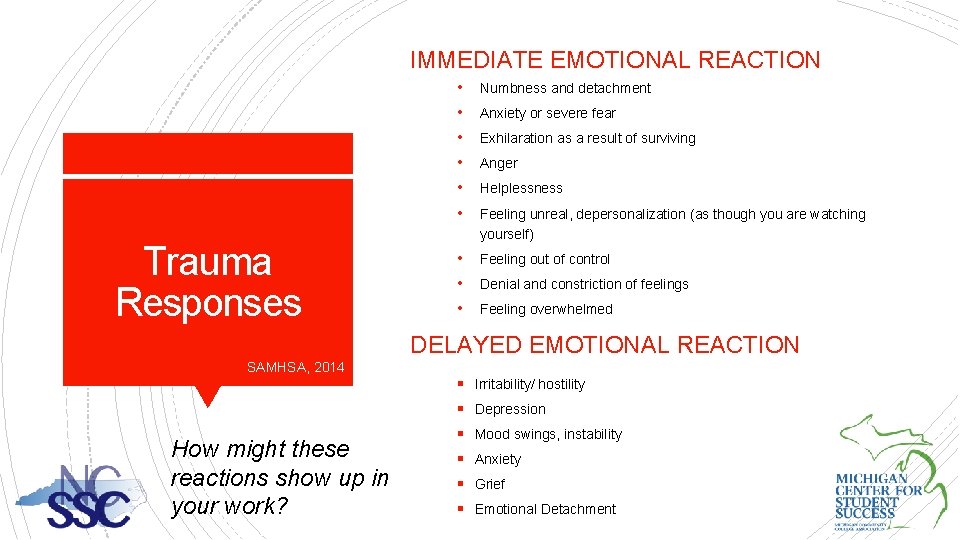
IMMEDIATE EMOTIONAL REACTION Trauma Responses • Numbness and detachment • Anxiety or severe fear • Exhilaration as a result of surviving • Anger • Helplessness • Feeling unreal, depersonalization (as though you are watching yourself) • Feeling out of control • Denial and constriction of feelings • Feeling overwhelmed DELAYED EMOTIONAL REACTION SAMHSA, 2014 § Irritability/ hostility § Depression How might these reactions show up in your work? § Mood swings, instability § Anxiety § Grief § Emotional Detachment
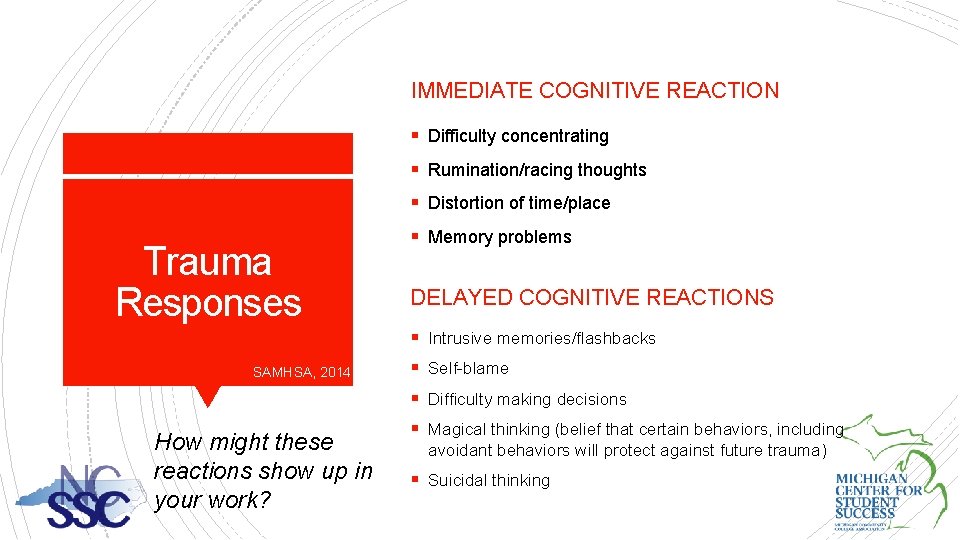
IMMEDIATE COGNITIVE REACTION § Difficulty concentrating § Rumination/racing thoughts § Distortion of time/place Trauma Responses § Memory problems DELAYED COGNITIVE REACTIONS § Intrusive memories/flashbacks SAMHSA, 2014 § Self-blame § Difficulty making decisions How might these reactions show up in your work? § Magical thinking (belief that certain behaviors, including avoidant behaviors will protect against future trauma) § Suicidal thinking
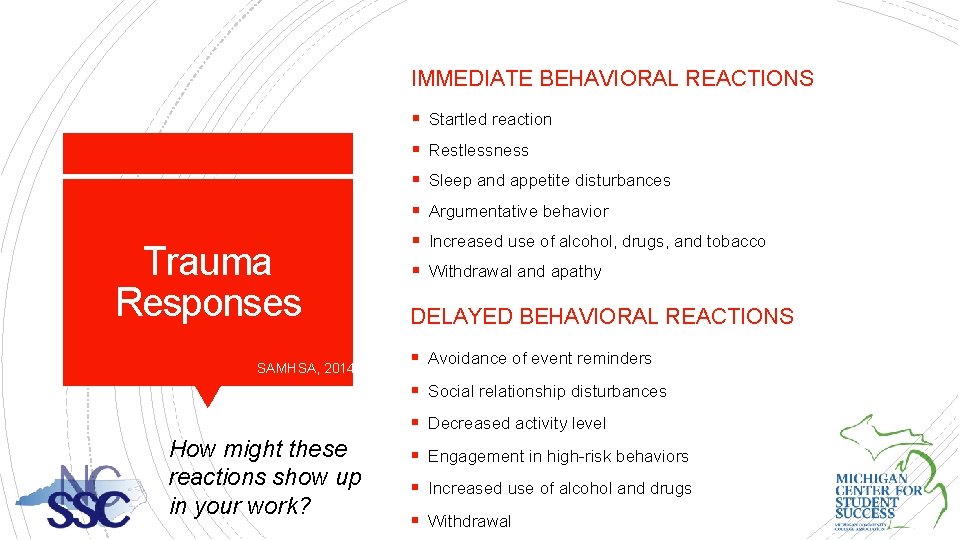
IMMEDIATE BEHAVIORAL REACTIONS § Startled reaction § Restlessness § Sleep and appetite disturbances § Argumentative behavior Trauma Responses SAMHSA, 2014 § Increased use of alcohol, drugs, and tobacco § Withdrawal and apathy DELAYED BEHAVIORAL REACTIONS § Avoidance of event reminders § Social relationship disturbances § Decreased activity level How might these reactions show up in your work? § Engagement in high-risk behaviors § Increased use of alcohol and drugs § Withdrawal
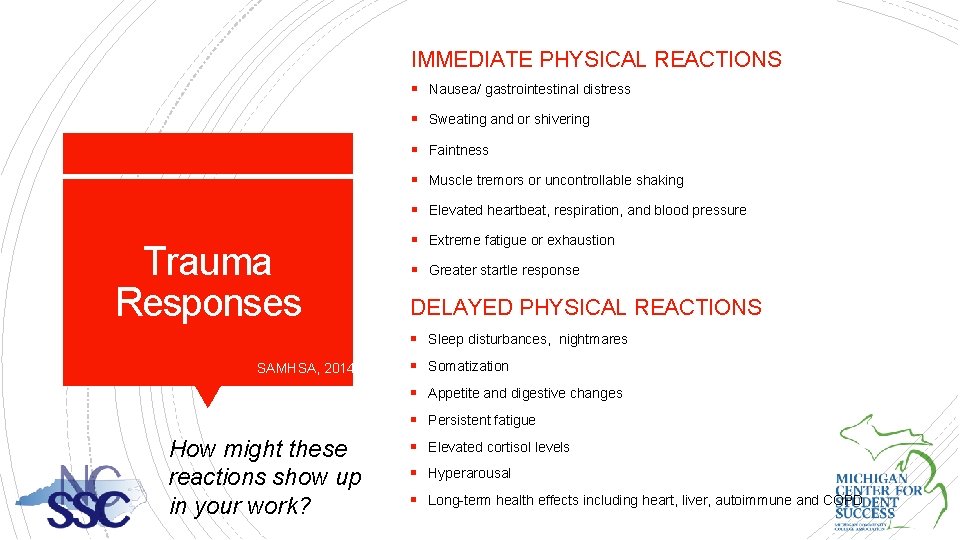
IMMEDIATE PHYSICAL REACTIONS § Nausea/ gastrointestinal distress § Sweating and or shivering § Faintness § Muscle tremors or uncontrollable shaking § Elevated heartbeat, respiration, and blood pressure Trauma Responses § Extreme fatigue or exhaustion § Greater startle response DELAYED PHYSICAL REACTIONS § Sleep disturbances, nightmares SAMHSA, 2014 § Somatization § Appetite and digestive changes § Persistent fatigue How might these reactions show up in your work? § Elevated cortisol levels § Hyperarousal § Long-term health effects including heart, liver, autoimmune and COPD
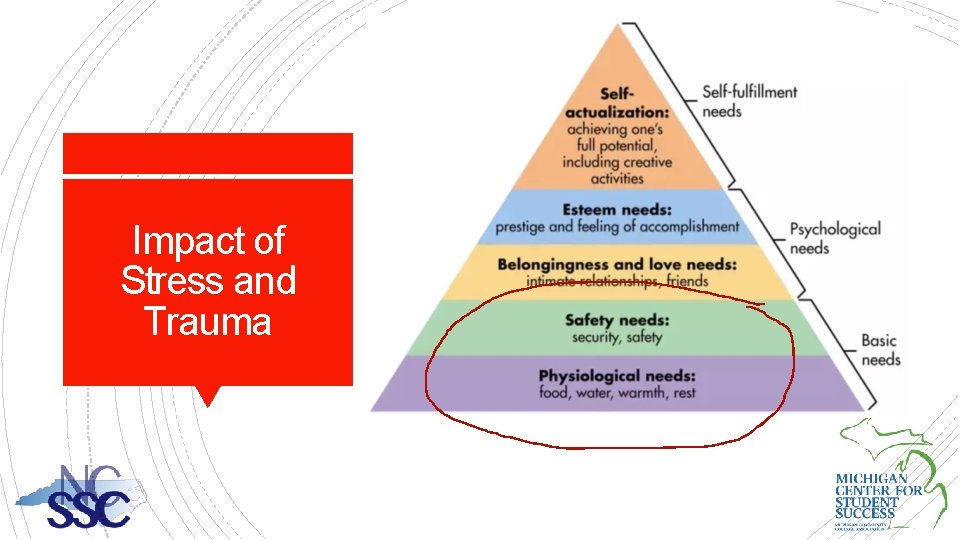
Impact of Stress and Trauma
Stress, Trauma, and, YOU How have YOU been impacted?

Your Turn. What’s The Secret To Finding Balance?

Surprise. There is no balance…
§ Dr. H’s Three R’s § Reflect on your values § What’s important to you right now? § What is your goal? § What helps you feel connected, valued, or seen? Think about what and who gives you a safe space to both give and get what you need. Can you find creative ways to meet your needs with the resources (emotional bandwidth, energy, time, etc. ) you have access to now? § Re-order your priorities It’s Your Turn Focus Inward § What do you want to invest your resources in? § Does your resource allocation match up with your values and your goals? § What must you invest in and what is flexible? § Release control § What can you actually control? § § § Attitude Behaviors/Actions Your own resources § How will can you “let go of”? The skill of reframing means taking a step back and examining your thoughts through different lenses. Instead of getting stuck in trying to force things to go back to the way they were or dwelling on perceived lack (goal attainment, missing out of vacations, football games, etc. ) or perceived loss (plans, expectations, face-to-face classes, etc), try leaning into the fact that things are not as you expected and it just is. You can only control what your resources will allow.

PSYCHOLOGICAL QUICKSAND AHEAD How might this be relevant for you and your students?
§ Professionals without a trauma-informed lens may cause more damage than good when it comes to students that have experienced trauma. § Close, supportive relationships with faculty or advisors is essential to student success Haizlip, 2012; Henfield, Owens, & Witherspoon, 2011; J. K. Miller & Stone, 2011; Protivnak & Foss, 2009; Robinson, Lewis, Henderson, & Flowers, 2009) Your Role § Students from underrepresented backgrounds lacking supportive relationships with faculty members experience feelings of isolation and marginalization (Protivnak & Foss, 2009) § Relationally-focused, culturally sensitive practice offers a way to meet students needs (Purgason et al, 2016)
§ Social support has been broadly defined as the emotional, informational, and instrumental support resources available to a person from the individuals, groups, and communities that comprise that person’s social network (Barrera, Sandler, & Ramsay, 1981; Cohen & Wills, 1985; Langford, Bowsher, Maloney, & Lillis, 1997). Social Support § High amounts of social support have been associated with decreased symptoms of depression and anxiety in response to life stressors, with increased positive coping, and with better psychological adjustment to chronic health conditions (Lakey & Cohen, 2000; Siedlecki, Salthouse, Oishi, & Jeswani, 2014; Thoits, 1995; Uchino, 2006)
§ Individuals low in social support may be at greater risk of experiencing substance abuse problems, mental and physical illness, and suicidal ideation (Benton, Robertson, Tseng, New- ton, & Benton, 2003; Ellis, Bernichon, Yu, Roberts, & Herrell, 2004; Kawachi & Berkman, 2001; Lamis, Ballard, May, & Dvorak, 2016). Social Support § Individuals’ perceptions of the availability, helpfulness, and adequacy of their support resources may have a greater impact on their psychosocial outcomes than the amount of support they actually receive (Barrera, 1986; Dunkel-Schetter & Bennett, 1990; Sarason, & Pierce, 1990)

Check-In What might this mean for providing students with social support?
§ Relational Awareness A Cultural. Relational Framework § Mutual Empathy § Authenticity
§ Stage 1: Establishing the Relationship Application of a Cultural. Relational Framework § Stage 2: Increasing Relational Awareness § Stage 3: Reflection, Evaluation, and Application of Relational Knowledge
Check-In What is the importance of supportive, growth-promoting relationships in your work?

§ Personality Factors Contributing to Depressive Symptoms § Anxious attachment § Avoidance attachment Identifying Student Social Emotional Needs § Perceived stress § Neuroticism § Personality Protective Factors Against Depression Symptoms § Number of friends § Extraversion § Contentiousness § Agreeableness (Rankin et al. , 2018)
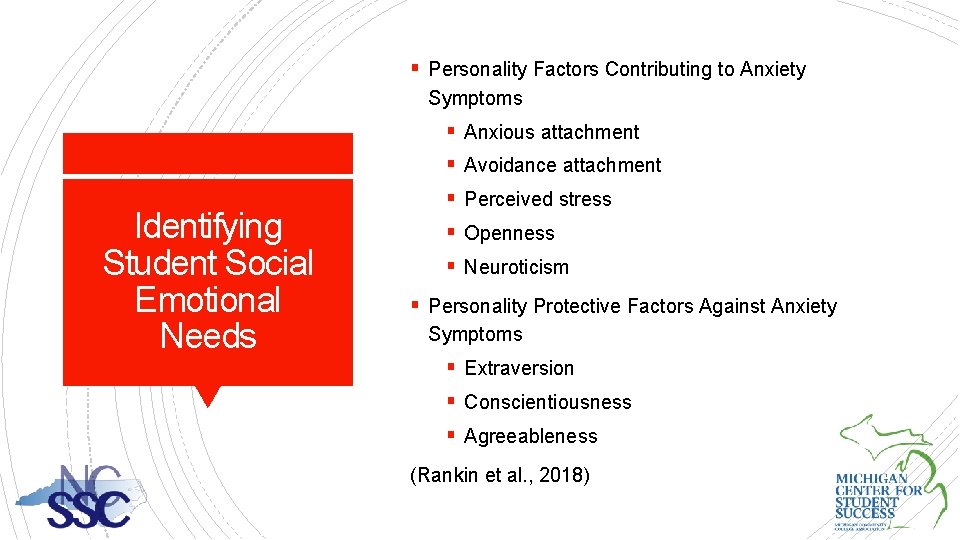
§ Personality Factors Contributing to Anxiety Symptoms § Anxious attachment § Avoidance attachment Identifying Student Social Emotional Needs § Perceived stress § Openness § Neuroticism § Personality Protective Factors Against Anxiety Symptoms § Extraversion § Conscientiousness § Agreeableness (Rankin et al. , 2018)

§ But, wait. There’s more. § The discrepancy between needed and received emotional support contributes to depressive symptoms MORE than personality traits. § When discrepancy between needed and received support was high, individuals were more likely to report depressive symptoms. Identifying Student Social Emotional Needs § Depressive symptoms were elevated (though, to a lesser degree) for individual’s who received more emotional support than they needed. § When there is a high need for support due to stress, anxious individuals may be more likely to seek out that support relative to depressed individuals (Matheson & Anisman, 2003). § Those who are highly depressed with little anxiety may lack the energy to seek support or they may perceive that there is little hope that they will indeed receive that support (Clark & Watson, 1991) (Rankin et al. , 2018)
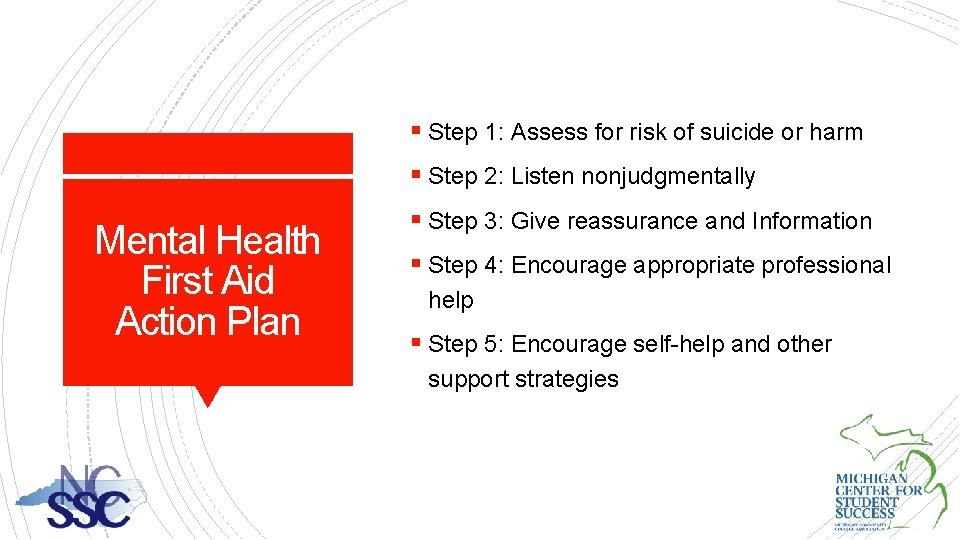
§ Step 1: Assess for risk of suicide or harm § Step 2: Listen nonjudgmentally Mental Health First Aid Action Plan § Step 3: Give reassurance and Information § Step 4: Encourage appropriate professional help § Step 5: Encourage self-help and other support strategies
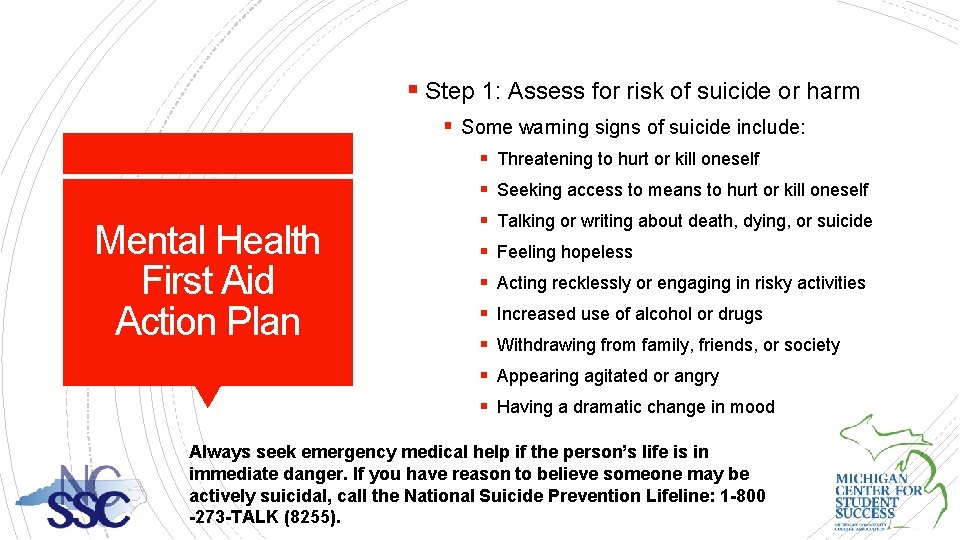
§ Step 1: Assess for risk of suicide or harm § Some warning signs of suicide include: § Threatening to hurt or kill oneself § Seeking access to means to hurt or kill oneself Mental Health First Aid Action Plan § Talking or writing about death, dying, or suicide § Feeling hopeless § Acting recklessly or engaging in risky activities § Increased use of alcohol or drugs § Withdrawing from family, friends, or society § Appearing agitated or angry § Having a dramatic change in mood Always seek emergency medical help if the person’s life is in immediate danger. If you have reason to believe someone may be actively suicidal, call the National Suicide Prevention Lifeline: 1 -800 -273 -TALK (8255).
§ Step 2: Listen nonjudgmentally § Listen to hear (not to solve, or at least not immediately) Mental Health First Aid Action Plan § Open body posture § Comfortable eye contact § Reflect content § Reflect emotion § Check-in (what do you need from me right now? ) § Don’t rush in but act (if needed)
Mental Health First Aid Action Plan § Step 3: Give reassurance and information § Convey respect § Treat the individual with dignity § Do not blame the individual for symptoms § Normalize their experience § “Given everything you’ve just said, I hear your frustration” § Normalization does not equal agreement § Stick to the facts, the student’s reported emotions and your observations (don’t reference other people’s actions) § Connect the student to campus/local resources
§ Step 4: Encourage appropriate professional help § There are many professionals who can offer help Mental Health First Aid Action Plan when someone is in crisis or may be experiencing the signs and symptoms of a mental illness or addiction. § Types of professionals § Doctors (primary care physicians or psychiatrists) § Social workers, counselors, and other mental health professionals § Certified peer specialists § Types of professional help § “Talk” therapies § Medication § Other professional supports
§ Step 5: Encourage self-help and other support strategies § Individuals with mental illness can contribute to their own recovery and wellness through: § Exercise Mental Health First Aid Action Plan § Relaxation and meditation § Participating in peer support groups § Self-help books based on cognitive behavioral therapy § Engaging with family, friends, faith, and other social networks

Challenges of Supporting Social. Emotional Needs Virtually § Lack of visual cues § Dulling of “felt sense” § Lose the ability of casual connection § Others?
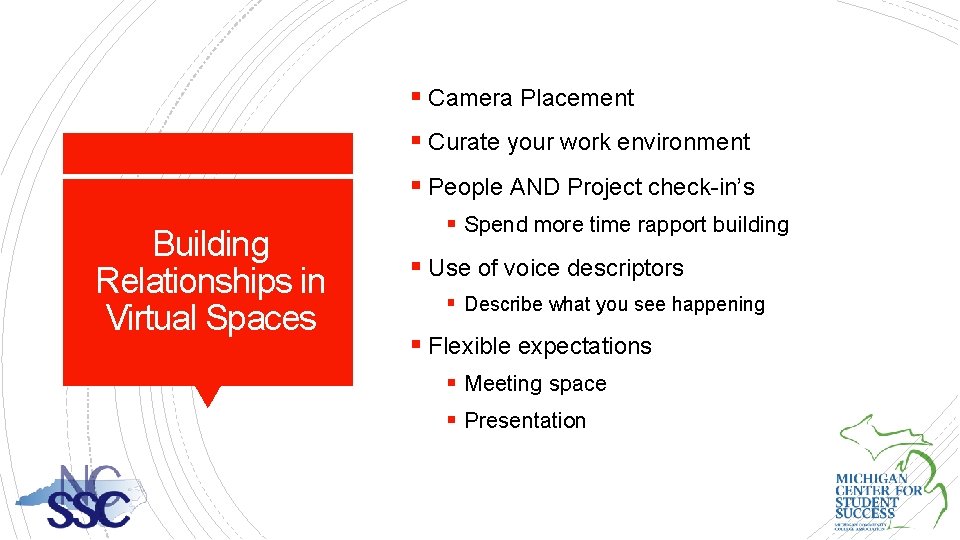
§ Camera Placement § Curate your work environment § People AND Project check-in’s Building Relationships in Virtual Spaces § Spend more time rapport building § Use of voice descriptors § Describe what you see happening § Flexible expectations § Meeting space § Presentation
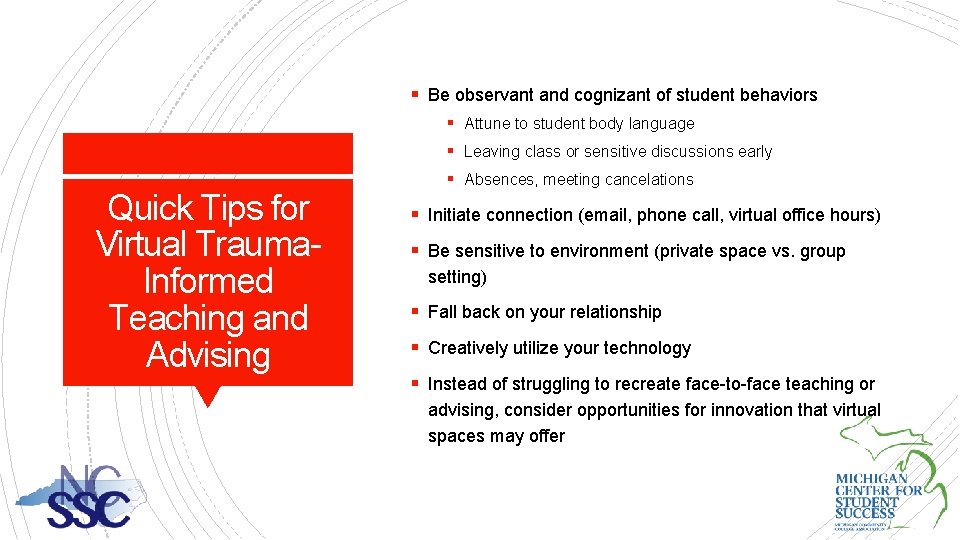
§ Be observant and cognizant of student behaviors § Attune to student body language § Leaving class or sensitive discussions early Quick Tips for Virtual Trauma. Informed Teaching and Advising § Absences, meeting cancelations § Initiate connection (email, phone call, virtual office hours) § Be sensitive to environment (private space vs. group setting) § Fall back on your relationship § Creatively utilize your technology § Instead of struggling to recreate face-to-face teaching or advising, consider opportunities for innovation that virtual spaces may offer
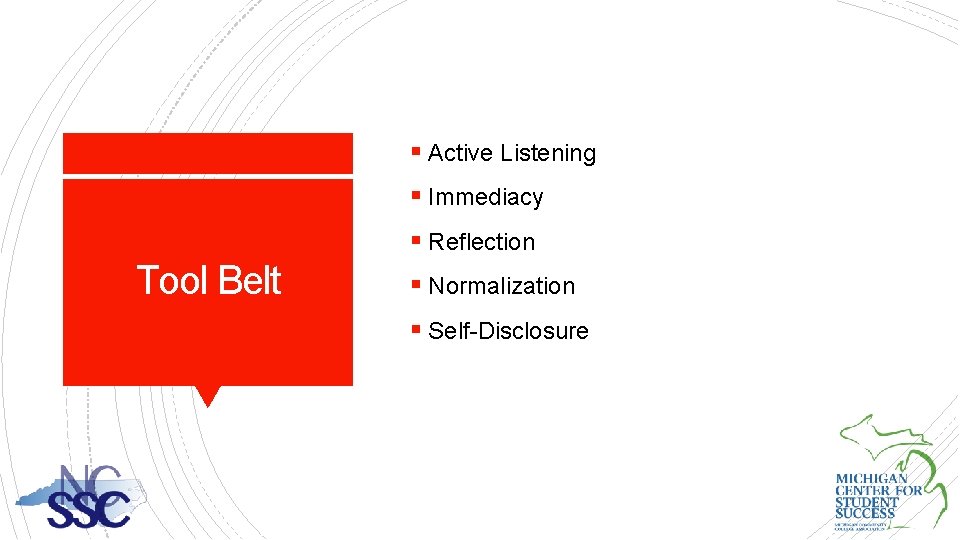
§ Active Listening § Immediacy § Reflection Tool Belt § Normalization § Self-Disclosure

Thoughts and Considerations?

Resources • https: //www. nccommunitycolleges. edu/student-success-center • https: //www. mcca. org/MI-BEST-Events

Thank You
- Slides: 43