
Trauma From Occlusion 2011 3 29 KHU PERIO
- Slides: 34
Trauma From Occlusion 2011년 3월 29일 치주과 인턴 이선화 KHU PERIO
Contents Definition and terminology Signs and symptoms Effect on gingival width Effect in periodontal disease - Analysis of human autopsy materials - Animal studies - Human studies u Treatment u Conclusion u u KHU PERIO
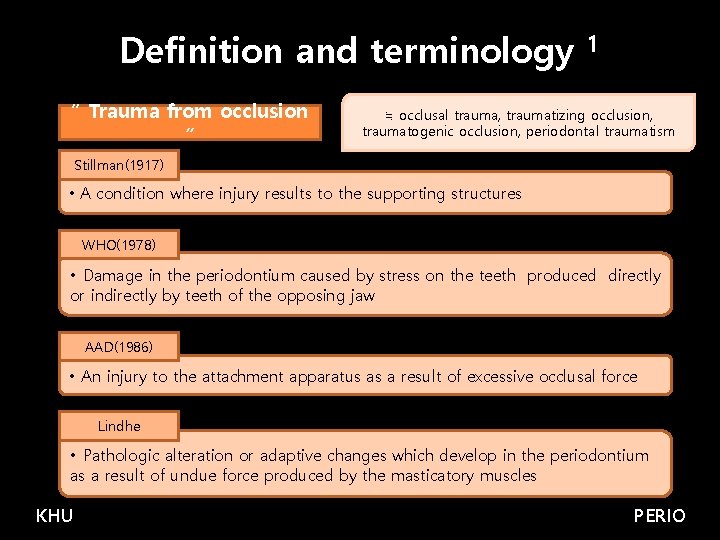
Definition and terminology “ Trauma from occlusion ” 1 ≒ occlusal trauma, traumatizing occlusion, traumatogenic occlusion, periodontal traumatism Stillman(1917) • A condition where injury results to the supporting structures WHO(1978) • Damage in the periodontium caused by stress on the teeth produced directly or indirectly by teeth of the opposing jaw AAD(1986) • An injury to the attachment apparatus as a result of excessive occlusal force Lindhe • Pathologic alteration or adaptive changes which develop in the periodontium as a result of undue force produced by the masticatory muscles KHU PERIO
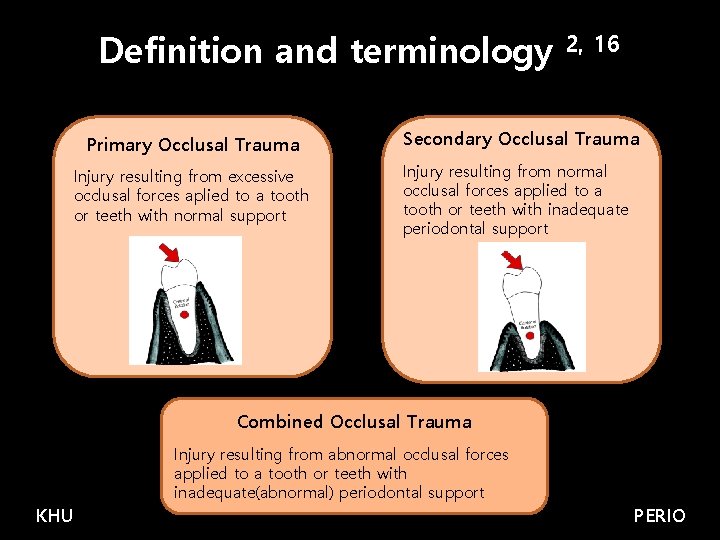
Definition and terminology Primary Occlusal Trauma Injury resulting from excessive occlusal forces aplied to a tooth or teeth with normal support 2, 16 Secondary Occlusal Trauma Injury resulting from normal occlusal forces applied to a tooth or teeth with inadequate periodontal support Combined Occlusal Trauma Injury resulting from abnormal occlusal forces applied to a tooth or teeth with inadequate(abnormal) periodontal support KHU PERIO
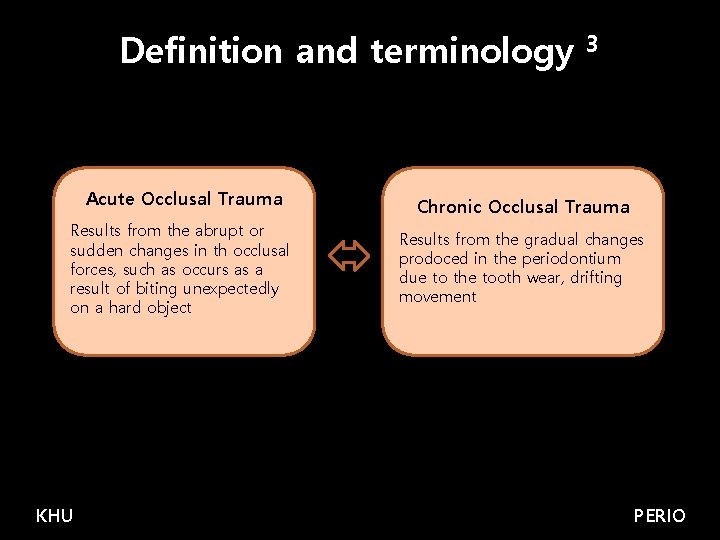
Definition and terminology Acute Occlusal Trauma Results from the abrupt or sudden changes in th occlusal forces, such as occurs as a result of biting unexpectedly on a hard object KHU 3 Chronic Occlusal Trauma Results from the gradual changes prodoced in the periodontium due to the tooth wear, drifting movement PERIO
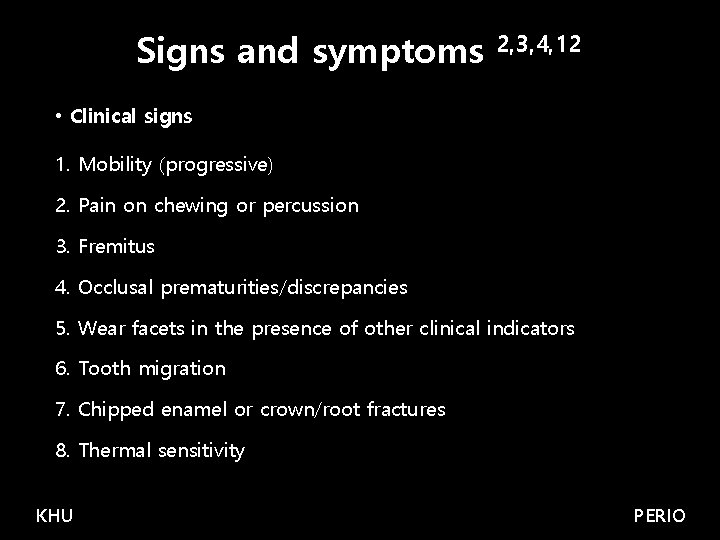
Signs and symptoms 2, 3, 4, 12 • Clinical signs 1. Mobility (progressive) 2. Pain on chewing or percussion 3. Fremitus 4. Occlusal prematurities/discrepancies 5. Wear facets in the presence of other clinical indicators 6. Tooth migration 7. Chipped enamel or crown/root fractures 8. Thermal sensitivity KHU PERIO
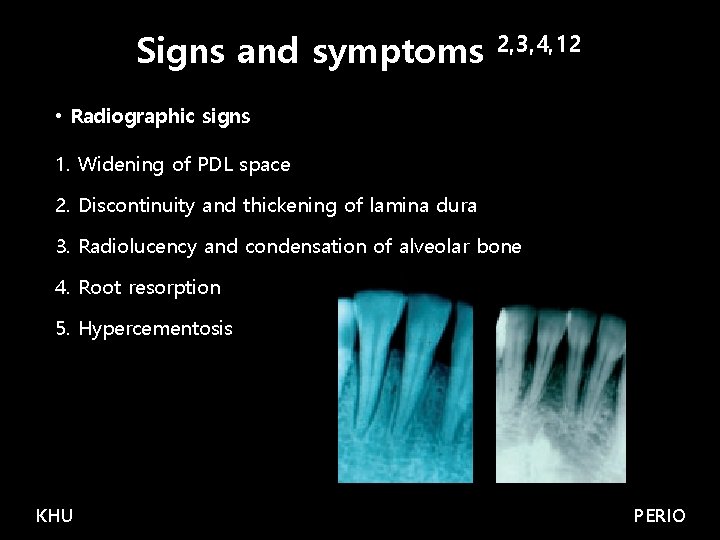
Signs and symptoms 2, 3, 4, 12 • Radiographic signs 1. Widening of PDL space 2. Discontinuity and thickening of lamina dura 3. Radiolucency and condensation of alveolar bone 4. Root resorption 5. Hypercementosis KHU PERIO
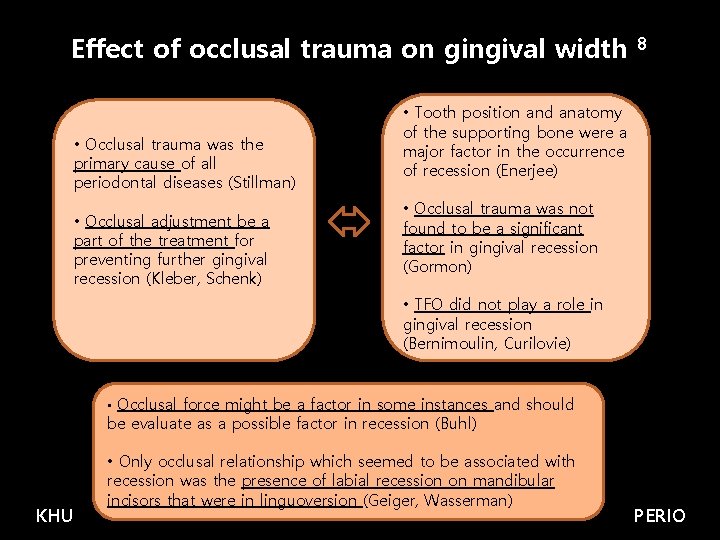
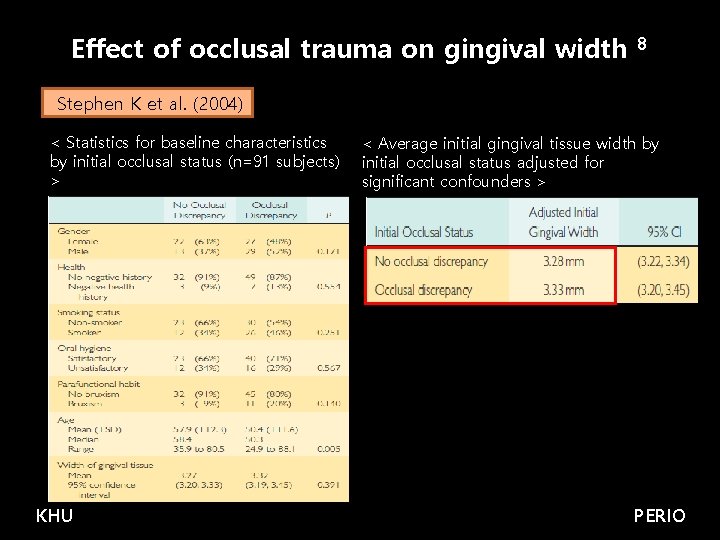
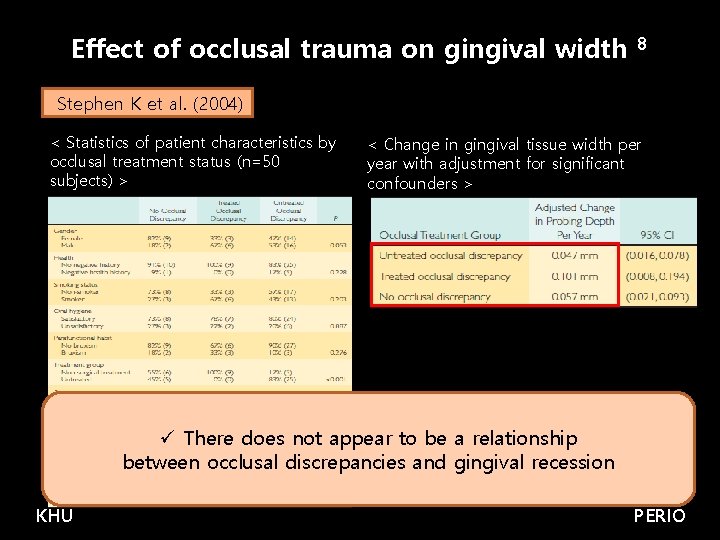
Effect of occlusal trauma on gingival width • Occlusal trauma was the primary cause of all periodontal diseases (Stillman) • Occlusal adjustment be a part of the treatment for preventing further gingival recession (Kleber, Schenk) 8 • Tooth position and anatomy of the supporting bone were a major factor in the occurrence of recession (Enerjee) • Occlusal trauma was not found to be a significant factor in gingival recession (Gormon) • TFO did not play a role in gingival recession (Bernimoulin, Curilovie) • Occlusal force might be a factor in some instances and should be evaluate as a possible factor in recession (Buhl) KHU • Only occlusal relationship which seemed to be associated with recession was the presence of labial recession on mandibular incisors that were in linguoversion (Geiger, Wasserman) PERIO
Effect of occlusal trauma on gingival width 8 Stephen K et al. (2004) < Statistics for baseline characteristics by initial occlusal status (n=91 subjects) > KHU < Average initial gingival tissue width by initial occlusal status adjusted for significant confounders > PERIO
Effect of occlusal trauma on gingival width 8 Stephen K et al. (2004) < Statistics of patient characteristics by occlusal treatment status (n=50 subjects) > < Change in gingival tissue width per year with adjustment for significant confounders > ü There does not appear to be a relationship between occlusal discrepancies and gingival recession KHU PERIO
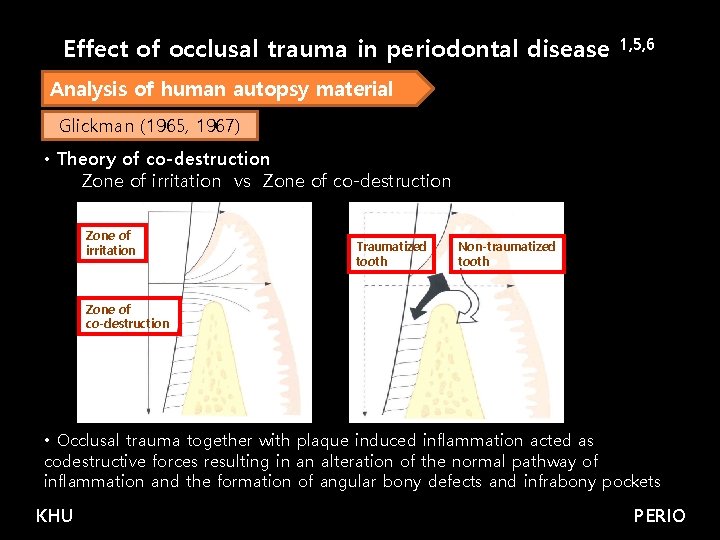
Effect of occlusal trauma in periodontal disease 1, 5, 6 Analysis of human autopsy material Glickman (1965, 1967) • Theory of co-destruction Zone of irritation vs Zone of co-destruction Zone of irritation Traumatized tooth Non-traumatized tooth Zone of co-destruction • Occlusal trauma together with plaque induced inflammation acted as codestructive forces resulting in an alteration of the normal pathway of inflammation and the formation of angular bony defects and infrabony pockets KHU PERIO
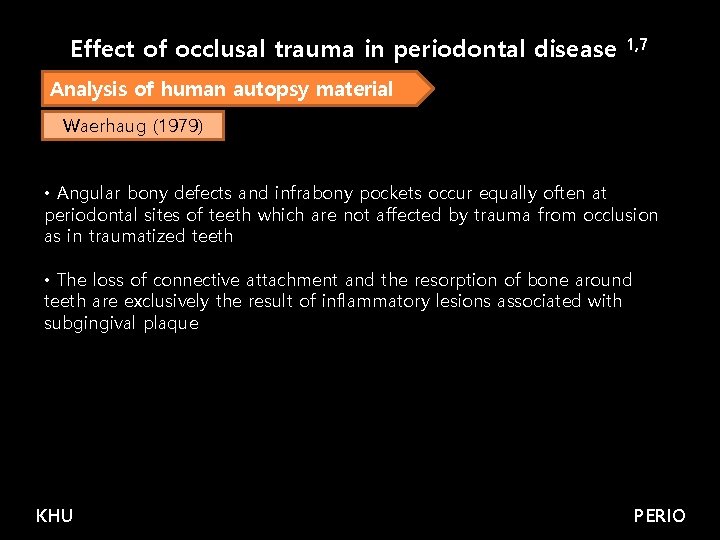
Effect of occlusal trauma in periodontal disease 1, 7 Analysis of human autopsy material Waerhaug (1979) • Angular bony defects and infrabony pockets occur equally often at periodontal sites of teeth which are not affected by trauma from occlusion as in traumatized teeth • The loss of connective attachment and the resorption of bone around teeth are exclusively the result of inflammatory lesions associated with subgingival plaque KHU PERIO
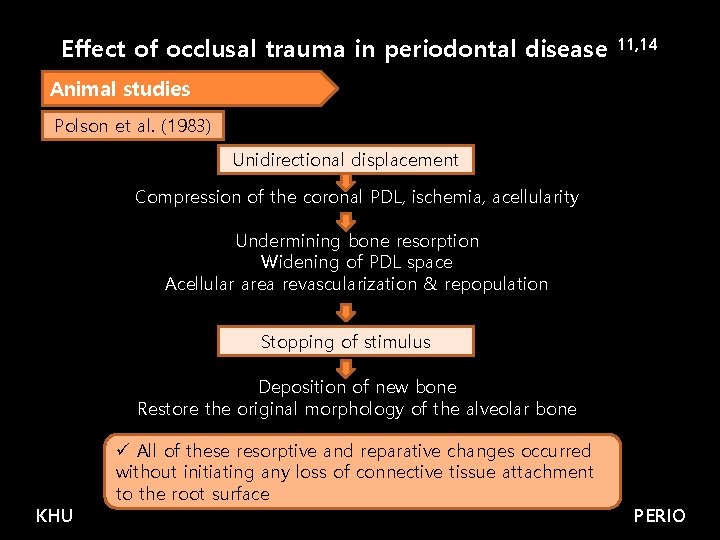
Effect of occlusal trauma in periodontal disease 11, 14 Animal studies Polson et al. (1983) Unidirectional displacement Compression of the coronal PDL, ischemia, acellularity Undermining bone resorption Widening of PDL space Acellular area revascularization & repopulation Stopping of stimulus Deposition of new bone Restore the original morphology of the alveolar bone KHU ü All of these resorptive and reparative changes occurred without initiating any loss of connective tissue attachment to the root surface PERIO
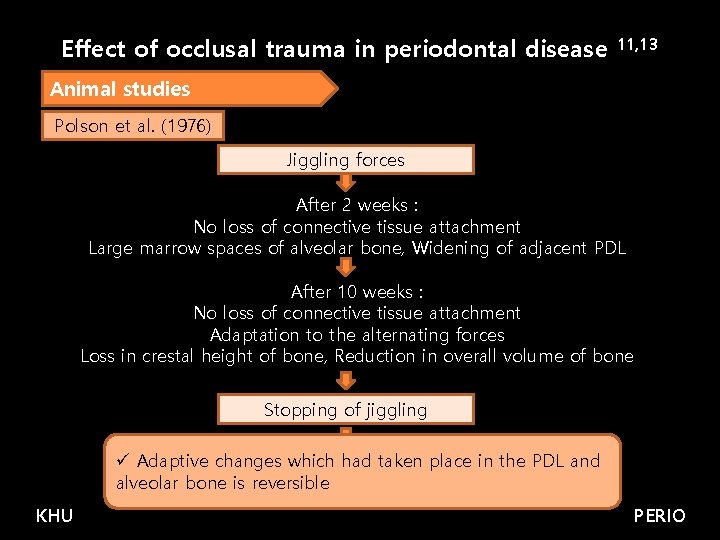
Effect of occlusal trauma in periodontal disease 11, 13 Animal studies Polson et al. (1976) Jiggling forces After 2 weeks : No loss of connective tissue attachment Large marrow spaces of alveolar bone, Widening of adjacent PDL After 10 weeks : No loss of connective tissue attachment Adaptation to the alternating forces Loss in crestal height of bone, Reduction in overall volume of bone Stopping of jiggling ü Adaptive changes which hadweeks taken: place in the PDL and After 10 alveolar bone Regeneration is reversible of alveolar bone KHU PERIO
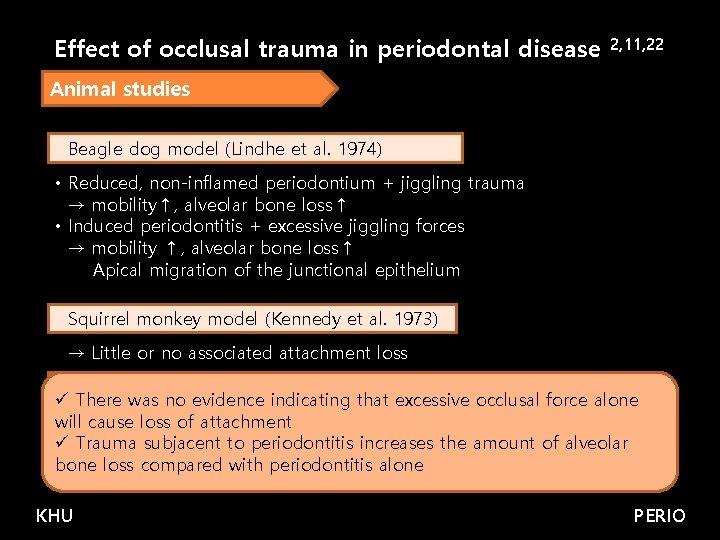
Effect of occlusal trauma in periodontal disease 2, 11, 22 Animal studies Beagle dog model (Lindhe et al. 1974) • Reduced, non-inflamed periodontium + jiggling trauma → mobility↑, alveolar bone loss↑ • Induced periodontitis + excessive jiggling forces → mobility ↑, alveolar bone loss↑ Apical migration of the junctional epithelium Squirrel monkey model (Kennedy et al. 1973) → Little or no associated attachment loss (Polson et al. 1983) ü There was no evidence indicating that excessive occlusal force alone → cause No associated attachment loss will loss of attachment Greater loss of bone with combination of periodontitis and trauma ü Trauma subjacent to periodontitis increases the amount of alveolar angular bone loss bone. Crestal loss compared with periodontitis alone KHU PERIO
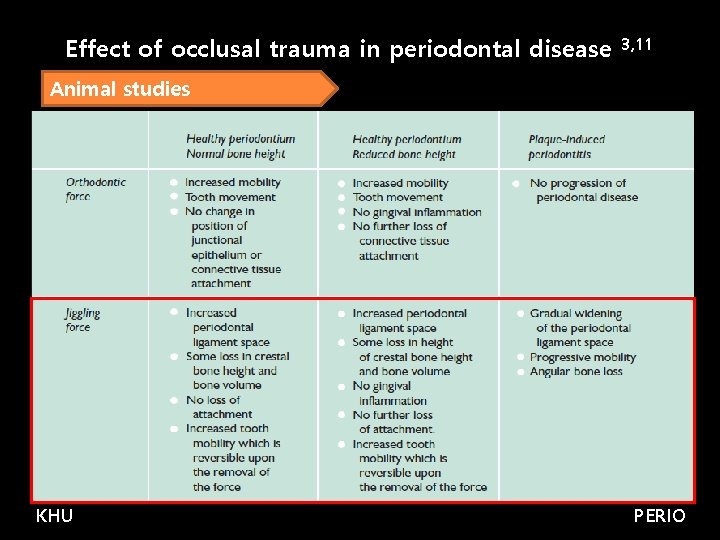
Effect of occlusal trauma in periodontal disease 3, 11 Animal studies KHU PERIO
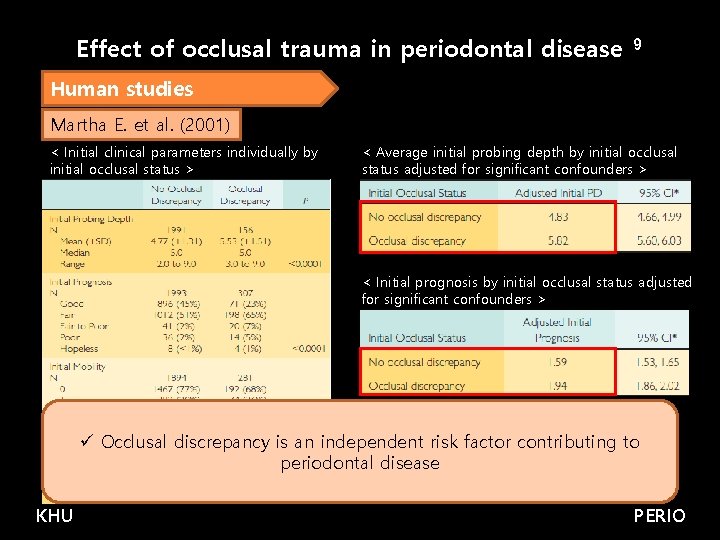
Effect of occlusal trauma in periodontal disease 9 Human studies Martha E. et al. (2001) < Initial clinical parameters individually by initial occlusal status > < Average initial probing depth by initial occlusal status adjusted for significant confounders > < Initial prognosis by initial occlusal status adjusted for significant confounders > ü Occlusal discrepancy is an independent risk factor contributing to periodontal disease KHU PERIO
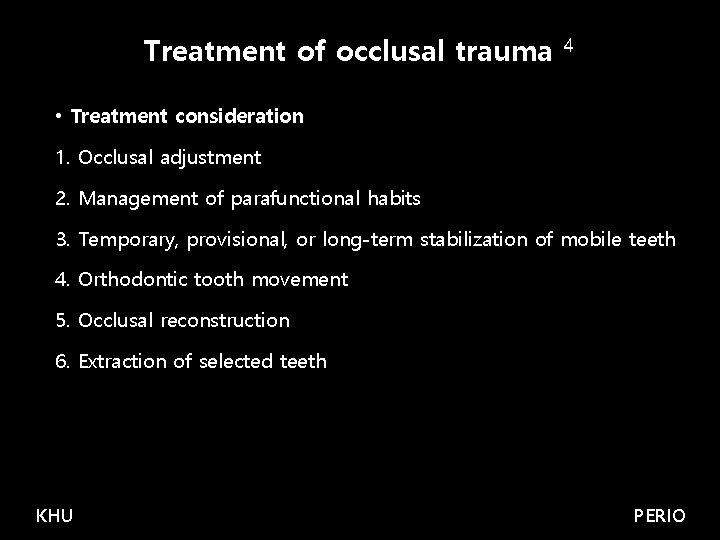
Treatment of occlusal trauma 4 • Treatment consideration 1. Occlusal adjustment 2. Management of parafunctional habits 3. Temporary, provisional, or long-term stabilization of mobile teeth 4. Orthodontic tooth movement 5. Occlusal reconstruction 6. Extraction of selected teeth KHU PERIO
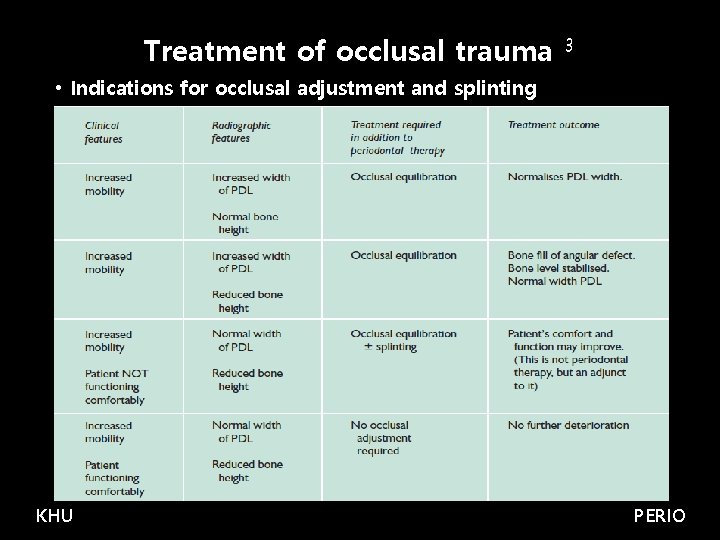
Treatment of occlusal trauma 3 • Indications for occlusal adjustment and splinting KHU PERIO
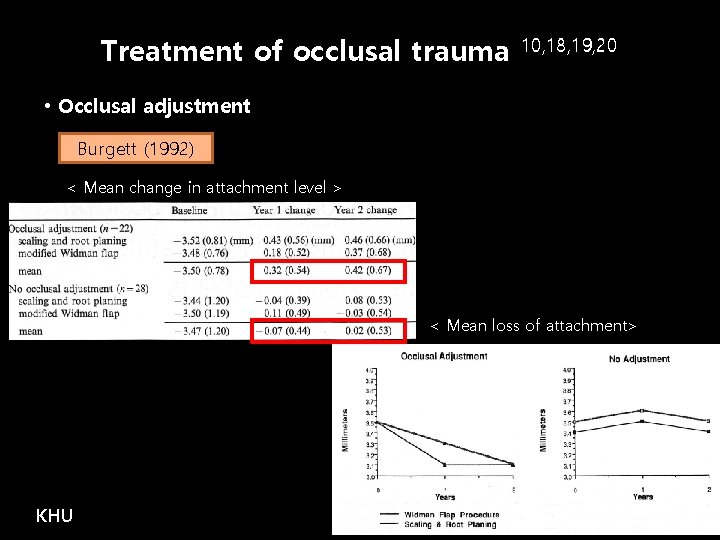
Treatment of occlusal trauma 10, 18, 19, 20 • Occlusal adjustment Burgett (1992) < Mean change in attachment level > < Mean loss of attachment> KHU PERIO
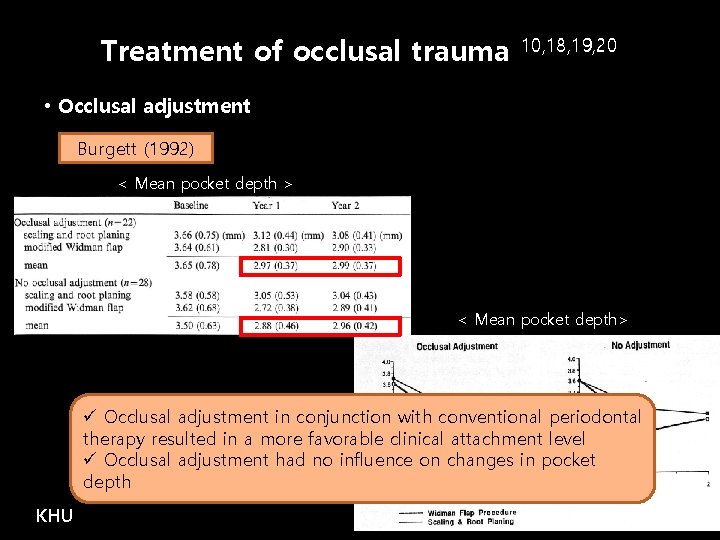
Treatment of occlusal trauma 10, 18, 19, 20 • Occlusal adjustment Burgett (1992) < Mean pocket depth > < Mean pocket depth> ü Occlusal adjustment in conjunction with conventional periodontal therapy resulted in a more favorable clinical attachment level ü Occlusal adjustment had no influence on changes in pocket depth KHU PERIO
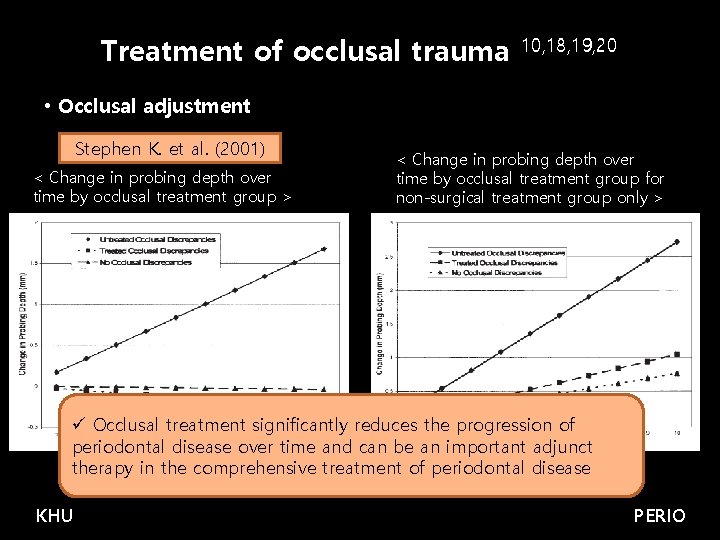
Treatment of occlusal trauma 10, 18, 19, 20 • Occlusal adjustment Stephen K. et al. (2001) < Change in probing depth over time by occlusal treatment group > < Change in probing depth over time by occlusal treatment group for non-surgical treatment group only > ü Occlusal treatment significantly reduces the progression of periodontal disease over time and can be an important adjunct therapy in the comprehensive treatment of periodontal disease KHU PERIO
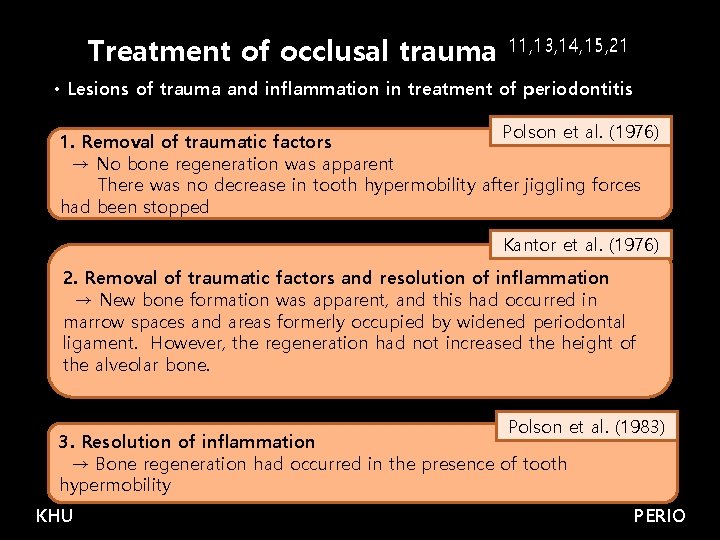
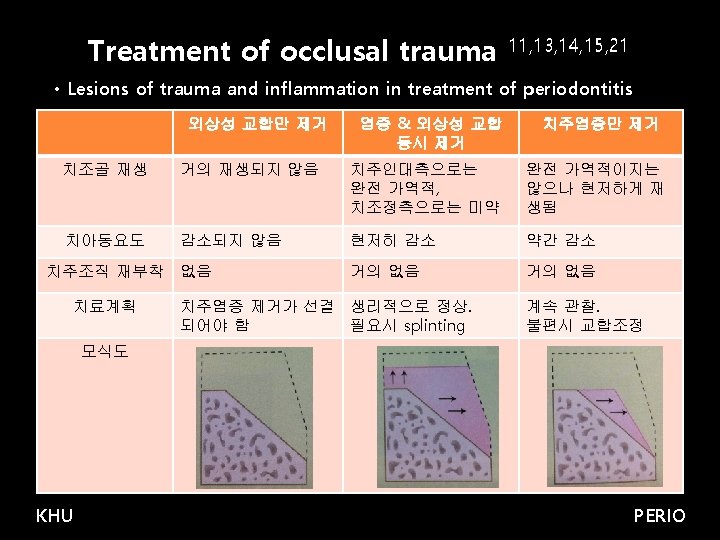
Treatment of occlusal trauma 11, 13, 14, 15, 21 • Lesions of trauma and inflammation in treatment of periodontitis Polson et al. (1976) 1. Removal of traumatic factors → No bone regeneration was apparent There was no decrease in tooth hypermobility after jiggling forces had been stopped Kantor et al. (1976) 2. Removal of traumatic factors and resolution of inflammation → New bone formation was apparent, and this had occurred in marrow spaces and areas formerly occupied by widened periodontal ligament. However, the regeneration had not increased the height of the alveolar bone. Polson et al. (1983) 3. Resolution of inflammation → Bone regeneration had occurred in the presence of tooth hypermobility KHU PERIO
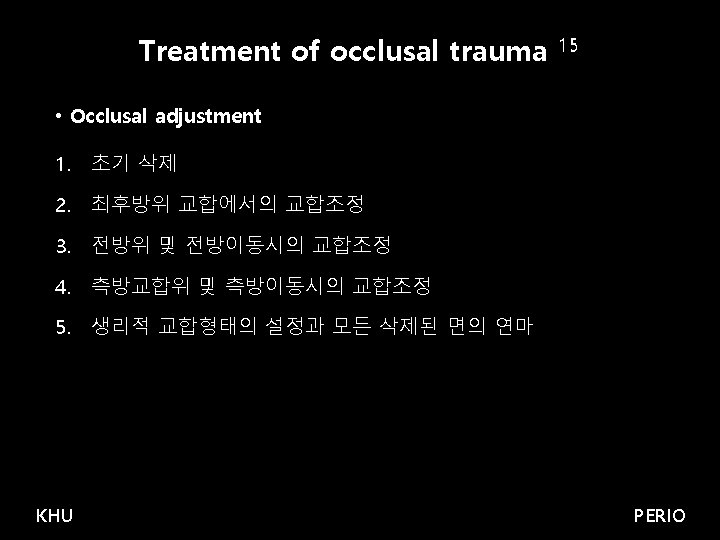
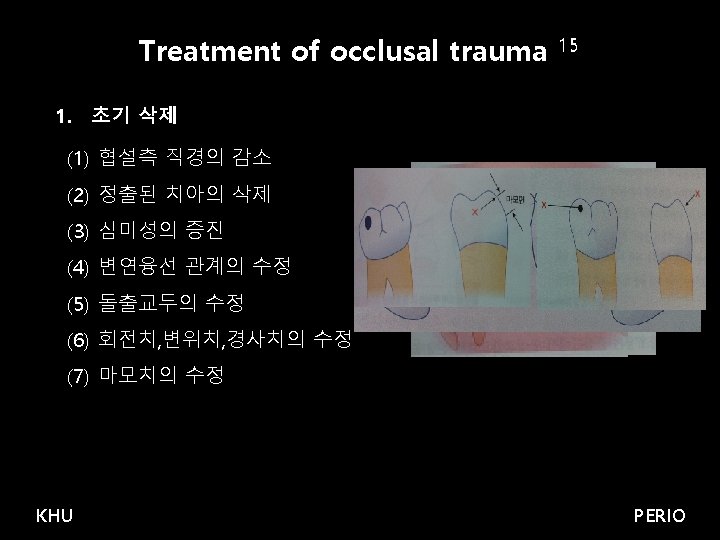
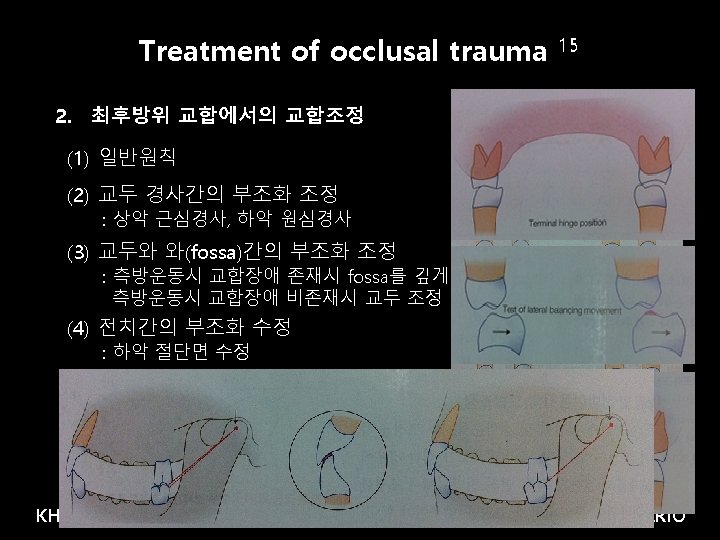
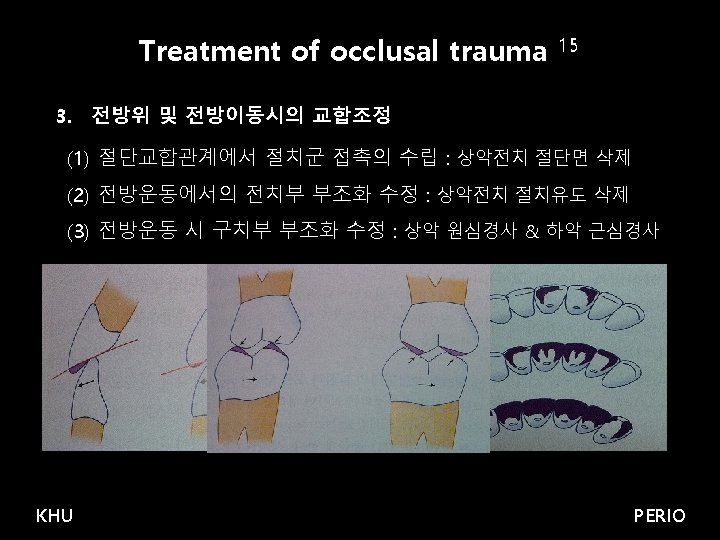
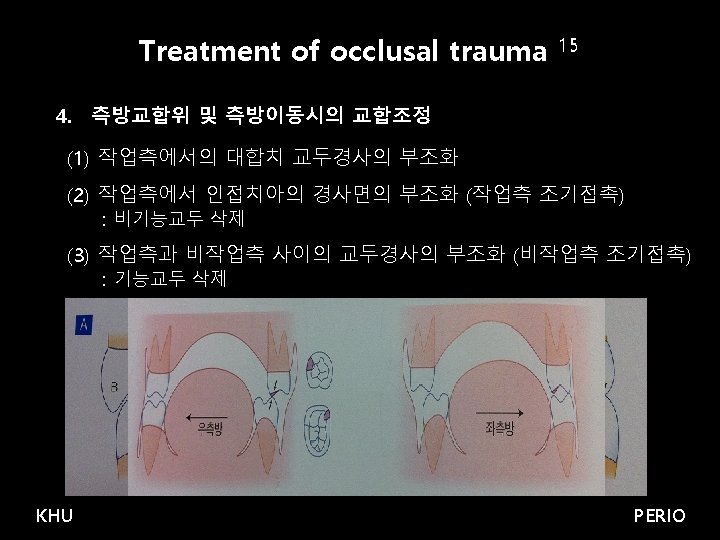
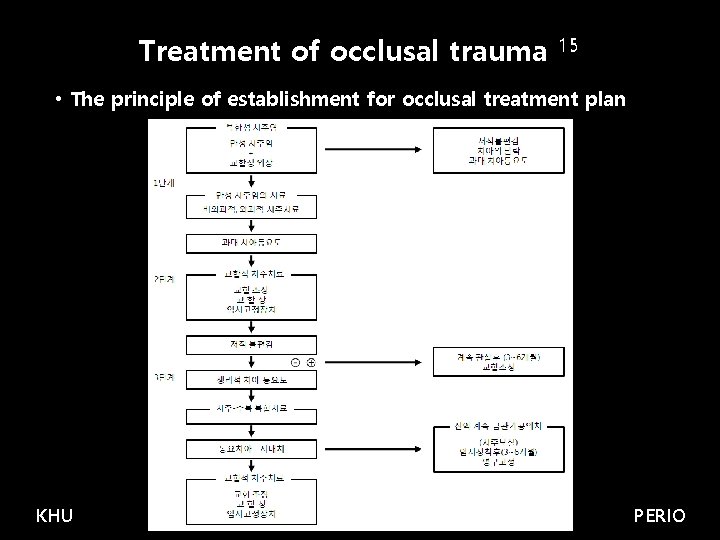
Treatment of occlusal trauma 15 • The principle of establishment for occlusal treatment plan KHU PERIO
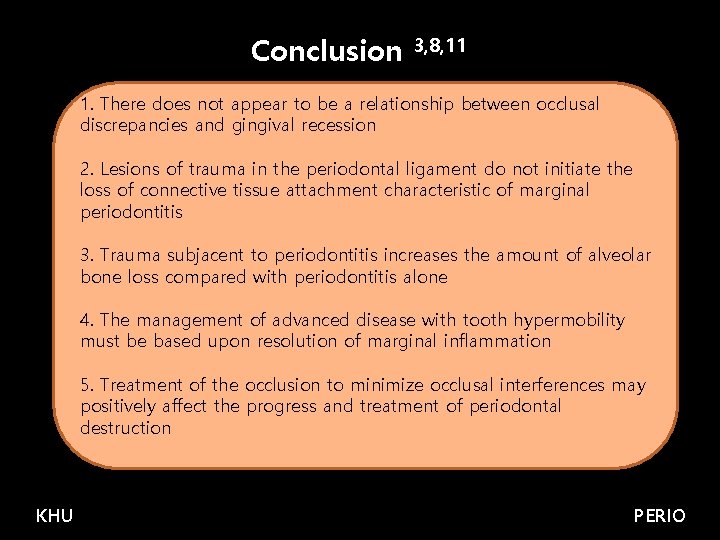
Conclusion 3, 8, 11 1. There does not appear to be a relationship between occlusal discrepancies and gingival recession 2. Lesions of trauma in the periodontal ligament do not initiate the loss of connective tissue attachment characteristic of marginal periodontitis 3. Trauma subjacent to periodontitis increases the amount of alveolar bone loss compared with periodontitis alone 4. The management of advanced disease with tooth hypermobility must be based upon resolution of marginal inflammation 5. Treatment of the occlusion to minimize occlusal interferences may positively affect the progress and treatment of periodontal destruction KHU PERIO
Reference 1. Jan Lindhe. Clinical periodontology and implant dentistry 5 th edition. Munksgaard, 2009; 279 -94 2. William W. Hallmon, Occlusal trauma: Effect and impact on the periodontium, Ann Periodontol, 1999; 4: 102 -107 3. S. J. Davies, Occlusal considerations in periodontics, British dental journal, 2001; 191: 597 -604 4. Parameter on occlusal traumatism in patients with chronic periodontitis, J Periodontol, 2000; 71: 873 -875 5. Glickman. I, Clinical significance of trauma from occlusion, Journal of the American Dental Association, 1965; 70: 607 -618 6. Glickman. I, Occlusion and periodontium, Journal of Dental Research, 1967; 46: Supplement 1, 53 7. Waerhaug. J, The infrabony pocket and its relationship to trauma from occlusion and subgingival plaque, Journal of Periodontology, 1979; 50: 355 -365 8. Stephen K. Harrel & Martha E. Nunn, The effect of occlusal discrepancies on gingival width, Journal of Periodontology, 2004; 75: 98 -105 9. Martha E. Nunn & Stephen K. Harrel, The effect of occlusal discrepancies on periodontitis. I. Relationship of initial occulsal discrepancies to initial clinical parameters, Journal of Periodontology, 2001; 72: 485 -494 KHU PERIO
Reference 10. Stephen K. Harrel & Martha E. Nunn, The effect of occlusal discrepancies on periodontitis. Ⅱ. Relationship of occlusal treatment to the progression of periodontal disease, Journal of Periodontology, 2001; 72: 495 -505 11. Polson, A. M. , The relative importance of plaque and occlusion in periodontal disease, J Clin Periodontol, 1986; 13: 923 -927 12. Bruce L. Association between signs of trauma from occlusion and periodontitis, J of Periodontol, 1985; 20: 1 -6 13. Polson, A. M. , Trauma and progression of marginal periodontitis in squirrel monkeys, Journal of Periodontal Research, 1976; 279 -289 14. Polson, A. M. , Effect of periodontal trauma upon intrabony pockets, Journal of Periodontology, 1983; 54: 586 -591 15. 전국치주과학교수협의회. 치주과학. 군자출판사. 2010; 387 -403 16. Bernal G, Carvajal JC, Muñoz-Viveros CA. Clinical management of mobile teeth. J Contemp Dent Pract. 2002 November; (3)4: 010 -022 17. Proceedings of the World Workshop in Clinical Periodontics. Chicago, America Academy of Periodontology, 1989 18. Burgett FG, Ramfjord SP, Nissle RR, et al. A randomized trial of occlusal adjustment in the treatment of periodontitis patients. J Clin Periodontol 1992 Jul; 19(6): 381 -7 KHU PERIO
Reference 19. Gher M. Non-surgical pocket therapy: Dental occlusion. Ann Periodontol 1996; 1: 576 20. Charles R. Anderegg, David G, et al. Tooth mobility revisited. J of Periodontol, 2001; 72: 963 -967 21. Kantor, M. , Polson, A. M. & Zander. H. A. Alveolar bone regeneration after removal of inflammatory and traumatic factors. J of Periodontol, 1976; 47: 687 -695 22. William W. Hallmon & Stephen K. Harrel. Occlusal analysis, diagnosis and management in the practice of periodontics. Periodontology 2000. 2004; 34: 151 -164 23. Stephen K. Harrel. Occlusal forces as a risk factor for periodontal disease. Periodontology 2000. 2003; 32: 111 -117 KHU PERIO