
Trauma A Granular Look Big T and Little
Trauma – A Granular Look: Big T and Little t Trauma Robert M Giannamore, MDiv, MS, NCC, LPC, CPT
Why? : A functional understanding • L. , a 18 year old female was recently admitted to the emergency room because of self-inflicted razor cuts to her wrists, which she claimed made her feel alive by feeling pain. L spent a week in the hospital and was discharged to a Partial Hospitalization program. • During the intake for the Partial Program, L was initially uncooperative stating she felt abandoned by society and especially by her friends and family. L. , expressed placing blame on teachers, past therapists and her parents for her inability to reach her dreams of being a model, which she claims contracts to model with various local modeling agencies. She is convinced that one day she will take her life back; however, in the interim, she will have to return to her mother’s home. She is very bitter and angry with both of her parents to whom she feels distance and that her parents owe her an explanation for their failure to support her dreams and ambitions.
Why? : A Functional Understanding • She admitted to the excessive use of benzodiazepines and alcohol to control her anxiety and numb the emotional pain. Her presenting complaints consisted to angry outbursts, feelings of emptiness, rejection, loneliness, and depression. She states that she has difficulty getting along with people and experiences rapid mood swings involving depression, anger, and anxiety. She has periods when she feels good about herself and practices self-care. At other times, she finds it impossible to get out of bed and take care of anything. She lacks a sense of identity and doesn’t really know who she is from one minute to the next. • During hospitalization the treatment focused on reduction of the imminent threat to L. ’s life and on helping her to develop more effective coping strategies. L. expresses little empathy for others and primarily focuses on immediate gratification of her needs and wants.
Why: A Functional Understanding • L’s ACE load is high with a family history of alcoholism, drug use, • • abandonment, sexual abuse by an uncle at 6 years old and ending when client stabbed uncle at 14. Client has a history of 2 abortions and 1 miscarriage. She has never brought a child to term. L has been involved in several relationships, her lasted 4 years and was abusive, emotionally, verbally and physically. Drug use is largely limited to meth and marijuana, Alcohol use is 4 beers a day. Diet is poor and L is currently 100 lbs overweight with markers of pre diabetes, high blood pressure and cholesterol
Why? : A Functional Understanding • L has been discharged to your care in the community clinic setting, • How would you treat L from the traditional medical model? • What would a collaborative medical approach look at for L? • • What assumptions do you have? What is the function of L’s behavior? What is the emotional age of L? What other questions or assumptions would you consider?
What? : Terminology https: //www. integration. samhsa. gov/clinicalpractice/SAMSA_TIP_Trauma. pdf
Neurobiology of Trauma • Research suggests that the brains of people with PTSD differ from brains of those without PTSD in two main ways: 1. They are hyperactive to threat (amygdala). 2. They have difficulty regulating or damping down anxiety and anger (medial PFC). (Greenberg, 2018)
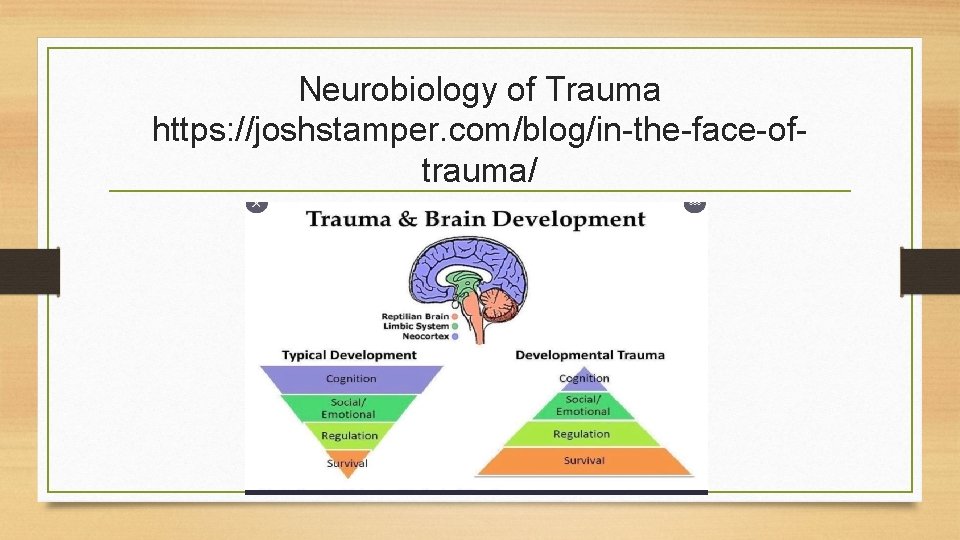
Neurobiology of Trauma https: //joshstamper. com/blog/in-the-face-oftrauma/
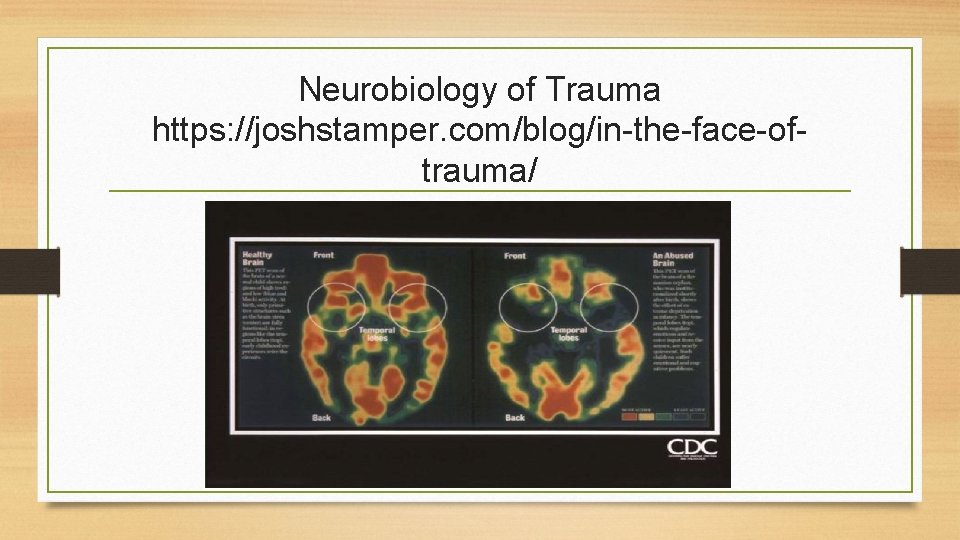
Neurobiology of Trauma https: //joshstamper. com/blog/in-the-face-oftrauma/
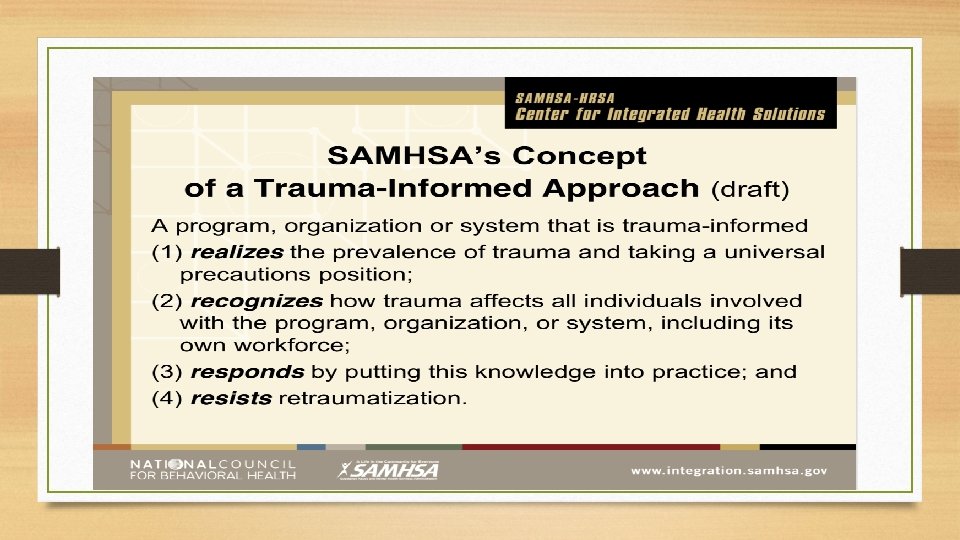
What? : SAMSHA PROTOCOLS
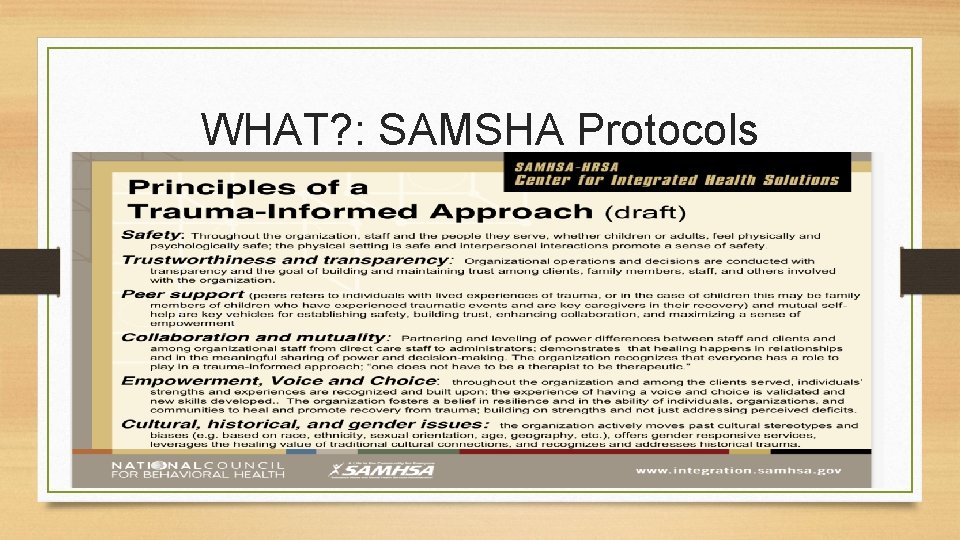
WHAT? : SAMSHA Protocols
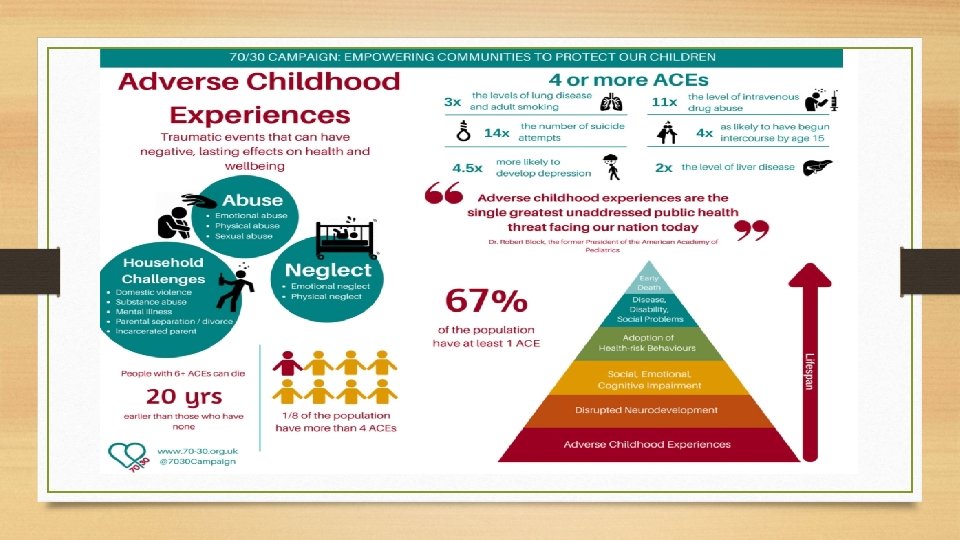
ACEs Study
Zare, Narayan, Lasway, Kitsantas, Wojtusiak, and Oetjen demonstrated in a data analysis of 31, 060 primary school-aged children was extracted from the nationally representative sample of 95, 677 children 0 to 17 years old. • 6% of children were diagnosed with depression and/or anxiety. • Economic hardship, poor parental mental/behavioral health, exposure to violence, or racial/ethnic discrimination increased the risk of depression and/or anxiety in 6 - to 11 year-old children. • Pediatric nurses(Any care provider) can help protect children from adverse childhood experience exposure and can help them recover from these events. ”(Zare, M. , Narayan, M. , Lasway, A. , Kitsantas, P. , Wojtusiak, J. , & Oetjen, C. A. 2018).
ACE’s : Prevention https: //m. youtube. com/watch? v=d-SSw. YTe 8 TY (CDC, 2018) Take a moment now in your groups to discuss what you can begin to do to mitigate the impact of ACE’s in your patient population. If there is a mental health aspect to ACE’s, what are the preventative physiological diseases that can arise from untreated mental health problems?
Trauma and Stress Related Disorders • Reactive Attachment Disorder or Developmental Trauma Disorder • RAD- an emotionally withdrawn/inhibited phenotype • Emotionally withdrawn • Social/emotional disturbance - reduced responsiveness, limited affect &/or irritability, sadness or fearfulness • Exposure to extremes of insufficient care – social neglect/deprivation, repeated caregivers, rearing in unusual settings(Albaugh, 2013) • Disinhibited Social Engagement Disorder(DSED) • DSED – an indiscriminately social/disinhibited phenotype • Reduced/absent reticence when interacting with unfamiliar adults • Behaviors not limited to impulsivity but include socially disinhibited behavior • Exposure to extremes of insufficient care – social neglect/deprivation, repeated changes in caregivers, rearing in unusual settings(Albaugh, 2013)
Trauma and Stress Related Disorders • • • PTSD Acute Stress Disorder Other specified trauma- and stressor-related disorder Unspecified trauma- and stressor-related disorder Anxiety –note anxiety disorders were linked to trauma disorders, however, Stress Disorders are now considered distinct because many patients do not have anxiety but instead have symptoms of anhedonia or dysphoria, anger, aggression, or dissociation • Depression • In this LPC’s experience, Axis II presentations
Epigenetics • Do you work with multigenerational trauma? How much backstory do you know about your clients cultural and ethnic background? • Researchers have shown that multigenerational trauma do not cause mutations of the genetic code, rather the way certain genes like anxiety and depression are expressed. • “Tiny chemical tags are added to or removed from our DNA in response to changes in the environment in which we are living. These tags turn genes on or off, offering a way of adapting to changing conditions without inflicting a more permanent shift in our genomes” (Henriques, 2019) • Men tend to be more likely to pass stress down their line.
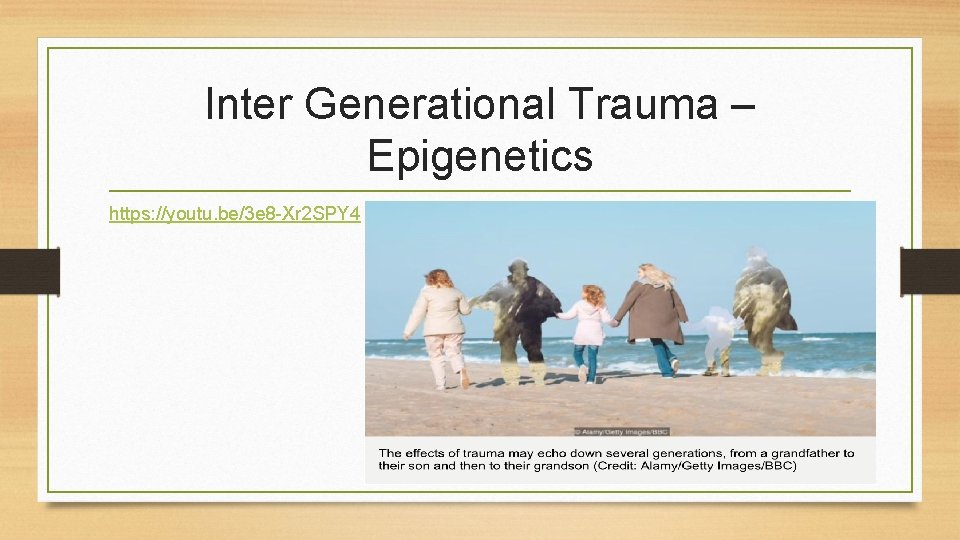
Inter Generational Trauma – Epigenetics https: //youtu. be/3 e 8 -Xr 2 SPY 4 (Henriques, 2019)
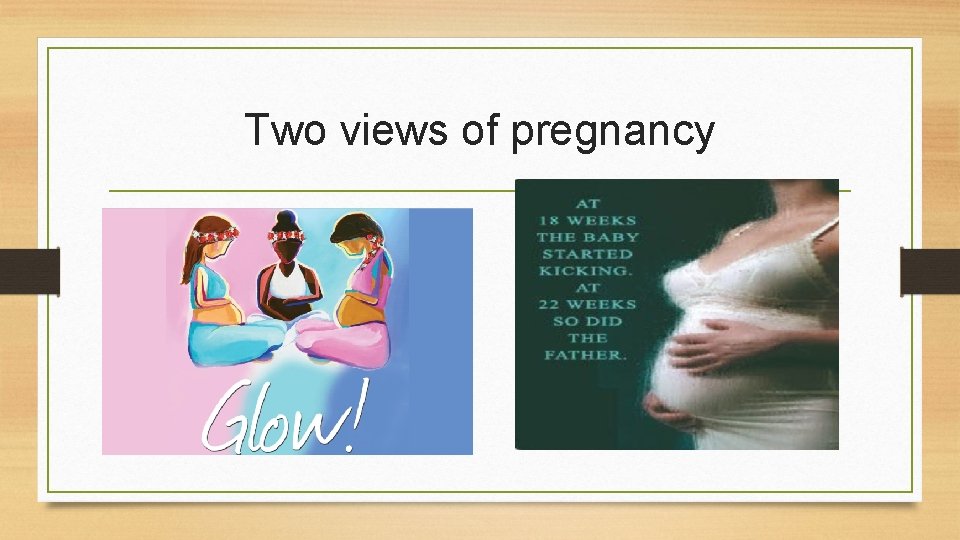
Two views of pregnancy
In the previous slide, you saw two sides of pregnancy, What expectations would you have in your patients who were experiencing the “Glow” of a healthy “normal” pregnancy? What expectations would have from a patient presenting with an abusive background? What assumptions would you have?
Prenatal Stress – What IS wrong with kids these days • In a summary for the Cognitive Neuroscience Society, they offer “The time babies spend in the womb is far from idle. The brain is changing more rapidly during this time than at any other time in development. It is an active time for the fetus to grow and explore, and of course connect to its mother. New evidence from in-utero fetal brain scans shows, for the first time, that this connection directly affects brain development” (Cognitive Neuroscience Society, 2018) SAMSHA biology of trauma: https: //www. aap. org/enus/Documents/ttb_aces_consequences. pdf
Prenatal Stress • In utero, babies are aware of sounds from their mothers and environments around them. • babies are susceptible to the mother’s use of alcohol, drugs, and even the violent and stressful environment the mother may be immersed in. https: //youtu. be/F 2 p. El. U 6 CWI 4
Attachment and Trauma • “The greatest source of danger and unpredictability is the absence of a caregiver who reliably and responsibly protects and nurtures the child”(Albaugh, 2013) • “Children exposed to complex trauma are unable to devote resources normally to growth and development, but instead their focus is on survival”(Albaugh, 2013).
Complex Trauma • Complex trauma describes both children’s exposure to multiple traumatic events—often of an invasive, interpersonal nature—and the wide-ranging, long-term effects of this exposure. These events are severe and pervasive, such as abuse or profound neglect. • They usually occur early in life and can disrupt many aspects of the child’s development and the formation of a sense of self. Since these events often occur with a caregiver, they interfere with the child’s ability to form a secure attachment. Many aspects of a child’s healthy physical and mental development rely on this primary source of safety and stability (National Child Traumatic Stress Network, 2019)
Complex Trauma: What to Expect? Attachment Disruption • As an infant, the job for this child is to form internal representations that are organized around Trust, Security and Wellbeing. • This time period ranges from 9 months to 5 years, when the child enters school and begins to test out these internal concepts externally with their first exposure to another organized social environment.
Why attachment is important https: //m. youtube. com/watch? v=apz. XGEb. Zht 0
Questions for Infant/Preschooler in beginning to understand their sense of self: • Will my signals of need and distress be understood and responded to? • What kind of responses can I anticipate? • Will I feel better worse as a result of the response I get? • Which of the many signals I give get attention? • Is it the kind of attention I want? (Albaugh quoting Liberman and Zeanah, 2013)
Symptoms of Attachment Disorder • • • Superficially engaging and charming child Indiscriminately affection with strangers Lack of affection with parents on their terms(not cuddly) Persistent nonsense questions and incessant chatter Inappropriate demanding and clingy behavior(Albaugh, 2013)
Symptoms of Attachment Disorder • Lying about the obvious • Stealing • Destructive behavior to self, others and to material things(accident prone) • Abnormal eating patterns • No impulse control(Frequently act hyperactive/ hyper vigilant(Albaugh, 2013)
Symptoms of Attachment Disorder • • Lags in learning Abnormal Speech patterns Poor peer relationships Lack of cause and effect thinking Lack of conscience Cruelty to animals Preoccupation with fire (Albaugh, 2013)
Who do this symptoms fit? where have you seen these behaviors in your practice?
Grief and Trauma • Bowlby and Parkeshttps: //www. frazerconsultants. com/2018/03/grief-theories-seriesparkes-and-bowlbys-four-phases-of-grief/ • Shock and Numbness: This is the initial phase immediately following the loss of a loved one. The shock and numbness are attributed to not being ready to accept the reality of a loss. According to Parkes and Bowlby, this phase is a self-defense mechanism that allows a person to cope immediately after learning about their loss. • Yearning and Searching: In this phase, a person experiences all types of emotion — from anxiety to anger, despair, confusion, sorrow, and much more. The bereaved begin to yearn for the return of their loved one, as well as search for meaning in their loss.
Grief and Trauma • Bowlby and Parkes - https: //www. frazerconsultants. com/2018/03/grieftheories-series-parkes-and-bowlbys-four-phases-of-grief/ • Disorganization and Despair: In this phase, a person starts to accept the reality of their loss. As they do so, they might feel the need to withdraw from their everyday life or from activities and hobbies they once enjoyed. They begin to understand that their old reality will never be the same, and this leads to feelings of despair or hopelessness. • Reorganization and Recovery: This is the phase where the mourner begins to understand that their old life is forever changed, but they begin to accept their new “normal. ” It’s a slow process, but a person begins to understand the positive aspects of their life after loss. They begin to have increased energy and positive emotions, and find renewed interest in activities and hobbies. It doesn’t mean a person stops grieving — they’ll still have moments of sorrow and sadness — but they will also begin to have more positive memories about their relationship with their loved one.
Nutrition and Trauma Disclaimer – I am not a nutritionist, none of this information is to be construed as nutritional/ medical advice. It is beyond my scope of practice to promote or prescribe nutritional plans.
Nutrition and Trauma A review of literature demonstrates that there is a link between trauma it’s impact on our gut health. Studies point to irritable bowel syndrome. • “Functional gastrointestinal disorders affect 35% to 70% of people at some point in life, women more often than men. These disorders have no apparent physical cause — such as infection or cancer — yet result in pain, bloating, and other discomfort • Numerous studies have suggested that while stress can be good for you, stress also can trigger and worsen gastrointestinal pain and other symptoms, and vice versa. ”(Suarez, 2010)
Nutrition and Trauma: What’s Going On? • In the short term, stress can shut down appetite. • But if stress persists — or is perceived as persisting — it's a different story. The adrenal glands release another hormone called cortisol, and cortisol increases appetite and may also ramp up motivation in general, including the motivation to eat. • fat- and sugar-filled foods seem to have a feedback effect that inhibits activity in the parts of the brain that produce and process stress and related emotions. So part of our stressinduced craving for those foods may be that they counteract stress. Harvard Health Publishing. (n. d. ). How stress can make us overeat. Retrieved November 3, 2019, from https: //www. health. harvard. edu/healthbeat/how-stress-can-make-us-overeat.
Nutrition and Trauma • The bottom line is our clients/ patients need a collaborative approach to medicine which considers the why the client/patient presents the way they do. • Are they hungry, sick, tired or scared? All these stressors along with financial and food insecurity can lead to eating patterns that increase risk for other chronic non communicable diseases like diabetes, cardiovascular disease and obesity
References Ackerman, C. (2018, April 27). What is Attachment Theory? Bowlby's 4 Stages Explained. Retrieved from https: //positivepsyhology. com/attachment-theory/Specific quote came from: Williams, L. , & Haley, E. (2017). Before the five stages were the FOUR stages of grief. Retrieved from https: //whatsyourgrief. com/bowlby-four-stages-ofgrief/ Albaugh, M. (2013). Attachment Workshop. Lecture presented in Perseus House, Erie. Ambeskovic, M. , Babenko, O. , Ilnytskyy, T. , Kovalchuk, I. , Kolb, B. , & Metz, G. (2019). Supplemental Information 2: NCBI genome database accession information (PDF file). Nature, 9(6389). doi: 10. 7717/peerj. 6447/supp-2 Centers for Disease Control and Prevention (CDC). (2018, June 26). Retrieved June 19, 2019, from https: //m. youtube. com/watch? v=d-SSw. YTe 8 TY About the CDC-Kaiser ACE Study |Violence Prevention|Injury Center|CDC. (n. d. ). Retrieved June 19, 2019, from https: //www. cdc. gov/violenceprevention/childabuseandneglect/acestudy/about. html Cognitive Neuroscience Society. (2018, March 26). Prenatal stress changes brain connectivity in-utero: New findings from developmental cognitive neuroscience. Science. Daily. Retrieved June 17, 2019 from www. sciencedaily. com/releases/2018/03/180326110123. htm Complex Trauma in Children and Adolescents. (2019). National Child Traumatic Stress Network. www. NCTSNet. org
References Greenberg , M. (2018, September 29). How PTSD and Trauma Affect Your Brain Functioning. Retrieved November 4, 2019, from https: //www. psychologytoday. com/us/blog/the-mindful-selfexpress/201809/how-ptsd-and-trauma-affect-your-brain-functioning. Harvard Health Publishing. (n. d. ). How stress can make us overeat. Retrieved November 3, 2019, from https: //www. health. harvard. edu/healthbeat/how-stress-can-make-us-overeat. Henriques, M. (2019, March 26). Future - Can the legacy of trauma be passed down the generations? Retrieved from http: //www. bbc. com/future/story/20190326 -what-is-epigenetics Korja, R. , Nolvi, S. , Grant, K. , Mc. Mahon, C. , & Grant, K. A. (2017). The Relations Between Maternal Prenatal Anxiety or Stress and Child’s Early Negative Reactivity or Self-Regulation: A Systematic Review. Child Psychiatry & Human Development, 48(6), 851– 869. https: //doi. org/10. 1007/s 10578 -017 -0709 -0
References Karatekin, C. (2018). Adverse Childhood Experiences (ACEs), Stress and Mental Health in College Students. Stress & Health: Journal of the International Society for the Investigation of Stress, 34(1), 36– 45. https: //doi. org/10. 1002/smi. 2761 Park, S. H. , Videlock, E. J. , Shih, W. , Presson, A. P. , Mayer, E. A. , & Chang, L. (2016). Adverse childhood experiences are associated with irritable bowel syndrome and gastrointestinal symptom severity. Neurogastroenterology & Motility , 28(8), 1252– 1260. https: //doi. org/10. 1111/nmo. 12826 Reuben, A. , Moffitt, T. E. , Caspi, A. , Belsky, D. W. , Harrington, H. , Schroeder, F. , … Danese, A. (2016). Lest we forget: comparing retrospective and prospective assessments of adverse childhood experiences in the prediction of adult health. Journal of Child Psychology & Psychiatry, 57(10), 1103– 1112. https: //doi. org/10. 1111/jcpp. 12621 Suarez K, et al. "Psychological Stress and Self-Reported Functional Gastrointestinal Disorders, " The Journal of Nervous and Mental Disease (March 2010): Vol. 198, No. 3, pp. 226– 29. Retrieved from https: //www. health. harvard. edu/newsletter_article/stress-and-the-sensitive-gut Stam, R. , Akkermans, L. M. , & Wiegant, V. M. (1997). Trauma and the gut: Interactions between stressful experience and intestinal function. Gut, 40(6), 704709. doi: 10. 1136/gut. 40. 6. 704. Retrieved from https: //www. ncbi. nlm. nih. gov/pmc/articles/PMC 1027192/pdf/gut 00039 -0018. pdf You. Tube, 6 Sept. 2015, youtu. be/3 e 8 -Xr 2 SPY 4. Zhang, W. , Li, Q. , Deyssenroth, M. , Lambertini, L. , Finik, J. , Ham, J. , … Nomura, Y. (2018). Timing of prenatal exposure to trauma and altered placental expressions of hypothalamic‐pituitary‐adrenal axis genes and genes driving neurodevelopment. Journal of Neuroendocrinology, 30(4), 1. https: //doi. org/10. 1111/jne. 12581 Zare, M. , Narayan, M. , Lasway, A. , Kitsantas, P. , Wojtusiak, J. , & Oetjen, C. A. (2018). Influence of Adverse Childhood Experiences on Anxiety and Depression In Children Aged 6 to 11 Years. Pediatric Nursing, 44(6), 267– 274. Retrieved from http: //search. ebscohost. com/login. aspx? direct=true&db=a 2 h&AN=133645940&site=ehost-live
- Slides: 41