
transversity measurements by COMPASS Andrea Bressan CERN and
transversity measurements by COMPASS Andrea Bressan CERN and INFN Trieste on behalf of the COMPASS Collaboration Outline • The COMPASS experiment • Results on: – Collins/Sivers asymmetries : positive and negative hadrons p±, K ± For: Two hadron asymmetries: – Beyond Collins/Sivers: – DIS 2007 C. Shill on Thursday A. Kotzinian on Thursday Andrea Bressan 1
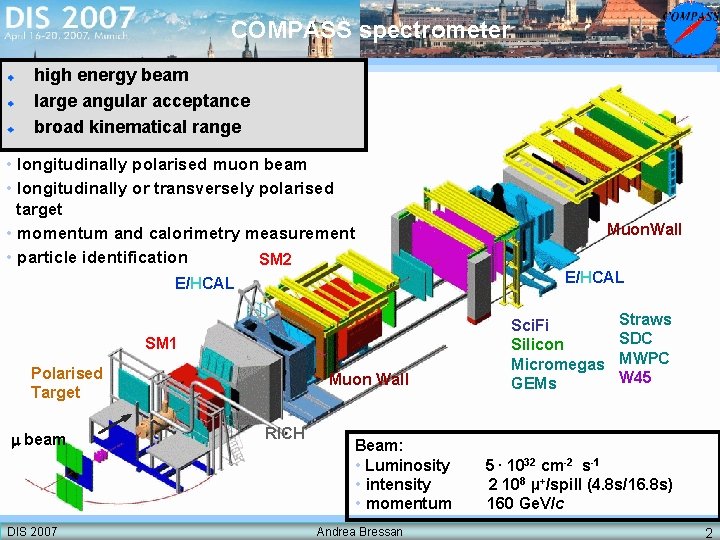
COMPASS spectrometer high energy beam large angular acceptance broad kinematical range • longitudinally polarised muon beam • longitudinally or transversely polarised target • momentum and calorimetry measurement • particle identification SM 2 E/HCAL SM 1 Polarised Target m beam DIS 2007 Muon. Wall Muon Wall RICH Beam: • Luminosity • intensity • momentum Andrea Bressan Sci. Fi Silicon Micromegas GEMs Straws SDC MWPC W 45 5. 1032 cm-2 s-1 2 108 µ+/spill (4. 8 s/16. 8 s) 160 Ge. V/c 2
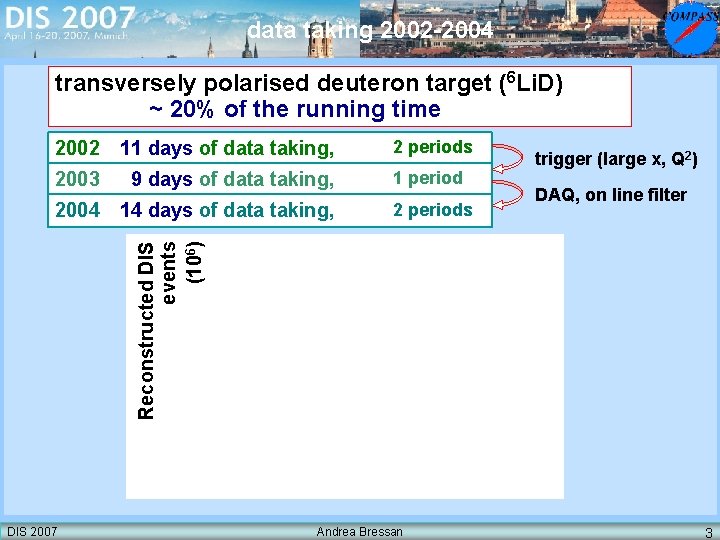
data taking 2002 -2004 transversely polarised deuteron target (6 Li. D) ~ 20% of the running time 2002 11 days of data taking, 2003 9 days of data taking, 14 days of data taking, 1 period 2 periods trigger (large x, Q 2) DAQ, on line filter Reconstructed DIS events (106) 2004 2 periods DIS 2007 Andrea Bressan 3
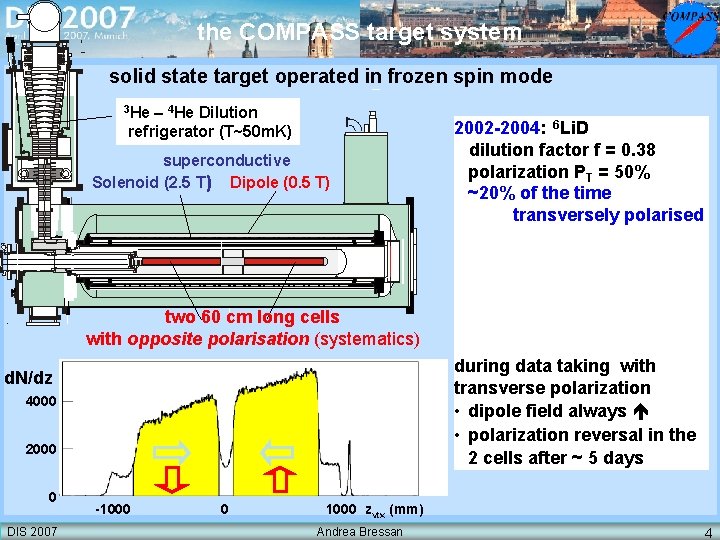
the COMPASS target system solid state target operated in frozen spin mode 3 He – 4 He Dilution refrigerator (T~50 m. K) superconductive Solenoid (2. 5 T) Dipole (0. 5 T) 2002 -2004: 6 Li. D dilution factor f = 0. 38 polarization PT = 50% ~20% of the time transversely polarised two 60 cm long cells with opposite polarisation (systematics) during data taking with transverse polarization • dipole field always • polarization reversal in the 2 cells after ~ 5 days d. N/dz 4000 2000 0 DIS 2007 -1000 0 1000 zvtx (mm) Andrea Bressan 4
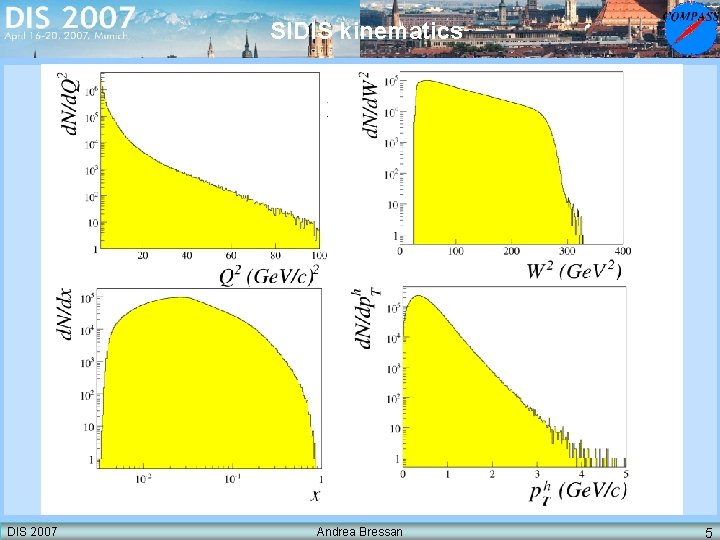
SIDIS kinematics DIS 2007 Andrea Bressan 5
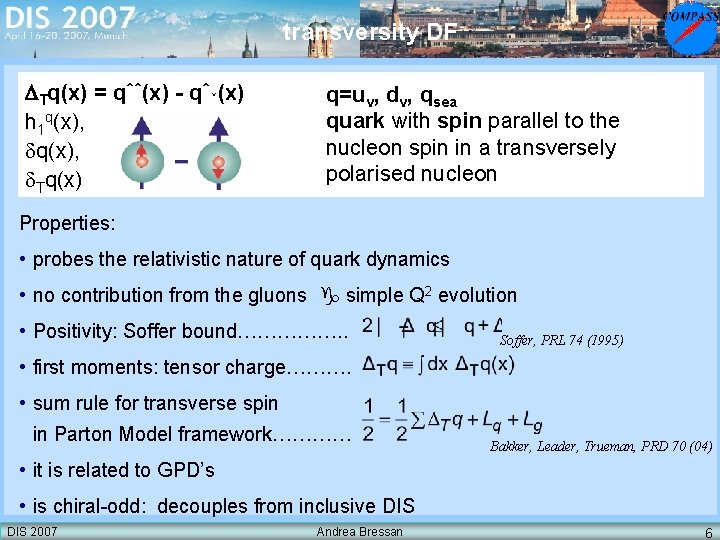
transversity DF Tq(x) = q↑↑(x) - q↑↓(x) h 1 q(x), d. Tq(x) q=uv, dv, qsea quark with spin parallel to the nucleon spin in a transversely polarised nucleon Properties: • probes the relativistic nature of quark dynamics • no contribution from the gluons simple Q 2 evolution • Positivity: Soffer bound……………. . Soffer, PRL 74 (1995) • first moments: tensor charge………. • sum rule for transverse spin in Parton Model framework………… Bakker, Leader, Trueman, PRD 70 (04) • it is related to GPD’s • is chiral-odd: decouples from inclusive DIS 2007 Andrea Bressan 6
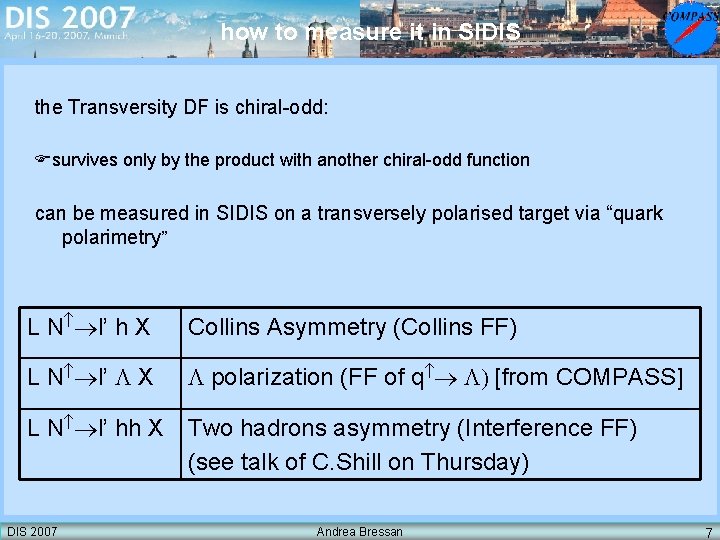
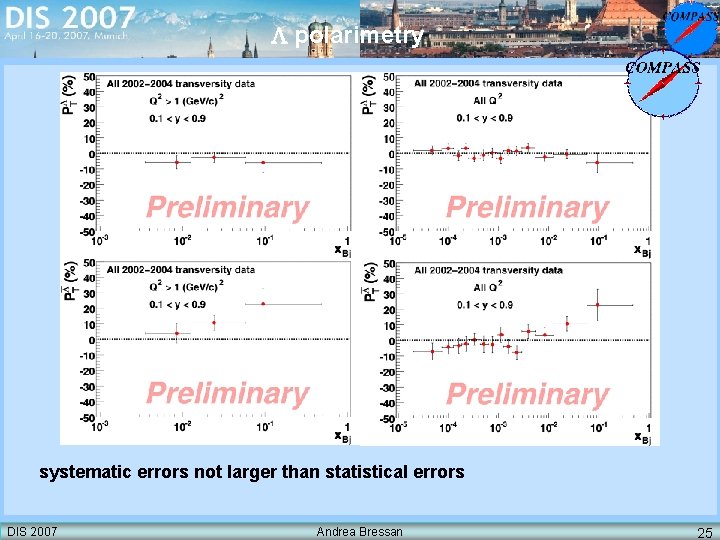
how to measure it in SIDIS the Transversity DF is chiral-odd: survives only by the product with another chiral-odd function can be measured in SIDIS on a transversely polarised target via “quark polarimetry” L N l’ h X Collins Asymmetry (Collins FF) L N l’ L X L polarization (FF of q L) [from COMPASS] L N l’ hh X Two hadrons asymmetry (Interference FF) (see talk of C. Shill on Thursday) DIS 2007 Andrea Bressan 7
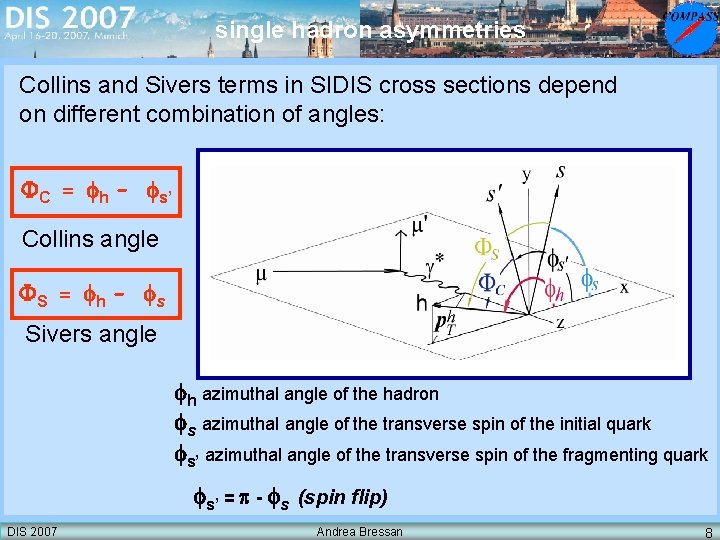
single hadron asymmetries Collins and Sivers terms in SIDIS cross sections depend on different combination of angles: C = h - s’ Collins angle S = h - s Sivers angle h azimuthal angle of the hadron s azimuthal angle of the transverse spin of the initial quark s’ azimuthal angle of the transverse spin of the fragmenting quark s’ = p - s (spin flip) DIS 2007 Andrea Bressan 8
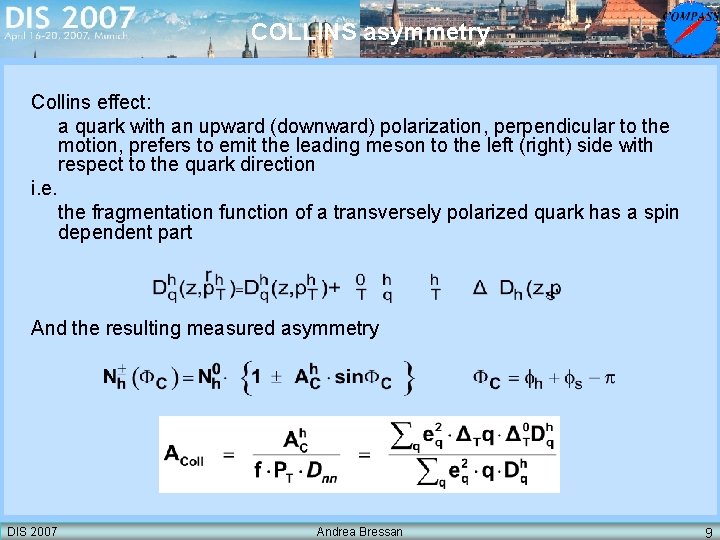
COLLINS asymmetry Collins effect: a quark with an upward (downward) polarization, perpendicular to the motion, prefers to emit the leading meson to the left (right) side with respect to the quark direction i. e. the fragmentation function of a transversely polarized quark has a spin dependent part And the resulting measured asymmetry DIS 2007 Andrea Bressan 9
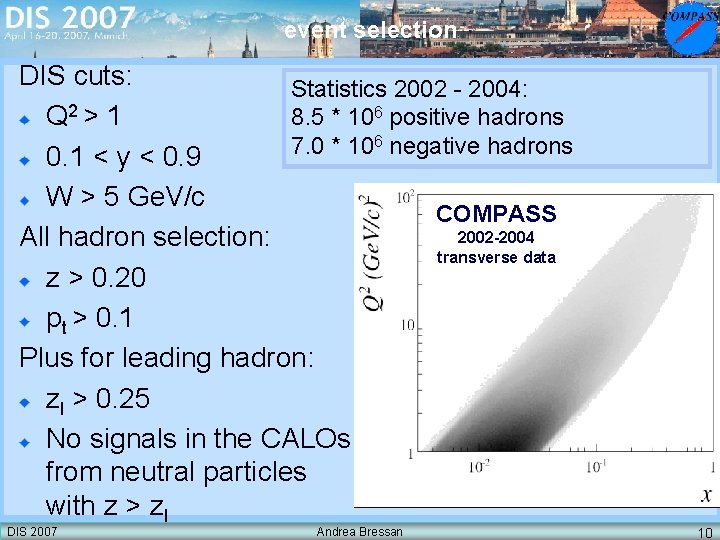
event selection DIS cuts: Statistics 2002 - 2004: Q 2 > 1 8. 5 * 106 positive hadrons 6 negative hadrons 7. 0 * 10 0. 1 < y < 0. 9 W > 5 Ge. V/c COMPASS 2002 -2004 All hadron selection: transverse data z > 0. 20 pt > 0. 1 Plus for leading hadron: zl > 0. 25 No signals in the CALOs from neutral particles with z > zl DIS 2007 Andrea Bressan 10
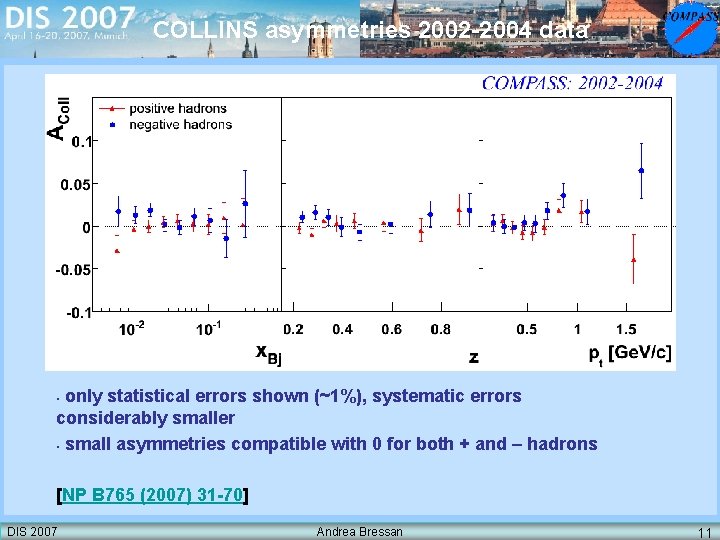
COLLINS asymmetries 2002 -2004 data only statistical errors shown (~1%), systematic errors considerably smaller • small asymmetries compatible with 0 for both + and – hadrons • [NP B 765 (2007) 31 -70] DIS 2007 Andrea Bressan 11
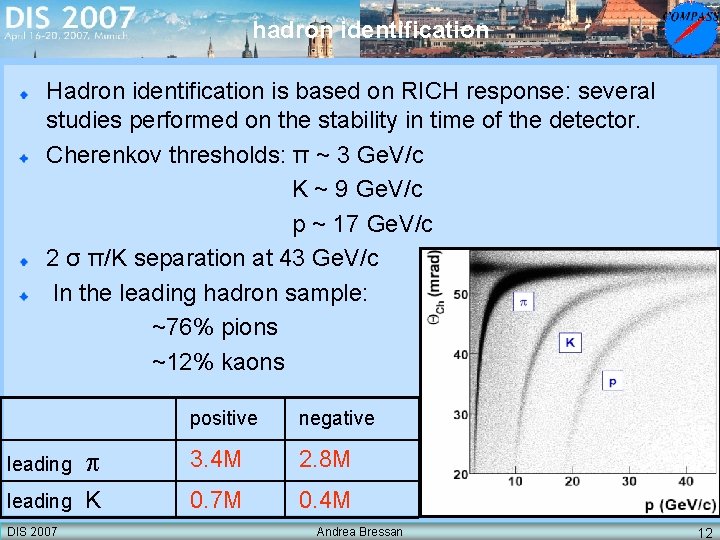
hadron identification Hadron identification is based on RICH response: several studies performed on the stability in time of the detector. Cherenkov thresholds: π ~ 3 Ge. V/c K ~ 9 Ge. V/c p ~ 17 Ge. V/c 2 σ π/K separation at 43 Ge. V/c In the leading hadron sample: ~76% pions ~12% kaons positive negative leading 3. 4 M 2. 8 M leading K 0. 7 M 0. 4 M DIS 2007 Andrea Bressan 12
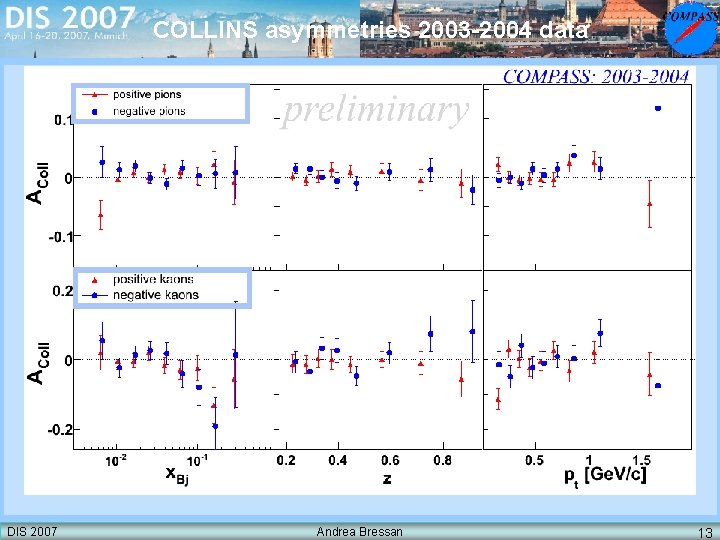
COLLINS asymmetries 2003 -2004 data DIS 2007 Andrea Bressan 13
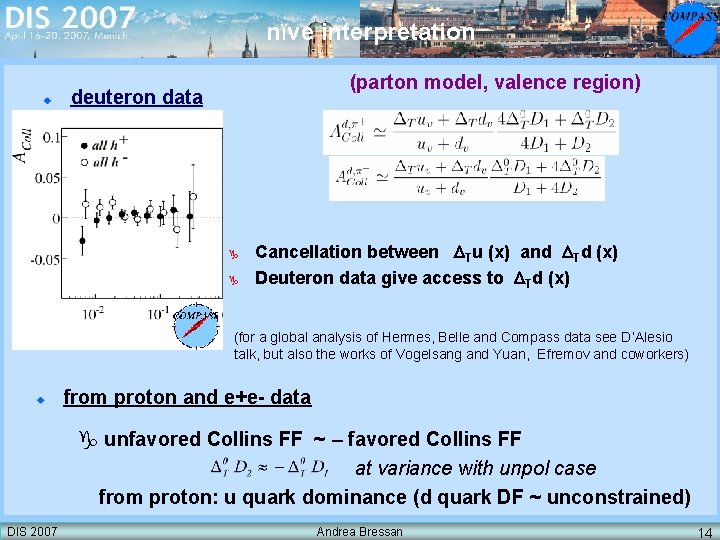
nïve interpretation (parton model, valence region) deuteron data Cancellation between Tu (x) and Td (x) Deuteron data give access to Td (x) (for a global analysis of Hermes, Belle and Compass data see D’Alesio talk, but also the works of Vogelsang and Yuan, Efremov and coworkers) from proton and e+e- data unfavored Collins FF ~ – favored Collins FF at variance with unpol case from proton: u quark dominance (d quark DF ~ unconstrained) DIS 2007 Andrea Bressan 14
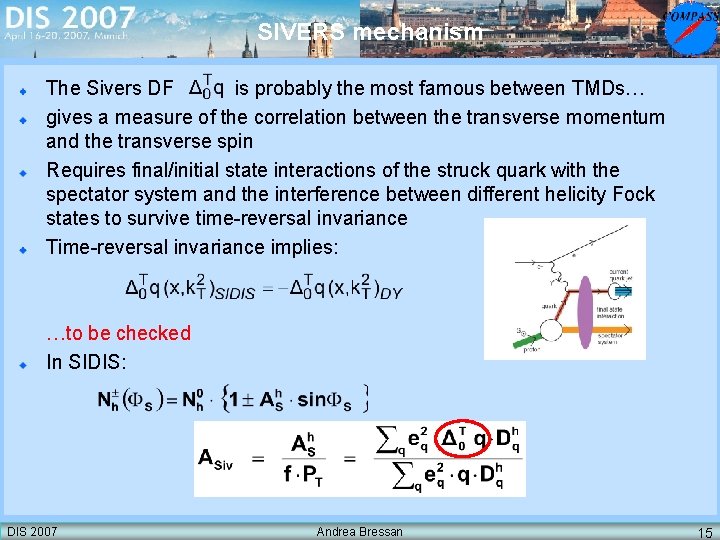
SIVERS mechanism The Sivers DF is probably the most famous between TMDs… gives a measure of the correlation between the transverse momentum and the transverse spin Requires final/initial state interactions of the struck quark with the spectator system and the interference between different helicity Fock states to survive time-reversal invariance Time-reversal invariance implies: …to be checked In SIDIS: DIS 2007 Andrea Bressan 15
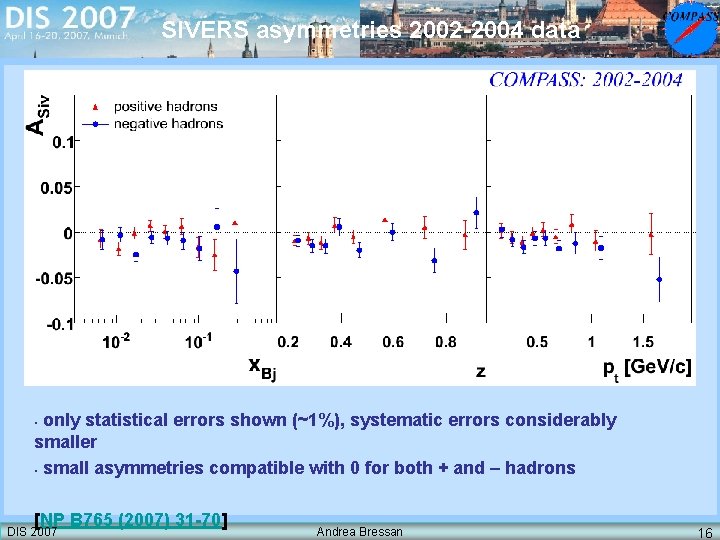
SIVERS asymmetries 2002 -2004 data only statistical errors shown (~1%), systematic errors considerably smaller • small asymmetries compatible with 0 for both + and – hadrons • [NP B 765 (2007) 31 -70] DIS 2007 Andrea Bressan 16
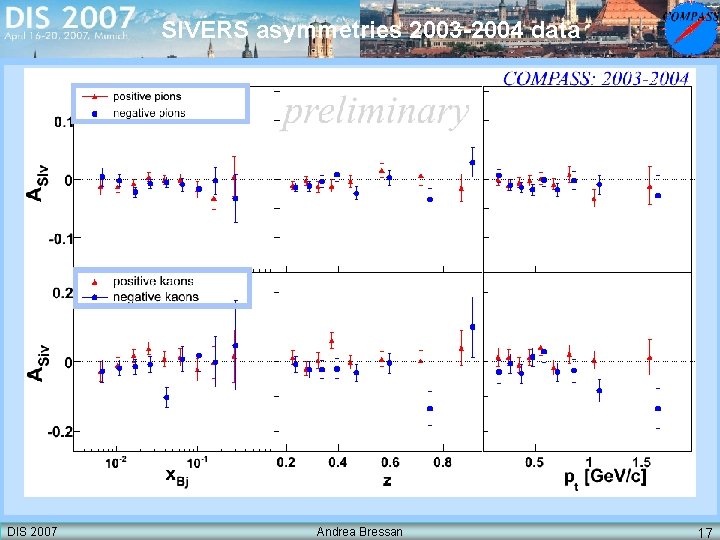
SIVERS asymmetries 2003 -2004 data DIS 2007 Andrea Bressan 17
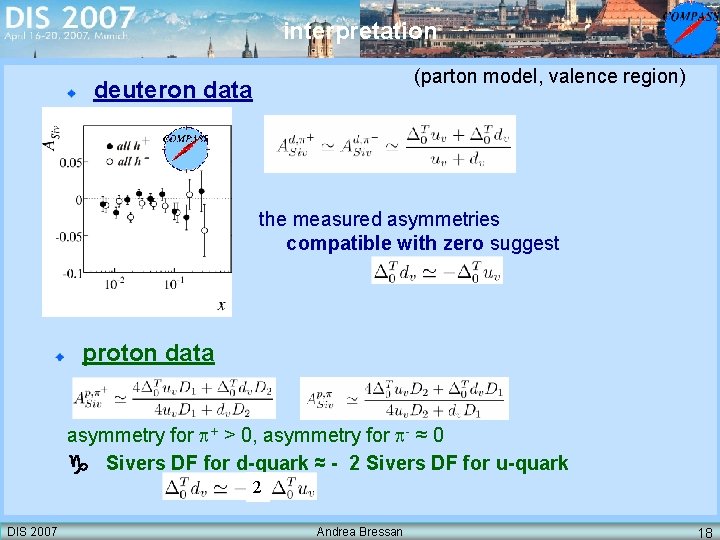
interpretation (parton model, valence region) deuteron data preliminary 2002 -2004 the measured asymmetries compatible with zero suggest proton data asymmetry for + > 0, asymmetry for - ≈ 0 Sivers DF for d-quark ≈ - 2 Sivers DF for u-quark 2 DIS 2007 Andrea Bressan 18
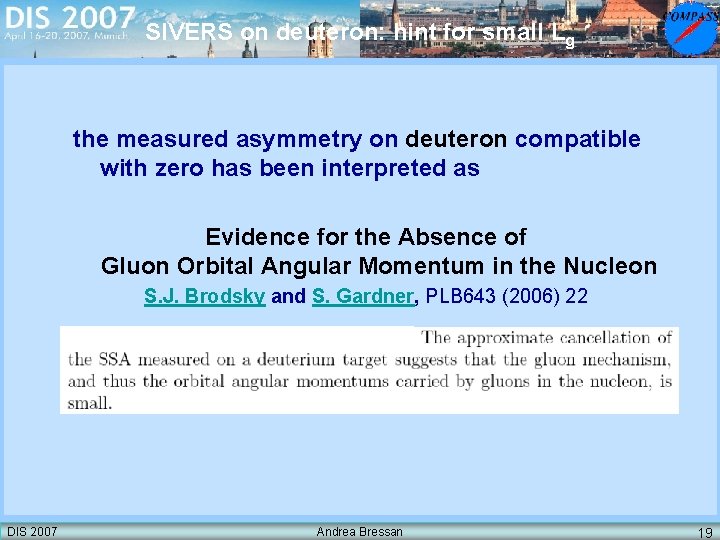
SIVERS on deuteron: hint for small Lg the measured asymmetry on deuteron compatible with zero has been interpreted as Evidence for the Absence of Gluon Orbital Angular Momentum in the Nucleon S. J. Brodsky and S. Gardner, PLB 643 (2006) 22 DIS 2007 Andrea Bressan 19
summary and outlook precise deuteron data from COMPASS are now available Collins and Sivers asymmetries h±, p±, K± all the measured deuteron asymmetries are very small, and compatible with zero COMPASS data on deuteron allows to determine the d-quark contribution [for two hadron asymmetries C. Shill] [for all transverse momentum dependent SSA azimuthal asymmetries A. Kotzinian] present phenomenological studies can describe at the same time the BELLE (FF), the HERMES (proton) and COMPASS (deuteron)…and have allowed a first extraction of the transversity distribution Tq At the same way COMPASS and HERMES data have allowed a first extraction of the Sivers DF (work ongoing) DIS 2007 Andrea Bressan 20
summary and outlook in the near future COMPASS will complete the analysis of the recorded deuteron data: K 0 asymmetries exclusive r production on transversely polarised target A little further in time… g 2 transverse effects from longitudinal data Cahn and Boer-Mulders effect in 2007 COMPASS will take data with a transversely polarised proton target (NH 3) (with 50 days running, precision ~ deuteron at small x, better at “large” x for the new PT magnet) On a longer time scale, good perspective for a measurement of Drell-Yan pairs in COMPASS and further measurements of transverse spin effects in SIDIS 2007 Andrea Bressan 21
Just in Case DIS 2007 Andrea Bressan 22
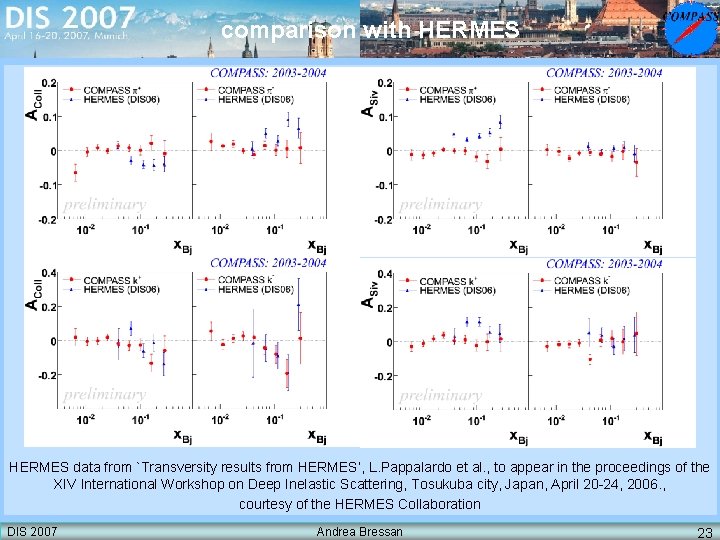
comparison with HERMES data from `Transversity results from HERMES’, L. Pappalardo et al. , to appear in the proceedings of the XIV International Workshop on Deep Inelastic Scattering, Tosukuba city, Japan, April 20 -24, 2006. , courtesy of the HERMES Collaboration DIS 2007 Andrea Bressan 23
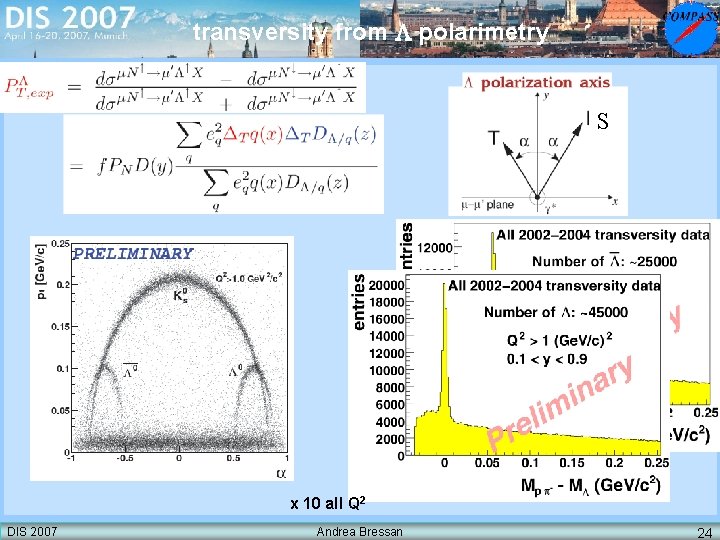
transversity from L polarimetry S x 10 all Q 2 DIS 2007 Andrea Bressan 24
L polarimetry systematic errors not larger than statistical errors DIS 2007 Andrea Bressan 25
- Slides: 25