
Transtheoretical Model and Motivational Interviewing A Very Brief
Transtheoretical Model and Motivational Interviewing: A Very Brief Introduction Cathy Crouch, LCSW Trainer, MI Network of Trainers Executive Vice-President SEARCH Homeless Services - Houston ccrouch@searchhomeless. org
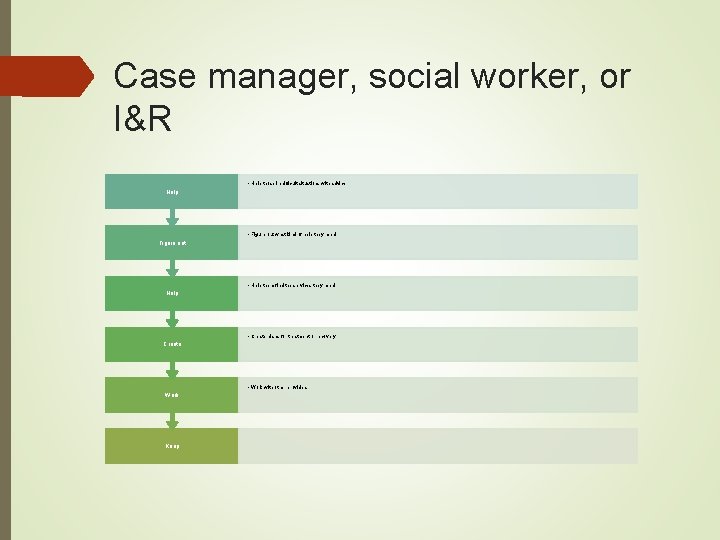
Case manager, social worker, or I&R • Help those in difficult situations with advice Help • Figure out what kind of help they need Figure out • Help them find the services they need Help • Create plans for treatment or recovery Create • Work with other providers Work Keep
Personal Change Exercise What change did you make? How did you decide to make this change? What people or events influenced your decision? What steps did you take to make the change? How long was it from the first time you became aware of that issue to the time you began to try to change it? How long was it between the time you first began trying to change and when you finally completed and felt it was all behind you?
Successful Behavior Change Takes time Often requires multiple attempts and treatments Consists of self-change and/or treatment Length of treatment does not correspond to duration of recovery Involves changes in other areas of a person’s life Di. Clemente
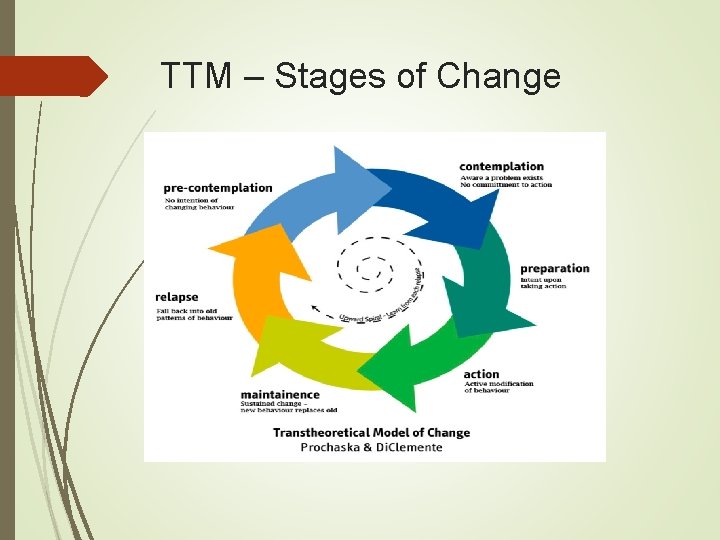
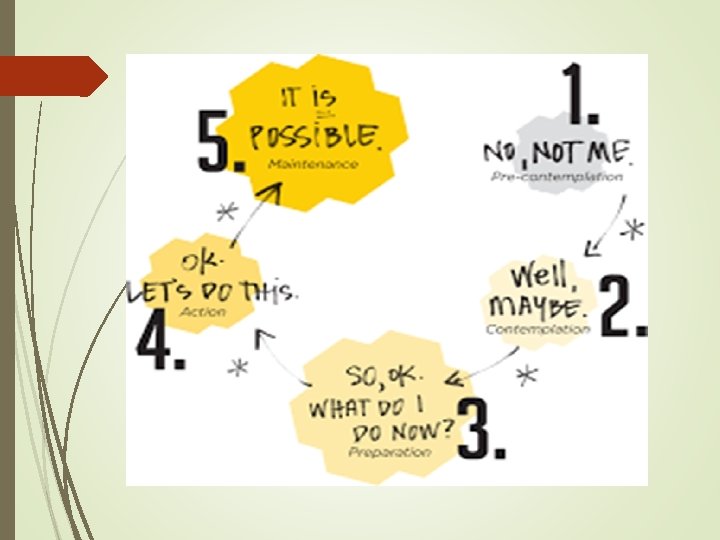
TTM – Stages of Change
Assessing Stage of Change Focus on area of concern that is most important to the client Identify specific target behavior Assess stage of change URICA, SOCRATES or other standardized instruments Readiness Ruler Language, emotion and behavior Indicator that you may have misread stage is “resistance” – arguing, interrupting, denying, or ignoring
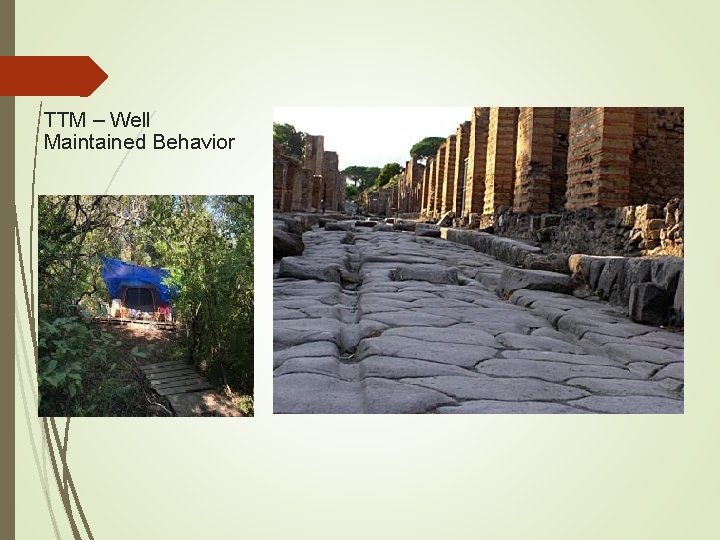
TTM – Well Maintained Behavior
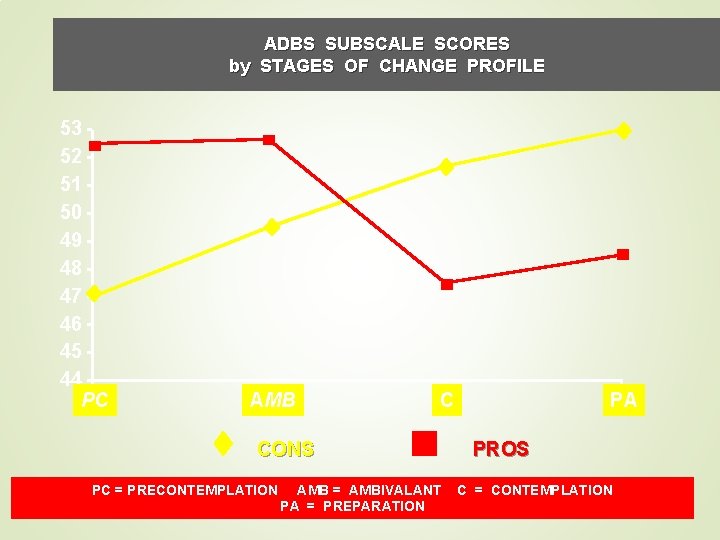
ADBS SUBSCALE SCORES by STAGES OF CHANGE PROFILE 53 52 51 50 49 48 47 46 45 44 PC AMB C CONS PC = PRECONTEMPLATION AMB = AMBIVALANT PA = PREPARATION PA PROS C = CONTEMPLATION

Transtheoretical Model �A comprehensive model of change �Provides an integrative framework for �understanding behavior change �assessing/measuring �intervening in client’s behavior �Clinicians assess clients’ readiness to change their behavior and design appropriate interventions based upon the clients stage of readiness Di. Clemente (modified)
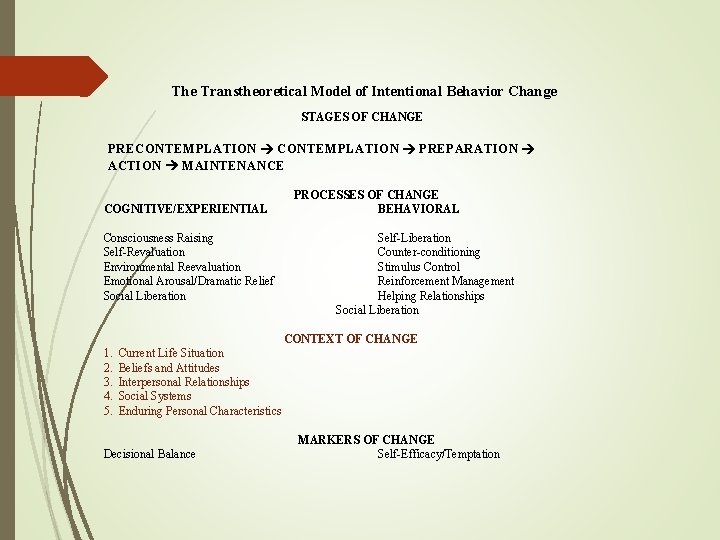
The Transtheoretical Model of Intentional Behavior Change STAGES OF CHANGE PRECONTEMPLATION PREPARATION ACTION MAINTENANCE COGNITIVE/EXPERIENTIAL Consciousness Raising Self-Revaluation Environmental Reevaluation Emotional Arousal/Dramatic Relief Social Liberation PROCESSES OF CHANGE BEHAVIORAL Self-Liberation Counter-conditioning Stimulus Control Reinforcement Management Helping Relationships Social Liberation CONTEXT OF CHANGE 1. 2. 3. 4. 5. Current Life Situation Beliefs and Attitudes Interpersonal Relationships Social Systems Enduring Personal Characteristics Decisional Balance MARKERS OF CHANGE Self-Efficacy/Temptation
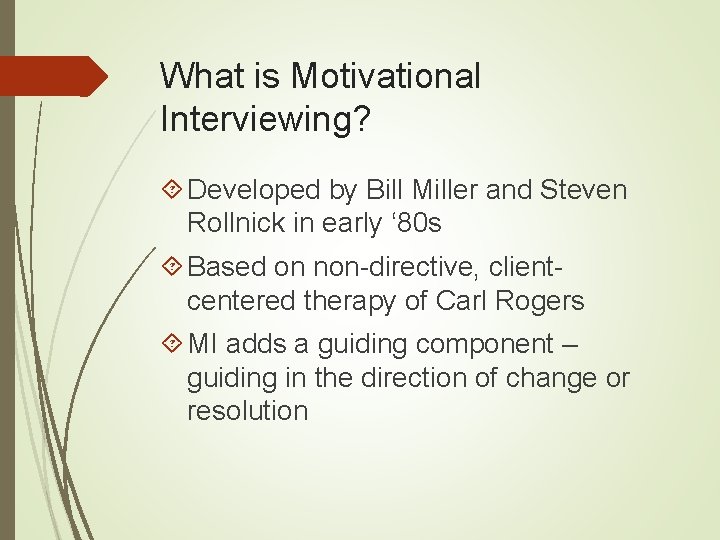
What is Motivational Interviewing? Developed by Bill Miller and Steven Rollnick in early ‘ 80 s Based on non-directive, clientcentered therapy of Carl Rogers MI adds a guiding component – guiding in the direction of change or resolution
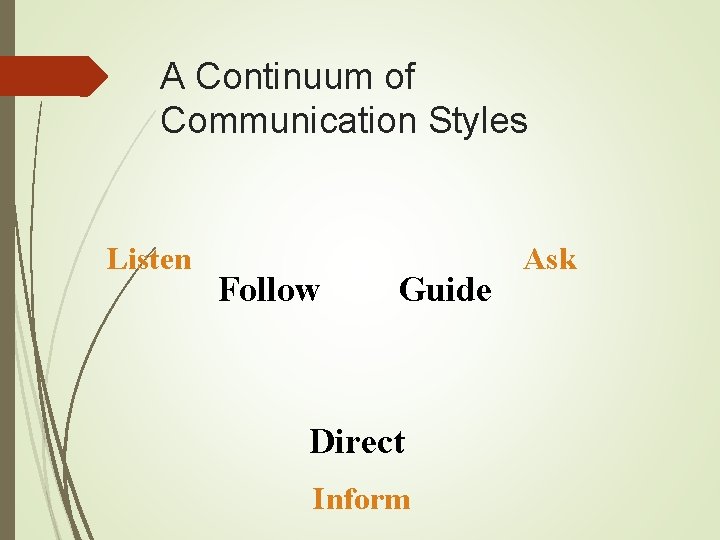
A Continuum of Communication Styles Listen Follow Guide Direct Inform Ask
Definition of MI Layperson’s Definition: Motivational interviewing is a collaborative conversation style for strengthening a person’s own motivation and commitment to change. Miller and Rollnick, 2012
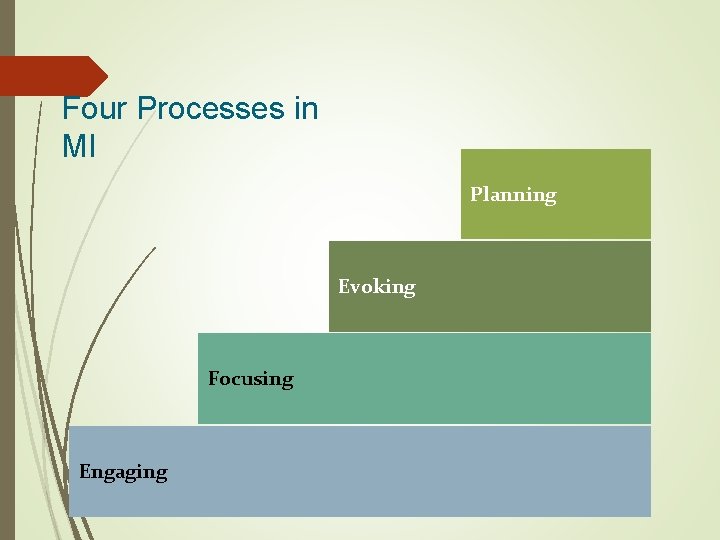
Four Processes in MI Planning Evoking Focusing Engaging
Engaging What promotes engagement? Desires or goals Importance Positivity Expectations Hope What early traps promote client disengagement? Assessment Trap Expert Trap Premature Focus Trap Labeling Trap Blaming Trap Chat Trap
Spirit of MI Underlying spirit(PACE): o Partnership o Acceptance o Compassion o Evocation
MI Spirit: Partnership Collaborative – Extent to which the clinician behaves as if the interview is occurring between two equal partners, both of whom have knowledge that might be useful in the problem under consideration (MITI 3. 1) Resist the “righting reflex” Client talks more than the clinician Tempers advice giving, suggestions, feedback and asks permission before giving
MI Spirit: Acceptance Person-centered conditions: 1. Inherent worth and potential, what Carl Rogers called unconditional positive regard 2. Accurate empathy 3. Autonomy/support 4. Affirmation
MI Spirit: Autonomy/Support – extent to which the clinician supports and actively fosters client perception of choice as opposed to attempting to control the client’s behavior or choices. Explores clients options genuinely Acknowledges client option not to change without sarcasm, that it’s their choice Gives credence to client’s ideas about change and motivation (MITI 3. 1)
Empathy & Compassion � Empathy – degree to which the clinician understands or makes an effort to grasp the client’s perspective and feelings. � Empathy should not be confused with warmth, acceptance, genuineness, or client advocacy; these are independent of empathy. � Reflective listening is an important part of this characteristic, but empathy captures all effort that the clinician makes to understand the client’s perspective and convey that understanding to the client. (MITI 3. 1) � Goes beyond collecting facts, history, and asking information-seeking questions. � Requires more than a shallow attempt to understand the client � Conveys interest in the client’s perspective and effectively communicates this viewpoint. � Often encourages the client to elaborate, say more
MI Spirit: Evocation – extent to which the clinician conveys an understanding that motivation for change, and the ability to move toward that change, reside mostly within the client and therefore focuses efforts to elicit and expand it within therapeutic interaction (MITI 3. 1) Elicit – to draw forth or bring out (latent or potential) Requires you to use the core skills (OARS) The counselor’s main task is to elicit change talk and commitment talk
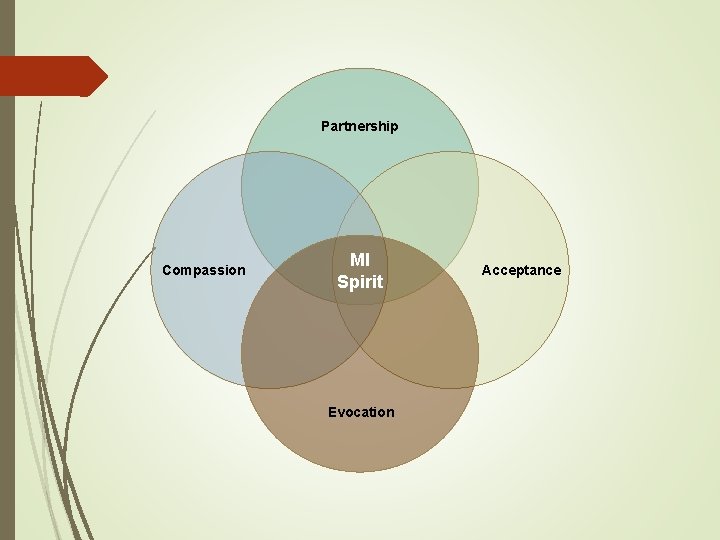
Partnership Compassion MI Spirit Evocation Acceptance
Definition of MI Layperson’s Definition: Motivational interviewing is a collaborative conversation style for strengthening a person’s own motivation and commitment to change. Practitioner’s Definition: Motivational interviewing is a person-centered counseling style for addressing the common problem of ambivalence about change. Miller and Rollnick, 2012
MI Inconsistent �Unsolicited Advice, Persuading, Sermonizing, Directions & Feedback �Emphasize Abstinence �Direct Confrontation �Powerlessness, Loss of Control �Asserting Authority �Close-Ended Questions MIA-STEP
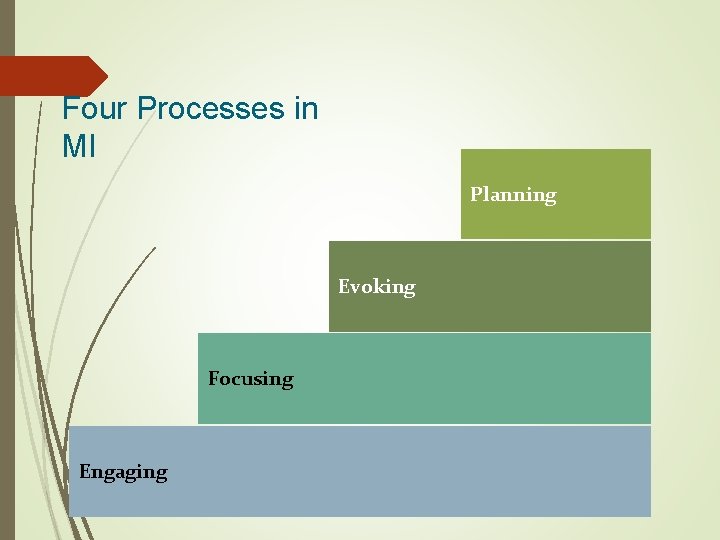
Four Processes in MI Planning Evoking Focusing Engaging
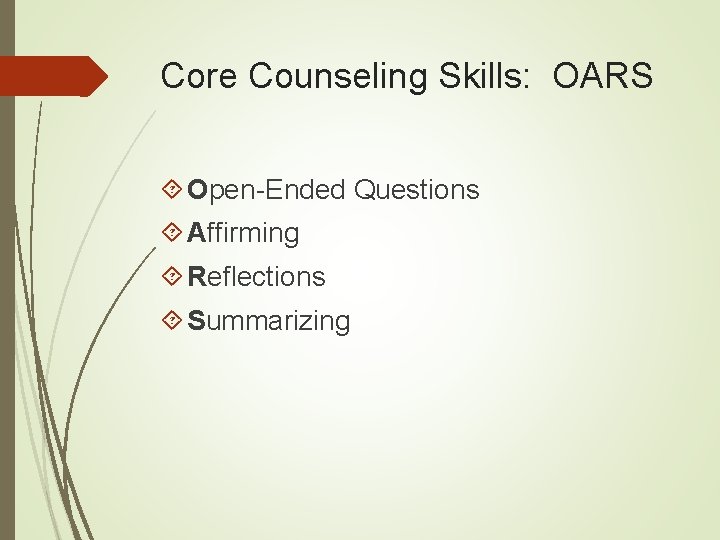
Core Counseling Skills: OARS Open-Ended Questions Affirming Reflections Summarizing
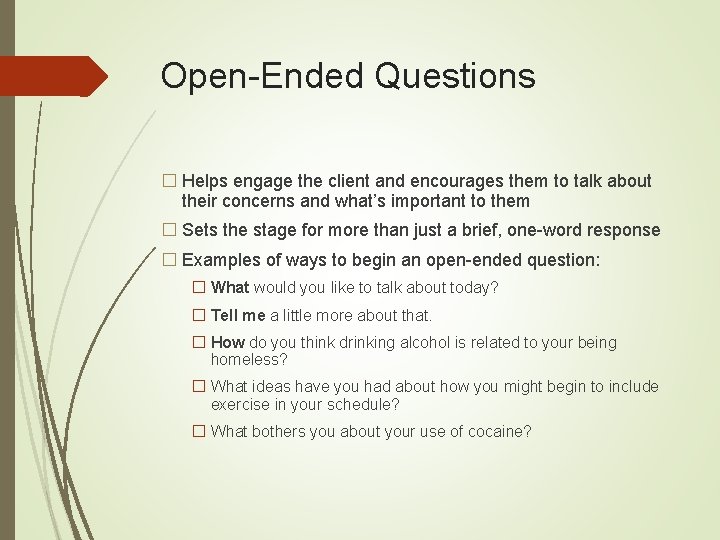
Open-Ended Questions � Helps engage the client and encourages them to talk about their concerns and what’s important to them � Sets the stage for more than just a brief, one-word response � Examples of ways to begin an open-ended question: � What would you like to talk about today? � Tell me a little more about that. � How do you think drinking alcohol is related to your being homeless? � What ideas have you had about how you might begin to include exercise in your schedule? � What bothers you about your use of cocaine?
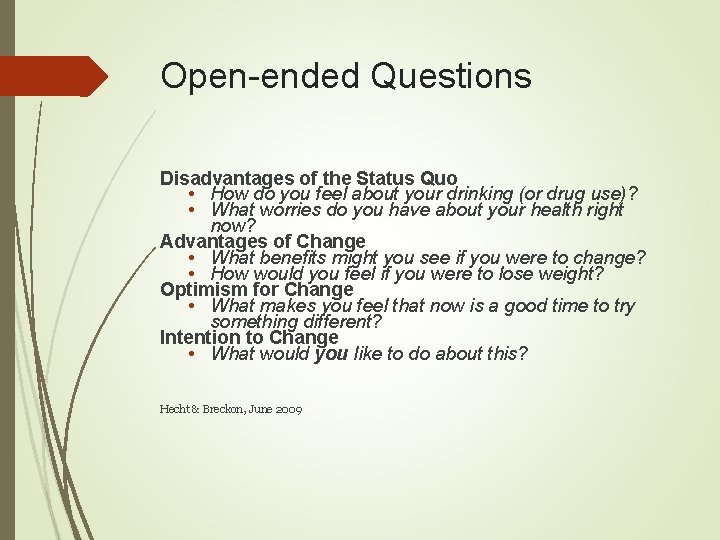
Open-ended Questions Disadvantages of the Status Quo • How do you feel about your drinking (or drug use)? • What worries do you have about your health right now? Advantages of Change • What benefits might you see if you were to change? • How would you feel if you were to lose weight? Optimism for Change • What makes you feel that now is a good time to try something different? Intention to Change • What would you like to do about this? Hecht & Breckon, June 2009
Affirming When we affirm, it is genuine Judicious, not promiscuous Shows that we notice the effort the client has made Usually directed toward something specific that the client has done and that has furthered movement toward change Affirm specific behaviors, values that support change Affirmations consistently evoke change talk, much more consistently than reflections or open questions (Apodaca)
Affirmations In Latin it means “to make firm” In MI you want to strategically anchor (make firm, drive home, reinforce) internal strengths, values, beliefs, thoughts or behaviours. An affirmation is an anchoring to support self-efficacy It is not about the clinician agreeing, praising or approving but rather seeing the client’s strengths, skills, and insights and reinforcing them. Hecht & Breckon, June 2009
Reflections Primary way to show empathy Shows that you are listening to the client Form a hypothesis, a guess, as to what the client means Requires using statements instead of questions Can be used strategically to emphasize certain aspects of the client’s view, emotion, ambivalence, and change talk
Guiding – the degree to which clinicians maintain appropriate focus on a specific target behavior or concerns directly tied to it. Can exert guiding by selectively reinforcing client discussion toward the possibility of concern or change with regard to the target behavior. Returns to the target behavior when the conversation wanders. Does not lack structure or have an aimless quality to the session (MITI 3. 1)
34 Discord Trying to convince a client that a problem exists or that change in needed can precipitate even more discord If you try to prove a point, the client predictably takes the opposite side Discord is predictive of poor treatment outcomes and lack of involvement in therapeutic process More constructive viewpoint is that the client views the situation differently than you do Discord is a signal to change direction or listen more carefully TIPS 35
12 Tasks in Learning MI The ‘spirit’ of motivational interviewing OARS: Client-centered counseling skills Identifying change goals (target behavior) toward which to move Exchanging information and providing advice Recognizing change talk and sustain talk Evoking change talk Responding to change talk in a way that strengthens it Responding to sustain talk and discord in a way that does not amplify it Developing hope and confidence Timing and negotiating a change plan Strengthening commitment Flexibly integrating MI with other clinical skills and practices
36 Learning and Developing Skill in MI Workshop alone seldom sufficient Training plans should include: Deliberate, concentrated practice Continuing coaching Feedback Supervision Additional ways to learn can include: Peer learning groups Video trainings Reading books Book discussion groups
37 Recommended Readings Transtheoretical Model o Prochaska: Changing for Good Motivational Interviewing o Miller & Rollnick: Motivational Interviewing, Helping People Change (3 rd edition)
38 Contact Information Cathy Crouch, LCSW, Executive Vice-President SEARCH Homeless Services 2015 Congress Street Houston, TX 77002 ccrouch@searchhomeless. org 713. 276. 3077 (direct)
- Slides: 38