
Transporting Hazardous Materials by Rail u Railroads transport
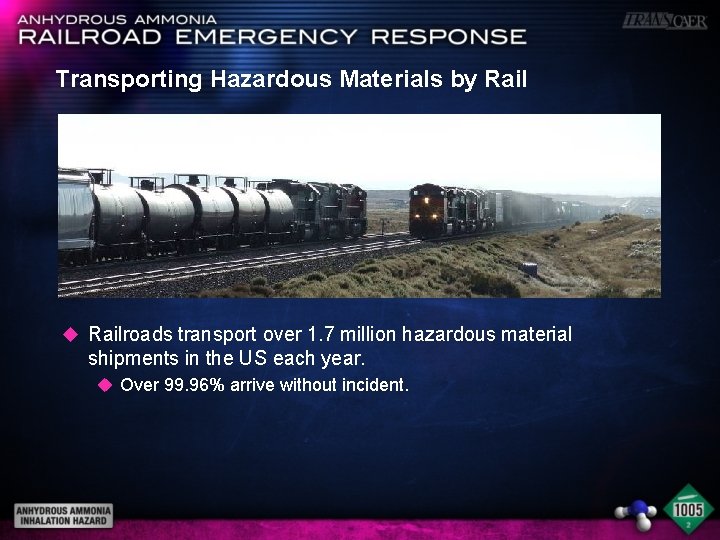
Transporting Hazardous Materials by Rail u Railroads transport over 1. 7 million hazardous material shipments in the US each year. u Over 99. 96% arrive without incident.
Transporting Hazardous Materials by Rail u When emergencies occur, the railroads are there to help you handle the incident. . . YOU ARE NOT IN IT ALONE!
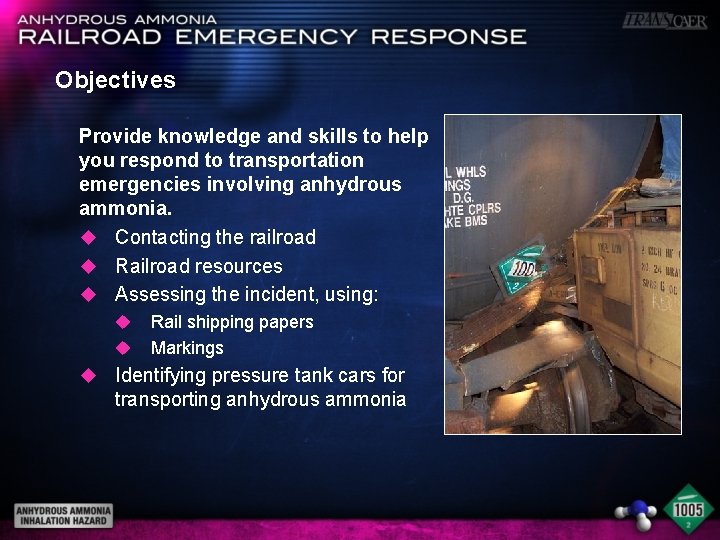
Objectives Provide knowledge and skills to help you respond to transportation emergencies involving anhydrous ammonia. u Contacting the railroad u Railroad resources u Assessing the incident, using: u u Rail shipping papers Markings u Identifying pressure tank cars for transporting anhydrous ammonia

Contacting the Railroad When notified of a rail emergency: u Contact the railroad using the railroad’s emergency phone number. u Make sure the railroad knows about the emergency. u Stop trains if necessary. § BNSF - 800 -832 -5452 § Canadian National - 80 § Canadian Pacific - 800 0 -465 -9239 § CSX Transportation - 8 -716 -9132 00 -232 -0144 § Kansas City Southern - 877 -5279464 § Norfolk Southern - 800 -453 -2530 § Union Pacific 888 -UPRR-COP (87 7 -7 § CHEMTREC - 800 -422647) § CANUTEC - 613 -996 -6 -9300 666 (collect)

Contacting the Railroad Crossing Sign Information u Ownership u Emergency telephone number u Crossing ID number u Milepost location
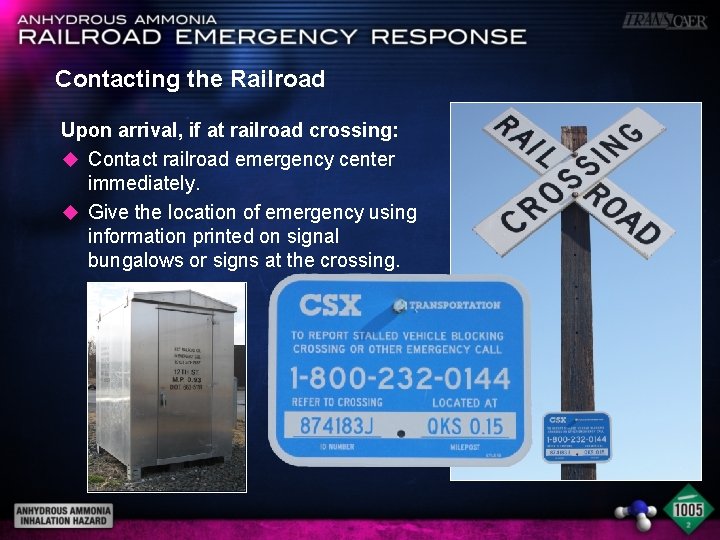
Contacting the Railroad Upon arrival, if at railroad crossing: u Contact railroad emergency center immediately. u Give the location of emergency using information printed on signal bungalows or signs at the crossing.

Contacting the Railroad Upon arrival, if between rail crossings: u Look for railroad mileposts in all directions. u Give the railroad emergency center your location using the closest rail milepost number in addition to any other location information. u If you have GPS, provide your coordinates to the railroad emergency center.

Railroad Resources Railroad Emergency Center u Stay in contact with the emergency center - you are their eyes and ears. u They are staffed 24 hrs/day. u They make reports/calls to CHEMTREC®, National Response Center and shippers. u They make mandatory notifications to state and federal agencies.
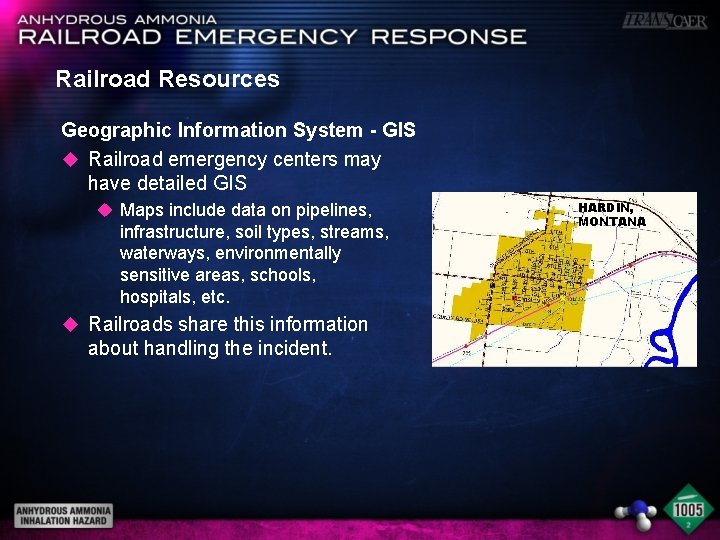
Railroad Resources Geographic Information System - GIS u Railroad emergency centers may have detailed GIS u Maps include data on pipelines, infrastructure, soil types, streams, waterways, environmentally sensitive areas, schools, hospitals, etc. u Railroads share this information about handling the incident. HARDIN, MONTANA
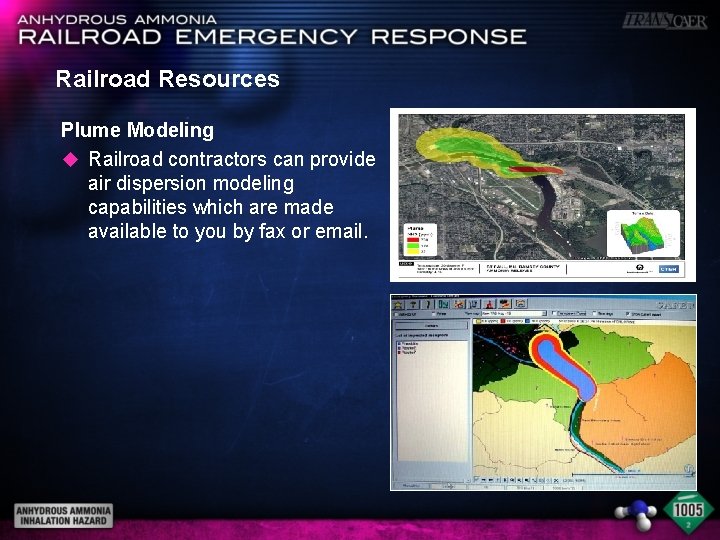
Railroad Resources Plume Modeling u Railroad contractors can provide air dispersion modeling capabilities which are made available to you by fax or email.
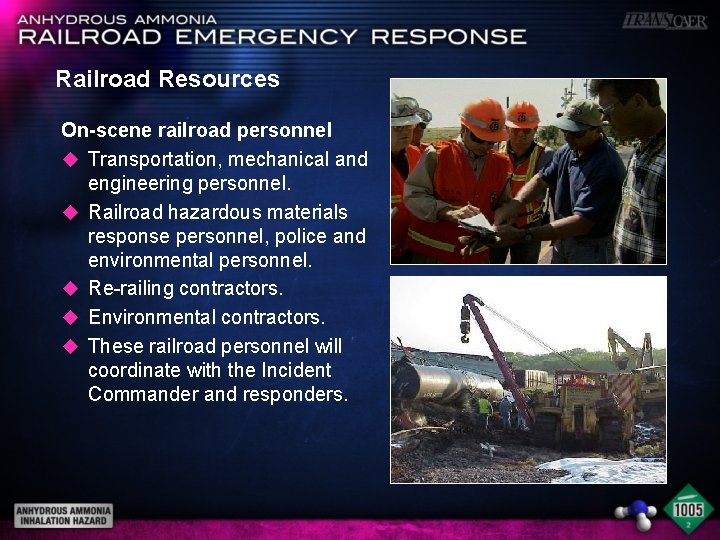
Railroad Resources On-scene railroad personnel u Transportation, mechanical and engineering personnel. u Railroad hazardous materials response personnel, police and environmental personnel. u Re-railing contractors. u Environmental contractors. u These railroad personnel will coordinate with the Incident Commander and responders.
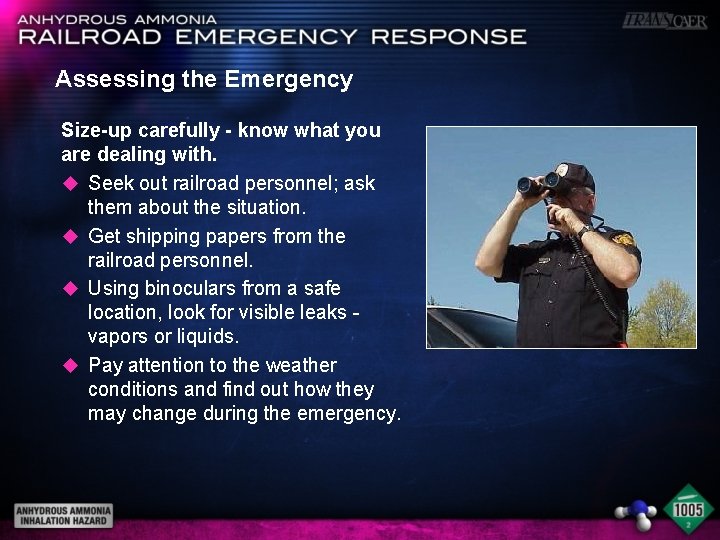
Assessing the Emergency Size-up carefully - know what you are dealing with. u Seek out railroad personnel; ask them about the situation. u Get shipping papers from the railroad personnel. u Using binoculars from a safe location, look for visible leaks vapors or liquids. u Pay attention to the weather conditions and find out how they may change during the emergency.
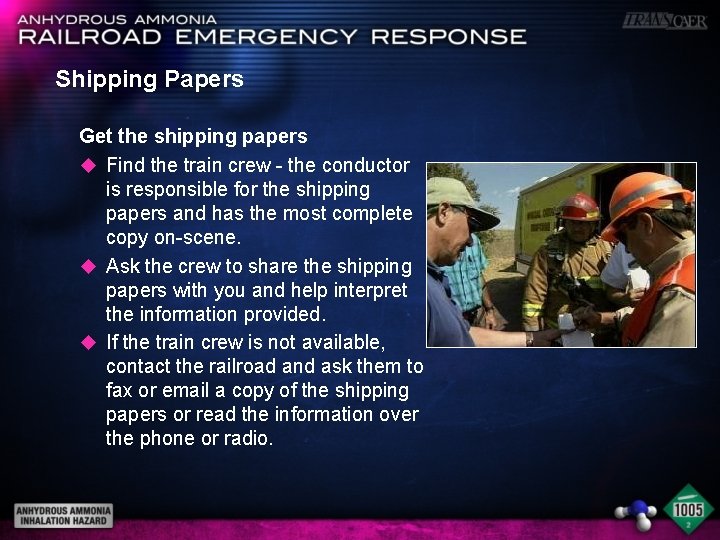
Shipping Papers Get the shipping papers u Find the train crew - the conductor is responsible for the shipping papers and has the most complete copy on-scene. u Ask the crew to share the shipping papers with you and help interpret the information provided. u If the train crew is not available, contact the railroad and ask them to fax or email a copy of the shipping papers or read the information over the phone or radio.

Shipping Papers Shipping papers are the primary safety instrument at a rail emergency. Shipping papers provide: u Location of each HM shipment in a train u Description of contents of each HM shipment u Emergency response information for each HM 11 UTLX 95248 L T 19 NFGAS HO 754 I CG PUEB AM 6 OS IN ZAP COOL 0 -MPH 126 -TONS 51 -FT 1 -P 1. 00 -B R RK 1585 -ATONS 106 AIL SECURITY SENSI 8 -AFT TIVE MATERIAL F LAT YARD - DO NOT KICK 1/TC, 150000 L ********* B ******* UN 1005 * DANGEROUS * AMMONIA, ANHYD ********* ROUS ******* 2. 2 EMERGENCY CONTACT: RQ (AMMONIA) 1 -800 -424 -9300 INHALATION HAZ ARD TN=(ANHYDROUS AMMONIA) SHIPPER CONTACT CHEMTREC HAZMAT STCC = 4904210 12 PROX 33205 L T 32 APOISN OW 409 3 8 -751 -55 WULA HE 6 DGE 0 -MPH 128 -TONS 68 S WA AGRIUM GAM -FT 1 -P 1. 00 -B R RK 648 -ATONS 305 AIL SECURITY SENSI -AFT TIVE MATERIAL F LAT YARD - DO NOT KICK 1/TC, 72590/KG ********* UN 1005 * DANGEROUS * ANHYDROUS AMMO ********* NIA ******* 2. 3 (8 ) EMERGENCY CONTACT: RQ (AMMONIA) 8007928311 POISON-INHALAT ION HAZARD ZONE D ERP 2 -1451 8007928311 AGRIUM PARTNER SHIP 16 KM E OF GIBB ONS AB ON H REDWATER OPERA TIONS BEAMER AB T 0 A 2 W SHIPPER CONTAC T AGRIUM HAZMAT STCC = 4920359

Shipping Papers Key information for each hazardous material on the train: u Line number u Emergency contact number u Reporting marks (initials) and number u Shipping description entries 19 UTLX 95248 LT 19 NFGAS HO 754 ICG PUEB AMOS IN ZAP COOL 60 -MPH 126 -TONS 51 -FT 1 -P 1. 00 -BRK 1585 -ATONS 1068 -AFT RAIL SECURITY SENSITIVE MATERIAL FLAT YARD - DO NOT KICK 1/TC, 150000 LB ************* UN 1005 * DANGEROUS * AMMONIA, ANHYDROUS ************* 2. 2 EMERGENCY CONTACT: RQ (AMMONIA) 1 -800 -424 -9300 INHALATION HAZARD TN=(ANHYDROUS AMMONIA) SHIPPER CONTACT CHEMTREC HAZMAT STCC = 4904210
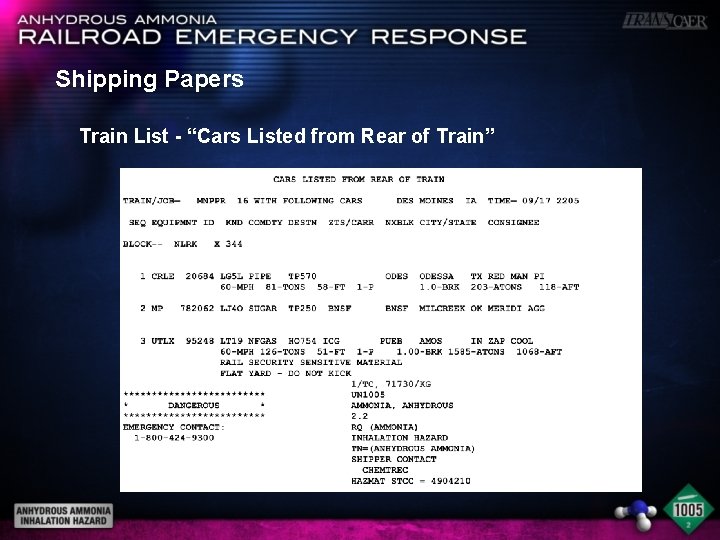
Shipping Papers Train List - “Cars Listed from Rear of Train”

Shipping Papers Shipping description entries - United States 1/TC, 150000/LB ************* UN 1005 * DANGEROUS * AMMONIA, ANHYDROUS ************* 2. 2 EMERGENCY CONTACT: RQ (AMMONIA) 1 -800 -424 -9300 INHALATION HAZARD TN=(ANHYDROUS AMMONIA) SHIPPER CONTACT CHEMTREC HAZMAT STCC = 4904210
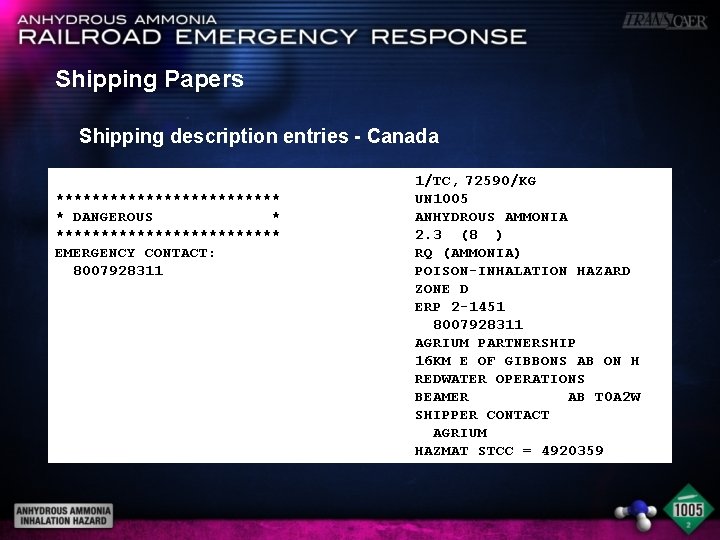
Shipping Papers Shipping description entries - Canada 1/TC, 72590/KG ************* UN 1005 * DANGEROUS * ANHYDROUS AMMONIA ************* 2. 3 (8 ) EMERGENCY CONTACT: RQ (AMMONIA) 8007928311 POISON-INHALATION HAZARD ZONE D ERP 2 -1451 8007928311 AGRIUM PARTNERSHIP 16 KM E OF GIBBONS AB ON H REDWATER OPERATIONS BEAMER AB T 0 A 2 W SHIPPER CONTACT AGRIUM HAZMAT STCC = 4920359

Shipping Papers Shipping description entries - residue/empty shipments of anhydrous ammonia 1/TC ************* UN 1005 * DANGEROUS * RESIDUE: LAST CONTAINED ************* AMMONIA, ANHYDROUS EMERGENCY CONTACT: 2. 2 1 -800 -424 -9300 RQ (AMMONIA) INHALATION HAZARD TN=(ANHYDROUS AMMONIA) SHIPPER CONTACT CHEMTREC HAZMAT STCC = 4904210
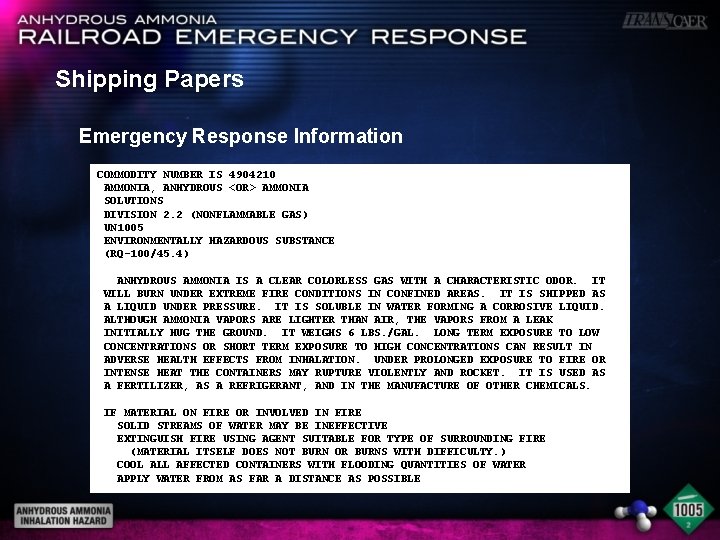
Shipping Papers Emergency Response Information COMMODITY NUMBER IS 4904210 AMMONIA, ANHYDROUS <OR> AMMONIA SOLUTIONS DIVISION 2. 2 (NONFLAMMABLE GAS) UN 1005 ENVIRONMENTALLY HAZARDOUS SUBSTANCE (RQ-100/45. 4) ANHYDROUS AMMONIA IS A CLEAR COLORLESS GAS WITH A CHARACTERISTIC ODOR. IT WILL BURN UNDER EXTREME FIRE CONDITIONS IN CONFINED AREAS. IT IS SHIPPED AS A LIQUID UNDER PRESSURE. IT IS SOLUBLE IN WATER FORMING A CORROSIVE LIQUID. ALTHOUGH AMMONIA VAPORS ARE LIGHTER THAN AIR, THE VAPORS FROM A LEAK INITIALLY HUG THE GROUND. IT WEIGHS 6 LBS. /GAL. LONG TERM EXPOSURE TO LOW CONCENTRATIONS OR SHORT TERM EXPOSURE TO HIGH CONCENTRATIONS CAN RESULT IN ADVERSE HEALTH EFFECTS FROM INHALATION. UNDER PROLONGED EXPOSURE TO FIRE OR INTENSE HEAT THE CONTAINERS MAY RUPTURE VIOLENTLY AND ROCKET. IT IS USED AS A FERTILIZER, AS A REFRIGERANT, AND IN THE MANUFACTURE OF OTHER CHEMICALS. IF MATERIAL ON FIRE OR INVOLVED IN FIRE SOLID STREAMS OF WATER MAY BE INEFFECTIVE EXTINGUISH FIRE USING AGENT SUITABLE FOR TYPE OF SURROUNDING FIRE (MATERIAL ITSELF DOES NOT BURN OR BURNS WITH DIFFICULTY. ) COOL ALL AFFECTED CONTAINERS WITH FLOODING QUANTITIES OF WATER APPLY WATER FROM AS FAR A DISTANCE AS POSSIBLE

Placards Shipments within the United States 1/TC, 150000/LB ************* UN 1005 * DANGEROUS * AMMONIA, ANHYDROUS ************* 2. 2 EMERGENCY CONTACT: RQ (AMMONIA) 1 -800 -424 -9300 INHALATION HAZARD TN=(ANHYDROUS AMMONIA) SHIPPER CONTACT CHEMTREC HAZMAT STCC = 4904210 U. S. Nonflammable Gas placard
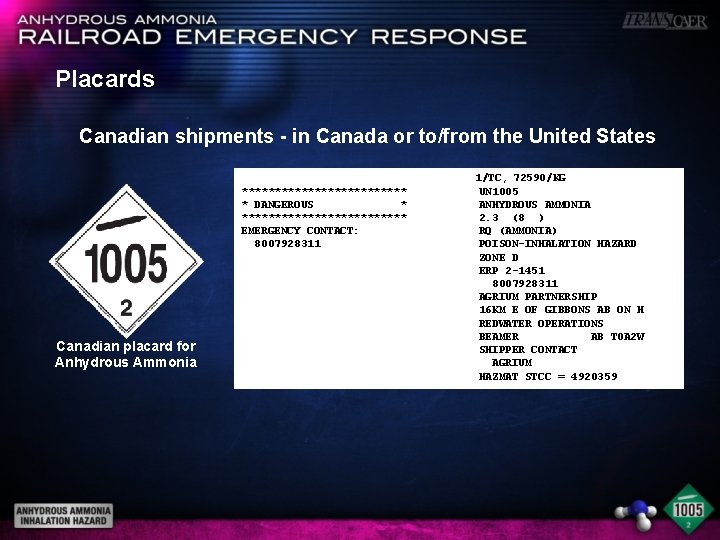
Placards Canadian shipments - in Canada or to/from the United States 1/TC, 72590/KG Canadian placard for Anhydrous Ammonia ************* UN 1005 * DANGEROUS * ANHYDROUS AMMONIA ************* 2. 3 (8 ) EMERGENCY CONTACT: RQ (AMMONIA) 8007928311 POISON-INHALATION HAZARD ZONE D ERP 2 -1451 8007928311 AGRIUM PARTNERSHIP 16 KM E OF GIBBONS AB ON H REDWATER OPERATIONS BEAMER AB T 0 A 2 W SHIPPER CONTACT AGRIUM HAZMAT STCC = 4920359

Tank Cars for Anhydrous Ammonia u Pressure tank car – typically DOT/TC Class 105 s and 112 s (specifications 105 S 340 W, 105 J 300 W, and 112 J 340 W) u Steel tank (minimum 11/16” thick) u Top mounted fittings within a protective housing
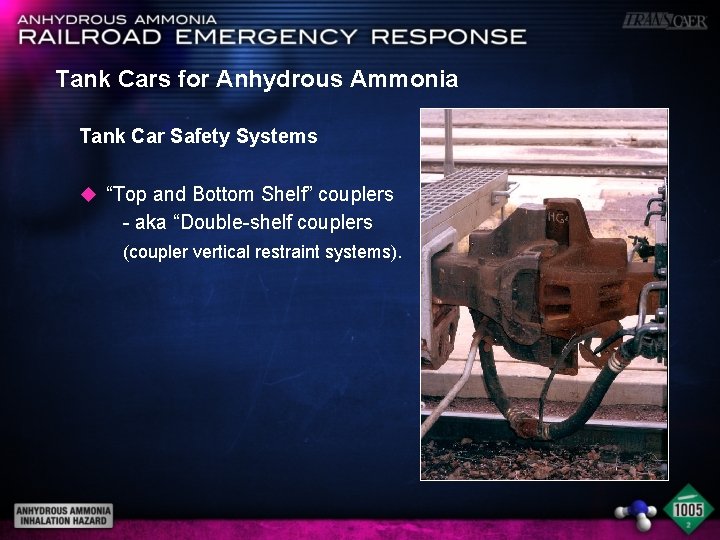
Tank Cars for Anhydrous Ammonia Tank Car Safety Systems u “Top and Bottom Shelf” couplers - aka “Double-shelf couplers (coupler vertical restraint systems).
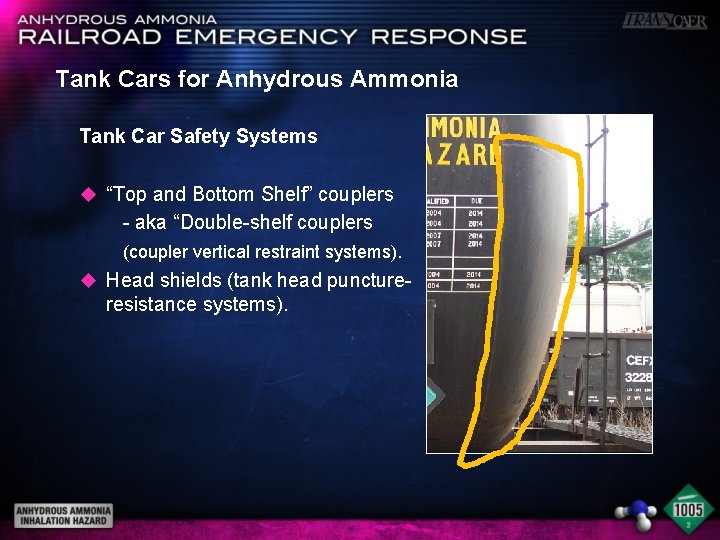
Tank Cars for Anhydrous Ammonia Tank Car Safety Systems u “Top and Bottom Shelf” couplers - aka “Double-shelf couplers (coupler vertical restraint systems). u Head shields (tank head puncture- resistance systems).
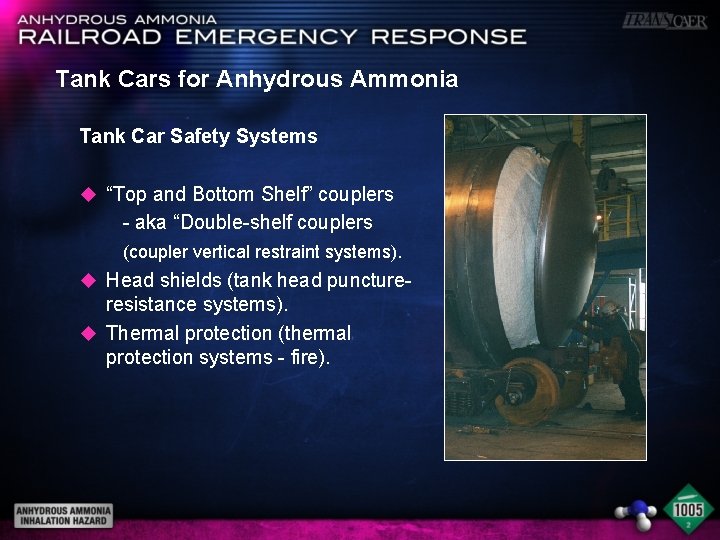
Tank Cars for Anhydrous Ammonia Tank Car Safety Systems u “Top and Bottom Shelf” couplers - aka “Double-shelf couplers (coupler vertical restraint systems). u Head shields (tank head puncture- resistance systems). u Thermal protection (thermal protection systems - fire).

Tank Cars for Anhydrous Ammonia Thermal Protection Performance u Will not lose any lading due to effects of heat (except through the pressure relief device) for: - 100 minutes in pool fire - 30 minutes in torch fire

Tank Cars for Anhydrous Ammonia Tank Car Service Equipment (valves and fittings) u Liquid eduction lines (2) u Vapor eduction line (1) u Pressure relief valve (spring loaded)(1) u Gauging device (closed type)(1) u Sample line (1) u Thermometer well (1) Ball type Plug type angle valve
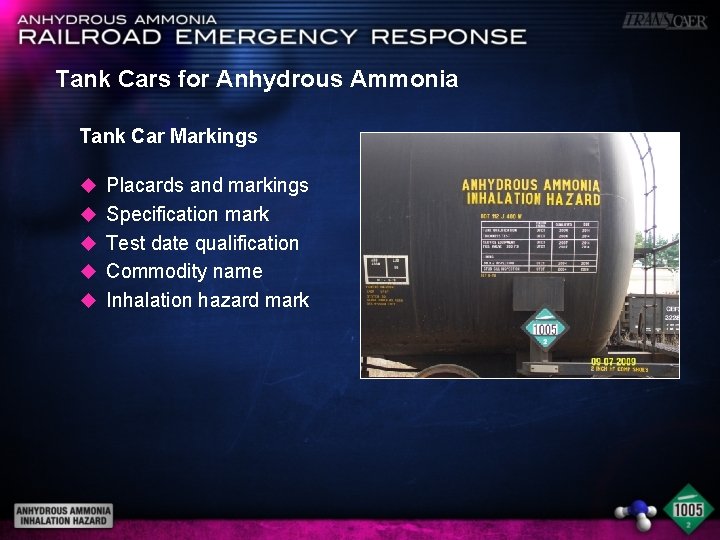
Tank Cars for Anhydrous Ammonia Tank Car Markings u Placards and markings u Specification mark u Test date qualification u Commodity name u Inhalation hazard mark

Damage Assessment Utilize railroad responders to determine damage; they are trained to assess damage to tank cars and other rail equipment.

Damage Assessment Jacket damage - not leaking.
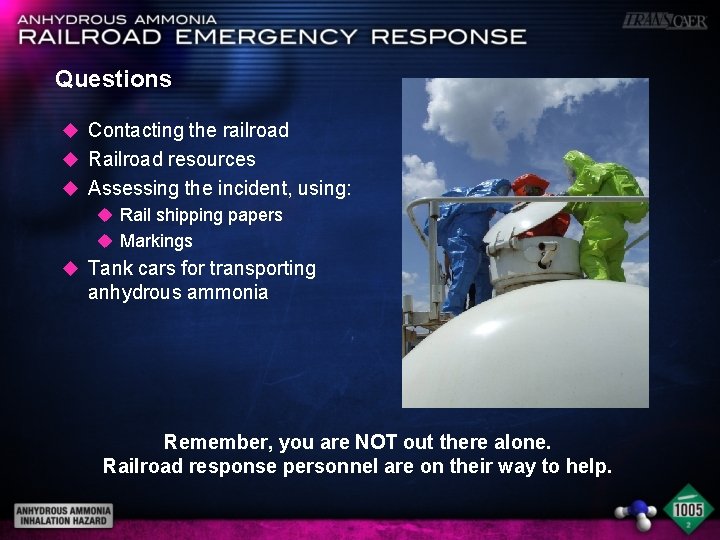
Questions u Contacting the railroad u Railroad resources u Assessing the incident, using: u Rail shipping papers u Markings u Tank cars for transporting anhydrous ammonia Remember, you are NOT out there alone. Railroad response personnel are on their way to help.
- Slides: 34